Memecoin Prop Firm: CoinProp’s Solution for Safer Trading
Published
Discover why CoinProp is the best crypto prop firm for memecoin traders, offering a CoinProp Free Trial, seamless prop firm challenges, and access to Bybit liquidity through the CPX terminal and funded accounts. Trade safely with a funded crypto account and explore the fastest growing memecoin prop firm ecosystem built for high volatility markets.
- CoinProp enters the Crypto Wild West with MemeCoin listings for prop firm traders
- Meme Coin Funded Account Opportunities
- Trading Volatile Meme Coins Safely with Prop Firm Capital
- How Do Memecoin Prop Firms Work? Profit Splits, Drawdown Rules, and Payouts
- Crypto Prop Firms That Allow Meme Coin Trading
- Why “Bybit Markets Available” Does Not Mean Unlimited Meme Coin Trading
- Memecoin Prop Firm Comparison: CoinProp vs. HyroTrader vs. Crypto Fund Trader
- Crypto Prop Firms That Allow Shorting Meme Coins With Published Leverage Limits
- Risk Management for Meme Coin Trading with Prop Capital
- David’s Journey: A Memecoin Trader’s Story
- Execution Advantage: No Added Spread and Slippage Shown Upfront
- Best Crypto Prop Firms for Meme Coin Day Trading
- The Volatility Advantage: How to Trade Memecoins
- Meme Coin Prop Strategy: From Entry to Exit
- FAQ: Memecoin Trading Prop Firms
CoinProp enters the Crypto Wild West with MemeCoin listings for prop firm traders
Meme coins have always been crypto’s wild side: huge moves, viral narratives, sudden liquidity, and plenty of opportunities for traders who know how to manage the risk. CoinProp was already offering memecoin trading in its funded environment by November 10, 2025, when its Meme category featured more than 50 listings across spot, perpetuals, and pre market markets. Today, that category has grown to 57 listings.
Hey crypto degens and meme lords! From Dogecoin and Shiba Inu to newer dogs, cats, frogs, and completely absurd community driven tokens, the Meme category gives prop traders access to a market built around volatility and momentum. These aren’t your grandma’s blue chips. A meme coin can rocket higher in minutes, or wipe out just as quickly.
But trading meme coins through a memecoin prop firm is about more than simply having the coins listed on a platform. Challenge fees, profit targets, profit splits, daily loss limits, maximum drawdown, leverage, position size restrictions, and payout rules can all determine how much freedom a trader actually has.
And this is where things get interesting. Several crypto prop firms now advertise access to Bybit markets or meme coin trading, but the actual trading conditions can be very different from one firm to another.
So let’s go beyond the meme coin listings and look at how memecoin prop firms actually work, what restrictions matter, and how different firms compare. DYOR, manage your risk, and let’s get into it.
Why Crypto Prop Firms for Memes?
Most traditional prop firms are still trapped in the 2018 era where Bitcoin, Ethereum, and maybe XRP were everything. Meme coins? Forget about it. Too risky, too volatile, too unpredictable.
But the crypto industry evolved. Meme coins are now:
Early narrative indicators
Liquidity magnets
Community-driven volatility engines
Mini ecosystems of pure culture
A Memecoin Prop Firm flips the script. Instead of risking your own capital with high leverage on retail exchanges, you use their capital, their rules, their risk systems, and their liquidity access.
In practice, a memecoin prop firm gives traders access to a funded trading environment where they first meet the firm’s trading requirements and can then trade supported meme coins under its funded account rules. The exact evaluation model, drawdown limits, leverage, and payout conditions depend on the firm.
This means:
You keep your savings safe.
You trade high volatility assets.
You trade at live Bybit prices with no added spread.
Your performance determines scaling.
The Doge Dynasty: Classic Canine Kings
Dogecoin (DOGE), The one that started it all.
Shiba Inu (SHIB), The “Doge killer.”
FLOKI, Inspired by Elon Musk’s own pup.
Bonk (BONK), The pride of Solana.
Maxi Doge (MAXI), The gym bro Doge.
Feline Frenzy: Cats Taking Over Solana & Base
Popcat (POPCAT), Viral clicking cat meme.
MEW, Cat rebellion token.
Mog Coin (MOG), Multi chain mischief.
Mochi Cat (MOCHI), NFT kawaii energy.
1000Cats (1000CAT), Solana feline army.
Frog Fever & Absurdity: Pepe’s Progeny
Pepe (PEPE), King of frog memes.
PepeNode (PEPENODE), Mine-to-earn frog.
Fartcoin, Solana fart humor.
SPX6900, OG numeric meme coin.
T6900, Derived from SPX6900.
Hat Wearing Weirdos & Solana Speedsters
WIF, Dog in a pink hat.
Moo Deng, Baby hippo.
Book of Meme (BOOK), Meme history archive.
Ponke, Mischievous monkey.
Slerf, The sloth of Solana.
Base Chain Bangers: Ethereum L2 Shenanigans
Brett (BRETT), Mascot of Base.
Degen (DEGEN), Tokenized degen culture.
Jager (JAGER), Hunter cat.
ACT, Kindness token on Base.
Political & Pop Culture Plays
Official Trump (TRUMP), MAGA-frog hybrid.
Boden (BODEN), Parody Biden coin.
Pudgy Penguins (PENGU), NFT to meme.
GME Meme (GME), Retail rebellion token.
Emerging & Niche Gems
Turbo (TURBO), AI-generated meme coin.
Book of Meme (BOME), Meme archive spin-off.
Bitcoin Hyper (HYPER), Bitcoin L2 experiment.

Meme Coin Funded Account Opportunities
In the past, having a Funded Meme Coin Account felt like an impossible dream. Most crypto prop firms were terrified of the wild, uncontrolled volatility that defines meme coins. But CoinProp recognized the enormous potential in this space and created an environment where skilled traders can pass challenges and earn a legitimate Meme Coin Funded Account.
Why a Meme Coin Funded Account is a Game-Changer
Trading meme coins with your own personal capital is nerve-wracking for any trader. But when you have a funded account behind you, everything changes:
You can focus purely on skill instead of worrying about losing your life savings.
With larger account sizes, even small moves in trending tokens can deliver profits equivalent to months of Bitcoin trading.
The strict rules of a funded account force you to trade like a professional, not an emotional gambler.
Passing the Challenge
To unlock a Meme Coin Funded Account, you must prove in CoinProp’s challenges that you can handle extreme volatility with discipline.
The formula for success is straightforward: use controlled leverage and strictly respect daily drawdown limits. Traders who approach these challenges with a hunter’s mindset reach the funded stage faster than others and get to enjoy up to 95% profit splits.

Trading Volatile Meme Coins Safely with Prop Firm Capital
In the crypto world, meme coins act like powerful storms, they can rocket you to massive gains or wipe out an account in minutes. In this section, instead of fearing the volatility, we break it down so you can learn how to safely profit from these extreme swings using CoinProp’s funded capital.
Meme Coin Volatility vs Prop Firm Drawdown Rules
The extreme volatility of meme coins directly collides with every prop firm’s red line: drawdown. When a token swings 20% in a single hour, a trader who doesn’t use precise position sizing can easily breach the daily drawdown limit with just one reversal candle, resulting in an immediate account shutdown.
Master rule: In meme coin trading, your position size must be significantly smaller than what you use for Bitcoin. This prevents the natural wild swings of these tokens from accidentally violating prop rules.
Profiting from Meme Coin Volatility
The biggest advantage of trading meme coins on CoinProp is that you’re not using your own personal money. This removes the heavy psychological pressure of potentially losing life savings, especially when combined with no trailing drawdown instead of the punishing trailing models used by many other firms. You can focus entirely on precise entries, timing, and exits while staying calm and professional, knowing your account won’t be squeezed by artificial rules.
Key point: The prop firm’s capital acts as a protective shield, enabling you to trade meme coins like a disciplined professional rather than an emotional gambler.
Why Entry Precision Matters More Than Size in Meme Coins
Meme coins are community driven and experience violent swings that can create enormous profits in minutes, or push an account dangerously close to the daily drawdown limit. We explain this volatility clearly so traders understand that in the meme coin market, “entry precision” is far more important than position size.

How Do Memecoin Prop Firms Work? Profit Splits, Drawdown Rules, and Payouts
A memecoin prop firm gives traders access to a funded trading environment where they can trade volatile meme coins under a defined set of risk and performance rules. While the basic model is similar to other crypto prop firms, meme coin trading can make those rules particularly important because these assets can experience sharp price movements and rapid changes in liquidity.
Traders typically start by purchasing an evaluation or challenge account. They then need to meet the firm's profit target without violating its daily loss or maximum drawdown limits. Once the evaluation is passed, the trader may receive a funded account and become eligible to earn a share of the profits generated under the firm's rules.
The details can vary significantly between firms. Challenge fees, profit targets, drawdown models, leverage, position limits, profit splits, and payout requirements can all affect how much flexibility a trader actually has when trading meme coins.
Memecoin Prop Firm Challenge Fees
Most funded trading programs require traders to pay an upfront fee to enter an evaluation. The fee usually depends on the account size and the firm's challenge model.
For example, a trader might choose between a smaller account with a lower entry fee and a larger account with a higher fee. Some firms also offer different evaluation structures, such as one-step challenges, while others may use multiple phases.
The challenge fee is only one part of the cost equation. Traders should also compare the profit target, drawdown limits, payout conditions, and other trading restrictions attached to the account. A cheaper challenge is not necessarily more flexible if the account comes with tighter risk rules.
Profit Targets for Memecoin Prop Firm Challenges
A profit target is the amount of simulated profit a trader must generate during the evaluation before becoming eligible for a funded account.
The target can vary between firms and account types. For example, one firm may require a 9% profit target, while another may set the target at 10%.
This difference can matter for meme coin traders because highly volatile assets can reach a target quickly, but volatility also increases the risk of hitting the account's loss limits before reaching it. The target therefore needs to be considered alongside maximum drawdown and daily loss rules rather than viewed on its own.
Profit Splits and Funded Account Payouts
After passing an evaluation, funded traders typically receive a percentage of the profits they generate under the firm's payout rules. This is known as the profit split.
For example, a firm may offer an 80% profit split by default and allow traders to increase their share through an add-on or another account option. Other firms may offer a maximum profit share of 90% or more.
Payout eligibility can also differ considerably. Some firms require a minimum number of funded trading days before a withdrawal can be requested, while others may have additional profit or account requirements. Processing times, withdrawal methods, and payout frequency can also vary.
For meme coin traders, these details are important because a high profit split does not necessarily mean a better overall trading environment. The payout percentage needs to be evaluated together with the firm's drawdown rules, trading restrictions, and conditions for becoming eligible to withdraw profits.
Daily Loss Limits and Maximum Drawdown
Daily loss limits and maximum drawdown are among the most important rules in any funded account, particularly when trading meme coins.
A daily loss limit determines how much an account can lose within a trading day before the account breaches its risk rules. Maximum drawdown defines the total amount the account can lose before the account is considered to have failed or violated its funded-account conditions.
The drawdown model also matters. A static drawdown remains fixed at a defined level, while a trailing drawdown can move upward as the account balance or equity increases.
For example, a 6% static maximum drawdown gives a trader a fixed loss boundary based on the account's starting balance. A trailing model can create a different risk profile because the drawdown level may move as the account grows.
This distinction can be especially important for meme coin traders. A sudden 5% or 10% move in a volatile token can happen much faster than in a more established market, meaning a trader can approach a firm's risk limit very quickly even when the broader trade thesis remains intact.
Leverage and Position Size for Meme Coins
Leverage determines how much market exposure a trader can control relative to the account's available capital. However, leverage is not the only factor that determines how large a meme coin position can be.
Some prop firms may impose maximum margin, position-size, allocation, or cumulative exposure limits. These restrictions can substantially reduce the practical amount of exposure available to a trader, even when the platform technically supports the market.
For example, a firm might allow meme coin trading but limit how much of the account can be allocated to meme or altcoin positions. Another firm may impose a maximum margin requirement or cumulative exposure limit across open positions.
This is why traders should look beyond statements such as “meme coins available” or “Bybit markets supported.” Market availability does not necessarily mean unrestricted trading access. The actual leverage, margin, position-size, and allocation rules determine how a trader can use that market within the funded account.
Crypto Prop Firms That Allow Meme Coin Trading
Not every prop firm has the guts to let traders touch the wild world of meme coins. A real Crypto Prop Firm doesn’t just allow trading on tokens like PEPE, DOGE, and SHIB, it also delivers the infrastructure to handle extreme volatility, with no added spread and slippage shown before you execute. At the top of this list stands CoinProp, thanks to its direct access to Tier-1 exchange liquidity.
Key Features of Prop Firms Offering Meme Coin Trading
When choosing the best Crypto Prop Firms That Allow Meme Coin Trading, you need to focus on three critical factors:
- Asset Selection: Do they only offer a couple of major coins like Dogecoin, or do they regularly add trending tokens?
- Execution Speed: In the meme coin market, milliseconds can mean the difference between hitting your target and blowing through your drawdown limit.
- Flexible Rules: A firm that won’t shut down your account on weak excuses during violent price swings.
We’ve thrown out the old restrictions. Our traders get access to 800+ USDT perpetual markets, including a large selection of popular meme coins.
To see how our infrastructure prices fills off live Bybit order-book depth, with no added spread, during these massive community-driven pumps, you can read the CoinProp trading firm overview to analyze our full scaling rules. This means you can run your strategy on virtually any token with a strong community behind it, without worrying about the outdated limitations you see at traditional forex-focused prop firms
Why “Bybit Markets Available” Does Not Mean Unlimited Meme Coin Trading
Seeing “Bybit markets available” on a crypto prop firm website can sound like traders have access to the same markets and trading conditions they would have on the underlying exchange. In practice, that is not necessarily the case.
A prop firm can use Bybit market data or provide access to Bybit-listed assets while applying its own rules around leverage, margin, position size, asset allocation, or cumulative exposure. These rules can significantly change how a trader can use meme coins within a funded account.
That distinction matters because meme coin traders often need more flexibility than a simple market-availability list suggests.
Market Availability vs. Trading Restrictions
Market availability answers a relatively simple question: Can this asset be traded through the firm's platform or trading environment?
Trading restrictions answer a different question: How much of the asset can the trader actually trade, and under what conditions?
A firm may make hundreds of Bybit markets available while still applying separate restrictions to certain assets or categories. Meme coins may be subject to allocation limits, position-size rules, leverage restrictions, or other risk controls that do not apply in the same way to BTC or ETH.
For traders specifically looking for a best crypto prop firm with Bybit, our dedicated guide compares Bybit market access, trading infrastructure, and the conditions that matter when choosing a Bybit based crypto prop firm.
This means traders should not compare prop firms based only on the number of markets they list. Two firms can both offer access to Bybit markets while providing very different levels of practical trading flexibility.
Meme Coin Allocation and Position Limits
Allocation limits can be particularly important for meme coin traders.
For example, a prop firm may allow meme and altcoin trading but limit the percentage of the account that can be allocated to those positions. Under the rules reviewed for HyroTrader, meme and altcoin positions are subject to a 5% allocation limit. A trader with a $100,000 account, for example, would therefore need to consider that restriction when determining how much capital can be allocated to qualifying meme or altcoin positions.
This can have a major impact on a strategy. A trader might identify a high-conviction setup but still be unable to take the position size they would normally use because the firm's allocation rule limits exposure.
The important point is that a tradable market is not necessarily an unrestricted market. Traders need to check the firm's specific allocation and position-size rules before assuming that every supported meme coin can be traded at the same size as BTC or ETH.
Leverage, Margin, and Cumulative Exposure Limits
Leverage is another area where prop firms can differ substantially.
For example, CoinProp's rules allow up to 10× leverage on BTC and ETH, up to 5× on SOL, BNB, HYPE, DOGE, and XRP, and up to 2× on other altcoins and meme coins, while its account structure does not impose a separate maximum-margin cap. Other firms can approach exposure differently.
HyroTrader, for example, uses a 2× cumulative exposure limit for BTC, ETH, and SOL under the rules being compared here. It also applies a 25% maximum-margin limit relative to the initial account balance.
These rules are not interchangeable. A trader looking only at the headline leverage number could miss the practical difference between leverage, margin, and cumulative exposure.
For meme coin traders, this distinction becomes even more important because high volatility can make position size a significant part of the risk equation. The amount of leverage technically available does not automatically tell you how large a position you can open or how much total exposure you can maintain.
How Trading Rules Affect Meme Coin Strategies
Prop firm restrictions can directly influence how a trader approaches meme coins.
Scalpers may care more about position-size limits, execution, and the ability to enter and exit quickly. A small allocation cap can make a strategy difficult to execute even when the market itself is available.
Day traders may focus more heavily on daily loss limits, leverage, margin requirements, and cumulative exposure. A strategy that works with larger positions on a retail exchange may need to be adjusted when trading under funded-account rules.
High-conviction traders can be particularly affected by allocation and position limits. Meme coins can occasionally produce large directional moves, but a firm may restrict how much exposure a trader can take to capture that move.
The same principle applies to strategy design. A trader should build the position size, stop-loss, leverage, and number of simultaneous positions around the actual prop firm's rules, rather than assuming that access to a Bybit-listed market means unrestricted exposure.
Ultimately, when comparing memecoin prop firms, the question is not simply “Can I trade meme coins?” It is “How can I trade them under this firm's specific rules?”
Memecoin Prop Firm Comparison: CoinProp vs. HyroTrader vs. Crypto Fund Trader
For memecoin traders, comparing prop firms goes beyond the number of meme coins listed on the platform. Challenge fees, profit targets, drawdown rules, leverage, exposure limits, allocation restrictions, profit splits, and payout conditions can all affect how freely a trader can execute a strategy.
The three firms below use different account structures, so the comparison focuses on the rules that have the most direct impact on memecoin trading.
Challenge Fees and Profit Targets
For a 10K account, the three firms use different pricing and evaluation structures.
CoinProp's 10K Signature account has a 9% profit target and a regular one-time fee of $99, while the 10K Booster uses a different account structure and also has a 9% profit target.
HyroTrader's 10K One-Step challenge uses a 10% profit target and requires traders to complete at least five trading days.
Crypto Fund Trader offers several evaluation types rather than one universal challenge structure. Its 1-Phase evaluation uses a 10% profit target, while its 2-Phase structure uses an 8% target in Phase 1 and 5% in Phase 2.
For memecoin traders, the challenge price should therefore be considered alongside the profit target and the risk limits required to reach it. A cheaper evaluation is not necessarily more flexible if the account gives the trader less room to withstand volatility.
Drawdown and Daily Loss Rules
Drawdown structure is one of the most important differences between these firms.
CoinProp Signature uses a 6% static maximum drawdown and a 3% static daily loss limit. Booster uses a 3% maximum drawdown and a 3% daily loss limit.
HyroTrader's current One-Step rules use a 3% daily drawdown and a 5% maximum loss.
Crypto Fund Trader varies by evaluation type. Its 1-Phase program uses a 4% daily maximum loss and a 6% trailing drawdown, while its 2-Phase program uses different loss limits and a fixed maximum-loss structure.
This distinction is particularly relevant for memecoin traders. A static maximum loss and a trailing drawdown can behave very differently after an account experiences a strong winning run followed by a normal pullback.
Meme Coin Leverage and Exposure
Leverage is one of the easiest numbers to compare between prop firms, but it can also be misleading. A firm may advertise very high leverage while applying strict limits elsewhere that determine how large a position you can actually open.
CoinProp uses explicit leverage limits. BTC and ETH can be traded with up to 10x leverage, and SOL, BNB, HYPE, DOGE, and XRP with up to 5x, while other assets, including the remaining altcoins and meme coins, are capped at 2x leverage. CoinProp does not impose a separate maximum-margin cap under these rules.
HyroTrader takes a different approach. It does not impose a simple low leverage cap such as 2x on BTC, ETH, or SOL. Instead, much of the restriction is applied through margin and exposure limits. Its documentation states that leverage can reach 100x or more depending on the trading pair.
However, high available leverage does not mean traders can freely use 100x leverage on a funded account. HyroTrader currently limits total margin exposure to 25% of the initial account
balance and limits the cumulative notional value of open positions to 2× the initial account balance.
For example, on a $100,000 funded account, the 25% margin rule means that total margin used across open positions cannot exceed $25,000, while cumulative open-position value is capped at $200,000 under the 2× exposure rule.
This creates an important difference between the two models:
CoinProp restricts leverage directly, while HyroTrader allows much higher leverage but controls how much margin and total exposure a funded trader can use.
For memecoin traders, this distinction matters. A higher leverage number on the platform does not automatically give a trader more usable risk capacity. The actual trading room depends on the interaction between leverage, margin, cumulative exposure, allocation limits, and the firm's drawdown rules.
Meme Coin Allocation Limits
Allocation restrictions can be particularly important for traders who focus on smaller or more volatile meme coins.
HyroTrader currently limits exposure to low-cap coins to 5% of the initial account balance, including leverage. The firm determines which assets fall into the low-cap category based on its own criteria.
This creates a practical difference between simply having a meme coin available for trading and being able to build a large position in it.
CoinProp's published rules do not list the same 5% low-cap allocation restriction. Instead, meme coins fall under its general leverage and account risk rules, with most altcoins and meme coins capped at 2x leverage.
For traders who specialize in smaller meme coins, this distinction can matter more than the total number of markets available. A firm can list hundreds of assets while still placing strict limits on how much exposure a trader can take in a particular category.
Profit Splits and Payout Conditions
Profit splits are another area where the headline percentage does not tell the entire story.
CoinProp's funded accounts start with an 80% profit split, with the Reward Split add-on increasing the trader's share to 95%. Payouts become available after at least 5 funded trading days, subject to the firm's funded-account conditions.
HyroTrader offers an 80% starting profit split that can increase to 90%. Its payout conditions and processing times depend on the funded-account structure.
Crypto Fund Trader also offers profit splits of up to 90%, while payout eligibility varies by the selected program and its applicable trading-day or calendar-day requirements.
For memecoin traders, the maximum profit split should therefore be considered together with payout frequency, minimum funded trading requirements, payout limits, and any additional performance conditions.
Trading Platforms and Bybit Market Access
The trading environment is another important difference between the three firms.
CoinProp provides trading through its CPX terminal, with native TradingView integration and access to 800+ USDT perpetual markets, including crypto, stocks, ETFs, commodities, and forex majors, through Bybit market data and liquidity.
HyroTrader provides access to Bybit and supported trading interfaces, giving traders access to a large selection of crypto markets and exchange-based market data.
Crypto Fund Trader supports different trading environments depending on the selected program, including Bybit-related crypto setups as well as other platforms.
However, saying that a prop firm offers "Bybit markets" does not automatically mean that traders receive the same trading conditions as they would on the underlying exchange. Each firm can apply its own leverage, margin, exposure, allocation, drawdown, and trading-behavior rules.
For memecoin traders, platform access should therefore be evaluated together with the actual account rules. A long list of available markets is useful, but the more important question is how freely those markets can actually be traded.
Which Memecoin Prop Firm Offers More Trading Flexibility?
There is no universal winner for every memecoin strategy because flexibility depends on how a trader uses leverage, position size, drawdown, and exposure.
CoinProp offers a relatively straightforward structure for traders who value a static maximum drawdown, 9% evaluation target, no evaluation consistency rule, 2x leverage on most meme coins (5x on DOGE), and a potential 95% funded profit split. Its CPX environment also combines native TradingView integration with Bybit market data and liquidity.
HyroTrader takes a different approach. It offers much higher headline leverage on supported pairs, but controls funded trading capacity through margin and cumulative exposure limits, as well as a 5% low-cap coin exposure limit. For a trader focused on smaller meme coins, those restrictions can be more important than the advertised leverage number.
Crypto Fund Trader has multiple account structures, so its flexibility depends heavily on the specific program selected. Its different evaluation models use different profit targets, drawdown structures, and payout conditions.
For a memecoin trader, the better question is therefore not simply which prop firm offers the most meme coins or the highest leverage. The more useful question is which firm's combination of drawdown, leverage, allocation, exposure, payout, and platform rules gives the trader's specific strategy enough room to operate.
For a broader breakdown of these three firms beyond memecoin trading, see our HyroTrader vs Crypto Fund Trader vs CoinProp comparison.
Crypto Prop Firms That Allow Shorting Meme Coins With Published Leverage Limits
In the volatile crypto market, profits aren’t limited to long positions. Experienced traders know that meme coins can crash just as fast as they pump after hype-driven bubbles. Finding Crypto Prop Firms That Allow Shorting Meme Coins gives you a major strategic edge, it lets you profit from both directions of the market using the firm’s capital. CoinProp makes this easy by offering perpetual futures pairs with deep liquidity.

The Dynamics of Shorting Volatile Assets in Prop Trading
Why is it so hard to find Crypto Prop Firms That Allow Shorting Meme Coins? Because shorting highly volatile assets carries serious liquidity risk. At CoinProp, we’ve solved this by connecting directly to deep liquidity pools. This allows our traders to confidently short fake pumps and manipulated rallies while keeping their accounts profitable.
Expert Tip: In short positions, using a Stop Loss is more critical than ever. A successful CoinProp trader knows exactly when to take profits during a shitcoin crash, and when to exit before a sudden reversal wipes out the gains.
Power of Leverage in Your Hands: Shorting Meme Coins on CoinProp Explained
In most prop firms, shorting meme coins is either completely banned or comes with crippling restrictions. Leverage isn’t just a fancy tool, it’s real execution power available across all crypto pairs, from Bitcoin to the hottest new meme coins. This means you can short overhyped, bubble-like meme coins with the same confidence you trade major pairs.
Leverage Discipline on Meme Coin Short Positions at Prop Firms
Using leverage to short meme coins is about smartly tapping into CoinProp’s liquidity to capture large downside moves. As a funded trader, you understand that leverage is a risk management tool, not a gambling instrument.
Golden Rule: On short positions, consistent and clearly defined leverage lets you know exactly how much profit you’ll capture with every price move. This stability and transparency is exactly why professional traders stay with CoinProp.
Risk Management for Meme Coin Trading with Prop Capital
In the brutal world of meme coins, risk management isn’t just a suggestion, it’s the rule of survival when trading with prop firm capital. We believe that even 50%+ swings in a single token shouldn’t put your funded account in jeopardy. This section breaks down exactly how to control volatility and protect your drawdown, even in the most chaotic market conditions.
If you want to master risk management for crypto prop firm, especially when trading high-volatility assets, the key is building a system that keeps your emotions in check and your account rules intact.

Position Sizing for Volatile Memecoins
In meme coin trading, the distance to your stop-loss is often much wider than in traditional crypto pairs.
Expert Tip: Never use the same fixed position size you trade Bitcoin with when entering meme coins. Your lot size must be calculated so that if the price moves sharply against you and hits your stop-loss, the dollar loss equals no more than 1% of your total prop account balance. Because of extreme volatility, this usually means significantly smaller positions than you’re used to.
Monitoring Daily Drawdown During Market Storms
Many traders fail prop firm challenges not because of bad entries, but because they underestimate how fast meme coins can create large wicks, gaps, or sudden reversals that breach daily drawdown limits.
Vital Insight: Proper risk management always leaves breathing room in your account. You must structure every trade so that one violent swing or fakeout doesn’t instantly violate your daily drawdown rule and get your funded account closed automatically.
David’s Journey: A Memecoin Trader’s Story
Let's dive into the story of David, a 21-year-old who was completely immersed in the world of crypto.
David lived for meme coins. To him, it wasn’t just investing, it was the rush of hunting those thousand-percent rockets, the late-night adrenaline when charts turned blood-red or deep green. He had a real instinct for spotting the next narrative that could shake the market. Somehow, he always knew which internet dog or frog was about to explode.
But David wanted more than hype. He wanted less risk and more consistency. He’d heard about prop firms, but none of them gave him real freedom to trade meme coins, just hidden rules and tight restrictions.
Every trade carried fear, fear of losing everything. That fear made him exit too early… or go all-in at the worst possible moment, hoping luck would save him.
Then came a turning point: CoinProp.
One night, exhausted and searching for anything that made sense, he discovered crypto prop firms. The deeper he researched, the more CoinProp stood out, especially its unmatched conditions for meme-coin trading.
The deal was simple:
Prove you can trade.
We fund you.
The only risk? The challenge fee.
The upside? Massive, at least an 80% profit share.
For the first time, David felt like he had a real path forward. He didn’t want to be a gambler anymore; he wanted to trade like a professional, he just never had the right structure.
So he signed up for the CoinProp challenge. The rules were clear:
Hit 9% profit.
Stay within one golden limit, a 6% max drawdown.
That’s when everything changed.
He couldn’t YOLO his balance into a random coin anymore.
The prop-firm framework forced him into real risk management.
No more adrenaline chasing, only steady, repeatable gains.
The days were tough.
He went from spraying trades like a machine gun… to acting like a sniper, small positions, precise timing, zero emotional noise. He refused to violate the 3% daily drawdown limit.
Thirty days later, an email arrived:
“Congratulations, you’ve passed the challenge.
Your $100,000 funded account is ready.”

Execution Advantage: No Added Spread and Slippage Shown Upfront
High-Volume Moves
One of the biggest advantages of trading on CoinProp is that no spread is added to Bybit prices and any slippage fee is shown upfront, paired with low, published fees.
Impact on High-Leverage Trading
This combination of no added spread, slippage shown upfront and low fees helps traders who use leverage. When you're leveraged heavily, even small slippage or slightly higher fees can significantly cut into your profits.
The Memecoin Strategy
Now, let’s talk memecoins. Trading memecoins can deliver strong long-term returns if you manage your risk and capital wisely. It all comes down to sizing your positions properly to match market conditions and ongoing volatility.
Execution Speed Matters
Another key advantage is fast execution. Speed is absolutely critical, especially with how quickly memecoins can move.
When you hit buy or sell, your market order fills at the tick you see, with any slippage fee shown in the order confirmation before you execute.
CPX offers Market and Trigger orders: a trigger order waits for your level, then executes at market.
Bottom Line
low, published fees, no added spread and fast execution are built for today’s fast moving crypto market, making it a strong fit for memecoin traders.
CoinProp Crypto Listings: Meme Coins & Opportunities
This crypto prop firm regularly expands its list of available instruments by adding new tokens. For many token projects, this moment marks the true beginning of their market journey.
What Is a Listing? A Simple Explanation
A crypto listing is the process of adding a new asset to a trading platform.
How to Find New Memecoin Listings
There are several ways to stay updated on new listings:
Official Website & Blog: This section (including this article) is regularly updated with newly added coins.
Social Media & Community: Channels such as Twitter and Telegram often announce upcoming listings.
Discord Announcements & Newsletters: Major listing updates are shared through official Discord channels and email newsletters.
Listing & Delisting System
A streamlined process for listing and delisting crypto assets, engineered to maximize market transparency and enhance trader protection.
Listing Process
A token or trading pair may be removed for several reasons, including:
Unusual or unstable market conditions
Increased risk to traders
Hard forks or major structural changes to the token
Poor development quality or project abandonment
Fraudulent or misleading activity that could harm users
With this improved listing and delisting system, CoinProp aims to maintain a safer, more transparent environment, protecting users while keeping the prop firm’s standards high.
Delisting Process
A token or trading pair may be removed for several reasons, including:
Unusual or unstable market conditions
Increased risk to traders
Hard forks or major structural changes to the token
Poor development quality or project abandonment
Fraudulent or misleading activity that could harm users
Best Crypto Prop Firms for Meme Coin Day Trading
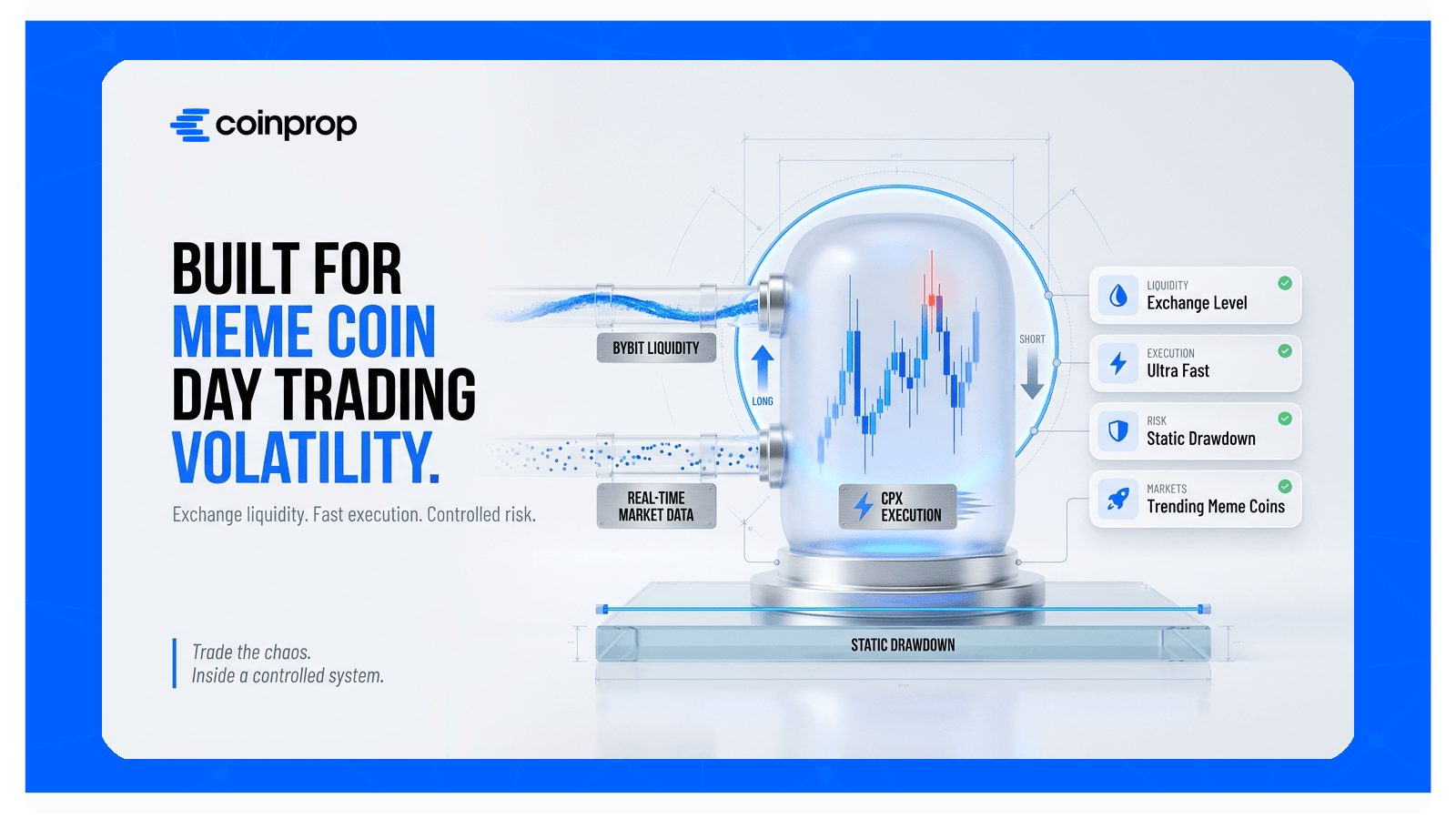
CoinProp is one of the best crypto prop firms for meme coin day trading because it combines exchange level liquidity, fast execution infrastructure, flexible risk conditions, and access to high volatility crypto markets. Unlike traditional trading environments where traders rely entirely on personal capital, CoinProp provides a structured funded environment designed for traders who want to participate in meme coin opportunities while maintaining controlled exposure.
By integrating Bybit liquidity and real time market data, CoinProp allows traders to operate with pricing conditions that closely reflect actual exchange activity. Combined with CPX execution infrastructure, static drawdown protection, long and short trading capabilities, and access to trending meme coin markets, creates an environment built specifically for the unique challenges of meme coin day trading.
What Makes a Crypto Prop Firm Good for Meme Coin Day Trading?
Trading meme coins requires more than simply having access to volatile assets. The best crypto prop firms for meme coin day trading need to provide infrastructure and rules that match the speed and unpredictability of these markets.
Key factors traders should consider include:
- Reliable Liquidity and Accurate Market Data Meme coins can experience rapid price changes and liquidity shifts within seconds. Access to exchange level data and deep liquidity helps traders execute positions based on real market conditions while reducing unnecessary pricing differences and execution issues.
- Fast Execution Infrastructure In highly volatile meme coin markets, timing is critical. A delay of only a few seconds can significantly impact entry prices, exits, and overall trade performance. Fast execution systems help traders react more effectively to sudden market movements.
- Access to Trending Meme Coins and New Listings Many meme coin opportunities appear during early market narratives and exchange listing events. A strong crypto prop firm should provide access to a wide range of active tokens rather than limiting traders to only major cryptocurrencies.
- Flexible Risk Management Rules Because meme coins often experience extreme volatility, traders need risk structures that provide protection without creating unnecessary restrictions. A suitable drawdown model should allow enough flexibility to manage sudden market movements while maintaining account discipline.
- Long and Short Market Access Meme coins can generate opportunities in both bullish and bearish conditions. The ability to trade both directions allows traders to participate during explosive rallies as well as sharp market corrections.
The Volatility Advantage: How to Trade Memecoins
Strategically Using Crypto Prop Firms and CoinProp’s CPX Terminal
Memecoins represent a unique and highly speculative segment of the digital asset market, defined by extreme volatility, community-driven momentum, and an increasing overlap with modern financial technology. These tokens, often inspired by internet memes or cultural humor, have evolved far beyond simple jokes. Today, they form a high stakes trading arena where only skilled traders thrive.
Successfully navigating this environment requires not just sharp timing and an understanding of market sentiment, but also a robust risk-management framework capable of handling rapid and unpredictable price swings.
CoinProp has rapidly become the go to prop firm for traders who want to navigate the high volatility world of memecoins with real structure, real tools, and real funding power. By offering fast execution, deep liquidity access, transparent listings, and a crypto‑native risk framework, CoinProp bridges the gap between degen energy and professional trading discipline.
Whether you’re chasing dog tokens, cat raids, frog chaos, political memes, or newly emerging micro‑caps, this ecosystem gives you the freedom to trade 100x coins safely, without risking your own capital. The memecoin market will always be wild, unpredictable, and narrative‑driven, but with the right prop‑firm structure, it becomes a landscape where skill, timing, and strategy truly shine.
In the end, memecoin trading isn’t just about hype, it’s about having the right tools, the right execution, and the right risk model. CoinProp delivers all three, empowering traders to turn volatility into opportunity and speculation into a scalable path forward.

Meme Coin Prop Strategy: From Entry to Exit
Once you’ve built a solid risk management foundation, the next step is developing a high performance Meme Coin Prop Strategy that lets you capture explosive gains using the prop firm’s capital.to succeed in these challenges, you need to master the Best Crypto Prop Trading Strategies adapted for high-volatility markets."
Trading meme coins on funded accounts requires a unique mix of strategic patience and military-level execution speed, without letting market hype or FOMO override your trading logic.
Entry Strategies: Following the Smart Money
In the meme coin world, classic technical indicators often lag far behind. A winning Meme Coin Prop Strategy relies on real-time monitoring of smart money flow and liquidity:
- Volume Confirmation: Only enter when you see an unusual spike in volume on lower timeframes (such as the 5-minute chart). This is often the first sign that whales are waking up.
- Break of Structure (BOS): Look for clean breaks above recent highs. The safest entry is usually on the first pullback after the breakout, allowing you to ride the explosive trend with better risk-reward.
Exit Strategies and Profit Securing in Volatile Trades
Massive profits in meme coins can disappear just as fast as they appear. For prop traders, protecting profits is often more important than making them.
- Partial Take Profit: As soon as price hits your first target, close at least 50% of the position. This immediately brings your trade to breakeven or better.
- Moving Your Stop: As the trade moves in your favor, move your stop-loss higher yourself by editing the position’s TP/SL in CPX.
- Expert Tip: Never let a winning trade turn into a loser. Once the position is in profit, move your stop-loss to breakeven as quickly as possible to lock in peace of mind.

Meme Coin Prop Review: Evaluating CoinProp’s Performance
In the prop trading industry, there are plenty of bold claims, but smart traders only care about real performance. A honest Meme Coin Prop Review must answer one key question: When the market gets extremely volatile, does the platform stand strong beside you, or does it leave you hanging? After thorough testing, CoinProp has proven it’s changing the game for meme coin traders.
Technical Infrastructure: The Slippage Test
Execution quality is one of the most important factors in any Meme Coin Prop Review. CoinProp prices fills off Bybit’s live order book. This means when you click buy or sell during intense volatility, your order fills at the tick you see on the chart with no added spread, and any slippage fee, sized from the book depth for that pair and your position size, is shown in the order confirmation before you execute.
Stability During Market Volatility
Meme coins are known for sudden pumps and dumps. In our tests, CoinProp’s CPX platform remained stable and responsive even during heavy traffic and extreme price spikes.
Key Strength: Complete transparency, no hidden rules Drawdown limits and profit targets are clearly explained upfront, so traders can focus entirely on performance and ROI instead of worrying about surprise violations.
If you’re looking for a funded meme coin account that not only allows trading on highly volatile tokens but also gives you the tools to manage risk effectively, CoinProp stands out as a top contender.
Special Offer – Free Trial:
Still unsure about your ability to handle meme coin volatility? CoinProp lets you test their platform with a Free Trial. You can experience the speed of the CPX terminal, order execution quality, and drawdown management in real market conditions, completely risk-free. It’s the perfect way to test your Meme Coin Prop Strategy safely before going live.
FAQ: Memecoin Trading Prop Firms

What is a memecoin prop firm?
A memecoin prop firm is a proprietary trading company that allows traders to trade memecoins using funded accounts instead of risking large amounts of personal capital. Traders typically complete an evaluation process before gaining access to firm-funded accounts.
Can I trade meme coins with a funded crypto account?
Yes. Some crypto prop firms allow traders to access funded accounts that support memecoin trading. Availability depends on the firm's asset list, liquidity providers, and risk management policies.
Can you short memecoins in a prop firm account?
Many crypto prop firms support perpetual futures trading, allowing traders to take both long and short positions on memecoins. This enables participation during both bullish and bearish market conditions.
Why are memecoins considered high-risk trading assets?
Memecoins often experience extreme volatility, rapid liquidity shifts, and strong sentiment-driven price movements. These factors can create large profit opportunities but also increase the risk of significant losses.
What is the advantage of trading memecoins with prop firm capital?
Trading with prop firm capital reduces the need to risk substantial personal funds. Instead of exposing personal savings to high-volatility markets, traders operate within predefined risk limits using funded accounts.
How important is liquidity when trading memecoins?
Liquidity is critical because low-liquidity markets can increase slippage and make order execution less predictable. Access to deep exchange-level liquidity generally helps traders enter and exit positions more efficiently.
What risk management rules are commonly used in memecoin prop firms?
Most prop firms apply rules such as maximum drawdown limits, daily loss limits, and position sizing requirements. These controls help protect trading capital during periods of extreme volatility.
How do new memecoin listings affect trading opportunities?
New listings often introduce fresh market narratives, increased trading volume, and additional volatility. Active listing cycles can create new opportunities for traders seeking momentum-driven setups in emerging memecoin markets.
Looking for a broader overview? This crypto prop firm list explains how crypto prop firms use exchange liquidity from platforms like Bybit and give traders access to hundreds of trading pairs, making it possible to trade everything from major cryptocurrencies to a wide range of altcoins.