Crypto prop firms with no trailing drawdown are becoming increasingly popular among traders looking for more predictable risk management. Unlike trailing models that move your loss limit higher as profits grow, static drawdown keeps risk fixed from the starting balance. This structure gives traders more flexibility, more breathing room during volatility, and greater freedom to manage positions without constantly adapting to changing risk limits. As the crypto prop firm industry evolves, more traders are prioritizing stable risk models over restrictive drawdown systems.

When comparing prop firms, many traders naturally look for the lowest drawdown rules possible. However, the drawdown percentage alone does not always determine whether a trading environment is better. The way the drawdown is structured, whether it is static or trailing, often has a much greater impact on flexibility, risk management, and long term trading performance.
For example, CoinProp uses a 6% static drawdown combined with a 9% profit target, creating a balanced risk to reward structure for crypto traders. Because the drawdown is calculated from the starting balance and does not trail with profits, traders can build their account without facing a constantly increasing risk limit. This creates a more predictable environment where successful performance does not automatically lead to tighter restrictions.
A prop firm with a lower drawdown percentage is not always the better choice. Traders should evaluate how the rule works in real trading conditions, including whether the drawdown remains fixed, how daily loss limits are calculated, and how the overall structure affects their trading strategy during periods of market volatility.
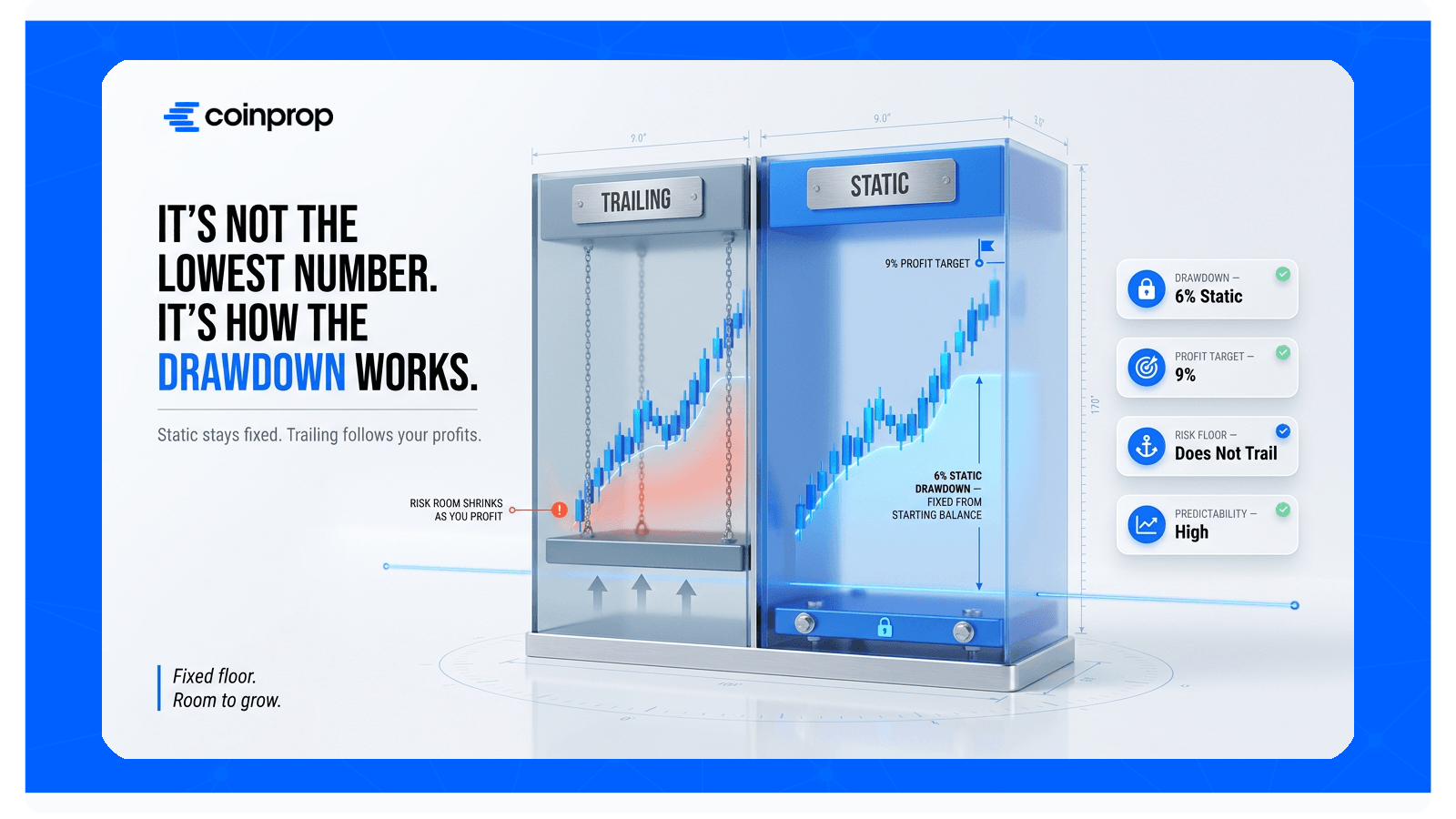
Many traders make the mistake of choosing a prop firm based only on the advertised drawdown percentage. While a lower drawdown limit may appear more attractive, the actual impact depends on how that limit is calculated and whether it changes as the account grows.
For example, a 5% static drawdown and an 8% trailing drawdown may look very different when comparing numbers alone. The trailing model appears to provide more room, but the drawdown limit moves higher as profits increase. This means the available buffer can become smaller after successful trades.
A static drawdown model works differently. The maximum loss limit stays fixed from the initial account balance, allowing profits to increase the distance between the current balance and the drawdown threshold.
This difference can make a smaller static drawdown more practical than a larger trailing drawdown. Traders are not only managing losses; they are also managing how the account rules behave after profitable performance.
CoinProp’s 6% static drawdown model follows this approach by keeping the risk limit predictable throughout the trading process. Instead of increasing restrictions after profits, the system allows traders to maintain a consistent risk framework.
The type of drawdown is often more important than the percentage itself.
With a static drawdown system, the maximum loss limit is determined from the starting balance and remains unchanged. This gives traders a clear understanding of their risk boundaries from the beginning.
For example, if a trader starts with a $100,000 account and a 6% static drawdown, the maximum loss limit remains fixed at $94,000. Even if the account grows significantly, the drawdown level does not move higher.
Trailing drawdown systems operate differently. The maximum loss level follows the account’s highest balance or equity level. As profits increase, the drawdown threshold also moves upward, reducing the room available for future losses.
This can create several challenges:
This difference is especially important for crypto traders because digital assets often experience sharp price movements and temporary retracements even during strong trends.
For this reason, many traders searching for crypto prop firms without trailing drawdown focus on the structure of the risk model rather than only the drawdown percentage.
Before choosing a prop firm challenge, traders should analyze the complete drawdown system instead of focusing only on the maximum loss percentage.
Important factors to review include:
Drawdown Type:
Is the drawdown static or trailing? A fixed drawdown provides predictable risk, while a trailing model changes as account performance improves.
Calculation Method:
Is the drawdown calculated from balance, equity, or another measurement? Equity based trailing drawdown can be more restrictive because floating profits may affect the risk limit.
Daily Loss Rules:
Traders should also check how daily drawdown works, including reset timing, calculation method, and whether it remains fixed or changes with profits.
Relationship Between Drawdown and Profit Target:
The balance between allowed loss and required profit is another important factor. A reasonable structure should allow traders to reach targets without forcing excessive risk taking.
CoinProp’s 6% static drawdown and 9% profit target is an example of a balanced model where traders have a clear risk limit while working toward a realistic objective. Because the drawdown does not increase as profits grow, traders can focus on execution, risk management, and strategy development instead of adapting to changing account restrictions.
Ultimately, the best prop firm is not necessarily the one with the lowest drawdown percentage. The better choice is the firm that offers a drawdown structure aligned with your trading strategy, risk tolerance, and the market conditions you trade.
No trailing drawdown prop firms are trading firms that use a fixed risk limit model instead of a dynamic, profit-following loss limit. In simple terms, once your account starts, your maximum allowed loss is locked and does not move upward as you generate profits. This is known as static drawdown.
This structure is becoming increasingly popular in crypto prop trading because it removes one of the biggest pain points in traditional prop firm rules: the moving safety net problem created by trailing drawdown systems. Instead of forcing traders to constantly protect accumulated profits, static models allow traders to focus purely on market conditions and strategy execution.
To understand why this matters, it’s important to break down what no trailing drawdown actually means, how static and trailing systems differ, and why this distinction is especially critical in volatile crypto markets.

It’s Like Playing Temple Run
You’re sprinting forward, stacking wins, feeling good. But that monster (the drawdown limit) is running right behind you at the exact same speed. Every step you take ahead doesn’t buy you safety, it just drags the kill zone up with you.
You can never stop, breathe, or actually enjoy the profits you just made. One normal pullback that would’ve been fine at a lower balance now wipes you out because the floor rose with your gains.
It’s not just math. It’s constant psychological pressure. You’re not only fighting the market, you’re fighting to protect profits you’ve already earned.
For crypto traders who swing big on breakouts, hold through volatility, or scale into winners, trailing drawdown is a death sentence.
That’s why any serious prop firm worth joining today has to be no trailing drawdown, pure static drawdown. The limit stays fixed from your starting balance, no chasing, no moving goalposts.
You bank a win? Great. That profit is now real breathing room. You can manage risk like an adult without the system punishing you for being good at your job. Static drawdown isn’t a luxury. In crypto, it’s survival. If your prop firm still uses trailing, run. You deserve better. Before buying your next challenge, reviewing a solid crypto prop firms list that filters out these moving traps is the smartest move you can make.
In prop trading, drawdown refers to the maximum loss a trader is allowed to take before the account is considered failed or breached. In a no trailing drawdown model, this limit is fixed from the beginning and does not adjust based on performance.
This means:
Even if you grow the account to $120,000 or $150,000, the risk limit does not move upward. Your profit is not used against you.
This is fundamentally different from trailing systems, where the drawdown follows your highest balance or equity peak. In those systems, every new profit can increase your risk of failure if the market retraces.
In short, no trailing drawdown means:
Your risk limit is fixed, predictable, and independent of your profit curve.
The difference between static and trailing drawdown is not just technical, it directly affects trading psychology, strategy flexibility, and long-term survivability.
A simple way to understand the difference:
This creates two completely different trading environments. One is stable and predictable, while the other becomes increasingly restrictive as performance improves.
Crypto markets are fundamentally different from traditional markets like forex or futures because of their high volatility, rapid price swings, and unpredictable liquidity shifts. These conditions make drawdown structure extremely important in prop firm environments.
In crypto trading, it is normal for prices to move 5–20% within short periods. In a trailing drawdown system, even a healthy profit phase can quickly turn into a risk breach during a normal market correction.
This creates a situation where:
Many crypto strategies rely on:
Trailing drawdown limits make these strategies difficult because any pullback after a profit peak reduces safety margin or triggers violation risk.
Instead of feeling safer as profits grow, traders experience the opposite:
This often leads to:
Static drawdown removes the moving target problem. Traders can:
In crypto prop firm environments, this structure is often considered more aligned with real trading conditions because it separates market risk from rule-based risk escalation.
No trailing drawdown prop firms use a fixed risk system that keeps the loss limit stable regardless of performance. Compared to trailing drawdown models, static systems provide greater predictability, less psychological pressure, and better compatibility with crypto volatility. This is why many modern crypto prop firms are shifting toward static drawdown structures as a more trader-friendly standard.

Static drawdown and trailing drawdown are the two fundamental risk models used in prop trading, and the difference between them completely changes how a trader experiences risk, profit growth, and long-term survivability. While both systems are designed to protect the firm’s capital, they operate in very different ways, especially in crypto prop firm environments where volatility is high and price swings are frequent.
Understanding this comparison is essential before choosing any prop firm, because the drawdown structure often matters more than the profit target itself. It determines how much freedom you actually have to trade, how your profits are treated, and how easily a normal market pullback can end your account.
Static drawdown is the simplest and most trader-friendly risk model. In this system, the maximum allowed loss is fixed at the beginning of the account, usually based on a percentage of the starting balance, and it never changes.
For example:
From the moment the account starts, that $90,000 level becomes the permanent line in the sand. No matter how much profit you generate, that limit does not move upward.
If the account grows to:
This creates a key advantage: profits increase your buffer, not your risk pressure.
The more you earn, the safer you actually become. This structure allows traders to:
Static drawdown essentially separates performance from punishment. Winning does not tighten your risk constraints
Trailing drawdown works in the opposite way. Instead of staying fixed, the drawdown level moves upward as your account reaches new highs. This means your risk limit is always chasing your best performance.
For example:
At first glance, this might seem fair because it locks in profits. However, in practice it creates a constantly shrinking safety buffer after each winning phase.
The core issue is simple:
Every new profit increases the minimum level you must stay above.
This leads to a situation where:
Instead of rewarding success with freedom, trailing systems often turn success into added pressure.
Trailing drawdown is not a single system, it has two main variations, and both behave differently in real trading conditions.
Equity-based trailing drawdown updates in real time based on your live account value, including open trades.
Key characteristics:
This version is considered more aggressive because even temporary price swings can increase risk constraints.
Balance-based trailing drawdown only updates after trades are closed and profits are realized.
Key characteristics:
While it appears more stable, it still reduces your buffer as your account grows.
Both versions share the same core problem:
They reduce your margin for error as your performance improves.
The only difference is timing, equity-based is immediate, balance-based is delayed.
The behavioral impact of static vs trailing drawdown is where the real difference becomes obvious. It is not just a structural change, it directly affects how traders make decisions.
Static systems create a stable environment where traders can plan consistently, while trailing systems gradually increase pressure as performance improves.
In volatile markets like crypto, this difference is critical. A normal correction in price action can be harmless in static systems but dangerous in trailing systems.
This is one of the most important conceptual differences. In static models, winning gives you breathing room. In trailing models, winning reduces your margin for error.
Many strategies that rely on holding positions or riding volatility become difficult under trailing rules.
This psychological divergence often determines long-term consistency more than technical strategy.
Static drawdown creates a stable, predictable risk environment where profits work in your favor. Trailing drawdown creates a dynamic risk environment where profits can increase pressure instead of reducing it. In crypto prop trading, where volatility is naturally high, this distinction becomes one of the most important factors in choosing the right prop firm model.

Trailing drawdown might work in more stable markets, but in crypto trading it often becomes one of the most restrictive risk systems a trader can face. The core issue is not just the mechanism itself, but how it interacts with the extreme volatility, fast price reversals, and unpredictable momentum shifts that define crypto markets.
Instead of simply limiting risk, trailing drawdown frequently reshapes how traders behave, often forcing them into overly defensive decisions that conflict with natural market conditions. This is why many crypto prop traders view it as a structural disadvantage compared to static drawdown models.
Crypto markets are inherently volatile. It is normal for prices to move aggressively in both directions within short timeframes. Double-digit percentage swings can happen in a single day, especially during high-impact news, liquidity shifts, or breakout phases.
In a trailing drawdown system, this volatility becomes a direct risk factor because:
The problem is not the volatility itself, but how trailing drawdown reacts to it. Instead of allowing traders to operate within natural fluctuations, the system effectively penalizes them for participating in them.
This creates a mismatch between market reality and risk structure. Crypto demands flexibility, but trailing systems enforce progressively tighter constraints as price action expands.
One of the most counterintuitive aspects of trailing drawdown is that winning does not always make trading easier, it can make it harder.
As your account grows, the drawdown floor moves upward. This means:
In practical terms, this creates a paradox:
The better you perform, the less room you have to make mistakes.
This is especially problematic in crypto, where even strong trends contain sharp retracements. A trader who is in profit may suddenly find that a routine pullback is now enough to threaten the entire account.
Instead of reinforcing success, the system converts it into increased fragility.
Trailing drawdown does not only affect numbers, it strongly influences trader psychology. As the account grows, traders often shift from a growth mindset to a protection mindset.
This leads to several behavioral changes:
Over time, the trader becomes less focused on execution and more focused on preserving a moving risk boundary.
This psychological burden is amplified in crypto markets because price movement is fast and unpredictable. Even minor fluctuations can create anxiety when the drawdown level is closely tied to equity peaks.
The result is often:
Emotional trading replacing systematic trading.
Many trading strategies, especially those used in crypto, are not designed for restrictive, adaptive risk ceilings. They are built around volatility, trend continuation, and natural retracement cycles.
Trailing drawdown interferes with these strategies in several ways:
Swing traders rely on holding positions through pullbacks. In trailing systems, those pullbacks can directly threaten account survival, even if the overall trend is correct.
Trend-following strategies require patience. However, trailing drawdown often forces traders to exit early to protect their moving risk buffer, reducing long-term profitability.
Even short-term strategies are affected because equity fluctuations can constantly shift risk thresholds, leading to over-monitoring and hesitation.
Algorithmic or rule-based systems rely on statistical edge over many trades. Trailing drawdown interrupts this consistency by introducing external constraints that are not part of the strategy itself.
Trailing drawdown creates a trading environment where risk is not fixed but continuously evolving against the trader. In crypto markets, where volatility is a core feature, not an exception, this structure often leads to reduced flexibility, increased psychological pressure, and strategy distortion. As a result, many traders find that trailing systems are not aligned with how crypto markets actually behave.

Static drawdown is widely considered the more trader-friendly risk model in crypto prop trading because it prioritizes stability, predictability, and real market flexibility. Unlike trailing systems that continuously adjust risk based on performance, static drawdown keeps the loss limit fixed from the start, allowing traders to operate in a more natural and less restricted environment.
In volatile markets like crypto, where price swings, sudden reversals, and extended trends are common, this structure provides a significant operational advantage. It allows traders to focus on strategy execution rather than constantly adapting to shifting risk boundaries.
One of the biggest advantages of static drawdown is its predictability. From the moment a trader starts, the maximum allowed loss is clearly defined and does not change regardless of account performance.
This creates a stable trading framework:
For example, if a trader has a $100,000 account with a 10% static drawdown, the risk limit remains at $90,000 whether the account is at $101,000 or $150,000.
This predictability is critical because it removes uncertainty from risk management. Traders can plan positions, manage exposure, and evaluate setups without recalculating risk thresholds after every winning trade.
In short, static drawdown turns risk into a fixed variable, not a moving target.
In trading, one of the most important principles is allowing winning trades to run. However, trailing drawdown systems often punish this behavior by tightening the risk buffer as profits increase.
Static drawdown removes this limitation entirely.
With a fixed risk floor:
This is especially important in crypto markets, where major price moves often occur in extended waves rather than small incremental steps.
Traders can:
Essentially, static drawdown allows traders to behave like professionals, letting the market play out instead of reacting defensively to risk system pressure.
Effective risk management depends on consistency. Static drawdown supports this by ensuring that position sizing rules remain valid regardless of account growth.
Because the risk floor does not move:
This stability is crucial for systematic traders who rely on fixed percentage risk models or structured trading plans.
In contrast, trailing systems constantly change the effective risk environment, which forces traders to:
Static drawdown eliminates this complexity. Traders can focus on execution rather than continuously adapting to shifting constraints.
The result is a more disciplined and mathematically clean approach to trading.
Crypto markets are naturally volatile, and many of the most profitable opportunities come from swing trading, holding positions through multiple phases of expansion and retracement.
Static drawdown is particularly well-suited for this style because it provides the necessary breathing room for price fluctuations.
With static risk rules:
This flexibility is essential because crypto price action rarely moves in straight lines. Even strong bullish or bearish trends include sharp corrections that would be dangerous in trailing systems.
Static drawdown allows traders to:
In essence, it aligns risk management with how crypto markets actually behave, rather than forcing traders into overly restrictive behavior.
Static drawdown provides a stable, predictable, and strategy-friendly risk environment. By keeping the loss limit fixed, it allows traders to scale positions confidently, hold winning trades longer, and navigate crypto volatility without structural penalties. For many crypto prop traders, this model represents a more natural and sustainable way to trade compared to trailing drawdown systems.

To understand the real impact of static and trailing drawdown, it helps to look at how both systems behave in a realistic trading environment. On the surface, the difference seems technical, but in practice it completely changes how a trader manages risk, handles volatility, and scales profits, especially in crypto prop firm conditions where price swings are frequent and unpredictable.
Let’s take a simple $10,000 account example and assume both accounts start with the same risk rules: a 5% maximum drawdown, meaning the account cannot fall below $9,500. From this point onward, however, the behavior of static and trailing models starts to diverge significantly as soon as the trader becomes profitable.
In a static drawdown model, the risk limit is fixed from the very beginning. The drawdown floor remains locked at $9,500 regardless of how much profit the trader generates. This means that as the account grows, the trader’s safety buffer increases in a very straightforward way. Profit adds cushioning, not pressure. The account might move to $10,400 or $10,800, but the risk limit stays exactly where it started.
In contrast, a trailing drawdown system behaves differently. Instead of staying fixed, the drawdown level follows the account’s peak performance. As soon as the trader reaches new equity highs, the minimum allowed balance also moves upward. This creates a dynamic where profits are partially protected, but at the cost of reducing flexibility during normal market pullbacks.
At first, both systems feel similar because the drawdown floor starts at the same level. However, the difference becomes more visible as soon as the account enters profit territory.
At around +4% profit, the static account has already created a noticeable buffer above the fixed drawdown floor. If the account reaches $10,400, the risk limit is still $9,500, meaning the trader now has $900 of breathing room. This space allows normal fluctuations, minor losing trades, or short-term volatility without any structural risk change.
In the trailing drawdown model, the situation begins to shift. As the account reaches $10,400, the drawdown floor moves upward as well, often to around $10,000 depending on the specific rule set. This reduces the effective buffer to approximately $400. At this point, the trader is already operating with significantly less margin for error compared to the static model.
As profits increase further to +6%, the gap becomes even more obvious. The static account continues to grow freely, and the safety buffer expands proportionally because the floor remains unchanged. However, in the trailing system, the drawdown level continues to rise with every new high, compressing the usable risk space even more.
By the time the account reaches +8% profit, the difference becomes critical. The static account now has a healthy buffer of over a thousand dollars, allowing it to withstand normal crypto volatility without structural risk. Meanwhile, the trailing account is operating with a much tighter margin. A standard market pullback that would be considered normal in crypto trading can suddenly become a violation risk simply because the drawdown floor has moved too close to current price levels.
The key advantage of static drawdown becomes clear when looking at long-term behavior. Instead of tightening risk conditions as the trader becomes more successful, static drawdown allows the account to naturally become safer over time. Every profitable trade increases the distance between current equity and the fixed risk floor, effectively rewarding performance with stability rather than restriction.
Trailing drawdown, on the other hand, does the opposite. While it initially protects profits on paper, it gradually reduces flexibility as the account grows. The better the trader performs, the less room they have to absorb normal market movement. In a volatile environment like crypto, this often leads to premature exits, reduced position sizing, or overly defensive behavior.
Static models align more naturally with real trading conditions because they separate market volatility from risk enforcement rules. Traders are allowed to experience normal pullbacks without constantly adjusting their behavior around a moving risk boundary. Over time, this creates a more stable trading experience where consistency is easier to maintain and strategy execution is less affected by external constraints.
In essence, static drawdown provides a structure where growth increases safety, while trailing drawdown often creates a structure where growth increases pressure.
When comparing prop firms, one of the most important differences is not the profit target or scaling plan, but the drawdown structure. FTMO, Topstep, and modern crypto prop firms all operate under different risk models, and these differences significantly affect how traders manage positions, handle volatility, and survive evaluation phases.
Understanding these models side by side makes it clear why many traders are shifting toward crypto prop firms with no trailing drawdown, especially in highly volatile markets.
FTMO is widely known for using a static maximum loss model, which is considered one of the most trader-friendly approaches in traditional prop trading.
In this system, the maximum loss is defined at the start of the account and does not move with profits. For example, if a trader has a $100,000 account with a 10% maximum loss limit, the account must not drop below $90,000 regardless of performance.
As the account grows, the risk floor remains fixed. If the account reaches $120,000, the trader still has the same $90,000 drawdown limit. This means that profits effectively increase the trader’s buffer rather than tightening their risk constraints.
This structure is particularly attractive because it:
FTMO’s model is often seen as a benchmark for static drawdown systems in traditional prop trading environments.
Topstep, on the other hand, uses a trailing drawdown model, primarily designed for futures trading environments. Unlike static systems, Topstep’s risk limit adjusts based on account performance, which creates a dynamic and evolving risk structure.
In most cases, the drawdown starts trailing once the account begins generating profits. As equity increases, the maximum allowable loss level moves upward as well. This means that the trader’s safety buffer is constantly recalculated based on peak performance.
One of the key characteristics of Topstep’s system is that it often includes a lock mechanism once a certain profit threshold is reached. However, even after locking, traders may face indirect constraints because withdrawing profits or reducing account equity can still impact their effective risk cushion.
This structure leads to several behavioral effects:
While this model works in certain futures environments, it can feel restrictive for traders who rely on volatility-based strategies or longer holding periods.
Crypto prop firms differ significantly from both FTMO and Topstep because they operate in a market environment that is inherently more volatile, faster, and less predictable. As a result, many crypto prop firms are increasingly adopting static drawdown models with no trailing mechanisms.
Traditional firms are generally designed around:
FTMO leans toward static drawdown, which offers stability, while Topstep uses trailing drawdown to enforce tighter risk control in futures environments.
Crypto prop firms operate in a fundamentally different environment:
Because of this, static drawdown models are often preferred. They allow traders to:
Trailing drawdown in crypto environments often becomes problematic because price swings can quickly reduce safety margins even during valid trading conditions.
The core difference between traditional and crypto prop firms comes down to risk philosophy:
As a result, crypto prop firms with no trailing drawdown are increasingly seen as more aligned with how modern traders actually operate in volatile digital asset markets.
FTMO offers a stable static drawdown model that rewards consistency, Topstep uses a trailing system that emphasizes tight risk control in futures markets, and crypto prop firms are increasingly moving toward static models to better handle volatility. This divergence highlights a broader industry trend: traders are favoring risk systems that enhance flexibility rather than restrict performance as profits grow.
Although this article focuses primarily on crypto prop firms, the discussion around static and trailing drawdown extends far beyond digital asset markets. Futures traders face many of the same challenges when evaluating funding programs, particularly when it comes to risk management rules and account sustainability.
For years, trailing drawdown has been a common feature in the futures prop trading industry. While these models are designed to protect firm capital, many traders argue that they can also create unnecessary limitations, especially as account profits begin to grow. As a result, there is increasing interest in futures prop firms that offer no trailing drawdown or static drawdown alternatives.
The appeal is simple: traders want risk rules that remain predictable and allow them to focus on market execution rather than constantly monitoring a moving loss limit.
Many futures traders prefer static drawdown because it provides a more stable and transparent framework for managing risk. In a static model, the maximum loss limit is fixed from the beginning and remains unchanged regardless of account performance.
This creates an environment where profits genuinely improve account flexibility. As the account grows, traders gain additional room to absorb losses, manage larger positions, and navigate temporary market fluctuations without worrying about a tightening risk threshold.
For futures traders who rely on structured risk management plans, this consistency is extremely valuable. Position sizing calculations remain stable, risk-reward models remain intact, and trading decisions can be based on market conditions rather than account-rule constraints.
Another reason static drawdown is attractive is that it aligns more closely with how professional traders typically think about risk. In real-world trading, increasing profits generally improves account resilience. Static drawdown preserves this relationship by allowing traders to build a larger buffer over time instead of reducing flexibility as performance improves.
This approach can be particularly beneficial for:
Because the risk framework remains consistent, traders can focus on executing their edge rather than adapting to constantly changing limitations.
Trailing drawdown impacts futures traders in much the same way it affects crypto traders. As profits increase, the drawdown threshold rises as well, reducing the amount of available room for normal losses and market retracements.
At first, this may seem like a reasonable risk-control mechanism. However, over time, many traders discover that it changes the way they trade.
Instead of focusing solely on identifying quality setups, traders often become preoccupied with protecting their drawdown buffer. This can lead to a variety of behavioral changes, including exiting profitable trades too early, avoiding otherwise valid opportunities, or reducing position size after successful periods.
The challenge becomes even more noticeable in trending markets. Many profitable futures strategies depend on allowing winners to develop over time. Yet under a trailing drawdown structure, traders may feel pressure to lock in gains quickly because every new profit high can effectively tighten future risk limits.
As a result, trailing drawdown can create a disconnect between strategy design and actual execution. A system that performs well in backtesting or personal accounts may become more difficult to implement consistently when account rules continuously adjust based on performance.
This does not necessarily mean trailing drawdown is ineffective. Some traders successfully operate within these constraints. However, it often requires a more conservative approach and greater attention to account-rule management compared to static models.
One of the main reasons traders fail prop firm challenges is not their strategy itself, but a misunderstanding of how drawdown rules actually work. In crypto prop trading, where volatility is high and account rules are strict, even a small misinterpretation of risk structure can lead to account breaches despite having a profitable system.
Most mistakes happen early, before or shortly after traders start making consistent profits. These errors are often structural rather than technical, meaning they come from misunderstanding the rules rather than poor trading execution.
One of the most common mistakes is misunderstanding how trailing drawdown behaves as the account becomes profitable. Many traders assume that once they are in profit, they are in a safer position. In reality, with trailing drawdown systems, the opposite can happen.
As profits increase, the drawdown level also moves upward, which reduces the available buffer for normal losses. This creates a situation where traders unknowingly become more vulnerable after successful trades.
The critical misunderstanding is thinking:
I’m up in profit, so I have more safety.
But in trailing systems, the reality is:
I’m up in profit, so my risk margin may actually be tighter.
This leads to unexpected violations when normal market pullbacks occur. Traders often fail not because they lose money overall, but because the drawdown floor has moved too close to current equity after a winning streak.
Another frequent mistake is increasing position size too aggressively after a few successful trades. Early profits often create overconfidence, especially in fast-moving crypto markets where winning streaks can happen quickly.
Traders may start to:
In both static and trailing drawdown systems, this behavior can be dangerous, but it becomes especially risky in trailing environments. As leverage increases and drawdown tightens, a single normal loss can wipe out both recent gains and the remaining buffer.
This mistake is not about strategy failure, it is about emotional scaling instead of structured scaling. Professional prop trading requires gradual, rule-based position increases, not reactionary changes based on short-term performance.
Perhaps the most costly mistake traders make is choosing a prop firm without fully understanding its drawdown model. Many traders focus on profit targets, fees, or scaling plans, while completely overlooking whether the firm uses static or trailing drawdown.
This leads to mismatched expectations, especially when traders:
Ignoring drawdown structure often results in selecting a firm that is fundamentally incompatible with the trader’s style. For example, a trader using longer-term setups may struggle significantly in a trailing system where normal market retracements are treated as increased risk exposure.
Understanding drawdown rules before entering a challenge is essential because it defines:
In many cases, traders fail not because their strategy is wrong, but because the risk framework does not support the strategy in the first place.
Most drawdown-related failures in crypto prop trading come from misunderstanding system behavior, overreacting to early success, or choosing a firm without analyzing its risk structure. Avoiding these mistakes requires not only technical trading skill but also a clear understanding of how static and trailing drawdown models impact long-term performance and decision-making.
In recent years, there has been a noticeable shift in how crypto prop firms design their risk management systems. While trailing drawdown models were once common across many funding programs, the industry is increasingly moving toward static drawdown structures. This change is not accidental, it reflects a broader evolution in trader behavior, market volatility, and the need for more realistic risk frameworks in crypto trading environments.
Static drawdown is no longer seen as just a simpler alternative. It is gradually becoming the preferred standard for firms that want to attract serious traders and support sustainable long-term performance.
One of the main reasons for this industry shift is the growing demand for trader-friendly risk systems. Traditional prop models often emphasized strict control mechanisms designed to protect capital at all costs. However, over time, it became clear that overly restrictive systems can limit trader performance and reduce overall success rates.
Static drawdown models offer a more balanced approach. By keeping the risk limit fixed, traders are not penalized for generating profits. Instead, they are given a stable environment where performance can develop naturally without constant adjustment to changing risk thresholds.
This shift reflects a broader change in philosophy:
As a result, more crypto prop firms are redesigning their evaluation and funding programs around static drawdown principles.
The rise of static drawdown is also strongly driven by trader demand. Crypto traders operate in one of the most volatile financial markets, where price movements are fast, unpredictable, and often extreme. In this environment, flexibility is not a luxury, it is a necessity.
Trailing drawdown systems often feel restrictive because they reduce trading freedom as profits grow. Many traders experience situations where:
As a result, traders increasingly prefer prop firms that allow them to:
This demand has pushed the industry toward models that better align with real trading behavior, making static drawdown a more attractive and competitive option.
Another important factor behind the rise of static drawdown is its long-term sustainability for both traders and prop firms. Unlike trailing systems, which dynamically adjust risk exposure in a way that can become increasingly restrictive over time, static systems remain stable throughout the trading lifecycle.
From a trader’s perspective, this stability allows for:
From a prop firm perspective, static drawdown creates:
In the long run, this balance benefits both sides. Traders get a fair and stable environment to execute strategies, while firms benefit from more consistent and sustainable trading outcomes.
Static drawdown is becoming the new industry standard in crypto prop trading because it aligns better with modern market conditions and trader expectations. The shift is driven by the need for flexibility, improved trader experience, and more sustainable risk frameworks that support long-term consistency rather than short-term restriction.
No trailing drawdown prop firms represent a clear shift in how risk is structured in modern crypto trading environments. Instead of continuously adjusting risk limits based on performance, these firms rely on a fixed drawdown model that stays constant from the start. This fundamental difference has a direct impact on how traders experience volatility, manage positions, and build long-term consistency.
As crypto markets continue to evolve, the discussion is no longer just about profit targets or funding speed. It is increasingly about whether the underlying risk framework actually supports realistic trading behavior. In that context, static drawdown has emerged as one of the most practical and trader-aligned approaches.
Choosing between static and trailing drawdown ultimately comes down to how closely a risk model matches the behavior of the market being traded. Crypto markets are fast, volatile, and often unpredictable, with frequent sharp movements that can easily challenge rigid risk structures.
Trailing drawdown systems tend to work better in environments where price action is more stable and retracements are less extreme. In crypto, however, even strong trends are usually interrupted by deep pullbacks and sudden reversals. This makes dynamically tightening risk limits harder to manage in practice.
Static drawdown fits modern crypto trading more naturally because it:
As a result, many traders find that static models align better with how crypto actually moves, making them a more practical choice for both short-term and long-term strategies.
Static drawdown is increasingly viewed as a more professional and sustainable approach to prop trading because it prioritizes consistency over restriction. Instead of modifying risk exposure as traders succeed, it keeps the framework stable and predictable throughout the entire trading process.
This stability allows traders to develop more disciplined habits, focus on execution quality, and build strategies that are not constantly influenced by shifting risk boundaries. Over time, this leads to more reliable performance and fewer rule-based disruptions caused by normal market behavior.
From a long-term perspective, static drawdown supports:
In contrast to trailing systems, which can introduce increasing pressure as performance improves, static drawdown creates an environment where success does not come with hidden constraints.
No trailing drawdown prop firms are gaining popularity because they offer a more stable and realistic approach to risk management in crypto markets. Static drawdown, in particular, is increasingly seen as a long-term professional standard due to its consistency, flexibility, and alignment with the natural behavior of volatile trading environments.
CoinProp is designed around a pure no trailing drawdown model, built specifically for crypto traders who need stability, flexibility, and a clear risk structure. Instead of using dynamic risk limits that move with account performance, CoinProp applies a static drawdown system from day one, meaning your maximum loss is fixed and never increases as you generate profits.
This approach removes the moving target problem found in trailing drawdown systems and allows traders to focus entirely on strategy execution rather than constantly managing a shifting risk boundary. In highly volatile crypto markets, this structure is designed to create a more predictable and trader-friendly environment.
At CoinProp, the drawdown limit is locked immediately when the account begins. This means that whether you are in a challenge phase or a funded account, your maximum allowable loss does not change over time.
For example, if you start with a $100,000 account and a 10% drawdown rule, your risk floor remains at $90,000 throughout the entire trading period. Even if the account grows to $120,000 or beyond, the drawdown level stays fixed.
This creates a stable environment where:
Unlike trailing drawdown systems, CoinProp does not adjust risk levels based on account highs or equity peaks. In trailing systems, every new profit high can push the drawdown level upward, effectively reducing the trader’s margin for error over time.
CoinProp avoids this structure entirely. Instead of rewarding performance with tighter constraints, it maintains a consistent risk framework regardless of trading results.
This difference means:
The goal is to align risk management with real crypto market behavior rather than artificially tightening constraints as performance improves.
Crypto markets are known for high volatility, fast price movements, and frequent reversals. Traditional trailing drawdown systems often struggle in this environment because normal market fluctuations can unintentionally bring traders close to violation levels.
CoinProp is structured specifically to match these conditions by offering a static drawdown model that:
This design reflects the reality of crypto trading, where flexibility and risk stability are more important than continuously tightening constraints.
Trading with CoinProp’s static drawdown model provides several structural advantages that directly impact performance and consistency.
First, it offers predictable risk behavior, allowing traders to plan and execute strategies without uncertainty about shifting drawdown levels. This predictability is essential for both manual and systematic trading approaches.
Second, it provides greater freedom during profitable phases, since gains do not reduce available risk buffer. Traders can scale positions, hold trades longer, and navigate volatility without structural penalties.
Finally, it supports long-term trading consistency by removing one of the most common failure points in prop trading, drawdown tightening after success. Instead of increasing pressure as traders perform better, the system maintains a stable environment where performance can develop naturally over time.
Overall, CoinProp’s static drawdown model is built to support traders who prioritize consistency, flexibility, and alignment with real crypto market behavior.
This section answers some of the most common questions traders have about no trailing drawdown prop firms and how static drawdown systems actually work in real trading environments. Understanding these concepts is important before choosing a prop firm, especially in crypto markets where volatility can quickly expose weaknesses in risk management rules.
A no trailing drawdown prop firm is a trading firm that uses a fixed risk limit system, also known as static drawdown. In this model, the maximum allowed loss is set at the beginning of the account and does not move as the trader generates profits.
This means that if you start with a $100,000 account and a 10% drawdown limit, your risk floor stays at $90,000 regardless of whether the account grows to $110,000 or $150,000. Unlike trailing systems, your profits do not increase your risk pressure, which makes the structure more predictable and stable.
Static drawdown is generally considered better for crypto trading because it provides more flexibility and stability in volatile markets. Since the risk limit does not move, traders are less likely to be penalized for normal market pullbacks.
Trailing drawdown, on the other hand, can become restrictive as profits grow, because the risk buffer shrinks over time. This can make it harder to hold positions, manage volatility, or maintain long-term strategies.
However, whether one is better ultimately depends on trading style. Short-term, highly controlled strategies may adapt to trailing systems, but most crypto traders prefer static drawdown for its consistency and freedom.
Many modern prop firms, especially in the crypto space, are adopting static drawdown models because they are more trader-friendly and better suited for volatile markets. Traditional firms like FTMO are often referenced for using static-style risk structures, while newer crypto-focused firms increasingly avoid trailing mechanisms.
In general, firms that emphasize:
are more likely to use static drawdown systems. Traders should always verify the specific risk rules of each firm, as definitions can vary slightly between providers.
Yes, trailing drawdown can negatively impact certain trading strategies, especially in crypto markets. The main issue is that as your account becomes more profitable, your drawdown limit moves closer to your current equity, reducing your margin for error.
This can affect strategies such as:
Because of this, traders may feel forced to exit trades early, reduce position size, or avoid valid setups simply to protect their drawdown buffer.
Yes, static drawdown is often more suitable for beginners because it provides a simpler and more predictable risk structure. Beginners do not need to constantly adjust their behavior based on changing drawdown levels, which reduces complexity during the learning phase.
With static drawdown, beginners can:
However, beginners still need to practice proper risk control per trade, because static drawdown does not eliminate the possibility of account loss, it only makes the rules more stable and easier to understand.
No trailing drawdown prop firms use a fixed risk model that offers greater stability and predictability compared to trailing systems. For most crypto traders, especially beginners and swing traders, static drawdown provides a more practical and forgiving environment for developing consistent trading performance.
Understanding how a crypto prop firm operates can help you make better decisions when comparing trading rules, risk limits, and payout structures.
