
Best Crypto Prop Trading Strategies for Long-Term Success
Published
Discover the best crypto prop trading strategies for high R:R wins as a funded trader. From high probability swing trading and ICT concepts to liquidity sweeps, Order Block setups, and precision scalping, this guide helps traders pass challenges and manage risk with consistency. Instead of relying on generic strategy PDFs, the focus here is on practical frameworks built for real crypto prop firm trading conditions.

- Cryptocurrency Trading Basics for Prop Firm Success
- Most Profitable Prop Trading Strategies for Crypto Funded Traders
- Common Trading Strategies Used in Crypto Prop Firms
- Comparing Prop Trading Strategies : Which One Fits You?
- Position Management Strategies to Protect Prop Firm Capital
- Alternative Trading Strategies for Crypto Prop Traders
- Core Trading Frameworks Behind Profitable Crypto Prop Strategies
- Best Strategy PDF & Books for Crypto Prop Traders
- Profit Lock In Tactics, Our Gift to Prop Traders
- The Crypto Fund Trader Is a Risk Architect
- FAQ: Crypto Prop Trading Strategies
Cryptocurrency Trading Basics for Prop Firm Success
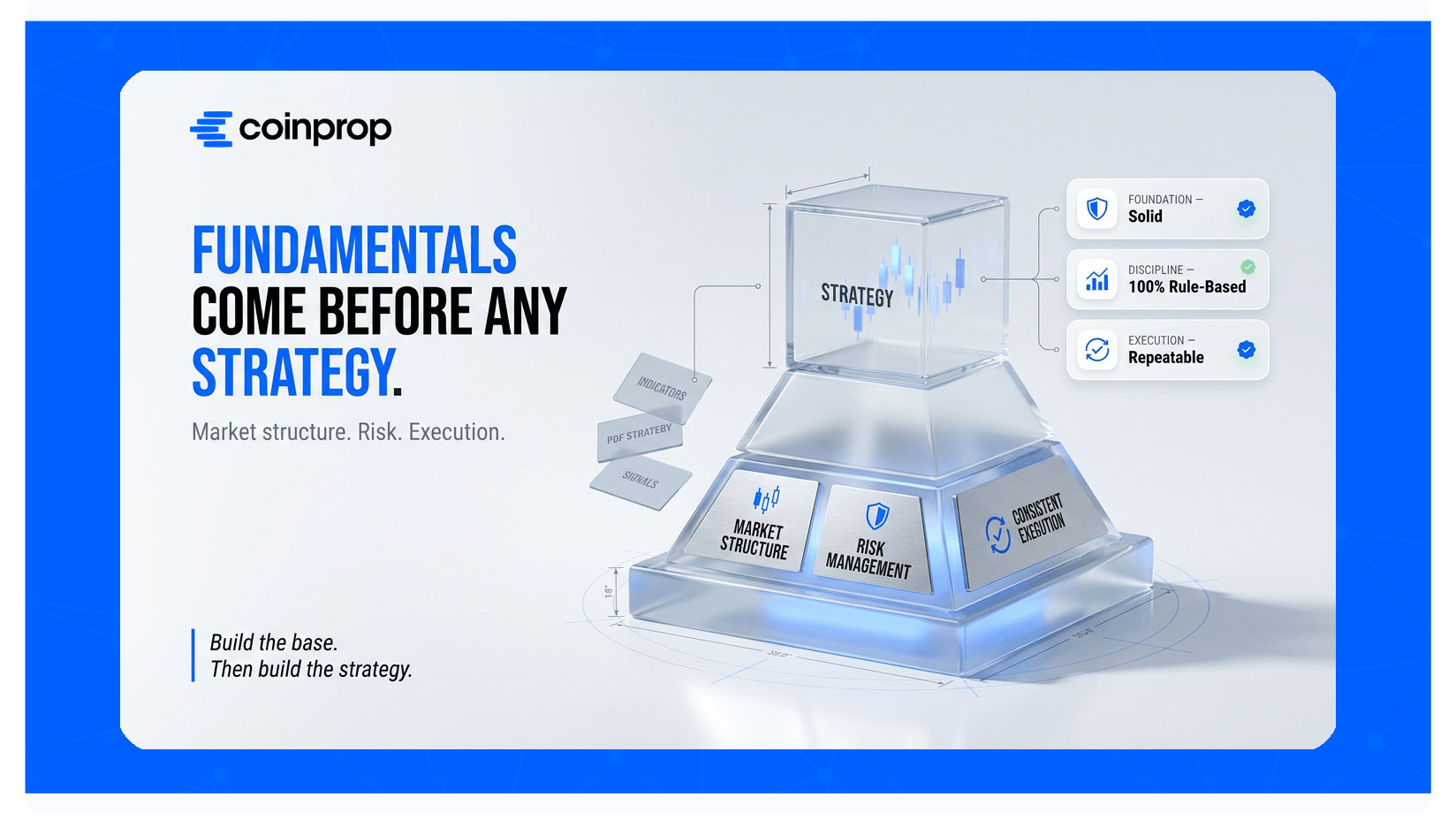
Before searching for the best crypto prop firm strategy, it's important to understand that no strategy can consistently succeed without a solid foundation. Many traders spend weeks testing indicators or downloading trading PDFs, but they often overlook the core principles that successful funded traders rely on every day.
The most profitable prop traders are not necessarily those with the most complex strategies. Instead, they build their trading around market structure, disciplined risk management, and consistent execution. Once these fundamentals become part of your trading process, almost any well tested strategy becomes easier to execute.
Understand Market Structure Before Looking for Entries
Every successful trading strategy starts with understanding market structure. Before entering any trade, identify whether the market is trending, ranging, or transitioning between the two.
Look for higher highs and higher lows during an uptrend, or lower highs and lower lows during a downtrend. Trading with the prevailing market structure generally provides higher probability opportunities than trying to predict reversals.
This simple habit helps traders filter out low quality setups and avoid unnecessary losses during prop firm evaluations.
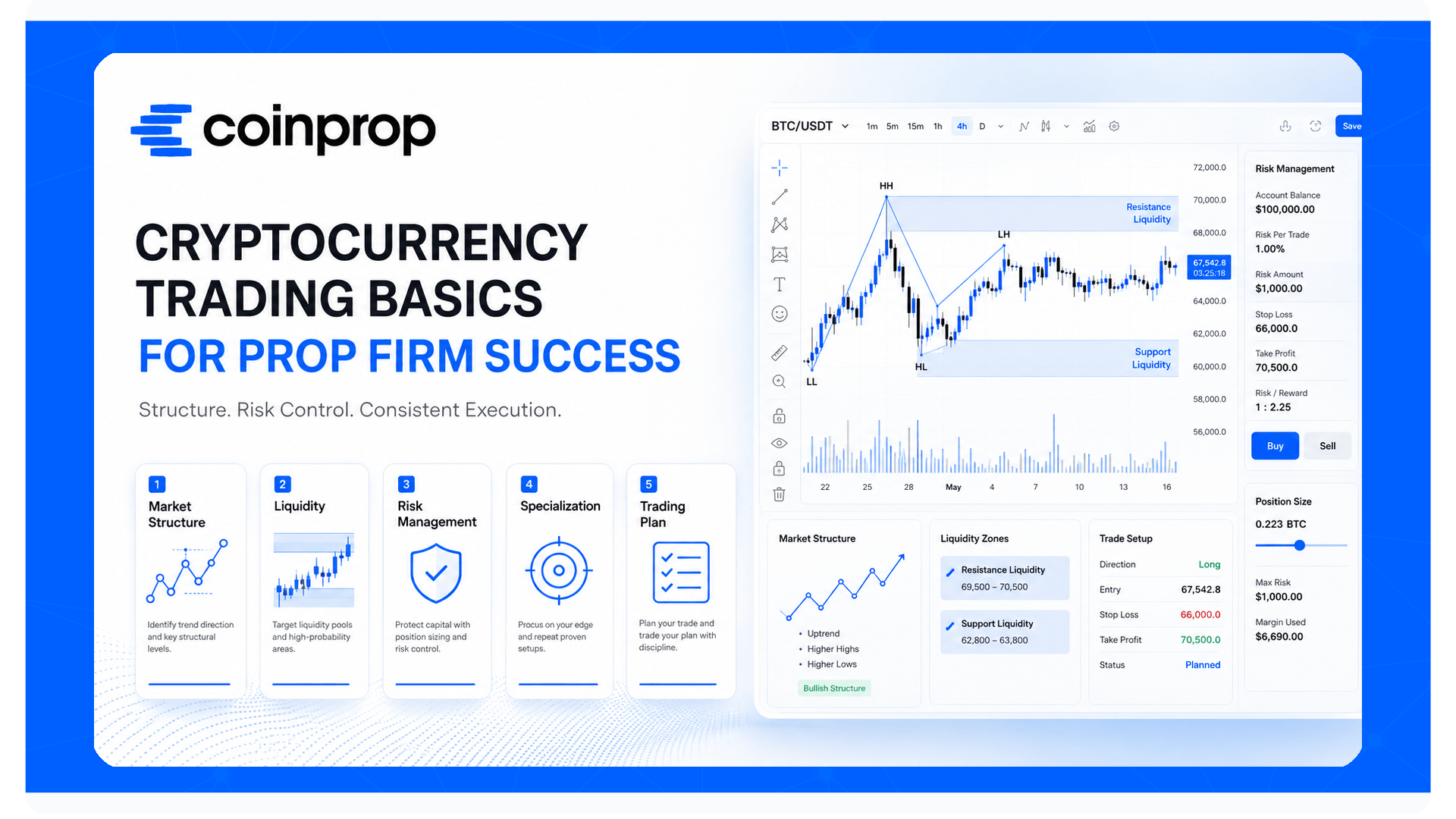
Learn How Liquidity Moves the Market
Professional traders don't simply react to candlestick patterns, they pay close attention to liquidity.
Price frequently moves toward areas where stop loss orders are concentrated, such as previous highs, previous lows, and well known support or resistance levels. These liquidity zones often create some of the highest probability trading opportunities.
Understanding liquidity is one of the reasons strategies like Liquidity Sweep Trading and ICT concepts have become increasingly popular among experienced crypto traders.
Risk Management Is More Important Than Strategy
One of the biggest misconceptions in trading is believing that a winning strategy alone guarantees success.
In reality, many funded traders maintain profitability with win rates below 50% because they consistently manage risk.
A trader risking only 0.5% to 1% per position with a favorable risk to reward ratio can remain profitable even after several consecutive losing trades.
This is particularly important in crypto prop firms, where violating daily or maximum drawdown limits usually results in an immediate challenge failure.
Focus on One Market and One Trading Style
Many beginners constantly switch between Bitcoin, Ethereum, meme coins, forex, and different trading styles.
Successful funded traders usually do the opposite.
Instead of chasing every market opportunity, they specialize in one or two instruments and master a single trading style, whether that's scalping, day trading, or swing trading.
Specialization improves pattern recognition, builds confidence, and creates the consistency that prop firms are looking for.
Build a Trading Plan Before Executing Any Strategy
Every professional trader follows a repeatable process before entering a position.
A basic trading plan should answer questions such as:
- Is the market trending or ranging?
- Where is the nearest liquidity zone?
- What is the exact entry trigger?
- Where will the stop loss be placed?
- Does the trade offer at least a 1:2 risk to reward ratio?
- Does this trade fit today's risk limits?
If you cannot answer these questions before entering a trade, the problem is usually not your strategy, it's your preparation.
Once these cryptocurrency trading basics become part of your routine, you'll be in a much better position to apply the strategies covered in the next sections. Whether you prefer swing trading, scalping, liquidity based setups, or trend following systems, strong fundamentals will always be the foundation of long term success in any crypto prop firm.
Most Profitable Prop Trading Strategies for Crypto Funded Traders
Crypto is a thrill ride. Every trader has a different style, from fast scalping to patient swing trading. But once you step into a crypto prop firm, the game changes completely. You are no longer trading in a personal account with unlimited flexibility. You are trading inside a structured, rule based environment where risk control matters just as much as profitability.
A strategy that works on a small personal account can fail quickly in a funded challenge if it depends on oversized risk, emotional execution, or inconsistent decision making. In this environment, the two lines that matter most are simple: daily drawdown and maximum overall drawdown. Cross either one, and the account is gone.
That is why the real challenge in prop trading is not just finding a setup that can make money. It is finding one that can hit profit targets while staying inside the rules of a funded evaluation.
The best strategies for crypto prop traders are built to do more with less damage. They focus on risk management, aiming to generate strong returns while staying well within drawdown limits. That balance is what separates a random trader from someone who can consistently pass challenges and remain funded over the long term. Understanding how crypto prop firms work can also help traders choose an environment that fits their trading style.
What Makes a Winning Strategy in a Crypto Prop Firm?
The strategies that consistently perform well in funded environments usually share three non negotiable traits.
High Entry Precision
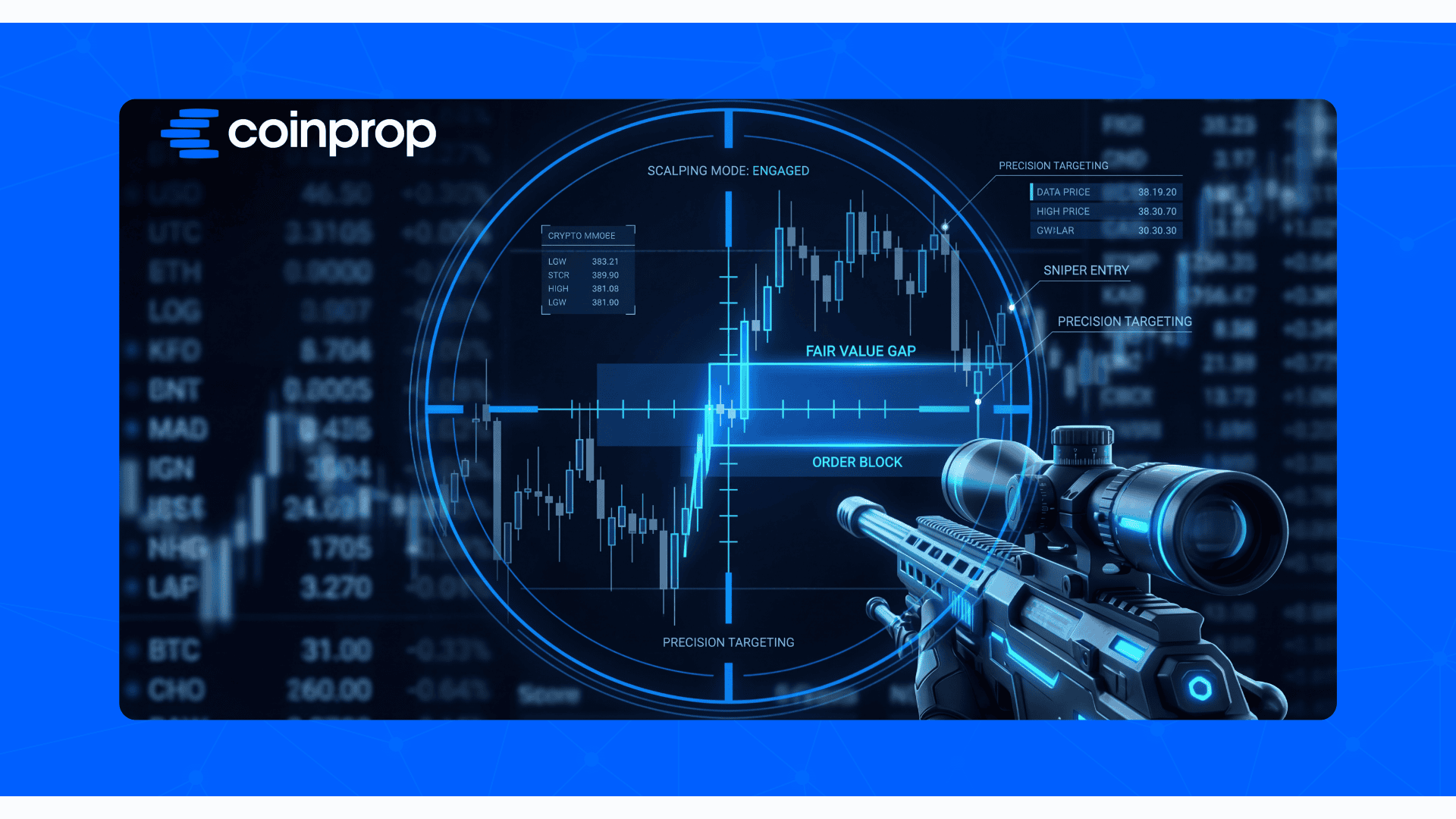
Once the analysis is there, the next step is turning that insight into high quality entries with favorable risk to reward.
This is where many traders lose their edge. A strong setup can still fail if execution is poor, entries are rushed, or position sizing is inconsistent. In crypto prop trading, where drawdown limits matter, precision becomes part of the strategy itself.
The goal is not to trade more. It is to enter better.
A profitable strategy often comes down to waiting for the right setup, taking fewer trades, and making sure each position has a clear structure behind it.
Strong Risk to Reward
In a drawdown based trading environment, risk to reward matters more than excitement. Tight stops and well timed entries allow traders to risk 0.5% to 1% in pursuit of 3R, 4R, or more.
A few high R:R wins can often do more for a funded account than dozens of average trades.
Repeatability
A profitable strategy is not just one that works once. It has to work repeatedly across different market conditions.
That means your edge should be:
- clearly defined
- backtested
- and simple enough to execute consistently
Repeatability is what turns trading from random performance into a professional process.
In this guide, we are focusing on strategies that check all three boxes. These are not flashy “get rich quick” ideas. They are practical, high probability approaches designed for traders who want to pass evaluations, protect capital, and build long term consistency.
Not every profitable trading style works inside a prop firm environment. Below, we’ll break down three of the most profitable strategies for funded traders, focusing on the setups that offer strong risk to reward, cleaner execution, and better compatibility with prop firm rules.
Liquidity Sweep Strategy
Liquidity sweep trading is one of the most powerful price action strategies used by modern traders , especially in fast moving markets like crypto. Instead of chasing breakouts or reacting emotionally to every candle, this strategy focuses on understanding where liquidity is hiding, why price moves toward it, and how to use those moves for high precision entries.
At its core, a liquidity sweep occurs when price temporarily pushes beyond a recent high or low to trigger a cluster of stop loss orders, breakout entries, or pending orders. Once that liquidity is “swept,” the market often reverses sharply, creating high probability trading opportunities for those who know how to read the setup.
This is exactly why liquidity sweeps are a cornerstone of smart money concepts and high risk to reward crypto strategies. They help traders avoid low quality entries, reduce unnecessary drawdown, and get positioned much closer to the real turning points of a move.
For funded traders and crypto prop firm participants, this precision is even more critical. In an environment where daily drawdown limits and strict risk rules determine success, every tick matters.
What Is a Liquidity Sweep in Trading?
A liquidity sweep is a deliberate price move that pushes above a recent high or below a recent low to grab resting orders. These orders typically include:
- Stop losses from existing positions
- Breakout entries expecting continuation
- Pending orders sitting at obvious support or resistance
- Weak handed retail positions clustered around visible levels
Once these orders are triggered, the market often gains the fuel it needs to either reverse aggressively or continue with stronger momentum. Experienced traders don’t just ask “Where is price going?” , they ask “Where is the liquidity?”
Why Liquidity Sweeps Happen
Markets need liquidity to move efficiently. Large players can’t enter or exit big positions without enough opposing orders. That’s why price is frequently drawn to obvious highs, lows, equal highs, equal lows, and clear breakout zones , areas where retail traders naturally place their stops and pending orders.
When price sweeps these zones, it usually does one of two things: reverses sharply after grabbing the liquidity, or uses it as fuel to push further. In crypto, the reversal setup is often the cleaner and more reliable one.
Why the Liquidity Sweep Strategy Works So Well
The liquidity sweep strategy works because it keeps you from entering at the worst possible time. Most losing traders buy after a breakout or sell after a breakdown , essentially stepping into liquidity. Smart liquidity traders do the opposite: they wait for the trap or stop hunt to happen first, then look for signs of reversal.
This approach delivers:
- Better entry prices
- Tighter, more logical stop losses
- Cleaner trade invalidation
- Stronger risk to reward ratios
- Fewer emotional, impulsive trades
How to Identify and Trade Liquidity Sweeps
The best setups form around obvious, highly visible levels such as previous swing highs and lows, equal highs/lows, session highs/lows, and round numbers.
A clean liquidity sweep setup usually includes four elements:
- A clear liquidity zone
- A decisive sweep beyond that level
- A strong rejection or behavioral shift afterward
- A well defined entry, stop, and target
Bullish Liquidity Sweep:
Price sweeps below a recent low, triggers sell side liquidity, then reverses upward aggressively.
Bearish Liquidity Sweep:
Price sweeps above a recent high, triggers buy side liquidity, then reverses downward.
Best Practices for Liquidity Sweep Trading
- Wait for confirmation (rejection candle, structure break, or reclaim) instead of jumping in on the sweep alone.
- Place stops just beyond the sweep extreme for logical invalidation.
- Take partial profits at 1R or 2R and trail the rest.
- Risk only 0.5–1% per trade and be highly selective.
For crypto prop traders, liquidity sweeps are especially powerful because they promote precision, discipline, and controlled drawdown , exactly what prop firms reward.

Order Block Trades
Order block trading is one of the most popular and effective smart money strategies in modern price action trading. In the fast moving world of crypto, where volatility is high and emotional entries often lead to traps, order blocks bring structure, precision, and logic back into the game.
Instead of chasing random breakouts or jumping in late after a move has already extended, order block trading focuses on identifying the exact price zones where strong institutional buying or selling likely started. These zones frequently act as high probability reaction areas, offering cleaner entries, tighter stops, and much better risk to reward setups.
That’s why order blocks have become a favorite among traders who focus on market structure, liquidity, and high probability crypto trading strategies.
For funded traders and crypto prop firm participants, this approach is especially valuable. In an environment where drawdown control, clean execution, and repeatable setups determine success, order blocks provide a practical and disciplined edge.
What Is an Order Block in Trading?
An order block is a specific price zone where large players (institutions or smart money) likely entered the market before a strong impulsive move occurred.
In simple terms, it is often the last opposing candle or small consolidation area right before a powerful directional move. These zones matter because they represent areas where significant accumulation or distribution took place.
- A bullish order block typically forms before a strong upward move.
- A bearish order block typically forms before a strong downward move.
When price later returns to these zones, traders watch closely for potential reactions, continuations, or reversals based on the broader market context.
Why Order Blocks Matter in Crypto Trading
Crypto moves fast and emotionally, which creates two big problems for most traders: entering too late after a move has already run, or getting caught in fakeouts and weak breakouts.
Order blocks help solve both issues. By waiting for price to return to zones where real institutional activity likely began, traders can plan higher quality setups with better structure and logic.
Key benefits in crypto:
- More logical and precise entry zones
- Reduced emotional chasing
- Better alignment with liquidity
- Tighter stop loss placement
- Naturally stronger risk to reward ratios
Why the Order Block Strategy Works
Markets rarely move in straight lines. Strong moves are often followed by pullbacks that revisit the areas where the original momentum started. Order block traders take advantage of this behavior by positioning themselves at these high probability zones instead of chasing price after it has already moved.
This approach allows traders to:
- Enter earlier with better prices
- Keep stops tighter and more logical
- Improve overall risk to reward
- Define clear invalidation levels
How to Identify an Order Block
A valid order block isn’t just any candle , it should be connected to a clear impulsive move and a shift in market behavior.
Look for the last opposing candle (or small cluster) right before a strong directional expansion. For example:
- Before a strong bullish move → mark the last significant bearish candle
- Before a strong bearish move → mark the last significant bullish candle
The strongest order blocks show clear displacement (strong momentum) away from the zone.
Bullish vs Bearish Order Blocks
Bullish Order Block: Forms before a strong upward move, usually as the last bearish candle or consolidation before price rallies. Traders look for long opportunities when price returns to this zone, especially in an uptrend or after a liquidity sweep.
Bearish Order Block: Forms before a strong downward move, typically as the last bullish candle before price drops. Traders look for short setups when price revisits the zone, ideally in a downtrend or after sweeping buy side liquidity.

How to Trade Order Blocks Effectively
Confirmation is key. The best setups combine the order block with:
- A liquidity sweep
- Rejection candles or engulfing patterns
- Break of Structure (BOS) or Change of Character (ChoCH)
Entry Methods:
- Confirmation Entry (most recommended): Wait for rejection or structure shift inside the zone
- Retest Entry: Wait for price to react and retest the level
- Limit Entry: Place orders directly in the zone (better for advanced traders)
Stop Loss Placement:
Usually just beyond the order block or the extreme of the reaction wick for clean invalidation.
Take Profit:
Target opposing liquidity, previous highs/lows, fair value gaps, or higher timeframe structure. Use partial profits at 1R–2R and trail the rest when possible.
Risk Management for Order Block Trading
Even strong setups can fail, so discipline is essential:
- Risk only 0.5%–1% per trade
- Be selective , not every zone is worth trading
- Focus on zones that showed real displacement
- Always size positions based on stop distance
Why Order Blocks Work Well for Crypto Prop Traders
Order blocks align perfectly with prop firm requirements. They promote tight drawdown control, strong risk to reward, fewer low quality trades, and disciplined execution , all while working across scalping, day trading, and swing trading styles.
Final Thoughts
Order block trading helps you move away from emotional candle chasing and toward professional level structure and precision. By focusing on zones where real money likely entered, you can achieve cleaner entries, better risk management, and more consistent results , especially important for funded traders in volatile crypto markets.
The goal isn’t to trade every order block you see. The goal is to wait for the ones that truly matter.
Break & Retest Setup
The Break & Retest setup is hands down one of the most reliable strategies used by successful funded traders in crypto. The concept is straightforward: when price breaks a significant support or resistance level, it very often comes back to retest that same level before continuing in the new direction. That retest is usually where the smartest entries happen.
Instead of chasing the initial breakout like most retail traders do, you simply wait for the market to prove the break is real. This approach gives you cleaner entries, much tighter stops, and far better risk to reward , which is exactly what you need when you're trading with prop firm capital.
Why Break & Retest Works So Well in Crypto
Crypto is full of fakeouts and liquidity grabs, especially around obvious levels. A clean retest helps filter out the noise and shows you whether the breakout has real strength behind it or if it was just a trap.
What makes this setup particularly powerful for prop traders is its structure. You get a clear zone to enter, a logical place for your stop loss, and often a very favorable reward relative to your risk. In a world where daily drawdown limits can end your challenge in seconds, having this kind of control is huge.
How a Typical Break & Retest Looks
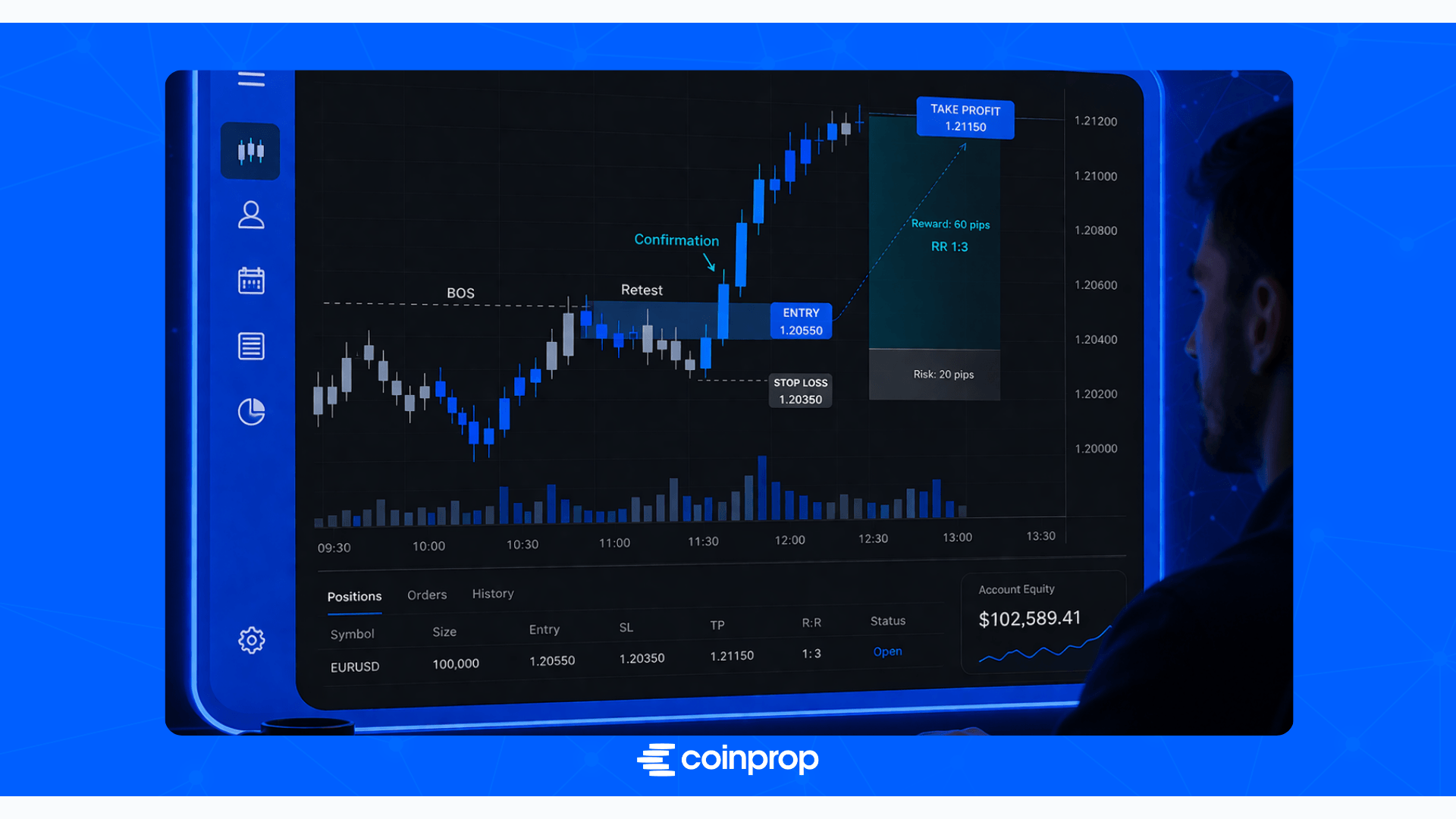
In a bullish Break & Retest, price breaks above resistance, pulls back to that same level (now acting as support), and then bounces higher.
In a bearish version, price breaks below support, retraces back up to test it as new resistance, and then rolls over.
The magic happens during that retest. Instead of buying the top of the breakout candle or selling the bottom of the breakdown, you're entering where the market has already shown it wants to respect the new level.
Best Way to Trade It
The strongest trades usually come when you wait for some confirmation on the retest , things like a rejection candle, a strong engulfing bar, or a clear shift in momentum on a lower timeframe. Jumping in the second price touches the level again can be dangerous. Giving it a moment to prove itself tends to pay off.
Your stop loss typically goes just beyond the retest zone, which keeps your risk tight and well defined. As for targets, you can aim for the next major structure level or previous swing points. Many of these setups naturally offer 1:2 or 1:3 risk to reward without forcing anything.
Why Prop Traders Love This Setup
This strategy fits prop firm trading like a glove because it encourages patience and discipline , two things that separate traders who pass challenges from those who blow up. It keeps you from chasing momentum and helps you stay within drawdown rules more easily.
You won’t be taking dozens of trades a day, but the ones you do take tend to be higher quality and easier to manage.
Final Thoughts
Break & Retest isn’t the flashiest strategy out there, but it’s one of the most consistent and repeatable ones, especially in crypto. If you're serious about building a prop trading edge that actually works under real pressure, this setup should definitely be in your toolbox.
Simple, logical, and effective , exactly what good trading is all about.
Common Trading Strategies Used in Crypto Prop Firms
Crypto prop trading is a whole different ballgame compared to personal accounts. It’s not just about making money,it’s about passing challenges, managing drawdowns, and staying consistently funded.
Choosing the right trading style can make all the difference. Some traders thrive on multi day setups with high probability swing trades. Others prefer the adrenaline of fast, precise scalping sessions. And some find balance in structured day trading, capturing short term moves while staying disciplined.
we’ll break down the three Common Trading Strategies approaches for crypto prop traders,swing trading, scalping, and day trading. You’ll learn how each style works, the best setups, risk management considerations, and which type of trader they’re best suited for.
Whether your goal is to master liquidity trading strategies, implement high probability swing trading strategies, or find the best scalping strategy for prop challenges, this guide gives you the framework to make smarter, more consistent decisions in a funded environment.
By understanding these three approaches, you’ll be able to pick a style that fits your personality, screen time, and risk tolerance,while staying aligned with prop firm rules.
Swing Trading in Prop Trading
Swing trading is one of the smartest and most sustainable ways to trade when you're trying to pass a prop firm challenge. Instead of getting caught up in all the noise on lower timeframes, swing traders focus on catching bigger moves that play out over several hours or even days. They pay attention to overall market structure, momentum shifts, and where liquidity is sitting.
This style is especially well suited for crypto prop trading because it naturally helps you avoid the two biggest account killers: overtrading and emotional decisions. With fewer trades, cleaner setups, and much better risk to reward ratios, swing trading gives you a calmer, more controlled path toward getting funded and staying funded.
Why Swing Trading Fits Prop Firms So Well
Prop firms reward discipline, patience, and risk control , and swing trading encourages exactly those qualities.
You’re not glued to the screen reacting to every little wiggle. Instead, you spend most of your time on higher timeframes where the real story of the market is much clearer. This reduces a ton of the random noise, fake breakouts, and liquidity grabs that destroy so many prop accounts on 5 minute or 15 minute charts.
Because you take fewer trades, you also dramatically lower the chance of unnecessary drawdown. One well structured swing setup with solid reasoning can often outperform ten rushed lower timeframe trades. That’s a massive advantage when you’re working with strict daily and overall drawdown limits.

The Core Advantages of Swing Trading in Crypto
What makes swing trading really shine is its simplicity and effectiveness:
Better Risk to Reward:
You’re usually aiming for larger moves, so it’s much easier to find setups where your potential reward is 2x or 3x your risk , sometimes even more.
Cleaner Price Action:
Higher timeframes filter out a lot of the chaos. Support and resistance levels, trend structure, and liquidity zones become much more reliable.
Less Emotional Pressure:
When you’re not constantly watching every candle, it’s easier to stay calm, stick to your plan, and avoid revenge trading or FOMO entries.
More Realistic for Real Life:
Many traders have jobs or other responsibilities. Swing trading doesn’t require you to stare at charts all day.
Key Swing Trading Concepts That Actually Work
The strongest swing traders don’t rely on complicated indicators. They build their edge around a few proven ideas:
Liquidity Based Swing Trading
They look for areas where stop losses and pending orders tend to cluster , previous swing highs and lows, equal highs/lows, and major structure levels. These zones often create high probability reactions or acceleration points.
Market Structure & Trend Continuation
Instead of trying to pick tops and bottoms, many swing traders simply trade in the direction of the dominant trend. They wait for healthy pullbacks into strong support (in uptrends) or resistance (in downtrends) and then ride the next leg higher or lower.
Smart Money & ICT Concepts
A lot of successful swing traders incorporate ideas like liquidity sweeps, order blocks, fair value gaps, break of structure (BOS), and change of character (ChoCH). When used on higher timeframes, these tools become even more powerful because you have more context.
Classic Support & Resistance
Sometimes the simplest setups are still the best , waiting for price to revisit a major level, show clear rejection or acceptance, and then trading the reaction.
Pros and Cons of Swing Trading for Prop Traders
The Good:
- Excellent risk to reward potential
- Fewer trades = less drawdown risk
- Lower stress and emotional fatigue
- More compatible with having a life outside trading
The Challenges:
- You need real patience , setups don’t come every hour
- Overnight and weekend volatility can sometimes shake you out temporarily
- Fewer opportunities mean you must be comfortable waiting for the right ones
Who Swing Trading Is Best For
This style is ideal if you:
- Prefer quality over quantity
- Don’t want to be chained to your screen all day
- Value structure and logic in your trading
- Have a full time job or other commitments
- Want a more sustainable, less stressful way to trade prop challenges
If you’re someone who gets bored easily and needs constant action, swing trading might feel too slow. But for disciplined, methodical traders, it’s often one of the most effective and long term profitable approaches in crypto prop trading.
Final Thoughts
At the end of the day, swing trading isn’t about being fancy or taking the most trades , it’s about being selective and letting the market come to you. When done right, it gives you cleaner entries, stronger risk management, and a much better shot at passing prop challenges and scaling your account.
Whether you combine it with liquidity concepts, ICT ideas, or simple market structure, the real secret is the same: patience, selectivity, and rock solid risk control.
In prop trading, the traders who ultimately succeed aren’t usually the ones taking the most trades. They’re the ones taking the right ones.
Scalping for Prop Accounts
Scalping is one of the fastest and most intense trading styles in crypto. While most traders are trying to catch bigger swings over hours or days, scalpers go after small, quick price moves that can play out in just minutes , sometimes even seconds.
When done right, scalping can be incredibly effective in a crypto prop firm environment. It gives you frequent opportunities, fast feedback, and the ability to stack small wins throughout the day. But it’s a double edged sword: the same speed and activity that creates opportunity also brings a lot of pressure, and one bad session can quickly eat into your drawdown limits.
Scalping rewards precision, lightning fast execution, and ice cold discipline. It punishes hesitation, sloppy entries, and emotional overtrading more than almost any other style.
Why Scalping Works Well in Crypto
Crypto is perfect for scalping because of its constant volatility and 24/7 nature. The market is always moving, creating short term imbalances, liquidity grabs, momentum bursts, and quick reversals that scalpers can exploit.
Unlike slower markets, crypto gives you real movement on very short timeframes. A well timed scalp can turn a tiny inefficiency into a solid win in just a few minutes. That constant activity is what draws many traders to scalping strategies in the first place.
However, success here depends heavily on execution. Because your targets are small, even a few ticks of slippage or a bad fill can ruin an otherwise good setup. That’s why top scalpers are obsessed with clean entries, tight stops, and trading only the highest probability moments.
The Best Scalping Approaches for Prop Traders
The strongest scalpers aren’t just fast , they’re selective. They don’t trade every wiggle on the chart. Instead, they look for short term setups that still have real structure behind them.
Here are some of the most effective scalping concepts used by successful crypto prop traders:
Liquidity Sweep Scalping
One of the cleanest and most reliable methods is trading short term liquidity sweeps. When price quickly raids a local high or low, triggers stops, and then sharply reverses, it often creates a high probability scalp with tight risk and fast follow through.
Breakout & Momentum Scalping
This involves watching short term ranges or compression zones and jumping on clean breakouts when momentum confirms. The key is not chasing the move late , the best entries usually come right as volume picks up and structure breaks in your favor.
Rejection & Pullback Scalping
Many experienced scalpers prefer waiting for pullbacks or retests instead of chasing breakouts. Retests of freshly broken levels, rejections from support/resistance, or small pullbacks into momentum zones often give cleaner entries and better risk control.
Tick Scalping / Micro Movement Trading
This is the most aggressive form , catching very small price ticks repeatedly. It requires razor sharp focus, excellent execution, and strict rules. It’s not for beginners, but skilled traders can make it highly efficient during high volatility periods.

Pros and Cons of Scalping in Prop Trading
The Upside:
- Plenty of trading opportunities throughout the day
- Fast feedback so you can improve quickly
- Ability to compound small wins and build momentum
- Works well in active, volatile market conditions
The Downside:
- Much higher emotional pressure and risk of overtrading
- Execution mistakes hurt more because targets are small
- Tighter stops mean less room for error
- It’s easy to turn a good system into a losing one by forcing too many trades
In a prop firm challenge, overtrading is often more dangerous than having too few trades. Many traders blow their accounts not because their scalping strategy is bad, but because they can’t stop taking marginal setups.
Who Scalping Is Best For
Scalping isn’t for everyone. It suits traders who:
- Thrive in fast paced environments
- Can make quick, decisive decisions without freezing
- Enjoy being actively engaged with the charts
- Have strong emotional control and discipline under pressure
- Can handle the mental fatigue that comes with many trades per session
If you prefer a calmer, more methodical approach with fewer decisions, swing trading or slower intraday styles will probably serve you better. Scalping demands focus and mental sharpness , if you don’t have that naturally, it can become exhausting very quickly.
Scalping can absolutely be one of the most profitable crypto trading strategies for the right prop trader. It offers speed, excitement, and the potential to grow an account faster than slower styles , but only if you treat it with serious discipline.
The real edge in scalping doesn’t come from taking more trades. It comes from taking better ones. Focus on high probability setups, protect your drawdown like it’s your last dollar, and never let speed replace structure.
When executed with patience and precision, scalping can be a powerful weapon in a funded trader’s arsenal. But if you let emotion or overtrading creep in, it can become one of the fastest ways to lose a prop account.
The choice is yours , just make sure the style matches who you really are as a trader.
Day Trading for Crypto Prop Firms
Day trading sits right in the sweet spot for many crypto prop traders. It gives you enough action and opportunities during the day without forcing you to hold positions overnight or react to every tiny tick like a pure scalper. You’re basically trading short term moves within a single session, which makes it easier to stay in control of your risk and your emotions.
In a prop firm environment, where daily drawdown limits, overall loss caps, and profit targets rule everything, day trading can be a really smart middle ground. You get enough setups to make meaningful progress, but you’re not exposed to the wild swings that can happen while you’re sleeping.
The real key isn’t trying to trade more , it’s trading with better intention and structure.
Why Day Trading Works So Well in Prop Challenges
One of the biggest advantages is that you close everything by the end of your session. No overnight gaps, no surprise weekend moves, and no waking up to a nasty drawdown because of news you didn’t see coming. That peace of mind alone makes day trading attractive for funded traders.
It also forces a certain level of routine. You pick your trading hours, focus on specific market sessions, and develop a clear process. That structure helps reduce impulsive decisions and keeps you from falling into the “I have to be in a trade all the time” trap that destroys so many prop accounts.
Plus, it’s much easier to align with prop firm rules. You can decide in advance how many trades you’ll take, how much risk you’ll put on each setup, and when you’ll walk away for the day.
Popular Day Trading Setups That Actually Work in Crypto
The best day trading strategies in crypto are usually simple, repeatable, and built around how the market really moves.

Opening Range Breakout
Many day traders start by marking the high and low of the first hour or two of their session. Once price breaks out of that range with conviction, it often leads to a strong directional move. The setup is clean, easy to define risk on, and works especially well when you see strong volume behind the breakout.
Gap and Go Trading Strategy
Sometimes price gaps sharply away from a key level and just keeps running. When this happens with real momentum and volume, it can create nice continuation trades. The trick is not to chase the first explosive move , wait for a small pullback or consolidation, then join the trend if it still looks strong.
Volume Trading Strategy
Volume is a big tell in crypto day trading. A breakout or reversal that happens on expanding volume usually carries more weight than one on low volume. Watching how volume behaves around important levels (support, resistance, or liquidity zones) helps separate real moves from fakeouts.
Liquidity Sweep Reversal
This is one of my favorite intraday setups in crypto. Price raids a local high or low, grabs stops, and then quickly reverses. These moves often create sharp reactions with tight risk and decent reward. If you combine it with a clear rejection candle or structure shift, the probability goes up nicely.
Weekend trading is also possible in crypto since the market never sleeps, but most prop traders treat weekends as lower priority sessions. Liquidity is thinner, moves can be erratic, and fakeouts are more common , so selectivity becomes even more important.
Pros and Cons of Day Trading in Prop Firms
The Good:
- You avoid overnight risk completely
- More opportunities than swing trading, but less chaos than scalping
- Easier to build a consistent daily routine
- Gives you a good balance of action and control
The Challenges:
- Performance still depends heavily on choosing the right trading hours
- You can still fall into overtrading if you sit in front of the chart too long
- Requires solid timing and execution , sloppy entries hurt more than in swing trading
Who Day Trading Is Best For
Day trading tends to suit traders who like having a clear structure to their day. If you prefer trading during set hours, closing positions before bed, and having a rhythm to your routine, this style often feels very natural.
It’s also a great fit if you want more activity than swing trading but aren’t comfortable with the extreme speed and screen time that scalping demands. Many traders who have jobs or other responsibilities during the day still make day trading work by focusing on high liquidity sessions (like London or New York overlap).
Day trading can be one of the most practical and balanced approaches for crypto prop traders. It gives you enough movement to grow your account while keeping risk manageable and overnight exposure to a minimum.
The traders who do best with it aren’t the ones constantly jumping in and out of the market. They’re the ones who wait for clean, high probability setups, manage their risk tightly, and know when to step away.
At the end of the day, prop trading success isn’t about how many trades you take , it’s about how well you take the ones that actually matter. Day trading, when done with discipline and intention, gives you a solid framework to do exactly that.
News Catalyst & Weekend Gaps
Some of the biggest moves in crypto happen around events most traders ignore. These two high volatility strategies, Weekend Gaps and news catalysts, can deliver monster R:R, but they demand tight discipline to stay inside prop drawdown limits.
Weekend Gap Strategy
Every Friday, the CME Bitcoin futures market closes while the rest of crypto keeps trading all weekend. When it reopens Sunday evening, price often gaps sharply from Friday’s close. These gaps have a strong tendency to fill because of institutional psychology and liquidity flows.

How to Trade It on CoinProp
CPX uses Bybit data, which runs 24/7, so you won’t see the gap on your main chart. That’s actually good, no fake candle clutter.
Step 1: Open CME Bitcoin futures chart on TradingView (free). Spot the gap between Friday close and Sunday open.
Step 2: Never jump in the second the gap appears. Wait for price to sweep liquidity in the opposite direction first (classic fakeout), then look for your usual confirmation, ChoCH break, Order Block, or Liquidity Sweep reversal, pointing toward gap fill.
Step 3: Enter small (0.3–0.5% risk max). These moves are explosive, so tight size keeps daily drawdown safe. Target the gap fill zone; partial exits at 50% fill, then move your stop-loss up by hand on the rest.
Pro tip: CME gaps act like magnets for the entire crypto market. Even though your CPX chart doesn’t show the gap, price still respects it. Use it as a high probability target or extra confluence for your regular setups.
Why it works in props
One or two gap fill trades can knock out half your profit target in a single weekend. High reward, controlled risk, low trade count, perfect for passing challenges fast. Master gaps as confirmation, not blind entries.
News Trading Strategy in Crypto (High Risk, High Reward)
Crypto isn’t like stocks, unique fundamental events can ignite massive volatility overnight. Think ETF approvals, major airdrops, network upgrades, or landmark court rulings (like SEC vs. Ripple). These catalysts create explosive opportunities, but they’re also drawdown magnets if you play them wrong.
The Forbidden Approach: Gambling on Rumors
Jumping in on speculation before the news drops is pure gambling. Price whipsaws violently on leaks or rumors, triggering stops left and right. In prop trading, that’s a quick way to torch your daily drawdown on noise alone. Stay out.
The Smart Approach: Trading the Post News Volatility
Pros wait for clarity, then strike.
Step 1: Sit on your hands during the initial chaos. News hits, price spikes both ways, sweeping liquidity and trapping early chasers. That’s the market hunting stops, don’t be the prey.
Step 2: Enter after the dust settles. Once the initial frenzy calms and the real direction emerges from the news impact, look for your edge. The best play? Use the Liquidity Sweep model: price wicks hard one way (grabbing stops), then reverses sharply. Enter on the reversal side after a clean ChoCH or Order Block confirmation.
This puts you on the actual trend fueled by the catalyst, not the fakeout.
Risk Management: Size Small, Survive Big
These trades are rocket fuel, huge potential reward, but insane volatility. Cut position size way down (0.3–0.5% risk max). Tight stops behind the sweep wick, scale out fast on the first leg, and trail the runner.
One or two well timed catalyst plays can smash half your profit target in hours. But over size or chase the news dump, and daily drawdown ends your run.
Catalysts aren’t for every day. Save them for big events, trade them disciplined, and let the volatility work for you, not against you. High risk, massive reward, when you play it right.
Ready to move beyond theory and actually pass funded crypto prop challenges? The fastest path depends on your experience, risk appetite, and how much time you can commit.
Here’s your roadmap to action:
- Strategies for Beginners , Simple, reliable methods that teach the ropes while keeping losses in check.
- Advanced Strategies for Pro Crypto Fund Traders , Precision entries, liquidity plays, and structure based setups for serious edge.
- High Leverage Trading Strategies , Amplify returns without blowing your account.
Pick your path, follow it carefully, and start turning prop firm challenges into consistent wins.

Strategies for Beginners crypto prop trader
Starting out in crypto prop trading can feel intimidating. There are so many charts, terms, and opinions floating around that it’s easy to overthink everything and freeze up.
The good news? You don’t need complicated strategies to get started , and in many cases, the simpler you keep it, the better your chances of passing a challenge. Most successful beginners succeed not because they have fancy systems, but because they focus on clear setups, solid risk control, and staying consistent.
In this guide, we’ll walk through some genuinely beginner friendly strategies that work well in prop firm environments. We’ll cover the core ideas, how to actually use them, and why keeping things straightforward often gives you the biggest edge.
Why Keeping It Simple Is Your Best Move
New traders often fall into the trap of thinking “more complicated = more professional.” In reality, complex strategies usually lead to hesitation, confusion, and broken rules when the market gets volatile.
Simple strategies win in prop trading for three main reasons:
- They’re much easier to follow under pressure
- They make risk management straightforward
- They help you build real confidence faster
When your trading plan is clear, you’re far less likely to make emotional decisions that blow up your drawdown.
The Best Setups for Beginners
As a new prop trader, stick to setups you can recognize quickly and explain in one sentence. Here are three of the most reliable ones:
- Support and Resistance Reactions: Price hitting a clear level and bouncing or rejecting
- Trend Pullbacks: Waiting for price to retrace in the direction of the main trend before jumping in
- Break & Retest: When price breaks a level, comes back to test it, and then continues
These setups are visual, logical, and don’t require a dozen indicators to confirm.
Support & Resistance , Your Starting Point
Think of support and resistance as the floor and ceiling of the market. These are zones where price has reacted strongly in the past.
Start on higher timeframes (1H or 4H) to find the most important levels. Then drop down to your trading timeframe and look for clear reactions , long wicks, strong candles, or price stalling exactly at the level.
The beauty of support and resistance is that it works whether you’re swing trading, day trading, or even doing light scalping. It’s one of the few tools that truly grows with you as you improve.
Trend Pullbacks , Entering Trades the Smart Way
Chasing price when it’s already running is one of the fastest ways to get burned. A much safer approach is waiting for a pullback.
In an uptrend, look for price to dip back toward support. In a downtrend, watch for bounces into resistance. This gives you a better price, tighter stop, and stronger reward to risk ratio.
Add a simple confirmation (like a rejection candle or a small base) and you have a clean, beginner friendly setup that respects prop firm risk rules.
Risk Management , The Part You Can’t Skip
Even the best looking setup can go wrong. That’s why risk management is non negotiable for beginners:
- Risk no more than 0.5–1% of your account per trade
- Always know exactly where your stop goes before you enter
- Never let one trade threaten your daily or overall drawdown limit
Your early goal isn’t to be right all the time , it’s to survive long enough to get consistently good.
Who These Strategies Are For
These simple approaches work best for:
- Complete beginners in crypto or prop trading
- Traders who want clear, easy to follow rules
- People who prefer steady progress over chasing excitement
If you’re someone who gets overwhelmed easily or doesn’t want to stare at charts all day, starting with these basics will help you build confidence without burning out.
You don’t need to master every indicator or learn complicated concepts to do well in crypto prop trading. Starting with simple support and resistance, trend pullbacks, and clean risk management gives most beginners the strongest foundation possible.
Stay patient, trade small, and focus on consistency rather than quick wins. Once these basics feel natural, you’ll have a solid base to build on , whether you eventually move into more advanced strategies or stick with what works.
The traders who pass challenges and stay funded aren’t usually the smartest ones in the room. They’re usually the ones who keep it simple and stick to their plan.
Advanced Strategies for Pro Crypto Fund Traders
Once you’ve nailed the basics and proven you can pass a prop challenge, the next step is moving beyond simple setups into more refined, high precision strategies. Professional crypto prop traders don’t just follow price , they anticipate where the market is likely to go by reading liquidity, structure, and smart money behavior.
These advanced techniques aren’t about being flashy or taking more trades. They’re about finding higher quality setups with better risk to reward, while still respecting strict prop firm rules on drawdown and risk.
Why Advanced Strategies Make a Difference
Beginner strategies help you survive and pass the challenge. Advanced strategies help you scale your account and trade like a pro. The focus shifts from simply “not losing” to consistently finding edges that offer strong reward with controlled risk.
The best pro traders rely on concepts like liquidity pools, break of structure, order blocks, and structure based entries. When used correctly, these tools give you cleaner entries, tighter risk, and more repeatable results across different market conditions.
Liquidity Targeting , Trading Where the Stops Are
Smart money doesn’t move randomly. It often hunts liquidity , the areas where clusters of stop loss orders and pending entries sit. Professional traders watch these zones closely because the market tends to react sharply once that liquidity is taken.
Instead of chasing price, they wait for the sweep, look for confirmation (such as a strong rejection or shift in momentum), and then enter with tight stops just beyond the liquidity level. This approach often produces high probability trades with excellent reward to risk ratios, which is exactly what funded accounts reward.
Break of Structure (BOS) Entries
A Break of Structure happens when price clearly shifts from one trend to another by breaking a previous swing high or low. For pro traders, BOS is a powerful signal that momentum is changing direction.
Rather than jumping in immediately, experienced traders wait for confirmation , often through volume, lower timeframe alignment, or a retest of the broken level. When everything lines up, BOS entries can offer some of the cleanest and highest R:R setups in prop trading.
Order Block Trades , Entering Where Institutions Likely Did
Order blocks are the zones where large players probably accumulated or distributed their positions before a strong move. These areas act like magnets for future price reactions.
Pro traders look for order blocks that align with the overall trend, then wait for price to return to the zone and show clear intent (rejection, engulfing candle, or structure shift). Because these entries are so precise, they usually allow for tight stops and strong profit potential while keeping drawdown risk low.
Structure Based Entries , Putting It All Together
The most advanced traders don’t rely on any single tool. They combine liquidity, order blocks, BOS, and overall market structure to create high conviction setups.
Instead of forcing trades, they wait for the market to show multiple layers of confirmation. This patient, context driven approach leads to fewer trades, but much higher quality ones , the exact formula that helps traders consistently scale their funded accounts.
Who These Strategies Are For
These advanced methods are best suited for traders who have already mastered the basics, are comfortable reading multiple timeframes, and understand the importance of discipline in a prop environment.
If you’re looking to move beyond basic support and resistance and want to trade with more precision and higher reward to risk, learning liquidity targeting, BOS, and order blocks can take your prop trading to the next level.
The goal isn’t to complicate your chart. The goal is to develop a clear edge that respects prop firm rules while giving you the best chance to grow your account over time.
High Leverage Trading Strategies for Funded Crypto Accounts
Trading with high leverage in crypto can dramatically boost your profits , but it can also wipe out your account in minutes if you’re not careful. For funded prop traders, using high leverage isn’t about taking big reckless bets. It’s about being extremely precise, disciplined, and fully aligned with prop firm rules.
Before applying high leverage strategies, it’s important to understand how risk behaves in funded environments. In fact, our analysis of high leverage crypto prop firm models shows that most successful traders only use leverage in very specific, high-conviction setups rather than across all trades.
The best traders treat leverage as a tool, not a thrill ride. They only apply it to their highest quality setups where the risk is clearly defined and the potential reward is significantly larger than the risk.
Why High Leverage Requires a Different Mindset in Prop Trading
Prop firms have strict daily and overall drawdown limits, so one bad leveraged trade can end your challenge instantly. That’s why experienced funded traders are very selective. They don’t use high leverage on every setup , they save it for moments when everything lines up: clean market structure, strong liquidity signals, and excellent risk to reward.
The goal is simple: amplify winning trades without putting the entire account at unnecessary risk.
Core Principles for Trading High Leverage Safely
Before you even think about increasing leverage, you need three things in place:
First, your entry must be high probability. This usually means waiting for liquidity sweeps, order blocks, or clear breaks of structure (BOS) with confirmation.
Second, your risk to reward needs to be strongly in your favor , ideally 1:3 or better. With leverage, even a small edge becomes powerful, but only if your winners are significantly larger than your losers.
Third, your trade management has to be sharp. This includes tight stops, partial profit taking, and the discipline to cut losses quickly when the setup fails.
High leverage magnifies both gains and mistakes, so emotional control becomes even more important.
High Leverage Strategies That Work Well in Prop Accounts
Here are three advanced approaches that many successful funded traders use:
Liquidity Sweep with Leverage
When price raids a cluster of stops (above a recent high or below a recent low) and then sharply reverses, it often creates a fast, high momentum move. Pro traders wait for that reversal confirmation and then apply leverage to ride the reaction. Because the invalidation point is usually very clear (just beyond the sweep), the risk stays controlled while the upside can be substantial.
Break of Structure (BOS) with Leverage
A clean break of a previous swing high or low signals that momentum is shifting. When this happens with volume and higher timeframe alignment, many traders add leverage to capitalize on the new trend direction. The key is not jumping in at the exact moment of the break, but waiting for a retest or confirmation before going in heavy.
Order Block Entries with Leverage
Order blocks represent zones where institutions likely built their positions. When price returns to a strong order block in line with the overall trend, it can offer one of the most precise entries in the market. Experienced traders sometimes increase leverage here because the setup is so well defined, allowing for tight stops and excellent reward potential.
Who Should Trade with High Leverage?
High leverage strategies are best suited for traders who:
- Already have a proven track record of consistency in prop challenges
- Can read market structure and liquidity confidently across multiple timeframes
- Have strong emotional discipline and never risk more than their prop rules allow
If you’re still working on mastering basic risk management or tend to get emotional during volatile moves, it’s usually smarter to keep leverage low until your execution becomes rock solid.
High leverage trading in crypto prop accounts isn’t about gambling or trying to get rich overnight. It’s about taking calculated, high conviction setups and letting leverage work in your favor while strictly protecting your downside.
When used with precision, proper structure, and iron clad risk rules, high leverage can become a powerful way to scale your funded account faster. But remember , the market doesn’t care how much leverage you’re using. The traders who succeed long term are the ones who respect risk above everything else.
Smart Money Concepts, The Core of Prop Strategy
The smartest strategies for surviving crypto prop challenges all boil down to one truth: crypto’s wild swings are driven by big players (Smart Money) hunting retail liquidity. To crush challenges, your setup has to deliver pinpoint precision entries and monster risk reward ratios while staying miles away from drawdown limits.
These strategies let you move in sync with the real intent behind price, turning prop rules from enemies into allies.
Structure Breaking Strategy: ChoCH and BOS
This is step one for any pro. You don’t guess direction, you wait for the market to prove it with clear structural breaks.
Change of Character (ChoCH) happens when price hits a key level and breaks the last local structure against the current flow on your execution timeframe (like 5M or 1M). It’s the first hint the tide might be turning, signaling a fresh opportunity brewing.
Break of Structure (BOS) seals the deal: after ChoCH, price prints a new high or low in your bias direction. That’s the market shouting the new trend is legit and has legs.
Key insight: these breaks mark the turning points where you start hunting Order Blocks or FVGs for the actual entry. No premature jumps,just cold, hard evidence.
Hunter Strategy: Order Block and FVG Models
These are the heart of high R:R setups in crypto props because they give you the tightest stops imaginable.
Order Blocks are the last big candles before explosive moves, footprints of heavy institutional orders. You enter on mitigation (retest) of that block. Stop goes just behind it, letting you risk tiny amounts for 1:4 or better rewards.
Fair Value Gaps (FVGs) are those three candle price imbalances where the market moved so fast it skipped fair pricing. Price loves returning to fill them. Entering an FVG is one of the cleanest ways to snag massive R:R with minimal exposure.
Filter Strategy: Liquidity Sweep
This acts as your final gatekeeper, slashing the risk of falling for traps.
In crypto, fakeouts and whips are designed to raid retail stops. The play: never enter on the initial break. Wait for price to wick through obvious highs/lows (sweeping liquidity) and snap back fast.
Your real entry only triggers after the reversal ChoCH on the lower timeframe, ideally into a fresh Order Block formed post sweep. You’re now riding the true move, right after smart money finished trapping the crowd.
Combine structure for bias, Order Blocks/FVGs for precision, and Sweeps for confirmation, and you’ve got a strategy that prints high R:R trades without ever flirting with drawdown death. Trade with the big players, not against them. That’s how prop challenges turn into funded reality.
Comparing Prop Trading Strategies : Which One Fits You?
Not every trading style works the same way in crypto prop trading. What feels comfortable for one trader can be stressful and ineffective for another. The key is finding the approach that matches your personality, how much time you can dedicate, and how you handle risk and pressure.
Here’s a clear, honest comparison between the three most common styles , Swing Trading, Scalping, and Day Trading , to help you figure out which one suits you best in a prop firm environment.
Swing Trading vs Scalping in Prop Trading
Swing trading and scalping sit at opposite ends of the spectrum.
Swing traders look for bigger moves that unfold over several hours or days. They spend less time in front of the screen, focus on higher timeframes, and usually aim for larger risk to reward ratios. This style rewards patience and the ability to let trades breathe without constant monitoring.
Scalping, on the other hand, is fast and intense. You’re trading tiny price movements on very short timeframes (1 minute or 5 minute charts), often entering and exiting within minutes. It requires sharp focus, quick decision making, and the ability to stay calm when the market is moving rapidly. While scalping can generate many opportunities in a single session, it also demands tighter stops and much higher emotional discipline.
In short: Swing trading is calmer and more strategic, while scalping is high energy and execution heavy.
Scalping vs Day Trading for Crypto Prop Traders
Both are short term styles, but they feel quite different in practice.
Scalping is all about speed and micro moves. You’re constantly watching for small inefficiencies and need near perfect execution. It’s high intensity and usually requires your full attention throughout the trading session.
Day trading sits somewhere in the middle. You still trade within the same day and close all positions before the session ends, but you work with slightly bigger moves and more structured setups. Day traders often focus on specific sessions (like London or New York open), use clearer levels, and generally have more time to analyze before pulling the trigger.
If you enjoy fast action and can handle constant decision making, scalping might suit you. If you prefer more breathing room and structured sessions without the extreme intensity of scalping, day trading is often a better fit.
Best Trading Style for Prop Firm Challenges
There’s no single “best” strategy , it really depends on who you are as a trader:
- If you’re patient, like working with clean charts, and don’t want to be glued to the screen all day, swing trading is usually the most comfortable and sustainable choice.
- If you thrive on speed, enjoy high intensity trading, and can stay focused for long stretches, scalping can be very rewarding (but it’s also the most mentally demanding).
- If you want a good balance between activity and structure, and prefer closing positions by the end of the day, day trading often feels like the sweet spot for many prop traders.
Other important factors to consider:
- How much screen time you realistically have
- How well you handle volatility and fast price swings
- Whether you prefer fewer high quality trades or more frequent opportunities
- How much emotional pressure you can manage under prop firm drawdown rules
Final Takeaway: Choosing the Right Strategy
The most successful prop traders aren’t necessarily the ones using the most advanced strategy. They’re the ones who picked a style that fits their personality and can execute it consistently while respecting the firm’s risk rules.
Take time to honestly assess your strengths, lifestyle, and risk tolerance. The right strategy should feel natural , not forced. When your trading style matches who you are, staying disciplined and passing challenges becomes much easier.
Position Management Strategies to Protect Prop Firm Capital
The sharpest crypto prop traders don’t stop at a perfect entry. Once confirmed and in the trade, they shift focus to protecting capital and squeezing every bit of profit. These techniques are built to beat fear, lock gains, and keep drawdown in check.
Breakeven Strategy (Risk-Free Trade Management)
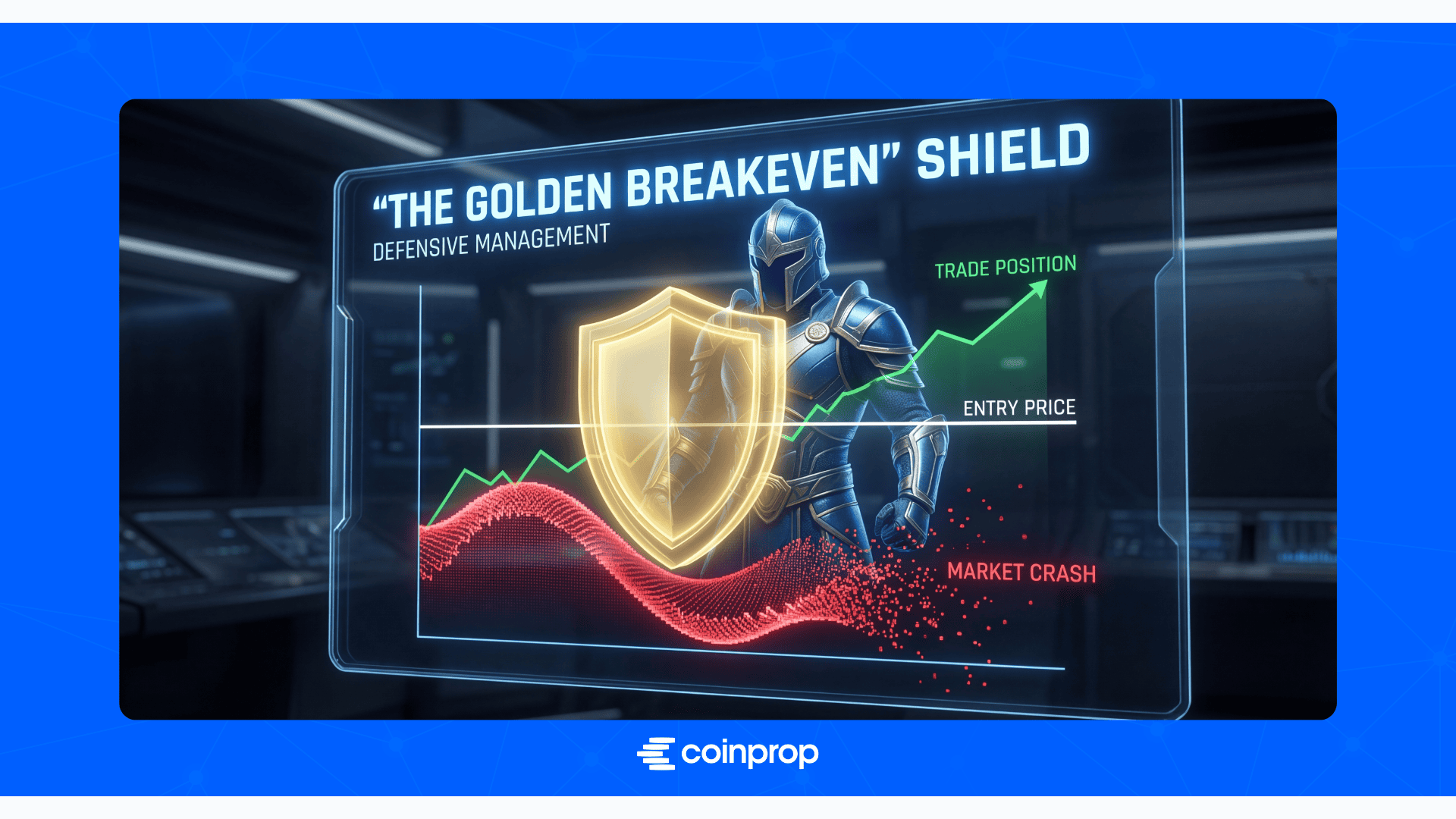
This is your ultimate defensive play. The goal is simple: turn a winning trade risk free the moment it proves itself.
As soon as the trade hits 1R profit (your initial risk amount matched in gains), move the stop loss to entry price, or just above to cover fees.
Why it’s huge in props: the trade is now mathematically zero risk. A reversal can’t hurt you. This keeps daily drawdown safe, kills the pressure of “must hit target,” and lets you think clear instead of panicking over open profit.
Scaling Strategy (Partial Profit Taking Technique)
Crypto loves explosive pumps. Dumping the entire position at one fixed target often leaves massive upside on the table.
Pros use multi level targets, like TP1 at 2R and TP2 at 4R.
At TP1, close the bulk (say 70%) to bank solid gains. Leave the runner (30%) with stop at breakeven.
The magic: you secure profit early while staying in for those sudden moons or extended trends. Partial exits need platform support for precise percentage closes, like what CPX delivers seamlessly.
Trailing Stop Strategy for Trend Protection
When a trade turns into a real runner, trailing the stop is how you ride it without giving everything back.
After hitting decent profit (around 2R), trail the stop manually or automatically under recent swing lows/highs, always locking in more as price moves your way.
In crypto’s sharp reversals, this guarantees you exit with profit even if the top blows out. No more watching big winners flip to breakeven or worse.
These three, quick breakeven, smart scaling, and trailing, turn good entries into consistent, low stress payouts. Protect first. Maximize second. That’s how pros stay funded long term.

Alternative Trading Strategies for Crypto Prop Traders
When the market isn’t serving up clean liquidity setups like Order Blocks or Sweeps, or volatility is just too wild for complex models, falling back on simpler, high discipline strategies keeps you in the game without forcing bad trades.
Break & Retest, The Simple & Reliable Classic
This is one of the oldest, most trustworthy setups out there, built on pure crowd psychology and role reversal of key levels.
The core idea: once a strong support or resistance level breaks convincingly, it flips roles, resistance becomes support, support becomes resistance.
How to Run It in Prop Crypto
Step 1: Spot a clear S/R zone on your execution timeframe (like H1 or M30). Look for levels that have held multiple times.
Step 2: Wait for a decisive break, a full body candle close beyond the level, not just a wick tease.
Step 3 (Entry): Never chase the break. Sit tight for the pullback. Price almost always retests the broken level. Your trigger is a strong reversal candle there, like a pin bar or engulfing showing rejection.
Risk management: Place your tight stop just beyond the reversal candle and the retest zone. Reward targets at the next logical swing or measured move.
Why It Crushes in Props
This setup gives you crystal clear invalidation. Stops are naturally tight, R:R easily hits 1:2 or 1:3, and the simplicity cuts mental noise, no overthinking or forcing entries in chop.
You’re trading proven psychology, not hoping for perfect liquidity sweeps. Fewer setups, but higher quality. Daily drawdown stays safe because you’re only in when the market hands you confirmation.
It’s not flashy, but it’s repeatable across any condition. When the fancy stuff isn’t lining up, Break & Retest keeps the wins coming without bending your rules. Sometimes simple is the ultimate edge. Stay patient. Trade clean. Fund faster.

Smart Strategy: Correlation Trading
In crypto, everything orbits Bitcoin. That tight bond isn’t just background noise, it’s one of the most powerful filters pros use to supercharge entry confirmation. Correlation trading turns Bitcoin’s behavior into your final green light, slashing risky trades and stacking the odds massively in your favor.
How Correlation Works in Crypto Prop
The mechanism is dead simple: major alts (ETH, BNB, SOL) and even Bitcoin itself move in strong harmony with BTC price action. When they don’t align, it’s usually a red flag.
Running It in Prop Challenges
Step 1: Pick your trade on a high volatility altcoin, these give bigger reward potential while still respecting drawdown limits.
Step 2: Wait for your main strategy confirmation on the alt, like a clean Order Block retest or FVG entry with Liquidity Sweep.
Step 3: Final filter, flip to Bitcoin’s chart right before you click buy/sell. Check if BTC is doing the same thing: testing a strong support zone, printing a bullish reversal candle, or holding above key structure. If yes, your alt entry just got triple confirmed. If BTC is diverging (weakening while your alt looks strong), walk away, no trade.
Why It’s a Prop Game Changer
This alignment filter skyrockets your confidence and cuts false entries in half. You’re only pulling the trigger when two independent assets scream the same direction at the exact same time. That confluence means higher probability setups, tighter effective risk, and smoother equity curves.
In prop rules, where one bad trade can end your run, correlation trading acts like an extra layer of armor. Fewer trades, but the ones you take are bulletproof.
It’s not complicated, it’s smart. Trade with the king (BTC) on your side, not against it. Your entries get stronger, your drawdown stays safe, and funding comes faster. Correlation isn’t just a tool. It’s your secret co pilot.
Range & Breakout Strategies for crypto Prop Trader
Crypto’s volatility means the market flips between quiet ranges and sudden breakouts. Smart funded traders know the difference, and how to trade both without getting trapped.
Range Trading: The Boring (But Profitable) Trap
Ranges happen when price bounces between clear support and resistance without strong direction. It looks dull, but it’s gold if you play it right.
Smart entry: Don’t guess the middle. Hunt reversals only at the edges. Best confirmations come from strong reversal patterns or, better yet, an Order Block or FVG forming right in the range boundary.
Risk management: Tight stop just beyond the range edge. Target the opposite side for solid R:R (usually 1:1.5 to 1:2). You’re banking on mean reversion, not chasing trends.
This keeps trades low stress and drawdown minimal, perfect for grinding steady gains while waiting for bigger moves.
Breakout Trading: Hunting Liquidity Without Getting Hunted
Breakouts look exciting, but crypto loves fakeouts. Most breaks are just liquidity grabs designed to trap early chasers.
Smart entry: Never buy the initial break. Pros wait for the real intent to show.
Liquidity Sweep first: Price often spikes through the level to raid stops, then snaps back. That’s the trap completing.
Break & Retest is your green light: After the sweep, wait for price to pull back and retest the broken level as new support/resistance. Enter on confirmation there, pin bar, engulfing, or fresh Order Block.
Risk management: Stop goes just behind the retest zone. Reward targets the next logical swing or measured move. R:R stays strong because you’re entering after the fakeout dust settles.
This filters the garbage breaks and puts you on the real trend, fewer trades, but the ones that run hard.
Range trading grinds consistency. Breakout trading catches the big swings.
Blend them with your core liquidity setups, and you’re ready for anything crypto throws. No forcing, no chasing, just disciplined, high probability plays that respect prop rules. Trade the market’s mood. Stay alive. Stack wins.
Pattern Based Strategies
Price and candlestick patterns are basically visual snapshots of crowd psychology, the simplest technical tools out there. But in the high volatility, high stakes world of crypto prop trading, relying on them alone is a fast way to burn drawdown.
The Main Challenges with Patterns in Crypto Props
Patterns run into two big problems under prop rules.
Lagging confirmation hits hard. Many classic formations, like head and shoulders or triangles, only signal entry after they’re fully formed. By then, the bulk of the move is already gone, and your stop has to be huge to give it room. That wide stop tanks your risk reward right from the start.
Weak R:R follows naturally. Big stops mean you’re risking a lot for modest gains. In prop challenges that demand high R:R to hit profit targets without blowing drawdown, patterns alone just don’t cut it.
The Smart Way to Use Patterns, As Filters, Not Triggers
In prop crypto, patterns aren’t your primary entry. They’re confluence boosters that confirm stronger setups.
Pair patterns with liquidity zones. A pro only trusts a candlestick pattern when it forms right on a key unmitigated Order Block or after a clean Liquidity Sweep. The pattern becomes the stamp of approval, proof the zone has real reversal power.
Use patterns for tighter stops. Instead of wide stops based on the full formation, grab small reversal candles on your execution timeframe (like 5M) as confirmation. Place the stop just behind the wick or body. That keeps R:R strong and drawdown exposure low.
Reliable Patterns Worth Using in Props
The patterns that hold up best in crypto are fast acting reversal candlesticks, ones that confirm quickly without needing massive stops.
Pin bars, engulfing candles, or morning/evening stars at liquidity zones shine because they give immediate reversal signals with tight invalidation. They’re perfect for filtering entries on Order Blocks or post sweep retests.
Reliable Candlestick Patterns for Crypto Prop Trading
These reversal candlestick patterns stand out in volatile crypto because they confirm fast, give clear invalidation, and pair perfectly with liquidity zones for tight stops and strong R:R.
Here's a breakdown of key candlestick patterns, their features, and how effective they are in prop crypto setups:
Engulfing Pattern
Features & Effectiveness: The strongest reversal signal. Shows a rapid power shift from buyers to sellers (or vice versa). When it forms on an Order Block or right after a Liquidity Sweep, it’s a top tier entry confirmation.
Pin Bar / Hammer
Features & Effectiveness: Signals quick rejection from a key zone with strong buying or selling pressure. The long wick often doubles as a Liquidity Sweep or fast test of an FVG,perfect for pinpoint entries.
Morning/Evening Star
Features & Effectiveness: Three candle pattern that screams strong trend reversal intent. Great for confirming a local ChoCH on lower timeframes, adding extra confluence to your liquidity based setups.
Patterns aren’t dead in prop trading, but they’re support players, not stars. Use them to confirm liquidity setups, tighten stops, and boost confluence.
Wrap Up: Never Rely Solely on Big, Complex Patterns
Big formations like triangles or wedges look impressive on the chart, but in crypto prop trading, entering based on them alone is a fast way to burn drawdown. They confirm late, force wide stops, and often deliver mediocre R:R, exactly what kills you under tight prop rules.
Patterns aren’t your primary trigger. They’re the final layer of confluence.
Use them only to tighten stops on already strong liquidity zones, like Order Blocks or supply/demand areas. A pin bar or engulfing right at that spot gives you the green light for a compressed stop and killer reward potential.
Keep patterns simple and supportive. Let liquidity and structure do the heavy lifting. Treat them as extra evidence, not the whole case. That’s how they turn from potential traps into real edges.
Core Trading Frameworks Behind Profitable Crypto Prop Strategies
In crypto prop trading, success isn’t just about picking the right setup, it’s about understanding the market’s underlying philosophy. Every move, every entry, ties back to how you view price action. Let’s break down the three foundational philosophies that guide the best strategies.
Momentum Trading
This is the beating heart of Smart Money Concepts. Momentum is all about catching the market when it’s gathering speed after a pause or correction. You wait for that decisive shift, a Change of Character (ChoCH), to confirm the new push is real and strong.
Why it works in props: It keeps you out of chop and only in when the energy is building. Enter on the acceleration, with tight stops behind the ChoCH level. You’re not forcing trades; you’re surfing the wave the big players just started. High R:R comes naturally because momentum often carries price far before reversing.
Trend Following
Once you’re in a solid move, trend following is how you protect gains and maximize upside. It’s simple: identify the direction on higher timeframes, then use tools like trailing stops and scaling out to ride it.
In practice: Trail your stop under recent swings as price pushes higher. Scale out partial profits at key levels (like 2R or 3R) to lock in wins, but leave a runner at breakeven to capture those explosive extensions. This philosophy turns good trades into massive ones without risking what you’ve already earned.
Prop edge: It aligns perfectly with drawdown rules, you’re never overexposed, and the trailing mechanism keeps you safe while the trend does the heavy lifting.
Fundamental Catalyst Trading
Don’t overlook the news side. Fundamentals in crypto are rocket fuel, ETF approvals, network upgrades, or regulatory shifts can ignite massive moves.
How to use it: Scan for catalysts that align with your technical bias. Avoid trading during high noise periods (like FOMC days), but jump in post event when the dust settles and price confirms direction with a ChoCH or liquidity sweep.
Why it’s essential: Fundamentals give you conviction to hold through pullbacks or scale in aggressively. In props, they help you spot multi day trends that clear profit targets fast, without grinding through endless small trades.
These philosophies aren’t separate, they blend seamlessly. Use momentum for timing, trend following for management, and fundamentals for conviction.
That’s the framework that turns random trades into a repeatable system. Master the mindset, and the profits follow.
Best Strategy PDF & Books for Crypto Prop Traders
If you’re looking for solid, practical resources to level up your crypto prop trading, here are some of the most recommended books and PDFs that actually get used by real traders. I’ve focused on materials that are beginner to intermediate friendly, emphasize risk management, and work well inside prop firm rules.
High Frequency Trading Book
For anyone curious about high frequency concepts (even if you’re not running algorithms yourself), the go to book is still High Frequency Trading: A Practical Guide to Algorithmic Strategies and Trading Systems by Irene Aldridge (2nd edition). It’s a bit older but remains one of the clearest explanations of market microstructure and execution.
If you want something more up to date with actual code examples, check out Developing High Frequency Trading Systems by Sebastien Donadio (2022). Both are available on Amazon or O'Reilly and give you a much deeper understanding of how liquidity and order flow really work.
High Probability Swing Trading Strategies PDF
One of the most popular and beginner friendly resources is High Probability Trading Strategies by Robert Miner. Full versions and well organized summaries often circulate as PDFs on Scribd and trading forums.
Another strong option is Swing Trading Playbook , High Probability Rules. It focuses on practical setups using Wyckoff principles, volume analysis, trend pullbacks, and clean breakout rules , all with clear risk management guidelines that fit perfectly in prop challenges.
Liquidity Trading Strategy PDF
For liquidity based trading (especially ICT/SMC style), the most shared and useful free resource is Liquidity Based Trading Strategies Guide. It covers liquidity pools, stop hunts, order blocks, imbalances, and mitigation blocks in a straightforward way.
A shorter but very practical one is Liquidity Sweep in Trading from HowToTrade.com , it includes step by step checklists for identifying sweeps, BOS vs. liquidity grabs, and high probability entries. Both are easy to find as free PDFs on Scribd and trading communities.
These resources stand out because they focus on realistic, repeatable setups rather than hype. They’re especially helpful for prop traders who need clean rules, strong risk management, and strategies that respect drawdown limits.
Profit Lock In Tactics, Our Gift to Prop Traders
Top prop traders know the biggest threat isn’t the market, it’s your own daily and overall drawdown. Most blowups happen not on losers, but when you’re already up and overconfidence creeps in, turning locked gains into givebacks. The final trick pros swear by is the 2R Rule with a strategic daily exit.
Enter with your precise setup, Order Block, FVG, Sweep, whatever your edge is. Once the trade hits 2R (twice your initial risk in profit), you’ve doubled your stake.
At that point, the elite trader makes two decisive moves.
First, lock the profit: scale out 70% of the position right there. Bank those gains cold, they’re now untouchable no matter what happens next.
Second, walk away when green: if you take another trade and it closes in profit (even small), call it a day. Shut the platform down.
The hidden philosophy behind this is simple: the human brain is most vulnerable at peak profit. Euphoria fuels greed, bigger size on the next trade, looser stops, forced setups. That’s when drawdown strikes and wipes the day or worse.
Stopping while ahead protects you from greed revenge. More importantly, it shields your daily drawdown from late session whipsaws or overnight gaps that could flip locked wins into red.
This trick guarantees you end the day green. No late volatility can steal what you’ve already secured. Instead of grinding for the full profit target in one session, you stack small, consistent locked wins day after day.
It’s not fancy technicals. It’s pure mind management, the discipline that separates funded traders from the ones who almost made it. Lock profits early. Walk away strong. Stay funded forever. That’s the real hidden edge.

The Crypto Fund Trader Is a Risk Architect
If we boil this entire article down to one sentence, it’s this: In crypto prop trading, your survival matters more than your profits. The successful prop trader isn’t the one who makes the most money on a hot streak, he’s the risk architect who protects capital under pressure and keeps profitability alive long term.
The three pillars that separate funded traders from the rest come down to this.
Precision Is King on Entries
The biggest gap between average traders and prop pros is the entry point. Liquidity and structure based strategies (Smart Money Concepts), Order Blocks, FVGs, Liquidity Sweeps, give you the tightest stops and the best risk reward ratios (R:R routinely above 1:3).
That high R:R is the only sustainable way to hit profit targets without ever threatening daily or overall drawdown. One or two clean trades do the work of ten sloppy ones.
Iron Discipline in Position Management
After entry, your job shifts to defense. The golden breakeven rule, move stop to entry the moment you hit 1R profit, is your first unbreakable shield against reversals.
Then lock gains with scaling out and the 2R profit lock in: close the bulk of the position, bank the win, and let a small runner breathe at breakeven. This kills greed driven blowups and turns good days into untouchable green ones.
The Right Infrastructure Seals the Deal
A platform like CoinProp’s CPX, with no added spread, slippage shown upfront, live Order Book, and Depth Chart, turns theoretical precision into real fills. Add external filters like CME gaps for extra confluence, and your confirmations go from solid to bulletproof.
One last reminder: CoinProp’s 14 day free trial is the perfect no risk sandbox to test every model, tighten your discipline, and prove your edge before the real challenge starts.
Treat drawdown as your ultimate red line. Build like an architect, precise, protected, patient. The funding, and consistent payouts, will follow. You’ve got the blueprint. Now go build.
FAQ: Crypto Prop Trading Strategies
1. What’s the biggest difference between prop trading strategies and personal account trading?
The focus shifts to risk management. In props, you must prioritize high R:R (>1:3) to hit profit targets with minimal drawdown exposure. Liquidity based setups (Order Block/FVG) are built exactly for this, tight stops, big reward potential, fewer trades.
2. What’s the most profitable crypto prop trading strategy?
It’s not about the most pips, it’s repeatability and R:R. Hybrid Smart Money Concepts (structure + liquidity) take the crown. Order Blocks, FVGs, and Sweeps with strong ChoCH confirmation deliver the tightest stops and highest reward potential consistently.
3. What’s the best crypto prop strategy for beginners?
Start simple with Break & Retest. It’s easy to grasp, levels flip roles after clean breaks, and teaches patience. Use it as confluence on key zones, not standalone. Beginners should avoid complex liquidity models until the basics are solid.
4. Is scalping recommended in crypto prop firms?
Day trading with strong confirmations is usually more efficient. Pure scalping racks up commissions over time and risks quick daily drawdown hits on losing streaks. Day trading strikes the best balance between opportunity and quality R:R.
5. What are the best day trading strategies for crypto?
Hunt structure during high volume sessions (London/NY overlap). Top plays: Order Block and FVG entries at session starts, or Liquidity Sweep reversals after obvious traps. These deliver fast, high R:R moves within a single day.
6. Why all the focus on Order Blocks and FVGs? Aren’t classic patterns enough?
Classic patterns confirm late and force wide stops, killing R:R. Order Blocks and FVGs are institutional footprints, letting you enter with tiny stops and massive upside. That precision is what keeps you alive under strict prop drawdown rules.
7. I hit 2R profit on a trade, what should I do next?
Follow the pro “profit lock in” rule: move stop to breakeven, scale out 70% to bank gains, leave 30% running at breakeven for bigger moves. Then seriously consider stopping for the day, greed after big wins is the first account killer.
8. Is arbitrage allowed?
No. Single exchange feeds and strict anti latency rules make it impossible and prohibited. Stick to directional trading.
9. Can I use indicators like RSI or moving averages in crypto prop strategies?
Yes, but only as confluence filters, not primary signals. Use RSI divergence to confirm Order Block strength or EMA 200 to validate overall bias. They boost precision without overcomplicating.
10. Range Trading vs. Breakout Trading, which is better for props?
Range trading is often safer in crypto’s chop, enter at edges with tight stops. Breakouts suffer from fakeouts, so wait for retest or Liquidity Sweep confirmation. Range setups give cleaner R:R in consolidation.
11. Can I use bots or algorithmic trading in CoinProp?
No. CoinProp has no API access, so all trading is done manually in the CPX terminal. Bots, EAs, high frequency trading and latency arbitrage are not possible.
12. Is long term holding recommended in CoinProp?
Yes, CoinProp accounts are swap free with no challenge time limits, so you can hold positions comfortably. Funding on perpetual markets mirrors Bybit and can be charged or credited, so factor it into longer holds. Still, we recommend focusing on active short to medium term trades for faster progress and tighter drawdown control. Long holds work best for high conviction macro plays.
Got more questions? Jump into Discord or the Help Center.
We’re here to get you funded.
If you're exploring funded trading opportunities, our complete crypto prop firm guide explains the evaluation process, account models, and key requirements.