Mastering risk management is the foundation of consistent success in crypto prop trading. Whether you’re a beginner learning through trading PDFs or an advanced trader calculating position size in TradingView, strong risk rules are what protect funded accounts in volatile markets. Using a risk calculator, defining strict stop loss levels, understanding stop loss vs stop limit, and controlling margin exposure are essential for long-term survival and growth in crypto prop firms.
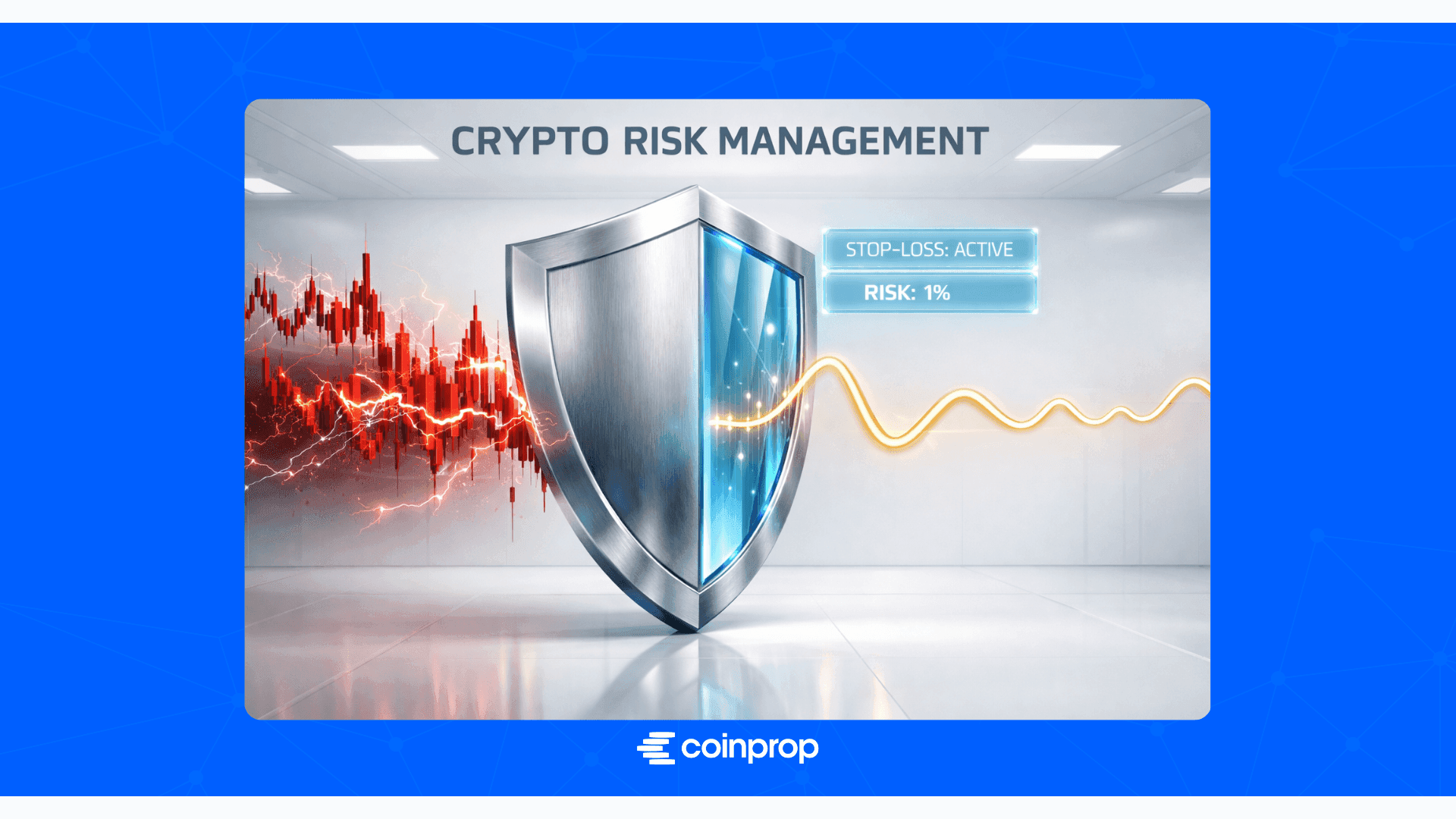
Risk management in crypto prop firms follows a structured framework designed to control losses and preserve capital. Unlike personal trading accounts, where traders can freely adjust risk according to preference, funded environments operate within predefined rules that shape every trading decision.
The goal is not simply to avoid losses. Losses are a normal part of trading and cannot be eliminated. The purpose of risk management is to control how much damage losses can cause and ensure that a trader can continue operating through changing market conditions.
In crypto prop trading, risk management functions as a system rather than a single rule. Position size, drawdown limits, exposure, leverage, and account restrictions work together to determine how much risk can be taken at any moment. Understanding this structure helps traders make decisions that fit the environment of funded accounts instead of treating them like ordinary trading accounts.
Funded accounts create a different relationship with risk because traders operate under predefined conditions established by the prop firm. While personal accounts allow almost unlimited flexibility, funded accounts impose boundaries designed to protect capital and encourage disciplined behavior.
These rules often include:
Because of these rules, trading decisions are no longer based solely on whether a setup appears attractive. Traders must also evaluate whether the trade fits within the account's risk boundaries.
For example, a trader managing a personal account might risk 5–10% on a high-conviction setup. In a funded environment, the same approach can become dangerous because only a few losing trades may consume a large portion of the allowed drawdown.
As a result, funded accounts shift the objective from maximizing short-term gains toward preserving long-term account stability.
Risk management in crypto prop firms is built around several interconnected components. Each one controls a different dimension of risk.
Position Size
Position size determines how much capital is allocated to a trade. Rather than entering random trade sizes, professional traders calculate size based on predefined risk levels and stop-loss distance.
The basic logic is simple:
Risk amount ÷ stop-loss distance = position size
This keeps the dollar risk consistent regardless of market volatility.
For example:
Account size: $50,000
Risk per trade: 1% ($500)
Stop distance: $1,000
Position size:
$500 ÷ $1,000 = 0.5 BTC
The objective is not maximizing size but maintaining controlled exposure.
Drawdown
Drawdown represents the decline in account value from a previous balance or equity level. Since funded accounts have strict limits, drawdown acts as the main risk boundary.
Even profitable traders can fail if they violate drawdown rules through excessive risk-taking.
Exposure
Exposure refers to the total amount of market risk currently active across positions.
This includes situations where traders unintentionally stack similar trades.
For example:
Although these appear to be separate positions, they often move together because of market correlation. The trader may unknowingly create a much larger combined risk than expected.
Managing exposure means evaluating total portfolio risk rather than looking at individual trades in isolation.

One of the most important differences between crypto prop firms is the drawdown model used within the funded account. This structure directly changes risk management decisions.
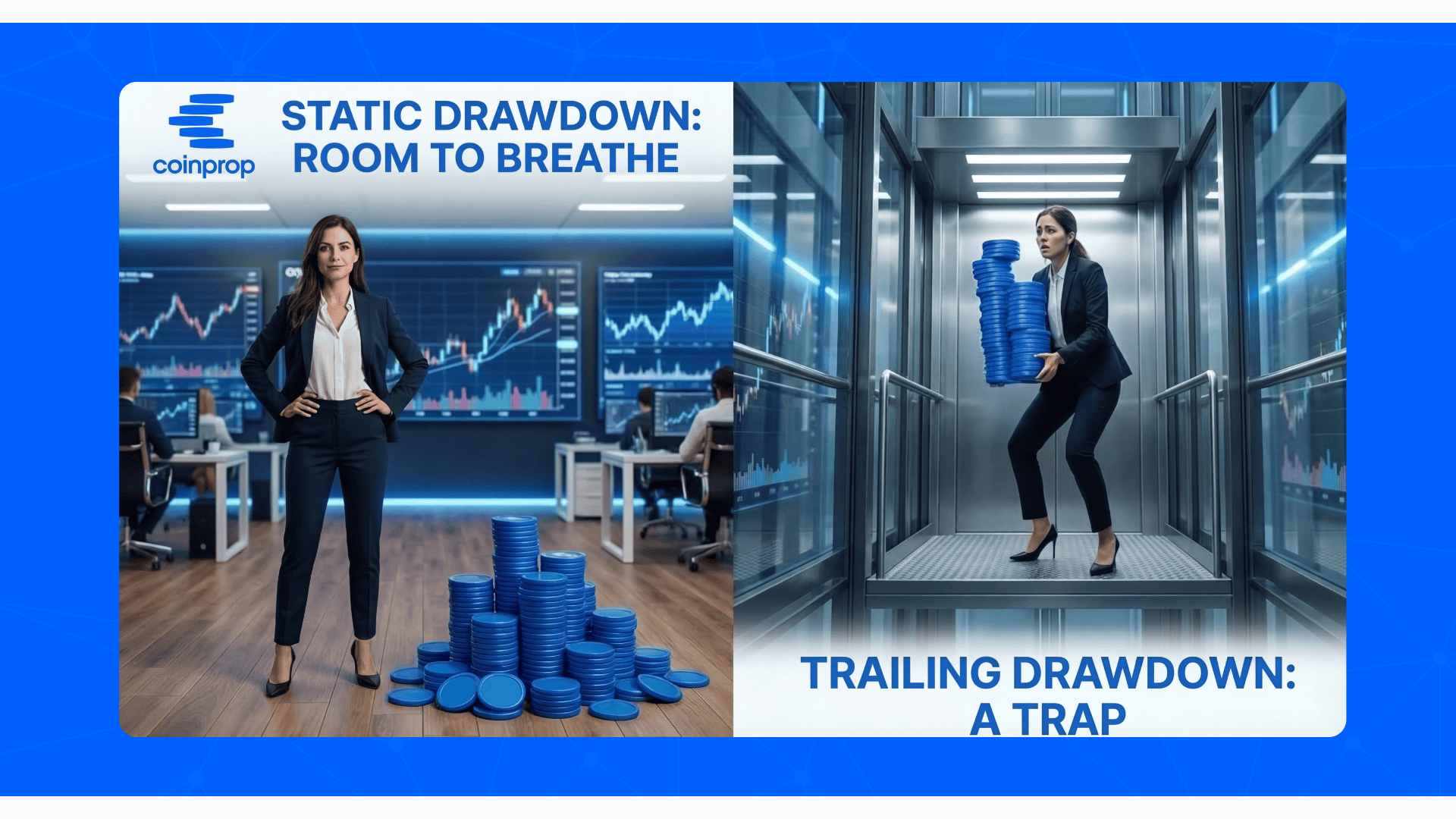
Static drawdown remains fixed throughout the life of the account.
Suppose a trader starts with:
Account balance: $100,000
Maximum drawdown: $10,000
The loss threshold stays at $90,000 regardless of future profits.
As the account grows, the distance between equity and the drawdown limit increases, creating a larger safety buffer.
This structure often gives traders greater flexibility:
Trailing drawdown behaves differently.
As account equity reaches new highs, the drawdown threshold moves upward.
For example:
Starting balance: $100,000
Maximum drawdown: $10,000
Account grows to: $105,000
The drawdown limit may move from $90,000 to $95,000.
This creates a shrinking margin for error because profits increase the required protection level.
As a result, traders often adapt by:
Two traders using the exact same strategy may therefore require completely different risk behavior depending on the drawdown model used by the firm.
Many inexperienced traders approach risk management as a tool designed only to avoid losses. Professional traders usually see it differently.
Risk management is primarily a survival framework.
No strategy wins on every trade. Even strong systems experience losing streaks, unexpected market events, and periods where conditions temporarily change. The purpose of risk management is to make sure those periods do not remove the trader from the game.
A trader risking too much per position may generate impressive short-term results, but high volatility in performance usually creates larger drawdowns and greater account instability.
By contrast, traders who maintain controlled risk can survive through fluctuations and allow probability to work over large numbers of trades.
Over time, consistency matters more than isolated wins.
In crypto prop firms, capital preservation comes first, because traders only benefit from opportunities they are still alive to trade.
Position sizing is one of the most important elements of risk management in crypto prop trading. Using a position size calculator for crypto prop firms can make it easier to translate a predefined risk amount into an appropriate trade size. Many traders focus heavily on finding better entries or predicting market direction, but even strong setups can fail if trade size is not controlled correctly.
In funded environments, position size determines how much capital is exposed on every trade. Since prop firms operate with strict drawdown limits and predefined risk rules, entering positions based on intuition or confidence levels can quickly become dangerous.
Professional traders usually decide risk first and trade size second. Instead of asking "How much Bitcoin should I buy?", they ask "How much am I willing to lose if the trade fails?"
That small shift changes trading from guessing into a controlled process.
Position size is typically calculated using a simple formula:
Position Size = Risk Amount ÷ Stop Loss Distance
The logic behind the formula is straightforward:
For example:
Account size: $50,000
Risk per trade: 1%
Dollar risk: $500
BTC entry price: $60,000
Stop loss: $59,000
Stop distance:
$60,000 − $59,000 = $1,000
Position size:
$500 ÷ $1,000 = 0.5 BTC
This means the trader can enter approximately 0.5 BTC, and if the stop loss is reached, the total loss remains close to the planned $500.
The goal is not finding the biggest possible position. The goal is keeping losses controlled and predictable.
Funded accounts are designed around survival rules.
Prop firms generally impose limits such as:
Position sizing acts as the mechanism that keeps traders inside these boundaries.
Without proper sizing, even a good strategy can fail.
Imagine a trader risking 10% per trade with a funded account. A few losses in a row could consume a large portion of the allowed drawdown and end the account.
Now compare that with a trader risking 1% per trade.
The second trader can survive losing periods, adapt to changing conditions, and continue trading long enough for statistical advantages to play out.
This is why professional traders often think about position sizing as a defensive tool rather than a profit tool.
The first objective is not maximizing gains.
The first objective is staying in the game.
Many traders judge their performance using only one number: win rate. A strategy that wins 70–80% of trades often appears safer and more profitable than a strategy winning only 40–50%. On the surface that seems logical, but in professional trading, especially inside crypto prop firms, profitability is rarely determined by win rate alone.
Funded trading operates under a different reality. The objective is not to win every trade. The objective is to produce stable results while staying inside drawdown limits and preserving the account over long periods.
This is where two concepts become critical:
Together they explain whether a strategy has a mathematical advantage over hundreds of trades rather than whether a few recent trades happened to win.
Many new traders assume:
"Higher win rate = better strategy."
In reality, a strategy can win most trades and still lose money.
Imagine Trader A:
Over 10 trades:
Wins:
8 × $100 = $800
Losses:
2 × $500 = $1,000
Net result:
–$200
Even though the trader was right 80% of the time, the account still lost money.
Now compare that with Trader B:
Over 10 trades:
Wins:
4 × $300 = $1,200
Losses:
6 × $100 = $600
Net result:
+$600
Trader B lost more trades than they won, yet produced better results.
This happens because profits and losses are not equal in size.
A trading strategy is not judged by how often it wins. It is judged by whether the winners compensate for the losers and create positive expectancy over time.
This becomes especially important in crypto prop trading where traders face:
Chasing a perfect win rate often pushes traders toward bad habits:
The result is usually lower long-term performance despite a high percentage of winning trades.
Expected value (EV) measures the average amount a trading strategy is expected to gain or lose per trade over a large sample size.
It answers one fundamental question:
"If I repeat this strategy hundreds of times, what should happen on average?"
The formula is:
Expected Value = (Win Rate × Average Win) − (Loss Rate × Average Loss)
Where:
For example:
Win rate:
40%
Average win:
$300
Average loss:
$100
Formula:
EV = (0.40 × 300) − (0.60 × 100)
EV = 120 − 60
EV = +$60
This means the strategy generates an average profit of approximately $60 per trade over time.
The important point is that expected value focuses on long-term behavior rather than short-term outcomes.
Individual trades are unpredictable.
A trader may lose five trades in a row even with a profitable system.
But if the expected value remains positive, the statistical edge remains intact.
This is one of the biggest mindset shifts professional traders make:
They stop thinking about individual trades and begin thinking in terms of probabilities and large samples.
Risk-to-reward ratio compares potential profit to potential loss on a trade.
For example:
Risk:
$100
Target:
$300
Risk-to-reward ratio:
1:3
This means the trader risks one unit to potentially earn three units.
Higher R:R ratios create more room for mistakes because traders do not need extremely high win rates to remain profitable.
Consider several examples:
1:1 Risk-to-Reward
Average gain = $100
Average loss = $100
Break-even win rate:
50%
1:2 Risk-to-Reward
Average gain = $200
Average loss = $100
Break-even win rate:
33.3%
1:3 Risk-to-Reward
Average gain = $300
Average loss = $100
Break-even win rate:
25%
As the reward relative to risk increases, the percentage of required winning trades decreases.
This provides important advantages in crypto prop trading.
Markets are volatile and funded accounts have strict limitations. Traders cannot assume they will consistently maintain extremely high win rates.
A strategy with:
can often outperform a strategy with:
Long-term profitability usually comes from combining multiple pieces together:
Professional traders understand that success is rarely about predicting every market move correctly.
It is about creating a system where average gains exceed average losses over time.
In crypto prop trading, the goal is not to win every trade.
The goal is to build a structure where mathematics works in your favor over hundreds of trades.
Drawdown management is one of the most important parts of risk control in crypto prop firms. These limits can include maximum drawdown and daily loss limits in crypto prop firms, which restrict how much a trader can lose over a specific period. Traders often focus on entries, indicators, and market direction, but funded accounts are usually lost because of poor drawdown management rather than poor analysis.
In personal trading accounts, losses mainly affect available capital. In funded accounts, losses affect account survival itself. Every prop firm defines limits that determine how much downside a trader can tolerate before violating rules.
Because of this, managing drawdown is not simply about reducing losses. It is about controlling the size and speed of losses so the account remains active long enough for the trading edge to play out.
A trader with a profitable strategy can still fail if losses accumulate too quickly. Likewise, a trader with an average strategy may survive and scale simply because risk is controlled consistently.
Understanding how drawdown structures work changes the way traders approach position sizing, trade frequency, and overall exposure.

Not all crypto prop firms use the same drawdown system. The model itself changes how traders manage risk.
The two most common structures are:
Static Drawdown
Static drawdown keeps the maximum loss threshold fixed throughout the account.
For example:
Starting account balance:
$100,000
Maximum drawdown:
$10,000
The account cannot fall below:
$90,000
Even if the account later grows to $110,000 or $120,000, the loss limit remains unchanged.
As profits increase, the distance between current equity and the drawdown threshold becomes larger.
This creates several advantages:
Many traders consider static drawdown easier to manage because profits expand the safety buffer rather than increasing restrictions, which is one reason some traders look for a crypto prop firm without trailing drawdown.
Trailing Drawdown
Trailing drawdown behaves differently.
As account equity reaches new highs, the drawdown limit moves upward with it.
Example:
Starting balance:
$100,000
Maximum drawdown:
$10,000
Account reaches:
$105,000
New drawdown threshold:
$95,000
If equity later reaches $110,000:
New threshold:
$100,000
This structure creates a moving risk boundary.
While profits increase account value, they also reduce available room for future losses.
This changes trader behavior significantly.
Traders often respond by:
The same trading strategy can therefore produce different outcomes under different drawdown systems.
A strategy that performs comfortably with static drawdown may require substantial adjustments under trailing drawdown conditions.
Every trading strategy experiences losses.
No system wins continuously, regardless of how strong the analysis appears.
One of the biggest mistakes new traders make is assuming losing streaks indicate a broken strategy.
In reality, consecutive losses are statistically normal.
The important question becomes:
Can the account survive them?
This concept is often described as risk of ruin, which represents the probability that losses eventually push an account beyond recoverable limits.
Risk per trade dramatically affects this probability.
Consider two examples.
Trader A
Risk per trade:
5%
Ten consecutive losses:
Remaining capital:
Approximately 60%
Trader B
Risk per trade:
1%
Ten consecutive losses:
Remaining capital:
Approximately 90%
Both traders experienced identical performance.
The difference is survival.
Large risk creates rapid drawdown acceleration.
Small risk creates resilience.
This becomes extremely important in funded environments because crypto markets frequently experience periods of unusual volatility.
Even high-quality systems can encounter:
Traders who maintain lower risk per trade give themselves enough room for probability to work over larger samples.
Many professional traders keep risk between 0.5–1% per trade specifically to reduce risk of ruin.
The objective is not avoiding losses.
The objective is avoiding account elimination.
One of the most misunderstood aspects of trading is recovery mathematics.
Many traders assume losses recover linearly.
For example:
If I lose 20%, I simply need to gain 20% to recover.
The math does not work that way.
As losses become larger, the required recovery percentage increases at an accelerating rate.
The effect becomes severe during larger drawdowns.
A trader losing half the account must double the remaining capital simply to return to break-even.
The psychological effects become equally dangerous.
Large losses often create emotional reactions such as:
These behaviors often create additional losses and deepen drawdowns further.
This is why professional traders focus heavily on preventing large drawdowns from occurring in the first place.
Small losses are manageable.
Large losses become exponentially harder to recover from.
In crypto prop firms, preserving the account usually matters more than maximizing short-term profits.
The trader who avoids deep drawdowns stays active longer, survives difficult market periods, and gives long-term probabilities enough time to create consistent results.

Technical risk management refers to the tools and execution methods traders use to control risk directly inside the trading process. Position sizing and psychology determine how much risk a trader plans to take, but technical risk management determines how that risk is actually controlled in live market conditions.
This becomes particularly important in crypto prop trading because the market operates continuously and can move aggressively within minutes. Sudden volatility, liquidity shifts, and rapid price movements can quickly turn small mistakes into significant drawdowns.
Even a strong strategy can fail if execution risk is ignored.
Professional traders do not rely only on prediction. They build protective systems around their trades using stop mechanisms, execution controls, and portfolio-level exposure management.
Technical risk management focuses on reducing situations where market behavior creates unexpected losses beyond the original trading plan.
Although the terms are sometimes used interchangeably, stop loss and stop limit orders behave differently and serve different purposes.
Understanding this difference matters because execution quality directly affects actual risk.
Stop Loss (Stop Market Order)
A stop loss triggers a market order once the specified price level is reached.
For example:
BTC entry:
$60,000
Stop loss:
$59,000
If price reaches $59,000, the platform immediately sends a market order to close the position.
Advantages:
Limitations:
In highly volatile markets, price can move rapidly beyond the stop level before the order is executed.
For example:
Stop level:
$59,000
Actual fill:
$58,700
Although the trader planned to lose $1,000, the final loss becomes larger because of execution differences.
Stop Limit Order
A stop limit combines a trigger price with a limit price.
Once the stop level is reached, a limit order is created rather than an immediate market order.
Example:
Stop:
$59,000
Limit:
$58,950
Advantages:
Limitations:
If the market falls quickly below the limit price, the position may remain open.
This can become dangerous during sudden crashes or high-impact news events.
In practice, many crypto prop traders use:
The choice often depends on volatility, liquidity, and market conditions.

Risk does not disappear once a trade moves into profit.
One of the biggest challenges in trading is protecting gains while allowing profitable positions enough room to continue moving.
Trailing stops help solve this problem.
Unlike fixed stops, a trailing stop automatically moves with price when the trade moves favorably.
For example:
BTC long position:
Entry: $60,000
Trailing distance:
$500
Price rises to:
$62,000
The stop automatically adjusts upward:
New stop:
$61,500
If the market reverses, the position closes while preserving part of the gains.
Trailing stops provide several advantages:
However, trailing stops also require caution.
If the distance is too narrow:
If the distance is too wide:
Many traders use volatility-based methods such as Average True Range (ATR) to adjust trailing distances dynamically.
Another major technical risk is slippage.
Slippage occurs when the actual execution price differs from the expected price.
Several factors can create slippage:
For example:
Expected entry:
$60,000
Actual entry:
$60,300
Difference:
$300 slippage
Small slippage may appear insignificant on individual trades, but repeated over hundreds of positions it can heavily affect overall performance and distort risk-to-reward calculations.
Methods commonly used to reduce slippage include:
Execution quality itself becomes part of risk management.
Many traders believe opening multiple positions automatically creates diversification.
In crypto markets this assumption is often misleading.
Many digital assets move together because of strong market relationships.
Bitcoin frequently influences overall market direction, causing numerous altcoins to react similarly.
For example:
A trader opens:
At first glance, these appear to be three independent trades.
In reality, the trader may simply be increasing exposure to one broad market move.
If Bitcoin falls sharply:
Instead of risking 1% on a single idea, the trader may unintentionally expose the account to several times that amount.
This is known as correlation risk.
Managing correlation risk involves evaluating total portfolio exposure rather than individual positions alone.
Professional traders often reduce correlation risk through methods such as:
For example, instead of holding several highly correlated long positions simultaneously, traders may balance exposure across different setups or reduce overall position size.
This becomes particularly important in crypto prop firms because drawdown rules apply to the entire account rather than to individual trades.
Several small correlated positions can create the same damage as one oversized trade.
Technical risk management therefore extends beyond entries and stop placement.
It also includes understanding how positions interact with one another and how execution decisions affect overall account stability.
Many traders assume risk management is mostly about numbers, formulas, and position sizing. While mathematical risk control is essential, a large part of trading performance is influenced by psychology. A trader can understand position sizing perfectly, know how to calculate risk-to-reward ratios, and follow a profitable strategy on paper, yet still fail because emotions repeatedly interfere with decision-making.
Crypto markets create an environment where emotional pressure becomes even stronger. Prices can move aggressively within minutes, profits and losses fluctuate rapidly, and market sentiment changes continuously. Under these conditions, traders often stop following systems and begin reacting emotionally.
In crypto prop trading, this problem becomes more significant because funded accounts operate under strict drawdown rules. A few emotionally driven decisions can quickly consume available risk and violate account limits.
Psychological risk management focuses on reducing situations where emotions replace rules. The objective is not removing emotions entirely. Fear, excitement, and frustration are normal reactions. The goal is building systems and habits that prevent those emotions from controlling trading behavior.
Human psychology naturally dislikes losses more than it enjoys gains. Behavioral research often describes this as loss aversion, where the emotional pain of losing feels stronger than the satisfaction of winning the same amount.
For example:
Losing $100 often feels significantly worse than the pleasure generated from making $100.
In trading, this creates a dangerous problem.
When a trade moves toward a stop loss, traders often begin changing their behavior.
Instead of accepting the planned loss, thoughts may appear such as:
"Maybe price will reverse."
"I’ll give the trade a little more room."
"It looks oversold now."
What started as a predefined trading plan slowly turns into emotional decision-making.
As a result, traders may:
This often develops into what can be called false hope.
False hope appears when traders stop relying on probabilities and begin relying on emotional expectations.
The market itself has not changed, but the trader's relationship with the trade changes.
Professional traders generally approach losses differently.
They understand that losses are part of the process rather than evidence of failure.
A losing trade does not necessarily mean:
Even profitable systems experience losses.
The objective is not avoiding every loss.
The objective is keeping losses controlled and predictable.
One of the most destructive psychological behaviors in crypto prop trading is revenge trading.
Revenge trading usually appears immediately after losses.
Imagine a trader loses several trades in a row.
Instead of accepting the outcome and continuing to follow the trading plan, frustration begins to take control.
The internal dialogue often changes:
"I need to recover this immediately."
"One big trade can bring everything back."
"I can't finish the day negative."
At this point, trading decisions become emotional rather than analytical.
Common revenge-trading behaviors include:
The problem is that emotional decisions usually occur under stress, and stress often reduces judgment quality.
One emotional trade frequently turns into several emotional trades.
Small losses then become larger drawdowns.
In funded accounts, this creates serious consequences because prop firm rules are fixed regardless of emotional state.
The account does not recognize:
It only recognizes account equity.
Many experienced traders create protective rules specifically to reduce emotional trading behavior.
Examples include:
These rules function as psychological safety mechanisms rather than trading strategies.
Their purpose is preventing temporary emotions from creating permanent damage.

Crypto markets create constant opportunities, but they also create constant psychological pressure.
Large price movements, sudden rallies, and social media excitement frequently trigger FOMO, or fear of missing out.
FOMO occurs when traders feel pressure to participate simply because the market appears to be moving rapidly.
For example:
A trader watches BTC rise several percent within a short period.
Instead of waiting for planned conditions, thoughts begin appearing:
"Everyone else is making money."
"I’m missing the move."
"It will probably keep going."
The result is often:
Ironically, traders frequently enter just as momentum begins slowing down.
FOMO usually shifts focus away from the trading process and toward short-term emotional reactions.
Another common psychological trap is confirmation bias.
Confirmation bias occurs when traders selectively search for information that supports existing beliefs while ignoring information that contradicts them.
Imagine a trader becomes strongly bullish on Ethereum.
After entering the trade, they may begin:
The objective unconsciously changes from finding the truth to protecting the original opinion.
This becomes dangerous because markets do not reward certainty.
Markets continuously change.
Professional traders often ask difficult questions before entering or holding positions:
These questions reduce emotional attachment and encourage objective thinking.
Psychological risk management ultimately becomes a process of protecting traders from themselves.
Many trading losses do not occur because traders lack knowledge.
They occur because emotions temporarily override discipline.
In crypto prop trading, strategies create opportunities, but psychology often determines whether traders survive long enough to benefit from them.
Most traders focus heavily on charts, indicators, and technical setups, but in crypto prop trading, a significant portion of risk comes from outside the chart itself. These are called macro and environmental risks, factors that can disrupt price behavior, liquidity, and execution without warning.
Unlike technical risk, which can be measured and controlled through stop losses and position sizing, environmental risk is often unpredictable and driven by external forces such as economic data releases, regulatory announcements, exchange issues, or sudden liquidity changes.
In funded trading accounts, these risks become even more important because drawdown limits are strict. A single unexpected event can push an account into violation even if the trading strategy itself is sound.
Managing macro and environmental risk is about awareness, preparation, and reducing exposure during unstable conditions rather than trying to predict the unpredictable.
High-impact news events are one of the most common sources of sudden volatility in crypto markets. These events include macroeconomic announcements such as inflation reports, interest rate decisions, and central bank statements, as well as crypto-specific news like regulatory updates or major exchange developments.
During these events, market behavior changes significantly:
Even strong technical setups can fail during these periods because market structure becomes unstable.
For example, a trader might place a well-planned position based on technical analysis, but during a news release, price may move far beyond normal levels in seconds, triggering stop losses at worse-than-expected prices.
In crypto prop trading, this creates additional risk because drawdown rules are fixed. A single volatile move during news can cause multiple losses or even account breaches.
To manage this risk, professional traders often adjust their behavior around high-impact events:
The key idea is not to avoid trading entirely, but to avoid trading when market structure becomes unpredictable.
In many cases, the most effective decision is simply waiting for liquidity to return and price behavior to normalize.
Black swan events are rare, extreme market events that are difficult or impossible to predict in advance. In crypto markets, these events can cause sudden and severe price dislocations across multiple assets at the same time.
Examples of black swan events include:
Unlike normal volatility, black swan events do not follow typical technical patterns. They often break support and resistance levels instantly and create gaps or rapid cascades in price.
For crypto prop traders, the main risk is not just volatility but execution failure during these moments.
Stops may not fill at expected levels due to:
This can result in losses larger than planned risk per trade.
Because of this, risk management for black swan events focuses on preparation rather than prediction.
Common protective approaches include:
The key principle is simple: black swan events cannot be prevented, but their impact can be limited.
In prop trading environments, survival through rare events is more important than maximizing gains during stable periods.
Unlike traditional financial markets, crypto trading depends heavily on technology infrastructure. This introduces an additional layer of risk that many traders underestimate.
Infrastructure and platform risks include:
In fast-moving crypto markets, even a short interruption can create significant consequences.
For example, if a trader is holding a leveraged position and loses internet access during a sharp market move, they may be unable to:
During this time, price can move rapidly, and the position may hit stop levels or liquidation zones without intervention.
In crypto prop trading, where drawdown limits are strict, infrastructure failures can directly lead to account violations even if the original trade setup was correct.
To reduce these risks, professional traders often implement redundancy systems such as:
The goal is not to eliminate risk completely, but to ensure that no single point of failure can fully disconnect the trader from their positions.
Infrastructure risk becomes even more important during high volatility periods, when execution speed and access to the market matter most.
In professional crypto prop trading, technical reliability is not just convenience, it is part of risk management itself.
One of the most exciting parts of prop trading is the scaling plan, when your consistent performance unlocks larger funded accounts. But as the capital grows, risk management must evolve with it. Bigger accounts don’t mean bigger risks; they mean tighter discipline.
A risk management calculator is built on a simple but powerful principle: every trade should risk a fixed percentage of total capital, regardless of market conditions or asset volatility.
To achieve this, the calculator uses three core inputs:
From these values, it automatically calculates the correct position size so that the maximum loss stays constant.
The logic behind it is straightforward:
This structure is essential in crypto prop firms because volatility can expand risk instantly if position size is not adjusted correctly. A wider stop without reducing size, or a tight stop with oversized exposure, both lead to inconsistent risk.
By standardizing this process, the calculator ensures that risk remains stable across all market conditions.

Let’s go through a practical example to understand how the calculator works in a real trading scenario.
Assume the following:
Now we apply the formula:
Position Size = Risk Amount ÷ Stop Loss Distance
So:
This means the trader should enter a position of approximately 0.0667 BTC.
Now the important part:
If the trade goes against you and hits the stop loss at $58,500, the loss will be exactly $100, no more and no less.
This is the key advantage of using a risk calculator. It converts uncertain market movement into a fixed, controlled outcome.
Without this calculation, traders often make two critical mistakes:
Both lead to inconsistent risk exposure and higher probability of drawdown violations in prop firm accounts.
With proper calculation, every trade becomes predictable in terms of risk, even if the outcome is not predictable.
One of the most effective ways to implement risk management is by building your own Excel or Google Sheets calculator. This allows instant position sizing without relying on external tools.
A simple structure includes four input fields:
Then you calculate position size in cell E2 using the formula:
=(A2*B2)/ABS(C2-D2)
Here’s what happens:
This setup is extremely powerful because it is:
You can also expand this spreadsheet by adding:
In professional crypto prop trading, this kind of system becomes part of your trading infrastructure. It ensures that every execution aligns with your overall risk framework.
Ultimately, the goal is simple: you don’t want to calculate risk in your head while the market is moving. You want a system that does it for you instantly, so you can focus entirely on execution and strategy.
In crypto prop trading, having a good strategy is not enough. What separates long-term funded traders from those who repeatedly fail challenges is not prediction ability, but the ability to operate within a consistent and sustainable risk management framework.
A sustainable framework is not a single rule or indicator. It is a structured system that defines how much you risk, how you behave after wins or losses, and how you repeat decisions over time without emotional deviation.
The goal is simple: survive long enough for your edge to play out across hundreds of trades while staying within prop firm constraints such as drawdown limits and consistency rules.
One of the most important components of a sustainable risk framework is defining a maximum daily loss limit. This is different from per-trade risk. Even if each trade is properly sized, a series of losses in one day can still damage an account.
Daily risk limits act as a “circuit breaker” for emotional and statistical risk.
For example:
This rule protects traders from the most dangerous pattern in prop trading: loss spirals caused by emotional recovery attempts.
In crypto markets, volatility can cluster losses within short periods. A trader might hit three consecutive stop losses not because of a broken strategy, but due to normal market noise. Without a daily cap, this often leads to overtrading and rule violations.
A strict daily limit enforces discipline in three ways:
Professional prop traders treat daily loss limits as non-negotiable. Once it is hit, the market is “closed” for them regardless of opportunity.
A trading journal is one of the most underused but powerful tools in risk management. While calculators manage numerical risk, journals manage behavioral risk.
In crypto prop trading, repeated mistakes rarely come from strategy failure, they come from repeating emotional or structural errors.
A proper journal records every trade with key details such as:
Over time, this creates a personal dataset that reveals patterns like:
The value of a journal is not recording trades, it is identifying repeatable mistakes that silently destroy accounts.
Once patterns are visible, they can be systematically removed. For example:
This turns risk management from theory into measurable behavioral control.
A sustainable framework only works if trading becomes a repeatable process, not a series of emotional decisions.
A repeatable process means every trade follows the same structured sequence:
The key idea is consistency. The trader is not reinventing decisions every time, they are executing a predefined system.
In crypto prop firms, this is critical because:
A repeatable process ensures that:
Over time, this structure transforms trading from a reactive activity into a controlled system.

A sustainable risk management framework is not about avoiding losses. It is about making losses predictable, controlled, and non-threatening to account for survival.
When daily limits, journaling, and a repeatable process work together, trading becomes stable even in volatile crypto conditions. In prop trading, this stability is the real edge, not prediction, not leverage, but consistency under strict risk constraints.

Risk management in crypto prop firms is all about protecting your capital while staying within strict firm rules like drawdown limits and risk-per-trade caps. Most traders fail not because of bad strategies, but because of poor risk control, overleveraging, and emotional decisions. A proper risk framework ensures consistent position sizing, controlled losses, and long-term account survival.
Because prop firms enforce strict rules like drawdown limits and consistency requirements. Even a profitable strategy can fail if position sizing or loss control is inconsistent. One bad trading day can lead to account termination.This bias creates a dangerous blind spot in risk management. When we’re emotionally tied to a trade, we unconsciously underestimate the real risk. We convince ourselves this one is different, the fundamentals are strong, or it’ll bounce back. Suddenly, stops get widened, size gets increased, or warnings get dismissed, all because the mind wants to protect the story we’ve built, not the capital.
The pro fix is brutally simple: force yourself to ask the hard question before every entry and during every hold: What if my analysis is completely wrong? What’s the worst case scenario? This flips the script from emotional attachment to cold probability. You start sizing based on real downside, not hope. You set stops where the thesis breaks, not where it feels comfortable. You cut losses when evidence contradicts, not when the pain becomes unbearable.
Confirmation bias turns good traders into gamblers. It blinds us to correlation risks, news catalysts, or liquidity traps. In crypto prop trading, where drawdown limits are strict and one bad decision can end the run, this mental trap is lethal.
Break it with discipline: journal your thesis before entry, list counter arguments, and review them daily. Stay detached. The market doesn’t care about your feelings or story, it only rewards those who see reality clearly.
Position sizing. It determines how much you lose on each trade. Even with a good win rate, oversized positions can destroy an account during a normal losing streak.
Trailing drawdown is more restrictive because winning increases pressure on your account buffer.
Most professional traders risk 0.5% to 1% per trade. This keeps losing streaks survivable and prevents hitting drawdown limits too quickly.
Because of poor risk control, not bad analysis. Common reasons include:
No. A trader can be profitable with a 40%–50% win rate if they maintain a strong risk-to-reward ratio and positive expected value.
Revenge trading. After a loss, traders often increase risk or take impulsive trades to recover quickly, which usually leads to even bigger losses.
A trading journal helps identify behavioral patterns like overtrading, emotional decisions, or losses during specific market conditions. It turns mistakes into measurable data for improvement.
In most cases, yes or at least reduce risk significantly. High-impact news can cause slippage, gaps, and unpredictable volatility that can break normal risk assumptions.
The safest approach is:
No. Many professionals lose more trades than they win, but they manage risk so that winning trades are larger than losing ones.
The main goal is not to maximize profit, it is to ensure account survival long enough for your edge to play out over time.
Understanding how these rules fit into the crypto prop firm challenge and evaluation model can help traders prepare for evaluation requirements and manage risk more effectively.
