Starting crypto prop trading involves building essential trading skills, choosing a reliable crypto prop firm, understanding the evaluation rules, creating a disciplined trading plan, passing the evaluation, and managing a funded account responsibly. This guide walks you through each step, helping beginners avoid common mistakes and increase their chances of becoming funded crypto traders. One of the smartest ways to start crypto prop trading is by practicing first. CoinProp's free trial account lets you test your strategy, explore the trading platform, and experience the evaluation process before starting a paid evaluation.
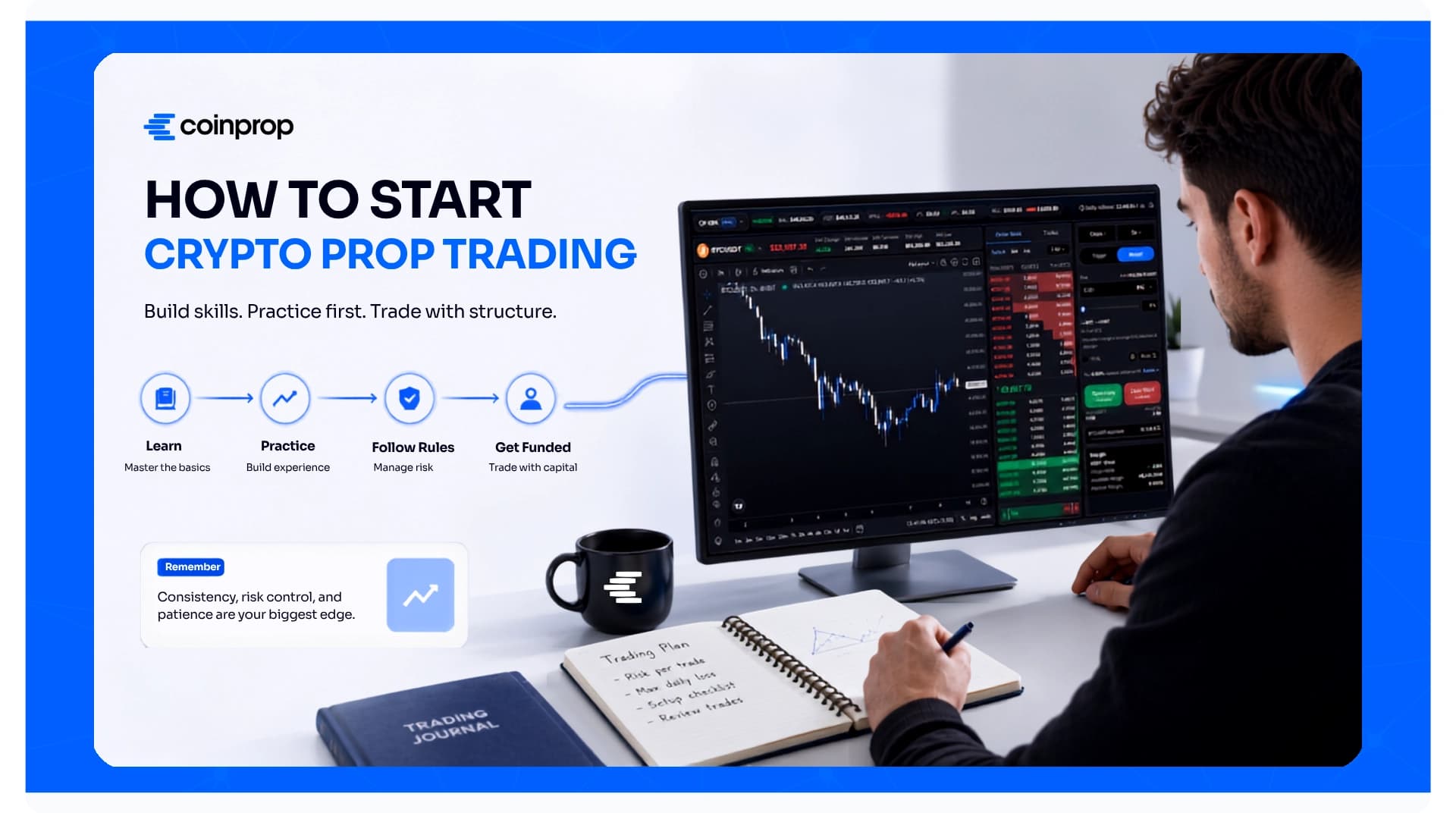
Successful crypto prop traders need more than a basic understanding of the cryptocurrency market. Before joining a crypto prop firm or taking a prop firm evaluation, you should build a strong foundation in technical analysis, trading strategy, risk management, trading psychology, and performance tracking.
These skills work together. A profitable strategy is not enough if you cannot control your risk, and good risk management will not help much if you have no consistent trading process. Developing these skills before purchasing an evaluation can help you avoid common mistakes, trade with greater discipline, and improve your chances of passing a crypto prop firm challenge and managing a funded account successfully.
Before placing your first trade, learn how cryptocurrency markets move. Understanding market structure, trends, support and resistance, liquidity, and price action can help you identify high probability trading opportunities instead of relying on predictions, guesswork, or emotions.
Start by learning how to identify whether a market is trending, ranging, or transitioning between different conditions. Practice marking swing highs and lows, identifying higher highs and higher lows in uptrends, and recognizing lower highs and lower lows in downtrends.
You should also learn how price reacts around important areas rather than treating support and resistance as exact lines. Look at previous highs and lows, major price levels, liquidity zones, and areas where strong buying or selling previously occurred.
Before starting an evaluation, practice answering questions such as:
The goal is not to predict every price movement. It is to develop a repeatable process for identifying where a trade may have a favorable probability and where your trading idea is no longer valid.
A trading strategy should clearly define when to enter, where to place a stop loss, when to take profit, and how much to risk. Rather than constantly switching between strategies, focus on developing and testing one approach that fits your trading style and produces consistent results across different market conditions.
Start by choosing a trading style that matches the amount of time you can realistically dedicate to trading. A trader who can only monitor the market for a few hours each day may need a different approach from someone who actively watches cryptocurrency markets throughout the day.
Then define your strategy in objective terms. Your plan should specify:
Once the rules are defined, test the strategy before using it in an evaluation. Backtesting can help you understand how the strategy performed historically, while demo or trial trading can show how well you execute it under current market conditions.
Pay attention to more than the win rate. Track your average winning trade, average losing trade, maximum losing streak, drawdown, and overall expectancy. A strategy does not need to win every trade to be profitable, but you should understand its normal performance before risking money on an evaluation.
Most importantly, don't change your entire strategy after a few losing trades. Give it enough trades to produce meaningful data, then make adjustments based on evidence rather than emotion.
Risk management is one of the most important skills in crypto prop trading. Even profitable traders can fail a prop firm evaluation by violating daily loss limits, maximum drawdown rules, or risking too much on individual trades.
Start by deciding how much you are willing to risk on a single trade. Then calculate your position size based on that risk and the distance to your stop loss. This prevents you from choosing a position size first and discovering afterward that the potential loss is too large.
Your risk management plan should define:
Your personal limits should normally be more conservative than the firm's hard limits. If a crypto prop firm allows a 3% daily loss, for example, you do not need to risk enough to approach that limit. Setting a lower personal threshold creates a buffer that can help prevent an emotional trading session from becoming an evaluation violation.
You should also understand the difference between risk per trade and position size. A larger position does not necessarily mean more risk if the stop loss is very tight, while a smaller position can still create significant risk if the stop is far away.
Before every trade, know exactly how much you can lose if the stop loss is triggered. This makes risk management a decision you make before entering the market rather than something you try to control afterward.
Fear, greed, impatience, revenge trading, and overconfidence can all lead to poor trading decisions. In crypto markets, the problem can become even more pronounced because the market operates 24/7 and can experience significant price movements within a short period.
Successful prop traders don't eliminate emotions. Instead, they build a process that prevents emotions from controlling their decisions.
Start by identifying your personal psychological triggers. For example, do you tend to increase your position size after a winning streak? Do you enter trades immediately after a loss to recover your money? Do you move your stop loss because you don't want to accept a losing trade?
Once you identify these behaviors, create specific rules to prevent them.
You might decide to:
You should also accept that losing trades are a normal part of any trading strategy. The objective is not to avoid losses completely, but to make sure individual losses remain controlled and do not cause you to abandon your trading plan.
Keep a detailed trading journal to review every trade, identify recurring mistakes, and measure your performance over time. Without tracking your results, it is difficult to determine whether your strategy is genuinely working or whether your recent performance is simply the result of favorable market conditions.
Record information such as:
Chart screenshots can also help you review whether your entry and exit decisions matched your strategy.
After collecting enough trades, look for patterns rather than focusing on individual results. You may discover that your strategy performs particularly well in trending markets, that you consistently enter too early, or that your results deteriorate after a certain number of trades in one session.
Use this information to make gradual improvements. If your journal shows that you frequently break your risk rules after losing trades, the solution may not be a new strategy. You may need a stricter daily stop or a lower position size.
The ultimate goal is to create a feedback loop:
Plan → Trade → Record → Review → Improve → Repeat.
By building this process before starting a crypto prop firm evaluation, you can enter the challenge with a tested strategy, defined risk limits, greater psychological discipline, and a clear understanding of your own trading performance.
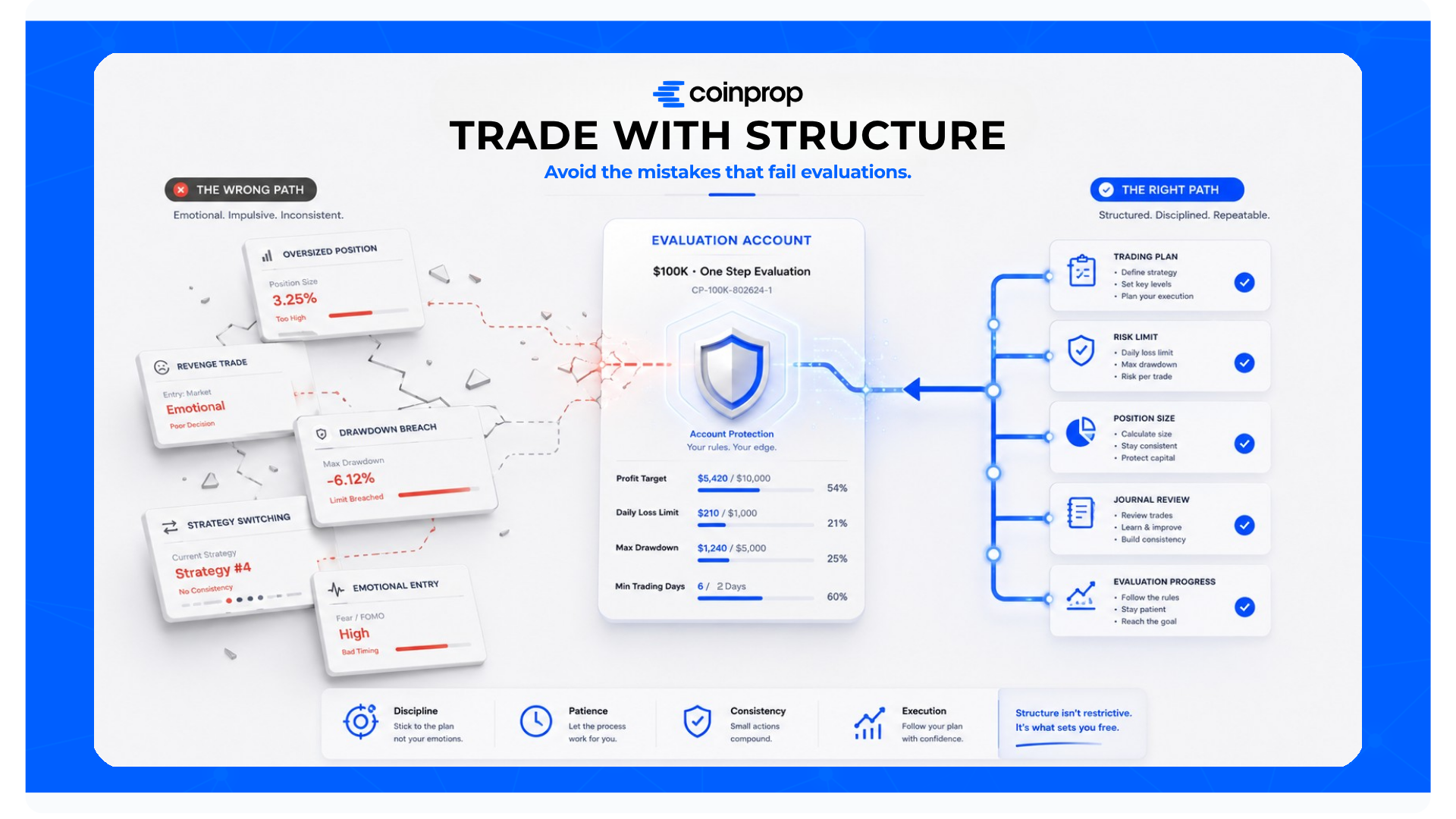
Crypto prop trading isn't the right path for every trader. While it offers access to larger trading capital and the opportunity to scale without risking significant personal funds, it also requires discipline, consistency, and the ability to follow strict risk rules. Before joining a crypto prop firm, it's important to evaluate whether this trading model matches your experience, goals, and personality.
Crypto prop trading is a good fit for traders who already have a profitable strategy but are limited by their account size. It's also ideal for disciplined traders who can follow predefined rules, manage risk consistently, and treat trading like a long term business rather than a way to make quick money. If you're confident in your ability to execute a trading plan without emotional decision making, a crypto prop firm can provide an opportunity to scale your results with firm capital.
New traders who are still learning the basics of technical analysis, frequently change strategies, or struggle with emotional trading may find prop firm evaluations challenging. Since most firms enforce strict drawdown limits and consistency requirements, rushing into an evaluation before developing the necessary skills can lead to unnecessary failures and added costs. Taking time to build experience first often leads to better long term results.
Trading your own capital gives you complete freedom to manage risk and trading decisions, but every loss comes directly from your personal funds. Crypto prop trading, on the other hand, allows qualified traders to access significantly more capital after passing an evaluation. In return, traders must follow the firm's risk rules and share a portion of their profits. For traders with consistent performance and strong risk management, trading firm capital can provide greater growth opportunities while reducing the amount of personal capital at risk.
Choosing the right crypto prop firm is one of the most important decisions you'll make before starting your crypto prop trading journey. The cheapest challenge or the highest advertised profit split is not necessarily the best choice for every trader. Different firms can have significant differences in evaluation models, drawdown rules, trading conditions, payout policies, supported platforms, and restrictions.
Instead of choosing a firm based only on its challenge price or account size, compare the rules and conditions that will directly affect how you trade. The right crypto prop firm should match your strategy, risk tolerance, preferred markets, and experience level while offering clear rules and a reliable path to payouts.
The first step is to determine which funding model fits your experience and trading style. Most crypto prop firms offer either an evaluation based program or an instant funding model, although the exact structure can vary from one firm to another.
Evaluation programs usually require traders to reach a specific profit target while staying within predefined maximum drawdown and daily loss limits. Some firms use one step evaluations, while others may require multiple stages. Before choosing one, look beyond the number of steps and compare the profit target, drawdown, minimum trading days, time limits, and other rules that determine how difficult the evaluation actually is.
Instant funding programs provide access to a funded account without requiring traders to complete a traditional evaluation first. However, they may have higher upfront costs, smaller initial account allocations, different profit sharing structures, or additional restrictions.
When comparing the two models, consider:
A trader who already has a tested strategy and wants to prove their consistency may prefer an evaluation model. Someone who values immediate access and is willing to accept different costs and conditions may prefer instant funding. The important point is to compare the complete trading conditions, not simply the advertised account size.
Trading rules can have a greater impact on your chances of success than the challenge price itself. Before joining a crypto prop firm, read the complete rule set and determine whether you can realistically trade within its limits.
Start with the firm's maximum drawdown and daily loss limit. These rules determine how much room you have for losing trades before your account is breached. Also check whether drawdown is static or trailing, whether daily loss is calculated from the starting balance or current equity, and whether unrealized losses are included in the calculation.
You should also review:
This is particularly important for crypto prop trading because cryptocurrency markets operate 24/7 and can experience significant volatility outside traditional market hours. A trader who regularly holds BTC or altcoin positions overnight, for example, should confirm that the firm's rules allow this.
Don't choose a firm simply because its drawdown percentage looks attractive. Calculate how the rules would work with your actual strategy and typical position sizes. A trading strategy that works comfortably with a 7% maximum drawdown may become difficult to execute under a much tighter limit.
A high advertised profit split does not automatically make a crypto prop firm a better choice. You should evaluate the firm's entire payout structure, including how often you can withdraw profits and what conditions must be met before receiving a payout.
Start by comparing the profit split, but then look at the details behind it. Some firms offer a standard profit split that can increase through add ons, scaling programs, or performance milestones. Others may advertise a maximum percentage that is only available under specific conditions.
Before choosing a firm, check:
You should also look for evidence that traders actually receive their profits. Transparent payout procedures, clear payment information, and verifiable transaction records can provide more useful information than marketing claims alone.
The goal is to evaluate the realistic path from profitable trading to receiving your money, rather than focusing only on the percentage displayed on the firm's homepage.
Your trading environment can directly affect execution, charting, order management, and overall performance. Before selecting a crypto prop firm, make sure its platform and market infrastructure support the way you already trade.
Check which trading platforms are available and whether the firm integrates with tools you are comfortable using. For example, some crypto prop firms offer TradingView integration, while others use proprietary platforms or connect traders to specific exchange liquidity providers.
Also verify which assets and markets are available. If your strategy depends primarily on BTC and ETH, make sure those markets are supported. If you trade altcoins or memecoins, check the actual asset list rather than assuming that every cryptocurrency is available.
Important factors to compare include:
The best platform is not necessarily the one with the most features. It is the one that provides the markets, execution environment, and tools you need to execute your existing strategy efficiently.
Finally, research the firm's reputation before paying for an evaluation or funding program. A professional website alone does not prove that a firm is reliable. Look for evidence of transparent operations, clearly documented rules, consistent customer support, and a credible payout history.
Start by reviewing the firm's official rules and terms. Make sure important conditions are easy to find and that there are no major restrictions hidden behind vague language. Then look for independent trader feedback across multiple sources rather than relying on testimonials published by the firm itself.
Pay attention to:
You should also pay attention to how the firm handles negative feedback. No company will have a perfect record, but transparent communication and consistent explanations can be more informative than a collection of five star reviews.
Ultimately, choosing a crypto prop firm is about finding a combination of favorable trading conditions, realistic risk limits, reliable payouts, and transparent operations. The firm with the largest account or highest profit split is not necessarily the best fit. Choose the one whose rules you can understand, follow, and realistically trade under for the long term.
Tip: If you're not sure how to compare different firms, read our complete Crypto Prop Firm Guide to understand evaluation models, funding options, payout systems, trading rules, and the features that matter most before making your decision.
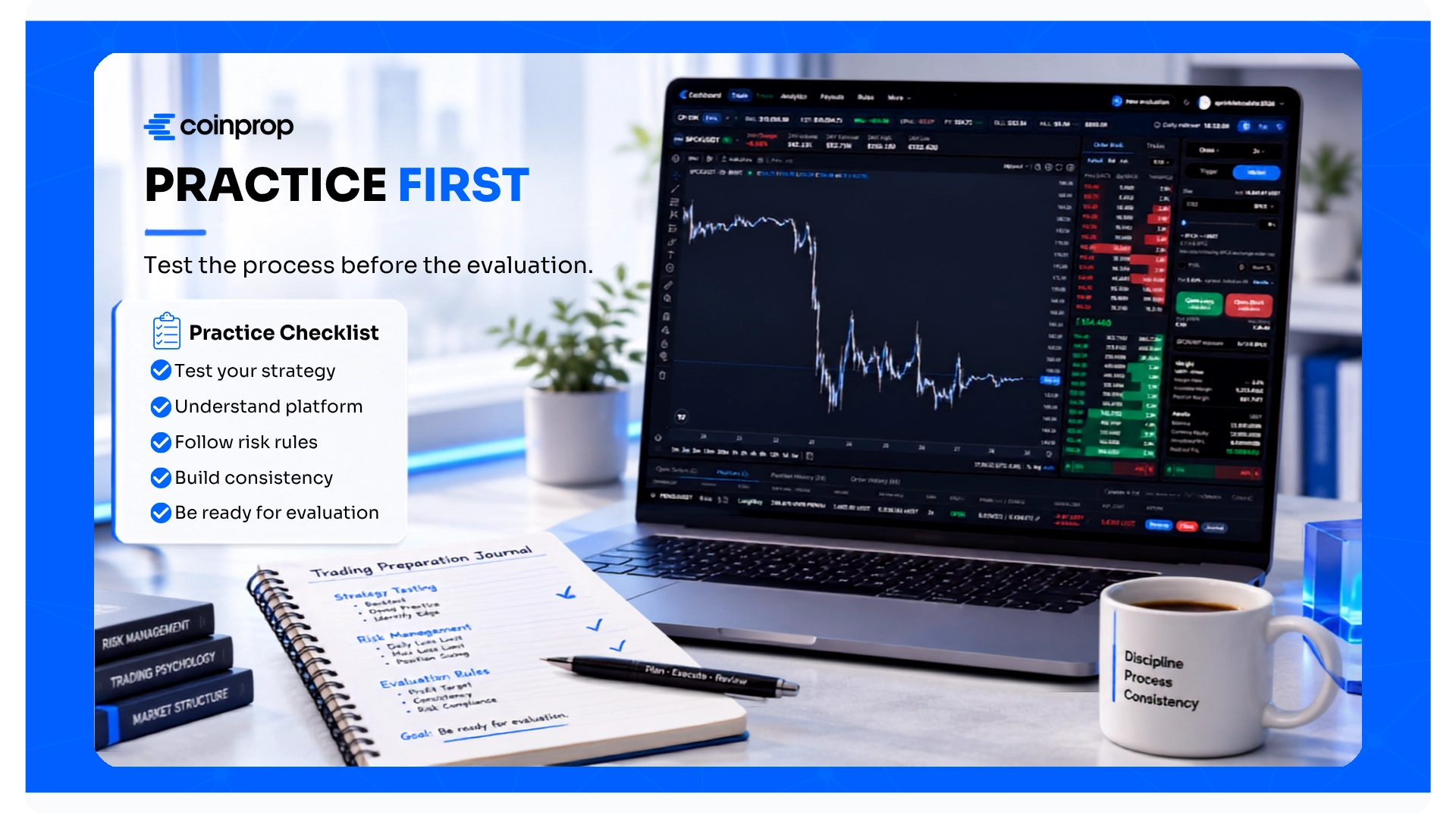
One of the smartest ways to prepare for crypto prop trading is to practice before purchasing a paid evaluation. Passing crypto prop firm challenge requires more than having a profitable strategy. You also need to understand how your strategy performs under specific drawdown limits, daily loss rules, profit targets, and other trading restrictions.
Instead of buying an evaluation immediately, use a practice period to test your strategy and trading behavior under conditions that closely resemble the evaluation you plan to take. This gives you an opportunity to identify weaknesses, measure your consistency, and build the discipline required to follow the rules when real money and performance targets are involved.
Before paying for an evaluation, use a free trial account whenever one is available to test whether your strategy can perform consistently in the same type of market environment you will face during the evaluation.
Don't use the trial simply to see whether you can make a profit. Treat it as a structured practice period. Follow the same entry criteria, position sizing rules, stop loss rules, and trading schedule you intend to use during the paid evaluation.
During the trial, track:
You should also test your strategy across different market conditions. For example, BTC and other cryptocurrencies can behave very differently during strong trends, ranging markets, and periods of high volatility. A strategy that performs well for a few days may not necessarily be robust enough for an evaluation.
The goal is not to achieve the highest possible return during the trial. The goal is to determine whether you can execute your strategy consistently while controlling risk.
Once you have tested your strategy, recreate the rules of the evaluation as closely as possible. This is one of the most valuable preparation steps because many traders fail evaluations not because their strategy is unprofitable, but because they violate a risk rule.
For example, if the evaluation has a 3% daily loss limit and a 6% maximum drawdown, use those limits during your practice period. Don't allow yourself to lose 5% in a day simply because you are trading on a demo account. Doing so would teach you habits that could eventually cause a real evaluation failure.
Create your own practice rule set based on the evaluation you intend to take:
It's also useful to create a personal risk limit below the firm's maximum limit. For example, if a firm allows a 3% daily loss, you might stop trading after losing 1% or 1.5%. This creates a safety buffer and reduces the chance that one bad trading session will put your evaluation at risk.
Most importantly, practice following the rules before you need to follow them. Your objective is to make proper risk management automatic rather than something you only think about after a trade starts moving against you.
Confidence should come from evidence, not from a few profitable trades. Before purchasing an evaluation, review your practice results and determine whether you can repeatedly execute your strategy without breaking your risk rules.
Ask yourself:
If the answer to several of these questions is no, purchasing an evaluation may be premature. Go back to practice, identify the problem, and test your adjustments before paying for another challenge.
A free trial can be particularly useful because it lets you experience the trading platform, execution environment, available markets, and evaluation style rules without immediately committing to a paid program. However, the value of a free trial depends on how seriously you treat it.
The best time to start a paid crypto prop firm evaluation is not when you feel excited or confident after a few winning trades. It's when your practice results show that you can execute a tested strategy, control your risk, and consistently follow the rules that will determine whether you pass or fail.
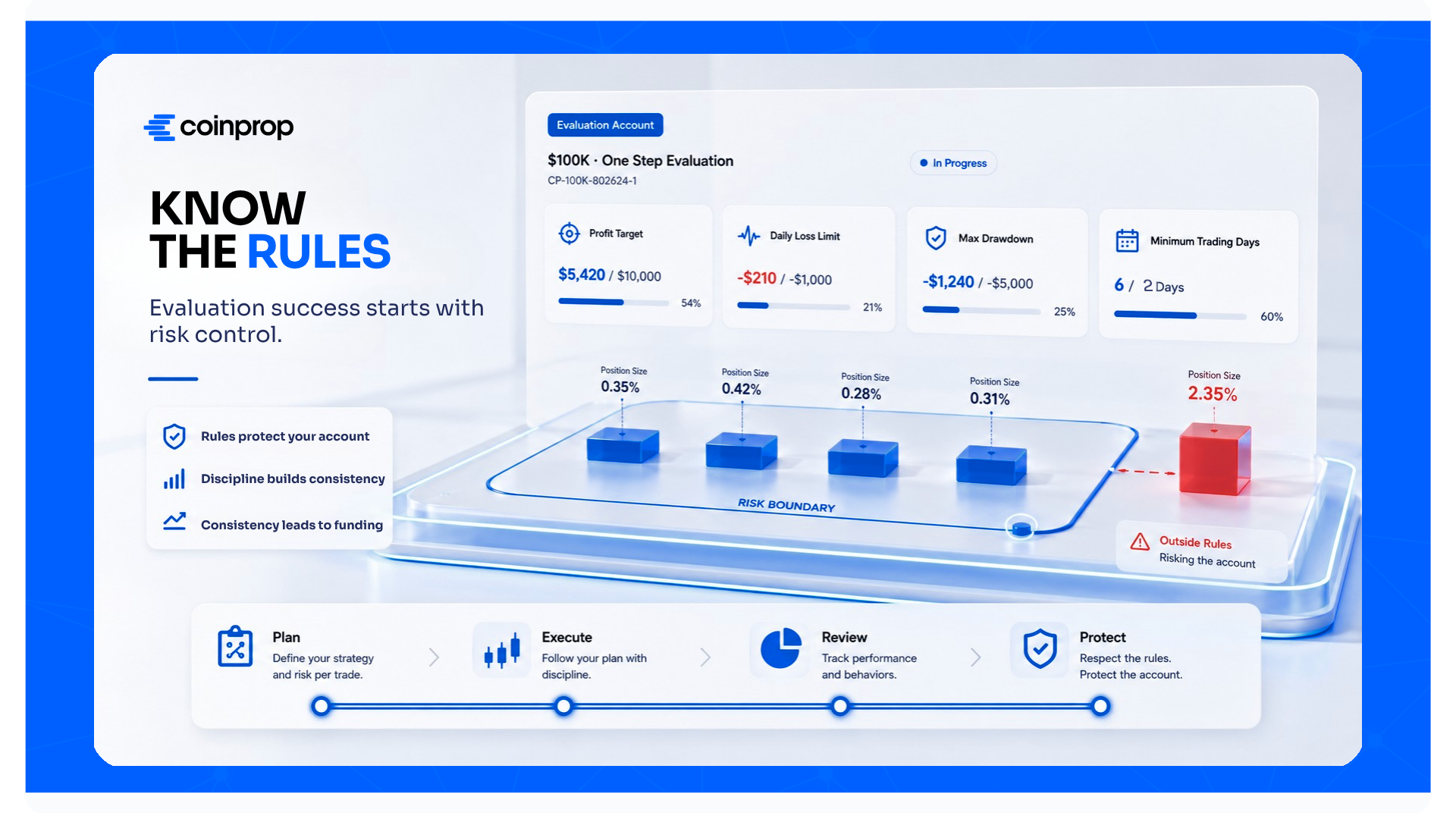
Before starting a crypto prop firm evaluation, learn exactly how the evaluation is structured and how each rule affects your account. Every crypto prop firm can use different profit targets, drawdown calculations, daily loss limits, minimum trading day requirements, and trading restrictions. A strategy that works under one firm's rules may not be suitable for another.
Don't treat the evaluation rules as terms to read after purchasing a challenge. Use them to build your trading plan before your first trade. Knowing your maximum allowable loss, required profit, and other restrictions allows you to determine appropriate position sizes, daily risk, and realistic trading objectives.
Most crypto prop firms require traders to reach a specific profit target before passing an evaluation. However, the target should be treated as an objective to reach through consistent trading rather than a number you need to hit as quickly as possible.
Start by calculating what the target means relative to the account size. For example, a 9% profit target on a $100,000 evaluation means you need to generate $9,000 in simulated profit. That does not mean you should risk a large percentage of the account on every trade to reach the target faster.
Instead, determine how much you normally risk per trade and estimate how many successful trades you would realistically need to reach the target.
For example, if your average risk is 0.5% per trade and your strategy produces a positive expectancy, you can focus on executing your setup rather than trying to make several percentage points in a single position.
When planning around the profit target:
A profit target should influence your planning, but it should never cause you to abandon the risk management system that protects your account.
Maximum drawdown is one of the most important rules to understand before entering a crypto prop firm evaluation. It determines how much your account can lose before the evaluation is considered failed.
Don't assume that a stated drawdown percentage tells you everything you need to know. Find out exactly how the firm calculates it. Some firms use a static drawdown, while others use a trailing drawdown that can move upward as your account balance or equity increases.
You should also determine whether the calculation is based on:
For example, if a $100,000 account has a 6% static maximum drawdown, the account may have a fixed $6,000 loss threshold. But a trailing drawdown can work differently because the threshold may move as the account reaches new highs.
Once you understand the calculation, translate the percentage into an actual dollar amount and build your position sizing around it. Ideally, your personal risk limit should be comfortably below the firm's maximum drawdown so that a single trade or short losing streak does not put the evaluation in danger.
A daily loss limit restricts how much you can lose during a specific trading day. This is separate from your maximum overall drawdown, so you need to understand both rules independently.
For example, if an evaluation has a 3% daily loss limit, you need to know exactly how that 3% is calculated and when the daily limit resets. Some firms may calculate the limit using the starting balance for the day, while others may use equity, balance, or another methodology.
Before trading, determine:
Then establish your own daily risk limit below the firm's maximum. For example, if the firm allows a 3% daily loss, you could decide to stop trading after reaching a 1% personal loss limit.
This creates a buffer between your trading behavior and the firm's hard failure threshold.
Most importantly, have a predefined stop trading rule. If you reach your personal daily loss limit, don't continue trading in an attempt to recover the loss. Revenge trading after a losing session can quickly turn a manageable loss into an evaluation failure.
Some crypto prop firms require traders to complete a minimum number of trading days before an evaluation can be considered complete. This requirement is designed to prevent traders from passing solely through one unusually profitable trading session.
Before starting, find out what the firm considers a trading day. In some programs, simply opening a position may count, while others may require a minimum amount of trading activity or another condition.
You should also determine whether:
Once you understand the requirement, incorporate it into your trading plan. Don't force trades simply because you need another trading day. If your strategy produces a valid setup only a few times per week, taking low quality trades just to satisfy a minimum day requirement can create unnecessary risk.
The objective is to complete the required trading days while continuing to follow your normal strategy and risk management rules.
Passing a crypto prop firm evaluation is not simply a matter of reaching the advertised profit target. You need to reach the target without violating any of the firm's other requirements.
Before starting, create a checklist containing every condition that can cause an evaluation failure. This should include the profit target, maximum drawdown, daily loss limit, minimum trading days, and any restrictions related to your trading strategy.
Also review rules covering practices such as:
Then build your trading plan around those rules.
A useful approach is to create a personal safety margin below every hard limit. If the firm allows a 6% maximum drawdown, don't design your strategy around losing 5.9%. If the daily loss limit is 3%, don't routinely risk enough to approach 3% in one session.
The goal is to make rule violations unlikely through your normal trading process.
Think of the evaluation as a test of risk management, consistency, and execution, not a race to generate the highest possible return. Once you understand every requirement and know how your strategy behaves within those limits, you can start the evaluation with a clear plan instead of trying to figure out the rules while trading.
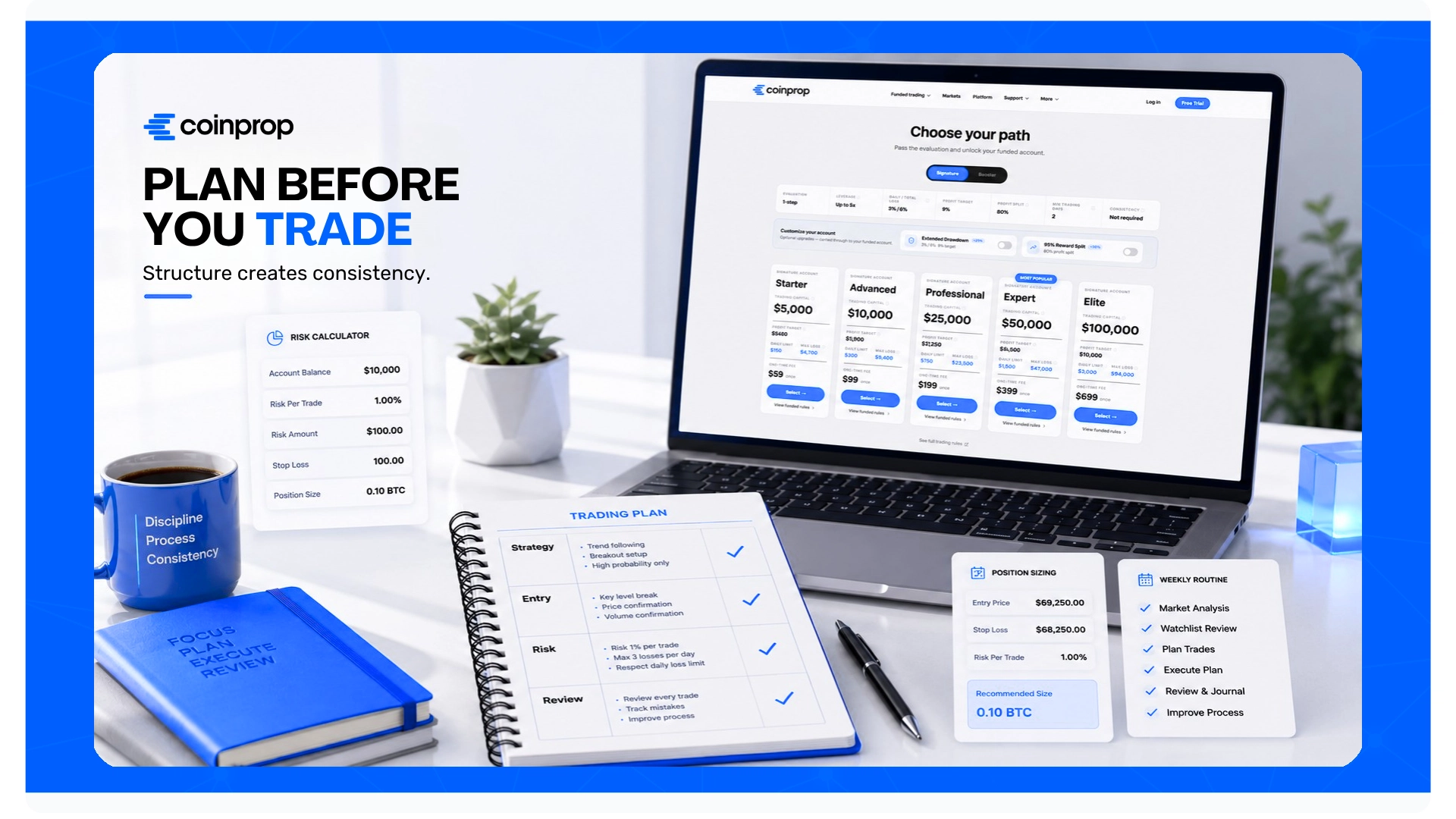
A successful crypto prop firm evaluation starts long before you place your first trade. Instead of entering the market based on intuition or changing your approach after every win or loss, create a written trading plan that defines exactly how, when, and under what conditions you will trade.
Your trading plan should connect your strategy with the specific rules of the evaluation you are taking. It should define your setups, entry and exit conditions, position sizing, daily risk limits, trading schedule, and rules for stopping. Having these decisions written down in advance reduces emotional decision making and gives you a consistent process to follow throughout the evaluation.
Start by choosing a trading strategy that matches your experience, personality, available trading time, and the markets you understand best. There is no single strategy that is best for every crypto prop trader. Trend following, breakout trading, range trading, momentum trading, and other approaches can all work when properly tested and executed.
The important point is to avoid entering an evaluation with a strategy you have not already tested.
Before choosing your primary strategy, determine:
For example, a trader who primarily trades BTC breakouts should know exactly what qualifies as a breakout before starting the evaluation. Simply deciding that a price move "looks strong" is not a repeatable strategy.
Backtest or practice your strategy over a meaningful number of trades and record the results. Look at metrics such as win rate, average risk to reward ratio, maximum losing streak, and drawdown. You don't need a perfect strategy, but you should understand its historical behavior well enough to know what to expect.
Most importantly, don't switch strategies because of a few losing trades during an evaluation. A strategy should be evaluated over a sufficient sample of trades rather than based on individual outcomes.
Once you have selected your strategy, turn it into specific entry and exit rules. Your goal should be to make it possible to determine whether a trade qualifies without relying heavily on emotions or intuition.
Define exactly what needs to happen before you enter a position. For example, your setup might require a market structure break, a specific price level, confirmation from volume, and a particular candle close. The exact conditions will depend on your strategy, but they should be objective enough to apply consistently.
Your plan should also specify:
Decide where your stop loss belongs before entering the trade rather than moving it based on fear after the position is open. The same applies to profit targets. If your strategy has a predefined exit condition, follow it instead of allowing emotions to determine when you close the position.
This creates a repeatable process: identify the setup → confirm the conditions → calculate the risk → enter → manage → exit.
Risk management should be one of the most detailed sections of your trading plan, particularly when trading under a crypto prop firm's drawdown and daily loss rules.
Start by determining your maximum risk per trade. Many traders choose to risk only a small percentage of their evaluation account on each position, leaving enough room for a series of losing trades without approaching the firm's drawdown limits.
Your plan should define:
For example, if you decide to risk 0.5% per trade, calculate your position size based on the distance between your entry and stop loss rather than choosing a position size first and then determining how much you could lose.
Your personal risk limits should also be lower than the firm's hard limits. If the evaluation allows a 3% daily loss, you don't need to use the entire 3% as your personal trading allowance. Creating a buffer gives you room to make mistakes without immediately violating the firm's rules.
Also define what happens after a losing streak. For example, you might reduce your position size after several consecutive losses or stop trading for the day after reaching your personal loss limit.
A good risk management plan should make it difficult for one bad trade, emotional decision, or losing session to destroy the entire evaluation.
A trading plan becomes much more effective when it is supported by a consistent trading routine. Instead of opening your platform and immediately looking for trades, establish a repeatable process before, during, and after each trading session.
Your pre trading routine can include:
During the session, focus only on setups that meet your predefined criteria. Avoid constantly switching between markets simply because another cryptocurrency is moving faster.
After the session, review your execution rather than focusing only on whether you made money. A profitable trade that violated your plan is still a trading mistake, while a losing trade that followed your rules can be a perfectly valid outcome.
Your routine should also account for the 24/7 nature of cryptocurrency markets. You don't need to trade constantly simply because crypto markets are always open. Define the hours or market conditions in which you are most comfortable trading and avoid taking low quality setups outside that schedule.
A trading journal turns your individual trades into useful data. Record every trade consistently so you can identify whether your results are coming from a repeatable process or from random outcomes.
At a minimum, record:
Screenshots of your chart before and after the trade can also be extremely useful. They allow you to compare what you saw before entering with what actually happened afterward.
Don't only review your journal after losing trades. Review your results regularly and look for patterns across a larger sample of trades. You may discover, for example, that a particular setup performs better during trending markets, that you consistently enter too early, or that your performance deteriorates after several consecutive trades.
Use these findings to make small, data based improvements to your trading plan rather than changing your entire strategy after a few losses.
The objective of a trading journal is not simply to document whether you passed an evaluation. It is to create a feedback loop:
Plan → Trade → Record → Review → Improve → Repeat.
That process can help you develop the consistency and discipline required not only to pass a crypto prop firm evaluation, but also to maintain the same trading behavior after receiving a funded account.
Many traders fail their first crypto prop firm evaluation not because they lack market knowledge, but because they make avoidable mistakes in risk management, execution, and discipline. A strategy can be profitable and still fail an evaluation if the trader uses excessive leverage, overtrades after a loss, or violates a firm's drawdown and daily loss limits.
Learning these mistakes before starting can help you build better trading habits from the beginning. Instead of trying to maximize profits during an evaluation, focus on protecting your drawdown, following your trading plan, and making decisions consistently.
One of the most common mistakes in crypto prop trading is risking too much on a single position. Traders who want to reach the profit target quickly may increase their position size or use excessive leverage, but one losing trade can then consume a significant portion of their available drawdown.
Start by deciding how much you are willing to lose on a single trade before entering the position. Then calculate your position size based on your stop loss distance and predetermined risk rather than choosing a large position first.
For example, if your trading plan allows you to risk 0.5% per trade, that percentage should remain relatively consistent regardless of how confident you feel about a particular setup. A high conviction trade should not automatically become a high risk trade.
To avoid excessive risk:
The objective is to make sure that a single trade cannot significantly damage your evaluation. Consistent small risks give your strategy enough opportunities to prove itself.
A losing trade can create an emotional urge to immediately make the money back. This often leads to revenge trading, where a trader enters positions that would not normally meet their strategy's criteria.
Overtrading can also happen after winning trades. A trader may become overconfident and start taking setups that are weaker than their normal criteria because they feel they have "room" to take more risk.
To prevent this, establish clear rules for when you will and will not trade. For example, you can define a maximum number of trades per session, a personal daily loss limit, and specific conditions that require you to stop trading.
After a loss, ask:
If the trade was valid and simply resulted in a normal losing outcome, there may be nothing to fix. Take the loss, record it in your journal, and wait for the next valid setup.
If you reach your personal daily loss limit, stop trading. Don't allow the desire to recover a loss to turn a normal losing session into an evaluation failure.
No legitimate trading strategy wins every trade. Even a strategy with a positive long term expectancy will experience losing trades and losing streaks.
A common mistake among new prop traders is changing strategies immediately after a few losses. They may move from breakout trading to trend following, then switch to scalping or another approach without collecting enough data to determine whether any of the strategies actually work.
Instead, define your strategy before starting the evaluation and give it a meaningful sample of trades. Track its results and evaluate the data rather than judging the strategy based on individual outcomes.
When reviewing your strategy, look at:
A losing streak does not automatically mean that your strategy is broken. However, if your data consistently shows that the strategy has negative expectancy or performs poorly under the conditions you trade, then it may need to be adjusted.
The key is to change your strategy based on evidence, not emotion.
Many traders spend most of their time searching for better indicators, more accurate entries, or the next profitable setup while treating risk management as an afterthought.
In a crypto prop firm evaluation, this can be particularly dangerous because your objective is not simply to predict the market correctly. You must generate returns while staying within predefined risk limits.
Before every trade, know:
Your risk management plan should also account for correlated positions. For example, holding several highly correlated altcoin positions can create much more exposure than the individual risk of each trade suggests.
Avoid treating leverage as additional risk capacity. Higher leverage allows you to control a larger position, but it does not make the underlying trade safer.
The goal is to build a system where risk is controlled before the trade is opened, rather than trying to manage excessive risk after the market has already moved against you.
One of the biggest psychological mistakes is treating the evaluation as a race to reach the profit target. This mindset can encourage traders to increase risk, overtrade, or abandon their strategy as they get closer to the target.
Instead, treat the evaluation as a test of whether you can consistently execute a professional trading process under predefined constraints.
Your priorities should be:
A trader who passes an evaluation through excessive risk may struggle to maintain the account afterward. On the other hand, a trader who develops disciplined habits during the evaluation is better prepared for the responsibilities of managing a funded account.
The ultimate goal of crypto prop trading is not simply to pass one challenge. It is to develop a repeatable process that allows you to manage risk, execute your strategy, and remain consistent over the long term. When you focus on building those habits first, passing the evaluation becomes a consequence of good trading rather than the only objective.
Starting crypto prop trading is more than simply joining a prop firm or passing an evaluation. It requires developing the right trading skills, choosing a reputable crypto prop firm, understanding the evaluation process, following a disciplined trading plan, and managing risk consistently throughout your journey.
While becoming a funded trader is an important milestone, long term success comes from treating trading as a professional skill rather than a shortcut to quick profits. The traders who succeed are those who remain patient, follow their strategy, and continuously improve their performance over time.
If you're ready to take the next step, compare different crypto prop firms, understand their funding models, and choose the one that best fits your trading style and goals before starting your evaluation.
Yes. Beginners can start crypto prop trading, but they should first develop a solid understanding of market structure, technical analysis, risk management, and trading psychology. Choosing a best crypto prop firm for beginners can also make it easier to find an evaluation with rules and conditions that match a new trader’s experience level.
Can I Start Crypto Prop Trading Without My Own Capital?
Yes. One of the main advantages of crypto prop trading is that you don't need a large personal trading account to access significant capital. Most crypto prop firms require you to pass an evaluation or purchase an instant funding program before providing access to firm capital.
The amount depends on the crypto prop firm and the funding program you choose. Most firms charge an evaluation fee based on the account size, allowing traders to access much larger trading capital without funding the account themselves.
No, professional trading experience is usually not required. However, having a proven trading strategy, understanding risk management, and maintaining consistent trading discipline can greatly improve your chances of passing the evaluation.
Compare each firm's evaluation model, trading rules, drawdown limits, profit split, payout policies, supported platforms, and overall reputation. The right crypto prop firm should align with your trading style, experience level, and long term goals.
Yes. Many traders successfully complete prop firm evaluations while trading part time. Consistency, discipline, and following your trading plan are far more important than the number of hours you spend trading each day.
An evaluation requires traders to demonstrate consistent performance and follow risk rules before receiving firm capital. Instant funding provides immediate access to a funded account but usually involves a higher upfront cost and different trading conditions. The right option depends on your experience, budget, and trading objectives.
Before starting crypto prop trading, you should learn the fundamentals of market structure, technical analysis, risk management, and trading psychology. It's also important to develop a consistent trading strategy, understand how crypto prop firm evaluations work, and practice following risk rules before taking a paid evaluation.
The most common mistakes include trading without a plan, risking too much on individual trades, ignoring risk management rules, changing strategies too often, and letting emotions influence trading decisions. Many beginners also rush into a prop firm evaluation before they're fully prepared instead of practicing first and building consistent trading habits.
