A daily loss limit in a crypto prop firm sets the maximum amount a trader can lose during a single trading day before breaching account rules. While the concept appears simple, many traders misunderstand how daily loss limits are calculated, how open positions impact their remaining risk, and how these rules differ from maximum drawdown. This guide explains how daily loss limits work, how they are commonly calculated by prop firms, and what traders can do to avoid costly violations.
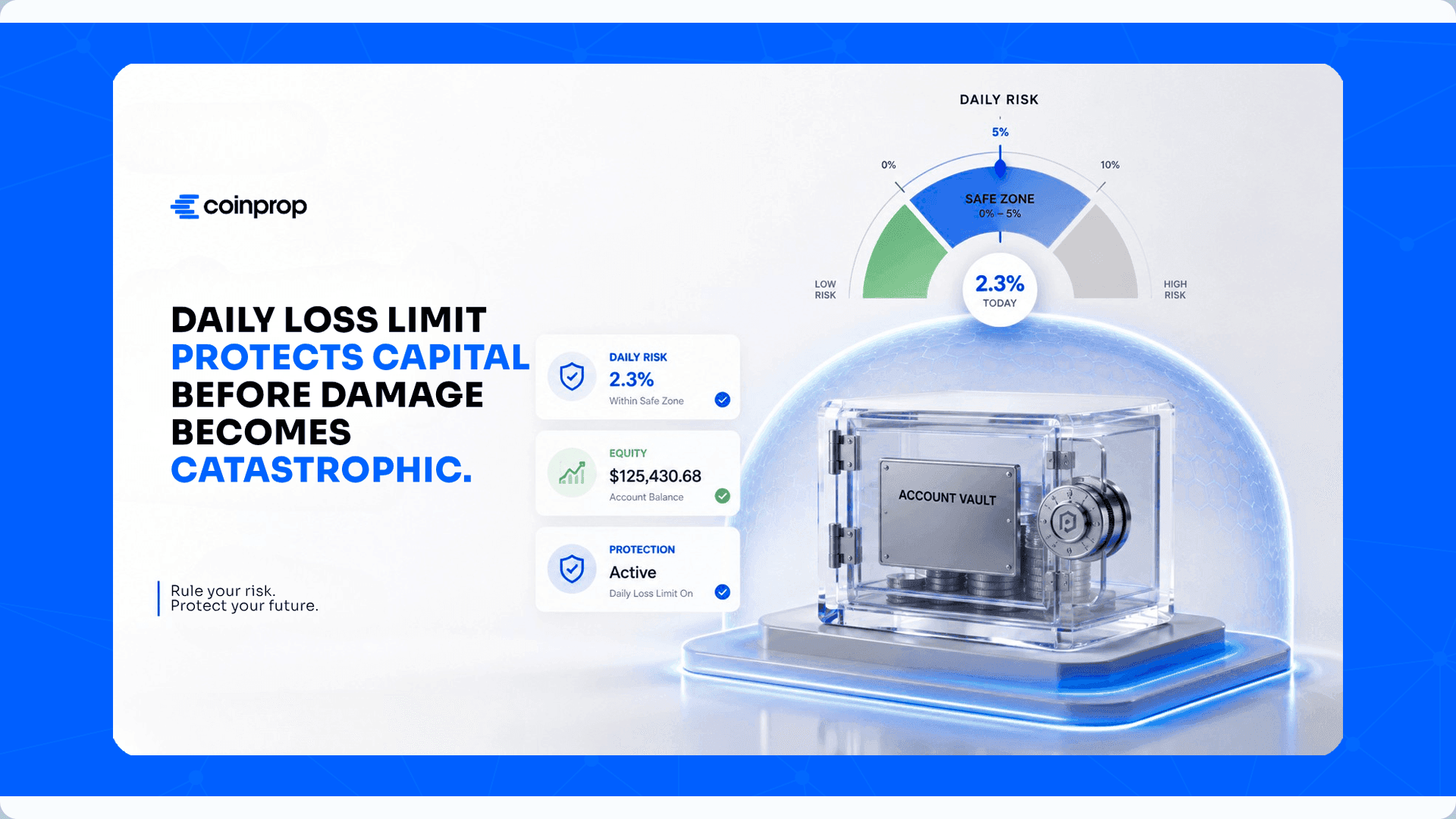
A daily loss limit is a risk management rule used by crypto prop firms to define the maximum amount a trader can lose within a single trading day. If the account reaches or exceeds this limit, it is considered a rule violation, regardless of whether the trader was previously profitable or still had room remaining under the account’s overall drawdown limit.
Daily loss limits are designed to prevent excessive losses from occurring in a short period of time. Rather than allowing traders to continue trading after significant drawdowns,crypto prop firms establish a daily threshold that helps control risk and encourage consistent trading behavior.
While the exact calculation method varies between firms, the core principle remains the same: once losses exceed the permitted daily amount, the account breaches the firm's risk rules.
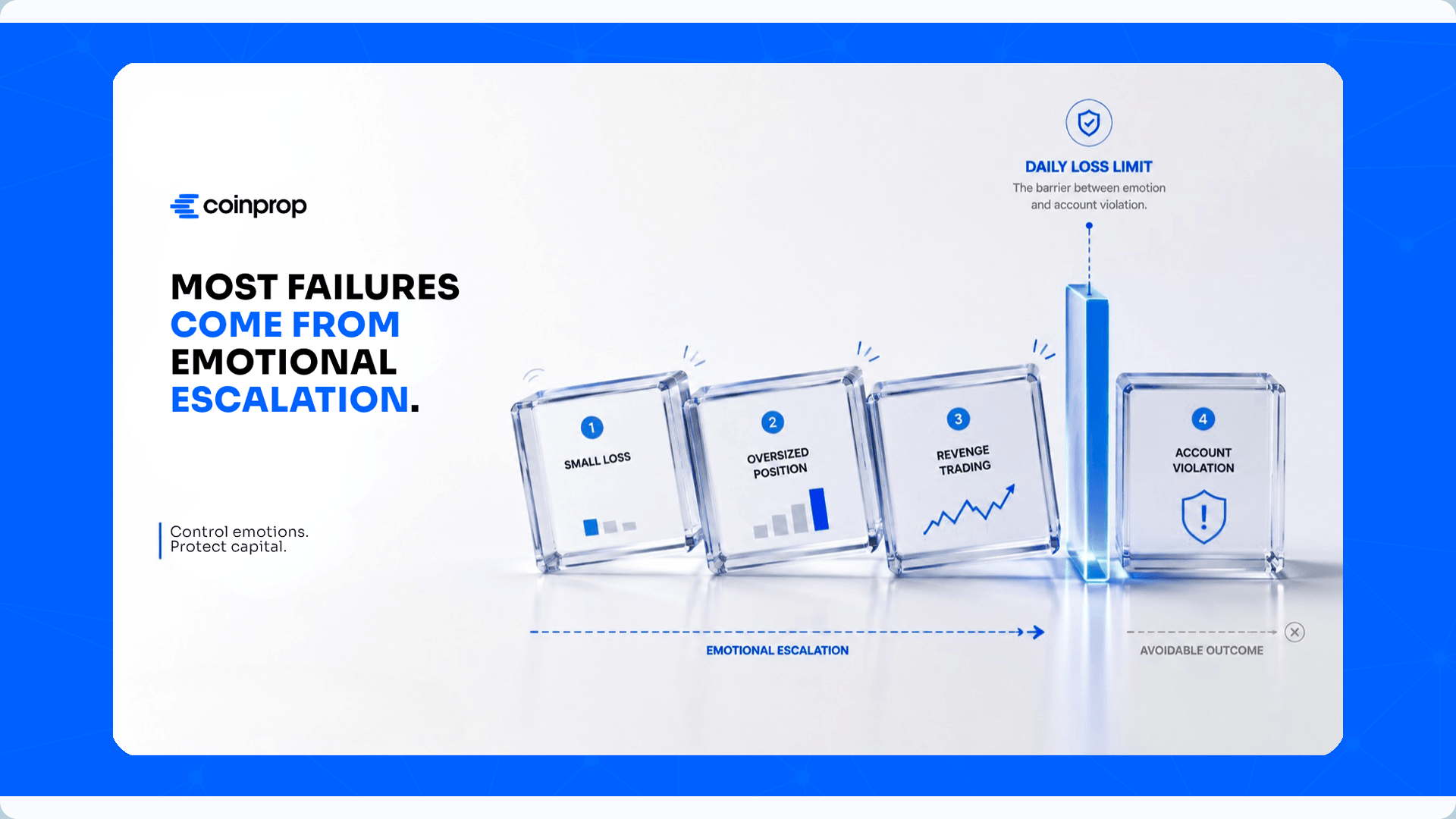
A daily loss limit is the maximum amount of equity a trader is allowed to lose during a 24-hour trading period.
This limit may be expressed as a percentage of the account size or as a fixed dollar amount derived from the initial balance. Depending on the firm's model, the calculation may be based on account balance, account equity, or a combination of both.
For example, if a prop firm offers a $100,000 account with a 5% daily loss limit, the trader may lose up to $5,000 during a single trading day. If losses exceed that threshold, the account violates the firm's rules.
An important detail is that many crypto prop firms calculate drawdown based on equity rather than balance. This means unrealized losses from open positions may count toward the daily loss limit even before a trade is closed. As a result, traders must monitor both their closed losses and their floating losses throughout the day.
Because cryptocurrency markets operate 24 hours a day, firms also establish a specific reset time, commonly based on UTC, to determine when a new daily loss cycle begins.
Daily loss limits exist because protecting capital is the primary objective of every prop firm.
A prop firm's business model depends on controlling downside risk across thousands of trader accounts. Without structured risk limits, a single period of emotional or reckless trading could result in disproportionate losses.
From a firm's perspective, daily loss limits help standardize risk across all traders. Regardless of trading style, experience level, or account size, every trader must operate within predefined risk boundaries.
For traders, daily loss limits create a framework that encourages discipline and consistency. They reduce the temptation to recover losses through aggressive position sizing, revenge trading, or excessive leverage after a losing streak.
Many evaluation failures occur not because traders are unable to generate profits, but because they violate risk rules while attempting to recover from temporary setbacks. A daily loss limit helps prevent these situations by forcing traders to stay within acceptable risk parameters.
In practice, the rule encourages traders to focus on long-term consistency rather than short-term recovery attempts, which is often a critical factor in successfully passing a prop firm evaluation.
Daily loss limits serve as a protective mechanism for both the trader and the prop firm.
For prop firms, the benefit is straightforward. The rule limits the amount of capital that can be lost within a single trading session, reducing the impact of unexpected market volatility, poor decision-making, or extreme leverage.
For traders, the protection is often less obvious but equally important.
One of the most common reasons traders fail evaluations is not a lack of profitable strategies. Instead, accounts are frequently lost after a series of emotional decisions following an initial loss. Traders may increase position sizes, remove stop losses, or take low-quality setups in an attempt to recover quickly. Daily loss limits interrupt this cycle before losses become catastrophic.
The rule also helps traders maintain consistent risk exposure. By knowing exactly how much risk is available each day, traders can structure position sizes more effectively, manage drawdown more responsibly, and avoid situations where a single trade jeopardizes the entire account.
In the crypto market, where volatility can increase dramatically within minutes, daily loss limits become even more important. Sudden price movements, liquidity shifts, and leveraged positions can create losses much faster than in many traditional markets. A clearly defined daily loss limit provides a safeguard against these risks while encouraging a more professional approach to capital management.
Ultimately, daily loss limits are not designed to restrict profitable traders. Their purpose is to preserve capital, enforce disciplined trading behavior, and create a sustainable environment where both traders and prop firms can manage risk effectively.
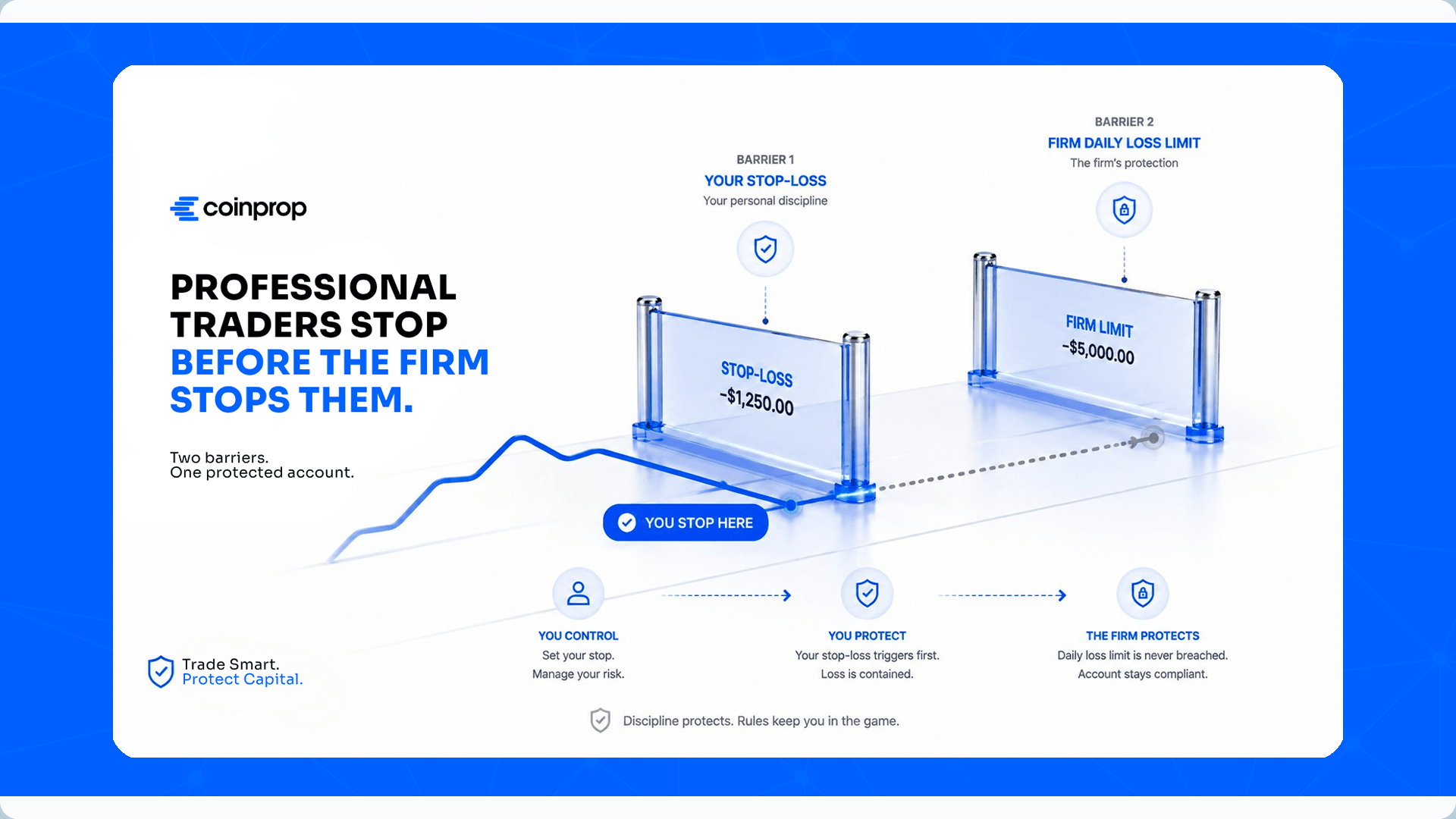
Although the concept of a daily loss limit appears straightforward, the way it is calculated can vary significantly between crypto prop firms. Some firms use fixed limits based on the initial account balance, while others use dynamic models that adjust as account equity changes. Certain firms calculate losses using account balance only, whereas others include unrealized losses from open positions.
Understanding these differences is essential because two firms may advertise the same daily loss limit percentage while enforcing it in completely different ways. Traders who fail to understand how their firm's risk model works often breach the rules unintentionally, especially when managing multiple positions or holding trades through periods of increased volatility.
Daily loss limits are just one component of a broader risk framework. Traders can learn more about risk management in crypto prop firms and how different firms structure their risk controls.
The terms daily loss limit and daily drawdown are often used interchangeably, but they do not always describe the same risk model.
A daily loss limit generally refers to the maximum amount a trader can lose during a single trading day before violating account rules. The limit is usually expressed as either a percentage or a fixed dollar amount.
Daily drawdown refers more broadly to the decline in account equity during a specific day. In some firms, the daily drawdown and daily loss limit are effectively the same rule. In others, daily drawdown may follow a more complex calculation that adjusts throughout the day based on account performance.
The distinction becomes important when comparing prop firms because the calculation method determines how much risk is actually available to the trader.
A fixed daily loss limit uses a predefined loss amount that does not change over time.
For example, a $10,000 account with a 3% daily loss limit may allow a maximum daily loss of $300. Regardless of whether the account grows to $11,000 or falls to $9,500, the loss amount itself remains fixed at $300.
This structure offers transparency because traders always know the exact amount of daily risk available. The calculation is straightforward, making it easier to plan position sizes and manage overall exposure.
Many traders prefer fixed daily loss limits because they are predictable and do not become more restrictive after profitable trading periods.
A dynamic daily loss limit adjusts according to account performance or changing equity levels.
Under this model, the daily loss threshold may increase as the account grows and decrease when account equity declines. The goal is to maintain risk limits that remain proportional to the current size of the account.
Dynamic systems are often considered more responsive to account performance, but they can also be more difficult to monitor. Traders must continuously track how their available risk changes as equity fluctuates.
Without a clear understanding of the firm's calculation method, dynamic daily loss limits can lead to unexpected rule violations, particularly during periods of high volatility.
A balance-based daily loss limit calculates risk using the account balance rather than current equity.
Under this approach, only closed trades affect the calculation. Open positions that are currently showing unrealized losses do not impact the daily loss limit until the trades are closed.
For example, a trader could have a floating loss of $1,000 on an open position without immediately affecting a balance-based daily loss calculation. The loss would only count once the trade is exited and the loss becomes realized.
Balance-based systems are generally easier to understand because traders only need to track completed trading results. However, they may not reflect the account's true risk exposure while positions remain open.
An equity-based daily loss limit uses real-time account equity rather than balance.
Equity represents the account balance plus any unrealized profits or losses from open positions. Because equity changes continuously as the market moves, the daily loss calculation updates in real time.
This means a trader can violate the daily loss limit even if no trades have been closed. If an open position moves far enough into loss, the account's equity may fall below the permitted threshold and trigger a rule violation.
Many crypto prop firms prefer equity-based calculations because they provide a more accurate picture of actual account risk. Since cryptocurrency markets can experience rapid price movements, monitoring equity helps prevent excessive exposure from developing through large floating losses.
Understanding the difference between realized and unrealized losses is critical when managing a prop firm account.
A realized loss occurs when a trade has been closed at a loss. The result is permanently reflected in the account balance.
An unrealized loss, sometimes called a floating loss, occurs when an open trade is currently losing money but has not yet been closed.
The treatment of unrealized losses depends on the firm's risk model. In balance-based systems, unrealized losses may not count toward the daily loss limit until the position is closed. In equity-based systems, unrealized losses are included immediately because they affect account equity in real time.
This distinction is one of the most common causes of rule violations. Traders often focus on closed losses while overlooking the impact of floating positions that continue moving against them.
For this reason, successful prop traders monitor overall equity exposure rather than relying solely on account balance.
Daily loss limits are measured over a defined trading day and reset according to the firm's specified schedule.
Most crypto prop firms use a fixed daily reset time, often based on Coordinated Universal Time (UTC). At the reset, the system establishes the reference point used to calculate the next day's allowable loss.
The exact reset mechanism depends on the firm's risk model. Some firms use the account balance at the start of the day, while others use a snapshot of the trader's current equity. This distinction can significantly affect how much risk is available during the following trading session.
Because cryptocurrency markets operate continuously without traditional market closes, understanding the reset time is particularly important. Holding positions through a daily rollover can affect available drawdown, daily loss calculations, and overall account risk.
Before trading with any crypto prop firm, traders should understand not only the size of the daily loss limit but also exactly when and how the limit resets. These details often determine how much flexibility is available when managing open positions across multiple trading sessions.
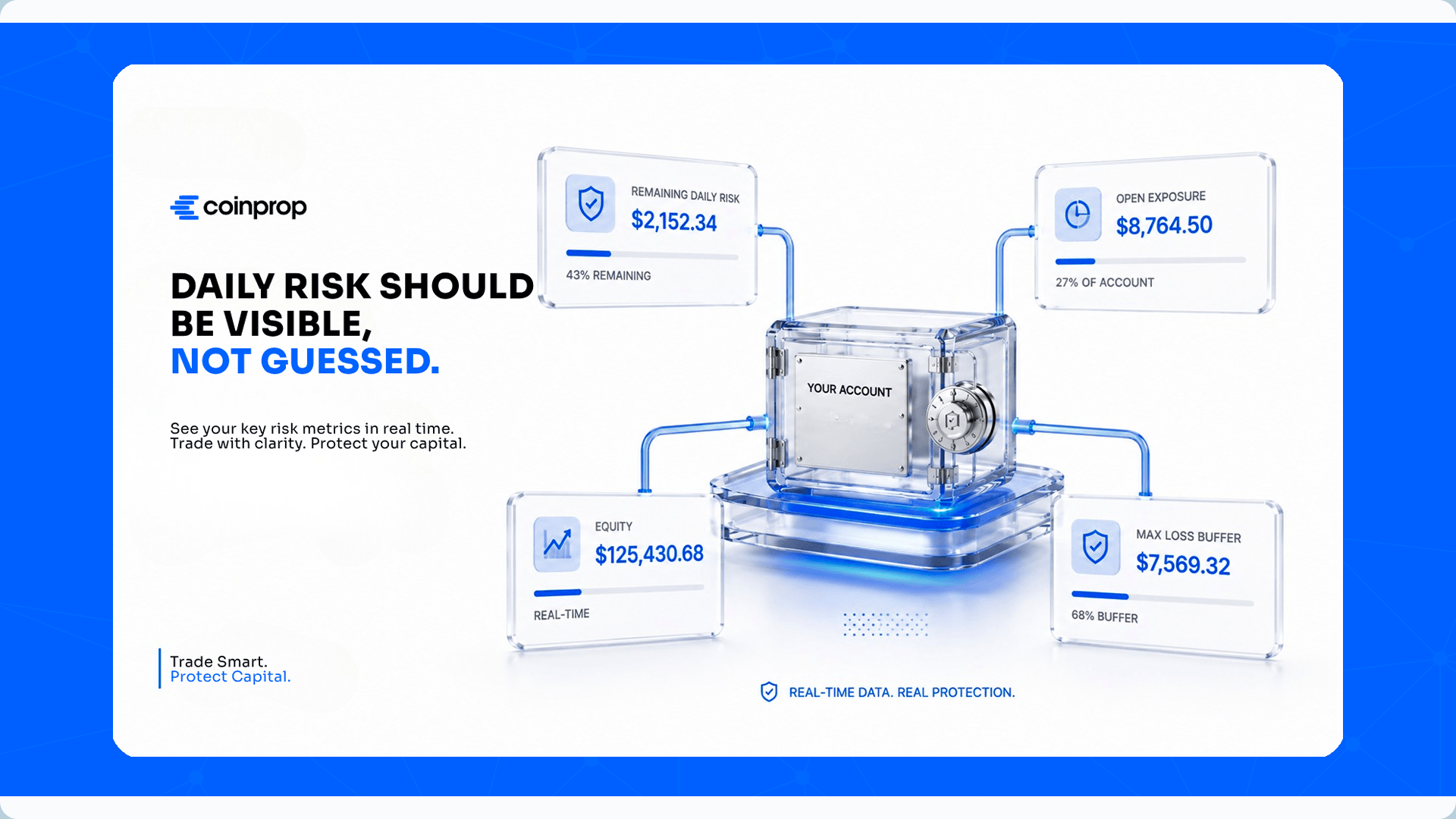
Understanding how a daily loss limit is calculated is just as important as knowing the percentage itself. Two prop firms may both advertise a 5% daily loss limit, yet the amount of risk available to traders can differ significantly depending on the calculation method.
Some firms calculate daily loss limits using the account's starting balance, while others rely on real-time equity. In addition, the treatment of open positions and unrealized losses can dramatically affect how much room a trader actually has before violating account rules.
Because daily loss limits are one of the most common causes of evaluation failures, traders should fully understand how their firm's drawdown model works before placing trades.
One of the simplest approaches is calculating the daily loss limit as a fixed percentage of the account's initial balance.
Under this model, the maximum daily loss amount remains constant regardless of whether the account is currently profitable or losing. The percentage is determined when the account is created and does not change unless the firm's rules specifically allow it.
For example, consider a $100,000 account with a 5% daily loss limit:
In this scenario, the trader can lose up to $5,000 during a single trading day before breaching the firm's risk rules.
The primary advantage of this method is simplicity. Traders always know exactly how much risk is available, making position sizing and daily risk planning more predictable.
Some prop firms use this fixed-dollar approach because it creates a clear and transparent risk framework that remains consistent throughout the evaluation process.
Many crypto prop firms use equity-based calculations instead of relying solely on account balance.
Equity represents the actual value of the trading account at any given moment, including both closed and open positions. Because equity changes continuously as market prices move, the daily loss calculation may also change depending on the firm's risk model.
For example, imagine a trader begins the day with:
The daily loss floor would be set at $9,700.
If the trader generates profits and account equity increases to $10,500 by the next daily rollover, the reference point may change depending on the firm's rules. Some firms will calculate the next day's allowable loss using the updated equity value, while others continue using the original balance.
Equity-based systems are often considered more accurate because they reflect real-time account risk rather than relying only on completed trades.
However, they also require traders to pay closer attention to floating profits and losses throughout the trading day.
Open positions can have a significant impact on daily loss calculations, particularly when a prop firm uses an equity-based model.
When a trade is open, its profit or loss remains unrealized. Although the position has not been closed, the market value of the trade still affects account equity.
As a result, a trader may violate a daily loss limit even if no losing trades have been closed.
For example, assume a trader has:
The trader opens a position that temporarily moves against them by $350.
Even though the trade remains open, account equity falls to $9,650. Because the equity has dropped below the allowed threshold, the account may immediately breach the daily loss limit.
This is one of the most misunderstood aspects of prop firm risk management. Many traders focus only on realized losses and fail to monitor the effect of floating drawdown on their available risk.
For this reason, professional traders typically track both closed losses and unrealized exposure throughout the trading session.
While every firm has its own rule set, most daily loss limits fall into one of several common calculation models.
Fixed Balance-Based Daily Loss Limit
The allowable loss is calculated from the account's initial balance and remains unchanged over time. This is one of the easiest models for traders to understand because the maximum daily loss amount never changes.
Balance-Based Daily Drawdown
The daily limit is measured using account balance, meaning only closed trades affect the calculation. Open positions do not contribute until the trades are closed.
Equity-Based Daily Loss Limit
The calculation uses real-time account equity. Both realized and unrealized losses count toward the limit, making risk management more dynamic.
Daily Equity Snapshot Model
Some firms take a snapshot of account equity at a specific time each day and use that value as the reference point for the next trading session. A fixed loss amount is then deducted from the snapshot equity to create the daily loss floor.
For example, if account equity is $10,600 at the daily rollover and the firm's fixed daily loss limit is $300, the trader's loss floor for the next day would be $10,300.
Trailing Daily Drawdown
A smaller number of firms use trailing daily drawdown models. In these systems, the allowable loss threshold may rise as account performance improves, reducing available risk after profitable periods. Traders must carefully monitor these models because the drawdown floor can become more restrictive over time.
Regardless of which model a prop firm uses, the most important factor is understanding exactly how the daily loss limit is measured. Knowing whether the calculation is based on balance, equity, snapshots, or trailing drawdown can prevent unnecessary violations and help traders manage risk more effectively.
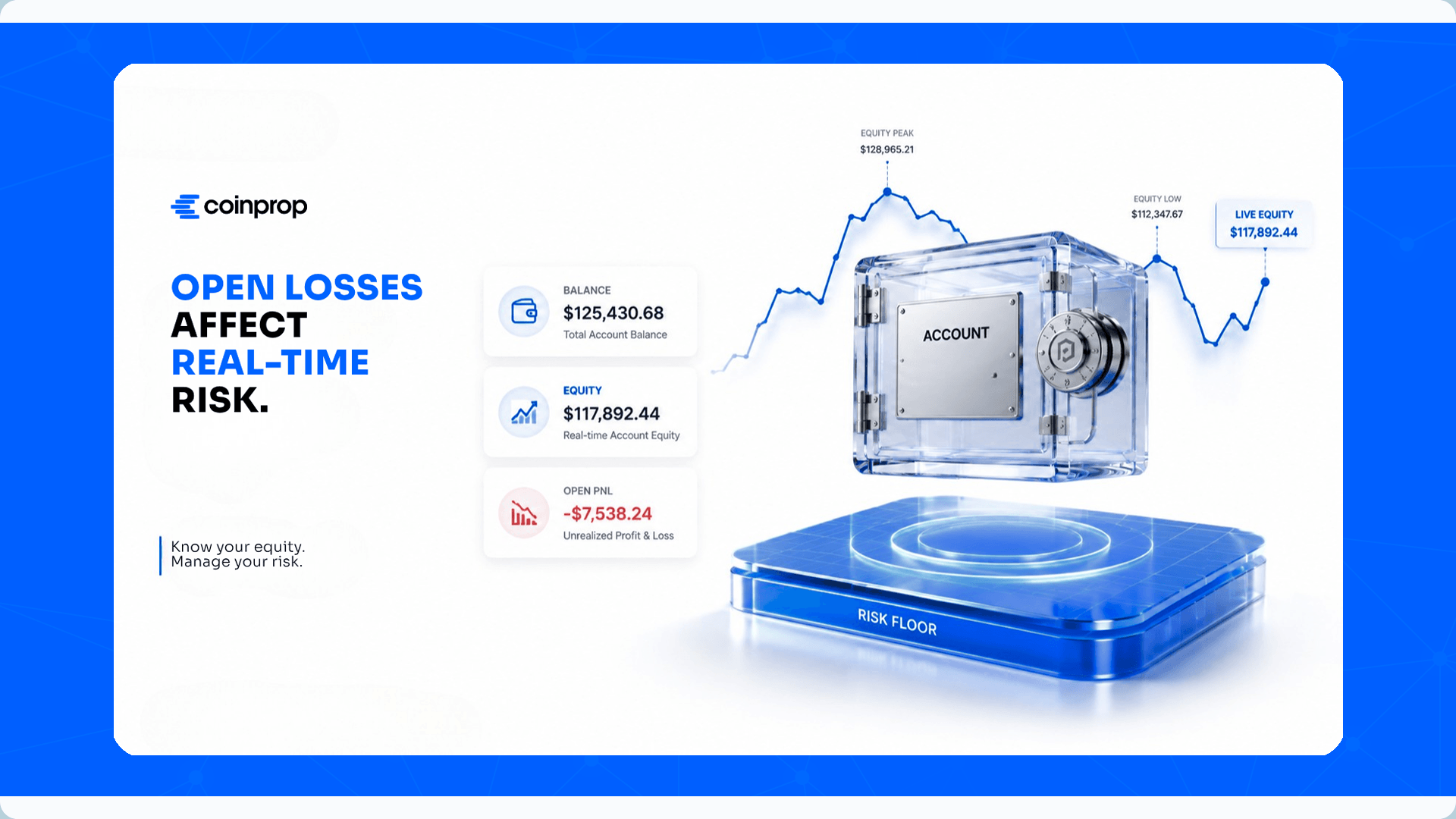
Understanding the theory behind daily loss limits is important, but practical examples make the concept much easier to apply. The following scenarios demonstrate how daily loss limits work in real trading situations and show how both closed and open losses can affect a prop firm account.
While every prop firm uses its own calculation method, these examples illustrate the most common situations traders encounter when managing risk under daily loss limit rules.
Assume a trader receives a $10,000 crypto prop firm account with a daily loss limit of 3%.
The maximum allowable daily loss would be:
This means the trader cannot lose more than $300 during a single trading day without violating the firm's risk rules.
If the trader starts the day with $10,000 in equity, the daily loss floor would be:
As long as account equity remains above $9,700, the account stays within the permitted risk limits.
Consider a trader operating under the same $10,000 account with a $300 daily loss limit.
During the trading session, the trader closes several losing positions:
Trade
Result
Trade 1
-$120
Trade 2
-$90
Trade 3
-$70
Total realized loss:
At this point, the trader remains within the daily loss limit because total losses are still below $300.
The trader then enters another position and closes it for a loss of $40.
Updated daily loss:
Because the total daily loss exceeds the $300 limit, the account has breached the firm's daily loss rule.
Even if future trades would have recovered those losses, the violation occurs as soon as the account exceeds the permitted threshold.
One of the most common mistakes among prop traders involves underestimating the impact of unrealized losses.
Assume the same account starts the day with:
The trader opens a highly leveraged Bitcoin position.
Initially, the position moves slightly against them:
The account remains safe because equity is still above the daily loss floor.
However, market volatility increases and the floating loss expands to:
Even though the trade remains open and has not been closed, the account's equity has fallen below the permitted daily loss threshold.
In an equity-based drawdown model, this would trigger a daily loss limit violation immediately.
This example highlights why traders should monitor overall equity rather than focusing only on closed trades. Open positions can create rule violations long before losses become realized.
Most crypto prop firms reset daily loss calculations at a specific time each day, often based on UTC.
Assume a trader finishes the day with:
If the firm's daily loss amount remains fixed at $300, the next day's loss floor may be recalculated using the updated equity snapshot.
At the daily reset:
For the next 24-hour trading period, account equity must remain above $10,300.
Now consider a different scenario.
The trader finishes another day with:
The new daily floor becomes:
This example demonstrates how daily reset mechanisms can change available risk from one trading session to the next.
Understanding when resets occur and how the new daily loss floor is calculated is critical for traders who hold positions overnight or trade continuously in the 24/7 cryptocurrency market. A trader who ignores rollover calculations may believe sufficient risk remains available when, in reality, the daily loss threshold has already changed.
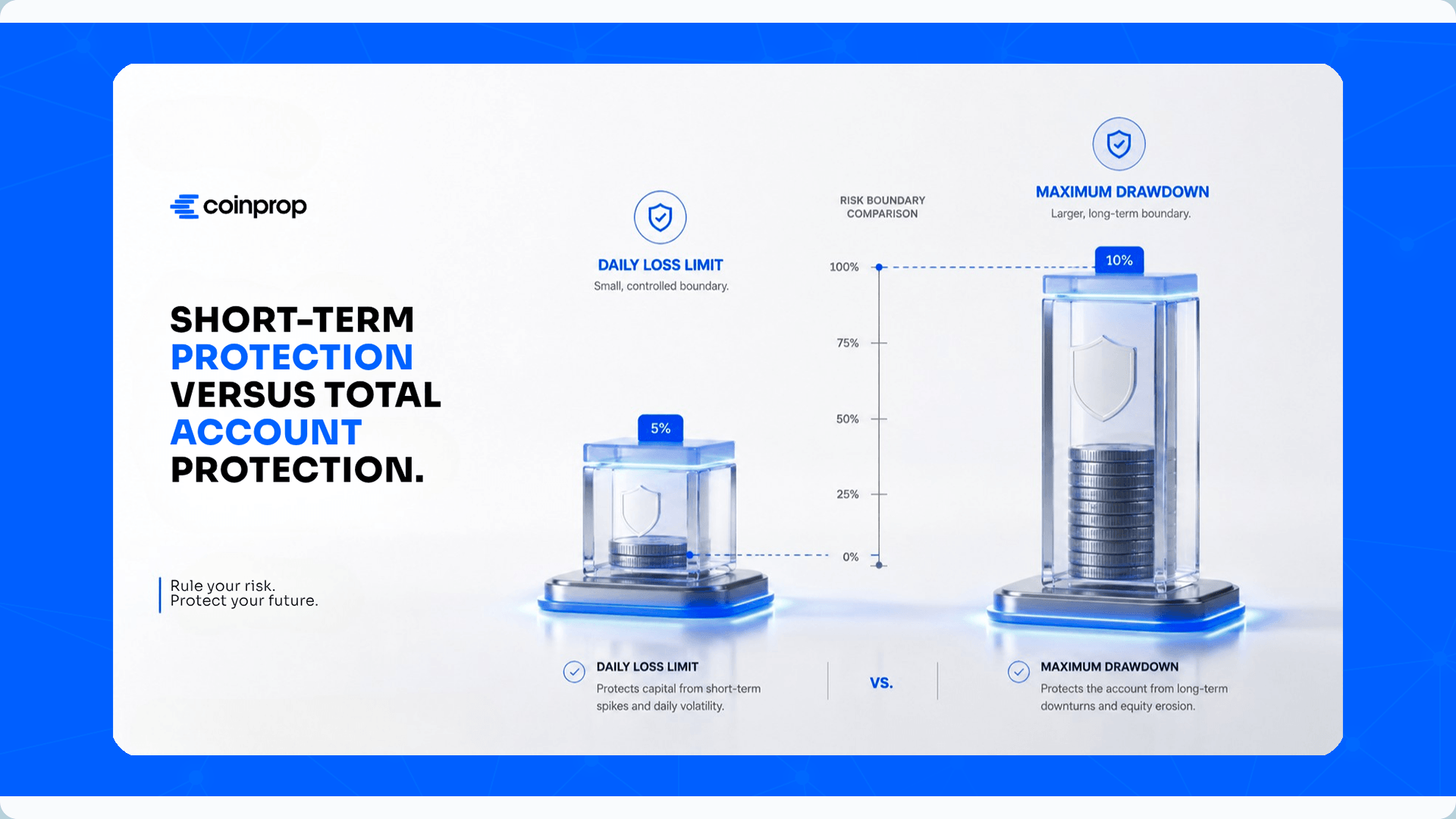
Daily loss limits and maximum drawdown are two of the most important risk management rules used by crypto prop firms. While they are often mentioned together, they serve different purposes and are calculated differently.
Many traders understand one rule but misunderstand the other, which can lead to unexpected account violations. A trader may stay comfortably within the maximum drawdown limit while still breaching the daily loss limit, or vice versa.
To manage risk effectively, it is important to understand how these two rules work together and why prop firms enforce both.
Maximum drawdown is the largest total loss an account can sustain before violating the firm's overall risk limits.
Unlike a daily loss limit, which applies to a single trading day, maximum drawdown applies to the entire life of the account. It acts as the ultimate loss threshold that cannot be breached under any circumstances.
For example, suppose a trader receives a $100,000 account with a maximum drawdown of 6%.
The maximum allowable loss would be:
This means the account's equity cannot fall below $94,000.
As long as the account remains above that level, the trader stays within the firm's overall risk requirements.
The exact implementation varies among prop firms. Some use fixed drawdown models that remain anchored to the initial balance, while others use trailing drawdown systems that adjust as account equity increases. Understanding which model a firm uses is essential because the available risk can differ significantly between the two approaches.
Although both rules are designed to limit losses, they monitor different aspects of trading performance.
A daily loss limit controls how much can be lost within a single trading day. Once the day ends and the next trading period begins, a new daily loss calculation is typically established according to the firm's rules.
Maximum drawdown, on the other hand, measures cumulative account losses over time. It does not reset each day and remains active throughout the evaluation or funded account.
The following comparison highlights the main differences:
Feature
Daily Loss Limit
Maximum Drawdown
Purpose
Controls daily risk
Controls total account risk
Time Period
Single trading day
Entire account lifetime
Reset Schedule
Usually resets daily
Does not reset
Focus
Short-term risk control
Long-term capital preservation
Violation Trigger
Excessive losses in one day
Excessive cumulative losses
Typical Size
Smaller
Larger
A useful way to think about these rules is that the daily loss limit protects against sudden short-term losses, while maximum drawdown protects against long-term account deterioration.
For example, a trader might have:
The trader could lose $2,500 on Monday, $2,000 on Tuesday, and $1,000 on Wednesday without violating the daily limit on any individual day. However, the combined losses would total $5,500, placing the account dangerously close to the maximum drawdown threshold.
Conversely, a trader could violate the daily loss limit in a single session even while remaining far above the maximum drawdown floor.
This is why both rules must be monitored simultaneously.
While both rules are responsible for failed evaluations, daily loss limits typically cause more account violations than maximum drawdown.
The reason is simple: daily loss limits are easier to breach during emotional trading.
After taking a loss, traders often attempt to recover quickly by increasing position sizes, adding risk to existing positions, or taking lower-quality setups. This behavior can rapidly push losses beyond the daily threshold long before the account approaches its maximum drawdown limit.
Daily loss limit violations are also common because many traders underestimate the impact of unrealized losses. In equity-based models, a single open position can trigger a violation even if no trades have been closed.
Maximum drawdown violations tend to occur more gradually. Reaching the overall drawdown floor usually requires a series of losing trades or a prolonged period of poor performance. As a result, traders often have multiple opportunities to adjust their strategy before reaching the maximum drawdown threshold.
In practice, successful prop traders often focus on the daily loss limit first. By controlling daily risk, they naturally protect themselves from reaching the maximum drawdown limit over time.
This is one reason experienced traders frequently set personal daily loss limits that are even smaller than the firm's official threshold. Limiting losses on a day-to-day basis helps preserve capital, maintain consistency, and significantly improve the chances of passing a crypto prop firm evaluation.
In crypto prop firm trading, many traders assume that the biggest challenge is reaching the profit target. In reality, most evaluation failures happen because traders violate risk rules, especially the daily loss limit, long before they get close to the required profit goal.
Profit targets are achievable through a wide range of strategies and timeframes, but daily loss limits are strict, immediate, and unforgiving. Once breached, the account is typically considered invalid regardless of overall performance. This makes risk control a more critical factor than profit generation in most prop firm environments.
Understanding why traders fail daily loss limits helps highlight the behavioral and structural mistakes that lead to account termination.
One of the most common reasons traders breach daily loss limits is excessive leverage or oversized position sizing.
In an attempt to reach profit targets quickly, traders often increase their position size beyond what their risk plan allows. While this can lead to rapid gains in favorable market conditions, it also increases exposure to sudden losses.
In volatile crypto markets, even a small price movement against a large position can result in significant equity drawdown. When losses accumulate quickly, traders may hit the daily loss threshold within minutes or hours of entering the market.
Proper position sizing is essential because it ensures that no single trade can put the entire daily risk limit at immediate danger.
Revenge trading occurs when a trader attempts to recover losses immediately after a losing trade by increasing risk or entering impulsive positions.
This behavior is one of the fastest ways to violate a daily loss limit. Emotional decision-making often leads to abandoning risk management rules, resulting in larger-than-planned positions or poorly timed entries.
Instead of recovering losses gradually, revenge trading typically compounds them. A small initial drawdown can quickly escalate into a full daily loss violation if multiple impulsive trades are executed in succession.
Prop firms are designed to discourage this type of behavior, which is why strict daily loss limits are enforced.
Many traders focus only on closed trades and ignore the impact of open positions on account equity.
In equity-based risk models, unrealized losses directly affect the daily loss limit. This means that an open position moving against the trader can trigger a violation even if no trade has been closed.
Ignoring floating drawdown is especially dangerous in crypto markets, where price swings can be sudden and aggressive. A position that appears manageable at entry can quickly expand into a significant equity loss if the market moves unexpectedly.
Traders who fail to monitor real-time equity often underestimate how close they are to breaching the daily limit until it is too late.
High-impact market events such as economic announcements, major news releases, or sudden liquidity shifts can cause rapid price movements in crypto markets.
During these periods, spreads may widen, slippage may increase, and price action can become unpredictable. Even well-planned trades can experience larger-than-expected losses.
If position sizes are not adjusted for volatility, a single adverse move can consume a large portion of the daily loss limit in a very short time.
Experienced traders often reduce risk exposure or avoid trading during extreme volatility specifically to prevent unexpected drawdown spikes.
A common psychological mistake among traders is focusing too heavily on reaching the profit target while neglecting risk management rules.
When traders become fixated on hitting a specific profit number, they may increase risk per trade or ignore early warning signs of drawdown. This mindset shifts attention away from capital preservation and toward short-term gain maximization.
In prop firm environments, this approach is particularly dangerous because even a profitable trading session can end in failure if the daily loss limit is breached at any point.
Successful traders typically reverse this mindset. Instead of prioritizing profit targets, they focus first on staying within risk limits. Profit becomes a byproduct of consistent risk-controlled execution rather than aggressive pursuit.
As a result, traders who respect daily loss limits consistently outperform those who prioritize short-term profit goals at the expense of risk discipline.
Daily loss limit violations are rarely caused by a single unexpected market event. In most cases, they result from repeated misunderstandings of how prop firm risk rules actually work combined with avoidable trading behavior.
Many traders assume they understand how their account is protected, but small gaps in knowledge, especially around equity, unrealized losses, and drawdown calculations, can quickly lead to rule breaches. Recognizing these common mistakes is essential for maintaining consistency in a crypto prop firm environment.
One of the most frequent mistakes traders make is failing to understand how equity-based daily loss limits work.
In equity-based systems, unrealized profit and loss directly affect the account's risk exposure. This means that even an open position that has not been closed can push the account below the daily loss threshold if the market moves sharply against the trader.
Many traders mistakenly assume that only closed trades count toward the daily loss limit. As a result, they continue holding losing positions without realizing how close their account is to a violation.
This misunderstanding is especially dangerous in crypto markets, where price movements can be fast and unpredictable.
Another common mistake is holding losing trades in the hope that the market will reverse.
While this behavior may sometimes result in a recovery, it also increases exposure to deeper drawdowns. The longer a losing position remains open, the greater the chance that volatility will push the account beyond the daily loss limit.
This issue often stems from emotional decision-making rather than structured risk management. Traders hesitate to close losing positions because they do not want to realize a loss, even when it is already within acceptable limits.
In many cases, the loss that eventually triggers a daily limit violation started as a manageable drawdown that was simply left open for too long.
Overexposure on a single position is one of the fastest ways to violate a daily loss limit.
When a trader allocates too much capital to one trade, even a small adverse price movement can create a significant equity drawdown. In highly leveraged crypto markets, this effect is amplified further.
A single oversized position can consume a large portion of the daily risk allowance in minutes, leaving little room for recovery or adjustment.
Professional risk management typically involves distributing exposure across multiple trades and ensuring that no single position can independently threaten the daily loss threshold.
Many traders fail to actively monitor how much of their daily loss limit has already been used during a trading session.
Without real-time tracking, it becomes easy to underestimate remaining risk capacity. Traders may continue opening positions based on profit potential without realizing how close the account is to breaching the daily limit.
This mistake is particularly common in fast-moving markets, where attention is focused on entries and exits rather than overall equity levels.
Successful traders continuously monitor their remaining risk throughout the day to ensure that every trade aligns with the available loss buffer.
A frequent conceptual error is confusing daily loss limits with maximum drawdown.
Although both rules are designed to control risk, they operate on different timeframes and follow different calculation methods. The daily loss limit applies to intraday performance, while maximum drawdown measures total account decline over time.
Some traders mistakenly believe that staying within maximum drawdown automatically means they are safe from daily violations. However, it is entirely possible to remain within overall drawdown limits while still breaching the daily loss threshold in a single trading session.
This misunderstanding often leads to unexpected account failures, especially during periods of high volatility or concentrated trading activity.
Understanding the distinction between these two rules is essential for maintaining compliance and building long-term consistency in a prop firm environment.
Avoiding a daily loss limit violation is not about predicting the market perfectly. It is about controlling risk consistently, managing exposure intelligently, and ensuring that no single trade or emotional decision can push the account beyond its allowed threshold.
Most violations happen not because of one catastrophic mistake, but because of a combination of small risk management failures that accumulate during a trading session. By applying structured rules and disciplined execution, traders can significantly reduce the likelihood of breaching their daily loss limit in a crypto prop firm environment.
Proper position sizing is the foundation of staying within a crypto prop firm risk management framework.
Each trade should be sized in a way that even a losing streak cannot push the account close to the daily threshold. In crypto markets, where volatility can be high, position size becomes even more critical because small price movements can quickly translate into large profit or loss swings.
A disciplined approach ensures that no single trade carries enough risk to endanger the entire daily allowance. Instead of focusing on maximizing profit per trade, traders should focus on ensuring that potential losses remain within a predefined risk percentage of the account.
A structured risk management plan defines how much capital can be risked per trade, per session, and per day.
Without a clear plan, traders tend to adjust risk dynamically based on emotions, recent wins, or losses. This inconsistency is one of the primary reasons daily loss limits are breached.
A proper plan includes predefined stop-loss levels, maximum daily risk exposure, and rules for reducing risk after consecutive losses. When followed consistently, it creates a predictable trading framework that aligns naturally with prop firm rules.
One of the most effective ways to avoid violating a firm’s daily loss limit is to set a personal stop-loss that is lower than the official limit.
This creates a safety buffer that prevents accidental breaches caused by slippage, volatility spikes, or miscalculations. For example, if a firm allows a 3% daily loss, a trader might choose to stop trading after reaching a 2% loss for the day.
This conservative approach reduces psychological pressure and helps prevent emotional decision-making after a losing session. It also ensures that even unexpected market movements are less likely to result in rule violations.
After a series of losing trades, many traders make the mistake of increasing risk in an attempt to recover quickly. This behavior significantly increases the probability of breaching the daily loss limit.
A more disciplined approach is to reduce position size after consecutive losses. This helps stabilize equity and prevents further drawdown from escalating.
Lowering risk after losses also allows traders to regain clarity and avoid emotional trading decisions that typically lead to larger account damage.
In equity-based daily loss limit models, open positions directly affect account equity and therefore the remaining allowable risk.
Failing to monitor open trade exposure can result in unexpected violations, especially during periods of high volatility. A position that appears safe at entry can quickly move into significant drawdown, pushing the account close to or below the daily loss threshold.
Successful traders continuously monitor their unrealized profit and loss throughout the trading session. This includes tracking how much of the daily loss limit has already been used and how much buffer remains before a violation occurs.
Real-time awareness of exposure ensures that traders can make informed decisions about whether to hold, reduce, or close positions before the risk becomes critical.
CoinProp uses a structured dual-risk system designed to balance account protection with trading flexibility. Unlike many traditional prop firms that rely on trailing drawdowns, CoinProp separates risk control into two independent limits: a fixed Max Loss Limit (MLL) and a dynamic Daily Loss Limit (DLL).
Understanding how these two mechanisms interact is essential for traders, because the daily loss behavior is not based on simple percentage calculations alone. Instead, it relies on equity snapshots, fixed risk amounts, and daily recalculations that adjust the allowable risk floor over time.
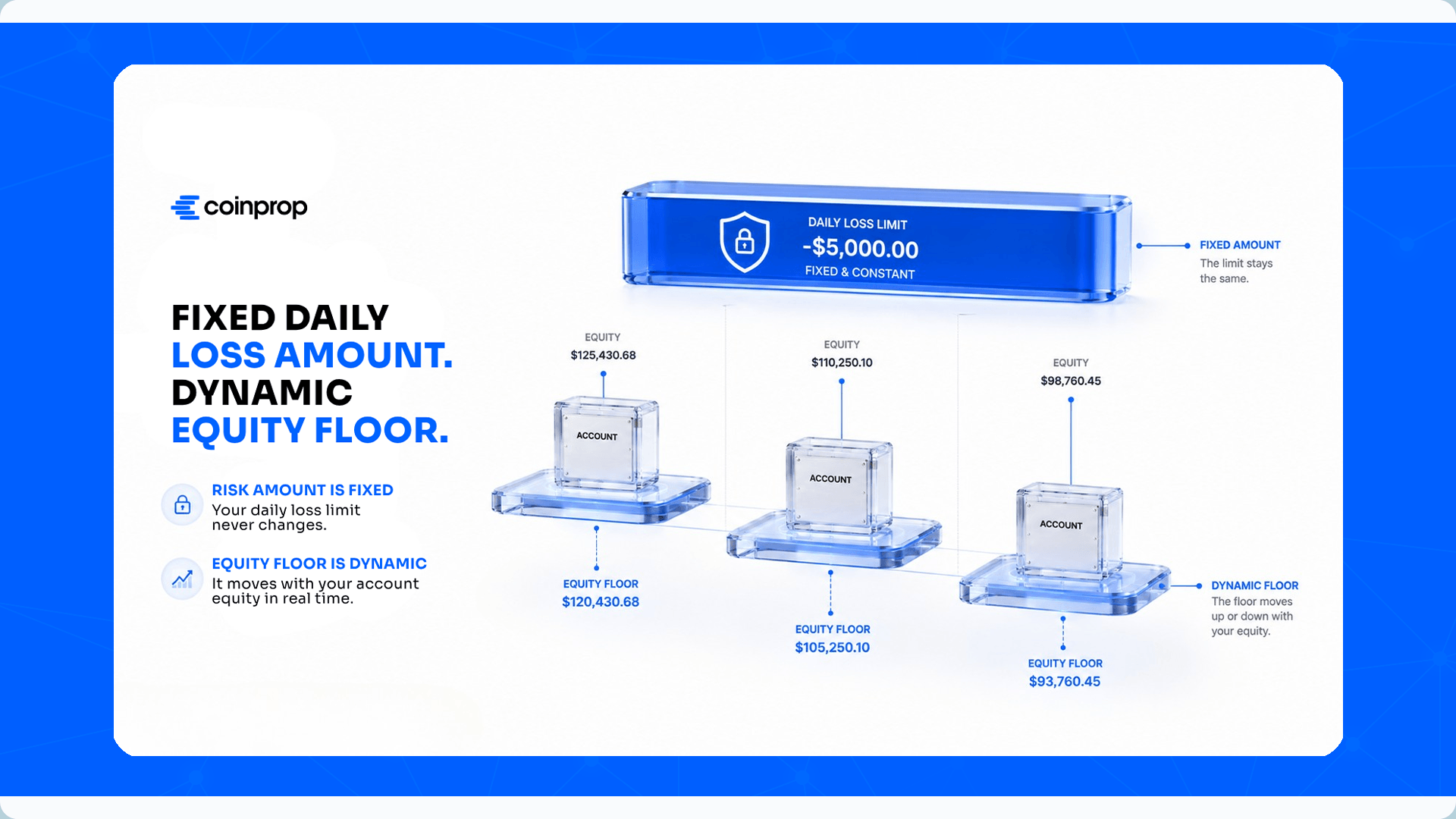
CoinProp’s Daily Loss Limit is based on a fixed percentage of the initial account balance. This means the dollar amount assigned as the daily loss limit does not change throughout the life of the account.
For example, on a $10,000 account with a 3% DLL, the daily loss amount remains $300 regardless of whether the account grows or declines.
However, while the loss amount is fixed, the daily loss floor is not static. It moves dynamically based on the trader’s equity at each daily reset. This combination of fixed risk value and dynamic equity reference creates a system that is both predictable and adaptive.
At every daily reset (00:00 UTC), CoinProp takes a snapshot of the account’s current equity.
This snapshot becomes the reference point for calculating the next day’s allowable loss floor. The fixed DLL amount is then subtracted from this equity snapshot to determine the minimum allowable equity for the next 24-hour trading cycle.
For example, if a trader’s equity at rollover is $10,600 and the fixed DLL is $300, the new daily loss floor will be set at $10,300.
This mechanism ensures that the daily loss limit always reflects the trader’s most recent account performance while keeping the risk amount itself unchanged.
Because the DLL floor is recalculated daily based on equity snapshots, it can move up or down depending on trading performance.
If a trader ends the day with higher equity, the next day’s loss floor increases accordingly, giving the account more breathing room. Conversely, if the trader ends the day with lower equity, the next day’s floor is also reduced.
This system ensures that risk limits remain aligned with current account conditions rather than remaining static throughout the evaluation period. However, the fixed DLL amount ensures that the overall risk exposure remains consistent and predictable.
Traders must be aware that overnight holding and end-of-day equity levels can directly influence their available risk for the next session.
CoinProp’s Max Loss Limit (MLL) operates independently from the Daily Loss Limit and is designed as a fixed overall account protection rule.
Unlike trailing drawdown systems used by many prop firms, CoinProp’s MLL is anchored to the initial balance and does not move upward when the account becomes profitable. This means that winning trades do not tighten the maximum allowable loss threshold.
For example, on a $10,000 account with a 6% MLL, the absolute floor remains $9,400 throughout the entire account lifecycle.
This fixed structure provides traders with more stability compared to trailing models, where profit increases can reduce available downside buffers.
If either the Daily Loss Limit or the Max Loss Limit is breached, the account is automatically considered violated.
In most cases, this results in immediate account closure. The trader is typically allowed to purchase a new evaluation account, but the current account cannot be recovered.
Because drawdown calculations are based on equity, unrealized losses from open positions can trigger a violation even if trades have not been closed. This makes real-time monitoring of account equity essential, especially during high-volatility market conditions.
CoinProp’s system is designed to enforce strict risk boundaries while still allowing traders flexibility in execution. However, once a limit is reached, the violation is final, emphasizing the importance of proactive risk management rather than reactive adjustments.
To fully understand how CoinProp’s Daily Loss Limit (DLL) works in practice, it is useful to look at real account scenarios. Because CoinProp uses a combination of a fixed daily loss amount and a dynamic equity snapshot model, the daily floor can shift depending on performance, withdrawals, and open trade exposure.
The following examples illustrate how the DLL behaves in different market conditions and why monitoring equity in real time is essential for avoiding violations.
Assume a trader has a $10,000 Rising account with a 3% Daily Loss Limit.
At the daily rollover (00:00 UTC), CoinProp takes an equity snapshot. If the trader’s equity at that moment is $10,000, the daily loss floor is calculated as:
This means the trader must keep account equity above $9,700 during the next trading day.
If during the day the trader’s equity drops below $9,700 at any point due to losses (realized or unrealized), the account will breach the daily loss limit.
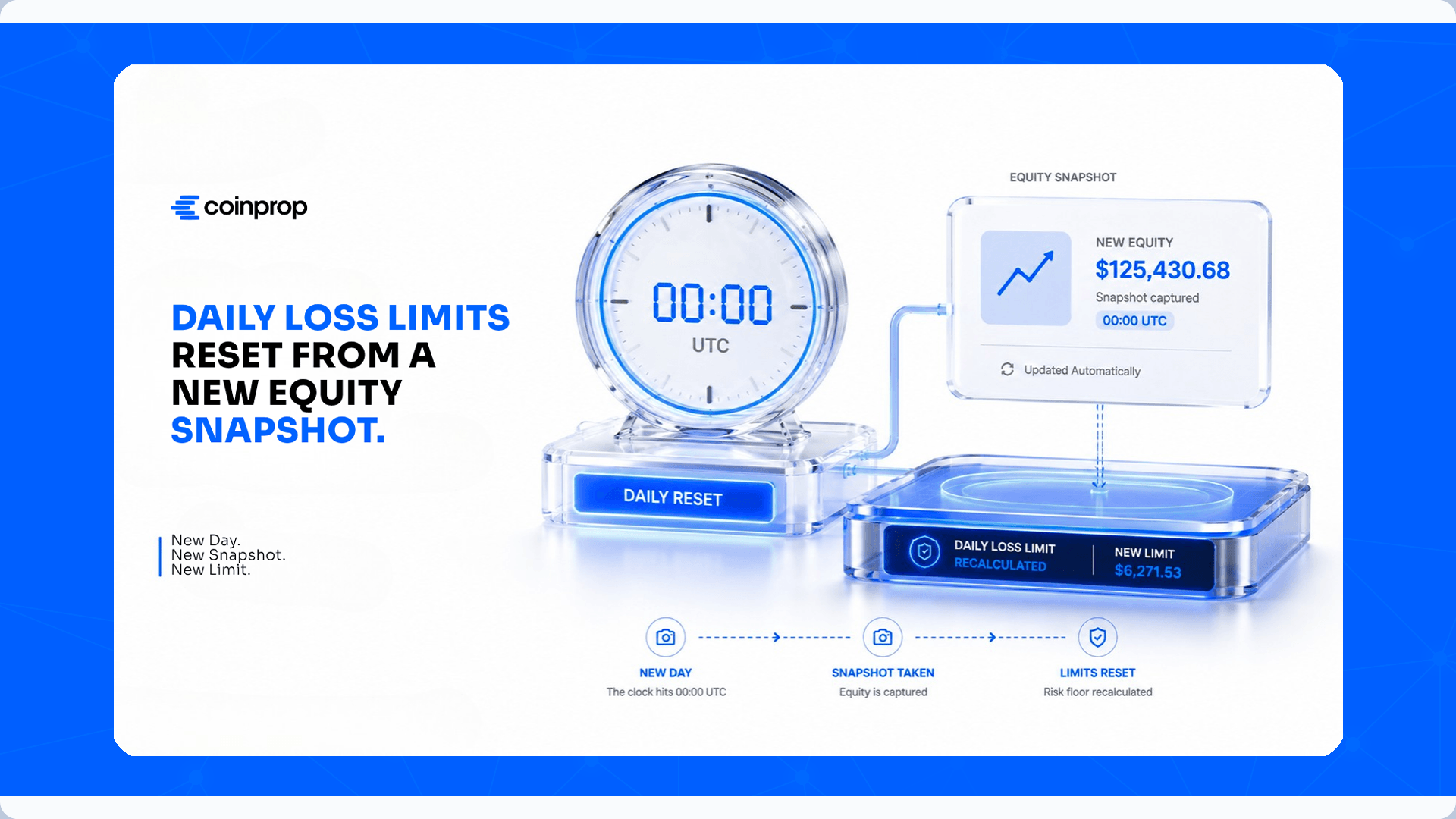
If the trader ends the day in profit, the next day’s risk parameters adjust based on the new equity snapshot.
For example:
At the next reset, the new daily loss floor becomes:
This means the trader now has a higher absolute buffer compared to the previous day.
However, the fixed DLL amount remains unchanged. Only the equity reference point moves. This ensures that risk scales naturally with performance without changing the underlying risk percentage.
Withdrawals directly reduce account equity, which in turn affects the next day’s DLL calculation.
For example:
At the next daily reset, the new floor becomes:
This shows that withdrawals reduce the equity snapshot, which lowers the starting point for the next daily loss calculation.
For this reason, traders must consider how profit withdrawals may impact their available risk buffer on subsequent trading days.
One of the most critical aspects of CoinProp’s DLL system is that unrealized losses are included in equity calculations.
Assume the following scenario:
Even though the trade has not been closed, the account equity has now dropped to:
Since this is below the $9,700 threshold, the daily loss limit is breached immediately.
This highlights why monitoring open positions is essential in real time. In volatile crypto markets, price movements can quickly turn manageable trades into violations without any trade being closed.
CoinProp’s equity-based structure ensures that risk is always calculated based on actual account exposure rather than only realized trading results. This makes disciplined position management a key factor in staying within daily limits.
One of the biggest challenges in prop firm trading is not understanding the rules, but actively tracking them during live market conditions. Daily loss limits are dynamic, equity-based, and often updated in real time, which makes manual calculation difficult, especially when multiple positions are open.
CPX is designed to reduce this complexity by giving traders a clear visual representation of their risk boundaries directly on the trading chart. Instead of calculating the remaining drawdown manually, traders can instantly see how close they are to violating either the Daily Loss Limit or the Max Loss Limit.
This transforms risk management from a reactive process into a real-time decision-making tool.
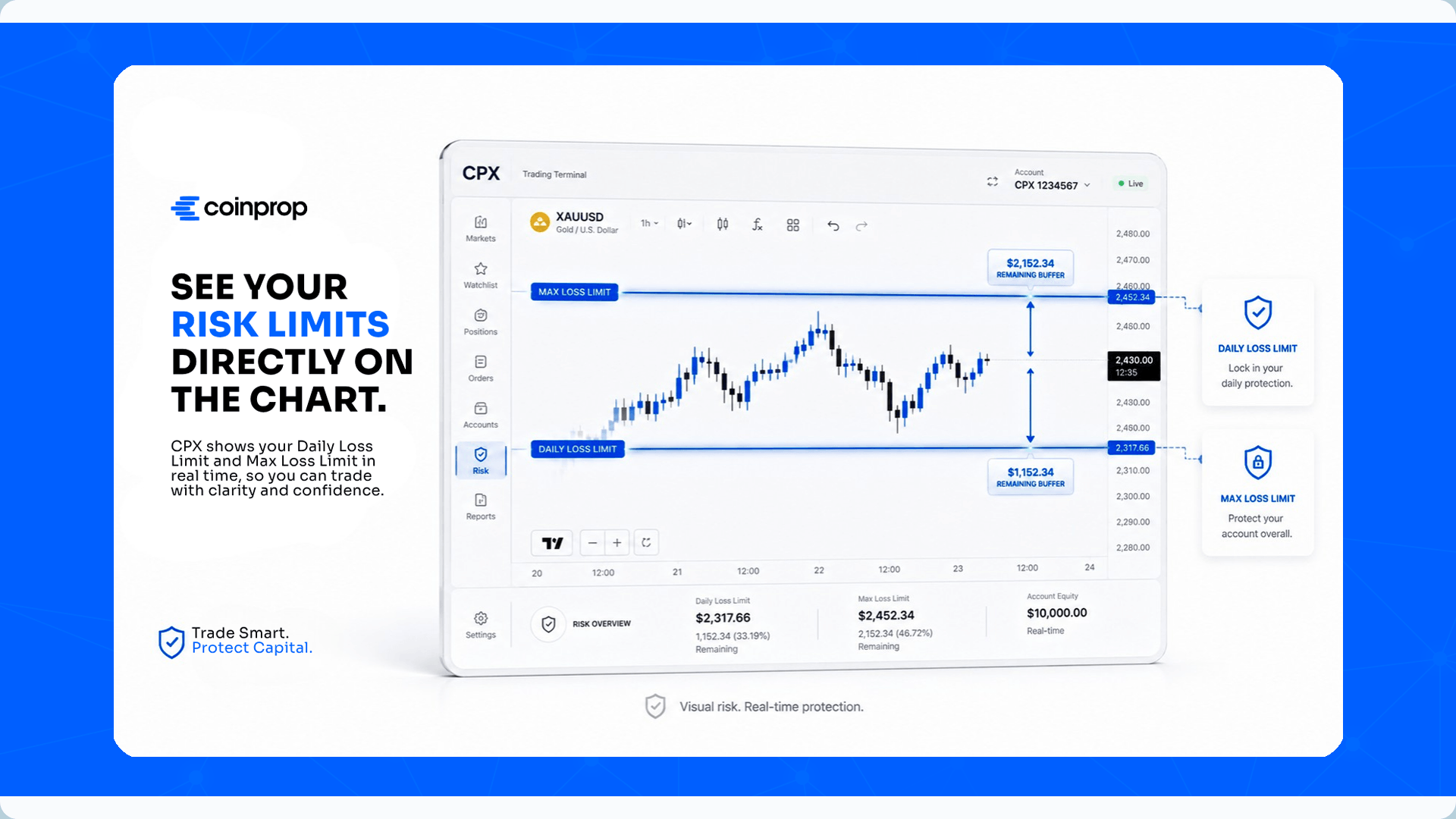
CPX displays the Daily Loss Limit and Max Loss Limit directly on the trading interface as visual reference lines.
These lines act as dynamic boundaries that update based on account equity and current market conditions. Traders can see exactly where the violation levels are in relation to current price action, open positions, and unrealized profit or loss.
This visual structure eliminates the need to constantly recalculate risk levels, reducing the chance of human error during fast-moving market conditions.
In addition to visual lines, CPX shows the real-time distance between current equity and the daily loss threshold.
This allows traders to understand not just whether they are safe, but how much buffer they actually have before a violation occurs.
For example, instead of guessing how close they are to breaching the limit, traders can immediately see remaining risk capacity in real time. This is especially useful during high volatility periods when equity can change rapidly within seconds.
While the Daily Loss Limit resets every day, the Max Loss Limit remains active throughout the entire account lifecycle.
CPX integrates both limits into a single visual system, allowing traders to monitor long-term and short-term risk simultaneously.
This removes the need to track multiple formulas or remember different percentage rules for each limit. The system automatically reflects both constraints in a unified view, ensuring traders always understand their full risk exposure.
Most daily loss limit violations are not caused by misunderstanding the rules themselves, but by small execution errors, such as miscalculating equity, ignoring floating losses, or losing track of remaining daily risk during active trading sessions.
CPX reduces these errors by turning abstract risk rules into visible, actionable information. When traders can see their risk boundaries clearly on the chart, they are less likely to overextend positions or hold trades beyond safe limits.
This creates a more disciplined trading environment where decisions are based on real-time risk awareness rather than manual estimation or emotional judgment.
As a result, CPX acts as both a monitoring tool and a behavioral safeguard, helping traders stay consistently within daily loss limits while maintaining focus on execution quality.
Daily loss limits play a central role in both evaluation phases and funded trading accounts within crypto prop firms. While profit targets often receive the most attention, it is the enforcement of risk rules, especially daily loss limits, that determines whether a trader progresses or fails.
Understanding how these limits function in different stages of a prop firm journey is essential for building consistency and avoiding unnecessary account violations.
During crypto prop firm challenges, daily loss limits act as a strict filter for risk discipline.
Even if a trader is profitable overall, a single violation of the daily loss limit is usually enough to fail the entire evaluation. This makes the rule more important than the profit target in many cases.
Evaluation accounts are designed to test not only a trader’s ability to generate returns but also their ability to control downside risk under pressure. Daily loss limits force traders to operate within predefined boundaries and prevent aggressive or emotionally driven trading behavior.
In practice, many evaluation failures occur not because traders lack profitable strategies, but because they violate risk constraints while attempting to reach the profit target too quickly.
Once a trader passes an evaluation and receives a funded account, daily loss limits remain equally important.
In funded environments, the goal shifts from passing a challenge to preserving capital and maintaining long-term profitability. Daily loss limits help ensure that traders do not expose the firm’s capital to excessive intraday risk.
Although the pressure of evaluation is removed, the consequences of violating a daily loss limit are often more significant in funded accounts, as it may result in immediate account closure and loss of trading privileges.
For this reason, disciplined traders treat funded accounts with the same level of caution as evaluation accounts, often applying even stricter personal risk limits than the firm requires.
Consistency in prop firm trading is built primarily through risk management rather than aggressive profit generation.
Daily loss limits encourage traders to focus on sustainable execution rather than short-term gains. By limiting how much can be lost in a single day, traders are naturally pushed toward more structured decision-making and controlled position sizing.
Over time, this approach helps eliminate destructive behaviors such as overtrading, revenge trading, and emotional decision-making after losses.
Traders who consistently respect daily loss limits tend to develop more stable equity curves, smoother drawdown profiles, and higher success rates in both evaluations and funded accounts.
Ultimately, daily loss limits are not just restrictive rules, they are a framework that reinforces discipline and helps traders transition from inconsistent performance to long-term trading stability.
This section answers the most common questions traders have about daily loss limits in crypto prop firms. Understanding these fundamentals helps prevent confusion during live trading and reduces the risk of accidental rule violations.
A daily loss limit is a predefined risk rule that sets the maximum amount a trader can lose within a single trading day. If losses exceed this limit, the account is considered in violation, regardless of overall performance or profitability.
It depends on the prop firm’s model. Some firms calculate daily loss limits based on balance, which only considers closed trades. Others use equity-based calculations, which include both realized and unrealized (floating) profits and losses. Equity-based models are more common in crypto prop trading due to higher market volatility.
In most modern crypto prop firms, yes. Unrealized losses are included in equity-based calculations because they directly affect the real-time value of the account. This means an open position moving against the trader can trigger a violation even before the trade is closed.
If the daily loss limit is exceeded, the account is typically considered breached immediately. In most cases, this results in automatic account closure and failure of the evaluation or funded account stage. Traders are usually required to start a new evaluation if they wish to continue.
Daily loss limits are usually reset at a fixed time defined by the prop firm, often at 00:00 UTC. At this reset, the system establishes a new equity snapshot and recalculates the allowable daily loss floor for the next trading period.
A daily loss limit controls how much a trader can lose within a single day, while maximum drawdown limits the total cumulative loss across the entire account lifecycle. The daily loss limit resets each day, but maximum drawdown is continuous and does not reset. Both rules must be respected simultaneously.
Yes. In equity-based systems, open trades affect account equity in real time. If an unrealized loss causes equity to fall below the daily loss threshold, the account can immediately violate the rule even if no positions have been closed.
CoinProp uses a hybrid structure. The Daily Loss Limit is a fixed percentage of the initial balance, while the daily loss floor is recalculated every day at 00:00 UTC using an equity snapshot minus the fixed DLL amount. This means the dollar risk remains constant, but the allowable equity threshold adjusts daily based on account performance.
The rules discussed in this article are commonly used by a crypto prop firm during trader evaluations and funded account management.
