The crypto prop firm challenge is your gateway for crypto traders to trade big capital without personal risk. It’s a skill based test: hit the profit target while staying within drawdown limits. Prove your edge in a real market environment, get funded, and scale profits with high splits. No gimmicks, just discipline, strategy, and consistency. Pass the trading challenge once, unlock funded accounts.

Most traders fail a crypto prop challenge for a simple reason: they treat it like a personal account. In a personal account, you might recover from oversized positions, wait through deep drawdowns, or take extra risks when you feel confident. A prop evaluation works differently inside the broader ecosystem of crypto prop firms. You are operating inside a framework with profit targets and strict risk limits, which means survival and consistency matter more than chasing big wins.
Passing a challenge usually isn’t about finding one huge trade. It’s about stacking disciplined decisions while protecting your account from unnecessary damage. Before diving into advanced strategies, psychology, or platform tools, keep these core principles in mind.
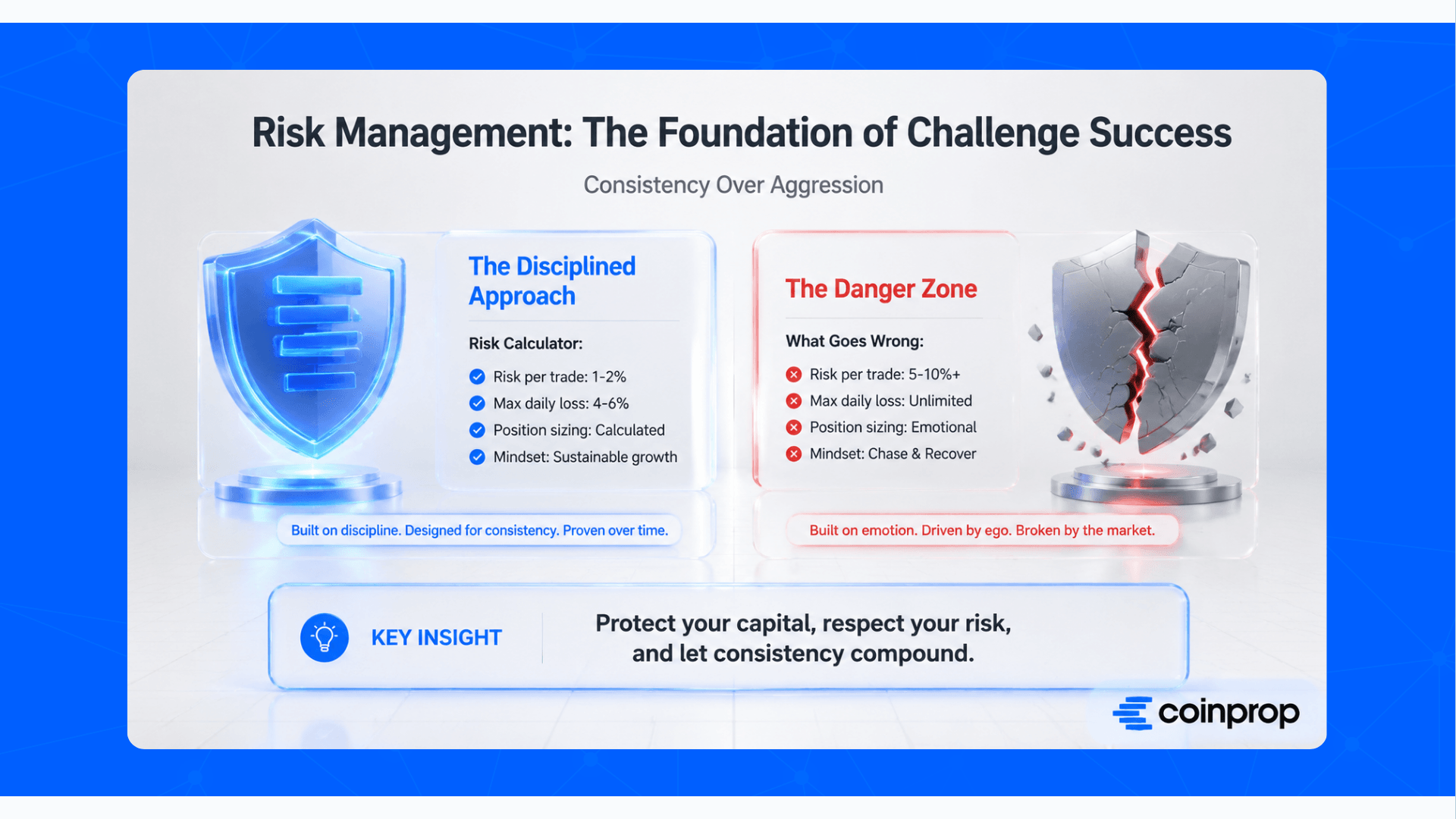
Risk management is the foundation of every successful challenge attempt. One of the fastest ways to destroy an account is placing oversized trades because you feel certain about a setup.
A simple approach used by many disciplined traders is risking between 0.5% and 1% of total account value per trade. This creates enough room to survive normal losing streaks without getting dangerously close to daily drawdown limits.
For example:
$50,000 challenge account
1% maximum risk = $500
0.5% risk = $250
Even if several trades hit stop loss consecutively, your account stays healthy and your decision making stays calm. Remember: challenge accounts reward consistency more than aggression.
Losses are part of trading. The problem starts when traders allow losses to affect their next decisions.
The 3-Stop Rule is simple:
If you hit three stop losses in one session or one day, stop trading immediately.
After several losses, many traders unconsciously shift into emotional decision making. They begin forcing setups, increasing position size, or trying to recover losses quickly.
Walking away protects both your account and your mindset. The market will still be there tomorrow.
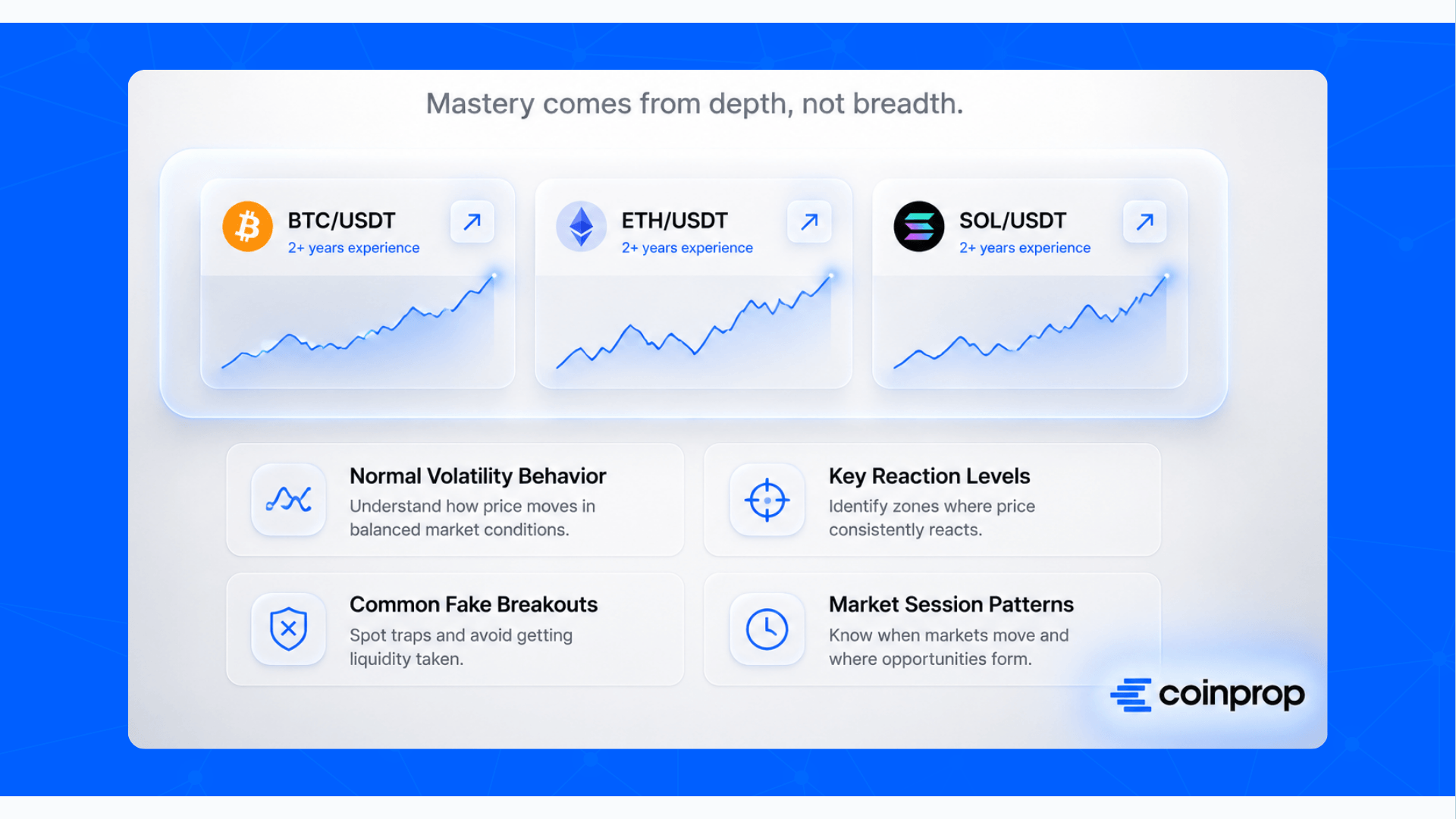
Crypto offers thousands of assets, but challenge traders usually benefit from narrowing their focus.
Trying to monitor ten or fifteen coins at the same time creates information overload:
Instead, focus on two or three coins you understand deeply, such as BTC, ETH, or one highly liquid altcoin.
Over time, you start recognizing:
Familiarity often creates better execution than constant searching for new opportunities.
Winning every trade is impossible. That is why risk-to-reward matters.
A 1:2 risk-to-reward ratio means:
For example:
Risk: $200
Potential reward: $400
This structure gives breathing room even with moderate win rates.
A trader with a 50–55% win rate and disciplined execution can still perform very well because winners become larger than losers over time.
Challenge accounts are usually passed by repeatable math, not by miracle trades.
Crypto markets run 24/7, which creates endless opportunities and endless emotional pressure.
FOMO says:
This move is the last opportunity.
Revenge trading says:
I need to recover my losses immediately.
Both usually lead to:
Professional traders accept that missing a setup is normal. In crypto, another opportunity always appears.
The goal is not catching every move. The goal is catching the right moves.
Not every market environment fits your strategy.
Some sessions become:
Many traders feel pressure to trade simply because they opened the charts.
But one of the most profitable decisions in a challenge is often doing nothing.
If market conditions no longer match your plan, step away and wait for clarity. Protecting your account during weak conditions often matters more than maximizing gains during strong ones.
The best challenge traders understand is something beginners usually learn later: preserving capital is not avoiding progress; preserving capital is what allows progress to continue.

Most traders do not fail crypto prop challenges because they lack market knowledge or because their strategy is completely broken. In many cases, they already understand technical analysis, know how to identify setups, and have experience trading crypto markets.
The real problem usually appears after the challenge begins.
A prop evaluation creates a different environment from personal trading. Profit targets, loss limits, and account rules introduce pressure that changes behavior. Traders who were patient on personal accounts suddenly become aggressive. Traders who normally follow a plan start forcing trades. Small mistakes begin to compound until the account eventually violates a rule.
The difficult part of a challenge is rarely finding profitable opportunities. The difficult part is maintaining discipline while operating under constraints.
Below are some of the most common reasons traders fail crypto prop challenges.
Leverage is one of the most powerful tools in trading, but it is also one of the fastest ways to destroy a challenge account.
Many traders see a challenge account and immediately think about maximizing returns:
If I use a larger size, I can hit the target faster.
The logic sounds attractive, but reality often works differently.
Larger positions increase everything:
Suppose two traders have identical $50,000 challenge accounts.
Trader A risks:
Trader B risks:
Both traders experience three consecutive losing trades.
Trader A:
Trader B:
Trader A still has room to recover and continue trading objectively.
Trader B may already be dangerously close to violating challenge rules or losing the account entirely.
Oversized positions also create psychological pressure. Small price movements suddenly feel massive. Traders begin staring at every candle, moving stop losses, exiting too early, or making impulsive decisions.
The goal in a challenge is not reaching the finish line in one trade. It is surviving long enough for your edge to play out.
Drawdown limits exist because protecting capital matters as much as generating profits.
Unfortunately, many traders treat drawdown rules as something to think about later.
They focus entirely on questions like:
How quickly can I reach the target?
instead of asking:
How much room do I have before I need to stop?
This mindset creates dangerous behavior.
A trader may lose:
At first, nothing feels catastrophic.
But after several emotional decisions, available risk begins shrinking rapidly.
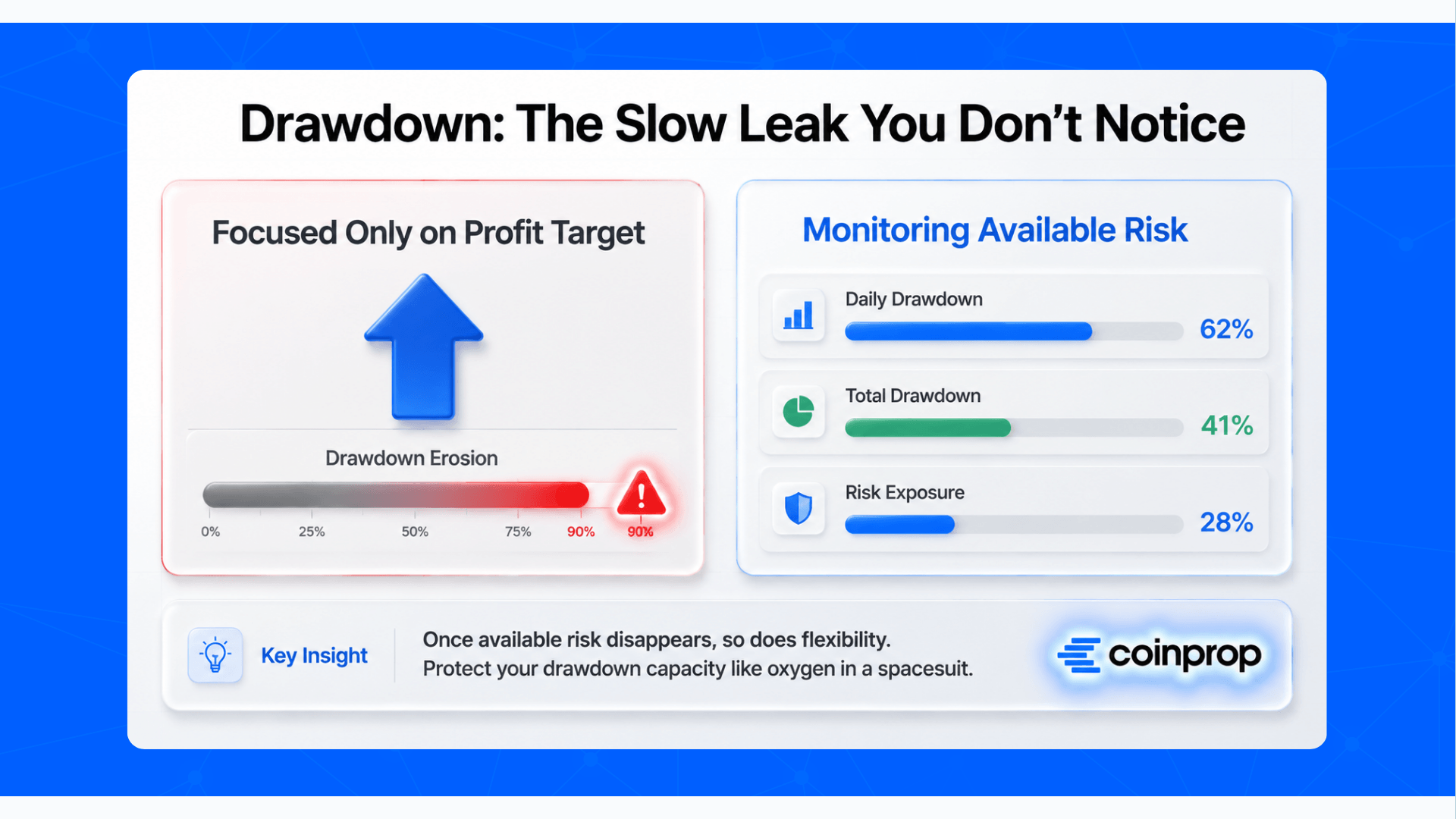
Drawdown often behaves like a slow leak rather than an explosion. Traders do not notice the danger until they suddenly realize they are operating near their maximum limits.
Professional challenge traders usually think differently.
They monitor:
Protecting available drawdown preserves opportunities for later setups.
Once available risk disappears, so does flexibility.
Crypto markets create an illusion of endless opportunity.
Thousands of assets move every day:
For inexperienced challenge traders, this often creates a feeling that they need to watch everything.
The result is usually information overload.
Tracking too many markets creates several problems:
Reduced focus
Instead of deeply understanding a few assets, attention becomes scattered across dozens of charts.
Different behavior patterns
Each coin behaves differently:
More emotional triggers
The more charts traders watch, the more opportunities appear to be missed.
This often increases FOMO and impulsive entries.
Many experienced traders prefer focusing on:
Trading fewer markets often creates stronger familiarity with price behavior and cleaner decision making.
Success in a challenge usually comes from better execution, not from monitoring every coin in existence.
The market itself is not always the biggest opponent during a challenge.
Sometimes the biggest opponent sits in front of the screen.
Emotions become stronger when money, performance pressure, and account rules combine.
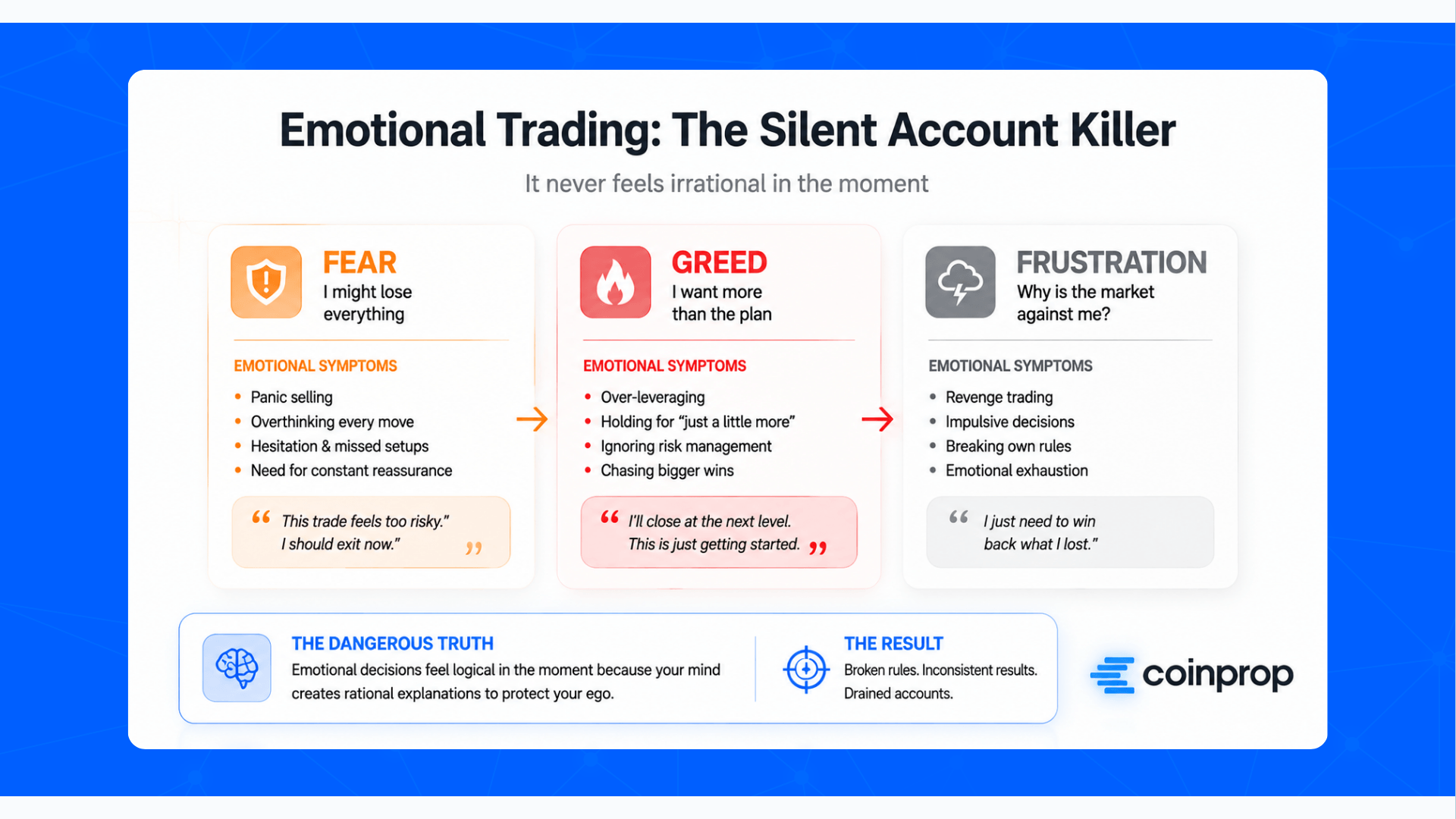
Fear can cause traders to:
Greed can cause traders to:
Frustration can cause traders to:
The dangerous part about emotional trading is that it rarely feels irrational while it is happening.
At the moment, traders usually convince themselves that the decision makes sense.
Only later do they realize they abandoned their original plan.
This is why routines become important:
Systems often protect traders when emotions become unreliable.
One of the most common misconceptions about crypto prop challenges is believing they must be completed as quickly as possible.
Many traders enter the challenge with thoughts like:
I need to hit 9% in two days.
or:
If I don't finish quickly, I'm falling behind.
That pressure often creates destructive behavior.
Traders begin:
Ironically, chasing fast profits often slows progress.
Large swings create larger emotional reactions. Larger emotional reactions create poorer decisions.
Many successful challenge traders take the opposite approach.
They focus on:
The interesting part is that disciplined trading frequently produces faster results anyway.
A challenge account is not a race against time or other traders.
It is a test of whether you can repeatedly make good decisions while operating under pressure.
Most traders fail because they try to force the destination. The traders who pass consistently usually focus on the process instead.

Before trying to pass a crypto prop challenge, it helps to understand what the evaluation is actually designed to measure. Many traders assume the challenge exists to see whether you can make large profits quickly. In reality, most prop firms are testing something different: whether you can generate returns while protecting capital and following rules consistently.
A challenge is essentially a controlled environment where traders prove they can operate under professional risk parameters. The market itself does not change. Bitcoin still moves the same way, volatility still exists, and your trading strategy may still work exactly as before. The difference is that now your strategy must operate within a predefined framework.
Most crypto prop firm evaluations are built around four core elements:
Understanding these rules before placing your first trade can prevent mistakes that eliminate accounts long before strategy quality becomes relevant.
The first objective of almost every crypto prop challenge is reaching a specific profit target.
This target represents the amount of profit required before you qualify for a funded account. Depending on the firm, targets often fall somewhere between 8–10%, although some challenges may require more or less.
For example:
At first glance, this may seem simple. Many traders immediately think:
Crypto moves 5–10% every day. I can reach that quickly.
That thinking creates problems.
The challenge isn't designed to reward aggressive trading. It rewards controlled performance. A trader who reaches a target while respecting risk rules is often viewed more favorably than someone who reaches the same number through oversized positions and emotional decisions.
Evaluation rules can vary between firms and may include:
Some firms also monitor whether profits come from repeatable behavior instead of one oversized trade.
The key principle is simple: reaching the target matters, but how you reach it matters just as much.
Daily drawdown is one of the most common reasons traders fail prop challenges.
A daily drawdown limit defines the maximum amount you are allowed to lose during a single trading day. Once that limit is reached, the challenge may be considered failed.
For example:
Imagine a trader takes several poor trades:
Trade 1 = -$600
Trade 2 = -$800
Trade 3 = -$700
Trade 4 = -$500
Total daily loss:
-$2,600
Even if that trader normally performs well, the account may already be gone.
The reason these limits exist is straightforward: prop firms want traders who know how to protect capital during difficult periods.
Daily drawdown rules also force traders to think differently:
Instead of asking:
How much can I make today?
Professional traders usually ask:
How much can I safely lose before I stop?
That shift alone changes decision making dramatically.
This is also why many challenge traders use smaller position sizes and stop trading after several consecutive losses.
Daily drawdown protects against short-term damage, but firms also set a maximum overall loss rule to control total account risk.
Unlike daily limits, this rule tracks the entire challenge period.
For example:
If account equity drops below $45,000 at any point, the challenge ends.
This rule often creates a different type of pressure because losses accumulate over time.
Consider this scenario:
Week 1:
+$1,200
Week 2:
-$1,500
Week 3:
-$2,000
Week 4:
-$2,200
Individually, none of these periods violate daily limits. But combined, they slowly push the account toward the maximum loss threshold.
Many traders fail because they focus entirely on reaching profit targets while forgetting to protect their remaining risk allowance.
The strongest challenge traders treat their available drawdown like valuable inventory. Once it disappears, opportunities disappear with it.
Depending on the firm, challenges may also include rules regarding time and trading activity.
Historically, many evaluations required traders to complete profit objectives within a fixed period, such as 30 or 60 days. Newer crypto-focused models may offer more flexibility, but restrictions still exist across many platforms.
Common examples include:
Minimum trading day requirements
Some firms require traders to trade for a certain number of days before completing
the challenge. This prevents traders from placing one oversized trade and immediately qualifying.
Holding restrictions
Some evaluations restrict holding positions:
Leverage limitations
Certain firms limit maximum leverage exposure to reduce excessive risk.
News and volatility restrictions
Some firms discourage trading around highly volatile market conditions where spreads and execution risks may increase.
Many traders make the mistake of viewing these restrictions as obstacles. In reality, they often push traders toward more disciplined behavior.
The goal of a crypto prop challenge is not proving that you can survive one lucky week. The goal is proving that you can manage risk, execute consistently, and operate like a trader who can handle larger capital over the long run.
Many traders spend most of their time searching for better indicators, more accurate entries, or new strategies. While strategy matters, crypto prop challenges are often won or lost through risk management.
A challenge account rewards consistency far more than occasional large profits. You do not need extraordinary returns to pass. You need a process that protects capital while allowing your trading edge enough time to work.
Think of risk management as the engine behind your entire evaluation. Even a strong strategy can fail if position sizes are too large, losses are unmanaged, or emotions begin controlling decisions.
The goal is not simply avoiding losses. Losses are inevitable in trading. The goal is controlling losses so that a normal losing period never becomes a challenge-ending event.
Below are some practical risk management principles that can significantly improve your chances of passing a crypto prop evaluation.
One of the most common mistakes challenge traders make is deciding position size based on emotion instead of structure.
Many traders increase size because:
The problem is that confidence does not reduce market uncertainty.
Instead of adjusting position size emotionally, position size should be determined by predefined account risk.
A common approach is risking 0.5–1% of account value per trade.
For example:
Challenge account: $50,000
0.5% risk:
1% risk:
Suppose your stop loss sits 2% away from entry.
Instead of randomly selecting trade size, calculate position exposure so that hitting the stop only produces the planned risk amount.
This creates several advantages:
Position sizing exists to protect the account during periods when the market does not cooperate.
Even profitable traders experience losing streaks. Correct sizing gives your strategy room to recover.

Daily drawdown limits are among the most dangerous challenge rules because many traders underestimate how quickly losses can accumulate.
The mistake usually happens gradually.
A trader loses one position and thinks:
No problem.
Another trade loses:
Still manageable.
Then another:
One more trade should fix this.
At that point, decision making often shifts from strategy to recovery mode.
A better approach is creating a predefined risk structure before the trading session begins.
For example:
Daily drawdown limit:
5%
Personal risk threshold:
2–3%
This means you voluntarily stop trading before reaching the platform's maximum limit.
Consider a $50,000 challenge account:
Firm daily drawdown:
Personal daily stop:
This creates a protective buffer that prevents emotional trades from pushing the account toward dangerous territory.
Many successful challenge traders do not operate at the edge of their allowed risk. They create additional space for mistakes.
Think of drawdown as fuel in a car.
If you use all of it immediately, the journey ends early.
Losing streaks are psychologically difficult because they make traders question everything:
The natural reaction is often to fight back immediately.
Some traders:
Unfortunately, these responses often increase losses rather than solve them.
A better approach is building rules before losses happen.
Examples:
The 3-Stop Rule
Stop trading after three consecutive losing trades.
Reduced Risk Mode
After multiple losses:
Review Before Continuing
Ask questions like:
Not every losing streak means your strategy stopped working.
Sometimes markets simply become less favorable for your approach.
Risk management exists to help you survive these periods without damaging long-term performance.
Challenge traders often move toward one of two extremes.
Some become excessively aggressive:
Others become excessively conservative:
Both approaches create problems.
Excessive aggression increases the probability of violating challenge rules.
Excessive caution may prevent meaningful progress toward profit targets.
The goal is finding balance.
Aggressive behavior should appear only in the quality of setup selection, not in uncontrolled risk exposure.
For example:
Aggressive approach:
Balanced approach:
Professional traders usually understand that passing a challenge does not require extreme decisions.
They are not trying to maximize every opportunity.
They are trying to maximize consistency.
A challenge account is essentially a game of probabilities. Strong risk management does not guarantee success in every trade, but it significantly increases the probability of surviving long enough for profitable outcomes to appear.

Many traders enter a crypto prop challenge believing that success depends mostly on strategy quality. They spend weeks refining indicators, testing entries, and studying chart patterns. Then the challenge begins, and suddenly something changes.
The strategy that looked perfect during backtesting starts breaking down. Trades are entered too early, exits become emotional, and risk rules begin to disappear.
Usually, the problem is not the strategy.
The problem is pressure.
A prop challenge creates a very different psychological environment compared to personal trading. Every trade now feels connected to profit targets, drawdown limits, and the idea of getting funded. Small losses feel bigger, missed opportunities feel painful, and emotions can quietly start controlling decisions.
This is why trading psychology matters.
Markets are unpredictable by nature, but your reactions do not have to be. Learning how to manage emotions during evaluations can be the difference between passing and repeatedly restarting challenges.
FOMO, or Fear of Missing Out, is one of the most common psychological traps in crypto trading.
Crypto operates 24/7. A coin can suddenly move 10–15% while you are away from the charts, and social media can make it feel like everyone else caught the move except you.
The internal dialogue usually sounds familiar:
BTC is moving.
SOL already broke out.
If I don't enter now, I missed the chance.
The problem is that FOMO creates urgency where patience should exist.
Instead of following a plan, traders begin:
Ironically, FOMO often causes traders to enter at the worst possible moment.
One useful mindset shift is remembering that crypto markets constantly create new opportunities.
There are:
Missing one move rarely matters over the long term.
Some practical ways to reduce FOMO include:
Professional traders understand something important:
They do not need every opportunity.
They only need the right opportunities.
Revenge trading usually starts with frustration.
A trade hits stop loss and immediately creates the feeling that something needs to be fixed.
Many traders begin thinking:
I can recover quickly.
or:
The market owes me this trade back.
That emotional reaction often creates a dangerous chain of events:
Loss → frustration → larger position → impulsive trade → larger loss
At that point, trading becomes emotional recovery instead of decision making.
Revenge trading is dangerous because it temporarily removes discipline.
Traders often:
One practical method for reducing revenge trading is creating mandatory interruption rules.
For example:
After any stop loss:
The goal is creating distance between emotion and execution.
Most emotional impulses weaken with time.
Many traders discover that after stepping away briefly, the urgency to immediately recover losses disappears.
One of the biggest mistakes challenge traders make is judging performance purely by profit and loss.
Winning trades feel good.
Losing trades feel bad.
But outcomes alone do not always reveal whether a decision was actually correct.
Consider two situations:
Trade A
Loss.
Trade B
Profit.
Most inexperienced traders celebrate Trade B and feel frustrated about Trade A.
Professional traders often think differently.
Trade A represents good execution.
Trade B represents bad behavior that happened to produce a good outcome.
The danger with toxic profits is that they reward poor habits.
If traders repeatedly make money through undisciplined behavior, they may start believing those habits work.
Eventually, market conditions change and the same behavior creates major losses.
This is why challenge traders should evaluate questions like:
Long-term success usually comes from repeating good processes rather than chasing perfect outcomes.
Many traders feel pressure to stay active.
They open charts and think:
I need to trade today.
But markets do not produce quality opportunities every session.
Some days become:
Forcing trades during weak conditions often creates unnecessary losses.
The Step Back Technique is built around a simple idea:
If conditions become unfavorable, stop participating.
This may happen when:
One practical structure might look like this:
Pause trading if:
Walking away is often difficult because doing nothing can feel unproductive.
However, preserving capital is also a trading decision.
Some of the most profitable actions during a challenge happen when no trade is placed at all.
Professional traders understand that activity does not always equal progress.
Sometimes stepping back protects both the account and the mindset that will be needed for the next opportunity.
Selecting the right assets during a crypto prop challenge is often more important than many traders realize. A strong strategy can produce very different results depending on the coin being traded. Some assets provide stable behavior and cleaner technical structures, while others can move violently without warning.
One of the biggest mistakes challenge traders make is believing that more opportunities automatically create better performance. They jump from chart to chart looking for the fastest-moving coin of the day, assuming larger price swings mean faster profits.
In reality, bigger movement does not always mean better opportunity.
Prop challenges reward controlled and repeatable execution. The goal is not finding the most explosive asset in the market. The goal is finding assets that allow your strategy to operate consistently within drawdown limits and risk rules.
When selecting coins during an evaluation, traders should consider factors such as:
The right coin can make risk management easier. The wrong one can create unnecessary stress and unpredictable results.
For many challenge traders, especially those early in prop trading, Bitcoin and Ethereum often become the foundation of their watchlist.
This does not mean BTC and ETH are risk free. Crypto markets remain volatile by nature. However, these assets generally provide conditions that are easier to manage compared to smaller cryptocurrencies.
Several factors make them attractive:
Higher liquidity
Bitcoin and Ethereum typically attract the largest trading volume in crypto markets. Strong liquidity often creates smoother order execution and smaller price gaps.
Higher liquidity can help reduce problems such as:
More stable market behavior
Smaller altcoins can suddenly move 10–20% within minutes because of social media activity, whale orders, or temporary hype.
BTC and ETH usually move in a more structured way.
Price action often respects:
This can make technical analysis easier to apply.
Better familiarity
Most traders spend more time watching Bitcoin and Ethereum than almost any other assets.
Over time, familiarity helps traders recognize:
During challenge evaluations, reducing uncertainty matters.
Familiar assets often create cleaner decisions than constantly searching for new opportunities.
High-volatility altcoins can create attractive opportunities because they often move much faster than BTC or ETH.
For example:
Bitcoin may move:
while an active altcoin could move:
within the same period.
This larger movement sometimes allows traders to reach profit targets more efficiently.
However, larger opportunity usually comes with larger risk.
High-volatility assets can create:
That does not automatically mean they should be avoided.
They may make sense under specific conditions:
You already understand the asset
Trading a fast-moving coin without experience can quickly become dangerous.
If you have traded an asset repeatedly, you may understand:
Market conditions support momentum
Strong trends or major catalysts can create cleaner movement.
Examples include:
Risk remains controlled
The mistake many traders make is increasing position size simply because they see larger price movement.
Volatility should not automatically increase account exposure.
Fast-moving assets often require smaller positions and stricter risk control.
The objective is not maximizing excitement.
The objective is maximizing consistency.
Low-liquidity assets can create some of the most frustrating experiences during a prop challenge.
At first, they often appear attractive.
Traders see:
The movement looks easy to trade.
Unfortunately, low liquidity frequently creates hidden risks.
Wider spreads
The difference between buying and selling prices can become larger.
This means traders may lose value immediately after entering positions.
Poor execution
Orders may not fill at intended prices.
Instead of entering at expected levels, traders may experience:
Unpredictable movement
Low-volume assets can move sharply because relatively small orders affect price significantly.
This often creates:
During a challenge evaluation, unpredictable movement increases stress and can push traders toward emotional decisions.
A simple rule many challenge traders follow is:
Trade assets with strong volume and established liquidity first.
A smaller move in a liquid market is often easier to manage than a larger move in a chaotic one.
Passing a crypto prop challenge is rarely about finding the most explosive coin. It is usually about selecting assets that allow disciplined execution, controlled risk, and repeatable results.

In a crypto prop firm challenge, most traders focus heavily on strategy and market analysis while underestimating the role of tools. However, the platform and tools you use can directly affect execution quality, risk control, and even emotional stability during trading.
A strong setup does not guarantee success, but a weak setup can easily turn a good strategy into inconsistent results. Small inefficiencies such as delayed execution, manual position sizing errors, or poor tracking of trades often compound into rule violations or unnecessary losses.
Using the right tools helps remove friction from decision-making and allows traders to focus more on analysis and discipline rather than calculations and manual processes.
TradingView has become the standard charting platform for most crypto traders, and for good reason. Its combination of clean charting tools, indicators, and real-time data makes it ideal for analyzing market structure.
In a prop challenge, speed and clarity matter. TradingView integration allows traders to:
Some advanced prop platforms also integrate TradingView directly into their trading interface, which removes the need to switch between tabs or platforms.
This reduces execution delay and helps traders act more confidently when a setup appears.
In fast-moving crypto conditions, even a few seconds of delay can change trade outcomes
One of the most common reasons traders fail prop challenges is incorrect position sizing.
Manual calculation of lot size or contract size under pressure can lead to:
Position size automation solves this problem by linking risk directly to account parameters.
Instead of calculating how much to trade manually, traders simply define:
The system then automatically calculates the correct position size.
This creates several advantages:
In a challenge environment, automation helps remove one of the most error-prone parts of trading: real-time calculation under pressure.
Trade journaling is often ignored by beginner traders, but it is one of the most powerful tools for improving consistency during a prop challenge.
A trading journal allows you to track:
Without journaling, traders often repeat the same errors without realizing it.
Over time, a journal helps identify:
Some advanced platforms automate journaling by logging trades automatically and attaching charts to each execution. This removes manual effort and ensures no data is lost.
A proper journal transforms trading from guesswork into a feedback-driven process.
Execution quality plays a critical role in crypto prop challenges, especially during high volatility periods.
Slippage occurs when the actual execution price differs from the expected price. This can happen during:
For example, a trader may plan to enter at $40,000, but the order fills at $40,150 or higher. This difference can significantly affect risk-to-reward ratios and stop-loss accuracy.
Poor execution quality can lead to:
This is why traders should use platforms with strong liquidity access and reliable order execution systems.
You can learn more about how execution quality impacts trading results in detail here: Slippage in Crypto Prop Trading
Reducing slippage is not only about choosing the right exchange or platform. It is also about avoiding low-liquidity assets, trading during stable market conditions, and using limit orders when appropriate.
In a prop challenge, where every percentage point matters, execution quality can be the difference between passing and failing.
In CoinProp, we ask for just 9% profit, a number totally within reach for a disciplined trader in crypto’s volatility. We don’t want you wasting energy in tight, exhausting ranges or chasing dying trends.
Here’s the battle tested plan to nail it in 2 days.
Day 1: Lock In Momentum and Hunt Fresh Moves
Goal: 4.5–5% profit.
Mid day approach: skip ten tiny trades. Focus on two coins breaking cleanly out of consolidation. Two solid 2% winners get you most of the way. Let one run as a runner for extra juice, half the challenge done in hours.
Scalper style: love quick hits? Target high volume swings. Four clean 1% wins stack up fast. Platform speed is your superpower here.
Golden rule: hit 5% and shut the laptop. Let the win sink in and rest your mind.
Day 2: Seal the Mission with Ice Cold Calm
Goal: remaining 4–4.5%.
No pressure, you’re already halfway. Pick coins flashing explosive potential or quality swings again. Two more calculated 2% trades or a handful of precise 1% scalps finish the job.
Day 2 loves tempting you to over risk and end it early. Resist. Stick to Day 1 discipline.
Mission complete: the second you hit 9%, congratulations, you’ve proven you’re a consistent trader who owns the market’s pulse.
CoinProp isn’t about dragging you through the mud. If you can build 9% in 2 days with smart timing and growing positions, you’ve shown patience for quality setups, skill to ride 2–3% crypto waves, and discipline to exit right. The road is smooth. Drive with a plan, and get funded.
The final stage of a crypto prop challenge is often the most dangerous phase psychologically.
Even experienced traders can make critical mistakes when they are close to the profit target.
One of the most common errors is overleveraging to finish faster. Traders see the remaining percentage and increase position size aggressively, hoping to complete the challenge in a single move. This usually leads to amplified losses instead of faster success.
Another frequent issue is revenge trading after a small setback. If a trade moves against them near the end, traders may immediately try to recover the loss instead of waiting for a proper setup. This often leads to breaking risk rules at the worst possible moment.
Some traders also fall into overtrading, believing that more trades will increase the probability of success. In reality, additional trades without quality often increase exposure to unnecessary risk.
Finally, emotional decision-making becomes more intense near completion. Fear of failing or excitement about passing can both distort judgment.
To avoid these mistakes, traders should focus on:
A crypto prop challenge is not won in a single aggressive push. It is completed through controlled execution across a short but disciplined timeframe, where protecting capital is just as important as reaching the target.
Choosing the right crypto prop firm challenge is just as important as your trading strategy. In fact, many traders fail not because they cannot trade profitably, but because they select a challenge structure that does not match their trading style.
Different prop firms use different rules, platforms, and payout models. Some are more flexible and trader-friendly, while others are designed with stricter limitations that can increase pressure during execution.
Before committing to any challenge, traders should evaluate whether the firm’s structure supports consistent trading or unintentionally encourages overtrading and excessive risk-taking.
A good prop firm should make disciplined trading easier, not harder.
The first factor to consider is the evaluation structure itself.
Some firms use multi-step challenges, while others offer single-phase evaluations. Each model has its own advantages and disadvantages.
Key elements to review include:
A lower profit target may seem easier at first, but strict consistency rules can make execution more challenging. On the other hand, higher targets may offer more flexibility but require stronger performance.
Traders should choose evaluation rules that align with their natural trading rhythm rather than forcing a completely different behavior pattern.
Drawdown rules are one of the most critical factors in determining whether a challenge feels manageable or overly restrictive.
There are two common models:
Static drawdown
Trailing drawdown
Many traders find static drawdown more forgiving in volatile crypto conditions because it provides more breathing room during normal market fluctuations.
Understanding how drawdown behaves is essential because even a profitable strategy can fail if risk limits are too tight or structured in a way that conflicts with your trading style.
Execution quality and platform performance can significantly impact results in a prop challenge.
Even a strong strategy can suffer if the trading environment is slow or unstable.
Important platform factors include:
Modern crypto trading requires fast execution, especially during breakout or news-driven conditions. A delay of even a few seconds can turn a winning trade into a losing one.
This is why many traders prefer platforms that offer integrated chart trading, real-time execution, and stable liquidity connections. These features reduce friction between analysis and execution.
A crypto prop firm challenge is not only about passing the evaluation, it is also about what comes after.
Traders should evaluate:
Some firms offer structured scaling programs where account size increases based on consistent performance. This allows traders to grow from small funded accounts into significantly larger capital allocations over time.
For example, platforms like CoinProp are designed with crypto-native trading in mind, focusing on fast evaluation processes, structured scaling opportunities, and trader-friendly rules that align with real market conditions.
However, regardless of the firm, traders should prioritize transparency and long-term sustainability over short-term marketing claims.
The best prop firm is not the one that looks easiest to pass, but the one that allows disciplined traders to grow consistently after funding.
In the end, choosing the right challenge structure can significantly increase your probability of success, not by changing your strategy, but by ensuring the environment supports it.
Crypto prop firm challenges often look simple on paper: reach a profit target, stay within drawdown limits, and follow the rules. In practice, however, traders face a mix of psychological pressure, risk constraints, and execution challenges that make the process more complex.
Below are some of the most common questions traders ask when preparing for or attempting a prop firm evaluation.
No, a profitable strategy alone does not guarantee success in a crypto prop challenge.
Many traders already have strategies that work well in personal accounts, but still fail evaluations. The reason is that prop challenges introduce additional constraints such as:
A strategy may be profitable in general market conditions, but still fail if risk is not managed properly or if emotional decisions override the plan.
In most cases, challenge success depends on combining three elements:
Without all three, even strong strategies can fail.
Most traders perform better when they focus on a small number of coins rather than trying to trade the entire market.
A practical range is usually:
Common examples include:
The goal is not diversification, but familiarity.
Trading too many coins can lead to:
By focusing on fewer assets, traders develop a deeper understanding of price behavior, volatility patterns, and key levels.
Experiencing stop losses is normal, but how you react to them often determines whether you pass or fail a challenge.
After multiple consecutive losses, the worst decision is usually to immediately increase risk or try to recover losses quickly.
A better approach is:
Many traders use rules such as the 3-stop rule, where they stop trading after three consecutive losses in a session.
This helps prevent emotional trading decisions and protects remaining drawdown.
The key idea is simple: losses should trigger review, not aggression.
Neither extreme is ideal.
Aggressive trading often leads to:
Slow or overly cautious trading can lead to:
The best approach is controlled consistency.
This means:
Challenge success is rarely about speed. It is about making repeatable, disciplined decisions.
The time required to pass a crypto prop challenge varies significantly depending on:
Some traders can pass within a few days if conditions are favorable and execution is precise. Others may take weeks or longer if they trade more conservatively or experience drawdowns along the way.
However, trying to rush the process often leads to failure.
Most successful traders focus on:
Rather than trying to complete the challenge as quickly as possible.
There is no universal best drawdown model, but each has different implications for trading behavior.
Static drawdown:
Trailing drawdown:
For many crypto traders, static drawdown feels more natural because crypto markets are volatile and can produce sudden price swings.
The best choice depends on your trading style:
Understanding how drawdown behaves is more important than the model itself.
Want to understand the bigger picture? Our complete crypto prop firm guide explains how funded trading programs work from start to finish.
