
Best Crypto Prop Firm with TradingView and Bybit
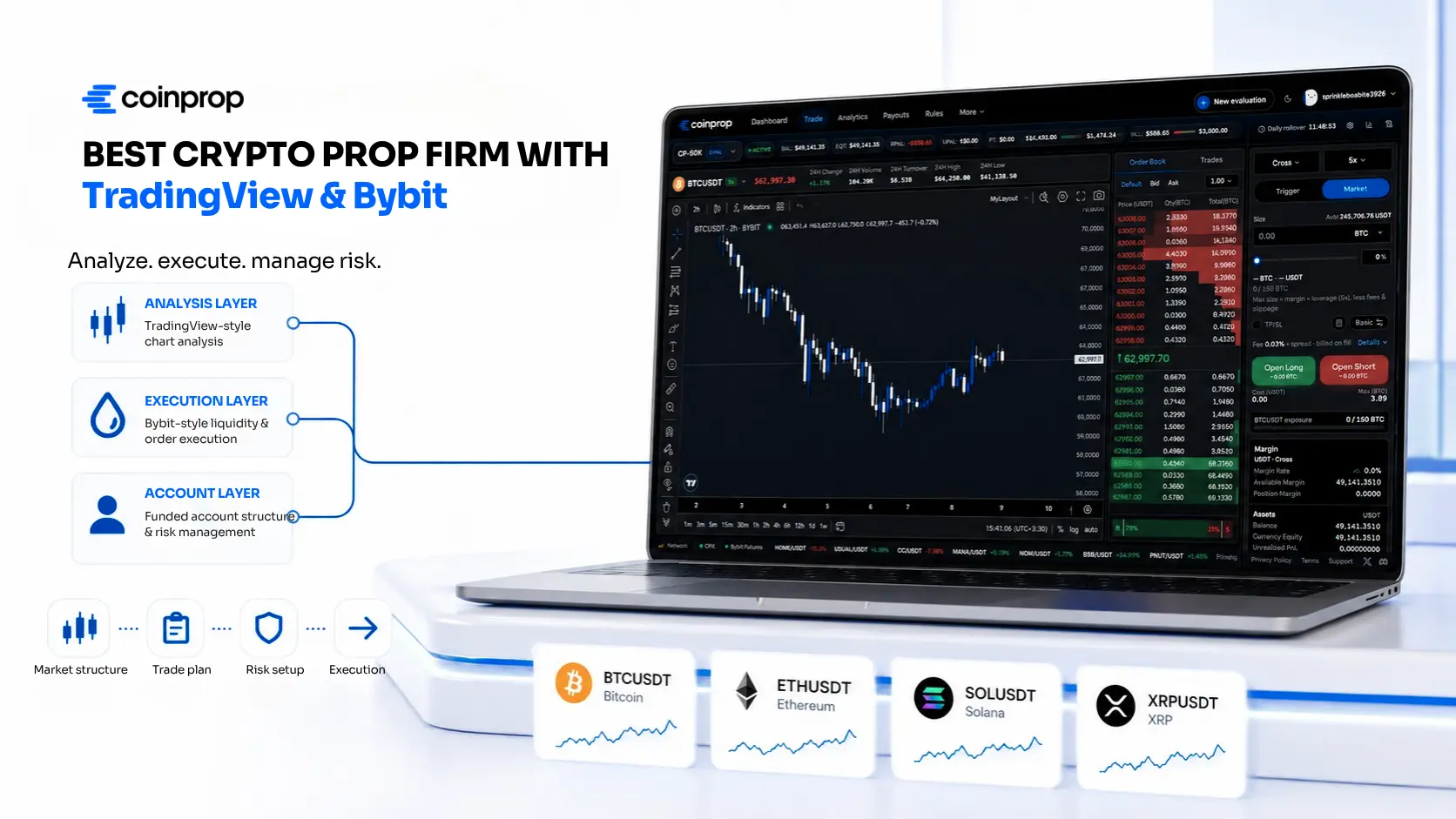
TradingView and Bybit have become central to modern crypto trading workflows, allowing traders to combine market analysis with efficient execution. Choosing the best crypto prop firm involves more than payouts or brand recognition, it also requires evaluating funding models, risk rules, and trading infrastructure. As the industry evolves, integrations such as TradingView and Bybit, offered by firms like CoinProp, are becoming increasingly relevant when comparing funded trading opportunities.
How Crypto Prop Firms Work in Real Trading Environments
Crypto prop firms have become one of the fastest growing segments of the digital trading industry. These companies provide traders with access to funded trading accounts, allowing participation in cryptocurrency markets without committing large amounts of personal capital.
Definition and Business Model of Crypto Prop Firms
A crypto prop firm is a company that provides traders with access to funded accounts after they successfully meet predefined performance and risk management requirements. Instead of relying solely on personal capital, traders are given the opportunity to trade under the firm's framework while receiving a share of generated profits. Most crypto prop firms operate through structured evaluation programs designed to assess consistency, discipline, and risk management. From a business perspective, prop firms generate revenue through a combination of evaluation fees, operational services, risk managed capital allocation models, and trader performance.
Retail Trading vs Prop Trading – Key Differences
The primary difference between retail trading and prop trading is the source of capital. Retail traders use their own funds and assume all financial risk associated with their trading decisions. Prop traders operate within a structured framework established by a prop firm. Rather than focusing solely on account growth, they must also comply with predefined risk management requirements and performance standards. Key differences often include:
- Access to larger trading capital
- Structured risk management rules
- Performance evaluation requirements
- Potential profit sharing arrangements
- Defined growth and scaling opportunities
History and Growth of Crypto Prop Trading
The rapid growth of cryptocurrency markets created demand for new forms of capital access and professional trading infrastructure. As digital asset exchanges expanded globally and perpetual futures markets gained popularity, more traders began seeking opportunities to scale strategies beyond the limitations of personal account balances. As the industry evolved, firms began introducing specialized evaluation models, crypto native trading environments, and infrastructure designed specifically for digital asset markets. Today, crypto prop trading represents a rapidly expanding segment of the broader proprietary trading industry, attracting traders from traditional finance, forex, futures, and cryptocurrency backgrounds.
Why Crypto Prop Firms Have Become Popular Among Traders
Several factors have contributed to the increasing popularity of crypto prop firms. First, many traders view funded accounts as a way to access larger capital allocations without taking on the full financial burden associated with growing a personal trading account. Second, structured evaluation processes encourage discipline and risk management. Third, the growth of professional trading infrastructure has made funded trading more accessible than ever before. Finally, prop trading offers a pathway for traders to focus on performance rather than account size alone.
How Crypto Prop Firms Connect Funding, Execution, and Trading Platforms
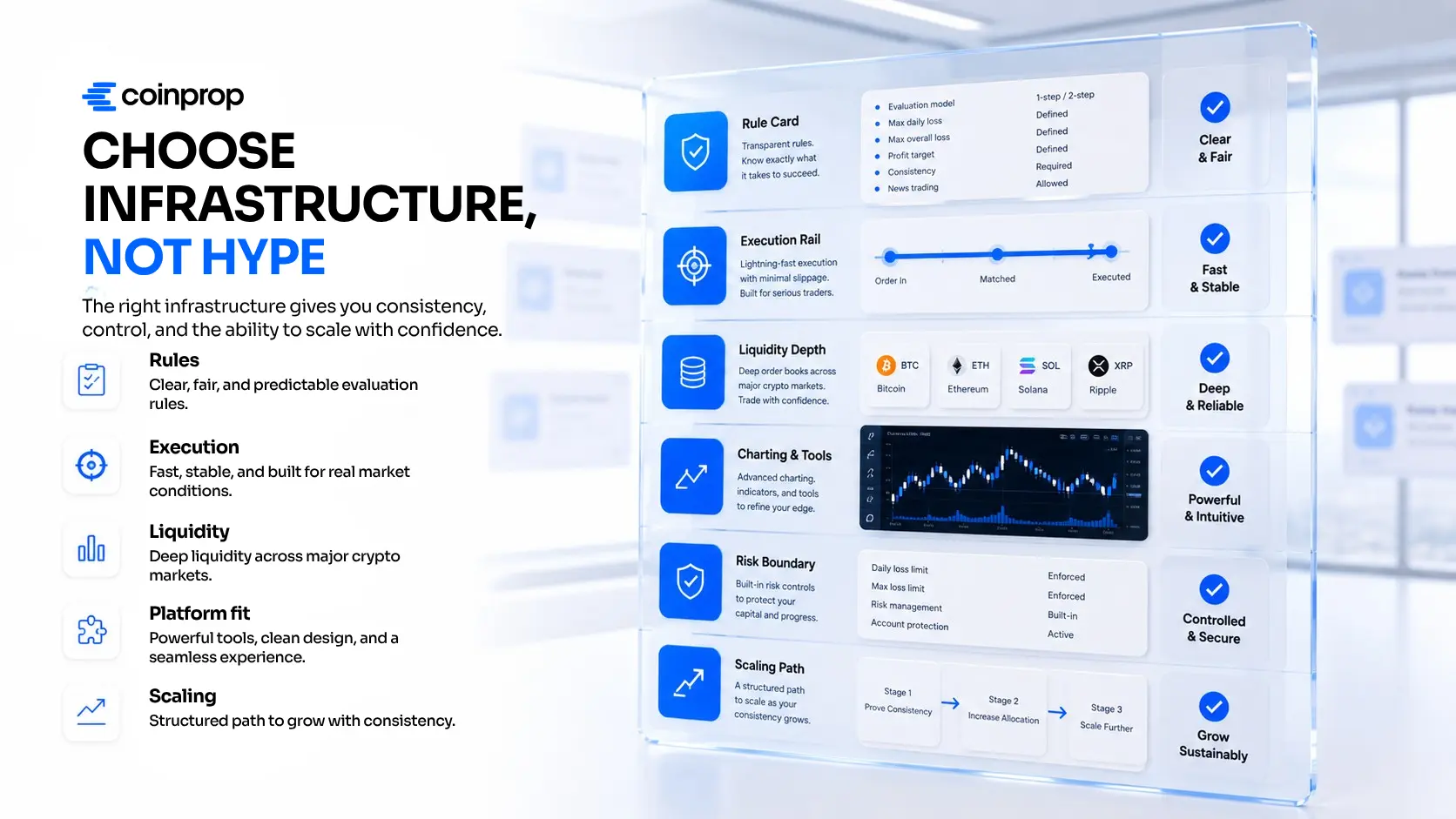
Crypto prop firms operate as integrated trading ecosystems where funding, execution, and analysis are not separate components but interconnected layers of a single trading workflow. Understanding how these three layers interact is essential for evaluating the quality of any crypto prop firm.
Role of Trading Platforms in Prop Trading Execution
Trading platforms act as the operational interface between traders and the market. In most crypto prop firm setups, these platforms are used to place trades, manage positions, and monitor account performance within defined risk parameters. While execution happens through the firm's trading infrastructure or connected exchange systems, the platform layer ensures that traders can interact with the market efficiently and consistently under the firm's rules.
How Bybit Is Used for Liquidity and Market Access
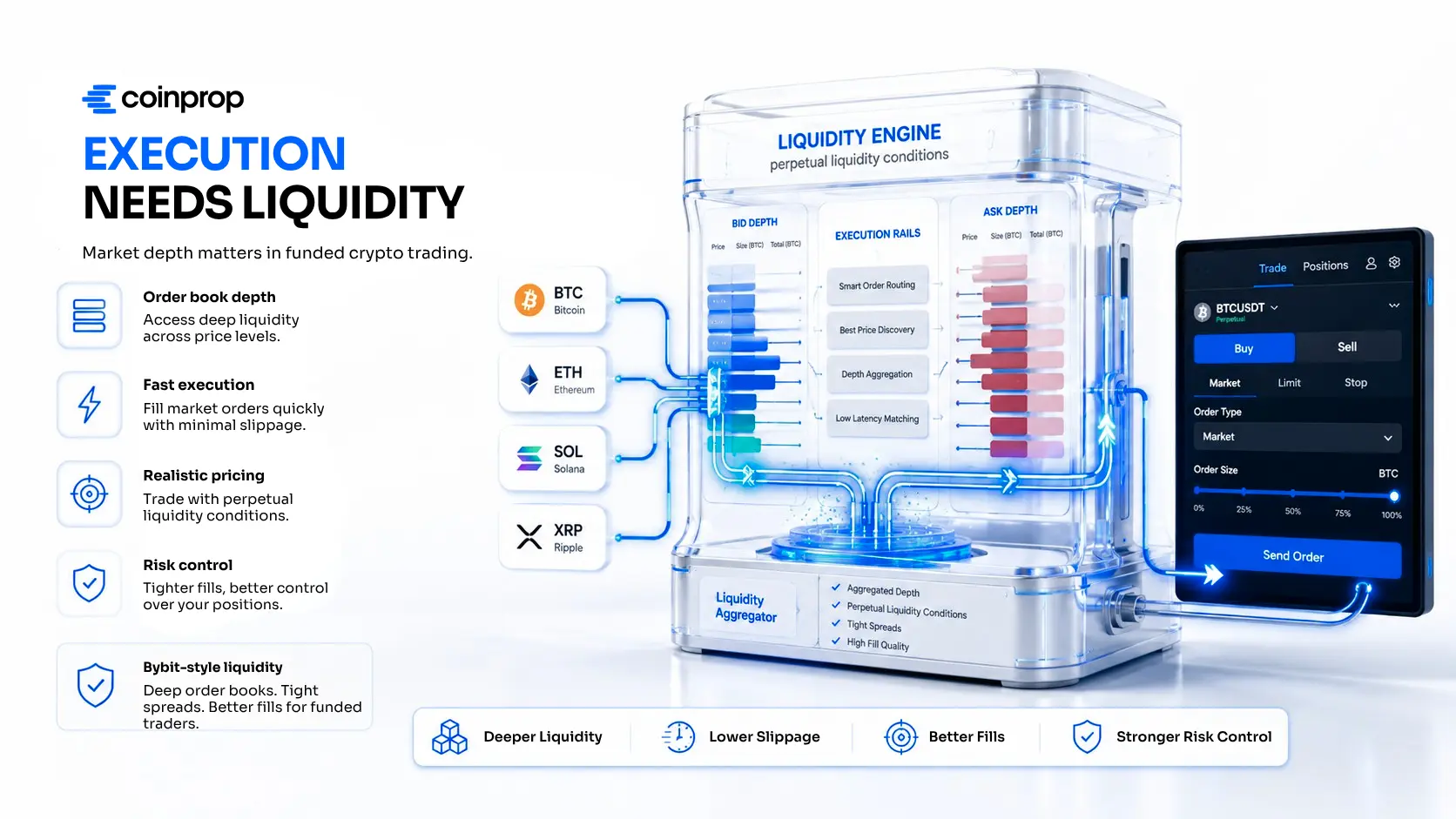
Bybit is often associated with crypto prop trading because of its deep liquidity and active derivatives markets. In many trading environments, Bybit or Bybit like execution conditions are used either directly or as a benchmark for trade execution quality. Some prop firms integrate exchange linked execution models, while others simulate similar market conditions internally. In both cases, the goal is to provide traders with realistic pricing behavior, order flow conditions, and volatility exposure similar to active crypto markets.
How TradingView Fits Into Analysis Workflows
TradingView plays a central role in pre trade analysis rather than execution. Traders use it to study market structure, identify trends, apply technical indicators, and build trading plans before executing trades within the prop firm environment. This separation between analysis and execution is common in crypto prop trading workflows. TradingView supports decision making, while execution is handled through the firm's trading platform or connected liquidity systems.
Why Execution Infrastructure Matters in Funded Trading
Execution infrastructure is one of the most important but often overlooked aspects of crypto prop trading. It determines how accurately trades are filled, how market conditions are reflected, and how consistently risk rules are enforced in real time. A strong execution system ensures that strategies developed in TradingView translate effectively into real trading outcomes, while also maintaining consistency with the firm's funding and risk management framework.
Crypto Prop Firm Challenges and Evaluation Models
Most crypto prop firms use structured evaluation programs to identify traders who can generate consistent returns while managing risk responsibly. Rather than providing immediate access to large amounts of capital, firms typically require traders to demonstrate performance within a predefined set of rules and objectives. Understanding how challenge models work is essential when comparing crypto prop firms, evaluating costs, and choosing a funded trading path that aligns with your trading style.
How a Crypto Prop Firm Challenge Works
A crypto prop firm challenge is an evaluation process that traders must complete before becoming eligible for a funded account. During this phase, traders operate under predefined objectives and risk parameters that simulate the conditions of a funded trading environment. Most challenges require traders to achieve specific performance targets while respecting risk limits. Firms evaluate not only whether a trader can generate profits, but also whether those profits are achieved through disciplined and repeatable decision making.
- Profit target requirements
- Maximum drawdown limits
- Daily loss restrictions
- Trading consistency expectations
- Account rule compliance
One Step vs Two Step Evaluation Programs
Crypto prop firms generally offer either one step or two step evaluation models. In a one step evaluation, traders must reach a single profit target while remaining within the firm's risk parameters. These programs are often simpler and faster to complete. A two step evaluation divides the assessment into separate phases. Traders typically complete an initial performance stage followed by a verification stage designed to confirm consistency. Neither model is inherently better than the other. The ideal choice depends on factors such as trading style, risk tolerance, experience level, and the amount of time a trader is willing to dedicate to the evaluation process.
Profit Targets and Consistency Requirements
Profit targets are among the most important components of any crypto prop firm challenge. A profit target represents the performance threshold traders must achieve before progressing through an evaluation or qualifying for funding. In addition to profit objectives, many firms evaluate consistency. Consistency requirements help ensure that performance is not driven by a small number of unusually large trades or excessive risk exposure. Common consistency related considerations include balanced profit generation over time, controlled position sizing, stable risk to reward management, and avoidance of extreme account volatility.
Daily Drawdown vs Maximum Drawdown Rules
Risk management is the foundation of nearly every crypto prop firm evaluation model. Daily drawdown refers to the maximum loss a trader may incur within a single trading day. This rule helps prevent significant account damage caused by emotional decision making, overtrading, or sudden market volatility. Maximum drawdown represents the largest allowable decline in account equity over the entire evaluation period or funded account lifecycle. Breaching this limit typically results in evaluation failure or account termination. While profit targets often attract the most attention, experienced traders frequently view drawdown management as the most important factor in successfully completing a prop firm challenge.
What Happens After Passing a Prop Firm Evaluation
After successfully completing an evaluation program, traders may become eligible to receive a funded account under the firm's rules and operating framework. The transition from evaluation to funding typically involves account activation, verification procedures, and acceptance of the firm's funded trading agreement. Once funded, traders continue operating under risk management requirements while gaining access to larger capital allocations.
Funded accounts may also include additional benefits such as profit sharing opportunities, scaling programs, increased capital allocations, access to advanced trading infrastructure, and eligibility for recurring payouts. Although passing an evaluation is an important milestone, long term success ultimately depends on maintaining consistent performance within the funded environment.
CoinProp Challenge and Evaluation Model
The CoinProp evaluation model is designed to assess a trader's ability to manage risk, maintain consistency, and operate within a structured trading framework. Like other professional evaluation systems, the objective is not simply to identify profitable traders, but to identify traders capable of sustaining performance over time. CoinProp provides evaluation pathways that allow traders to demonstrate their skills while following predefined trading rules and risk parameters. These rules are intended to create a transparent environment where performance can be measured objectively. For traders who want to experience a structured evaluation environment, CoinProp offers both a free trial option and affordable challenge accounts starting from $25, allowing users to test the platform before committing to a simulated funded trading path.
| Rule | CoinProp Value | Why It Matters |
|---|---|---|
| Profit Target | 9% | Allows capable traders to progress relatively quickly without forcing unnecessary activity |
| Minimum Trading Days | 2 days | Allows fast completion for skilled traders without forcing unnecessary activity |
| Maximum Trading Days | None | Removes time pressure — traders can wait for higher quality setups instead of overtrading to meet deadlines |
| Daily Loss Limit | 3% | A fixed dollar amount set from the initial account balance. The amount never changes, and the floor is set from your equity at each 00:00 UTC rollover |
| Maximum Drawdown | 6% | Static — tied to initial balance, providing a consistent, predictable risk framework during volatile conditions |
| Weekend Holding | Allowed | Supports natural strategy execution for traders who rely on volatility or event driven setups |
| News Trading | Allowed | Reduces the need to close profitable positions prematurely — supports event-driven and volatility-based strategies |
| Drawdown Type | Static | More predictable than trailing — doesn't tighten as profits grow, minimizing unnecessary constraints |
Cheapest Crypto Prop Firm
Challenge cost is often one of the first factors traders consider when comparing crypto prop firms. While finding an affordable entry point is important, the lowest priced challenge does not always provide the best overall trading opportunity. Evaluation difficulty, risk parameters, payout structures, and scaling potential can significantly influence the true value of a funded trading program.
What Is the Cheapest Crypto Prop Firm?
The cheapest crypto prop firm is generally the provider offering the lowest cost path to a funded trading account. This may include small account challenges, promotional offers, or lower priced evaluation programs designed to make funded trading more accessible. However, challenge fees should never be evaluated in isolation. Traders should also consider whether the firm's rules, payout policies, and funding structure create a realistic opportunity to succeed after purchasing a challenge. The most cost effective prop firm is often the one that combines affordability with transparent rules, reasonable objectives, and a clear path toward long term account growth.
Cheapest One Step Crypto Prop Firm Challenges
One step evaluations are often attractive to traders seeking a faster and more affordable route to funding. Instead of completing multiple verification stages, traders only need to satisfy a single set of performance and risk requirements before becoming eligible for a funded account. When comparing low cost one step challenges, traders should evaluate profit target requirements, maximum drawdown limits, consistency rules, account size options, and payout eligibility. A lower registration fee may seem attractive initially, but stricter rules can make the challenge significantly harder to complete successfully.
Cheapest Instant Funding Crypto Prop Firms
Instant funding models provide immediate access to funded accounts without requiring traders to pass an evaluation phase. Because these programs remove the challenge process, they often use different pricing structures than traditional evaluation based prop firms. For traders focused on minimizing upfront costs, comparing instant funding programs requires more than looking at the purchase price alone. Ongoing risk restrictions, scaling opportunities, payout conditions, and account flexibility can have a major impact on long term value. The cheapest instant funding account is not always the most attractive option if restrictive rules make it difficult to maintain or grow the account over time.
Lowest Cost vs Best Value Crypto Prop Firms
Many traders make the mistake of choosing a prop firm based solely on the lowest advertised challenge fee. While affordability matters, long term success depends on much more than the initial cost of entry. CoinProp is an example of an affordable crypto prop trading platform that offers challenge accounts starting from $25, creating a low barrier to entry for traders who want to begin their funded trading journey. When comparing crypto prop firms, traders should focus on overall value by evaluating challenge cost, profit target to drawdown ratio, profit split structure, payout reliability, trading infrastructure, scaling opportunities, and rule transparency.
Crypto Prop Firm with TradingView
TradingView is one of the most widely used charting and analysis platforms among crypto traders operating within prop firm environments. While most crypto prop firms do not directly integrate TradingView into their execution systems, the platform plays a central role in how traders analyze markets, develop strategies, and prepare trades before execution. In practice, TradingView functions as an external analytical layer, while actual order execution is typically handled through the prop firm's trading platform or connected exchange infrastructure.
How Prop Firms and Traders Use TradingView in Practice
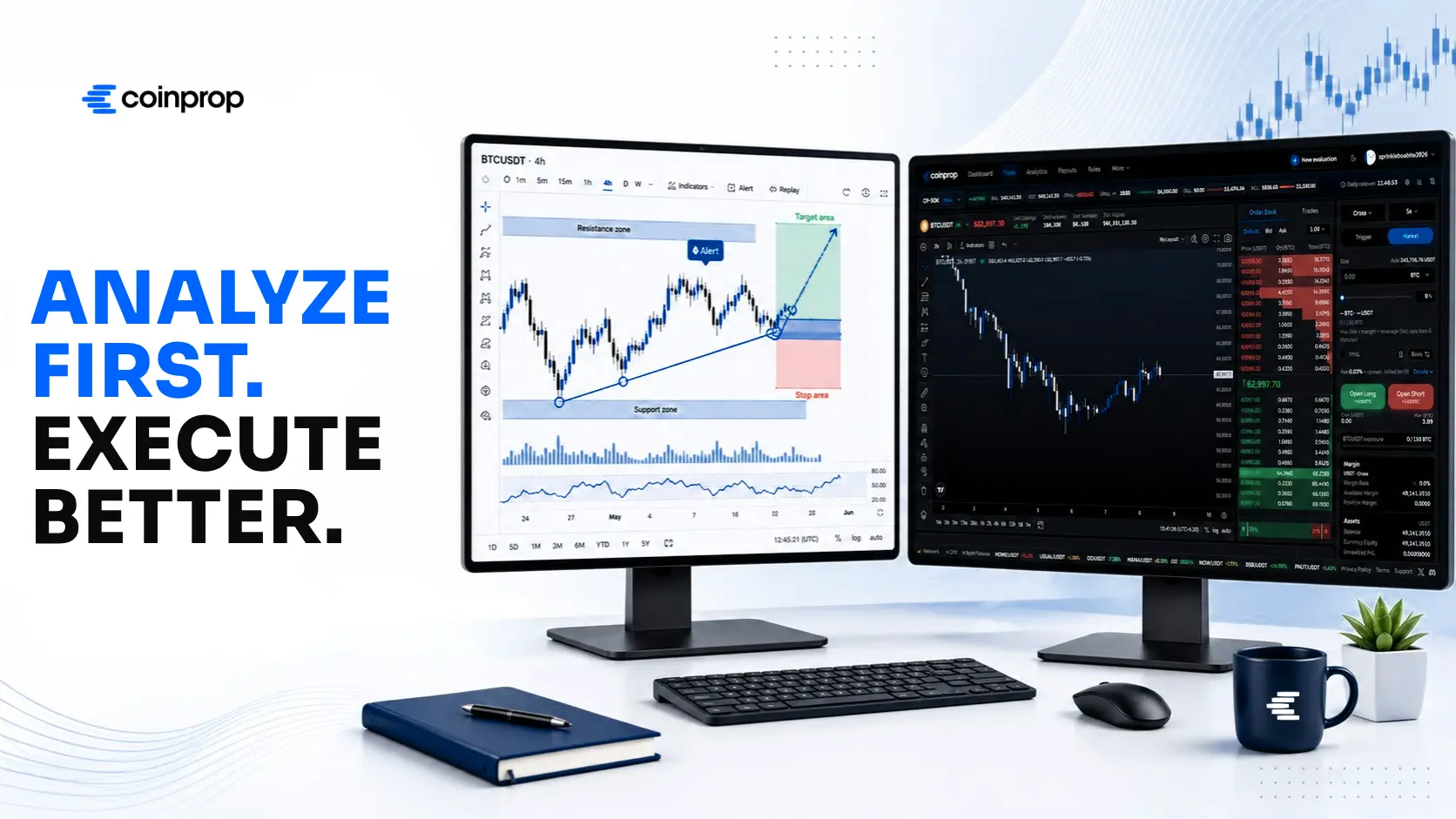
Within crypto prop trading workflows, TradingView is primarily used for decision making rather than execution. Traders rely on it to build structured market views and plan trades in advance. Typical use cases include market analysis, identifying key structural levels, setting price alerts, and organizing trading ideas across multiple assets. These functions help traders maintain a disciplined approach, especially when operating under strict risk management rules in funded accounts.
Key Features Traders Look for in TradingView Integration
When evaluating crypto prop firms that support TradingView based workflows, traders are less focused on direct integration and more focused on how effectively the platform supports their analysis process. Important aspects include advanced charting capabilities, reliable technical indicators, flexible multi timeframe analysis, and efficient alert systems. Traders also value the ability to maintain organized watchlists and structured layouts that support repeatable trading strategies.
TradingView Based Trading Workflows
A typical TradingView driven workflow in prop trading begins with higher timeframe analysis to understand overall market structure. Traders then move to lower timeframes to refine entry points and validate trade setups. During this process, TradingView is used to map support and resistance zones, evaluate trend direction, and structure risk to reward scenarios before any trade is executed on the prop firm's platform. This workflow helps ensure that decisions are based on structured analysis rather than impulsive reactions to market movement.
Limitations and Considerations
Although TradingView significantly improves market analysis and planning, it is not an execution system in most crypto prop firm setups. Traders must therefore evaluate the broader trading environment rather than relying on charting tools alone. Key factors that matter beyond TradingView include execution quality, order filling behavior, liquidity conditions, platform stability, risk management rules, and overall funding structure. These elements ultimately have a greater impact on long term performance in a funded trading environment than charting tools alone.
Best Crypto Prop Firms with Bybit
Crypto prop firms associated with Bybit have become increasingly popular among traders who want exposure to deep liquidity, fast execution, and a derivatives focused trading environment. While there is no official "Bybit prop firm" in most cases, many proprietary trading firms either integrate Bybit like pricing models or use Bybit liquidity as a reference for execution quality and market behavior.
Is There a Bybit Prop Firm?
In most cases, there is no official prop trading program directly operated by Bybit. Instead, crypto prop firms build their own funded trading systems and may reference Bybit pricing, liquidity, or derivatives markets to design realistic trading conditions. As a result, when traders search for a “Bybit prop firm,” they are usually referring to prop firms that use Bybit as a benchmark for pricing and execution quality, offer trading environments similar to Bybit futures markets, and provide access to crypto derivatives trading under funded account rules.
How Traders Access Bybit Through Crypto Prop Firms
Traders typically interact with Bybit related trading environments in two main ways. Some prop firms offer trading systems that closely mirror Bybit liquidity and price feeds to simulate real exchange conditions. Other firms use demo or internal trading systems that replicate Bybit market behavior for challenge and evaluation purposes. In both cases, the goal is to ensure that trading performance reflects real market conditions, including volatility, liquidity behavior, and order execution dynamics.
Why Bybit Is Used in Crypto Prop Trading
Bybit is widely referenced in prop trading due to its strong derivatives liquidity, active global user base, and efficient order execution infrastructure. These characteristics make it a useful benchmark for designing funded trading environments. Key reasons include high liquidity in perpetual futures markets, fast order execution and competitive spreads, strong market depth during volatile conditions, and popularity among active crypto derivatives traders. Because of these factors, many prop firms aim to replicate or align with Bybit like trading conditions when structuring their platforms.
What Traders Should Evaluate Beyond Exchange Access
While exchange reference such as Bybit is important, it is not the only factor when choosing a crypto prop firm. Traders should also evaluate the broader trading environment to understand long term value and sustainability. Key factors include evaluation structure and challenge rules, risk management policies including drawdown, leverage, and consistency rules, profit split and payout systems, scaling opportunities for funded accounts, and execution stability and platform reliability. Ultimately, exchange access or pricing reference is only one component of a broader funded trading ecosystem.
Crypto Prop Firm with Binance Liquidity
Some crypto prop firms reference Binance liquidity or Binance derived market data as part of their trading infrastructure. This is typically used to provide traders with pricing that reflects real crypto market conditions, even when execution does not take place directly on Binance. In most cases, Binance liquidity refers to market data feeds, liquidity aggregation layers, or API based routing systems rather than direct access to Binance's native order book.
Why Some Crypto Prop Firms Use Binance Market Data
Crypto prop firms may use Binance related market data to align their pricing with widely recognized crypto exchanges and improve the realism of trading conditions. This helps ensure that chart behavior, volatility structure, and price movements closely resemble real market environments. However, execution itself may still be handled through internal systems or external liquidity providers depending on the firm's architecture.
Binance Liquidity vs Simulated Pricing Models
There is a clear distinction between exchange aligned pricing models and fully simulated CFD based environments. Binance linked models aim to reflect real market conditions using external exchange data sources, while simulated models generate pricing internally or through broker feeds without direct exchange order book connection. This difference can influence execution transparency, price accuracy, and how closely trading conditions mirror real crypto markets.
Binance vs Bybit Liquidity in Crypto Prop Trading
Both Binance and Bybit are commonly referenced in crypto prop trading environments as liquidity or pricing sources, but their role depends on how the firm is structured. Some firms use Binance primarily as a market data reference, while others integrate Bybit more directly into execution workflows through API based connectivity. In most cases, the key difference is not the exchange itself, but whether the firm operates through CFD based pricing or exchange connected execution infrastructure.
Instant Funding Crypto Prop Firms
Instant funding crypto prop firms offer traders immediate access to a funded trading account without requiring them to complete a traditional evaluation or challenge phase. Instead of passing multi step performance tests, traders receive capital upfront and begin trading under predefined risk management rules set by the firm. This model has grown in popularity as more traders look for faster access to capital and prefer to skip extended evaluation processes.
Instant Funding vs Traditional Evaluation Models
Instant funding models generally apply stricter ongoing risk controls since traders are granted capital without prior performance verification. These controls may include tighter drawdown limits, stricter consistency rules, or more conservative trading conditions during funded account usage. On the other hand, one step evaluation models provide a simplified pathway to funding through a single challenge phase. Traders pass a predefined profit target and risk rules, and upon success, they receive a funded account with the ability to scale and continue trading under standard conditions. Both models aim to manage risk, but they differ in how traders are qualified and how trading freedom is structured after funding.
Are Instant Funding Accounts Worth It?
The value of instant funding depends on a trader's experience and strategy. Some traders prefer immediate access to capital without waiting through evaluation phases, while others benefit from structured challenges that help validate consistency before live trading. For traders with proven discipline, evaluation based models may offer more flexibility in the long term. For others, instant funding provides faster entry into live market conditions, but often with tighter operational constraints.
Risks and Limitations of Instant Funding Programs
Instant funding programs typically compensate for the lack of an evaluation phase by enforcing stricter risk management rules during live trading. This can include lower drawdown thresholds, tighter profit conditions, and more restrictive scaling policies. Because traders are not filtered through a prior challenge, firms must rely more heavily on ongoing account controls to manage risk exposure. As a result, while instant funding offers speed and convenience, it may require more precise risk control from traders to maintain account stability over time.
Crypto Prop Firms List 2026
The crypto prop firm landscape in 2026 is more diverse than ever, with different models designed to match varying trader preferences, risk tolerances, and execution needs. Instead of being a single unified category, crypto prop firms now operate under several distinct structures, ranging from traditional evaluation based systems to instant funding and crypto native trading environments.
Below is an overview of some of the most recognized crypto prop firms and how their trading models are structured.
CoinProp
Crypto prop firm built around Bybit liquidity, TradingView integration, and a one step evaluation model.
Brightfunded
Multi asset prop firm offering crypto trading through CFD based instruments.
FTMO
Established forex prop firm offering crypto CFDs alongside traditional markets.
Crypto Fund Trader (CFT)
Multi asset prop firm offering crypto trading alongside forex, indices, and commodities, with external market connectivity and different trading platform options.
HyroTrader
Crypto prop firm with exchange connected execution via external account integration.
FundedNext
Multi asset prop firm offering forex and crypto CFD trading under a multi asset structure.
Overall, crypto prop firms differ significantly in execution models, liquidity access, and trading conditions. Traders typically choose based on whether they prioritize crypto native execution, multi asset flexibility, or traditional CFD based trading environments.
CoinProp Review
When we talk about a next generation prop firm, we are not simply referring to a modern interface or better branding. The real difference lies in the trading infrastructure itself. CoinProp was built to remove many of the limitations found in traditional prop trading environments, allowing traders to focus on market execution instead of fighting platform inefficiencies.
Why CoinProp Focuses on Direct Crypto Liquidity
CoinProp is built around direct crypto liquidity data rather than synthetic CFD pricing models. Instead of relying on internal broker generated pricing, traders operate in a simulated environment priced from live exchange liquidity data from platforms such as Bybit. This infrastructure is one of the reasons many traders compare CoinProp among the best crypto prop firms with TradingView and Bybit when evaluating modern funded trading environments.
This structure helps reduce many of the pricing inconsistencies commonly seen in CFD based environments and creates a trading experience that more closely reflects actual crypto market conditions. Traders see deeper order book data, more transparent pricing, and execution conditions designed for high volatility crypto markets.
TradingView Integration and Execution Workflow
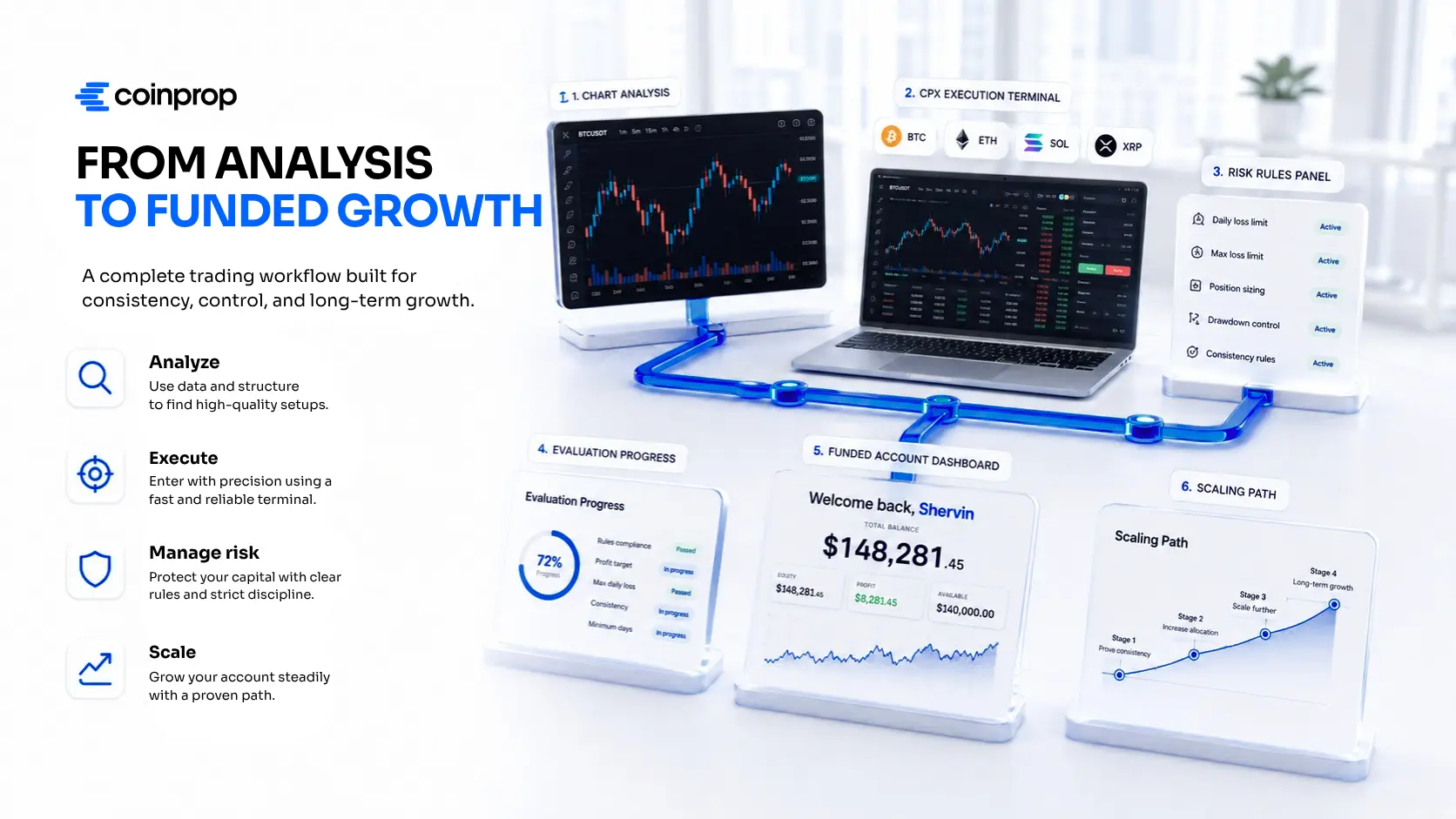
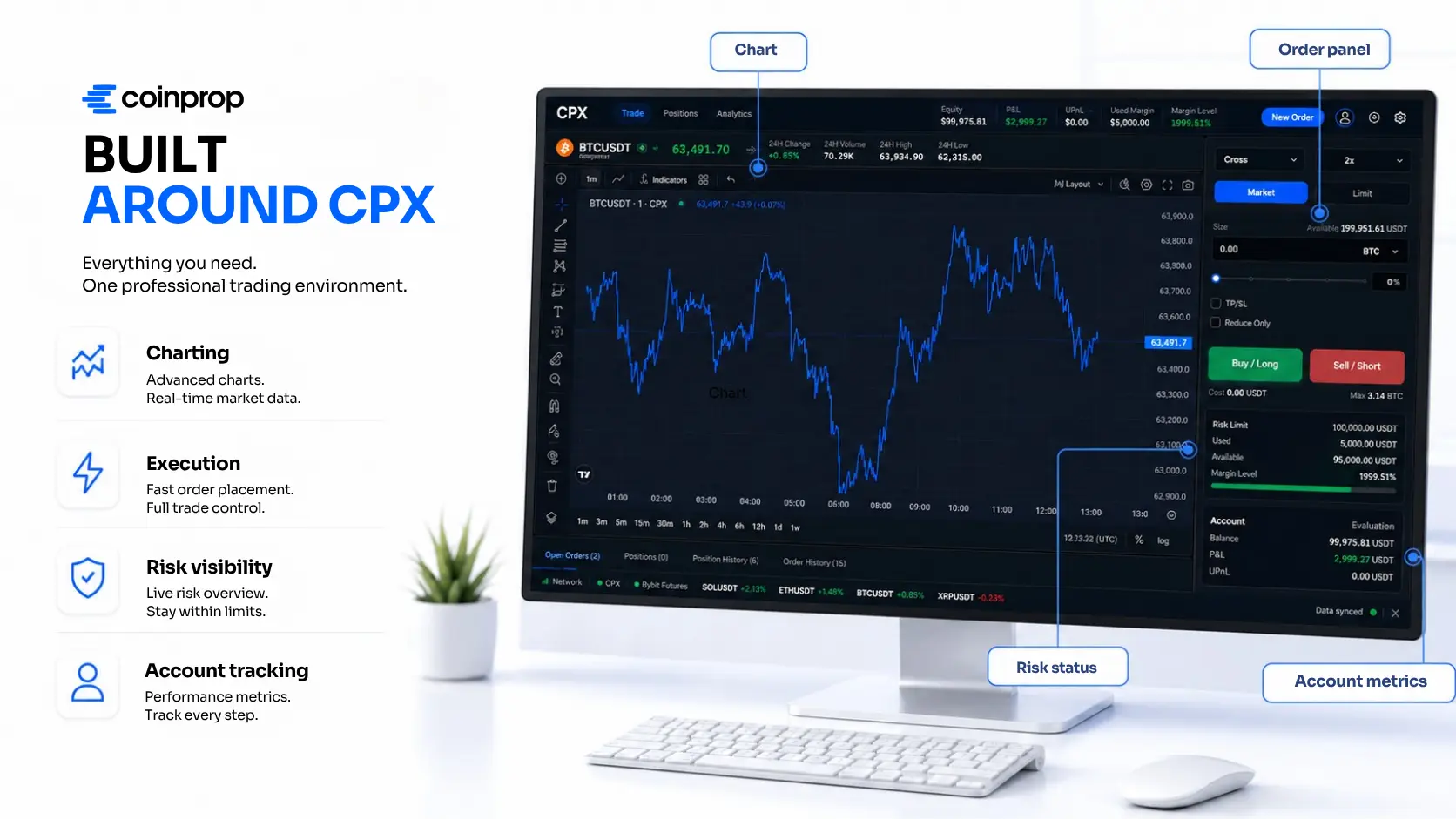
One of the biggest workflow problems for active traders is switching constantly between charting software and execution platforms.Coinprop CPX Terminal removes that friction through deep TradingView integration. Traders can analyze markets, manage positions, and execute orders directly within the same chart based environment. This unified workflow improves execution speed, reduces manual errors, and creates a more efficient trading experience during fast moving market conditions. However, even with optimized execution systems, traders must still be aware of factors such as prop slippage in crypto prop trading firms, especially in high volatility conditions where order fills can vary.
One Step Evaluation and Static Drawdown Model
CoinProp uses a one step evaluation model used by crypto prop firms designed to simplify the path toward simulated funded trading accounts. Instead of requiring multiple challenge phases, the evaluation process focuses on consistent trading performance under clearly defined risk parameters with a minimum trading requirement of 2 days.
The platform also uses a static drawdown model rather than a trailing drawdown structure. Unlike trailing systems that tighten as profits grow, static drawdown provides traders with more stable risk limits and greater flexibility in trade management.
Profit Split, Payouts, and Account Limits
CoinProp’s payout structure is designed around defined payout processes rather than short term trading cycles. For full details on how these processes are implemented, traders can refer to CoinProp transparency. Traders operate within a system where performance, rule compliance, and timing conditions determine eligibility for rewards and account expansion.
Traders can access reward splits of up to 95%, with payout requests available at regular intervals, including cycles as short as every 5 days. Approved payouts are processed within a short timeframe, typically under 6 hours in standard conditions, depending on account eligibility and compliance checks. All trading takes place in a simulated environment, and rewards are discretionary and governed by the applicable agreements.
Funded account limits are fixed rather than earned over time. A trader may hold up to four funded accounts at once, with a maximum of $400,000 in combined simulated capital across them. Both limits apply, and whichever is reached first is binding.
Who Is CoinProp Best Suited For?
CoinProp is designed for serious crypto traders who prioritize execution quality, trading workflow efficiency, and transparent risk conditions.
The platform is especially suitable for:
- Scalpers who require fast execution and low latency environments
- Technical traders heavily dependent on TradingView workflows
- Traders looking for direct crypto market conditions instead of synthetic CFD execution
- Funded traders who prefer static drawdown over restrictive trailing models
For traders focused on long term consistency in crypto prop trading, CoinProp represents a more infrastructure driven approach to simulated funded trading.
HyroTrader Review
HyroTrader is a crypto prop trading platform that provides funded account programs through external trading infrastructure. Instead of offering a proprietary trading terminal, it connects traders to crypto markets using exchange based systems.
How HyroTrader Connects Traders to Crypto Markets
HyroTrader allows traders to access crypto markets through external execution setups, such as Bybit account integration via API. This enables trading USDT perpetual futures directly on exchange liquidity with real order book conditions.
In some setups, traders may also use platforms like Cleo or similar third party interfaces for execution and account management. However, the underlying trading execution is still based on exchange infrastructure rather than an in house platform.
HyroTrader vs Traditional Forex Prop Firms
Compared to traditional forex prop firms, HyroTrader is more focused on direct crypto market access rather than CFD based trading models.
Forex prop firms typically rely on broker pricing and synthetic instruments, while HyroTrader operates closer to exchange connected execution environments used in crypto markets.
FTMO Review
FTMO is one of the most established prop trading firms, originally built around forex trading and later expanded to include multiple asset classes such as indices, commodities, and crypto CFDs. While it is widely used by retail traders, its core infrastructure is not crypto native.
The platform operates primarily as a CFD based prop firm, where traders are evaluated through structured challenges before gaining access to funded accounts.
Is FTMO a True Crypto Prop Firm?
FTMO is not a crypto native prop firm in terms of infrastructure or market design. Although it offers crypto instruments, these are provided through CFD contracts rather than direct crypto exchange execution or perpetual futures markets.
This means traders are not interacting with real crypto order books, but rather trading synthetic instruments that replicate price movements of underlying crypto assets.
FTMO vs Crypto Native Prop Firms
The main difference between FTMO and crypto native prop firms lies in market structure and execution model.
FTMO is built on a traditional CFD trading framework, originally designed for forex markets, with crypto added as an additional asset class. In contrast, crypto native prop firms are generally structured around exchange linked environments and crypto specific trading mechanics such as perpetual futures, funding rates, and real liquidity conditions.
As a result, FTMO is more aligned with traditional multi asset prop trading, while crypto native firms focus more directly on crypto market infrastructure and execution behavior.
Crypto Fund Trader (CFT) Review
Crypto Fund Trader (CFT) is a multi asset prop trading firm that offers funded trading programs across forex, indices, commodities, and crypto markets.
Crypto Fund Trader and External Exchange Connectivity
CFT offers crypto trading exposure through external exchange connectivity and platform integrations.
Depending on the trading setup, crypto trading may be supported through different execution environments or third party trading platforms. This allows the firm to provide access to a range of crypto instruments within its broader multi asset structure.
Rather than being built as a fully crypto native trading environment, CFT operates as a multi asset prop firm.
Crypto Fund Trader vs Crypto Native Prop Firms
Crypto Fund Trader operates as a multi asset prop firm that includes crypto market access as part of a broader trading offering.
By comparison, some crypto prop firms are designed with a stronger focus on crypto specific trading environments, including perpetual futures markets and exchange connected workflows.
These differences mainly relate to platform structure, trading setup, and how the trading environment is organized rather than the overall legitimacy or functionality of either model.
BrightFunded Review
BrightFunded is a multi asset prop trading firm that provides access to forex, indices, commodities, and crypto markets through CFD based trading instruments. The platform is structured around a traditional prop trading model where traders are evaluated through defined challenge processes before receiving funded accounts.
How BrightFunded Provides Crypto Market Exposure
BrightFunded offers crypto trading exposure through CFD instruments rather than direct exchange execution. In this setup, traders speculate on crypto price movements using broker derived pricing instead of interacting with underlying crypto exchange order books.
Crypto instruments are typically integrated into the same trading environment as other asset classes, allowing traders to operate within a unified multi market dashboard.
BrightFunded vs Crypto Native Prop Firms
BrightFunded follows a CFD based multi asset structure, originally designed for forex and expanded to include additional markets such as crypto.
In contrast, crypto native prop firms are generally structured around exchange linked execution environments and crypto specific market mechanics such as perpetual futures pricing, funding rates, and direct liquidity conditions.
As a result, BrightFunded is positioned as a multi asset CFD trading environment, while crypto native prop firms focus more directly on exchange aligned crypto market infrastructure.
FundedNext Review
FundedNext is a hybrid prop trading firm that offers funded accounts across multiple asset classes, including forex, indices, commodities, and crypto CFDs. The platform is designed around a traditional multi market prop trading model rather than a crypto native execution environment.
How FundedNext Combines Forex and Crypto Trading
FundedNext provides traders with access to both forex and crypto markets within the same prop trading framework. Crypto trading is typically offered through CFD instruments, allowing exposure to crypto price movements alongside traditional financial markets.
This hybrid structure enables traders to use a single funded account setup to trade different asset classes, but execution is still based on broker side pricing rather than direct crypto exchange order books or perpetual futures infrastructure.
FundedNext vs Crypto Focused Prop Firms
The key difference between FundedNext and crypto focused prop firms lies in market specialization and execution structure.
FundedNext follows a multi asset CFD based model, originally built for forex trading and extended to include crypto markets. In contrast, crypto focused prop firms are generally designed around crypto native trading conditions, including exchange linked execution and crypto specific market mechanics such as funding rates and perpetual futures behavior.
As a result, FundedNext is positioned more as a hybrid prop trading firm, while crypto focused firms are more specialized toward crypto market infrastructure and trading conditions.
Direct Crypto Liquidity Prop Firms vs CFD Based Prop Firms
Direct crypto liquidity prop firms and CFD based prop firms represent two different execution structures used in funded trading environments. The main difference is not about profitability or strategy, but about how trades are processed and where market pricing is sourced from. Understanding these differences helps traders evaluate execution quality, pricing behavior, and how closely a prop firm reflects real trading conditions.
How CFD Based Prop Firms Operate
CFD based prop firms allow traders to speculate on price movements without direct access to underlying crypto exchange liquidity. Trades are processed internally through the firm's pricing infrastructure, which is designed to reflect market prices but does not necessarily connect to real order books. This structure can result in differences in execution behavior, pricing feed sources, and how market conditions are simulated during trading.
How Direct Crypto Liquidity Works
Direct crypto liquidity prop firms route trades to real exchanges or liquidity providers. This means that orders interact with actual market depth, including live bids, asks, and order book dynamics. As a result, execution tends to reflect real market behavior more closely, especially during periods of high volatility or increased trading volume.
Advantages and Trade Offs of Each Model
Each execution model used in crypto prop firms has different structural characteristics that can influence trading behavior. Rather than being inherently better or worse, the differences mainly relate to how pricing is sourced and how trades are processed. Direct liquidity models are connected to external exchanges or liquidity providers, meaning execution reflects real market order flow and depth. This can introduce more direct exposure to live market conditions, especially during periods of volatility.

Crypto Funded Prop Firm Advantages Compared to Self Funded Trading
Crypto funded prop firms and self funded trading represent two fundamentally different approaches to participating in financial markets. In self funded trading, traders rely entirely on their own capital and bear full responsibility for both profits and losses. In contrast, funded prop firms provide traders with access to firm capital under defined rules, allowing them to trade larger accounts without committing significant personal funds.
Access to Larger Trading Capital
One of the key differences between funded prop trading and self funded trading is access to capital. Prop firms allow traders to operate with significantly larger account sizes than they would typically manage with personal funds alone. This increased capital exposure can enable traders to scale their strategies more effectively, particularly in markets like crypto where position sizing and volatility management play an important role in performance outcomes.
Reduced Personal Financial Risk
In self funded trading, every trade directly impacts the trader's personal capital, which can increase emotional pressure and risk sensitivity. Funded prop trading separates personal finances from trading capital, meaning traders are primarily risking evaluation fees or program costs rather than their own account balance. This structure can help reduce psychological pressure and allow traders to focus more on execution quality and strategy consistency.
Structured Risk Management Environments
Crypto prop firms typically operate under predefined risk management frameworks that include rules such as drawdown limits, position sizing restrictions, and consistency requirements. While these constraints may feel restrictive compared to self directed trading, they are designed to encourage disciplined trading behavior and long term capital preservation within funded accounts.
Scaling Opportunities for Consistent Traders
Many prop firms offer scaling programs that reward consistent performance by increasing account size or capital allocation over time. Unlike self funded trading, where growth depends entirely on account compounding, prop trading scaling structures can provide faster capital expansion for traders who demonstrate stable performance and adherence to risk rules.

Crypto Prop Trading Rules and Risk Management
Crypto prop trading rules and risk management frameworks are the foundation of nearly all funded trading programs. Unlike self-directed trading, where traders can freely adjust risk exposure, prop firms operate under predefined rule sets designed to protect capital, ensure consistency, and evaluate trader discipline over time. These rules are not only used to prevent excessive losses but also to assess whether a trader can operate within a structured, professional trading environment.
Position Sizing and Leverage Control
Position sizing and leverage limits are among the most important components of prop trading risk management. Prop firms typically define maximum position sizes or leverage caps to ensure traders do not expose the account to disproportionate risk. Proper position sizing allows traders to control drawdowns and maintain consistency across multiple trades, especially in volatile crypto markets where price swings can be significant within short timeframes.
Risk Management Requirements in Funded Accounts
Funded accounts usually come with strict risk management requirements that must be followed at all times. These may include daily loss limits, maximum drawdown thresholds, and consistency rules that govern how profits are generated. These constraints are designed to ensure that trading performance is stable and not dependent on high risk or irregular trading behavior. Maintaining compliance with these rules is essential for account continuity and scaling eligibility.
Common Rule Violations That Cause Failures
Many traders fail prop firm challenges not because of strategy inefficiency, but due to rule violations. Common issues include exceeding daily drawdown limits, over leveraging positions, inconsistent risk exposure, and ignoring trading restrictions during volatile market conditions. Even profitable traders can fail evaluations if their trading behavior does not align with the firm's structured risk framework, making discipline as important as strategy.
Long Term Survival Strategies for Funded Traders
Long term success in crypto prop trading depends on consistency, disciplined risk management, and adaptability to structured trading rules. Traders who survive and scale funded accounts typically focus on controlled position sizing, steady return generation, and avoiding high risk behavior during volatile market phases. Sustainable prop trading is less about maximizing short term profits and more about maintaining stable performance within defined risk parameters over time.

Funded Trader Payouts, Profit Splits, and Scaling Structures
Funded trader payouts, profit splits, and scaling structures are key components of the crypto prop trading ecosystem. They define how traders are compensated for profitable performance, how often earnings can be withdrawn, and how successful traders can increase their capital allocation over time. Unlike self funded trading, where all profits belong entirely to the trader, prop trading operates on a shared profit model. Understanding these structures is essential for evaluating the long term earning potential of any crypto prop firm.
How Profit Splits Work
Profit splits determine how trading profits are divided between the trader and the prop firm. In most funded trading models, traders receive a fixed percentage of the profits they generate, while the firm retains the rest as compensation for providing capital and infrastructure. The exact split varies between firms and account types, but the structure is typically designed to reward consistent performance while maintaining sustainability for the firm's capital allocation model.
Payout Schedules and Withdrawal Policies
Payout schedules define how frequently traders can withdraw their profits from funded accounts. Some prop firms offer bi weekly or monthly payouts, while others may allow more flexible withdrawal cycles depending on performance and account status. Withdrawal policies may also include minimum payout thresholds, verification requirements, and conditions related to account consistency or risk compliance. These rules ensure that payouts remain aligned with long term trading stability and risk management standards.
Scaling Plans and Capital Growth Opportunities
Scaling plans are designed to increase a trader's capital allocation based on consistent performance over time. When traders demonstrate stable profitability and adherence to risk rules, prop firms may gradually increase account size or provide access to larger funded tiers. This structure allows traders to grow their trading capacity without needing to deposit additional personal capital, making scaling one of the most attractive long term benefits of funded trading programs.
Factors That Influence Long Term Earnings
Long term earnings in crypto prop trading are influenced by multiple factors beyond just profit splits. Consistency, risk management discipline, trading frequency, and adherence to firm rules all play a significant role in determining overall payout potential. Traders who focus on stable performance and controlled risk exposure are more likely to qualify for scaling opportunities and maintain uninterrupted access to funded accounts, which directly impacts long term income potential.
| Limit | Value | How it applies |
|---|---|---|
| Largest single funded account | $100,000 | The top evaluation tier |
| Maximum funded accounts | 4 | Held at any one time |
| Maximum combined funded capital | $400,000 | Across all funded accounts |
| Which limit binds | Whichever is reached first | Eight $50,000 accounts are not permitted |
Crypto Prop Firm Review
Crypto prop firm reviews play an important role in how traders evaluate different funded trading programs. Since prop firms vary significantly in execution models, risk rules, payout structures, and funding conditions, reviews help traders understand real user experiences beyond marketing claims. However, not all reviews carry the same level of reliability. A structured approach is needed to distinguish between genuine trading feedback and biased or promotional content.
How Traders Evaluate Prop Firms
When assessing a crypto prop firm, traders typically focus on practical trading conditions rather than promotional messaging. Key evaluation factors include evaluation rules, drawdown limits, payout consistency, execution quality, and overall trading environment. Many traders also consider how well the firm's structure aligns with their trading strategy, especially in terms of risk tolerance and scalability potential.
Trust, Transparency, and Reputation Signals
Trust is a major factor in selecting a prop firm. Traders often look for transparency in areas such as trading rules, payout processes, execution behavior, and funding conditions. Reputation signals may include long term user feedback, consistency of payouts, clarity of rules, and how openly the firm communicates changes to trading conditions. A transparent structure generally indicates a more stable and predictable trading environment.
Common Red Flags to Watch For
Certain warning signs can indicate potential issues with a crypto prop firm. These may include unclear trading rules, inconsistent payout behavior, lack of transparency around risk parameters, or frequent changes to evaluation conditions without clear communication. Traders are also cautious when reviews appear overly promotional or when there is a lack of independent feedback across multiple sources.
Interpreting Online Reviews Correctly
Online reviews should be interpreted with context, as individual trading results can vary significantly based on strategy, risk management, and experience level. A balanced evaluation considers patterns across multiple reviews rather than isolated opinions. Traders who rely on structured feedback analysis are better positioned to identify reliable prop firms and avoid misleading or incomplete information.
How to Choose the Best Crypto Prop Firm in 2026
Choosing the best crypto prop firm in 2026 requires more than comparing profit splits or marketing claims. Modern prop trading environments differ significantly in terms of funding models, risk rules, execution infrastructure, and platform compatibility. As a result, traders need a structured approach to evaluate whether a firm aligns with their trading strategy and long term goals.
Matching Firm Rules to Your Trading Style
Every crypto prop firm operates with its own set of rules, including drawdown limits, profit targets, leverage restrictions, and consistency requirements. These rules can significantly impact how a trading strategy performs in a funded environment. Traders should evaluate whether their strategy is compatible with the firm's risk framework. For example, high frequency or aggressive strategies may not align well with strict drawdown controls, while more structured or conservative approaches may fit more easily within evaluation based systems.
Evaluating Funding Models and Costs
Funding models vary across crypto prop firms, ranging from evaluation based challenges to instant funding programs. Each model comes with different cost structures, risk expectations, and access conditions. One of the most overlooked metrics when comparing prop firms is the profit target to drawdown ratio. This ratio measures how much profit a trader must generate relative to the maximum risk allowed during an evaluation. Evaluating this ratio can provide a more accurate picture of challenge difficulty than challenge fees alone.
Comparing Trading Platforms and Infrastructure
Trading platforms and infrastructure play a critical role in execution quality and overall trading experience. Some prop firms offer proprietary platforms, while others integrate with external tools or exchange connected systems. Traders should evaluate factors such as execution speed, platform stability, order management tools, and compatibility with charting systems like TradingView. Strong infrastructure can improve execution consistency, especially in fast moving crypto markets.
Building a Decision Framework Before Buying a Challenge
Before purchasing a challenge or funded account, traders benefit from building a clear decision framework that evaluates multiple dimensions of a prop firm. This may include analyzing risk rules, funding structure, payout reliability, platform quality, and long term scaling opportunities. A structured approach reduces impulsive decision making and helps traders choose firms that align with both their strategy and risk tolerance over time.
Common Mistakes Crypto Prop Traders Make
Many crypto prop traders fail not because of a lack of trading skill, but due to avoidable mistakes in risk management, evaluation understanding, and decision making under pressure. Since prop trading operates within strict rules and structured funding models, even profitable strategies can fail if they are not executed within the firm's constraints. Understanding these common mistakes helps traders improve their consistency, pass evaluations more effectively, and maintain funded accounts over the long term.
Overleveraging and Poor Risk Control
One of the most common reasons traders fail prop firm challenges is excessive leverage usage and inconsistent risk control. High leverage can quickly amplify losses, especially in volatile crypto markets, leading to drawdown violations or account termination. Successful prop traders typically focus on controlled position sizing and consistent risk per trade rather than maximizing short term returns through aggressive exposure.
Misunderstanding Evaluation Rules
Many traders fail simply because they do not fully understand the rules of the evaluation process. Each crypto prop firm has specific requirements regarding profit targets, drawdown limits, trading days, and consistency conditions. Misinterpreting or overlooking even small rule details can result in disqualification, even if the trader is otherwise profitable during the challenge phase.
Chasing Funding Too Quickly
A common behavioral mistake is attempting to pass challenges too quickly without a stable or proven trading strategy. This often leads to overtrading, emotional decision making, and unnecessary risk exposure. A more sustainable approach focuses on consistency and strategy validation rather than rushing to obtain funded capital as quickly as possible.
Choosing the Wrong Prop Firm Model
Not all crypto prop firms are suitable for every trading style. Some models prioritize strict evaluation phases, while others offer instant funding or different risk structures. Selecting a firm that does not align with a trader's strategy can lead to unnecessary friction, poor performance, and repeated failures in evaluation programs. Traders benefit from evaluating firm rules, execution models, and risk frameworks before committing to a challenge.
Crypto Prop Firm Free Trial
Crypto prop firm free trials and demo accounts are often confused, but they serve different roles in the trading evaluation process. Both allow traders to explore a prop firm environment without committing full capital, but they differ in how closely they replicate real trading conditions and what they are designed to measure. In most cases, free trials are used to give traders a realistic preview of a prop firm's execution environment, while demo accounts are mainly designed for practice, strategy testing, and platform familiarization. Understanding this distinction is important for evaluating whether a prop firm aligns with a trader's expectations before purchasing a funded challenge.
What Traders Should Test During a Free Trial
A free trial is typically designed to help traders evaluate how a prop firm operates under near real conditions. Traders often use this stage to observe execution behavior, platform stability, and how trading rules are enforced in practice. During a free trial, the most important aspects to test include order execution quality, slippage behavior, trading platform responsiveness, and consistency of rule enforcement during different market conditions.
Free Trial vs Demo Evaluation Accounts
Free trials are generally structured to reflect live trading conditions more closely, giving traders insight into how the prop firm's systems behave in real market scenarios. They are often used as a preliminary step before committing to a paid evaluation or funded account. Demo evaluation accounts are fully simulated environments designed primarily for practice and strategy development. As a result, free trials are better suited for evaluating the actual trading experience of a prop firm, while demo accounts are more appropriate for refining strategies and building familiarity with trading tools.

Who Is Crypto Prop Trading Best For?
Crypto prop trading is not equally suitable for all types of traders. Because prop firms operate under strict rules, defined risk limits, and structured evaluation systems, the model tends to favor traders who can combine strategy with discipline. The best fit depends less on trading style alone and more on how well a trader can operate within a rule based funded environment. Understanding which profiles align with prop trading can help traders decide whether this model supports their long term goals.
Beginner Traders
Crypto prop trading can be appealing to beginner traders because it removes the need for large personal capital while providing a structured environment to learn discipline and risk management. However, beginners often face challenges due to strict evaluation rules and the pressure of maintaining consistency. For this group, success usually depends on focusing more on survival and rule compliance rather than aggressive profit generation.
Experienced Futures Traders
Experienced futures traders are often well positioned for crypto prop trading because they already understand leverage, volatility, and risk management concepts. This background makes it easier to adapt to evaluation requirements and funded account constraints. These traders typically benefit from prop firms by scaling their existing strategies using larger capital without increasing personal financial exposure.
Scalpers and Day Traders
Scalpers and day traders can find strong opportunities in crypto prop trading due to the high volatility and liquidity of crypto markets. However, they must carefully adapt to firm specific rules such as minimum holding times, consistency requirements, or restrictions on high frequency trading behavior. Success in this category depends heavily on execution speed, discipline, and strict adherence to risk parameters.
Swing Traders and Systematic Traders
Swing traders and systematic traders often align well with prop trading environments because their strategies are generally based on structured setups and predefined rules. These trading styles tend to fit naturally within evaluation frameworks that reward consistency over time. Since swing trading typically involves longer holding periods and lower trade frequency, it can also align well with drawdown management requirements and reduce the pressure of short term fluctuations.
Best Prop Firm for Crypto Trading
Choosing the best prop firm for crypto trading depends on several factors including funding model, execution environment, risk rules, payout structure, and platform compatibility. Since different prop firms are built for different trading styles, there is no single "best" option for every trader. However, among modern crypto prop trading environments, CoinProp stands out as a structured and trader focused platform designed to combine evaluation based simulated funding, risk management frameworks, and scalable trading opportunities within a unified system.
What Makes a Prop Firm Best for Crypto Trading?
A strong crypto prop firm is not defined only by profit splits or marketing claims. Instead, traders typically evaluate firms based on execution quality, rule transparency, liquidity access, platform stability, and how realistic the trading conditions are compared to live market environments. Other important factors include drawdown structure, consistency requirements, payout reliability, and whether the firm supports modern trading tools such as TradingView integration or exchange connected execution systems like Bybit.
Why CoinProp Fits Modern Crypto Prop Trading Needs
CoinProp is designed around a structured funding model that aligns trader performance with simulated capital allocation. Instead of relying on isolated features, the platform focuses on a complete trading ecosystem that includes evaluation based challenges, risk management rules, and scalable simulated funded accounts. This approach allows traders to develop consistency before accessing larger simulated capital, while maintaining a controlled environment that reflects real trading discipline and professional standards.
Evaluating Crypto Prop Firms Beyond "Best" Labels
The concept of a single best prop firm is misleading because trading strategies vary significantly. A scalper, swing trader, and systematic trader may each require different execution conditions and risk frameworks. For this reason, experienced traders often evaluate prop firms based on compatibility rather than ranking. Key considerations include whether the firm's rules support the trader's strategy, how execution behaves under volatility, and whether the scaling structure aligns with long term growth goals.
Final Consideration for Traders
Instead of focusing only on labels like "best crypto prop firm," traders benefit more from evaluating whether a platform offers a transparent evaluation process, realistic trading conditions, and a scalable funding structure that aligns with long term consistency.
CoinProp provides a structured simulated funded trading environment where traders can progress from evaluation to simulated funded accounts within a rule based framework focused on risk management and performance consistency. Traders can start by testing a free trial to understand the platform environment, or choose from low entry cost challenge accounts starting from $25, depending on their experience level and trading goals.
Crypto Prop Trading Firm FAQ (2026)
Crypto prop trading firms are structured trading environments that provide traders with access to funded capital under predefined risk rules. In 2026, these firms increasingly integrate with exchange-like execution systems, analytics platforms such as TradingView, and liquidity-based pricing models, making them a core part of modern crypto trading infrastructure.
1. What Is a Crypto Prop Firm?
A crypto prop firm is a trading company that allocates capital to traders after they pass an evaluation or purchase an instant funding account. Traders operate under strict risk management rules and typically keep a percentage of the profits they generate while trading the firm's capital.
2. Are Crypto Prop Firms Legit?
Legitimacy depends on factors such as transparency of trading rules, payout reliability, execution consistency, and whether trading conditions closely reflect real market environments. Traders evaluate each firm individually rather than relying on brand positioning alone.
3. How Do Crypto Prop Firms Make Money?
Crypto prop firms generate revenue through challenge fees, evaluation purchases, account resets, and structured funding programs. Their model is based on filtering traders through risk-controlled evaluations before allocating capital.
4. What Is the Best Crypto Prop Firm for TradingView Users?
The best crypto prop firms for TradingView users are those that support a workflow where TradingView is used for market analysis, technical indicators, and strategy planning, while execution is handled through the prop firm's trading system or connected infrastructure. This separation of analysis and execution is standard in modern crypto prop trading.
5. What Is the Best Crypto Prop Firm for Bybit Traders?
Crypto prop firms aligned with Bybit-style trading environments typically focus on liquidity-driven pricing and exchange-like execution conditions. Some firms integrate directly with Bybit liquidity, while others simulate similar market behavior to replicate real exchange conditions.
6. Is Crypto Prop Trading Based on Real Market Data?
Most modern crypto prop firms use either exchange-linked data feeds or simulated environments designed to replicate real market conditions, including volatility, spreads, and order flow behavior similar to active crypto exchanges.
7. What Is Instant Funding in Crypto Prop Trading?
Instant funding allows traders to access funded capital immediately without completing a challenge phase. While this provides faster entry into live trading conditions, it often comes with stricter risk controls or different pricing structures compared to evaluation-based models.
8. Can Traders Lose Money in a Prop Firm Challenge?
Traders typically do not risk trading capital directly, but they can lose the fee paid for the challenge or evaluation if they fail to meet performance targets or violate risk rules.
9. Are Crypto Prop Firms Better Than Trading Personal Capital?
Crypto prop firms and self-funded trading serve different purposes. Prop trading provides access to larger capital and structured risk frameworks, while self-funded trading offers full flexibility and control over trading decisions.
10. What Is the Cheapest Crypto Prop Firm?
The cheapest crypto prop firms are typically those offering low-entry-cost evaluation accounts. However, traders should evaluate cost together with risk rules, payout structure, and scaling potential rather than focusing on price alone.
Ready to Scale Your Trading to the Professional Level?
You've seen the rules, the infrastructure, and the transparency that sets CoinProp apart. Join thousands of traders using real exchange data in a simulated environment to prove their trading discipline.
 Join our Discord