Position Size Calculator for Crypto Prop Firm helps traders calculate the right trade size based on account balance, risk percentage, leverage, and stop-loss distance. For example, with 10x leverage and a 2% risk limit, it ensures precise position sizing to avoid overexposure. This tool improves risk control, protects capital, and helps traders stay consistent while meeting prop firm rules effectively.
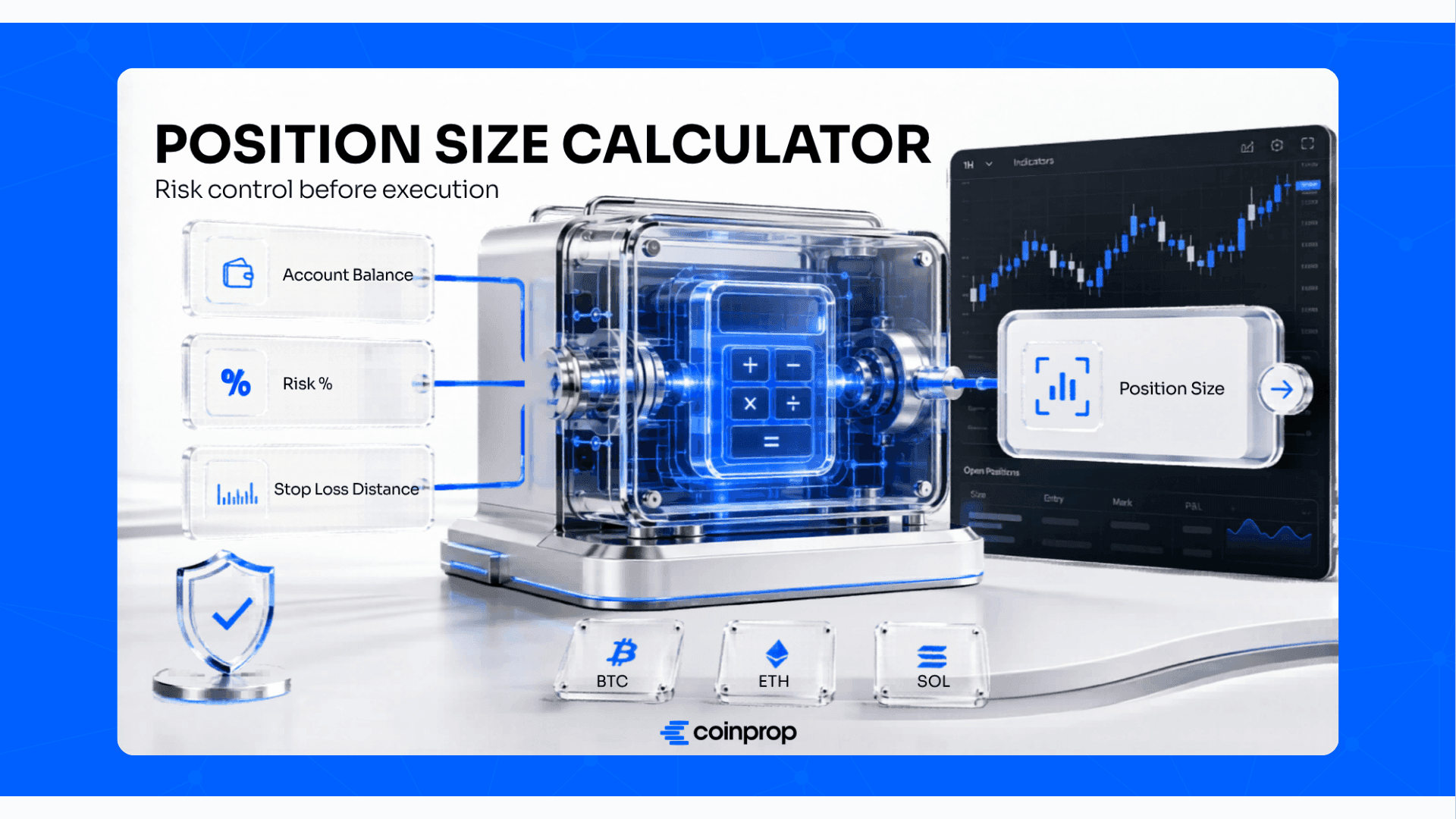
A Position Size Calculator in crypto trading is a specialized tool that converts a trader’s predefined risk into an exact trade size. Instead of manually guessing how much Bitcoin, Ethereum, or any altcoin to buy or sell, the calculator determines the precise position based on account equity, stop loss distance, and risk percentage. Position sizing is one of the most important components of crypto prop firm risk management, helping traders maintain consistency, control exposure, and protect funded accounts from violating strict drawdown rules.
Unlike traditional trading approaches where position size might be estimated or adjusted emotionally, the calculator enforces a structured, mathematical approach to every trade.
The Position Size Calculator is fundamentally a risk control system, not just a mathematical formula. Its primary purpose is to ensure that no trade exceeds a predefined level of acceptable loss, usually expressed as a percentage of the account (e.g., 0.5%–1%).
In crypto prop trading, this becomes critical because traders operate under strict rules such as:
Instead of focusing on how big the trade should be, the calculator shifts the entire logic to:
How much am I allowed to lose on this trade?
Once this risk is defined, the calculator automatically determines the correct position size that keeps the trade within safe boundaries. This removes emotional decision-making and ensures every trade follows the same risk structure, regardless of market conditions or asset volatility.
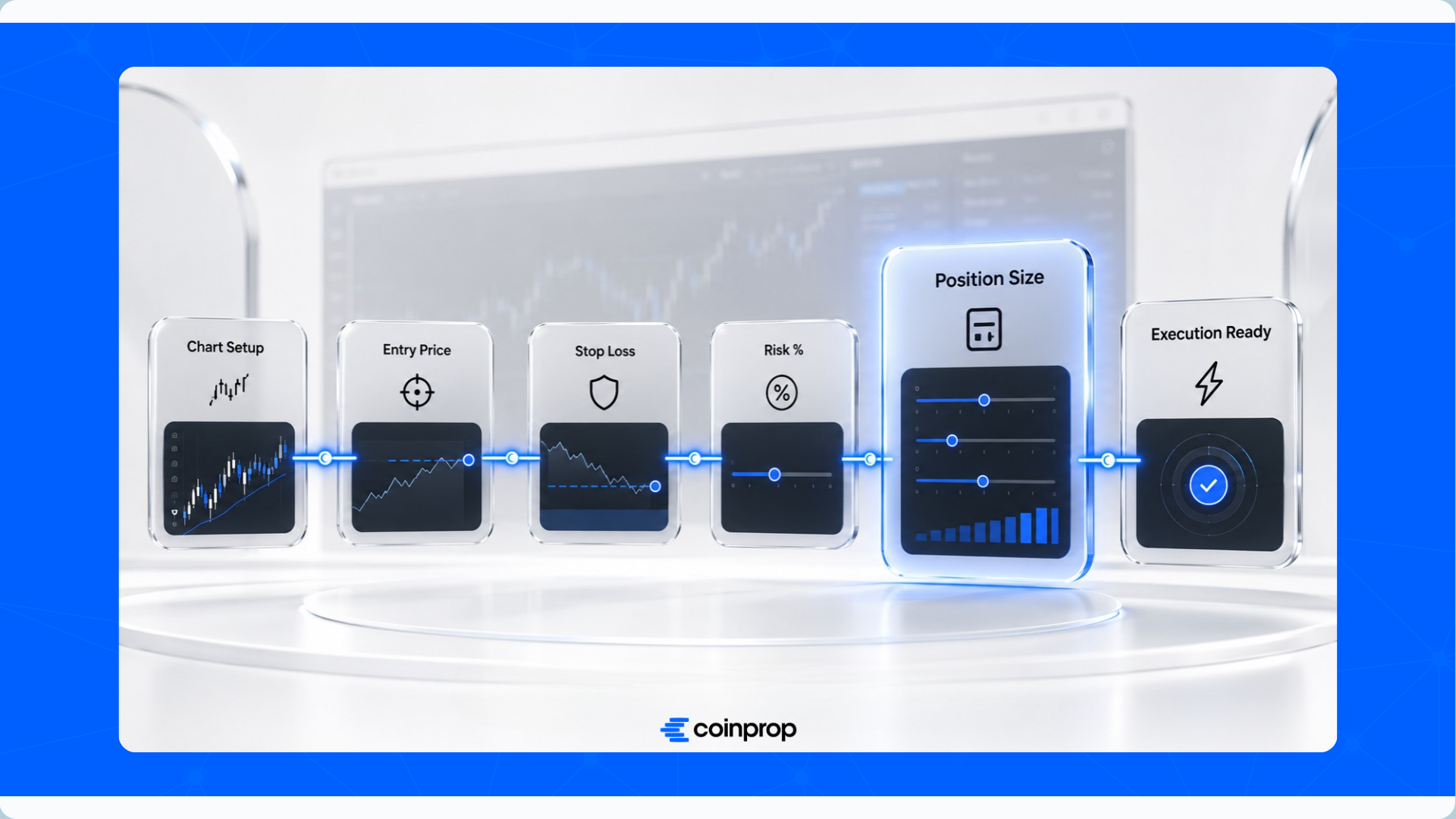
In real trading environments, the Position Size Calculator acts as a conversion engine between risk and execution.
It takes a few key inputs:
Then it performs a simple but powerful transformation:
Risk amount → Position size in actual coin units (BTC, ETH, etc.)
For example, instead of telling a trader to risk $100, the calculator converts that into something actionable like 0.05 BTC or 1.2 ETH, depending on market price and stop loss distance.
In practical terms, this means:
This dynamic adjustment is what makes the tool essential in crypto markets, where volatility and price ranges vary significantly between assets.
Crypto prop traders rely heavily on automation because manual position sizing introduces too many risks in high-speed, high-volatility environments.
There are three main reasons automation becomes essential:
1. Speed and execution efficiency
Markets move quickly, and traders cannot afford to calculate position size manually before every entry. Automation ensures instant conversion from risk to trade size.
2. Elimination of human error
Even small mistakes in calculation, such as incorrect decimals or misjudged stop loss distance, can lead to oversized positions and immediate drawdown violations in prop accounts.
3. Consistency under strict prop firm rules
Prop firms require traders to maintain stable risk behavior across all trades. Automation guarantees that every position follows identical risk logic, regardless of emotional state, winning streaks, or losses.
Ultimately, Position Size Calculators act as a protective layer between strategy and execution. They ensure that even if market predictions fail, the trader’s risk remains controlled and the account stays within survival limits.
A Position Size Calculator in real trading platforms is designed to convert risk inputs into an exact trade size that can be executed instantly on a chart or order panel. Instead of manually calculating exposure, traders input a few key variables, and the system automatically generates the correct position size that aligns with risk rules, stop loss levels, and account constraints.
In crypto prop trading environments, this process is critical because it ensures every trade is structurally safe before execution. It removes guesswork and guarantees that risk is predefined rather than discovered after entering the market.
The first step in any position size calculation is defining how much capital is available and how much of it can be risked on a single trade.
Traders typically input:
This step establishes the maximum dollar loss allowed for the trade. For example, a 1% risk on a $10,000 account means the trader is only willing to lose $100 on that specific setup.
This fixed-risk approach is the foundation of all professional position sizing models because it ensures consistency across different market conditions and asset classes.
Once risk is defined, the next step is to determine where the trade becomes invalid.
Traders input:
The distance between these two values is extremely important because it directly determines how large or small the position should be.
This relationship ensures that risk remains constant regardless of volatility or chart structure.
In crypto markets, where price swings can vary significantly, this step is essential for maintaining controlled exposure.
After inputs are provided, the calculator performs the core function: converting risk into position size.
The system calculates:
Position Size = Risk Amount ÷ Stop Loss Distance
This means the calculator determines exactly how many units of an asset (BTC, ETH, or any altcoin) can be traded while ensuring the maximum loss does not exceed the predefined risk.
At this stage, the trader no longer needs to think in terms of arbitrary trade sizes. Instead, the system translates risk into a precise executable quantity.
This automation is especially important in crypto prop trading because:
The final step is the output stage, where the calculator presents a complete risk profile for the trade before execution.
The output typically includes:
This final confirmation step allows traders to fully understand their exposure before entering the market. It acts as a safety checkpoint, ensuring the trade aligns with both personal risk rules and prop firm requirements.
In advanced trading platforms, this output is often integrated directly into the chart interface, allowing traders to adjust stop loss or take profit levels in real time while instantly seeing how position size changes.
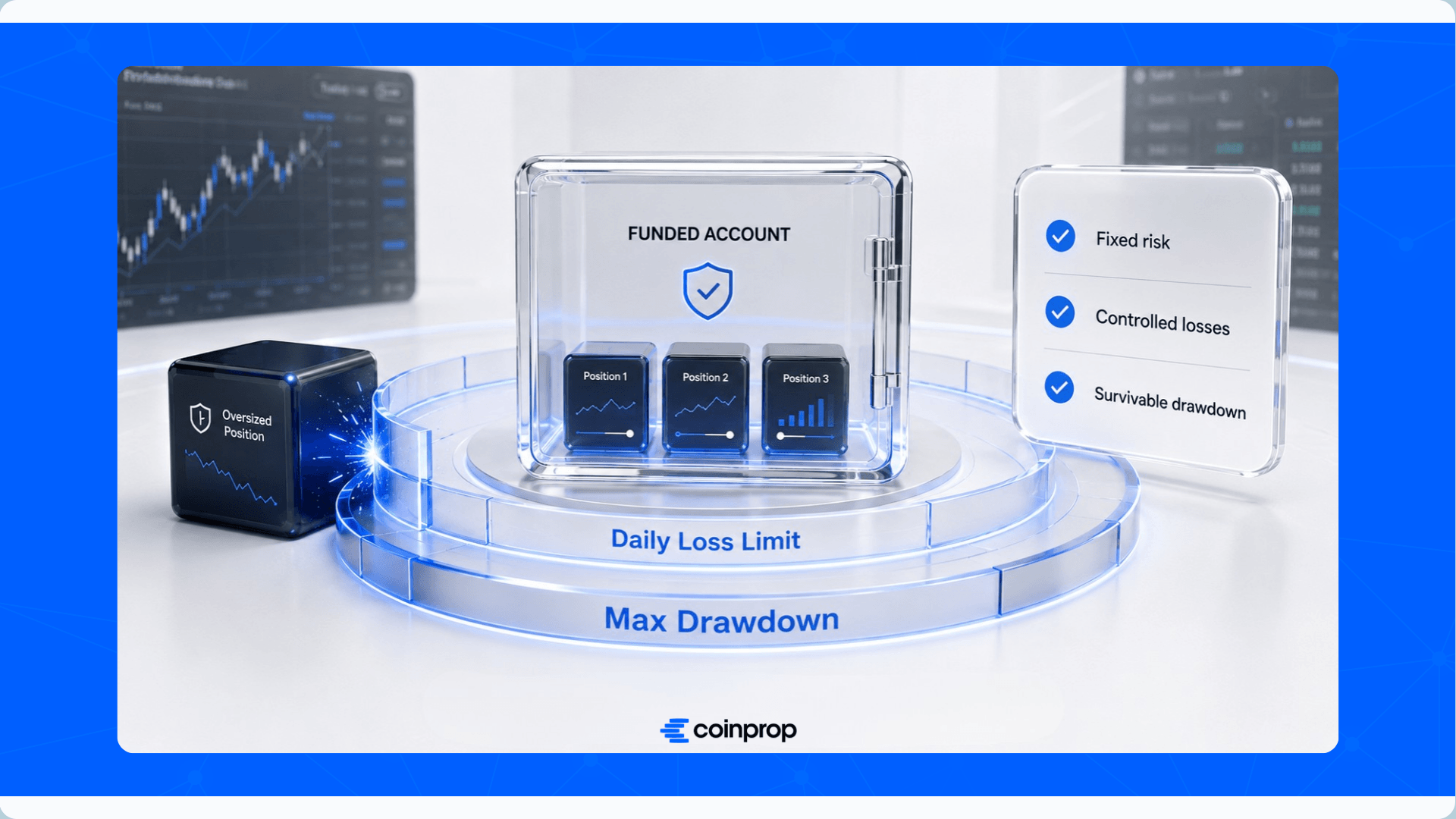
In crypto prop trading workflows, the Position Size Calculator is not an isolated tool, it is a core part of the execution pipeline that connects strategy, risk management, and order placement. Every trade in a funded account must pass through this system before execution to ensure it aligns with strict prop firm rules. The calculator essentially acts as a bridge between market analysis and controlled trade execution, making sure that no position is opened without predefined risk validation.
Unlike discretionary trading where position size might vary based on intuition, prop trading workflows require consistency. This is where the calculator becomes essential: it enforces structure across all trades, regardless of market conditions or trader emotion.
Prop firms operate under strict capital protection rules, and one of the most important is fixed risk per trade enforcement. This means traders are not allowed to randomly adjust their risk exposure based on confidence levels or market sentiment.
Instead, firms typically require:
The Position Size Calculator ensures these rules are followed automatically by converting the allowed risk into a precise position size. Once risk is defined, the trader cannot exceed it regardless of how large or attractive a setup looks.
This system prevents overconfidence after winning streaks and reduces panic-driven oversizing after losses, both of which are common causes of prop account failure.
Drawdown is the most critical metric in prop trading because it determines whether a trader remains funded or loses the account. Position size directly controls drawdown because it defines how much capital is exposed in each trade.
If position sizes are too large:
If position sizes are properly calculated:
The Position Size Calculator ensures that every trade contributes a controlled level of risk to the overall equity curve. Instead of risking random amounts per trade, each position is mathematically tied to account protection limits, making drawdown behavior predictable and manageable.
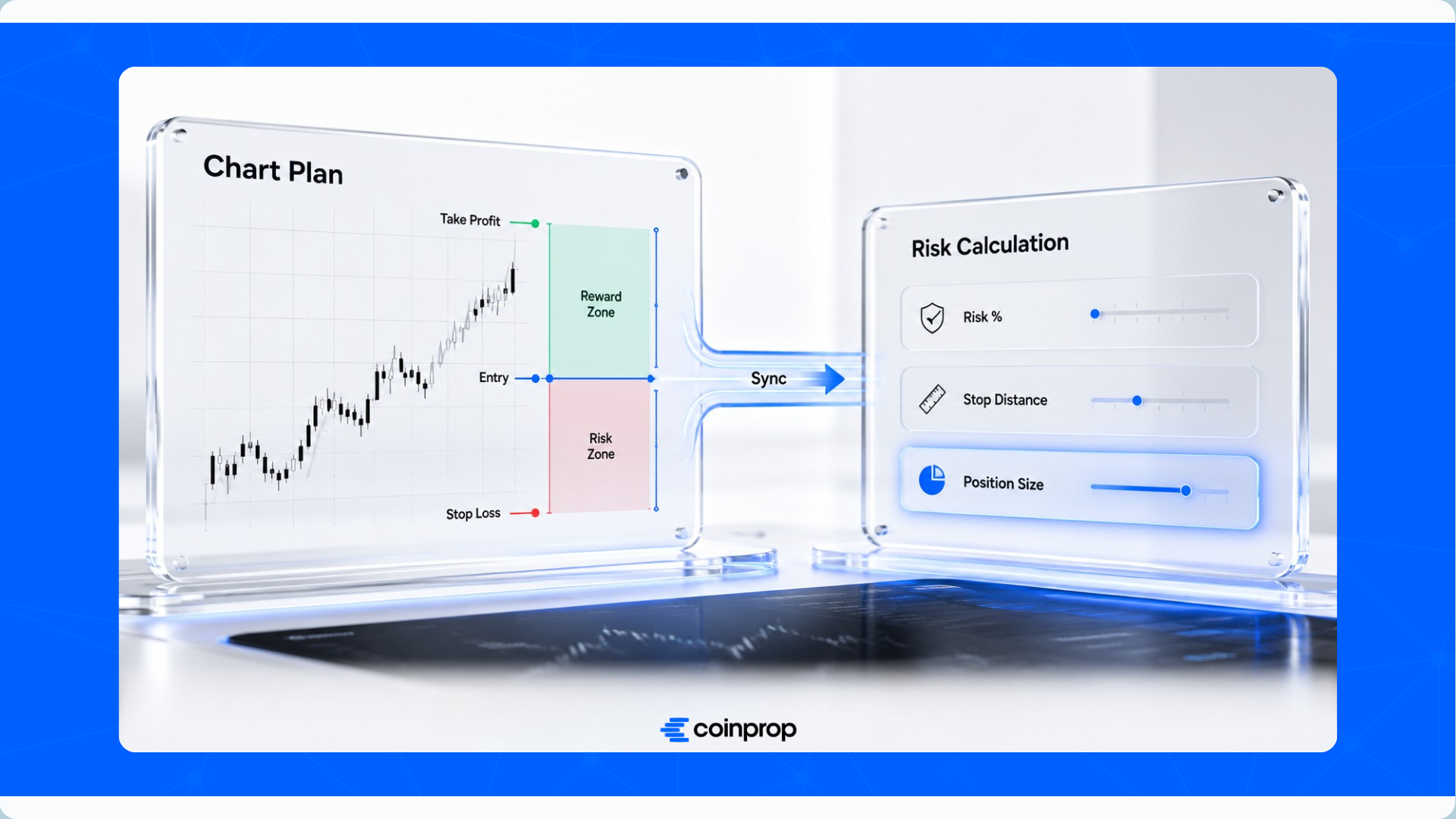
Consistency in position sizing is one of the most important factors separating successful prop traders from failed ones. Even profitable traders can lose funded accounts if their position sizes fluctuate unpredictably.
The Position Size Calculator enforces consistency by:
This consistency creates a stable equity curve, which is exactly what prop firms look for when evaluating traders. It also prevents hidden risk spikes, where a trader unknowingly takes oversized positions after a win streak or during high-confidence setups.
In practical terms, consistent sizing ensures that:
Ultimately, the Position Size Calculator acts as a behavioral control system inside prop trading workflows. It ensures that discipline is not optional but structurally enforced in every trade execution.
In modern crypto trading workflows, TradingView’s Long and Short Position tools are not just visualization features, they are practical instruments for applying position sizing logic directly on the chart. These tools allow traders to translate abstract risk calculations into a visual structure that clearly shows entry, stop loss, take profit, and potential return. In crypto prop trading, this visual layer is especially important because it connects strategy planning with real execution decisions.
Instead of calculating position size separately and then trying to match it with chart levels, traders can build the entire trade scenario directly on TradingView and then align it with position size calculations.
The Long Position tool in TradingView is designed to map a bullish trade scenario directly onto the chart. It allows traders to define:
Once these levels are set, the tool automatically visualizes:
This visual representation is critical for position sizing because it makes risk immediately understandable in price terms rather than abstract percentages. A trader can instantly see whether the stop loss is too wide for their risk tolerance or whether the reward justifies the exposure.
In prop trading, this step ensures that position size decisions are not made blindly, they are directly tied to a clearly defined chart structure.
The Short Position tool performs the same function as the Long tool but in reverse for bearish setups. It allows traders to map short trades by defining:
This tool is particularly important in crypto markets where shorting is a major part of strategy due to high volatility and frequent downtrends.
For position sizing, the Short tool helps traders understand:
By visually structuring bearish trades, it ensures that short positions follow the same disciplined risk logic as long positions. This prevents inconsistent sizing between bullish and bearish trades, which is a common mistake among less experienced traders.
The real power of TradingView appears when its Long/Short tools are combined with position size calculations. Together, they create a complete risk-to-execution workflow.
Here’s how the logic connects:
Traders looking for a seamless charting experience often prefer crypto prop firms that offer TradingView integration, as this allows position sizing, trade planning, and execution workflows to remain connected within a single environment.
This synchronization is important because:
In practice, TradingView becomes the planning layer, while the Position Size Calculator becomes the execution engine. Together, they ensure that every trade is both visually validated and mathematically controlled before entering the market.
In advanced crypto prop trading environments, the Position Size Calculator inside the CPX panel is not just a standalone tool, it is a fully integrated execution engine that connects risk management directly to live trading decisions. Instead of calculating position size separately and manually transferring it to the chart or order panel, CPX automates the entire process inside a unified trading interface. This ensures that every trade is both risk-controlled and execution-ready in real time.
Unlike traditional workflows where traders switch between calculators, charts, and order forms, CPX consolidates everything into one system. This reduces friction, increases speed, and eliminates critical human errors that often lead to oversized positions or invalid risk exposure.
The core function of the CPX Position Size Calculator is to transform a predefined risk percentage into an exact executable position size.
The process begins with three simple inputs:
Once these values are defined, CPX automatically calculates the precise trade size that ensures the maximum loss never exceeds the selected risk threshold.
Instead of thinking in abstract terms like I am risking $100, the trader receives a concrete output such as:
This conversion is critical in crypto prop trading because it ensures that every trade is mathematically aligned with account protection rules before execution even happens.
One of the most powerful features of the CPX system is real-time position sizing directly inside the trading chart interface.
As traders adjust:
The CPX panel instantly recalculates position size in real time. This creates a dynamic feedback loop between chart analysis and risk management.
For example:
This real-time synchronization allows traders to visually design setups while simultaneously controlling risk exposure. It eliminates the disconnect between analysis and execution that exists in traditional trading workflows.
In prop trading environments, this feature is especially important because it ensures that no adjustment on the chart can accidentally violate risk limits.
One of the biggest weaknesses in manual trading workflows is human error in calculations. Even experienced traders can miscalculate position size due to:
CPX removes this entire risk layer by fully automating the calculation process.
Once the trader defines risk parameters, the system handles everything else:
This automation ensures that trading decisions are based on strategy rather than arithmetic accuracy. In high-volatility crypto markets, where speed and precision are critical, eliminating manual math significantly reduces the probability of costly mistakes.
Ultimately, CPX transforms position sizing from a manual calculation step into an embedded risk control system inside the trading workflow, allowing traders to focus entirely on trade quality rather than numerical execution.
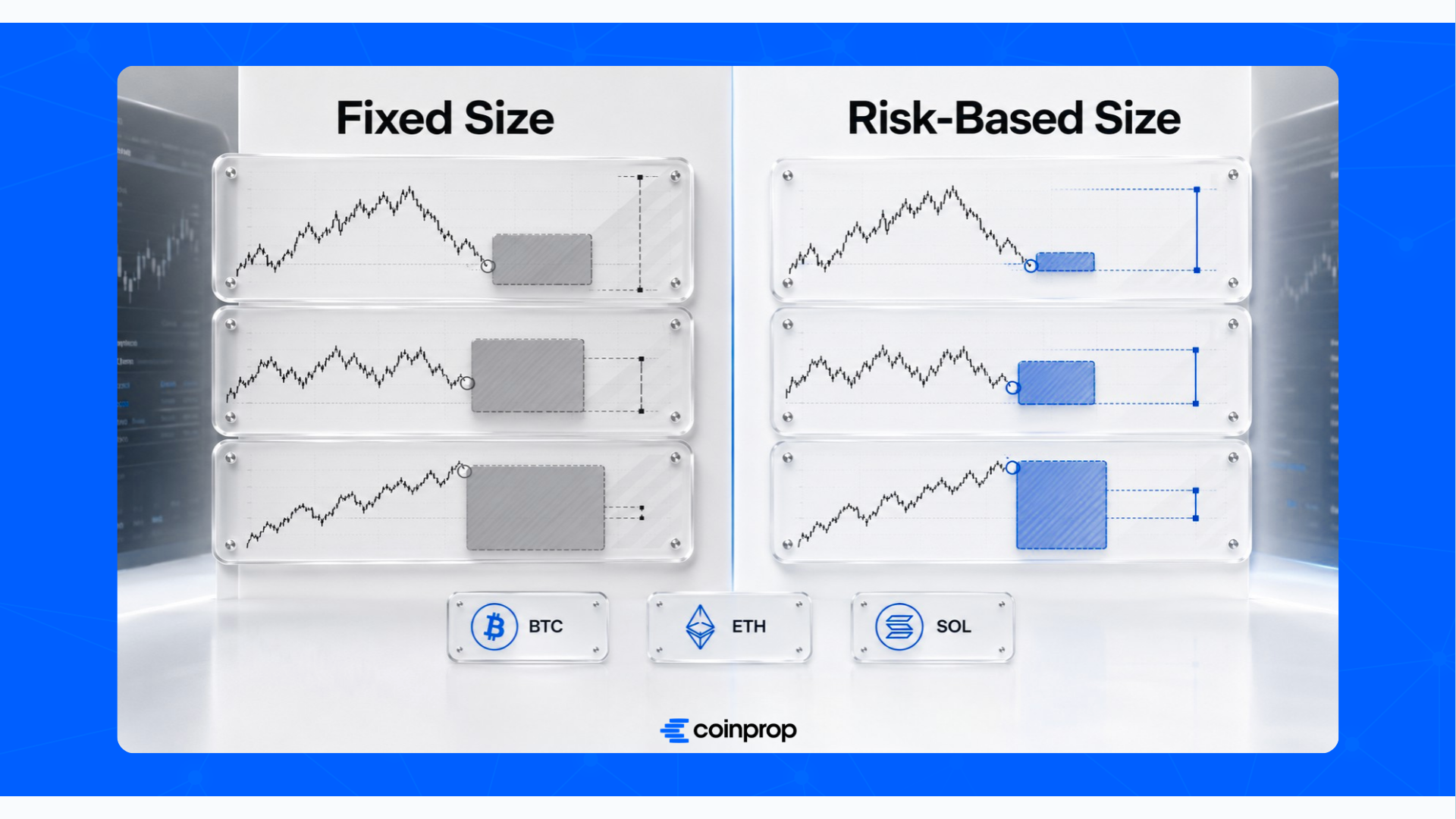
In trading, position size and lot size often appear similar on the surface, but they represent fundamentally different approaches to risk and trade execution. This difference becomes especially important when comparing traditional forex markets with modern crypto trading environments, particularly in crypto prop trading where flexibility and precision are required.
Understanding this distinction is critical because applying forex-style lot thinking to crypto markets often leads to incorrect sizing, inconsistent risk, and eventual drawdown violations.
Forex trading is built on a highly standardized structure where position size is measured in lots. A lot represents a fixed quantity of currency units, which simplifies execution across brokers and trading platforms.
Common forex lot definitions include:
This standardization exists because:
Because of this system, forex traders often think in terms of fixed increments rather than dynamic risk-based sizing. Position adjustments are usually made by changing the number of lots, not recalculating exposure based on volatility or stop loss distance every time.
Crypto markets operate under completely different conditions, which makes fixed lot-style thinking ineffective.
Unlike forex:
Because of this, crypto trading requires dynamic position sizing, where trade size is calculated based on:
Instead of using fixed units, traders adjust position size for every trade to ensure that the dollar risk remains constant, regardless of how large or small the stop loss is.
This is why tools like Position Size Calculators are essential in crypto prop trading, they automatically convert unpredictable market conditions into controlled, repeatable risk exposure.
Applying forex-style lot size logic to crypto trading creates structural problems, especially in prop firm environments where risk control is strict and non-negotiable.
The main failures include:
1. Inconsistent risk exposure
Using fixed sizes ignores stop loss distance. A tight stop and wide stop may result in the same position size, which breaks risk consistency.
2. Drawdown violations
In prop trading, even small miscalculations can push accounts beyond daily loss or maximum drawdown limits. Lot-based thinking does not adapt to volatility changes, making violations more likely.
3. Poor scalability across assets
A fixed lot approach does not account for the difference between BTC, ETH, and low-cap altcoins. This leads to oversized exposure on volatile assets or underexposure on stable ones.
4. Emotional trading behavior
Traders using a lot of thinking often adjust size manually based on confidence rather than risk rules, which introduces inconsistency and destroys long-term statistical edge.
In contrast, crypto prop trading requires a system where every trade is normalized through risk-based position sizing. This ensures that regardless of market conditions, asset type, or trader emotion, each position is mathematically aligned with account protection rules.
In crypto trading, especially in prop trading environments, position sizing is not based on intuition or fixed trade amounts. Instead, it is driven by a strict mathematical relationship between account risk, stop loss distance, and trade exposure. The purpose of this system is to ensure that every trade has a predefined and controlled downside, regardless of market volatility or asset type.
Understanding the formula behind position sizing is essential because it transforms trading from guesswork into a structured risk model.
The foundation of all professional position sizing strategies is a simple but powerful formula:
Position Size = Risk Amount ÷ Stop Loss Distance
Where:
This formula ensures that the trader never risks more than the predefined percentage of their account on any single trade.
For example:
If a trader has a $10,000 account and risks 1%, the maximum loss per trade is $100. If the stop loss distance represents a 2% price move, the position size is automatically adjusted so that a 2% loss equals exactly $100.
This system removes uncertainty and guarantees that every trade follows the same risk structure, regardless of whether the asset is Bitcoin, Ethereum, or any altcoin.
Stop loss distance is one of the most important variables in position sizing because it directly determines how large or small a trade can be while maintaining fixed risk.
The relationship works like this:
This inverse relationship exists because the goal is to keep dollar risk constant.
For example:
In crypto markets, where volatility can shift rapidly, this dynamic adjustment is critical. It ensures that traders do not unintentionally increase risk simply because the market requires a wider stop.
By tying position size directly to stop loss distance, traders align every trade with actual market structure instead of arbitrary sizing decisions.
In crypto prop trading, most firms enforce a fixed risk model to maintain capital protection and ensure long-term consistency. The most common standard is:
This means that regardless of trade setup quality or market conditions, each position must be sized so that the maximum potential loss stays within this range.
The advantages of this model include:
For example:
This fixed-risk approach is what separates structured prop trading from discretionary trading. It ensures that survival is mathematically guaranteed, and profitability becomes a function of strategy rather than inconsistent risk behavior.
In crypto prop trading, theoretical formulas only become meaningful when applied to real account scenarios. Position sizing is ultimately about translating risk rules into actual trade quantities that protect funded accounts while allowing consistent execution. The following examples demonstrate how position size changes based on account size, risk percentage, and stop loss distance.
These scenarios highlight how professional traders adapt sizing dynamically rather than using fixed trade volumes.
A $10,000 account is a common starting point in prop trading challenges, and it clearly illustrates how strict risk control works in practice.
Assume the trader follows a 1% risk rule:
Using the position sizing logic:
Position size is adjusted so that a 2% loss equals exactly $100.
This means:
Even though the market exposure might vary depending on the asset (BTC, ETH, or altcoins), the dollar risk remains constant. This ensures that even a losing streak of 5–10 trades does not threaten account survival.
A $50,000 funded account introduces stricter risk management requirements because drawdown limits become more significant in absolute dollar terms.
Assume:
In this case, position size is calculated so that:
This conservative sizing model is essential in funded environments because prop firms prioritize capital preservation and consistency over aggressive profit generation.
A trader using this approach can survive extended drawdown periods without breaching account rules, which is often the key difference between passing and failing a prop challenge.
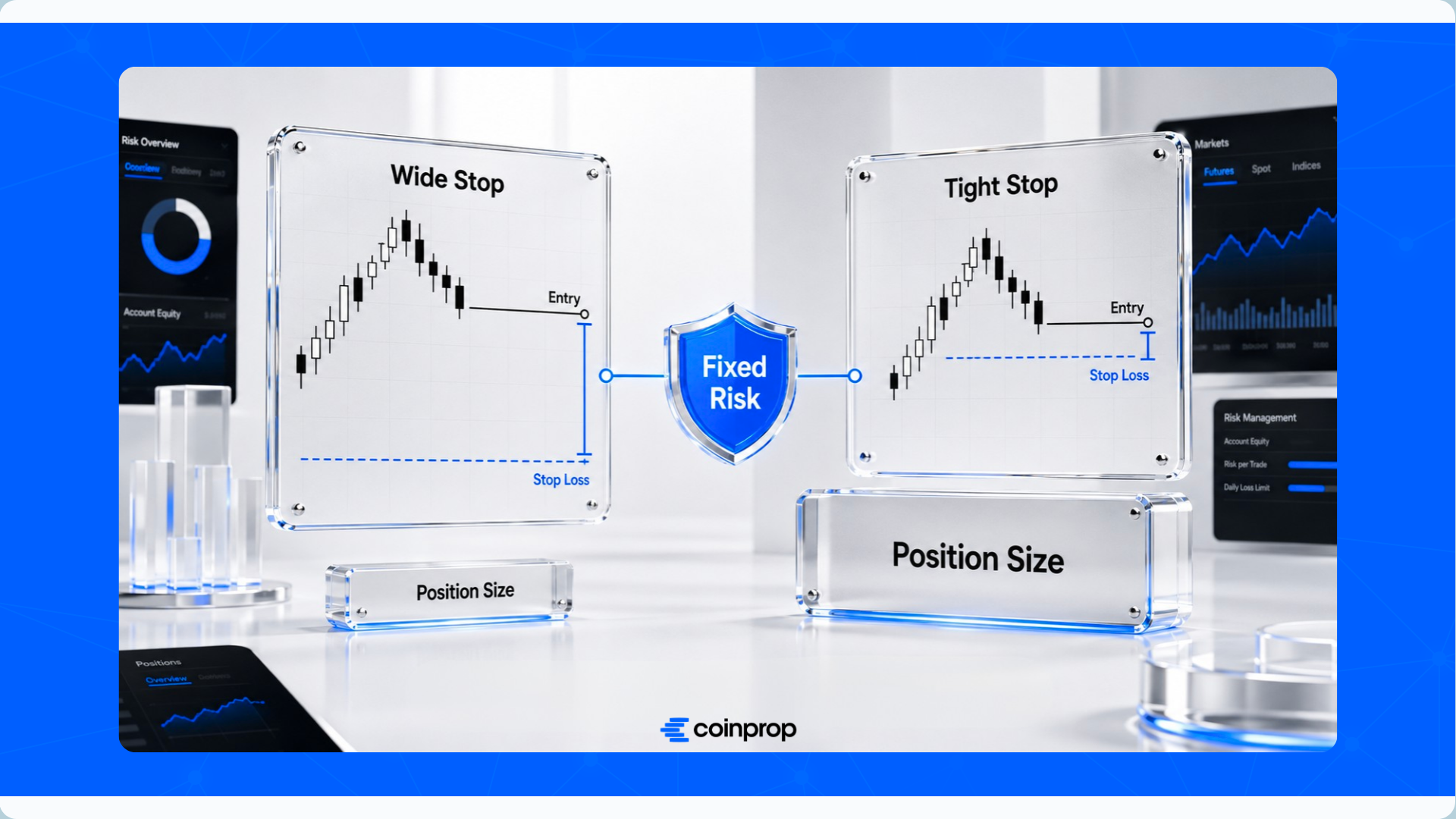
One of the most important principles in position sizing is that stop loss distance directly controls position size. Even with the same account and risk percentage, different stop loss levels produce different trade sizes.
Consider a $10,000 account with 1% risk ($100):
Scenario 1: Tight Stop Loss (1%)
Scenario 2: Medium Stop Loss (2%)
Scenario 3: Wide Stop Loss (5%)
The key insight is simple:
The wider the stop loss, the smaller the position size must be to maintain the same risk.
This relationship ensures that traders do not unintentionally increase risk simply because market conditions require different stop loss placements. Instead, position size automatically adjusts to maintain a fixed risk profile across all trades.
In crypto prop trading, this dynamic adjustment is essential for maintaining consistency, protecting drawdown limits, and ensuring that every trade fits within a controlled risk framework.
Position sizing is one of the most critical components of survival in crypto prop trading, yet it is also one of the most misunderstood. Many traders focus heavily on entry strategies while ignoring how position size directly controls risk, drawdown, and long-term consistency. Even with a profitable strategy, poor sizing decisions can lead to account failure.
Below are the most common mistakes that repeatedly cause traders to lose funded accounts despite having otherwise solid analysis.
One of the most damaging mistakes is using a fixed position size across all trades, regardless of setup quality, volatility, or stop loss distance.
In this approach, traders might consistently trade the same amount (e.g., always $5,000 per trade), assuming it represents discipline or consistency. However, in reality, this ignores the core principle of risk management.
The problem is:
In crypto prop trading, this leads to unstable equity curves and unpredictable drawdown behavior. Professional trading requires risk-based sizing, where position size is always derived from account risk and stop loss distance, not predefined trade amounts.
Another major mistake is failing to properly account for stop loss distance when determining position size.
Many traders focus only on how much they want to risk (e.g., I want to risk $100) but ignore how far the stop loss is from the entry price. This creates a dangerous disconnect between risk intention and actual exposure.
The consequences include:
In volatile crypto markets, stop loss distance can vary significantly between setups. Ignoring this variable leads to hidden risk accumulation, where traders unknowingly exceed their intended risk limits.
Proper position sizing always requires integrating stop loss distance into the calculation to ensure that dollar risk remains constant.
Even when position size is correctly calculated, many traders still fail due to overleveraging.
Leverage itself does not determine risk, but it amplifies exposure. Traders often misunderstand this relationship and assume that correct position sizing automatically makes leverage safe. In reality, excessive leverage can still create structural risk issues.
Common problems include:
In prop trading environments, where drawdown limits are strict, overleveraging can cause rapid account violations even if the nominal position size is technically correct.
The key principle is:
Position size controls risk, but leverage controls intensity.
Both must be aligned properly to ensure stable and sustainable trading performance.
Position Size Calculator in Prop Firm Risk Rules
In crypto prop trading, position sizing is not just a trading preference, it is a direct extension of prop firm risk rules. Every funded account operates under strict constraints designed to protect capital, and the Position Size Calculator becomes the practical tool that translates these rules into actionable trade sizes. Without it, traders are forced to manually interpret risk limits, which often leads to violations or inconsistent execution.
Understanding how position size interacts with prop firm rules is essential for passing evaluations and maintaining funded accounts over the long term.
The daily loss limit is one of the most important rules in prop trading. It defines the maximum amount a trader can lose in a single day before trading is restricted or the account is breached.
Position sizing directly determines how quickly this limit can be reached.
For example:
The Position Size Calculator ensures that every trade is sized so that:
No single loss or series of losses can unintentionally exceed the daily drawdown threshold.
This creates a controlled environment where traders can execute strategies without constantly worrying about rule violations from normal market fluctuations.
The maximum drawdown limit represents the absolute boundary for account survival. Once this level is breached, the funded account is typically terminated.
Position sizing is the primary mechanism that controls how quickly equity approaches this limit.
Proper sizing ensures:
Without correct position sizing, even a strong strategy can fail simply because losses accumulate too quickly. The calculator enforces discipline by ensuring that every trade contributes predictably to overall risk exposure.
In prop trading environments, survival is more important than profit speed, and position sizing is what makes that survival mathematically possible.
Many traders mistakenly believe that increasing trade size is the fastest way to grow a funded account. In reality, prop firms prioritize consistency over aggressive scaling.
Consistency in position sizing ensures:
A trader who risks 1% per trade consistently is far more likely to succeed than one who varies between 0.5% and 3% depending on confidence or market conditions.
The Position Size Calculator enforces this consistency by standardizing risk across all trades, ensuring that performance is driven by strategy quality, not inconsistent exposure levels.
In prop firm environments, consistency is not just a best practice, it is a requirement for long-term account survival.
In crypto prop trading, position sizing is one of the most important skills for account survival and consistency. Below are the most common questions traders ask when trying to understand how position size calculators actually work in real trading environments.
Position size in crypto trading is calculated based on three key variables: account balance, risk percentage, and stop loss distance.
The standard formula is:
Position Size = (Account Equity × Risk %) ÷ Stop Loss Distance
This ensures that every trade has a fixed and controlled risk in dollar terms, regardless of market volatility or asset type.
For example, if you risk 1% on a $10,000 account, your maximum loss per trade is $100. The position size is then adjusted so that if the stop loss is hit, the loss does not exceed that $100 limit.
Most crypto prop firms enforce strict risk control rules, and the most commonly recommended range is:
This range is considered optimal because it:
Higher risk percentages increase the probability of hitting daily or maximum drawdown limits, especially during volatile market conditions.
Yes. Position size is significantly more effective than lot size in crypto trading.
Lot size is a fixed concept used mainly in forex, where contracts are standardized. Crypto markets, however, are highly dynamic and volatile.
Position sizing is better because it:
In short, lot size is rigid, while position size is adaptive, making it essential for crypto prop trading.
TradingView helps traders visually define and manage position size through its built-in Long Position and Short Position tools.
These tools allow traders to:
When combined with a position size calculator, TradingView becomes a visual layer for planning trades, while the calculator ensures that the size of those trades matches risk rules precisely.
CPX is an integrated crypto trading system designed for prop trading workflows, where position sizing is fully automated inside the trading environment.
Instead of manually calculating risk, CPX:
This means that when a trader adjusts stop loss or entry level, CPX instantly recalculates position size to ensure risk always stays within predefined limits.
In essence, CPX turns position sizing from a manual task into an automated risk control system embedded directly into the trading workflow.
Want to understand the bigger picture? Our complete crypto prop firm guide explains how funded trading programs work from start to finish.
