Scaling up in crypto prop firms is the process of growing trading accounts through consistent performance and risk control. Scaling plans provide the structured framework that allows traders to expand capital over time, turning disciplined trading into sustainable long-term account growth.

Scaling up in crypto prop trading refers to the process of gradually increasing the amount of capital a trader manages through consistent performance rather than additional personal deposits. Instead of relying only on personal funds, traders gain access to larger account sizes as they demonstrate discipline, risk control, and sustainable profitability over time.
In traditional retail trading and crypto funded trading firms, account growth often depends on depositing more money or taking higher risks to increase returns. Prop trading works differently. Traders can expand buying power through structured growth systems, allowing account size to increase while personal financial exposure remains unchanged. The focus shifts from chasing quick gains to building a repeatable process capable of supporting larger amounts of capital.
The foundation of scaling up is simple: stable performance creates opportunities for larger capital allocation. Prop firms are generally more interested in traders who can generate repeatable results than traders who produce one exceptional month followed by heavy losses.
A trader who consistently delivers moderate returns while maintaining controlled risk often becomes more valuable than someone producing aggressive gains with unstable behavior. Long-term growth usually depends less on finding a “perfect strategy” and more on developing a process that survives changing market conditions.
Account growth in prop trading is often built around several factors:
As account size increases, the trader's challenge also changes. The objective is no longer simply making profitable trades; it becomes managing capital responsibly at a larger scale.
Many traders begin with relatively small accounts where profits and losses appear manageable in dollar terms. At this stage, decision-making can feel easier because the emotional pressure attached to each trade is limited.
As traders move into larger funded accounts, the experience changes significantly. A strategy that generated small gains on a lower balance now operates on substantially greater buying power. The technical process may remain identical, but the financial impact becomes much larger.
For example, a trader making 5% on a $10,000 account produces very different results from the same 5% performance on a $200,000 account. The percentage return remains unchanged, but the capital behind it increases dramatically.
This shift represents one of the major transitions in prop trading. Traders move from thinking like small account participants toward thinking like capital managers. The focus becomes preserving consistency, protecting capital, and maintaining efficient execution across larger positions.
Many traders naturally focus on large winning months because fast gains feel exciting. However, scaling systems typically reward reliability more than occasional high returns.
Strong short-term performance can be influenced by favorable market conditions, luck, or temporary volatility. Consistency demonstrates something different: the ability to follow a process repeatedly under different conditions.
A trader earning smaller but stable returns over multiple months may often be better positioned for long-term growth than a trader alternating between extreme gains and heavy drawdowns.
Consistency also creates practical advantages:
In crypto prop trading, larger accounts are rarely built through isolated winning trades. Sustainable growth usually comes from repeating disciplined actions over time and allowing structured account expansion to do the heavy lifting.
For many traders entering the prop industry, the initial objective is often straightforward: pass an evaluation, receive funding, and generate profits. Over time, however, experienced traders begin to realize that long-term opportunity is not only about winning individual trades. The larger objective becomes increasing the amount of capital being managed.
Scaling up changes the economics of trading. Instead of trying to produce increasingly aggressive returns from a limited account balance, traders gain access to larger buying power through performance. The same strategy, risk model, and execution process can potentially operate on a much bigger account size.
This is one of the major differences between short-term trading and long-term professional growth. Successful prop traders are not simply trying to earn more from the account they currently have; they are working toward expanding the capital available to them over time.
Retail traders often operate with limited personal funds. Because account size is smaller, many feel pressure to generate larger percentage returns in shorter periods. This sometimes leads to excessive leverage, oversized positions, or emotionally driven decisions.
Scaling introduces a different perspective.
Rather than asking:
"How much can I make from this account today?"
The question gradually becomes:
"How can I manage larger amounts of capital responsibly over the long term?"
This shift changes how traders approach the market.
Smaller accounts often encourage survival thinking:
Larger managed accounts require a different mindset:
Professional capital management is not necessarily about producing extraordinary monthly returns. In many cases, it involves generating stable performance while minimizing unnecessary risk.
As traders scale, they gradually move from acting like individual speculators toward functioning more like portfolio managers.
Many traders assume that scaling primarily depends on finding a highly profitable strategy. While strategy matters, long-term growth often depends more heavily on execution quality and discipline.
Markets constantly change. Conditions that work well during one period may become difficult during another. Traders who rely entirely on favorable market environments often struggle to maintain results.
Discipline helps create consistency regardless of changing conditions.
In practical terms, discipline often includes:
One of the biggest challenges after account growth occurs when traders become overconfident. Larger balances can create pressure or excitement that leads to abandoning established processes.
Many traders do not fail because their strategy suddenly stops working. They fail because they stop following the behavior that created the results in the first place.
Long-term scaling typically rewards traders who can repeat the same process consistently, even after account sizes increase.
One of the strongest advantages of scaling is the ability to benefit from compounding capital growth.
Compounding means that future growth occurs on an increasingly larger base rather than remaining fixed. As account size increases through scaling programs, even modest returns can create significantly different outcomes over time.
Consider two traders using identical strategies:
Trader A manages a small account and withdraws profits continuously without expanding account size.
Trader B focuses on maintaining performance while allowing account growth opportunities to increase available capital.
Initially, the difference between them may appear small. After several growth cycles, however, larger buying power can substantially increase the impact of the same percentage returns.
The important point is that compounding in prop trading is not only about profits being reinvested. It can also occur through structured capital increases that expand overall account size.
Steady performance may appear less exciting than aggressive trading, but over longer periods it often creates more sustainable results. Instead of depending on occasional large wins, traders build growth through repeated execution and disciplined decision-making.
For many professional traders, scaling becomes the long-term objective because it creates a path toward larger opportunities without requiring additional personal capital or excessive risk exposure.

A scaling plan in crypto prop firms is a structured system designed to increase a trader’s account size after meeting specific performance requirements over time. Instead of keeping traders locked at one account balance indefinitely, prop firms use scaling systems to reward consistent execution, risk control, and stable profitability with access to larger amounts of capital.
The purpose of a scaling plan is not simply to make account numbers look bigger. Its primary role is to identify traders who can manage risk responsibly while maintaining repeatable results. From a prop firm's perspective, long-term profitability depends more on disciplined traders than on traders who generate occasional high returns through aggressive risk-taking.
For traders, scaling plans create a pathway toward larger capital exposure without requiring additional personal deposits. Rather than repeatedly funding bigger accounts with personal money, traders can gradually earn increased buying power through performance.
While each prop firm structures its system differently, most scaling models share a similar objective: allowing sustainable account growth based on predefined rules and measurable trading behavior.
A prop firm scaling system is a set of predefined conditions that determines when and how a funded account can increase in size. These conditions are usually based on measurable metrics rather than subjective decisions.
A typical scaling structure may include factors such as:
For example, a firm may increase account size by a fixed percentage every three months if a trader remains profitable while respecting all account rules.
The important distinction is that scaling systems are designed around long-term behavior rather than short-term outcomes. A trader who earns large returns in a single month but repeatedly violates risk limits may never qualify for account growth. Meanwhile, a trader producing smaller but stable gains over multiple periods may progress steadily through scaling levels.
This shifts the focus away from “making as much money as possible today” and toward demonstrating reliable capital management over time.
Scaling plans generally work through gradual capital expansion rather than sudden account jumps. As traders continue meeting requirements, account size increases in stages.
The process often follows a pattern like this:
Step 1: The trader begins with an initial funded account.
Step 2: Performance is monitored over a defined period.
Step 3: The trader satisfies profitability and risk requirements.
Step 4: The account receives a capital increase.
Step 5: The process repeats during future cycles.
Over multiple growth periods, relatively moderate increases can create significant changes in buying power.
For example, a trader may begin with a $100,000 account and receive periodic capital increases after successfully completing each cycle. Although individual upgrades may initially appear modest, repeated growth stages can substantially expand total managed capital over time.
This creates an important advantage in prop trading: future earnings potential can increase even if trading performance remains relatively stable.
A trader generating consistent returns on a larger account may produce significantly different financial outcomes without changing strategy or increasing personal risk exposure.
Scaling systems therefore create a form of growth that depends on capital expansion rather than constantly pursuing larger percentage returns.
Crypto prop firms do not all use identical scaling structures. Two common approaches are fixed scaling models and rule-based scaling models.
Fixed scaling models generally follow predetermined upgrade schedules.
Examples may include:
The trader understands the growth schedule from the beginning, which creates predictability and clearer expectations.
Advantages of fixed systems may include:
However, these models can sometimes be less flexible because growth follows a predetermined structure.
Rule-based scaling models rely more heavily on ongoing performance metrics.
Account growth may depend on:
Rather than following a strict calendar schedule, upgrades occur only after specific requirements are satisfied.
Potential advantages include:
However, rule-based systems may also feel less predictable because progression depends on multiple variables.
Neither model is automatically better than the other. The ideal structure depends on the trader's style, risk tolerance, and long-term objectives. Some traders prefer the predictability of fixed milestones, while others may benefit from systems that adapt more directly to performance quality.
Ultimately, the goal remains the same across both approaches: identifying traders who can manage increasingly larger amounts of capital without sacrificing consistency or risk discipline.
Scaling up and scaling plans are closely connected, but they are not exactly the same thing. Scaling up refers to the overall process of growing as a trader and gradually managing larger amounts of capital. A scaling plan is the structured mechanism that makes that growth possible.
Without a defined scaling system, account growth often becomes unpredictable. Traders may need to rely on personal deposits, unusually high returns, or excessive risk exposure to increase account size. A scaling plan creates a more sustainable path by introducing measurable milestones and controlled account expansion.
This is why many professional prop firms use scaling systems as part of their long-term model. Instead of rewarding short periods of aggressive performance, they create a framework where larger capital is earned through stable execution and responsible trading behavior.
For traders, scaling plans act as a bridge between current performance and future opportunities. The objective is not only making profitable trades today but creating a process that continuously unlocks access to greater capital over time.
A useful way to understand the relationship between scaling up and scaling plans is to think of account growth as a destination and the scaling plan as the engine that drives the journey.
The destination may be managing significantly larger amounts of capital, but the path toward that objective needs structure. Without a system in place, growth can become inconsistent and heavily dependent on individual decisions.
Scaling plans provide that structure through predefined conditions such as:
These conditions transform account growth from something uncertain into a repeatable process.
For example, imagine two traders producing similar returns:
Trader A trades independently and increases account size only by adding personal capital or taking greater risks.
Trader B operates within a prop firm's scaling framework and gains larger capital allocations after meeting specific requirements.
Even if both traders generate similar percentage returns, the second trader may gain access to larger buying power through the scaling system itself.
This illustrates why scaling plans can become a major driver of long-term growth. The trader's performance remains important, but the account expansion mechanism creates additional opportunities that may not exist in traditional retail trading.
Prop firms typically do not increase account balances randomly. Most use structured growth cycles because larger capital introduces larger exposure and greater risk.
Before increasing a trader's buying power, firms generally want evidence that the trader can maintain stability across different market conditions.
A growth cycle may serve several purposes:
Short periods of profitability do not always indicate long-term skill. A trader may perform well during favorable market environments but struggle once conditions change.
Longer growth cycles help firms observe whether performance remains stable beyond temporary market opportunities.
For example, a trader who performs well for several months while respecting risk limits may demonstrate stronger long-term potential than a trader generating exceptional gains over a single week.
Structured cycles also help reduce emotional decision-making. Since upgrades follow predefined conditions, traders can focus more on execution quality and less on chasing rapid account growth.
This creates a more stable environment where progress is based on measurable behavior rather than impulsive actions.
The core principle behind most scaling systems is simple: larger capital should follow proven performance.
Prop firms generally increase account size because they see evidence that the trader can manage risk responsibly while maintaining consistency.
Several performance factors often influence account growth:
Notice that not every factor focuses purely on profits.
Many traders assume scaling is only about making more money. In reality, firms often pay equal attention to how profits are generated.
For instance, two traders may each produce a 10% return:
Trader A reaches that result by risking a large percentage of the account on a small number of trades.
Trader B reaches the same return while maintaining controlled risk and stable position sizing.
Even though both outcomes appear identical on the surface, the second approach may be viewed as more scalable because it demonstrates repeatable behavior.
This relationship between performance and capital allocation explains why long-term scaling depends less on isolated winning trades and more on sustainable processes.
As account size grows, the objective gradually changes. Success becomes less about maximizing every opportunity and more about protecting consistency while allowing account expansion to create larger opportunities over time.

Scaling plans are designed to create a structured path for account growth rather than allowing random increases in buying power. While exact rules vary across firms, most crypto prop scaling systems follow a similar sequence: traders begin with a funded account, demonstrate consistent performance over a defined period, satisfy risk requirements, and qualify for larger capital allocations.
The objective is not simply to reward profitability. Scaling systems are built to identify traders who can manage larger amounts of capital responsibly while maintaining stable behavior over time.
Instead of viewing account growth as a one-time event, traders should think of scaling as a repeating cycle. Each completed phase acts as a stepping stone toward larger buying power and potentially greater long-term earning opportunities.
Many scaling systems operate around periodic review cycles, with 90 days being one of the most common structures used in prop trading environments.
The purpose of a longer cycle is to evaluate performance across multiple market conditions rather than judging traders based on a few successful trades.
During a typical 90-day period, firms may observe:
A longer evaluation period provides a more complete picture of a trader's process.
For example, a trader could produce strong returns during a highly volatile market phase but struggle once volatility declines. A longer review cycle helps determine whether results are sustainable rather than temporary.
It also helps remove the pressure of forcing quick gains.
When traders become obsessed with short-term targets, they may:
A structured cycle encourages patience by shifting attention toward maintaining performance quality over time.
Scaling upgrades generally require traders to satisfy specific conditions before larger capital is granted.
Although requirements differ between firms, eligibility often depends on more than simply reaching a profit number.
Common requirements may include:
The important point is that profitability alone usually does not guarantee account growth.
For instance, two traders may generate identical returns over a review period:
Trader A achieves results through controlled execution and stable position sizing.
Trader B reaches the same profits by taking excessive risk and experiencing large swings in account equity.
Even though both traders finish with similar profits, only one may satisfy the conditions for long-term account expansion.
Scaling systems typically reward consistency and process quality rather than isolated outcomes.
Some crypto prop firms use predefined account growth percentages after successful completion of a scaling cycle.
A common approach is increasing account size by a fixed percentage once eligibility requirements are satisfied.
To understand the effect of repeated account growth, consider a simplified example:
Starting account balance:
$100,000
After first successful cycle:
$130,000
After second successful cycle:
$169,000
After third successful cycle:
$219,700
After fourth successful cycle:
$285,610
Although each increase appears moderate individually, repeated growth creates a compounding effect over time.
The significance of this process is not necessarily larger percentages on trades. Instead, the same trading performance begins operating on increasingly larger capital.
For example, a trader producing consistent monthly returns on a $100,000 account may generate substantially different outcomes once account size approaches several hundred thousand dollars.
This allows capital expansion itself to contribute to growth rather than relying solely on more aggressive trading.
Risk management remains one of the most important components of any scaling system.
As account balances increase, firms usually become increasingly focused on how traders protect capital.
Drawdown rules are designed to control downside exposure and reduce the likelihood of destructive behavior.
Typical risk restrictions may include:
Many traders make the mistake of assuming larger accounts justify larger risks.
In reality, larger capital often requires the opposite approach.
As account size grows, preserving stability becomes increasingly important because larger balances also create larger dollar fluctuations.
A 1% loss on a smaller account may feel manageable. The same percentage on a significantly larger balance can create stronger emotional pressure even though the risk model remains identical.
Successful scaling therefore depends on understanding that increased capital does not automatically require more aggressive trading behavior.
In most cases, traders who survive multiple scaling cycles are not the ones taking the largest risks. They are usually the traders who continue applying the same disciplined process regardless of account size.
Scaling up is not simply the result of passing time or completing a few profitable trades. As account size grows, the challenge becomes less about generating isolated wins and more about maintaining a process that can survive over long periods. Many traders focus heavily on reaching the next account level while overlooking the behaviors that actually make scaling sustainable.
One of the most common mistakes is treating a scaling cycle like a short-term race. Traders often become overly aggressive in pursuit of faster growth, increasing position sizes or forcing trades in an attempt to accelerate results. While this approach can occasionally create short bursts of profitability, it often introduces instability that eventually slows long-term progress.
A more effective approach is to think of scaling as a sequence of controlled phases. Each phase has a different objective, and understanding these stages helps create a more balanced path toward larger capital allocation.
During the early stages of a scaling cycle, the primary objective should not be maximizing returns. Instead, many experienced traders focus on building a profit buffer.
A profit buffer refers to accumulated gains that create distance between account equity and drawdown limits. Rather than acting purely as additional profit, the buffer functions as a protective layer that gives traders more flexibility later in the cycle.
Creating this cushion can provide several practical advantages:
Without a buffer, traders may feel forced to perform perfectly throughout the entire scaling period. Small losses can suddenly appear much larger because there is little room for normal market variation.
For example, imagine two traders at the midpoint of a growth cycle:
Trader A has gradually built a healthy profit cushion through stable performance.
Trader B remains near break-even after inconsistent results.
As market conditions become more difficult, Trader A can continue executing the strategy with relative calm because accumulated gains provide breathing room. Trader B, however, may begin forcing trades or increasing risk due to pressure to recover performance.
The objective in early stages should therefore be creating stability rather than chasing maximum gains.
As traders move closer to completing a scaling cycle, priorities often begin to change.
Many traders make a costly mistake near the end of a growth period. After building profits and approaching account upgrade eligibility, they suddenly become more aggressive in an attempt to maximize returns.
This behavior frequently creates unnecessary risk at the exact moment when preserving progress becomes more important than expanding it.
Defensive trading does not mean avoiding the market entirely. It means shifting focus from aggressive growth toward capital preservation.
Defensive adjustments may include:
The purpose is to protect what has already been achieved.
Consider a trader who has spent two months producing consistent gains and now sits close to a scaling milestone. Increasing risk dramatically for additional profits could expose the account to setbacks that outweigh the potential reward.
At this stage, maintaining discipline often becomes more valuable than maximizing opportunity.
The final phase of a scaling cycle is frequently where emotional decisions become strongest because traders can see the upgrade approaching. Remaining patient during this period may significantly improve long-term results.
Position sizing becomes increasingly important as account size expands.
Many traders assume that larger accounts automatically require larger risk exposure. In reality, sustainable scaling often depends on maintaining consistent risk behavior rather than increasing aggressiveness.
As account balances grow, even relatively small percentage risks can produce substantial dollar changes.
For example:
Risking 1% on a $10,000 account creates a very different emotional response than risking 1% on a $200,000 account.
Although the percentage remains unchanged, the dollar amount attached to each trade becomes significantly larger.
This creates one of the most common psychological challenges during scaling. Traders begin reacting to dollar values instead of focusing on the underlying risk process.
Sustainable position sizing often follows several principles:
One of the biggest misconceptions about scaling is believing that growth requires increasingly aggressive decisions.
In many cases, successful long-term traders do the opposite. They continue applying the same process that produced consistent results in the first place while allowing larger account balances to naturally increase overall opportunity.
Scaling does not necessarily reward traders who trade harder. More often, it rewards traders who remain disciplined as capital becomes larger.
Scaling up can create the impression that larger accounts automatically lead to easier profits and faster financial growth. In reality, account expansion often introduces new challenges that many traders never experience while managing smaller balances.
Some traders perform exceptionally well during early stages and successfully qualify for account upgrades, only to struggle shortly after scaling occurs. In many cases, the issue is not the trading strategy itself. The problem often comes from changes in behavior, decision-making, and risk perception once larger capital becomes available.
As account size increases, psychological pressure and expectations tend to increase as well. Small mistakes that previously had little impact can suddenly become much more costly. Understanding the most common errors can help traders protect long-term progress and avoid unnecessary setbacks.
One of the most common mistakes after receiving a larger account allocation is overtrading.
Account growth often creates excitement and confidence. Traders may feel that larger capital automatically means larger opportunities, causing them to increase trading activity without a clear reason.
This can appear in several forms:
The underlying thought process is often simple:
"I now have a bigger account, so I should make bigger profits immediately."
The problem is that more capital does not automatically create more high-quality opportunities.
Markets do not suddenly provide more valid setups because account size increased. If a trader previously took three strong trades per week, a larger account does not necessarily justify taking ten.
Overtrading can gradually damage performance because lower-quality decisions begin replacing disciplined execution.
The goal after account growth should not be increasing activity. It should be maintaining the same standards that produced consistent results before scaling occurred.
Larger balances can sometimes create a false sense of security.
Some traders see increased buying power and assume they now have more room for aggressive positions or larger losses. Others react in the opposite direction and become overly cautious because dollar fluctuations appear intimidating.
Both responses can create problems.
Risk management principles that worked on smaller accounts should remain consistent after scaling.
For example:
A trader risking 1% per trade on a $10,000 account should not suddenly increase exposure to 3–5% simply because the account grows.
Likewise, fear of larger dollar values should not cause traders to abandon valid opportunities.
One of the biggest psychological adjustments during scaling is separating percentage risk from emotional reactions to dollar amounts.
This challenge is often called dollar shock.
A loss that previously felt manageable may suddenly appear much larger because the numbers on the screen have changed significantly.
The danger is not necessarily the loss itself; the danger is changing behavior because of the larger dollar amount attached to it.
Ignoring risk after account growth can lead to:
Successful traders often continue using nearly identical risk structures regardless of account size.
Another common mistake appears when traders begin believing that larger accounts require entirely different trading methods.
After reaching a new capital level, some traders start questioning the system that produced their original results.
Typical thoughts may include:
"Now that I have a bigger account, maybe I need a more advanced strategy."
"Perhaps I should trade more frequently."
"Maybe I should switch to a different market or timeframe."
This often leads to unnecessary experimentation.
Traders begin introducing:
The problem is that account growth itself does not automatically invalidate an existing edge.
If a process consistently produced results before scaling, abandoning it immediately afterward may create instability rather than improvement.
Growth should not force traders to reinvent their trading approach.
In many cases, the adjustment needed after scaling is surprisingly small:
The system often stays the same, while position size and risk management adapt gradually.
Consistency becomes difficult when traders continuously change variables.
Many scaling setbacks happen not because traders lacked skill, but because they abandoned the process that helped them reach larger account levels in the first place.
Long-term growth usually favors repeatable execution over constant strategy changes.
A scaling plan can provide a structured path toward larger account sizes, but the system itself cannot create successful traders. Rules, growth cycles, and capital increases only define the framework. The actual outcome still depends on how consistently a trader executes within that framework.
Many traders assume that once they gain access to a well-designed scaling system, long-term growth becomes almost automatic. In reality, scaling plans are tools rather than guarantees. Two traders can operate under the exact same account conditions, use the same rules, and receive identical growth opportunities while producing completely different outcomes.
The difference often comes down to discipline.
Prop firms design scaling systems to identify traders capable of managing larger amounts of capital responsibly. The system can offer opportunities, but execution determines whether those opportunities become sustainable growth.
Without discipline, even the most attractive scaling structure can eventually break down.
One of the most common misunderstandings in prop trading is believing that success comes primarily from finding the “best” system.
Traders often spend significant time searching for:
While these factors can improve performance, many scaling failures happen because traders overlook something more important: execution quality.
A system only defines what should happen.
Execution determines what actually happens.
Consider two traders operating under identical conditions:
Both traders:
However:
Trader A follows the process consistently.
Trader B occasionally ignores rules, increases position size emotionally, and enters trades outside the strategy.
Over time, performance differences can become substantial even though the underlying system never changed.
This explains why changing systems repeatedly often fails to solve deeper problems.
Many traders do not struggle because they lack opportunity. They struggle because execution becomes inconsistent.
Scaling systems reward behavior that can be repeated over long periods rather than isolated moments of exceptional performance.
As account balances increase, emotional pressure often increases as well.
Many traders expect larger accounts to feel similar to smaller ones because risk percentages remain unchanged. In practice, the experience can feel very different.
Even when maintaining identical risk rules, larger balances create larger dollar fluctuations.
For example:
A 1% movement on a smaller account may appear manageable.
The same 1% movement on a significantly larger account may represent an amount that feels psychologically uncomfortable.
This creates a challenge often referred to as dollar shock.
Dollar shock occurs when traders begin reacting emotionally to monetary values rather than focusing on percentages and process.
Several behaviors commonly emerge:
Some traders respond differently and become excessively confident after account growth.
Instead of becoming cautious, they begin assuming larger capital means greater freedom to take aggressive positions.
Both reactions can damage long-term progress because they shift attention away from structured execution.
The challenge is not necessarily the larger account itself. The challenge is maintaining the same mindset despite changing numbers.
Many traders assume that scaling plans primarily reward profitability.
While profits remain important, long-term scaling systems generally evaluate something broader: repeatability.
Prop firms usually want evidence that traders can produce results consistently while respecting risk parameters and maintaining stable behavior.
Consistency often includes factors such as:
The goal is not perfection.
Every trader experiences losing trades, difficult market periods, and temporary setbacks. What often separates sustainable growth from repeated failure is the ability to continue following a process despite those challenges.
This is one reason disciplined traders frequently outperform highly aggressive traders over longer periods.
Large profits generated through unstable behavior may create short-term excitement, but scaling systems usually reward reliability because reliability can be repeated.
In the end, scaling plans do not increase account sizes simply because a trader had a few strong trades. They expand opportunities when a trader demonstrates the ability to manage capital consistently over time.
The system creates the opportunity, but discipline determines whether growth actually happens.
Understanding how scaling works becomes easier when looking at a practical scenario rather than only discussing theory. One of the biggest advantages of structured scaling plans is that account growth does not rely entirely on increasing trading aggression or chasing unusually high returns.
Instead, growth can occur through a combination of stable performance and periodic capital increases.
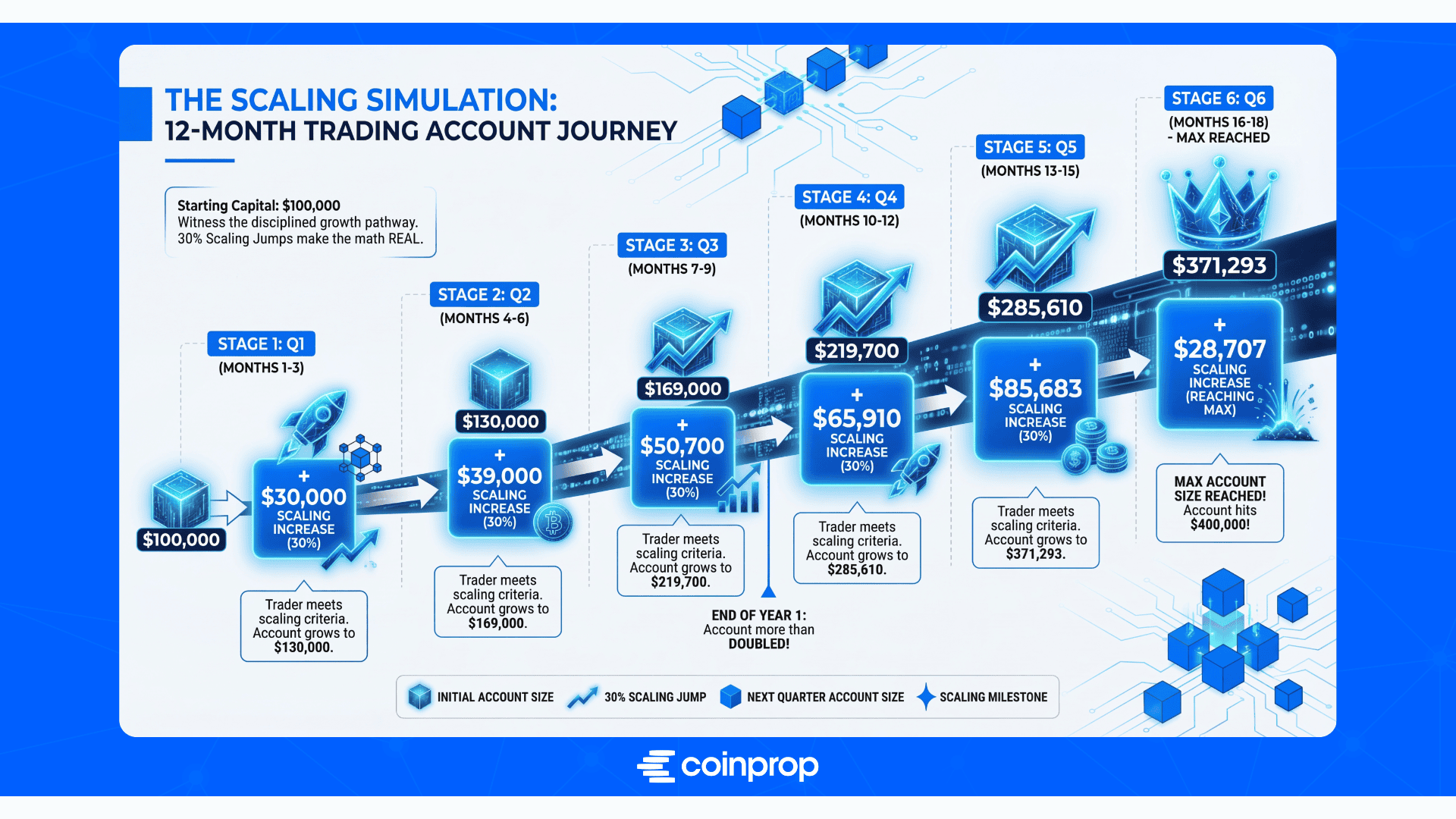
The following example illustrates how a disciplined trader could potentially progress over a 12-month period under a scaling model that increases account size by 30% after each successful cycle. This scenario is designed to demonstrate how scaling mechanics work and should not be interpreted as a guaranteed outcome.
Actual results can vary significantly depending on market conditions, trading consistency, and firm-specific requirements.
Assume a trader begins with the following conditions:
Starting account: $100,000
Scaling frequency: Every 3 months
Capital increase: 30% after each completed cycle
Risk approach: Controlled position sizing with consistent risk management
Trading objective: Preserve long-term growth rather than maximize short-term returns
In this scenario, the trader focuses on maintaining a repeatable process rather than forcing aggressive returns.
Instead of attempting to generate exceptionally high monthly profits, the objective is to:
The emphasis remains on sustainability.
If a trader consistently meets the requirements of each scaling cycle, account growth can follow a structured upward path over time. In this example, we assume a starting account of $100,000 with a 30% capital increase after every successful 3-month period.
In the first 3 months, the trader operates with the initial $100,000 account. If performance remains consistent and risk rules are respected, the account is upgraded to $130,000 in the next cycle.
During months 4 to 6, the same process continues. With stable execution, the account grows again by 30%, reaching $169,000. At this stage, even though the trading strategy has not changed, the capital being managed has already increased significantly.
In months 7 to 9, another successful cycle results in a new account size of $219,700. The important point here is that each upgrade is applied on top of the previous growth, meaning the effect becomes increasingly powerful over time.
By the final quarter (months 10 to 12), the account reaches approximately $285,610 after the next scaling increase, assuming all requirements are met without violations or major setbacks.
At the end of the 12-month period, the account has grown from $100,000 to roughly $285,610 under this scaling model.
The key takeaway is that this growth is not the result of changing strategies or taking higher risks. Instead, it comes from:
It is also important to understand that real-world results are rarely perfectly linear. Some traders may miss a scaling cycle due to drawdown, while others may take longer to qualify for upgrades. Market conditions and psychological factors can also affect consistency.
However, the core principle remains the same: scaling plans reward sustained discipline, and over time, even moderate performance can lead to significant account growth when capital is increased in structured stages.
Scaling up in prop trading is not equally suitable for every trader at every stage. While the idea of managing larger accounts is attractive, the ability to benefit from scaling depends heavily on a trader’s experience level, discipline, and overall approach to risk. For some traders, scaling becomes the main long-term objective, while for others it may remain a secondary consideration behind skill development and consistency building.
Understanding where you fit in this spectrum is important because scaling is not just about increasing capital size, it is about being able to handle that increase responsibly over time.
Beginner traders and advanced traders often approach scaling from very different perspectives.
For beginners, the primary focus is usually on learning the fundamentals of trading. This includes understanding market structure, risk management basics, trade execution, and emotional control. At this stage, scaling may seem like the main goal, but without consistency, it can become a distraction.
Beginners who focus too early on scaling often make the mistake of:
For advanced traders, scaling becomes more relevant because they already have a stable trading framework. They are typically more focused on refining execution rather than constantly changing strategies.
Advanced traders are better positioned to benefit from scaling because they:
In this sense, scaling is less about learning how to trade and more about expanding the impact of an already functional system.
At a certain stage in a trader’s development, the focus naturally begins to shift from short-term profit extraction to long-term capital growth.
In early stages, withdrawals and immediate profits may feel like the primary reward. However, as traders become more experienced, they often recognize that withdrawing everything limits long-term potential.
Scaling becomes more important than short-term profit taking when:
At this point, the opportunity cost of not scaling becomes significant. Every cycle where a trader qualifies for an upgrade represents a potential increase in future earning capacity.
Instead of focusing solely on extracting profits from the current account size, the trader begins to prioritize expanding the base that generates those profits.
This shift is a key transition from retail-style thinking to capital management thinking.
Not every trader is naturally suited for scaling systems, and risk profile plays a major role in determining compatibility.
Scaling models generally work best for traders with moderate and controlled risk profiles rather than highly aggressive or overly conservative approaches.
Traders who tend to fit scaling systems well usually share several characteristics:
On the other hand, traders who take very high-risk approaches may struggle with scaling because their performance often becomes too volatile to qualify for consistent upgrades. Similarly, extremely conservative traders may grow too slowly to fully benefit from scaling systems.
The most suitable risk profile for scaling is typically one that balances:
This balance allows traders to remain within risk limits while still generating enough performance to qualify for account growth over time.
Ultimately, scaling plans are designed for traders who can think in terms of long-term capital development rather than short bursts of profit.
This section covers some of the most common questions traders have about scaling up and how scaling plans actually work in crypto prop firm environments. While the exact rules can differ between firms, the core principles behind scaling remain fairly consistent across the industry.
No, scaling plans are not guaranteed. They are usually conditional and depend on a trader meeting specific performance and risk requirements over time.
Most prop firms require traders to demonstrate consistent profitability, controlled drawdowns, and rule compliance before any account increase is granted. Even if a trader is profitable, failing to follow risk guidelines or violating rules can delay or completely prevent scaling eligibility.
In other words, scaling is earned through sustained performance rather than automatically granted.
In most prop firm models, withdrawals do not directly prevent scaling, but they can indirectly influence the process depending on the firm’s rules.
Some firms require traders to maintain certain equity levels or meet profit thresholds within a cycle before qualifying for an upgrade. In such cases, withdrawing too much profit too early might slow down progress toward meeting those requirements.
However, in many modern prop firm systems, withdrawals are allowed without affecting scaling as long as the trader continues to meet all performance and risk conditions.
The key factor is always whether the trader remains within the defined scaling rules after taking payouts.
No, not all prop firms use scaling systems.
Some firms offer fixed account sizes where traders operate without structured growth opportunities. Others may provide aggressive scaling models, while some focus only on profit splits without any formal account expansion process.
Scaling systems are more common in firms that emphasize long-term trader development rather than short-term evaluations. These firms aim to reward consistency over time by gradually increasing capital allocation.
Traders should always check each firm’s model carefully, as scaling conditions, timelines, and requirements can vary significantly.
The biggest risk in scaling accounts is behavioral, not technical.
Most traders do not fail scaling because their strategy stops working. Instead, they fail because their behavior changes after account growth.
Common behavioral risks include:
Another major risk is psychological pressure. As account size increases, traders often start focusing on dollar values instead of percentages, which can lead to fear-based or impulsive decisions.
In most cases, the traders who successfully scale long-term are not those who change their strategy, but those who maintain discipline and consistency as capital increases.
Many of the concepts covered in this article are fundamental to how a crypto prop firm evaluates and funds traders. Learn more in our complete guide.
