
Prop Slippage in Crypto Prop Firm
Published
If you're asking what slippage is, it refers to the difference between the expected trade price and the actual execution price. It happens due to liquidity imbalances and execution delays in fast markets. In crypto prop trading, prop slippage can impact returns when large orders meet thin liquidity. Understanding crypto slippage and market impact is key for execution quality.
- What Is Slippage in Crypto Prop Trading Firm?
- Why Slippage Happens in Crypto Trading
- The Direct Link Between Spread and Slippage
- The Execution Layer Behind Prop Trading Slippage
- How Much Slippage Is Normal in Crypto Prop Trading?
- How to Avoid Slippage in Crypto Trading
- Raw Spread and Its Impact on Slippage in Crypto Trading
- Advanced Slippage Control: Iceberg Orders and Execution Algorithms
- Slippage FAQ: Clear Answers for Crypto Traders
What Is Slippage in Crypto Prop Trading Firm?
Let’s get real about slippage. It’s not some new crypto curse, it’s the same old friction that’s existed since humans started shouting bids in exchange pits. Slippage happens when your order fills at a worse price than you expected because of liquidity gaps in the order book or tiny execution delays.
Back in the old days, in the pits of Chicago or New York, you yelled Buy! and by the time the floor broker heard you and wrote it down, the price had already moved. That was physical slippage, slow humans, loud voices, slow hands.
Crypto is digital, 24/7, and never stops. No circuit breakers, no lunch breaks, no closing bell. When volatility spikes, liquidity can vanish in seconds. The order book thins out, and your big order suddenly has to eat through empty levels. That’s when slippage turns from a few ticks into several percent, especially on leverage.
In prop trading environments like crypto prop firms, slippage is your silent enemy. A clean 5% move can become 4.5% or less if your entry slips. On a funded account with leverage, that’s real money gone. The best firms fight it with deep, real liquidity and lightning execution.
Slippage Crypto Meaning
Slippage, plain and simple, is the difference between the price you wanted and the price you actually got filled at. It’s the friction between your decision and the market’s actual liquidity reality. In crypto, with its high volatility and no circuit breakers, slippage isn’t just a few ticks, it can be several percent. It’s part of the game, but the best firms minimize it so your strategy’s net returns stay strong.
Slippage Crypto Example
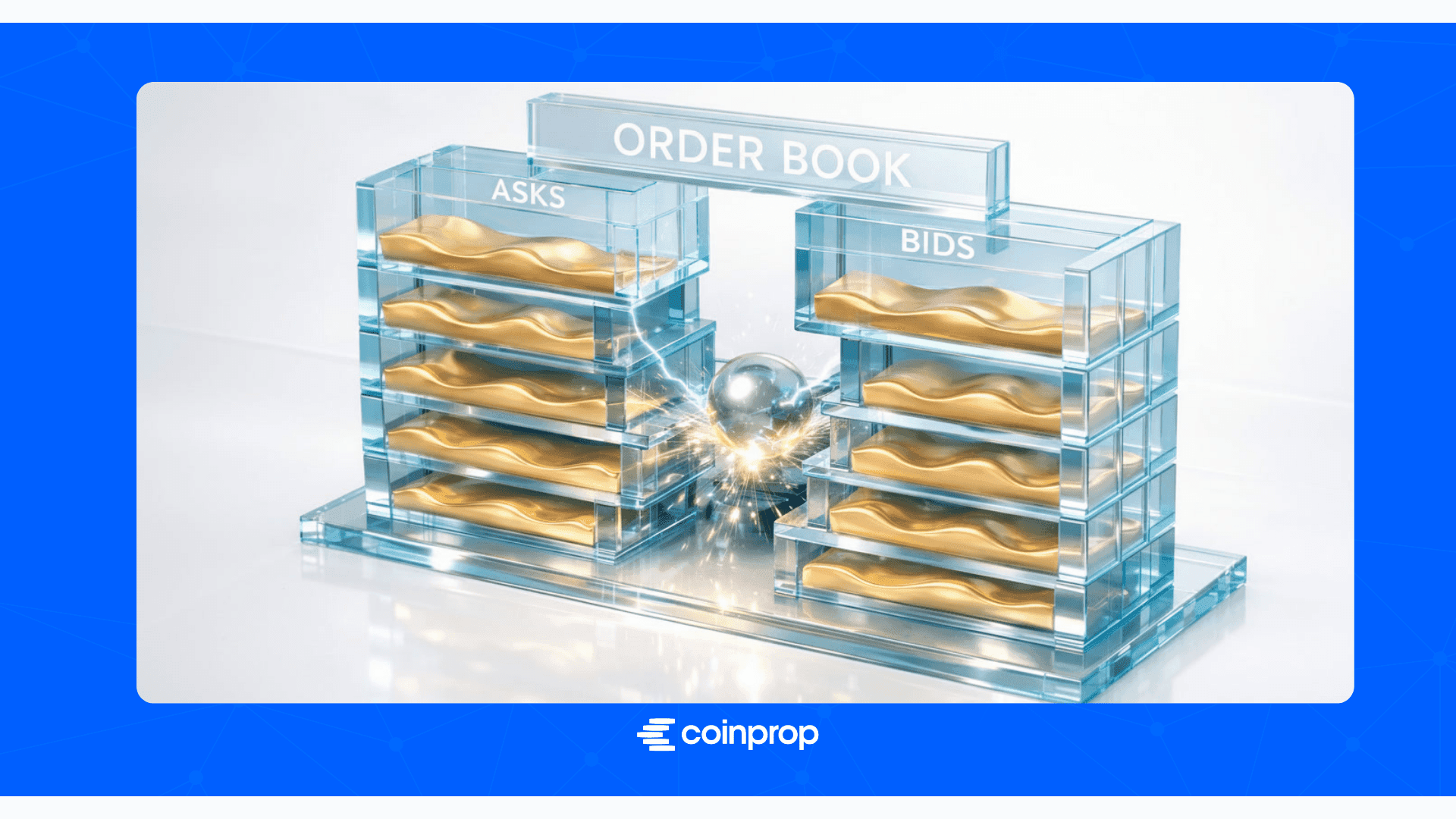
Let’s make it real and concrete. Imagine you want to buy at $60,000, but the top layer of bids only has $100,000 in volume available. Your $500,000 order can’t fill all at once at that price, it has to eat through the order book layer by layer.
The first $100,000 fills right at $60,000. The next $200,000 pushes into the next level and fills at $60,002. The remaining $200,000 moves even higher and fills at $60,005. Your average entry ends up around $60,003 instead of the $60,000 you targeted. You just moved the market 3 dollars yourself with that single order. That’s market impact in action, and it shows exactly why real liquidity and fast execution matter so much, especially when you’re trading larger sizes on leverage. Without deep books and quick fills, those small slips add up fast and eat into your edge.
Crypto Slippage Calculator: The Simple Formula
Now that you see it with real numbers, here’s the basic math pros use to estimate it. The formula for slippage based on order book depth is:
Slippage ≈ Order Size / Liquidity Depth at Level 1
Trade Size vs. Approximate Slippage in Bitcoin (Normal Conditions)
Let’s look at realistic numbers for Bitcoin trades on deep liquidity like Bybit:
A $10,000 order (0.1x effective leverage) usually sees zero slippage, less than the spread itself.
A $100,000 order (1x) typically slips 0.001% to 0.005%, barely noticeable.
A $500,000 order (5x on a $100k account) slips 0.01% to 0.03%, still very controlled.
A $1,000,000 order (10x) slips 0.05% to 0.1%, you feel the market move slightly, but it’s manageable.
Now imagine that same size on a lower volume altcoin. Slippage turns into a tsunami, price moves 1%, 2%, or more just from your order. That’s the difference between trading on a deep, liquid pool and a shallow one.
In crypto prop trading, visible order book depth is only part of the story. Hidden liquidity, HFT front running, and real execution speed determine how much of your edge actually survives the fill. CoinProp’s Bybit integration and CPX make that friction visible: no spread is added, and the slippage fee for your pair and size is shown in the order confirmation before you execute, so there are no nasty surprises.
See the real book,trade with depth,keep your edge intact.
Why Slippage Happens in Crypto Trading
Slippage is not random. It is the result of how markets process orders in real time under changing liquidity and volatility conditions. When you place a trade, multiple structural factors determine whether your execution matches the expected price or deviates from it.
Liquidity and Order Book Depth
One of the main drivers of slippage is liquidity. In simple terms, liquidity refers to how many buy and sell orders are available at each price level in the order book.
When liquidity is deep, large orders can be filled with minimal price movement. However, in thin markets, even relatively small orders can move through multiple price levels, resulting in worse execution prices.
This is why slippage tends to increase during low-volume periods or in less liquid trading pairs.
Spread and Market Friction
The bid-ask spread represents the immediate cost of entering or exiting a trade. A wider spread means a larger gap between buyers and sellers, which increases execution friction.
When spreads widen, traders are effectively starting further away from the mid-market price. This increases the probability of slippage, especially when market orders are used.
In efficient markets, tight spreads help reduce this initial pricing gap.
Order Size Relative to Market Liquidity
Slippage is also influenced by how large your order is compared to available liquidity.
Small orders usually get filled at or near the expected price. Large orders, however, consume multiple layers of the order book, pushing execution deeper into less favorable price levels.
This effect becomes more pronounced in fast-moving markets where liquidity is constantly shifting.
Market Volatility and Speed of Price Movement
Volatility plays a major role in slippage. In highly volatile conditions, prices can change significantly within milliseconds.
Even if your order is routed quickly, the market may have already moved by the time it reaches the matching engine. This creates a gap between expected and actual execution price.
Access to real-time market information and accurate order book visibility can help traders react faster to changing conditions, which is why many traders prefer crypto prop firms with free market data.
Volatility spikes, especially during news events or sudden market moves, are among the strongest contributors to slippage.
Why Slippage Is Higher in Meme Coin Markets
Meme coins represent an extreme example of how liquidity and volatility interact.
These assets often have shallow order books and highly unstable liquidity conditions. During hype cycles, liquidity may appear suddenly, only to disappear just as quickly.
As a result, even modest order sizes can experience significant slippage due to rapid price gaps and fragmented liquidity.
This makes execution in meme coin markets less predictable compared to major crypto pairs.
Summary
Slippage is the combined result of liquidity conditions, spread structure, order size, and market volatility. It is not a single-factor issue, but a reflection of how efficiently an order interacts with real-time market conditions.
Understanding these drivers helps traders make better decisions about order types, timing, and position sizing in different market environments.
The Direct Link Between Spread and Slippage
Understanding the relationship between spread and slippage is essential in crypto prop trading because both are directly influenced by market liquidity and execution depth.
We need to understand why wider spreads almost always lead to bigger slippage and how these two are deeply connected.
The Shared Root: Thin Liquidity
Both spread and slippage come from the same source: liquidity. When a pair like BTC/USDT has plenty of buyers and sellers, the spread stays tight, maybe just $1 or less. The order book is deep, and slippage is rare because your order gets absorbed quickly in the top layers.
But when liquidity dries up, like in a quiet memecoin or during a flash crash, the spread blows open. At the same time, slippage turns wild because there’s not enough volume in the visible layers to fill your order cleanly. Thin liquidity is the common enemy.
Spread: The Starting Point of Slippage
Spread is the baseline cost of entry. When the spread is wide, it means the top layer of the order book is already far from the current price. Think of it like a frozen road: the wider the spread, the more slippery the surface. Even a small market order can skid you further than expected. Wide spreads often indicate weakening liquidity conditions. In these environments, even moderate market orders may experience larger execution deviations as available depth disappears from the top levels of the order book.
The Math Behind Hidden Costs
Your true entry cost in a prop firm combines spread and slippage. When spread jumps during news (like CPI reports) from 2 pips to 20 pips, liquidity in the top layers has vanished. If you enter with size at that moment, your order blasts through weak layers.
You pay the initial 20 pip spread, then add slippage, maybe another 30 pips, as it pushes into deeper, more distant levels. Total? You’re effectively 50 pips behind where you wanted to be. That’s not a minor cost; it’s a direct hit to your net return.
The Subtle but Critical Difference
Traders need to be crystal clear on this: spread and slippage are not the same.
Spread is the visible gap between best bid and ask, you see it before you click.
Slippage is the surprise difference between the price you clicked and the price you actually filled at, after the order executes.
CoinProp’s Role in Execution Quality
At CoinProp, no spread is added on top of Bybit pricing, and the slippage fee on each fill is sized from live Bybit order-book depth for the pair and your position size, then shown in the order confirmation before you execute. In normal market conditions, deep order books keep both the spread and the slippage fee small across varying order sizes.
Even when spreads widen temporarily, strong liquidity depth helps reduce excessive price deviation by absorbing orders more efficiently at higher levels of the book.
Final Insight
A wide spread is often an early warning signal of reduced liquidity ahead. Ignoring it and executing market orders in such conditions can lead to significantly higher slippage.
In crypto prop trading, understanding how spread and slippage interact is not optional, it is a core part of managing execution risk and maintaining consistent trading performance.
The Execution Layer Behind Prop Trading Slippage
When you click Buy, it may feel instant. But in reality, your order begins a physical journey across global network infrastructure. Trade execution isn’t magic, it’s physics, distance, and engineering.
The Signal Path: From Your Click to the Exchange
Every trade starts as a data packet. The moment you place an order, that packet travels through multiple layers:
First, it moves from your device through your internet provider. This stage introduces local latency based on your connection quality and routing efficiency.
Next, the order reaches the trading platform’s servers. Professional prop firms place their infrastructure inside top tier financial data centers to minimize physical distance to exchange systems.
Finally, the order travels from the platform’s server to the exchange’s matching engine, the core system responsible for executing trades and updating the order book.
Execution speed depends heavily on how efficiently this path is optimized.
Physical Limits: Speed of Light and Network Distance
Data travels through fiber optic cables at roughly two thirds the speed of light. This creates real, measurable latency based on physical distance.
Even under ideal conditions, sending data across continents takes tens of milliseconds. Poor routing, overloaded servers, or indirect connections can increase delays significantly.
This is why infrastructure matters. The closer a platform’s servers are to exchange systems, the faster and cleaner execution becomes.
Direct Exchange Connectivity: Eliminating Unnecessary Delays
Professional grade trading platforms reduce latency by connecting directly to exchange infrastructure rather than relying on public internet routing.
By using dedicated fiber connections and optimized routing, execution delays are minimized. Orders reach the exchange faster, reducing slippage and improving fill accuracy, especially critical when trading volatile crypto markets.
This ensures that the price you see on the chart closely matches the price you get in execution.
Why Execution Speed Matters More in Crypto
Crypto markets move incredibly fast. Price changes of 1–2% can happen in seconds, and in leveraged trading, even tiny delays can turn winning setups into losses or erode profits. Fast, reliable execution is what keeps your edge intact.
When your order reaches the exchange instantly, you get accurate fills at the price you intended, no surprises from sudden moves while your packet is in transit. Reduced slippage means you avoid paying extra for thin liquidity or slow routing. Better risk control comes naturally because stops and targets trigger closer to your plan. Consistent trading performance follows: you execute with confidence, avoid forced adjustments, and compound gains over time.
Execution speed isn’t just a technical nice to have, it’s a core part of professional trading in crypto. Slow platforms or poor routing create hidden costs that add up fast. The best firms treat execution as a competitive advantage, not an afterthought.
Infrastructure Is the Invisible Edge
Successful trading isn’t only about strategy. It’s also about infrastructure.
Professional prop trading platforms optimize server placement, connectivity, and execution pipelines to ensure traders operate in the best possible environment.
Because in modern crypto markets, execution speed isn’t just convenience, it’s competitive advantage.
You can see this principle in modern crypto prop trading infrastructure, where platforms like CoinProp price orders directly off live Bybit order-book data to reduce friction between traders and exchanges.
Because in modern crypto markets, execution speed isn’t just convenience, it’s competitive advantage.
How Much Slippage Is Normal in Crypto Prop Trading?
Most traders think slippage is always a loss. In the pro world, it’s a two sided coin, let’s pull back the mask and look at both faces.
Negative Slippage: The Volatility Tax
This is the enemy number one. You aim to buy Bitcoin at $60,000, but due to a sudden spike or delay, your order fills at $60,002. On a $500,000 position (1:5 leverage on a $100k account), that 2 dollar difference equals a $10 unintended loss right at entry. In high leverage scalping, even small negative slippage can kill tight strategies fast. It’s the hidden tax of fast moving markets.
Positive Slippage
Here’s where a firm’s fairness shows. You place a sell order at $60,000, the price jumps to $60,001, and your order fills at the better price. That extra dollar is pure bonus profit. Many unfair firms pocket positive slippage for themselves (common in B Book models). At CoinProp, there is no hidden markup in either direction: orders fill at the exact tick shown, and the slippage fee is shown before you execute.
Slippage on Stop Loss
This is the one that hurts most. During a flash crash, there may be no buyers at your stop price. Your stop at $59,000 triggers, but the first real buyer is at $58,980. You close 20 dollars worse than planned. On CoinProp, fills are priced from Bybit’s live order book, so a stop that triggers in a fast market is charged a slippage fee sized from the book depth at that moment. Deep liquidity keeps that fee small on liquid pairs, but gaps like this can still cost you.
Types of Slippage and Their Psychological Impact
Negative slippage often triggers anger and revenge trading, amateurs lash out at the market. Pros treat it as the cost of doing business and move on. Positive slippage gets ignored by rookies but logged by pros as proof the platform is fair. Artificial slippage (from B Book manipulation) is the red flag that makes smart traders switch firms fast.
Slippage isn’t random chaos, it’s a direct measure of liquidity depth, execution speed, and platform honesty. In crypto prop trading, normal slippage is near zero on deep books like Bybit’s. Anything more signals thin liquidity or poor routing.
CoinProp keeps it transparent with real time Bybit data, no added spread, and a slippage fee shown before you execute. You pay less in hidden costs, keep more in net profits.
How to Avoid Slippage in Crypto Trading
By now, you understand what slippage is and why it’s a natural part of any real market. But professional traders don’t just recognize slippage, they actively manage it. Serious CoinProp traders follow clear execution protocols designed to minimize slippage and protect performance. Here are five practical rules you can apply directly inside the CPX platform.
Know Your Order Type
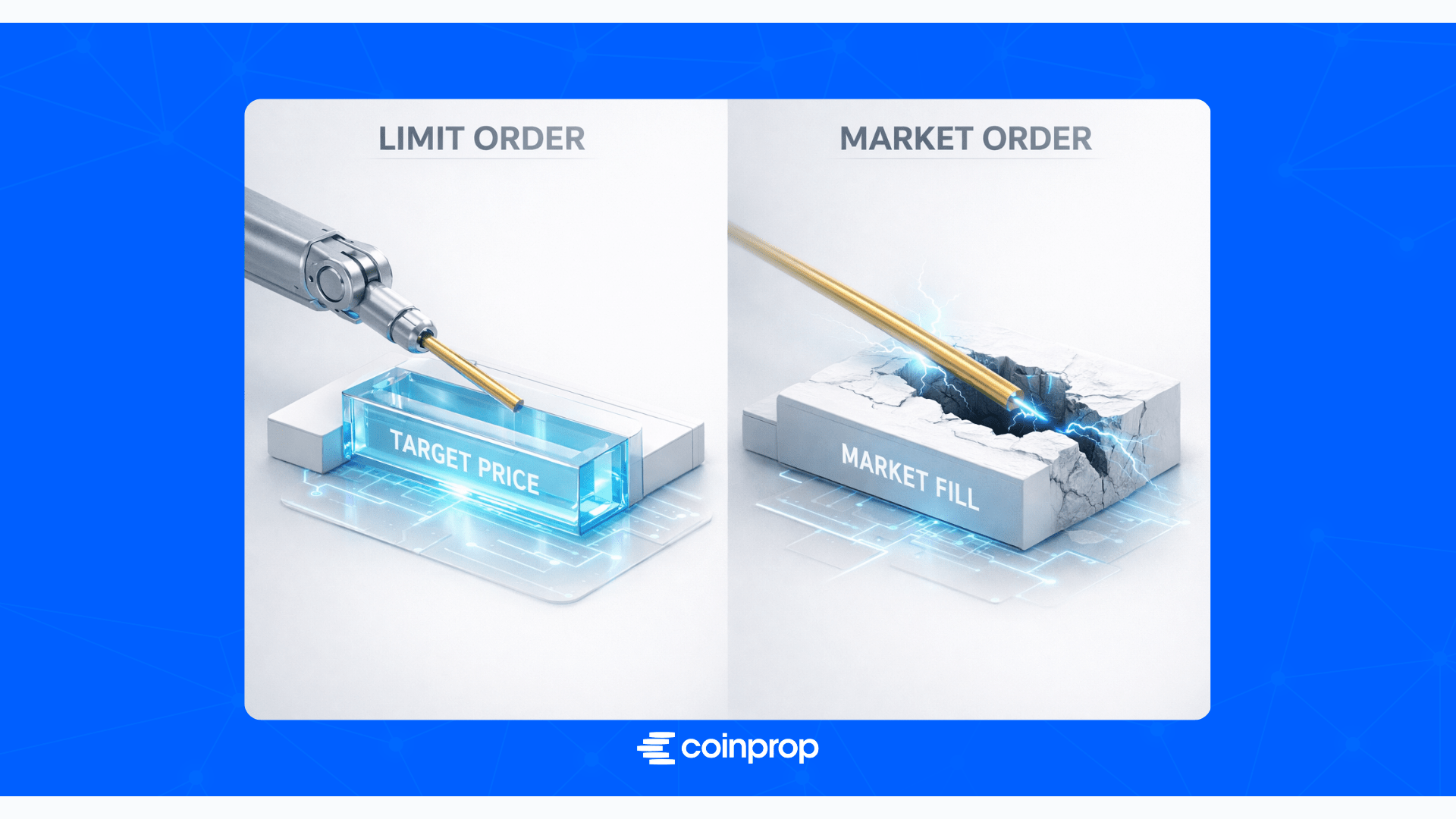
The simplest way to manage slippage is to know exactly how your order will fill. CPX offers Market and Trigger orders, and both execute at market.
A trigger order waits for the level you choose, then executes at market, so it does not cap your fill price. Check the slippage fee in the order confirmation before you confirm.
Professional insight: when you use a market order, you’re accepting the price liquidity offers at that moment. On large positions, especially when controlling $500,000 in exposure, even small execution differences can significantly impact long term profitability.
Check the Slippage Fee Before You Confirm
Every fill on CPX carries a slippage fee, sized from live Bybit order-book depth for the pair and your position size, and it is shown in the order confirmation before you execute.
It is usually small on liquid majors and larger on thin pairs, big sizes or fast markets. If the fee looks too high for your setup, reduce your size or wait for better liquidity.
This keeps unexpected costs out of your fills, especially during fast moving conditions.
Layer Your Entries
Entering large positions all at once can overwhelm available liquidity and increase slippage. Instead, professional traders scale in gradually.
Example: rather than entering a full position immediately, divide your order into smaller portions and execute them across nearby price levels or over short intervals.
This approach allows the order book to absorb your volume more efficiently and results in cleaner average execution.
Avoid Market Orders During Major News
During major macro announcements, liquidity can temporarily disappear, and spreads widen dramatically.
Best practice: avoid using market orders within a few minutes before and after high impact news events.
Even the deepest exchanges can experience rapid price gaps during these periods. Professional traders either enter positions ahead of time with controlled orders or wait for market stability to return.
Monitor Market Depth Before Entering
Before placing any trade, take a moment to review the order book depth.
If liquidity near your entry price appears thin, large orders are more likely to move the market and trigger slippage. In these situations, consider reducing your position size or waiting for liquidity to improve.
Execution awareness is a defining trait of consistently profitable traders.
Raw Spread and Its Impact on Slippage in Crypto Trading
In trading, the concept of raw spread plays a key role in understanding execution quality and slippage. While many traders focus only on entry price, the real difference between platforms often starts at the spread level, before slippage even happens.
What Raw Spread Means
Raw spread is the direct difference between the bid and ask price coming from liquidity providers or exchanges, without any markup.
Think of it as the pure market price. For major assets like BTC/USDT, this spread can be extremely tight, sometimes close to zero during high liquidity conditions.
This is the most transparent form of pricing available in trading infrastructure.
Why Most Brokers Widen the Spread
Many trading platforms do not pass raw pricing directly to traders. Instead, they add a markup on top of the original spread.
For example, if the real market spread is $1, a broker might display $3–$5.
This difference is not always shown as a separate fee, it is embedded directly into the price you see and trade on.
The result is a less transparent execution environment where costs are hidden inside pricing behavior.
The Link Between Raw Spread and Slippage
Raw spread and slippage are directly connected through execution depth and liquidity access.
When trading on true raw spread conditions, your order interacts more closely with the actual top-of-book liquidity. This means less artificial distance between your intended price and executed price.
However, when spread is artificially widened, your effective entry point starts deeper in the order book even before slippage occurs.
This increases the probability that market movement during execution will push your
fill further away from the expected price.
In simple terms:
- Raw spread reduces initial pricing friction
- Wider spread increases the effective starting distance from market liquidity
- Slippage adds additional deviation on top of that
Together, they define your true execution cost.
Raw Spread vs Standard Spread Execution
In a raw spread environment, pricing reflects real market conditions with minimal distortion. This is particularly beneficial for scalpers and short-term traders who rely on tight execution.
In contrast, standard spread models introduce additional embedded cost, which can distort entry and exit precision.
Over time, this difference becomes significant, especially in high-frequency or leveraged strategies.
The combination of spread width and slippage determines the total execution efficiency of a trading system.
Why Transparency in Pricing Matters
Many platforms promote zero commission models, but the cost is often shifted into wider spreads.
This does not eliminate trading costs, it simply changes how they are presented.
Transparent pricing models separate execution costs more clearly, allowing traders to understand where friction actually comes from: spread, slippage, or market volatility.
Summary
Raw spread is not just a pricing detail, it is a structural factor that directly influences slippage and execution quality.
Understanding this relationship helps traders evaluate platforms more accurately and focus on real execution conditions rather than surface-level costs.
Advanced Slippage Control: Iceberg Orders and Execution Algorithms
Now that we’ve calmed the mind, let’s sharpen the weapons. Institutional grade tools like the ones below are what large traders use on other platforms to keep slippage in check. CPX offers Market and Trigger orders only, so on CoinProp the same goal is reached manually, by splitting size into smaller entries and using partial closes.
Iceberg orders, offered on some exchanges, are built to drop a massive size, say $1 million, without tipping off the market. The system splits your big order into dozens of small hidden pieces. As soon as one piece fills, the next automatically appears. The order book never sees the full whale, so liquidity stays intact and slippage stays minimal.
TWAP (Time Weighted Average Price), offered on some platforms, is built for mid term heavy positions. You tell the platform to execute $500,000 over 30 minutes. The algorithm spreads the buys randomly across time so you don’t spike the price. It’s smart, quiet execution that avoids market impact and keeps your average entry close to fair value.
Liquidity sweeps are another pro move. Many CoinProp traders place orders exactly where other stops have been hit. When stops trigger, a flood of liquidity gets released. Entering right there means your order can fill fast and clean with less slippage, because the market just handed you the volume you needed.
Slippage During News Storms: When Liquidity Evaporates
Have you watched the chart during an FOMC rate decision or CPI release? Crypto turns into a flatline EKG hit with a defibrillator. In those moments, slippage stops being a minor slip, it becomes an explosion.
The Vanishing Liquidity Gap
During major macro news, big institutions and bank algos pull their orders from the book. They don’t want the risk. Depth disappears almost instantly, the ocean shrinks to a puddle. You try to sell at $60,000, but no buyers are there. The first real bid might be $59,500. That’s $500 slippage in one second on a large position.
Why Market Orders Are Suicide During News
Market orders during news are like jumping into a tornado hoping for a soft landing. The odds are 99% that the market dumps you at a horrible price. Smart traders either enter before the news or wait for the storm to pass and the sea to calm. Chasing price in those seconds is asking for pain.
The Trap Strategy: Let the Market Come to You
Instead of running after price during news, traders on platforms with resting limit orders set them away from the current level. They know price can throw a long wick, touch their order, and reverse. CPX offers Market and Trigger orders only, so on CoinProp the practical version is to stay out of the first seconds and enter with a trigger order at your level once the book has settled. Waiting lets the market do the work for you.
We’ve covered the mechanics, the psychology, the traps, and the tools. Now it’s decision time.
Candle Close Execution Trap
Many traders build strategies around candle closes. They wait for the 4 hour candle to end at 16:30, then click to enter. That’s when the trouble starts.
In the first second of the new candle, thousands of bots and traders hit buy or sell at once. This sudden demand surge creates a liquidity spike, everyone trying to squeeze through the same narrow door at the same time. The result? Slippage jumps because the order book gets overwhelmed. If you want to avoid candle close slippage, either enter 5 seconds before the close or wait 30 seconds after. Let the bots and noise settle before you step in.
Volume vs Liquidity: What Really Moves Your Fill Price
This is a heavy statistical truth every CoinProp trader needs to know. Volume (how much is traded) and liquidity (how deep the order book is) aren’t the same thing. A coin can have high daily volume but thin depth at any given moment.
Watch the ATR (Average True Range). When ATR is high during your trading window, price moves in big steps, and even small orders can face slippage. High ATR signals fast, choppy action, liquidity thins out quickly. Low ATR means smoother, deeper books. Always check ATR before sizing up.
Panic Exits: Where Profits Disappear
Most traders obsess over entry slippage. The real killer is exit slippage when you’re in profit and panic to close. You see the market turning, hit Close All or market sell, and the fill comes 20–50 pips worse because everyone else is dumping at the same time.
The fix: plan the exit before you need it. In CPX you can edit a position’s TP/SL at any time, so move your stop-loss up by hand as price moves in your favor instead of closing in a panic. It turns your exit into a planned move, not a desperate one, and helps protect gains without emotional overrides.
Weekend Liquidity Gaps and Execution Risk
Crypto never sleeps, but liquidity providers do. On weekends, Saturday and Sunday, major banks and institutions scale back. Bybit’s depth drops compared to Monday–Friday. Trading heavy size at 3 AM Sunday means you’re volunteering for 2x the usual slippage.
The rule: treat weekends like thin hours. Reduce size, check the slippage fee before you confirm, or skip trading altogether unless the setup is exceptional. Liquidity gaps are wider, and slippage turns small moves into big costs.
Slippage isn’t random, it spikes at candle closes, high ATR moments, panic exits, and off hours. CoinProp’s CPX and Bybit data help you spot and avoid these traps. Stay disciplined, use the tools, and keep slippage from stealing your edge.
CoinProp: The New Benchmark in Crypto Prop Trading
In a market where slippage can destroy a trader, CoinProp built a system with three core pillars.
First, honesty. Our model adds no spread, and the slippage fee is shown before you execute.
Second, power. Direct connection to Bybit’s top tier liquidity means even $500,000 orders are priced from the live order book, with the slippage fee shown before you execute.
Third, technology. CPX gives you a live order book for depth monitoring, trigger orders, TP/SL with partial closes, and the slippage fee upfront in the order confirmation. You manage slippage instead of becoming its victim.
Slippage is part of the game, but unfair slippage isn’t. If you want a sustainable prop career with real income, you need a platform that matches your skill level.
You’ve put in the hours analyzing charts and battling your own mind. Don’t let a slow platform or shady firm steal your results with suspicious slippage.
Trading is probability management. Choosing CoinProp removes one of the biggest hidden costs, because there is no added spread and the slippage fee is shown upfront. Now go take that $500,000 buying power and own the chart.
The market is waiting for traders who know where and how to fight.
Slippage FAQ: Clear Answers for Crypto Traders
Here are the most common questions traders ask about slippage in crypto prop trading, answered clearly and directly.
Is slippage always bad for the trader?
No. Slippage has two sides. Negative slippage means you enter at a worse price than expected. Positive slippage means the market gives you a gift and fills you better. At CoinProp, no spread is added on top of Bybit pricing, and the slippage fee is shown before you execute, so nothing is hidden.
Why do demo accounts show less slippage?
It’s one of the biggest traps in prop trading. Most demo accounts are simulated with fake depth and perfect fills. CoinProp is different, CPX mirrors real Bybit data even in demo mode, so you feel the exact friction you’ll face on a live $500,000 account. No sugar coating.
How does leverage affect slippage?
Leverage acts like a megaphone. It amplifies both profits/losses and slippage impact. Higher leverage means larger position size, which hits the order book harder. That can push you deeper into thinner layers, turning small slippage into big cost. The bigger the leverage, the more real liquidity matters.
Does using limit orders completely eliminate slippage?
Yes, for entry. Limit orders say my price or no trade, so slippage is zero. But in fast moves, price can jump past your level and you miss the setup entirely. Pros balance precision and speed, limit for control, market for urgency when timing is everything.
How much slippage should I expect during major news like CPI?
During big macro news, liquidity vanishes. Slippage on majors can hit 0.5% and on smaller coins can exceed 5%. The advice is simple: avoid market orders 5 minutes before and after red news. Smart traders are positioned early or wait for settlement. Gambling with market orders then is asking for pain.
How do I know if slippage is normal or manipulated?
If your positions always open a few pips worse than the quoted price and you are never shown why, that’s a red flag for B Book manipulation. At CoinProp, our prices mirror Bybit exactly, and the slippage fee is shown before you execute. Transparent, ruthless, but honest. You see real market behavior, not a rigged version.
Understanding how a crypto prop firm operates can help you make better decisions when comparing trading rules, risk limits, and payout structures.