Finding a crypto prop firm with low spreads is about more than comparing numbers. Spreads can vary depending on a firm's pricing model, liquidity source, and execution quality. Some crypto prop firms connect traders to pricing from major exchanges, which can provide tighter and more market reflective spreads. This guide explains what really affects spreads and what to look for before choosing a prop firm.
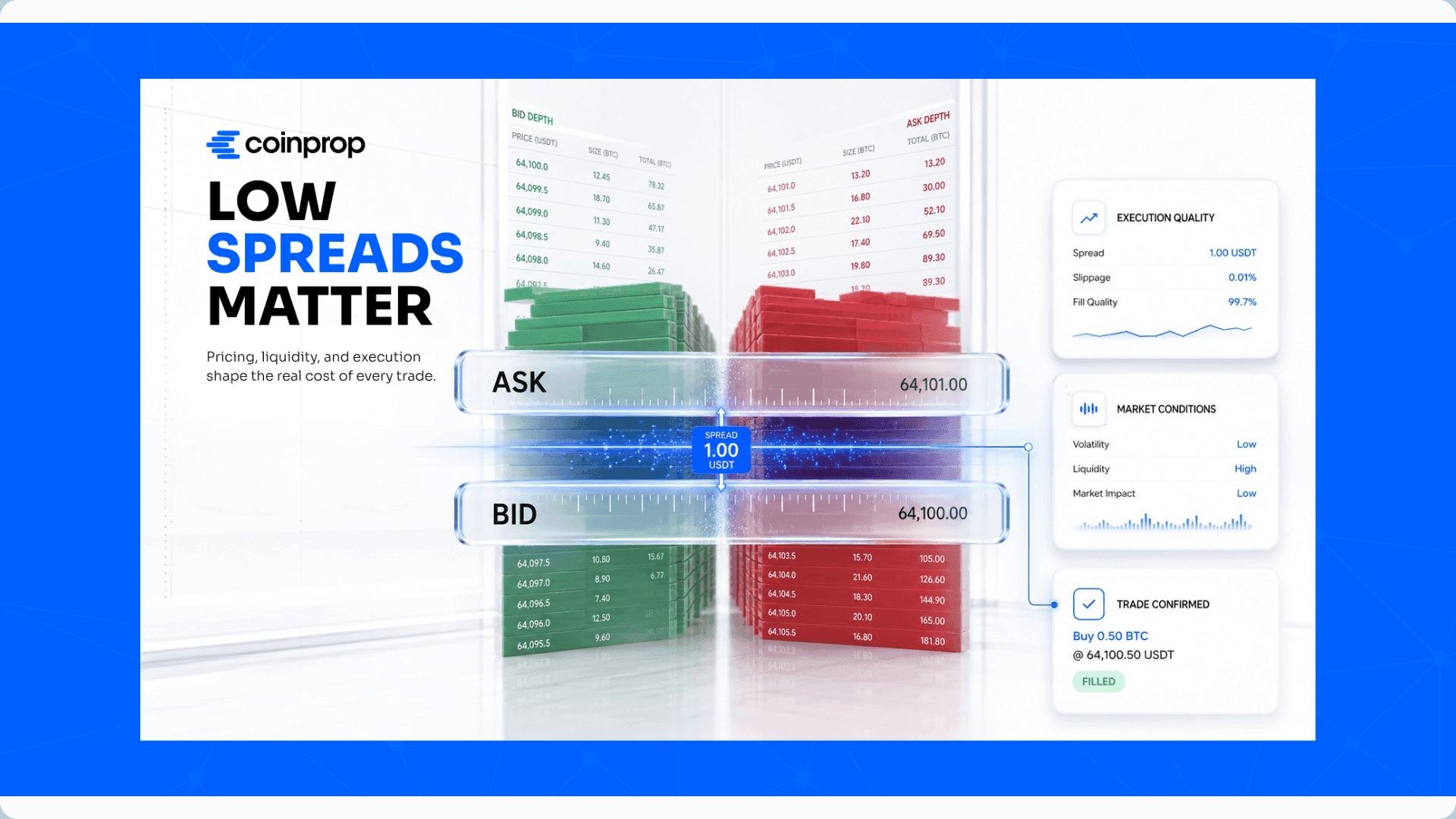
Low spreads can make a meaningful difference in crypto prop trading, especially for traders who execute multiple positions each day. Every trade begins by crossing the bid ask spread, making it one of the first costs you pay. Over time, even small differences in spreads can affect profitability, risk management, and overall trading performance.
The spread is the difference between the buy (ask) and sell (bid) price of an asset. A wider spread means you need the market to move further in your favor before your trade becomes profitable. For active traders, these costs accumulate quickly, reducing net returns over hundreds of trades.
Scalpers and high frequency traders often target small price movements. Because their profit targets are relatively small, every fraction of a spread matters. Lower spreads reduce the cost of entering and exiting positions, helping traders preserve more of their potential profits and maintain better risk to reward ratios.
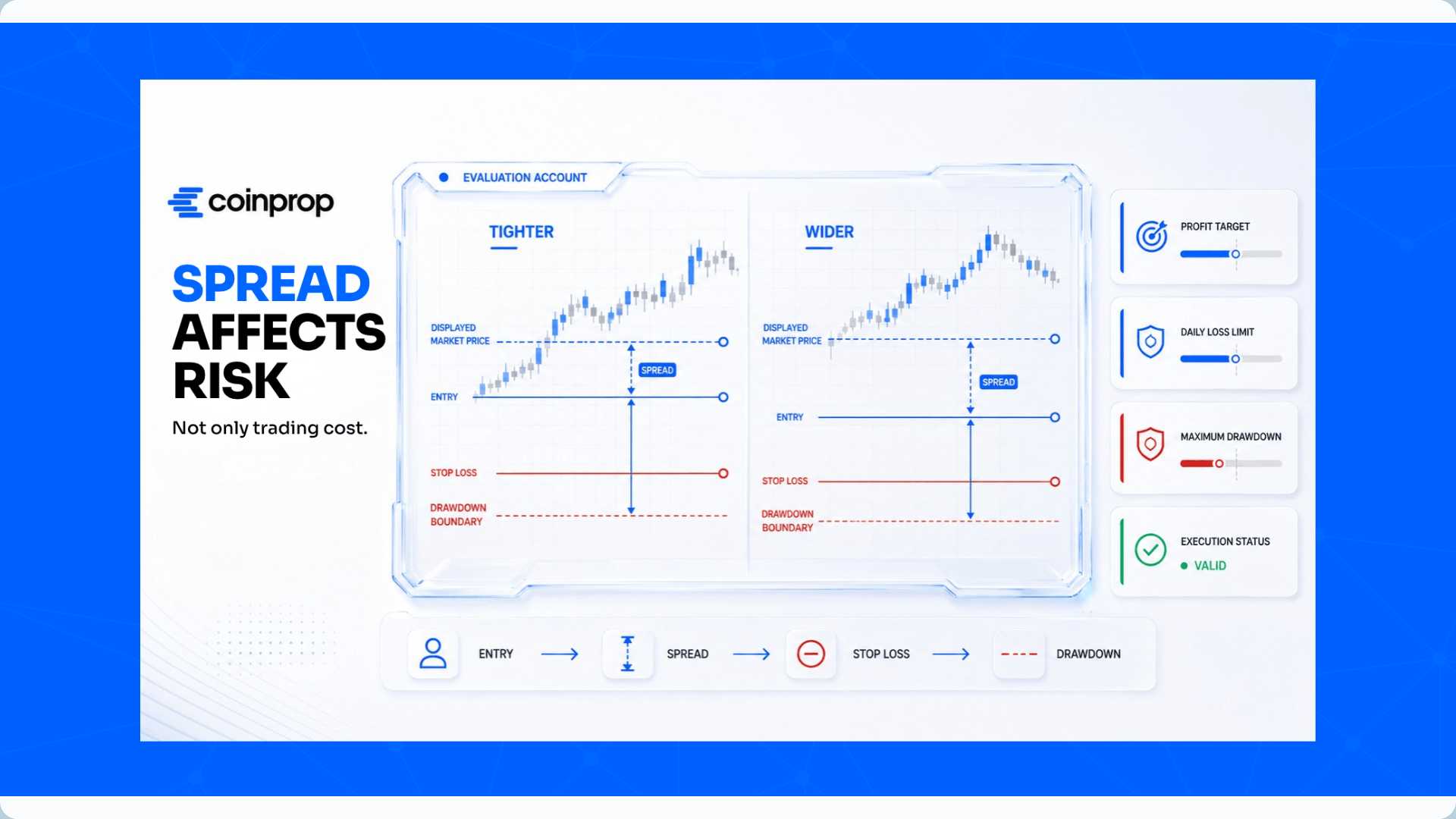
Trading costs become even more important during a prop firm evaluation, where traders must reach profit targets while staying within strict drawdown limits. Higher spreads can reduce effective profits, trigger stop losses sooner, and make consistent execution more difficult. Choosing a crypto prop firm with competitive spreads can help traders focus on strategy rather than unnecessary trading costs.
Not all crypto prop firms offer the same trading conditions, even when they provide access to the same markets. The spreads you see can vary depending on where price data comes from, how orders are executed, and whether the platform uses real exchange liquidity or synthetic pricing. Understanding these differences helps you evaluate a prop firm beyond simply comparing advertised spreads.
One of the biggest factors affecting spreads is how a prop firm sources its market prices.
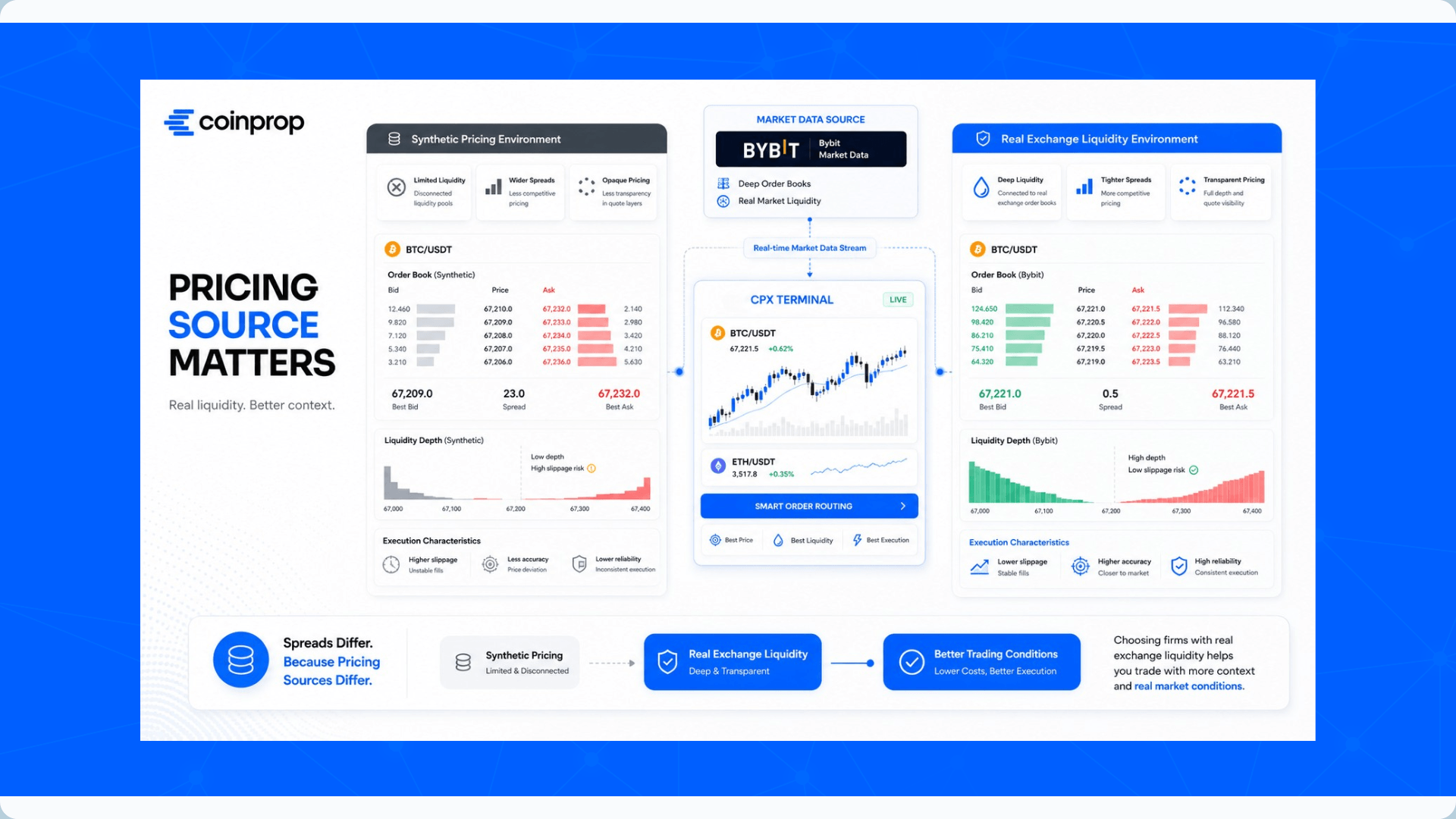
Some crypto prop firms use pricing based on live cryptocurrency exchanges, where spreads are determined by real buy and sell orders in the order book. Since prices reflect actual market activity, spreads tend to be more competitive and closely aligned with current market conditions.
Others rely on CFD or synthetic pricing, where quotes are generated by a broker or liquidity provider rather than coming directly from an exchange. Depending on the provider, spreads may be wider or behave differently during periods of increased volatility.
Even among firms using exchange based pricing, the liquidity source matters. Large global exchanges with deep order books and consistently high trading volume generally provide tighter and more stable spreads than lower liquidity venues.
For example, crypto prop firms that use market data from major exchanges such as Bybit can often offer pricing that closely reflects live market conditions, particularly on highly traded assets. The quality of the underlying liquidity source has a direct impact on the spreads traders experience.
Not every cryptocurrency trades with the same level of liquidity.
Major pairs such as BTC/USDT and ETH/USDT typically have tighter spreads because they attract significantly more trading activity. In contrast, lower volume altcoins often have wider bid ask spreads due to thinner order books and fewer active participants.
If you regularly trade less liquid assets, comparing spreads across different trading pairs is just as important as comparing prop firms themselves.
Pricing is only one part of the trading experience. A firm's execution infrastructure also affects how efficiently your orders are filled.
Fast order routing, low latency, and reliable execution help ensure trades are filled close to the displayed market price. Poor execution can increase slippage, meaning your actual entry or exit price differs from the quoted price. For active traders, execution quality is just as important as competitive spreads.
Even the best trading infrastructure cannot keep spreads constant at all times.
During major news events, periods of extreme volatility, or temporary declines in market liquidity, spreads naturally widen as market makers and liquidity providers adjust to changing risk. This behavior is normal across financial markets and should be expected regardless of which crypto prop firm you choose.
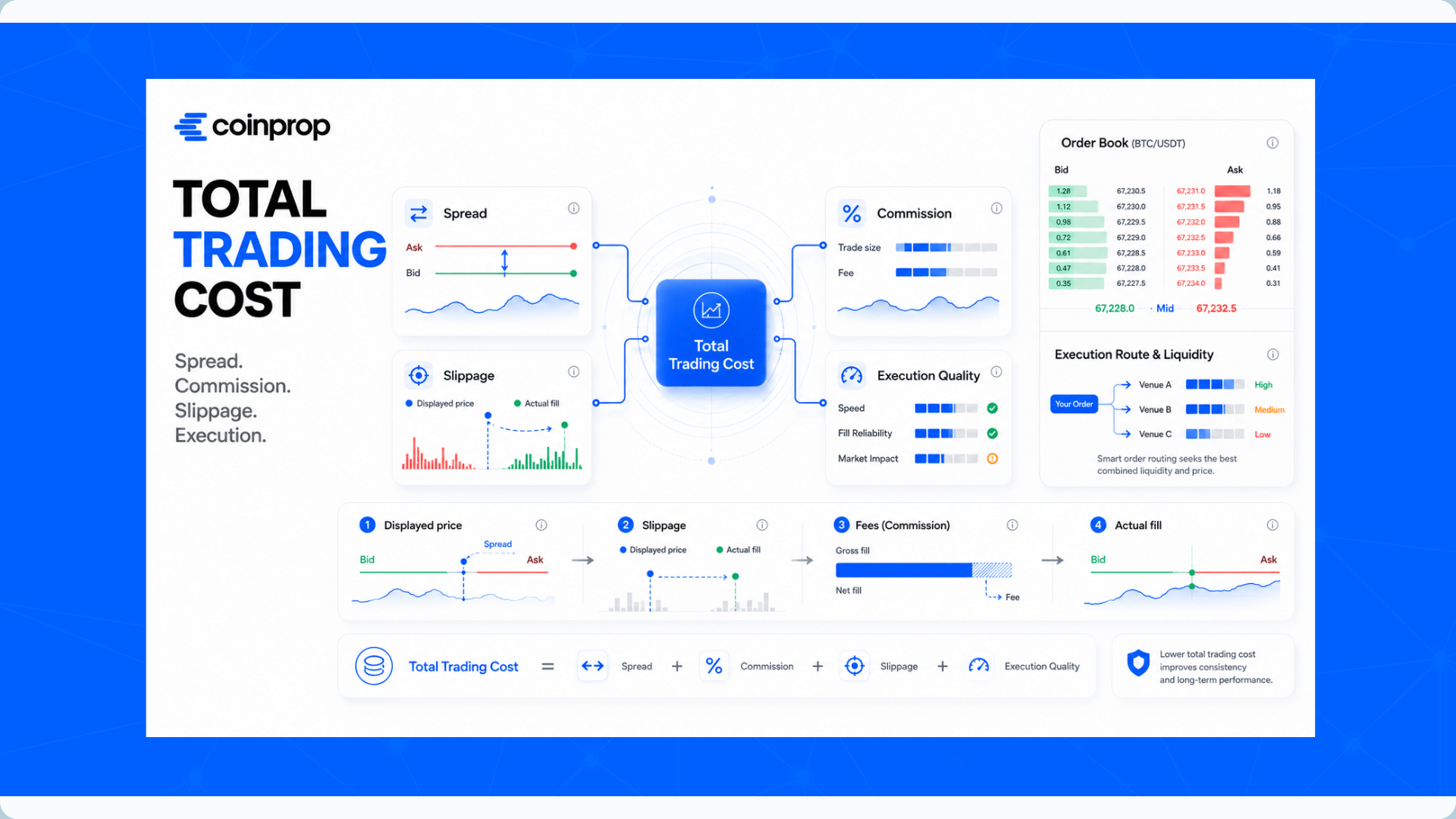
A low spread doesn't always mean lower trading costs. To evaluate a crypto prop firm fairly, you need to consider the total cost of every trade, including spreads, commissions, slippage, and any additional fees. Looking at these factors together gives a much more accurate picture of your actual trading expenses.
The spread is the difference between the bid and ask price and represents the first cost you pay when entering a trade. Lower spreads reduce the distance a trade must move before reaching break even, making them especially important for scalpers and high frequency traders.
Some crypto prop firms charge a fixed commission on every trade in addition to the spread. Others may advertise very low spreads but offset them with higher commissions. That's why it's important to evaluate both together rather than focusing on spreads alone.
Slippage occurs when your order is executed at a different price than expected. This usually happens during periods of high volatility or when market liquidity is limited. Even with competitive spreads, frequent slippage can significantly increase your trading costs and affect overall performance.
Not every trading cost is immediately visible. Platform fees, overnight financing charges (where applicable), funded activation fee, withdrawal fees, and poor execution quality can all reduce your net profitability. Before choosing a crypto prop firm, review its complete pricing structure instead of comparing spreads alone.
Ultimately, the best trading environment combines competitive spreads, transparent commissions, reliable execution, and minimal slippage, not just the lowest advertised spread.
This is why professional traders evaluate a prop firm's overall trading conditions, not just its spreads. The quality of liquidity, execution, and pricing transparency all play an important role in long term trading performance.
Choosing a crypto prop firm with low spreads involves more than comparing a single number. The overall trading environment, including liquidity, execution, platform quality, and pricing transparency, can have a significant impact on your trading performance. Before purchasing a challenge or funded account, evaluate the following factors.
Start by understanding where the prop firm's market prices come from. Firms that use pricing based on major cryptocurrency exchanges generally provide spreads that closely reflect live market conditions. Knowing the liquidity source also helps you determine whether prices are exchange based or generated through synthetic CFD models.
Don't compare spreads alone. Consider the total cost of trading, including commissions, slippage, and any additional fees that may apply. A prop firm with slightly wider spreads but lower overall trading costs may offer better value than one advertising the lowest spread.
Reliable execution is just as important as competitive pricing. Look for a prop firm that offers efficient order processing and consistent execution under different market conditions. Better execution helps reduce slippage and improves the accuracy of trade entries and exits.
Your trading platform should support your trading style without creating unnecessary friction. Evaluate the charting tools, order management features, platform stability, and overall user experience. If a free trial or demo is available, use it to become familiar with the platform before starting an evaluation.
Crypto markets are highly dynamic, and trading conditions can change rapidly during periods of increased volatility. Check how the prop firm handles major market events, whether spreads remain competitive, and whether execution stays reliable when trading activity increases.
By evaluating these factors together, you can choose a crypto prop firm that offers not only competitive spreads but also a trading environment designed to support consistent performance over the long term.
Advertised spreads don't always reflect the trading conditions you'll experience in real markets. Before purchasing a prop challenge, it's worth spending a few minutes evaluating how a firm's spreads behave under different conditions. This simple process can help you avoid unexpected trading costs and choose a platform that matches your trading style.
Start by comparing spreads on highly liquid trading pairs such as BTC/USDT and ETH/USDT. These markets typically have the deepest liquidity and provide a reliable benchmark when evaluating different crypto prop firms. If spreads are consistently wider than expected on major pairs, it's worth investigating the firm's pricing model and liquidity source.
Don't evaluate spreads at only one time of day. Crypto markets operate 24/7, but trading activity changes throughout the day as different regions become more active. Check spreads during multiple trading sessions to see whether pricing remains consistent as market participation changes.
Major economic announcements, sharp market moves, and sudden increases in trading volume can all affect spreads. Observe how a prop firm's spreads behave during these periods. While some widening is normal, excessive changes may indicate weaker liquidity or less stable trading conditions.
Finally, compare the trading platform's prices with a trusted cryptocurrency exchange. If the platform uses exchange based market data, you should see pricing and spreads that closely follow live market conditions. This comparison helps you understand whether the trading environment reflects actual market activity before committing to a prop challenge.
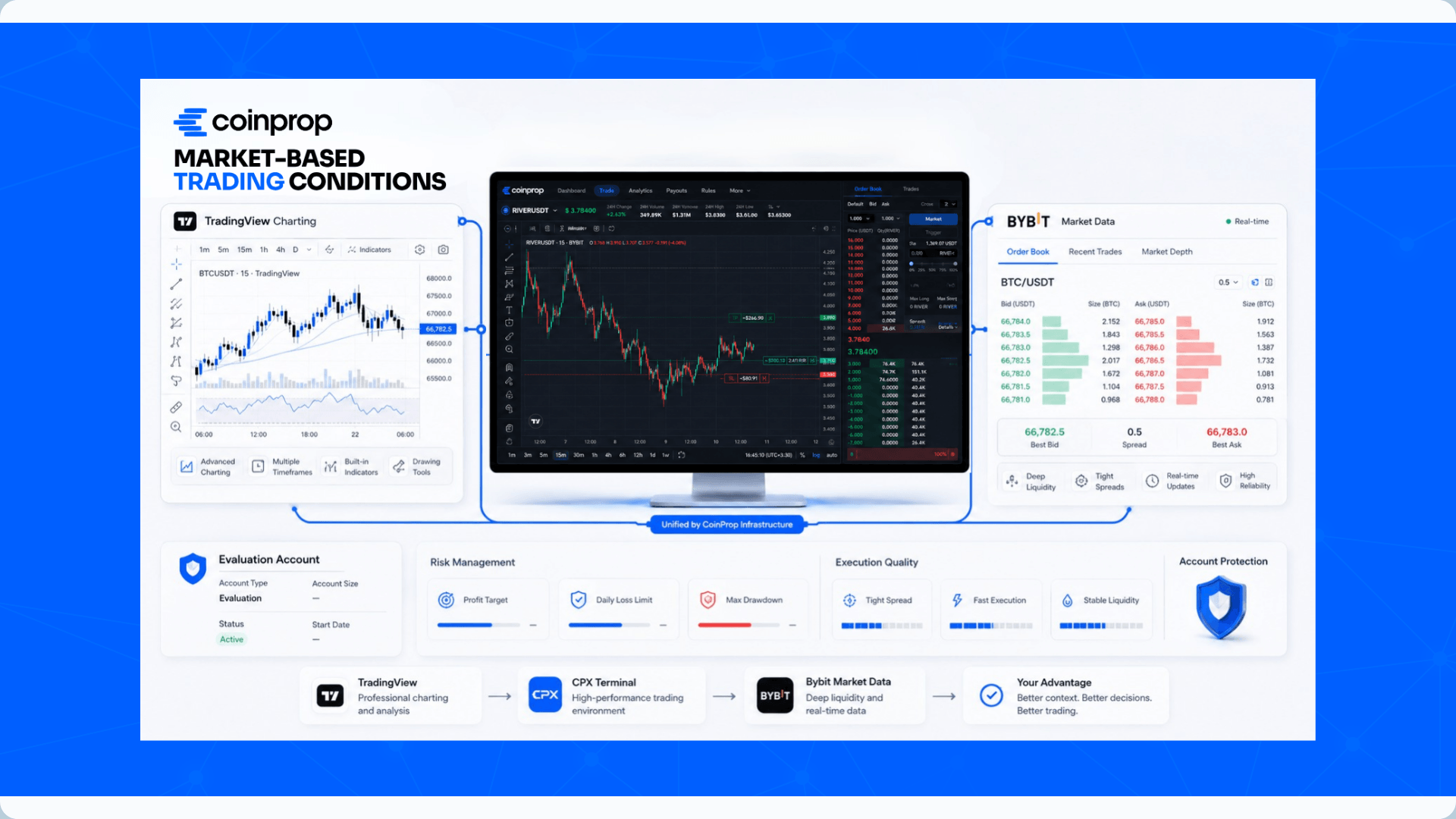
A crypto prop firm's trading conditions depend heavily on its pricing source, liquidity environment, and execution infrastructure. CoinProp trading firm focuses on providing traders with a market based crypto trading experience through its CPX terminal, combining TradingView functionality with Bybit market data.
CoinProp's CPX terminal integrates TradingView charts and trading functionality, allowing traders to analyze markets and manage positions within a familiar trading environment. This helps active traders access charting tools and execution features without switching between multiple platforms.
CPX uses Bybit market data to provide crypto prices, charts, and spread information directly within the trading environment. Since Bybit is one of the largest global cryptocurrency exchanges by trading activity, its order book and market conditions provide a reference based on live crypto market activity.
This means traders can view spreads that are influenced by real exchange conditions, including liquidity, trading volume, and the available buy and sell orders for each asset.
Crypto spreads naturally vary depending on the trading pair, liquidity, and market conditions. Major assets such as BTC and ETH typically benefit from deeper liquidity, while lower volume cryptocurrencies may experience wider spreads.
By using exchange based market data, CoinProp provides spreads that reflect current market conditions rather than relying on fixed or synthetic pricing models.
Competitive spreads are only valuable when combined with reliable execution. Factors such as order processing speed, market conditions, and liquidity availability can influence the final execution price.
CoinProp's trading infrastructure is designed to provide an efficient trading experience, helping traders interact with live crypto market conditions more effectively.
Active crypto traders need more than just low spreads. They need reliable market data, professional charting tools, transparent trading conditions, and an environment that supports frequent trading decisions.
By combining CPX, TradingView integration, and Bybit market data, CoinProp provides a trading environment built around the needs of crypto focused traders.
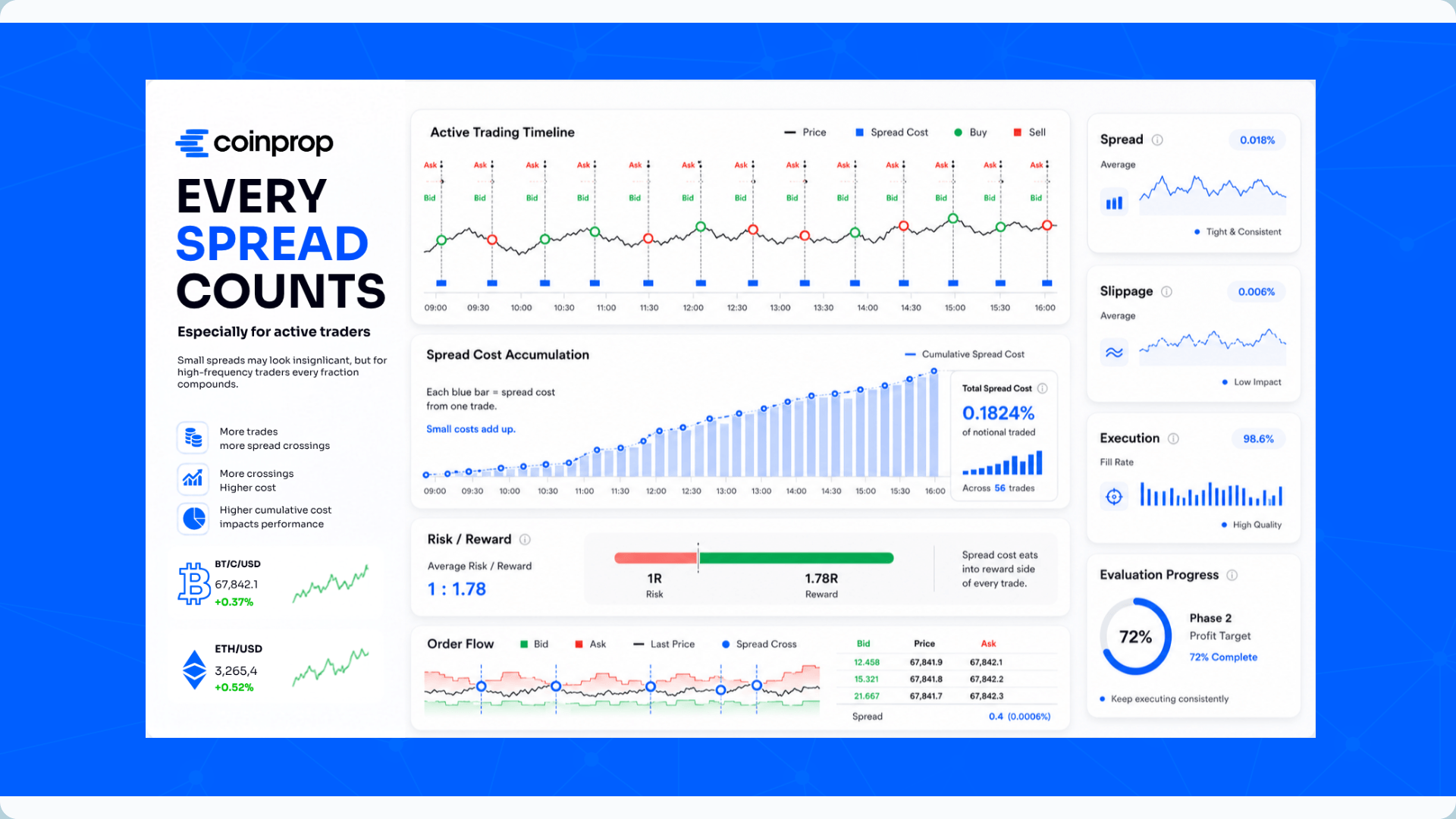
Spreads may seem like a small trading cost, but they can have a noticeable impact during a prop firm evaluation. Traders are usually required to reach specific profit targets while staying within strict drawdown limits, which means every trading cost can affect their overall performance.
When spreads are wider, trades need to move further in the trader's favor before becoming profitable. For traders who make frequent entries, these small costs can accumulate and make reaching evaluation targets more challenging.
Higher spreads can also affect risk management. A wider bid ask difference may increase the gap between the expected entry price and the actual market cost, which can reduce the available room before a stop loss is triggered.
During a prop challenge, where drawdown rules are strict, controlling unnecessary trading costs becomes even more important.
Spreads are not the only factor that affects trading performance. During high volatility, slippage can occur when orders are filled at a different price than expected. Combined with wider spreads, poor execution can increase trading costs and impact a trader's risk management.
For this reason, traders should evaluate a prop firm based on its overall trading conditions, not just the advertised spread.
A low spread in crypto prop trading means a small difference between the bid and ask price of an asset. The exact spread depends on the cryptocurrency pair, liquidity conditions, and market volatility. Major assets like BTC and ETH usually have tighter spreads due to higher trading volume and deeper liquidity.
Yes, low spreads are especially important for scalpers because they enter and exit positions frequently with smaller profit targets. Lower spreads reduce the cost of each trade and allow more of the price movement to contribute toward potential profits.
No. Crypto prop firm spreads can differ depending on factors such as liquidity sources, pricing models, exchange data providers, trading pairs, and execution infrastructure. Two firms trading the same cryptocurrency may offer different spreads based on their underlying market setup.
Yes. Crypto spreads can widen during periods of high volatility, major news events, or reduced market liquidity. This happens because liquidity providers adjust pricing to reflect increased market risk and changing order book conditions.
Not always. The total trading cost includes spreads, commissions, slippage, and execution quality. A firm with slightly higher spreads but better execution and lower overall costs may provide a better trading environment than one advertising only the lowest spread.
CoinProp provides crypto trading conditions based on Bybit market data through its CPX trading environment. Since spreads reflect live market conditions, they can vary depending on the asset, liquidity, and market activity. Traders can access pricing conditions designed to closely reflect real crypto market dynamics.
Choosing a crypto prop firm with low spreads is not only about finding the smallest bid ask difference. Traders should also consider liquidity sources, execution quality, commissions, slippage, and overall trading conditions.
A prop firm that provides market based pricing, reliable execution, and transparent trading conditions can help traders manage costs more effectively and focus on their strategies.
Before choosing a crypto prop firm, look beyond advertised spreads and evaluate the complete trading environment. The right combination of liquidity, technology, and execution can make a meaningful difference, especially for active traders and those completing prop firm evaluations.
