Withdrawing profits from a crypto prop firm involves more than submitting a payout request. Learn how crypto prop firm withdrawals work, when you can withdraw profits, available payment methods, on chain wallet transfers, withdrawal fees, processing times, rules, and common problems. This step by step guide explains how to withdraw profits safely and what traders should check before requesting a payout.
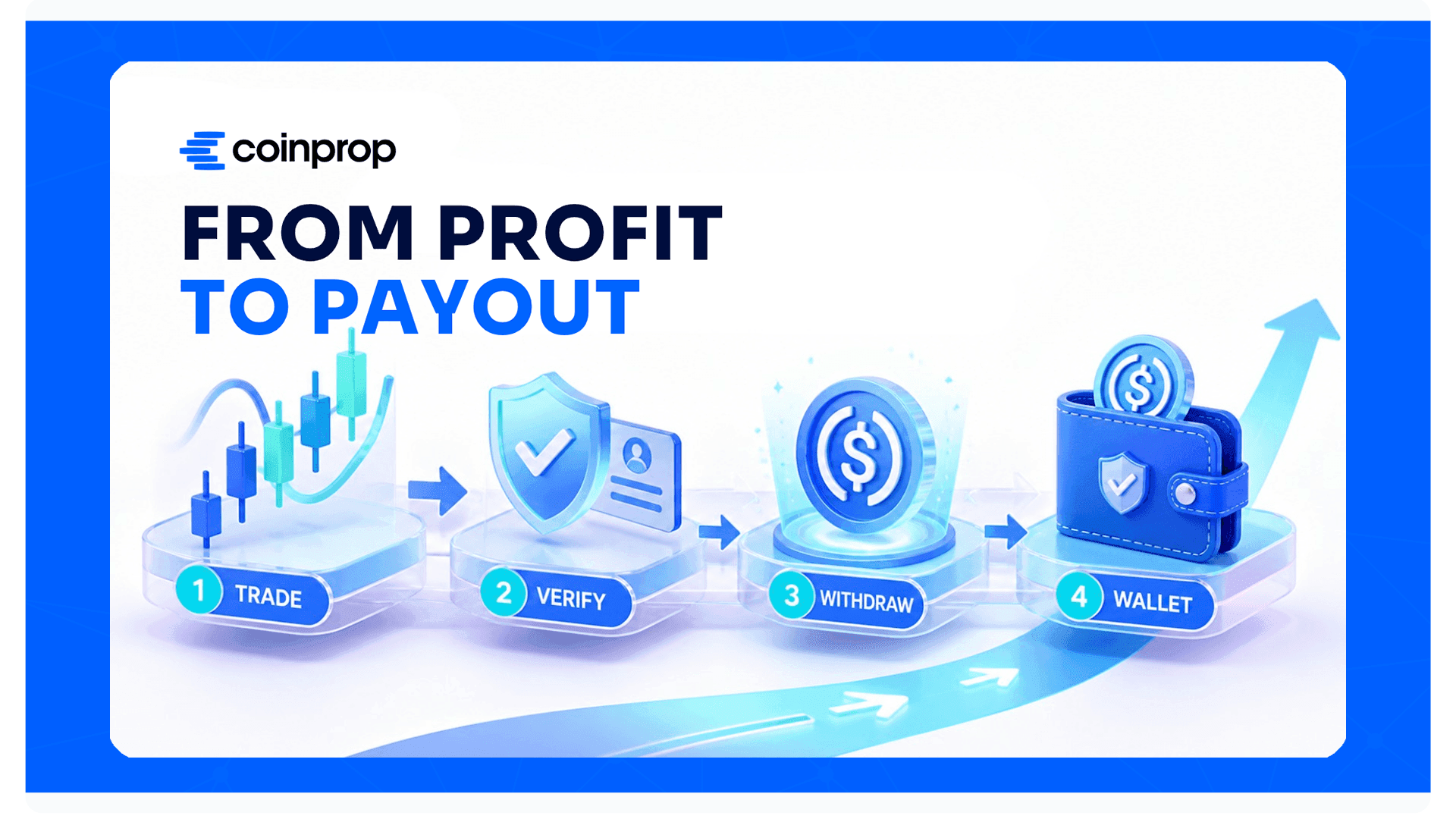
Withdrawing profits from a crypto prop firm generally follows a few straightforward steps, from checking your eligibility to receiving the final payout. While the exact process varies between firms, the overall workflow is similar: confirm that your account qualifies, submit a withdrawal request, complete any required verification, wait for processing, and confirm that the funds have been received.
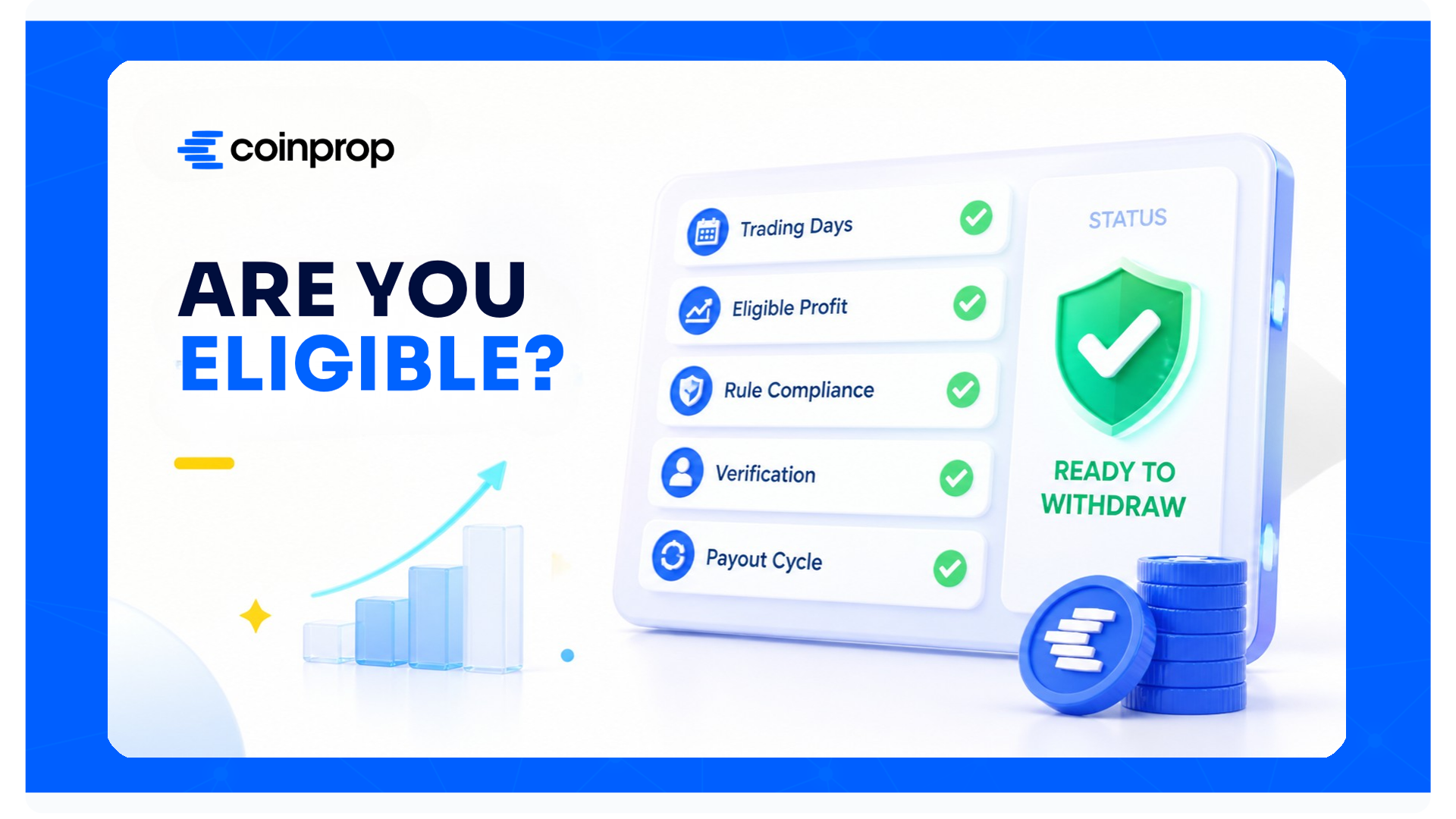
Before requesting a withdrawal, confirm that your account meets the firm's payout requirements. Depending on the prop firm, this may include completing a minimum number of trading days, reaching a required profit level, maintaining the account within its loss limits, and complying with the firm's trading rules.
Some firms may also impose minimum withdrawal amounts, payout schedules, or additional conditions for subsequent withdrawals. Reviewing the firm's current withdrawal terms before submitting a request can help prevent rejected requests or unnecessary delays.
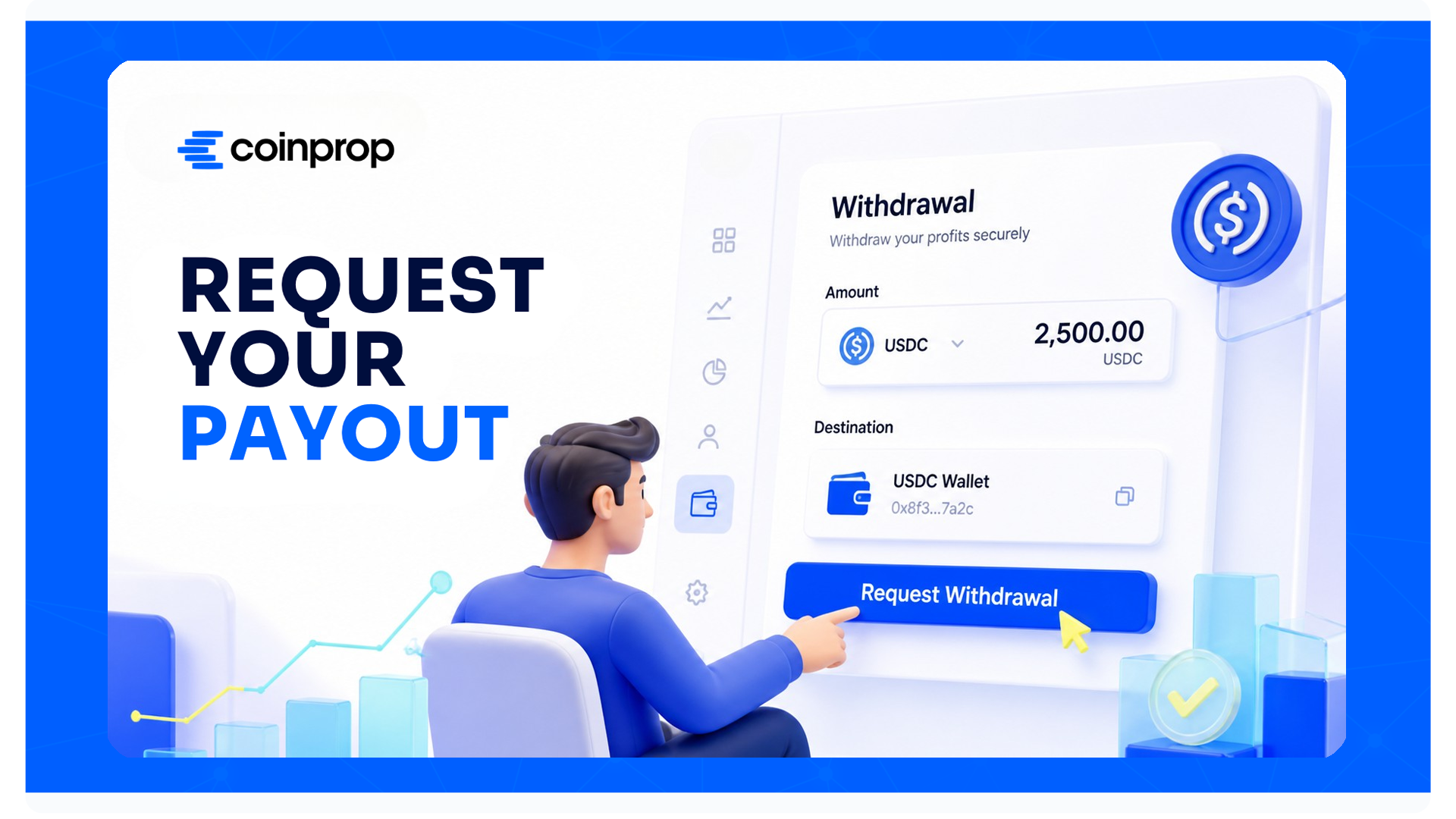
Once your account is eligible, submit a withdrawal request through the prop firm's dashboard or designated payout system.
You may need to specify the amount you want to withdraw and select one of the firm's supported payment methods. Depending on the prop firm, this could include an on chain crypto transfer, stablecoin payout, bank transfer, or third party payment provider.
Before confirming the request, carefully review the withdrawal amount and payment details. If you are withdrawing crypto to a wallet, make sure the wallet address and blockchain network are correct.
Some crypto prop firms require additional verification before approving or processing a withdrawal. This may include identity verification, account verification, or confirmation of payment details.
If verification is required, complete it through the firm's official platform or designated payment provider. Make sure the information you provide matches your account details to avoid unnecessary processing delays.
Not every prop firm uses the same verification process, so traders should check the requirements that apply to their specific account.
After submitting the request, the prop firm may review the account and process the payout.
The processing time depends on factors such as the firm's payout schedule, internal review process, payment method, and any additional verification requirements. For on chain withdrawals, there may also be additional time required for blockchain confirmations after the transaction is sent.
A withdrawal showing as pending does not necessarily mean that there is a problem. Traders should first compare the elapsed time with the firm's stated processing timeframe before contacting support.
Once the withdrawal has been processed, the funds are sent through the selected payment method.
For an on chain crypto withdrawal, traders can use the transaction ID (TxID) to verify the payment on the relevant blockchain explorer. After the required confirmations, the funds should appear in the receiving wallet.
Traders should confirm that the amount received matches the approved payout and that the correct asset and network were used.
Keeping the withdrawal confirmation, TxID, and other payment records can also be useful if the transaction needs to be investigated later.
A crypto prop firm withdrawal is the process of receiving eligible trading profits from a funded account. After a trader meets the firm's payout conditions, they can request a withdrawal and receive the approved amount through one of the payment methods supported by the firm.
A withdrawal is different from simply generating a profit. A trader may have a profitable account but still need to meet specific requirements before those profits become eligible for payout.
When a trader submits a withdrawal request, the prop firm typically checks whether the account meets its payout requirements. This may involve reviewing trading activity, account performance, rule compliance, and any applicable withdrawal conditions.
If the request is approved, the prop firm processes the payment through the selected payout method. For an on chain crypto withdrawal, this can involve sending the approved amount from the firm's payment or treasury wallet to the trader's cryptocurrency wallet.
The exact process varies between firms. Some may use direct crypto transfers, while others may rely on third party payment providers or fiat payment methods.
Withdrawal and profit split describe two different parts of the payout process.
The profit split determines how trading profits are divided between the trader and the prop firm. For example, if an account generates eligible profits, the profit split determines the portion allocated to the trader.
The withdrawal process determines how and when the trader receives that eligible share. It can involve payout schedules, withdrawal requirements, processing times, payment methods, fees, and limits.
This distinction is important because generating a profit does not necessarily mean that the entire amount is immediately available to withdraw.
For a detailed explanation of profit sharing structures, see our guide to profit split in crypto prop firms.
There is no universal withdrawal model across crypto prop firms. Each firm can establish its own payout schedule, eligibility requirements, withdrawal limits, supported payment methods, and verification procedures.
For example, one firm may allow withdrawals after a fixed number of trading days, while another may use a specific payout cycle. Payment methods can also differ, with some firms supporting on chain stablecoin transfers and others using third party payment providers.
Because these conditions can have a direct impact on when and how traders receive their profits, the withdrawal policy should be reviewed alongside the firm's trading rules before opening an account.
Making a profit in a crypto prop firm does not always mean you can withdraw it immediately. Most firms set specific conditions that determine when profits become eligible for payout. These conditions can include minimum trading days, payout schedules, minimum withdrawal amounts, and account requirements.
Some crypto prop firms require traders to complete a minimum number of trading days before they can withdraw their profits. The requirement may apply to the first withdrawal, subsequent payouts, or both.
How a firm defines a trading day can also vary. Some firms may count a day when a trade is opened or closed, while others may have specific requirements for what qualifies as an active trading day.
Traders should check the firm's rules to understand how many trading days are required and whether the requirement resets after each payout.
Crypto prop firms may use fixed withdrawal cycles that determine when traders can request their profits. Some firms allow withdrawals every few trading days, while others use weekly, biweekly, or monthly payout schedules.
Other firms may offer more flexible or on demand withdrawals once the account meets the required conditions.
The payout schedule is important because a trader may become eligible for a withdrawal but still need to wait for the next available payout window.
Some firms require traders to accumulate a minimum amount of eligible profit before submitting a withdrawal request.
For example, a trader may have generated a small profit but remain below the firm's minimum payout threshold. In that case, the trader may need to continue trading until the eligible profit reaches the required amount.
Minimum withdrawal amounts can vary by account type, payout method, or prop firm, so traders should check the applicable terms before requesting a payout.
Withdrawal eligibility may depend on more than simply having a positive account balance. A prop firm can require the account to meet specific performance and risk conditions before profits become withdrawable.
These conditions may include a minimum profit target, maintaining the account above a certain balance, complying with daily loss and maximum drawdown limits, or meeting consistency and trading behavior requirements.
As a result, account profit and withdrawable profit are not always the same thing. The firm's payout rules determine how much of the generated profit is currently eligible for withdrawal.
The requirements for subsequent withdrawals may differ from those for the first payout. Some firms require traders to complete another trading period, accumulate additional eligible profit, or meet a new minimum number of trading days before requesting another withdrawal.
Other firms may allow traders to request another payout once the standard withdrawal conditions are met again.
Traders should therefore check whether the firm's rules reset after each payout and whether any new conditions apply to subsequent withdrawals. Understanding the full payout cycle can help traders plan when they will be able to withdraw profits again.
Crypto prop firms can use different methods to pay eligible trading profits to traders. The available options depend on the firm's payout infrastructure, supported assets, payment providers, and the trader's location.
For crypto focused prop firms, on chain transfers and stablecoins are particularly relevant because they can allow profits to be sent directly to a cryptocurrency wallet. Other firms may offer fiat based payments or use third party providers to handle payouts.
An on chain withdrawal sends a trader's approved profits directly to a cryptocurrency wallet through a blockchain network. The trader typically provides a wallet address and selects a supported network when submitting the withdrawal request.
Once the transaction is broadcast, the payment can usually be tracked on the blockchain using its transaction ID (TxID). The transaction then needs to receive the required network confirmations before the funds are considered fully available.
Traders should carefully verify the wallet address, asset, and blockchain network before confirming an on chain withdrawal. Using an unsupported network or incorrect address can result in significant delays or, in some cases, permanent loss of funds.
Stablecoins such as USDT and USDC are commonly used for crypto prop firm payouts because they are designed to maintain a relatively stable value compared with cryptocurrencies such as Bitcoin or Ethereum.
A prop firm may support stablecoin withdrawals across one or more blockchain networks. The same stablecoin can exist on multiple networks, so traders need to confirm both the asset and network before submitting a withdrawal.
Network availability can also affect transaction fees and processing times. Traders should use the exact asset and network specified by the prop firm's current withdrawal instructions.
Some crypto prop firms may offer bank transfers or other fiat payment methods for receiving profits. These options allow traders to receive funds in traditional currencies rather than cryptocurrency.
Bank and fiat withdrawals may involve additional requirements, such as providing banking information, completing payment provider verification, or meeting geographic and currency restrictions.
Processing times and fees can also differ from crypto withdrawals. Availability depends on the firm's payment infrastructure and the countries and currencies it supports.
Some prop firms use third party payment providers instead of sending funds directly to a trader's wallet or bank account.
In this case, the trader may need to create or verify an account with the payment provider before receiving the payout. The provider may have its own requirements regarding supported countries, currencies, processing times, and fees.
Traders should distinguish between the prop firm's withdrawal rules and the payment provider's requirements. A withdrawal can be approved by the prop firm while still requiring additional processing through the external payment system.
The time required to withdraw profits from a crypto prop firm depends on several stages of the payout process. A withdrawal may need to pass through the firm's internal review, payment processing, and, for on chain transactions, blockchain confirmation. As a result, the time between submitting a request and receiving the funds can vary.
The first stage is the prop firm's internal processing of the withdrawal request. After a trader submits a request, the firm may review the account to confirm that the trader meets its withdrawal requirements and has complied with the applicable trading rules.
The firm's advertised processing time generally refers to this internal stage. It does not necessarily mean that the funds will be available in the trader's wallet or bank account within the same timeframe.
Some firms may process requests within hours, while others may require longer depending on their payout schedule, account review procedures, or withdrawal volume.
For on chain withdrawals, there is an additional stage after the prop firm sends the payment. The transaction must be processed and confirmed by the relevant blockchain network.
Confirmation times vary between networks and can also be affected by network activity. The receiving wallet or exchange may require additional confirmations before crediting the funds.
Traders can generally use the transaction ID (TxID) to track an on chain withdrawal and determine whether the transaction has been broadcast, confirmed, or remains pending.
Several factors can make a withdrawal take longer than expected. These can include additional account or identity verification, high withdrawal volumes, weekends or holidays, payment provider issues, or incomplete payment information.
For crypto withdrawals, blockchain congestion can also increase confirmation times. Providing an incorrect wallet address or selecting an unsupported network can create more serious payment problems.
If a withdrawal remains pending, traders should first check its status and compare the elapsed time with the firm's stated processing timeframe before contacting support.
It is important to distinguish between withdrawal processing time and total payment time.
Processing time usually refers to how long the prop firm takes to review and approve the withdrawal request. Actual payment time covers the complete process from the initial request until the funds become available to the trader.
For example, a firm may approve a withdrawal within a few hours, but an on chain payout may require additional time for the blockchain transaction to receive confirmations. Similarly, a third party payment provider may introduce another processing stage.
When evaluating a crypto prop firm's withdrawal process, traders should therefore look at the complete time to receive the payout, rather than focusing only on the firm's advertised processing time.
Withdrawal fees can affect the amount a trader ultimately receives from a crypto prop firm. Depending on the payout method, costs may come from the blockchain network, the prop firm's payment system, a third party provider, or currency conversion.
Not every prop firm charges the same fees, and some may cover certain costs on behalf of the trader. Understanding how these fees work is therefore important when comparing withdrawal terms.
On chain crypto withdrawals require a transaction to be processed by a blockchain network. The network may charge a transaction fee for processing and confirming that transfer.
The amount can vary depending on the blockchain and network activity. The fee is separate from the trader's trading performance and may or may not be deducted from the payout, depending on the prop firm's policy.
For example, a prop firm may cover the network fee when sending a stablecoin payout, while another firm may deduct the applicable cost from the amount being withdrawn.
Withdrawals processed through payment providers can involve additional processing fees. These may be charged by the prop firm, the payment provider, or another service involved in delivering the payout.
A processing fee can be a fixed amount or a percentage of the transaction. Some providers may also include their costs within the exchange rate or payout conversion.
Traders should check the withdrawal terms and any applicable payment provider fees before submitting a request.
A trader may incur additional costs when converting a crypto payout into fiat currency or another supported currency.
For example, converting a stablecoin payout into USD or another fiat currency can involve an exchange spread or conversion fee. These costs may come from an exchange, payment provider, or financial institution rather than the prop firm itself.
This means that a withdrawal advertised as fee free by a prop firm can still result in costs elsewhere in the payment process.
There is no universal rule for who pays withdrawal fees. The answer depends on the prop firm's payout policy and the payment method used.
A prop firm may:
Traders should also distinguish between the requested withdrawal amount and the net amount received. A trader may request a specific amount but receive slightly less after applicable fees.
Before choosing a prop firm or requesting a payout, check whether its advertised withdrawal terms refer to the gross payout or the amount the trader actually receives.
Crypto prop firms can impose specific rules that determine when traders can withdraw profits and how much they can receive. These conditions are separate from the basic process of submitting a withdrawal request and may vary by firm, account type, and payout model.
A profitable account does not automatically mean that every dollar of generated profit is immediately withdrawable. Traders need to satisfy all applicable withdrawal and account requirements before requesting a payout.
Some crypto prop firms require traders to reach a minimum amount of eligible profit before they can withdraw. This requirement may apply to the first withdrawal, subsequent payouts, or both.
The threshold can be expressed as a fixed dollar amount or as a percentage of the account balance. In some cases, it may also be combined with minimum trading day requirements or other payout conditions.
Traders should check whether the minimum applies to total trading profit or only to the portion considered eligible for withdrawal.
Some firms place a maximum on the amount a trader can withdraw during a specific payout cycle. The limit may be a fixed amount, a percentage of the account balance, or a maximum payout based on the account size.
Withdrawal limits can also change as an account grows or moves through different funding or scaling levels.
A maximum withdrawal limit is different from a profit split. The profit split determines the trader's share of eligible profits, while a withdrawal limit determines how much can be paid out under the firm's rules during a particular period.
Withdrawal eligibility can depend on whether the trader's account remains compliant with the firm's trading rules.
Violations involving daily loss limits, maximum drawdown, prohibited strategies, position restrictions, leverage, or other trading conditions may affect a trader's ability to withdraw profits.
Some firms may also impose specific conditions around open positions, account activity, or trading behavior before approving a payout.
For this reason, traders should review the firm's general trading rules alongside its withdrawal terms rather than treating the payout policy as a separate set of requirements.
A crypto prop firm may require identity or account verification before approving a withdrawal. This can involve submitting government issued identification, confirming personal information, or verifying payment details.
KYC requirements may apply before the first withdrawal or at another point during the account lifecycle. A firm may also request additional verification if a withdrawal triggers a compliance review.
Traders should complete verification through the firm's official platform or designated payment provider and ensure that the submitted information matches their account details.
Other rules can also affect whether a trader is able to withdraw profits. Depending on the firm, these may include consistency requirements, prohibited trading behavior, inactivity rules, account verification, payment restrictions, or conditions that apply after a previous payout.
The important point is that withdrawal eligibility can depend on the overall account status, not just the amount of profit generated.
Because these requirements vary significantly between crypto prop firms, traders should review the current trading rules and withdrawal terms together before requesting a payout.
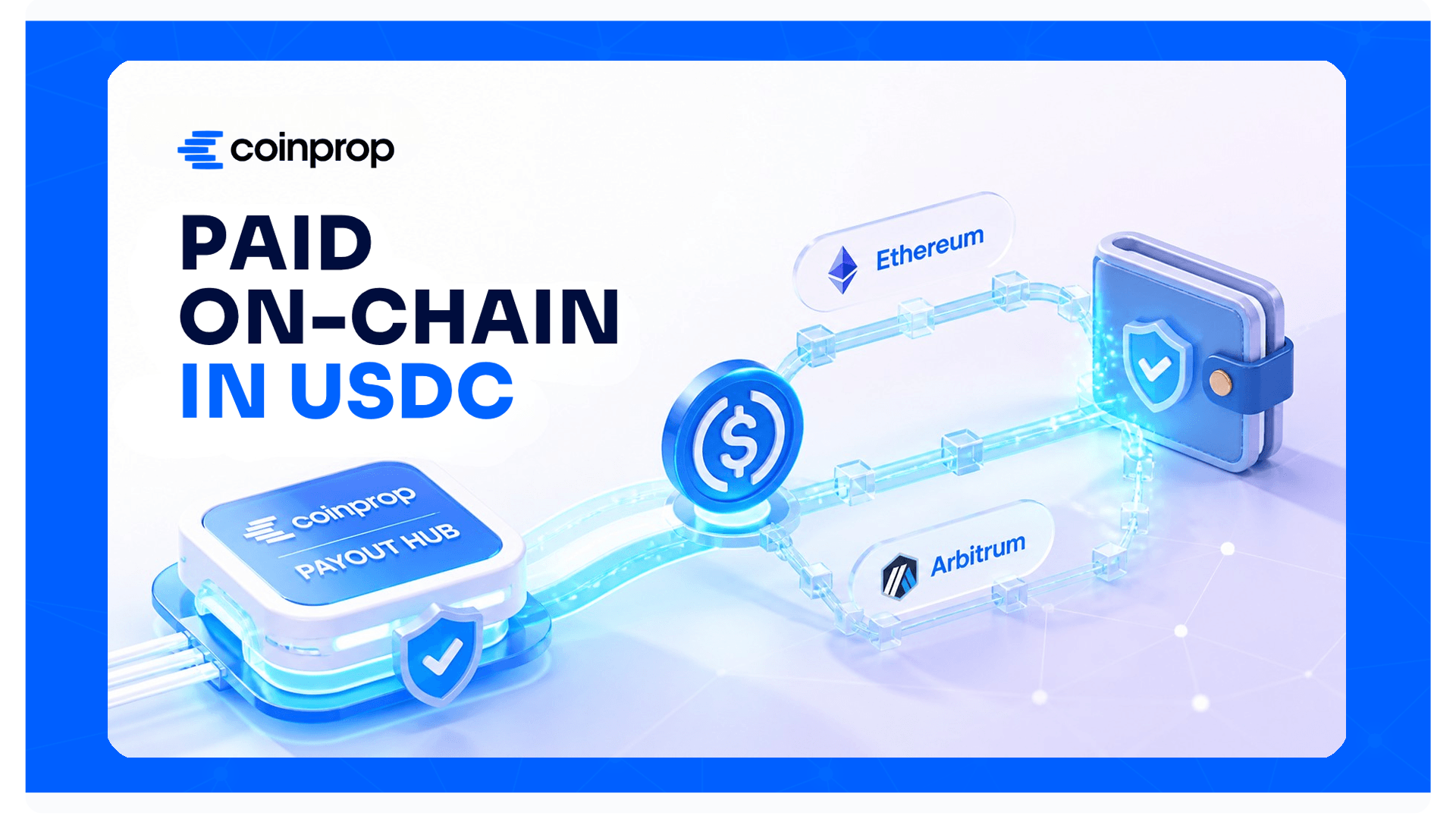
On chain withdrawals allow a crypto prop firm to send an approved payout directly to a trader's cryptocurrency wallet through a blockchain network. Unlike traditional payment methods, an on chain transaction can be independently verified on the blockchain, giving traders a way to confirm when a payment has been sent and track its status.
The process is straightforward in principle, but traders need to pay close attention to the asset, wallet address, and blockchain network used for the transfer.
After a withdrawal request is approved, the prop firm initiates the payment from its designated treasury or payment wallet to the trader's receiving wallet.
The transaction is created on the selected blockchain and broadcast to the network. Once it has been submitted, the transaction can typically be identified using a transaction ID (TxID).
The exact payment infrastructure varies between firms. Some may send funds directly from their own treasury wallets, while others may use a payment processor or another service to execute the transfer.
When withdrawing crypto profits on chain, traders need to select a blockchain network supported by both the prop firm and the receiving wallet.
This is particularly important for stablecoins such as USDT and USDC, which are available on multiple networks. Selecting a network that the receiving wallet or exchange does not support can prevent the funds from being credited correctly.
Before submitting the withdrawal, verify the asset, wallet address, and network against the receiving wallet's deposit instructions. Do not assume that the same wallet address or asset is compatible across every network.
Once an on chain withdrawal has been broadcast, the transaction can usually be tracked using its transaction ID (TxID), also known as a transaction hash.
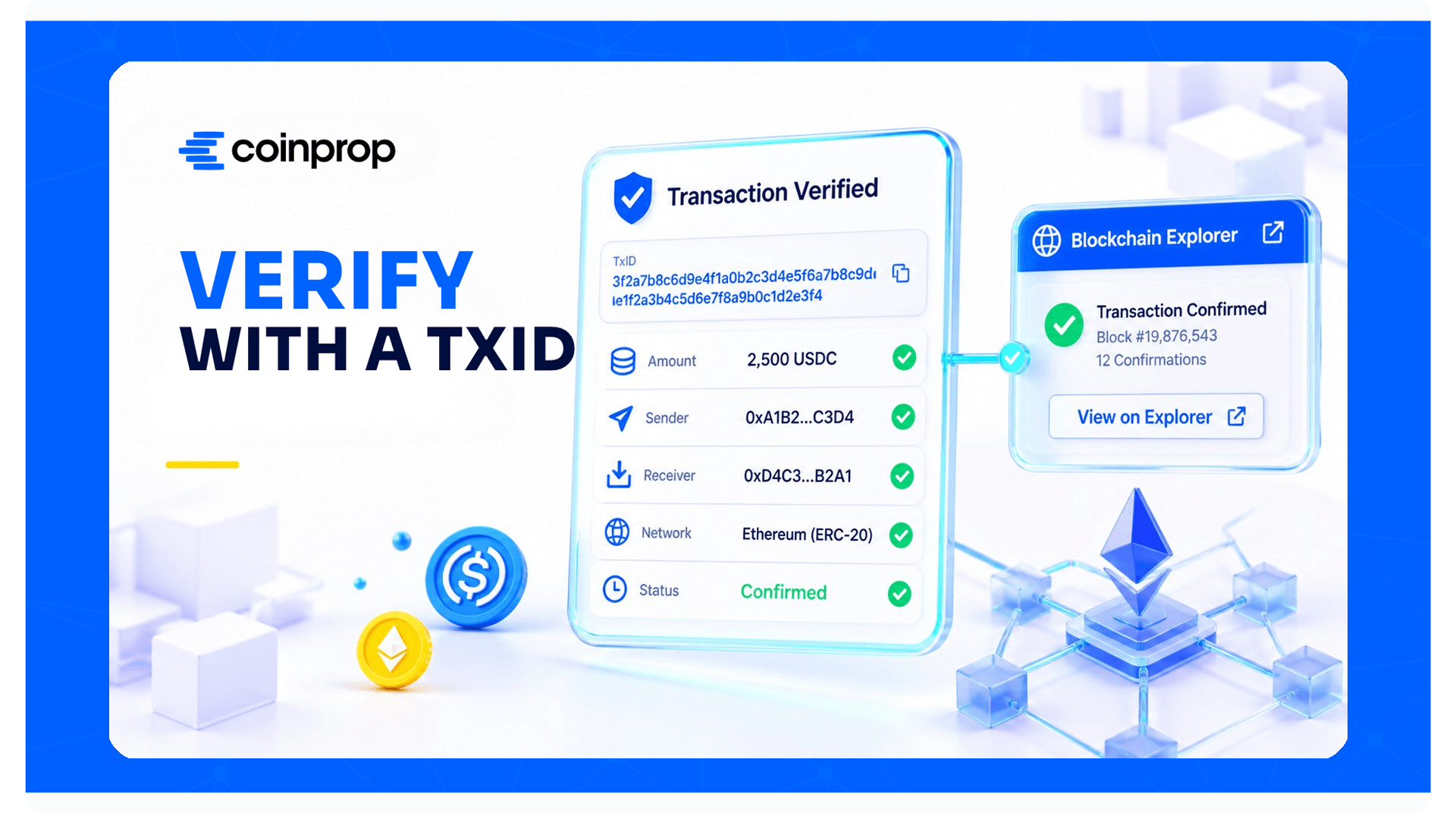
Entering the TxID into the relevant blockchain explorer can show details such as the transaction status, sending and receiving addresses, transferred amount, block information, and confirmation count.
This provides an independent way to verify whether the payment has been broadcast to the blockchain rather than relying solely on the prop firm's internal withdrawal status.
A blockchain confirmation indicates that a transaction has been included in a block and accepted by the network.
The number of confirmations required before funds are considered available can vary between blockchains and receiving services. A wallet or exchange may require several confirmations before crediting a deposit, even if the transaction already appears as confirmed on a blockchain explorer.
This is why the time shown by the blockchain and the time required for the receiving platform to make the funds available may not always be the same.
If an on chain withdrawal appears to be delayed, first determine whether the prop firm has actually broadcast the transaction.
If a TxID is available, check it on the relevant blockchain explorer. A transaction that is still pending may be affected by network conditions, while a confirmed transaction that has not appeared in the receiving wallet may require checking the wallet or exchange's deposit requirements.
If there is no TxID yet, the withdrawal may still be at the prop firm's processing stage. In that situation, check the withdrawal status and the firm's stated processing timeframe. If the delay exceeds that timeframe, contact the firm's official support team with the relevant withdrawal details.
Once a trader qualifies for a payout, CoinProp's withdrawal process is handled through the trader dashboard. Eligible profits are paid on-chain in USDC, with the payout process designed to provide a predictable and verifiable way for traders to receive their funds.
After qualifying for a payout, traders can submit a withdrawal request directly from their CoinProp dashboard. There is no need to manually arrange each payment through support.
The trader submits the eligible withdrawal amount and completes the required payout steps through the dashboard. Once the request enters the payout process, CoinProp handles the payment through its payout infrastructure.
CoinProp pays eligible withdrawals in USDC through on-chain transactions. Payouts are sent directly to the trader's designated wallet rather than being processed as an internal platform balance.
CoinProp supports Ethereum and Arbitrum for on-chain payouts. Using blockchain-based payments also allows completed transactions to be independently verified.
Each completed on-chain payout can be verified using its public transaction hash, also known as a TxID.
This allows traders to independently check the transaction on the relevant blockchain and verify details such as the transaction status, amount, sending address, receiving address, and network.
CoinProp also publishes payout records publicly, while trader names are represented using chosen usernames or privacy-safe aliases.
CoinProp's payout process is designed to process eligible withdrawal requests within 6 to 24 hours.
The process is systemized and automated where possible, allowing payout processing to continue outside traditional banking business hours. This includes weekends and holidays, rather than requiring traders to wait until the next business day.
After a completed payout, traders can become eligible to request their next withdrawal based on CoinProp's payout cycle.
CoinProp uses a 5-day payout cycle, meaning eligible traders can submit another withdrawal request after the next five trading days, subject to the applicable withdrawal requirements.
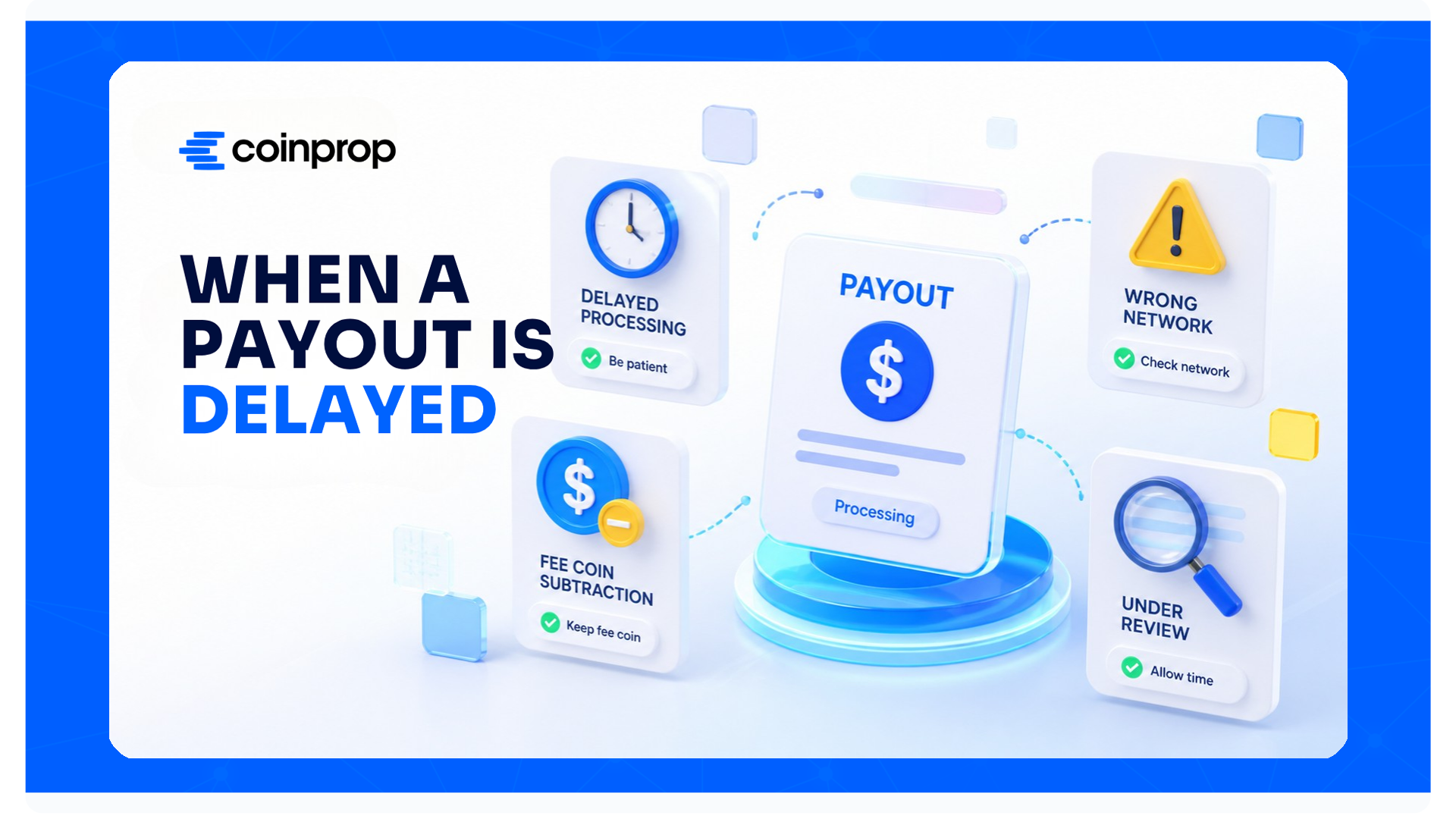
Although withdrawing profits from a crypto prop firm is usually straightforward, traders can encounter problems at different stages of the payout process. Delayed payments, rejected requests, incorrect wallet details, unexpected fees, and additional account reviews are among the most common issues.
Understanding the potential causes can help traders determine whether a problem requires immediate action or is simply part of the firm's normal withdrawal process.
A withdrawal can take longer than expected for several reasons. The prop firm may still be reviewing the account, the payment provider may be processing the transaction, or a blockchain network may be experiencing high activity.
Traders should first compare the elapsed time with the firm's stated processing timeframe. For an on chain payout, a TxID can also help determine whether the transaction has already been broadcast to the blockchain.
If the withdrawal remains pending beyond the expected timeframe, checking the withdrawal status and contacting the firm's official support team may be appropriate.
A withdrawal request can be rejected if the trader does not meet the firm's eligibility requirements or if the account has an unresolved rule violation.
Other possible causes include incomplete verification, incorrect payment information, unsupported payment methods, or technical problems with the payout system.
Traders should review the reason provided for the rejection before submitting another request. In some cases, the issue may be corrected by completing verification or updating payment information.
On chain withdrawals require accurate wallet information. Sending crypto to an incorrect wallet address or using an unsupported blockchain network can cause serious payment problems.
This is especially important for stablecoins, which can be available across multiple blockchain networks. A receiving wallet or exchange may support USDC or USDT on one network but not another.
Before confirming an on chain withdrawal, traders should verify the wallet address, asset, and network against the receiving wallet's instructions. These details should be checked carefully because blockchain transactions generally cannot simply be reversed after they have been confirmed.
The amount received from a withdrawal may sometimes be lower than expected because of network fees, payment processing charges, or currency conversion costs.
The fee may be charged by the prop firm, blockchain network, payment provider, exchange, or another service involved in the payment process.
If the received amount differs from the approved withdrawal amount, traders should review the firm's fee terms and the payment transaction details to determine where the difference came from.
A withdrawal request may be placed under review before the payment is released. This can happen when the prop firm needs to verify account activity, identity information, payment details, or compliance with its trading rules.
An additional review does not necessarily mean that the withdrawal will be rejected. It may simply indicate that the firm needs more information before completing the payout.
If a review continues beyond the firm's stated processing timeframe, traders should contact official support and provide the relevant withdrawal or account information. Keeping records of the request and any communication with the firm can also make it easier to resolve the issue.
If you cannot withdraw profits from a crypto prop firm, the issue may be related to withdrawal eligibility, account rules, verification, payment information, or a technical problem with the payout system. Before assuming that a withdrawal has been denied, work through the possible causes systematically.
First, confirm that your account currently meets all withdrawal requirements. Check whether you have completed the required trading days, reached the minimum eligible profit, and satisfied any conditions that apply to the current payout cycle.
Also check whether there are minimum or maximum withdrawal amounts that could prevent the requested payout from being processed.
If the account does not currently meet the firm's withdrawal conditions, the solution may simply be to satisfy the remaining requirements before submitting another request.
Review your recent trading activity and account status for any rule violations or conditions that could affect withdrawal eligibility.
Depending on the prop firm, issues involving daily loss limits, maximum drawdown, prohibited trading strategies, position restrictions, or other account rules may affect a payout.
It is also worth checking whether any conditions apply specifically after a previous withdrawal or during a particular stage of the account.
Incomplete identity verification or incorrect payment information can also prevent a withdrawal from being completed.
Check whether the firm has requested additional KYC or account verification and make sure the submitted information is accurate and consistent with your account.
For crypto withdrawals, carefully verify the wallet address, asset, and blockchain network. For bank or third party payments, confirm that the account and payment details are correct and that the selected method is supported in your location.
If your account appears to meet all requirements but you still cannot withdraw, contact the prop firm's official support team.
Provide the relevant information, such as your account details, withdrawal request number, requested amount, and any error or status message shown in the platform. If the issue involves an on chain payment, include the TxID when one is available.
Using the firm's official support channel can make it easier to establish a clear record of the issue and receive information specific to your account.
Keep records of the withdrawal request and any communication related to the problem. This can include screenshots of the withdrawal status, account conditions, payout terms, support responses, transaction details, and relevant timestamps.
For on chain withdrawals, save the TxID and blockchain explorer record if a transaction has already been broadcast.
Maintaining this information is useful if the issue takes time to resolve or if you need to compare what happened with the firm's published withdrawal terms. It also helps distinguish between a withdrawal that has not yet been processed and a withdrawal that was processed but encountered a payment problem.
Before choosing a crypto prop firm, traders should look beyond advertised profit splits and account prices. The withdrawal process can have a direct impact on how easily and reliably traders can access their eligible profits.
Checking the firm's withdrawal terms, payout history, and payment records can help traders identify unclear conditions, unexpected restrictions, or potential problems before opening an account.
Start by reviewing the firm's official withdrawal and payout documentation. Look for information about minimum trading days, payout cycles, minimum and maximum withdrawal amounts, processing times, supported payment methods, and applicable fees.
Pay particular attention to conditions that can make a withdrawal ineligible. Some firms may have additional requirements related to account performance, trading behavior, verification, or previous payouts.
The withdrawal rules should make it reasonably clear when a trader becomes eligible to withdraw and what happens after a request is submitted.
A firm's payout history can provide additional insight into how its withdrawal process works in practice.
Some crypto prop firms publish payout confirmations, transaction details, or payment records through their websites or public community channels. When on chain payments are used, blockchain transaction records can provide independently verifiable evidence that specific payouts were sent.
However, published payout history should not be treated as a guarantee that every future withdrawal will follow the same timeline or conditions. It should be considered alongside the firm's current withdrawal terms.
Trader experiences can reveal potential withdrawal issues that may not be obvious from official documentation.
Reviews and community discussions can provide information about payout delays, verification requirements, payment provider problems, or differences between advertised and experienced processing times.
Individual reports should not be treated as conclusive evidence on their own. Look for recurring patterns across multiple independent experiences and consider when the reports were published, since withdrawal policies and payment systems can change.
A crypto prop firm should clearly explain how its payout process works. Traders should be able to determine when withdrawals are available, how long processing normally takes, which payment methods are supported, and whether fees or withdrawal limits apply.
Vague terms around payout eligibility or withdrawal conditions can make it difficult to determine when profits are actually available to withdraw.
Clear payment terms also make it easier to compare crypto prop firms based on their actual withdrawal conditions rather than relying only on marketing claims.
For firms that use on chain payouts, blockchain transaction records provide an additional layer of transparency.
A transaction hash or TxID can be used to verify that a payment was broadcast and inspect details such as the transaction status, receiving address, transferred amount, and blockchain network.
Traders should verify that the transaction corresponds to the relevant payout and that the asset and network match the firm's stated withdrawal method.
On chain records can confirm that a particular transaction occurred, but they do not by themselves guarantee that every withdrawal request will be approved or processed under the same conditions.
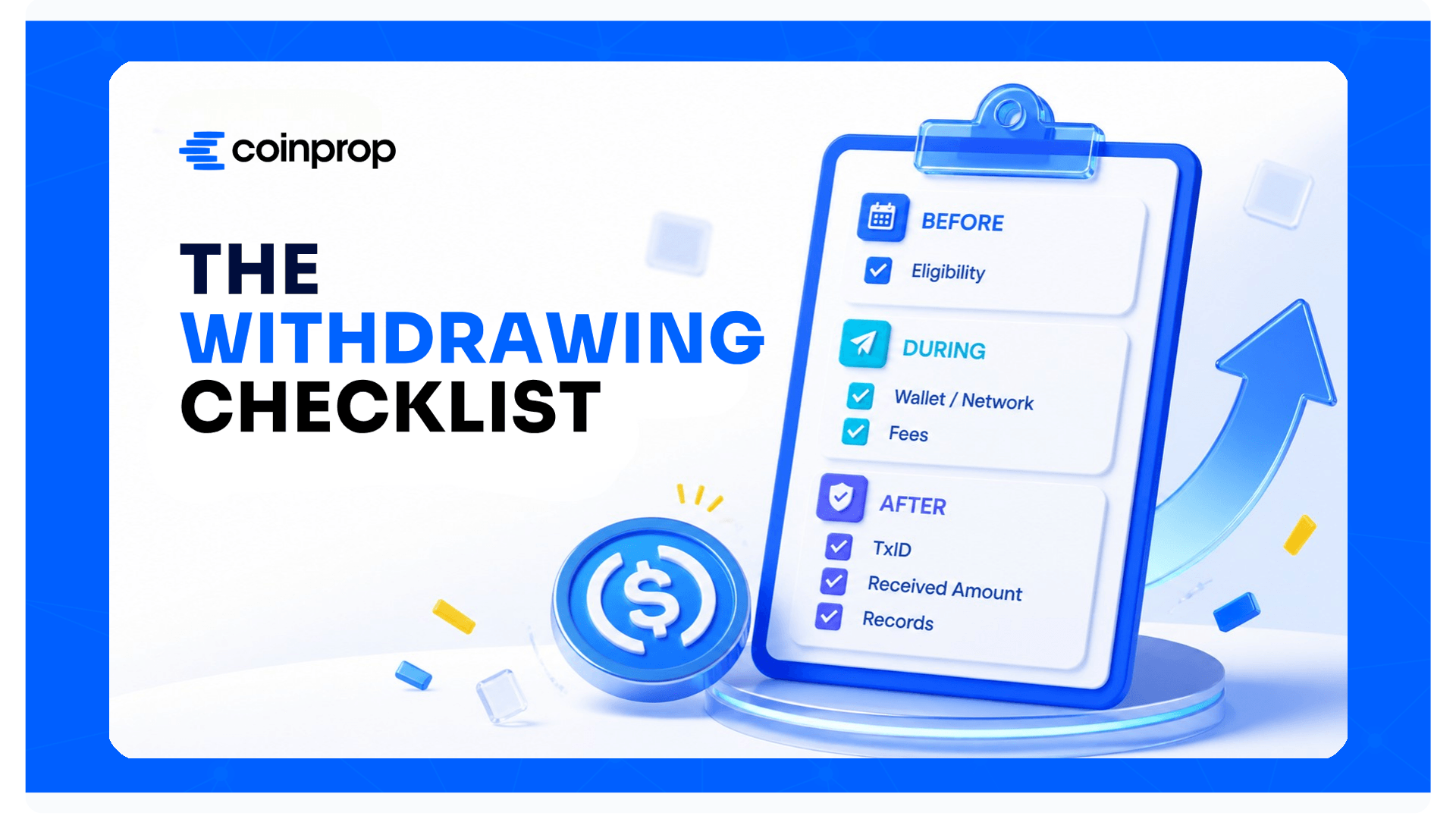
Before withdrawing profits from a crypto prop firm, traders should verify their eligibility, payment details, and the firm's current withdrawal terms. Following a simple checklist can help prevent avoidable delays, rejected requests, and mistakes with crypto wallet transfers.
A withdrawal checklist is especially useful for on chain crypto payouts, where an incorrect wallet address or blockchain network can create problems that may be difficult or impossible to reverse.
Withdrawing profits is an important part of the crypto prop trading experience. A trader may successfully generate profits, but the practical value of those profits ultimately depends on the firm's withdrawal requirements, payout process, payment method, and ability to deliver the approved funds within the stated timeframe.
The withdrawal process typically involves more than simply submitting a payout request. Traders need to confirm their eligibility, understand the firm's withdrawal rules, choose an appropriate payment method, complete any required verification, and monitor the payout until the funds are received.
For on chain withdrawals, traders should also understand how wallet addresses, blockchain networks, TxIDs, and confirmations affect the payment process.
Because withdrawal policies vary between crypto prop firms, traders should review the complete process before opening an account and again before requesting a payout. Knowing the requirements in advance can help prevent avoidable delays, rejected requests, and payment errors.
Withdrawal terms can be just as important as trading conditions when evaluating a crypto prop firm. Profit targets, drawdown limits, leverage, and profit splits determine how traders operate the account, while withdrawal rules determine how and when eligible profits can actually be accessed.
Traders should therefore look beyond advertised profit splits and consider payout frequency, withdrawal limits, processing times, fees, supported payment methods, and payment transparency.
Ultimately, the goal is not simply to find a crypto prop firm where profits can be generated, but one where the conditions for withdrawing those profits are clear, understandable, and suitable for the trader's needs.
To withdraw profits, first confirm that your account meets the firm's withdrawal requirements. Then submit a withdrawal request through the firm's platform, complete any required verification, and select a supported payment method. For on chain crypto payouts, you may also need to provide a compatible wallet address and blockchain network.
Withdrawal frequency depends on the firm's payout schedule. Some prop firms allow withdrawals after a specific number of trading days, while others use fixed payout cycles or allow more frequent withdrawals once certain conditions are met.
The total withdrawal time depends on the firm's internal processing, payment method, and, for crypto payouts, blockchain confirmation time. Traders should distinguish between the firm's stated processing time and the total time required for the funds to become available.
Yes. A withdrawal can be rejected if the trader does not meet the firm's eligibility requirements, violates applicable trading rules, has incomplete verification, provides incorrect payment information, or otherwise fails to satisfy the firm's payout conditions.
Some crypto prop firms cover withdrawal costs, while others may charge or pass on network, processing, or conversion fees. The applicable fees depend on the firm and payment method, so traders should review the withdrawal terms before requesting a payout.
If the prop firm supports on chain cryptocurrency withdrawals, profits can generally be sent to a supported personal wallet. Traders should verify that the wallet supports the selected asset and blockchain network before submitting the withdrawal request.
First, check the withdrawal status and compare the elapsed time with the firm's stated processing timeframe. If an on chain transaction has already been sent, use the TxID to check its status on a blockchain explorer. If the withdrawal remains delayed beyond the expected timeframe, contact the firm's official support team.
The tax treatment of crypto prop firm profits and withdrawals depends on the trader's country, tax residency, and how the income is classified under local tax rules. A withdrawal itself may not determine the tax treatment, so traders should consult the applicable tax authority or a qualified tax professional for guidance specific to their situation.
