A trading profit calculator for crypto prop firms helps traders estimate potential profit, risk, and position exposure before entering a trade. Understanding how leverage, position size, stop loss, take profit, and trading fees interact is essential for protecting funded accounts, improving risk-reward ratios, and maintaining consistent performance in crypto prop trading environments.

Crypto trading calculators have evolved from simple profit estimation tools into essential components of modern risk management. In crypto prop firms, traders operate under stricter conditions where position size, leverage, trading fees, and drawdown rules directly affect account survival. A trading profit calculator is not only used to estimate potential returns; it helps traders understand the relationship between risk exposure and expected outcomes before entering a position. Whether calculating position size, evaluating leverage impact, or projecting profit scenarios, these tools transform trading decisions from assumptions into measurable processes.
In personal trading accounts, many traders can survive small mistakes in position sizing or profit estimation because they are operating under flexible conditions. A slightly oversized trade or a poorly calculated stop loss may hurt performance, but it usually does not immediately end the trading journey. Crypto prop trading works differently. Funded traders operate within predefined risk boundaries where every decision directly affects account survival.
A funded account is not only about generating profits; it is also about preserving capital under strict rules. Daily loss limits, maximum drawdown thresholds, and consistency requirements create an environment where calculations become part of execution rather than optional analysis. A trader who enters positions without understanding potential profit and risk exposure is effectively making decisions without seeing the full picture.
Profit calculations serve several practical purposes for funded traders:
Professional traders do not enter positions asking, How much money can I make? They begin with a different question:
How much am I risking, and is the potential reward worth it?
That shift in thinking is often the difference between passing a challenge and losing a funded account.
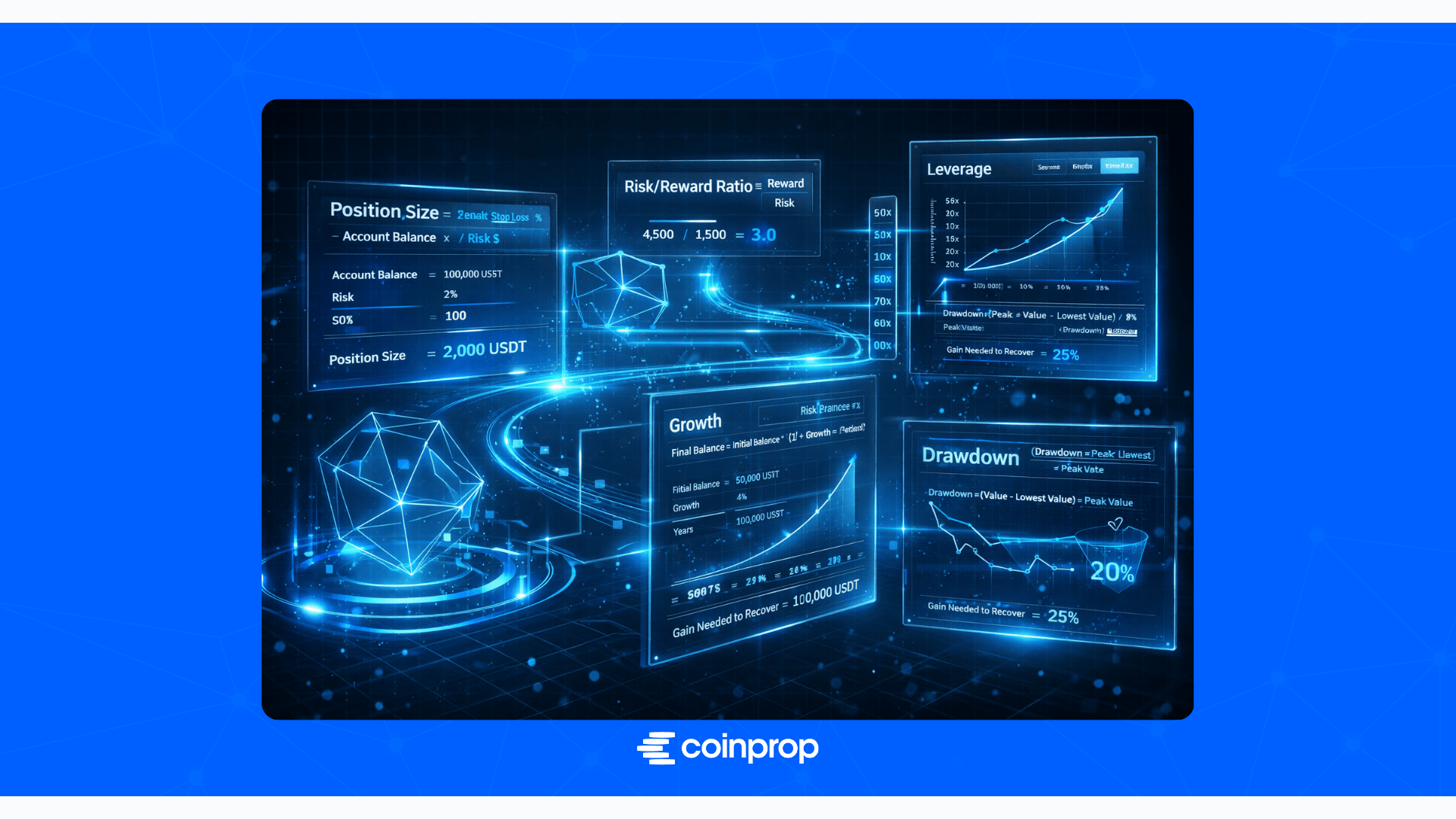
Trading profit inside a funded crypto prop firm environment is not simply a matter of price moving in the right direction. Several additional variables affect the final result.
Traditional trading assumptions often focus on a basic relationship:
Profit = Price Movement × Position Size
While technically correct, prop trading introduces more variables that influence actual account growth:
Leverage usage
Leverage changes exposure significantly. A small price movement on a highly leveraged position can produce meaningful gains, but it can also accelerate losses. Higher leverage increases sensitivity to market movement rather than creating free profit.
Position size and risk allocation
Two traders may enter the same BTC trade at the same price and exit at the same target, yet produce completely different results because their exposure differs. The amount of capital committed determines how strongly the trade affects account equity.
Trading costs
Fees, spreads, and execution costs reduce final profitability. A trade that appears attractive before costs may become much less efficient after commissions are considered.
Drawdown restrictions
Personal traders may accept larger temporary declines. Funded traders rarely have that flexibility. A profitable strategy with poor sizing can still fail because of rule violations.
For this reason, successful prop traders usually evaluate trades through a broader
framework:
Position Size + Risk + Leverage + Costs = Actual Trading Outcome
Profit becomes an engineered result rather than a random number appearing after trade execution.
Many traders begin by calculating risk and profit manually. On paper, the process appears simple enough. Estimate account risk, determine stop loss distance, calculate quantity, and project potential profit.
In reality, live market conditions introduce pressure.
Price moves rapidly. Multiple positions may be open simultaneously. Leverage changes exposure instantly. Under these conditions, small mathematical errors become expensive mistakes.
Common manual calculation errors include:
Misjudging the distance between entry and stop loss.
Using different risk percentages between trades.
Ignoring fees and transaction costs.
Increasing position size after winning trades.
Applying leverage without understanding real exposure.
These mistakes often appear small individually, but their effects accumulate. A trader who intends to risk 1% may unintentionally risk 2–3% because of incorrect quantity calculations. Over a series of trades, this inconsistency damages both statistical performance and account stability.
This is one reason modern crypto trading environments increasingly rely on integrated calculation tools rather than manual estimation. Inside the CoinProp CPX trading panel, traders can evaluate position size, leverage impact, projected profit, and trade risk directly alongside the chart. Combined with TradingView tools such as Long Position and Short Position analysis, calculations become part of the execution process itself rather than a separate task.
The goal is not to eliminate trader judgment. The goal is to eliminate avoidable mathematical mistakes so traders can focus attention where it matters most: identifying quality setups and executing them consistently.

A trading profit calculator is not just a simple tool that shows how much money you might earn. In crypto prop trading, it functions as a structured decision engine that connects key trading variables, position size, leverage, risk, and reward, into one unified outcome. Instead of guessing results after entering a trade, the calculator allows traders to model different scenarios before execution. This makes trading more systematic and removes emotional decision-making from the process.
At its core, every trading profit calculator answers one question:
If I enter this trade under these conditions, what will my real financial outcome be?
To answer that, it processes three essential input layers.
Position size is the foundation of every calculation because it determines how much capital is actually exposed to the market. In crypto trading, position size is usually expressed in units of the asset (such as BTC or ETH) or in notional value (USDT/USD equivalent).
The calculator typically requires the following inputs:
From these inputs, the calculator determines the exact trade size that keeps risk consistent.
A simplified logic looks like this:
Position Size = (Account Risk Amount) ÷ (Stop Loss Distance)
This ensures that no matter how volatile the asset is, the trader is always risking a fixed percentage of their account rather than an arbitrary amount. In crypto prop firms, this step is critical because even a slightly oversized position can violate drawdown rules.
Leverage and margin inputs define how much buying power is being used to open the position, but they do not directly define risk. Instead, they control capital efficiency and exposure scaling.
A trading profit calculator uses leverage in two key ways:
The basic relationship is:
Margin = Position Size ÷ Leverage
For example, a $10,000 position at 10x leverage requires only $1,000 in margin.
However, in crypto prop trading, leverage is not treated as a profit tool—it is a risk amplifier. The calculator helps traders visualize this distinction clearly:
This allows traders to avoid over-leveraging, which is one of the most common reasons funded accounts fail. The key value of the calculator here is not just computation, but clarity, showing exactly how much of the account is locked and how fragile the position becomes under different leverage settings.
The risk and reward section connects trade structure with expected outcomes. It evaluates whether a trade is statistically worth taking based on potential loss versus potential gain.
The calculator typically processes:
From these, it calculates:
A core relationship used here is:
Profit or Loss = Position Size × Price Movement %
This step is critical because even a correct market prediction can still result in poor performance if the risk-to-reward structure is weak. For example, a strategy with a 70% win rate can still lose money if average losses are larger than average wins.
In crypto prop trading environments, calculators are especially valuable at this stage because they force traders to evaluate setups objectively. Instead of relying on intuition, every trade must pass a numerical filter:
By combining these three input layers, position size, leverage, and risk/reward, the trading profit calculator transforms trading from speculation into structured decision-making.

Calculating trading profit in crypto markets is not just about measuring price movement between entry and exit. In professional trading environments, especially crypto prop firms, profit must be understood as a net result of position size, leverage exposure, and trading costs. A trade that looks profitable on the chart can still become less efficient, or even negative, after accounting for fees and incorrect sizing. That’s why structured profit calculation is essential before and after every trade.
Instead of guessing outcomes, traders use a simple framework that converts price movement into actual monetary results.
At its core, trading profit is derived from the relationship between price change and position size.
The simplest form of the formula is:
Profit or Loss = Position Size × Price Movement (%)
This means that the final outcome depends on two key factors:
For example, a 2% price movement will produce very different results depending on whether the position size is $1,000 or $10,000.
In leveraged crypto trading, this relationship becomes even more sensitive. Leverage increases exposure without changing the underlying price movement, which means small percentage changes in price can lead to large changes in account equity.
This is why professional traders always calculate profit based on full position exposure, not just the margin used.
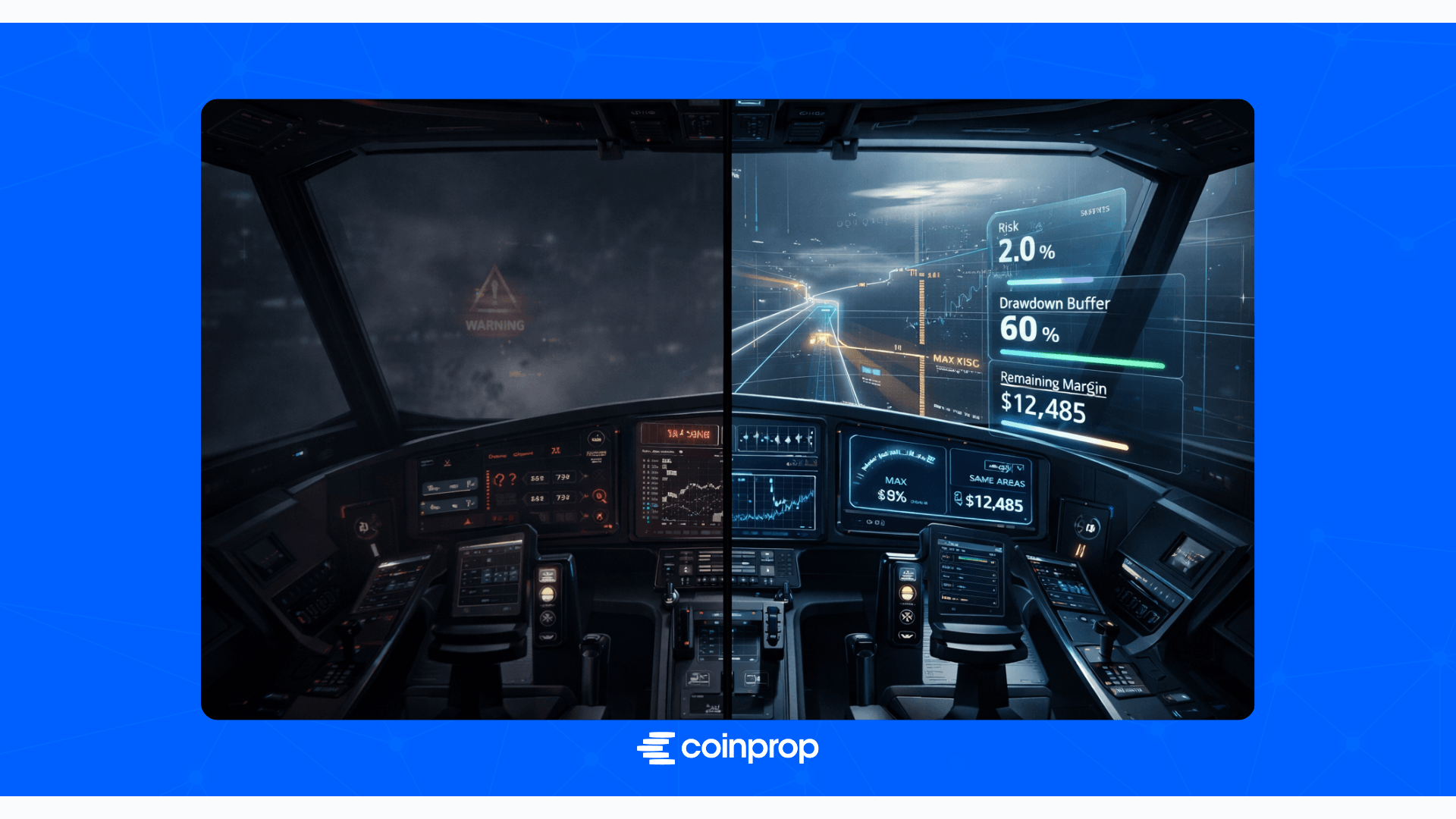
To understand how profit works in practice, consider a simple example.
Assume a trader opens a BTC position under the following conditions:
Now we apply the formula:
Profit = Position Size × Price Movement %
Calculation:
So the gross profit from this trade is approximately $166.50.
However, this is not the final result. In real trading environments, especially prop accounts, we must also consider trading fees and potential slippage.
Let’s look at a loss scenario for balance:
Loss = $5,000 × 0.02 = $100
This shows how structured position sizing keeps risk controlled. Even in a losing trade, the loss remains within predefined limits.
The key takeaway is that profit and loss are symmetrical, but only when position size is properly controlled.
One of the most overlooked factors in trading profit calculation is fees. While price movement determines gross profit, fees determine net profit, which is what actually impacts account balance.
Trading fees typically include:
Even if a trade is technically profitable, fees can reduce returns significantly, especially for high-frequency or small-margin strategies.
For example:
Net profit = $100 − $4 = $96
While this difference may seem small, it becomes highly significant over many trades. A strategy with 100 trades per month could lose 10–20% of total profit just from fees if not accounted for properly.
This is why professional trading systems always calculate net expected profit before execution, not after.
In structured environments like crypto prop trading, fee awareness is critical because consistency is measured not just by win rate, but by net profitability over time. Traders who ignore fees often overestimate performance and underestimate real drawdown impact.
By combining price movement, position size, and fee structure, traders can accurately estimate real trading outcomes before entering the market. This transforms trading from speculation into a controlled, data-driven process where every decision is backed by measurable expectations.
Many traders become obsessed with one number: win rate. They believe a high percentage of winning trades automatically means higher profits. In reality, professional trading, and especially crypto prop trading, works differently. A strategy can have a relatively low win rate and still generate strong long-term returns, while another strategy with an extremely high win rate can slowly destroy an account.
A Trading Profit Calculator with Win Rate helps traders move beyond emotional assumptions and understand how profits actually accumulate over time. Instead of focusing only on individual trades, it measures how your trading system behaves across dozens or even hundreds of trades.
For funded traders operating under strict risk rules, this becomes essential. Profitability is not determined by how often you win; it depends on how much you make when you win compared with how much you lose when you're wrong.
Win rate simply represents the percentage of trades that end in profit.
The formula is:
Win Rate = (Winning Trades ÷ Total Trades) × 100
For example:
Calculation:
55 ÷ 100 × 100 = 55%
This means the strategy wins 55% of all trades.
At first glance, many traders would immediately assume that a 55% win rate guarantees profitability. However, long-term results depend on the relationship between wins and losses.
Consider two examples:
Scenario A
Over 100 trades:
Net result:
+$6,000 profit
Scenario B
Over 100 trades:
Net result:
–$2,000 loss
This reveals an important truth:
A higher win rate does not necessarily create a profitable strategy.
For crypto prop traders, maintaining stable risk and healthy reward ratios usually matters more than maximizing winning percentages.
Win rate often creates a false sense of confidence because it ignores several critical variables.
It does not consider:
Many beginners become attracted to strategies promising 80–90% win rates. These systems often rely on very small profits combined with occasional extremely large losses.
For example:
A trader may collect:
Total result:
Final outcome:
–$100 overall
The trader technically won most trades but still lost money.
In funded trading environments, this becomes even more dangerous because large losses accelerate drawdown and can quickly violate account rules.
Professional traders therefore avoid evaluating systems based solely on win percentage. Instead, they focus on whether the overall statistical model produces sustainable returns.
A stronger measurement for long-term performance is the Profit Factor.
Profit Factor measures how many dollars are earned for every dollar lost.
The formula is:
Profit Factor = Total Gross Profit ÷ Total Gross Loss
For example:
Calculation:
$15,000 ÷ $10,000 = 1.5
Interpretation:
For crypto prop trading, Profit Factor usually gives a clearer picture than win rate because it measures actual money flow instead of simple trade counts.
Two traders may both have a 50% win rate:
Trader A
Trader B
The difference is not how often they win.
The difference is how efficiently they manage risk, position size, and reward.
This is why experienced funded traders do not ask:
How often do I win?
They ask:
How much do I make when I'm right, and how much do I lose when I'm wrong?
Leverage is one of the most misunderstood components in crypto trading, particularly when traders use high leverage crypto prop firms, where larger exposure can make risk management even more important. While many beginners associate leverage with higher profits, in reality, leverage is simply a mechanism that changes how much market exposure you control relative to your account size. A profit calculator that includes leverage does not just estimate earnings, it reveals how sensitive your position is to price movement and how quickly both profits and losses can scale.
In professional trading systems, leverage is never analyzed in isolation. It is always combined with position size, margin usage, and risk exposure to understand the full financial impact of a trade.
Leverage works by increasing the notional value of a position without requiring the trader to fully fund it. This means small price movements are reflected on a much larger exposure base.
The key relationship is:
Effective Exposure = Position Size × Leverage Effect
For example:
If the market moves:
This demonstrates the core reality: leverage does not create profit, it magnifies outcomes.
A profit calculator that includes leverage helps traders visualize this amplification before entering a trade. Without it, traders often underestimate how quickly small market movements can impact account equity, especially under prop firm drawdown rules.
Margin is the collateral required to open and maintain a leveraged position. It represents the portion of your account that is locked while the trade is active.
The basic formula is:
Margin = Position Size ÷ Leverage
For example:
This means the trader is controlling a $10,000 position using only $1,000 of actual capital.
However, margin usage has deeper implications in crypto prop trading:
A profit calculator that integrates margin helps traders avoid over-allocation. Even if a trade is technically profitable, excessive margin usage can reduce flexibility and increase vulnerability during volatile market conditions.
In prop environments, maintaining unused margin is often as important as generating profit, because it protects the account from forced liquidation scenarios during unexpected price spikes.
Despite its importance, leverage is often misused, especially by traders transitioning from personal accounts to funded environments. Most failures are not caused by bad analysis, but by incorrect leverage application combined with poor risk control.
Some of the most common mistakes include:
Using high leverage without adjusting position size
Many traders increase leverage but fail to reduce position size proportionally, leading to uncontrolled exposure.
Confusing leverage with risk management
Leverage does not define risk. Position size and stop loss do. Treating leverage as a risk tool leads to inconsistent outcomes.
Overleveraging during winning streaks
After a series of wins, traders often increase leverage to “scale faster,” which significantly increases drawdown risk.
Ignoring liquidation distance dynamics
High leverage reduces the distance between entry price and liquidation, making trades extremely sensitive to volatility spikes.
Failing to account for margin concentration
Allocating too much margin to a single trade reduces the ability to manage multiple positions or recover from losses.
In crypto prop trading, these mistakes are particularly dangerous because account rules are strict and non-negotiable. A single poorly managed leveraged position can violate drawdown limits even if the market eventually moves in the correct direction.
A well-designed profit calculator with leverage functionality helps eliminate these errors by showing real exposure, margin impact, and profit/loss scenarios before execution. This shifts decision-making from emotional speculation to structured risk analysis, which is essential for long-term survival in funded trading environments.
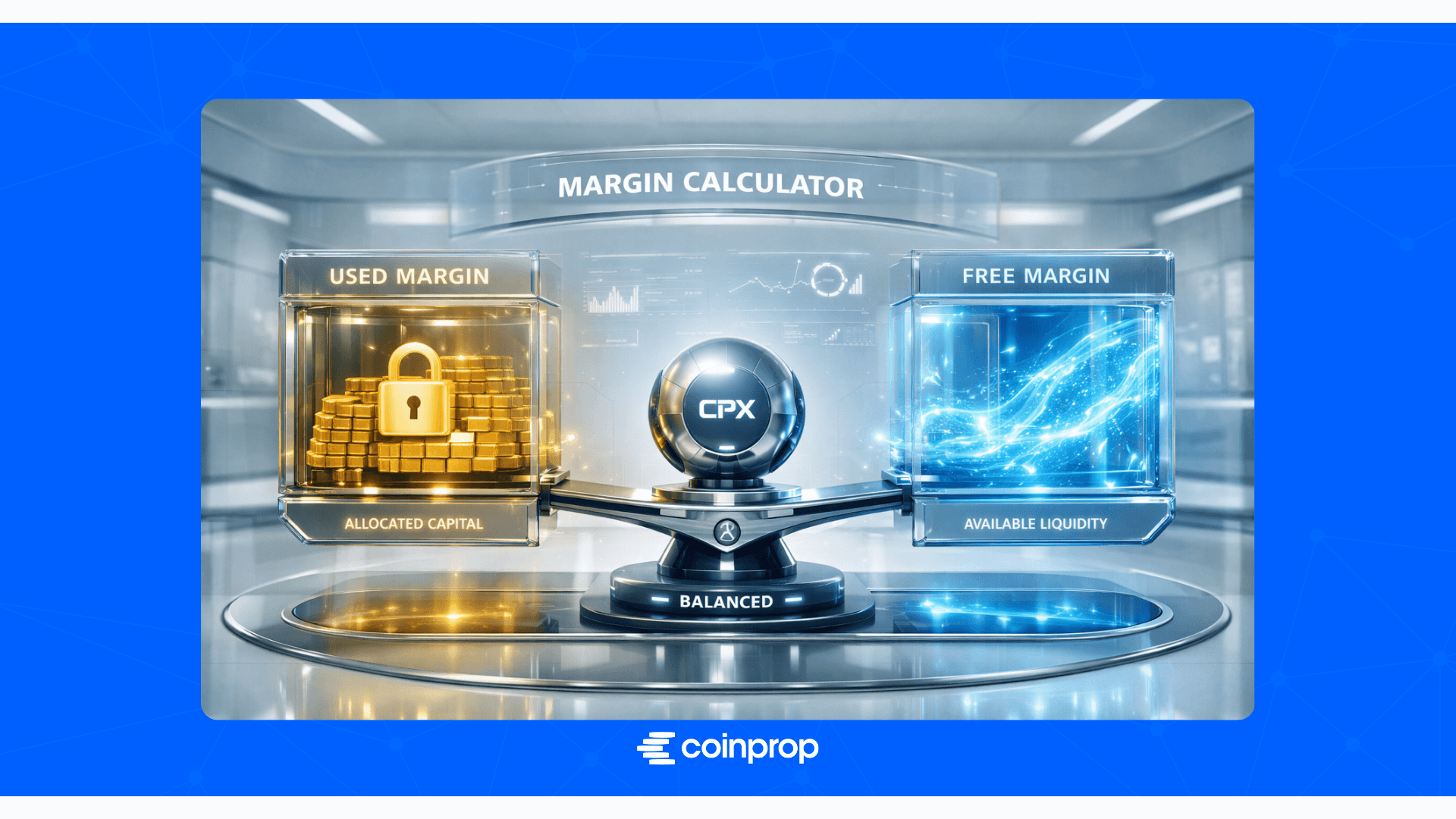
Modern crypto trading is no longer based on isolated tools or manual calculations. Instead, professional traders rely on integrated environments where charting, risk analysis, and profit estimation happen simultaneously. Traders using a crypto prop firm with TradingView can combine chart based planning with real time risk analysis and profit estimation, creating a workflow where trade planning and execution are connected in real time.
Rather than calculating profit after entering a position, traders can now visualize potential outcomes directly on the chart and validate risk before execution.
TradingView’s Long Position and Short Position tools are widely used for visualizing trade setups before execution. These tools allow traders to map out key levels such as entry, stop loss, and take profit directly on the chart.
Once applied, they provide an immediate visual breakdown of:
For example, a trader planning a long position on BTC can drag the entry, stop loss, and take profit lines directly on the chart. TradingView then automatically displays how much percentage gain or loss each scenario represents.
This visual approach is important because it removes abstraction. Instead of thinking in numbers alone, traders see the trade structure in context of real price action.
However, TradingView tools are primarily visual estimation tools, not full execution systems. They do not account for all trading variables such as exact contract specifications, real margin usage, or platform-specific fee structures. This is where integrated systems like CPX become necessary.
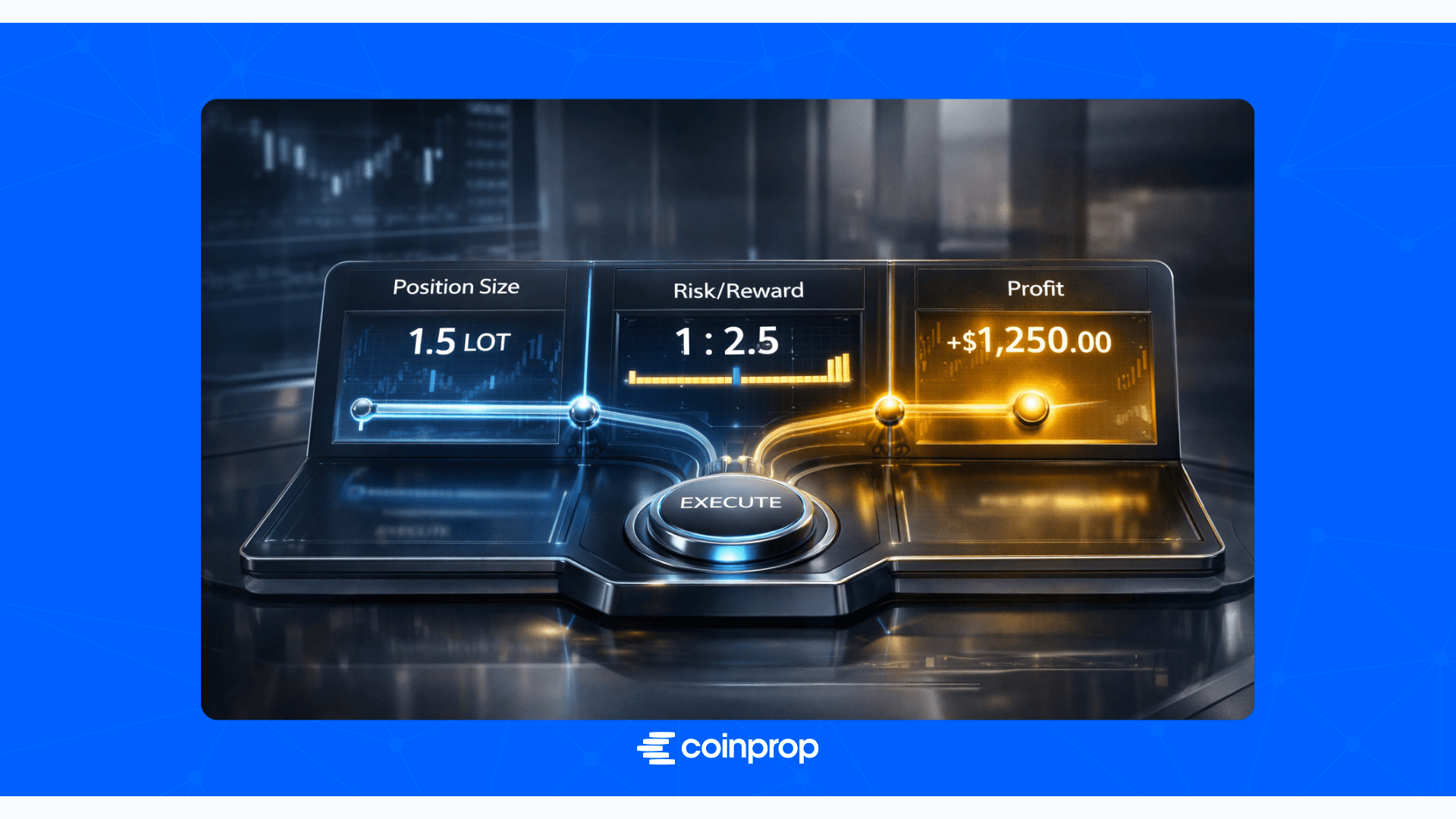
One of the key challenges in crypto prop trading is translating a risk decision into an exact position size. Traders often know how much they are willing to lose (for example, 1% of account equity), but struggle to convert that into correct order quantity under real market conditions.
CoinProp CPX solves this by automating the entire process.
Instead of manually calculating:
Position Size = (Account Risk) ÷ Stop Loss Distance
The trader simply inputs:
CPX then instantly converts this into:
This removes one of the most error-prone steps in trading: manual position sizing.
In practice, this means traders no longer need to switch between calculators, spreadsheets, and charts. Risk definition becomes a single input, and execution size is generated automatically based on that logic.
This is especially important in crypto prop environments where even small sizing errors can push a trader beyond daily loss limits or violate drawdown constraints.
Beyond position sizing, CPX also provides real time projection of trade outcomes. This means traders can see how a position will behave under different price scenarios before committing capital.
As price levels are adjusted, CPX dynamically updates:
This creates a live simulation environment where every adjustment to entry, stop loss, or take profit immediately reflects in financial outcomes.
For example, if a trader drags the take profit level higher on the chart, CPX instantly recalculates:
Similarly, moving the stop loss wider will immediately show:
This real-time feedback loop is critical in prop trading because it enforces discipline at the decision stage, not after execution. Traders can instantly see whether a setup still meets their risk rules or whether adjustments are required.
By combining TradingView’s visual trade mapping with CPX’s precise financial calculations, traders gain a dual-layer system:
Together, they transform trading from estimation-based decision making into a fully quantified and controlled process where every trade is defined before it is placed.
Position size is one of the most critical yet misunderstood factors in trading performance. Many traders focus on entry strategies, indicators, or market direction, but overlook the fact that even a perfect strategy can fail if position size is inconsistent or incorrectly calculated. In crypto prop trading, position size is not just a technical detail, it directly determines both profit potential and risk exposure.
Every trade outcome is ultimately scaled by position size. The same price movement can produce completely different results depending on how much capital is allocated to the trade. This is why professional traders treat position sizing as a core part of risk management rather than a secondary calculation.
In crypto prop firms, traders operate under strict rules such as daily loss limits, maximum drawdown thresholds, and consistency requirements. These constraints make position sizing far more important than in personal trading accounts.
Position size matters because it directly controls:
A trader with inconsistent position sizes may win frequently but still fail the evaluation due to occasional oversized losses. On the other hand, a trader with properly controlled position sizing can survive losing streaks and allow a statistical edge to play out over time.
In practice, position size is what separates controlled trading from emotional trading. Without it, even a strong strategy becomes unpredictable in terms of equity growth and drawdown behavior.

Position sizing in professional trading is based on a simple but powerful principle: risk must remain constant across all trades, regardless of market conditions or asset volatility.
The standard formula is:
Position Size = (Account Risk Amount) ÷ Stop Loss Distance
Where:
For example, if a trader has:
Then:
Position Size = $100 ÷ 0.02 = $5,000
This ensures that regardless of price movement, the maximum loss remains fixed at $100.
Risk percentage is the most important variable in this formula. In crypto prop trading, most professional traders keep risk between 0.5% and 1% per trade to ensure they can survive consecutive losses without violating account rules.
The key principle is consistency:
This transforms trading from guesswork into a structured risk model.
To understand how position size scales with different account sizes, consider the following examples using a fixed 1% risk model.
Example 1: $5,000 account
Example 2: $10,000 account
Example 3: $50,000 account
These examples show a key insight: position size increases with account size, but risk remains constant. This is what allows traders to scale profits without increasing relative drawdown risk.
However, what many traders overlook is that stop loss distance also plays a major role. If the stop loss becomes wider, position size must decrease to maintain the same risk level. This dynamic adjustment is essential in volatile crypto markets where price swings vary significantly between assets.
In prop trading environments, maintaining this balance is critical. A trader who increases position size without adjusting for stop loss distance effectively increases risk per trade, even if they believe they are following a fixed percentage model.
Proper position sizing ensures that:
Ultimately, position size is not just a calculation, it is the structural foundation of trading performance.
Day trading moves fast. Unlike swing traders who may hold positions for days or weeks, day traders often execute multiple entries and exits within a single session. In crypto markets where price movements happen around the clock, even small fluctuations can create meaningful profit opportunities, or compound losses very quickly.
Because of this speed, manually estimating profits becomes increasingly difficult. A Day Trading Profit Calculator helps traders instantly evaluate potential outcomes before entering a trade by combining position size, leverage, price movement, fees, and risk exposure into one process.
For crypto prop traders, this becomes even more important because profitability is not measured only by individual trade performance. It must also stay aligned with drawdown limits, risk rules, and account consistency requirements.
Day traders make decisions under time pressure. Markets can move several percentage points in minutes, and waiting to manually calculate exposure often means entering too late or taking unnecessary risks.
Fast profit estimation helps traders answer critical questions immediately:
Without a calculator, traders often rely on rough estimates:
This looks like a good setup.
Professional traders think differently:
What exactly does this setup return relative to the risk?
This distinction matters because two trades with identical chart patterns may produce completely different outcomes depending on position size and leverage.
Fast calculations transform trading from emotional decision-making into structured execution.
Unlike longer-term trading, day trading rarely involves just one position. A trader may execute several trades during a session, making cumulative profit calculation increasingly important.
The basic profit formula remains:
Profit/Loss = Position Size × Price Change %
However, day traders must combine results across all positions.
Example:
Trade 1
Profit:
$100
Trade 2
Loss:
–$60
Trade 3
Profit:
$70
Daily gross result:
$100 − $60 + $70 = $110
At first glance, the session appears profitable.
However, day trading requires another layer of calculation:
Once these are included, the actual net outcome may differ significantly.
For traders executing many positions daily, small calculation errors can accumulate quickly. What appears to be a profitable session can slowly become negative after costs are deducted.
This is why day trading calculators track the full picture rather than isolated trades.
High-frequency trading environments create a unique challenge: fees become part of the strategy itself.
Longer-term traders may only pay a small number of transaction costs, but day traders repeatedly open and close positions throughout the day.
Consider this example:
Total fees:
20 × $4 = $80
If the trader generated:
$150 gross profit
Actual net profit becomes:
$150 − $80 = $70
Almost half of the gains disappear because of transaction costs alone.
For crypto prop traders, this issue becomes even more important because repeated small losses and fees gradually consume available drawdown room.
Effective risk management in day trading therefore requires:
Platforms such as TradingView combined with integrated systems like CoinProp CPX simplify this process by projecting potential profit, loss, and costs before execution.
Successful day traders do not simply ask:
Can this trade make money?
They ask:
After risk, leverage, and fees, how much profit actually reaches the account?
In crypto prop trading, success is not determined by a single calculation, but by a repeatable workflow that controls risk, position sizing, profit expectations, and drawdown exposure in a structured sequence. A trading profit workflow ensures that every trade is processed through the same decision framework before execution. This removes randomness and enforces consistency across all market conditions.
Instead of thinking in isolated terms like entry or profit target, professional traders evaluate the entire trade lifecycle as one connected system.
The first and most important step in any trading workflow is defining how much capital you are willing to lose on a single trade. This is the foundation of risk management in crypto prop trading.
Most funded traders use a fixed percentage of their account equity, typically:
For example:
This number becomes your absolute boundary. No matter what setup appears on the chart, the trade must be structured so that a stop loss hit will never exceed this predefined amount.
This step ensures that emotional decisions do not override account protection rules.
Once risk is defined, the next step is translating that risk into an exact position size. This is where most trading errors occur when done manually.
The core relationship is:
Position Size = Risk Amount ÷ Stop Loss Distance
For example:
Result:
This means the trader can open a $5,000 position while still respecting the $100 risk limit.
After position size is defined, leverage is used to determine how much margin is required, not how much risk is taken:
Margin = Position Size ÷ Leverage
For example:
At this stage, the trader understands three critical values:
This separation is essential in prop trading because it prevents confusion between leverage and actual risk.
After risk and position size are defined, the next step is evaluating whether the trade is worth taking. This is done by estimating potential profit and subtracting trading costs.
The basic profit formula is:
Profit = Position Size × Price Movement %
For example:
Result:
However, real trading outcomes must include fees:
Assume:
Then:
This step is critical because it transforms a theoretical trade into a realistic financial projection. Many setups that look profitable on chart analysis become less attractive once fees are included.
Professional traders always evaluate net profit, not just gross returns, before execution.
The final step in the workflow is ensuring that the trade does not violate account-level risk constraints. In crypto prop trading, this is often the most important safety check.
Drawdown validation answers key questions:
For example:
If a new trade risks $100:
Even if a trade is statistically valid, it may still be rejected if it pushes the account too close to risk limits. This is a key difference between prop trading and personal trading, survival constraints matter as much as profitability.

When combined, the full trading profit workflow creates a structured decision system:
This sequence transforms trading from a reactive process into a controlled system where every trade is pre-engineered before execution.
Even with access to advanced tools and calculators, many traders still make fundamental mistakes when estimating trading profit. These errors are rarely related to market prediction itself; instead, they come from incorrect assumptions about position sizing, leverage, and trading costs. In crypto prop trading, where rules are strict and drawdown limits are unforgiving, these mistakes can quickly turn a profitable strategy into a failing account.
Understanding these common errors is essential because improving calculation accuracy often has a greater impact on long-term performance than changing entry strategies.
One of the most common mistakes traders make is calculating profit based only on price movement while ignoring trading fees. At first glance, fees may seem negligible, but in practice they have a cumulative effect that significantly reduces net profitability.
Trading fees typically include:
A trade may show a theoretical profit based on price movement, but once fees are deducted, the final result can be much lower than expected—or even negative in small-margin trades.
For example:
Net profit = $100 − $4 = $96
While the difference appears small in a single trade, it becomes significant over dozens or hundreds of trades. A strategy that ignores fees may appear profitable on paper but underperform in real account conditions.
In crypto prop trading, this mistake is even more critical because consistent net profitability, not gross performance, is what determines long-term success.
Another major error is using inconsistent or random position sizes across trades. Many traders adjust position size based on intuition, recent wins or losses, or emotional confidence rather than a structured risk model.
This approach creates several problems:
For example, a trader may risk 1% on one trade, 3% on the next, and 0.5% on another without a clear system. Even if the trading strategy is correct, inconsistent sizing destroys long-term stability.
Professional trading requires fixed risk logic, where position size is always derived from:
Position Size = Risk Amount ÷ Stop Loss Distance
Without this structure, traders are effectively changing their strategy on every trade, making performance impossible to evaluate accurately.
In crypto prop environments, this inconsistency is one of the fastest ways to fail an evaluation, even with a high win rate.

Leverage is often misunderstood as a tool to increase profit, but in reality it is a tool that increases exposure. Overusing leverage is one of the most dangerous mistakes in trading profit calculation because it amplifies both gains and losses without changing underlying risk logic.
Common misconceptions include:
In reality:
For example:
In both cases, if price moves 2% against the position, the loss is identical in dollar terms. The risk does not change, but liquidation sensitivity increases.
The danger of overusing leverage in crypto prop trading includes:
Traders often misuse leverage during winning streaks, assuming it will scale profits safely. However, without adjusting position size and risk exposure, this leads to disproportionately large drawdowns when the market reverses.
Proper use of leverage means treating it as a capital efficiency tool, not a profit multiplier.
Most trading profit calculation mistakes are not technical errors—they are behavioral and structural issues. Ignoring fees leads to inflated expectations, random position sizing destroys consistency, and overusing leverage introduces hidden risk.
In professional crypto prop trading, avoiding these mistakes is just as important as finding good trade setups. Accurate calculation is what ensures that a winning strategy remains profitable under real market conditions and strict risk constraints.

Trading profit calculations are more than simple arithmetic in crypto prop trading. Since funded accounts operate under strict risk rules, understanding how profit, leverage, fees, and position size interact can significantly improve long-term consistency. Below are some of the most common questions traders ask about trading profit calculators and their role in funded environments.
Trading profit in crypto is calculated by multiplying the percentage price movement by the total position value.
The basic formula is:
Profit = Position Size × Price Change %
For example:
Calculation:
$5,000 × 0.03 = $150
This represents gross profit before trading costs are deducted. In real trading environments, net profit is what matters most because commissions, funding charges, and order fees reduce the amount that actually reaches your account balance.
For funded traders, profit calculations should always be combined with position sizing and risk management rather than focusing only on raw returns.
Leverage itself does not directly create risk, but it amplifies exposure and increases the speed at which profits and losses affect an account.
Higher leverage can:
For example:
Using 10x leverage means a 2% price move creates roughly a 20% impact relative to your used capital.
This is why professional traders focus first on position size and risk percentage, then use leverage as an execution tool rather than as a profit shortcut.

There is no universal position size because trade size changes depending on account balance and stop loss distance.
However, most funded traders follow a risk model of:
This approach helps:
The best position size is not the largest possible size. It is the size that keeps risk constant across all trades.
Yes. Trading fees can have a larger impact than many traders initially expect, especially for high-frequency traders and scalpers.
Fees can reduce profitability through:
A trade that appears highly profitable before execution can become significantly less attractive once these costs are included.
For example:
Net profit:
$85
Over dozens or hundreds of trades, these small deductions compound and can dramatically affect overall performance.
TradingView and CPX work together by combining chart-based analysis with automated risk calculations.
TradingView provides:
CPX extends this process by:
Together, they create a unified trading process where chart analysis and risk management operate simultaneously, reducing manual calculations and improving execution accuracy.
Whether you're new to prop trading or already have experience, understanding how crypto prop firms work can help you evaluate different funding models, trading rules, and payout structures.
