On chain payouts are becoming a defining feature of modern crypto prop firms, giving traders faster, more transparent withdrawals directly to their crypto wallets. While many prop firms still rely on bank transfers, Deel, or Rise, newer platforms such as CoinProp have adopted blockchain-based payouts to streamline the withdrawal process. This guide explains how on-chain payouts work, why they matter, and how they are reshaping the future of crypto prop firm withdraw.
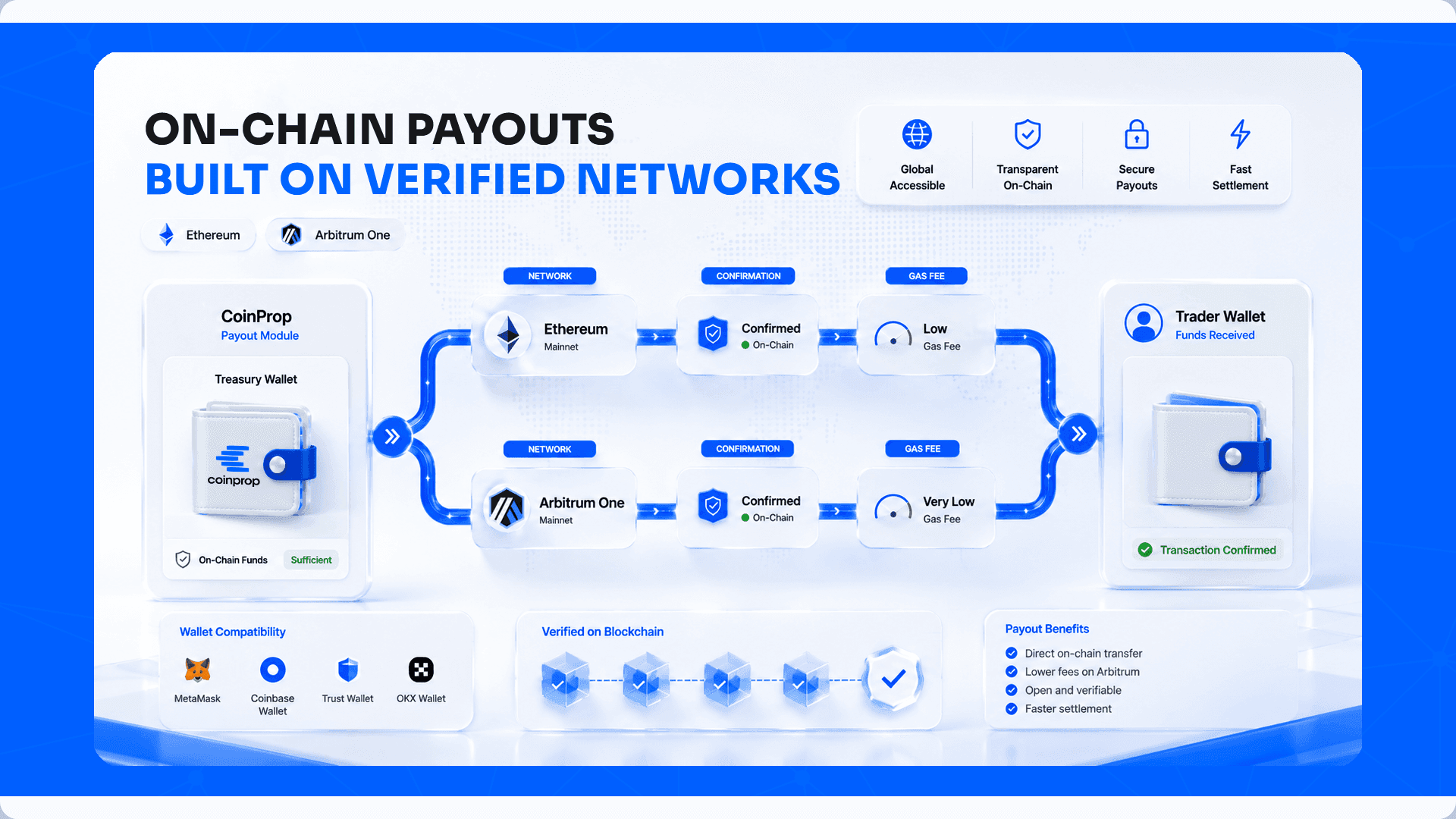
An on-chain payout is a blockchain based withdrawal method that allows a crypto proprietary trading firm to send a trader's profit directly from its treasury wallet to the trader's personal crypto wallet. Unlike traditional payout methods that depend on banks or third-party payment providers, every transaction is recorded on a public blockchain, making the transfer faster, more transparent, and easier to verify.
With an on-chain payout, funds move directly from the prop firm's treasury wallet to the trader's wallet without banking intermediaries. Instead of waiting for bank processing or payment platforms, the transaction is broadcast to the blockchain, confirmed by the network, and becomes publicly verifiable through a blockchain explorer. This approach enables faster global withdrawals while reducing delays, intermediaries, and unnecessary processing steps.
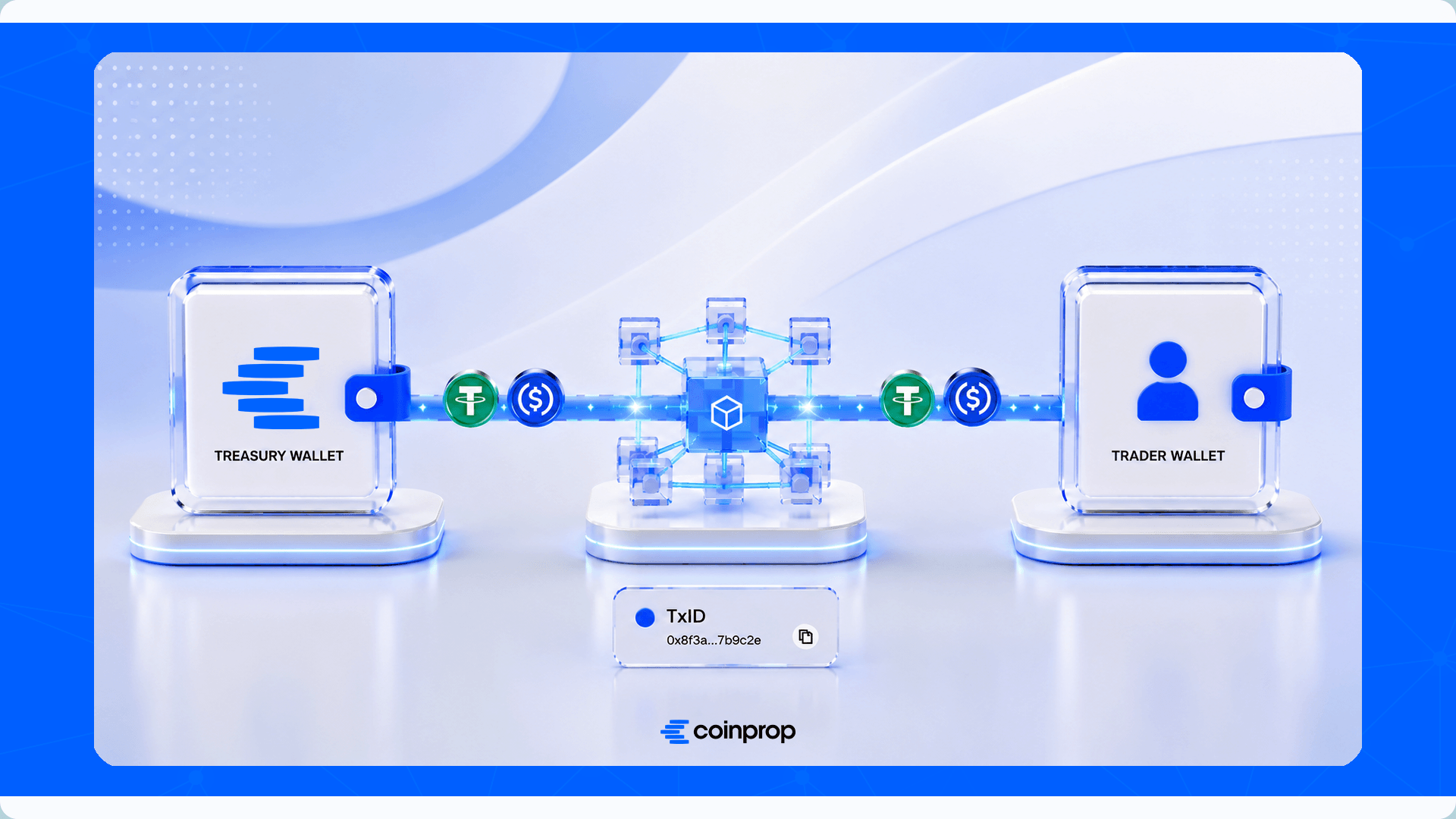
An on-chain payout follows a straightforward process that transfers a trader's profit directly from a crypto prop firm's treasury wallet to the trader's personal wallet. While the exact workflow may vary between firms, most blockchain-based payouts follow the same core steps.
After verifying that the trader meets the firm's payout requirements, the withdrawal request is approved. This may include checking profit targets, risk rules, identity verification (if required), and any applicable payout conditions.
Once approved, the crypto prop firm creates and cryptographically signs a blockchain transaction using its treasury wallet. The signed transaction authorizes the transfer without involving a bank or third-party payment processor.
The signed transaction is submitted to the blockchain network, where validators or miners process it according to the rules of the selected network, such as Ethereum, TRON, or Solana.
After the transaction is included in a block and receives the required confirmations, it becomes part of the blockchain's permanent record. At this point, anyone can verify the transaction using a blockchain explorer.
Once confirmed, the payout is available in the trader's crypto wallet. Because the transfer occurs entirely on-chain, traders can receive funds globally without relying on banks, payment providers, or business-hour processing.
On-chain payouts offer several advantages over traditional withdrawal methods used by many prop firms. By transferring funds directly through blockchain networks, crypto prop firms can provide faster, more efficient, and globally accessible payouts while improving transparency for traders.
Traditional withdrawals can take hours or even several business days, especially when banks or third-party payment providers are involved. On-chain payouts are typically processed much faster, with settlement times depending on the blockchain network and its confirmation speed. For traders who prioritize faster access to their earnings, instant and on-demand payout models can offer an alternative to traditional withdrawal schedules.
Global Accessibility
Blockchain networks operate without geographic restrictions, allowing traders to receive payouts from virtually anywhere with a compatible crypto wallet. This makes on-chain payments particularly valuable for international traders who may have limited access to traditional banking services.
Every on-chain payout is recorded on a public blockchain, allowing traders to verify the transaction status using a blockchain explorer. This transparency provides greater confidence than traditional payment methods, where transfer details are often only visible to the sender and recipient.
By removing multiple financial intermediaries, on-chain payouts can reduce processing costs compared with international bank transfers or payment platforms. Actual transaction fees depend on the blockchain network being used, but the overall payment process is often more cost-efficient.
Unlike banks, blockchain networks operate around the clock. Traders can receive payouts on weekends, holidays, or outside standard business hours without waiting for banking systems to reopen.
Bank holidays, international transfer restrictions, compliance checks, and regional payment limitations can all slow traditional withdrawals. On-chain payouts bypass these banking bottlenecks, enabling a more direct transfer from the crypto prop firm's treasury wallet to the trader's wallet.
For many traders, the biggest advantage of on-chain payouts isn't just speed, it's having a transparent, borderless payment system that operates independently of traditional banking infrastructure.

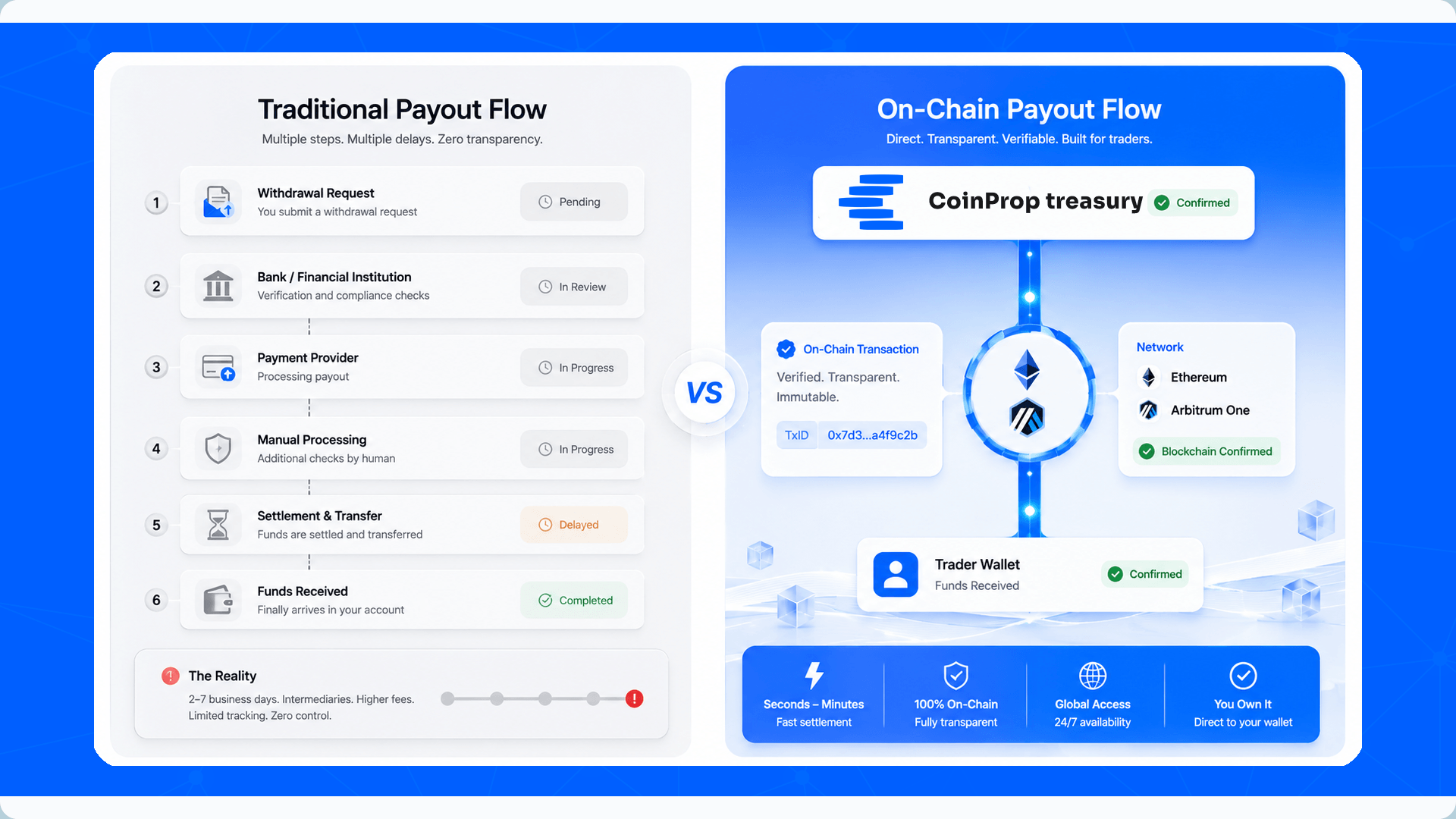
Although both traditional and on-chain withdrawal methods allow traders to receive their profits, they operate very differently behind the scenes. Traditional payouts rely on financial institutions and payment providers, while on-chain payouts use blockchain technology to transfer funds directly between wallets. Understanding these differences helps traders choose the payment method that best fits their needs.
Traditional prop firm withdrawals typically depend on banks or third-party payment providers such as Deel or Rise. Each transfer passes through one or more financial intermediaries before reaching the trader.
On-chain payouts use blockchain networks instead of banking infrastructure. Funds are transferred directly from the crypto prop firm's treasury wallet to the trader's personal crypto wallet without involving traditional financial institutions.
A traditional withdrawal usually follows this process:
Prop Firm → Payment Provider or Bank → Trader
An on-chain payout follows a simpler blockchain-based flow:
Crypto Prop Firm Treasury Wallet → Blockchain Network → Trader's Crypto Wallet
Traditional withdrawals are generally confirmed through payment notifications, emails, or the payment provider's dashboard. Traders often have limited visibility into the transfer once it leaves the firm's system.
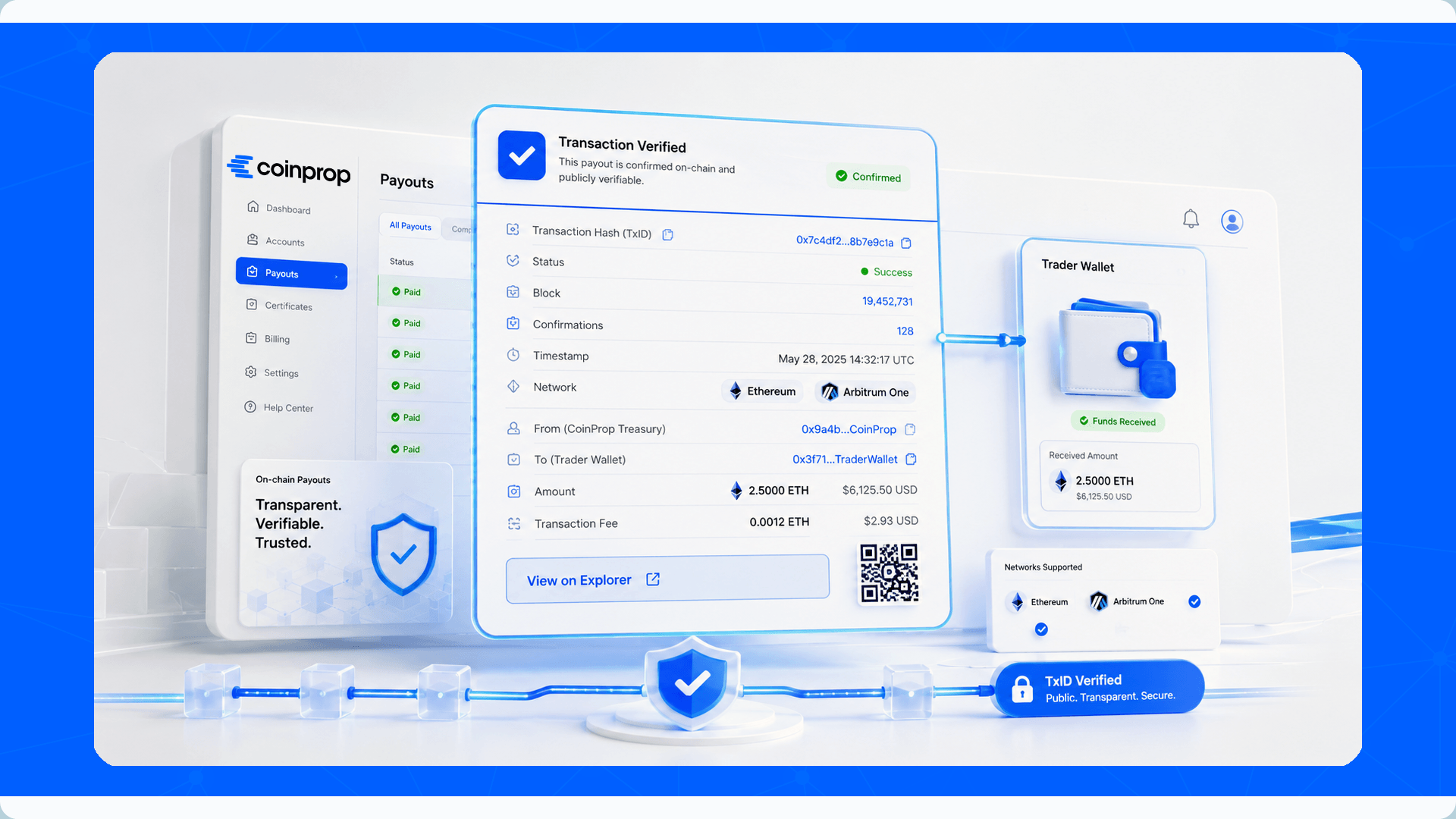
With an on-chain payout, every transaction receives a unique transaction hash (TxID). Traders can independently verify the payment on a blockchain explorer, providing a permanent and publicly verifiable record of the transfer.
Traditional withdrawals are settled through banking networks or licensed payment providers, with processing rules determined by those systems.
On-chain payouts are settled through blockchain confirmations. Once the network validates the transaction, it becomes part of the blockchain ledger and cannot be altered.
Traditional payment systems are often tied to banking hours, payment provider schedules, or regional processing windows.
Blockchain networks operate continuously, allowing on-chain transactions to be processed regardless of business hours or public holidays.
Traditional withdrawal methods may be limited by supported countries, banking regulations, or payment provider availability.
On-chain payouts are based on wallet addresses rather than bank accounts, allowing traders to receive funds from virtually anywhere, provided they have access to a compatible crypto wallet and supported blockchain network.
Crypto prop firms can support different blockchain networks for on-chain payouts, depending on their payment infrastructure and the cryptocurrencies they use. There is no single industry standard, so traders should always check which networks are supported before requesting a withdrawal. Below are some of the most commonly used blockchain networks.
Ethereum is one of the most widely adopted blockchain networks for crypto transactions. It offers strong security and broad wallet compatibility, although network fees can be higher during periods of heavy activity.
Arbitrum is an Ethereum Layer 2 network designed to reduce transaction costs and improve processing efficiency while maintaining compatibility with the Ethereum ecosystem.
Optimism is another Ethereum Layer 2 solution that provides lower transaction fees and faster confirmations compared with Ethereum's main network.
Polygon is a popular blockchain for low-cost transactions and is widely supported by many crypto wallets and decentralized applications.
BNB Smart Chain is known for its relatively low fees and fast transaction processing, making it a practical choice for many crypto payments.
Solana offers high throughput and low transaction costs, allowing transfers to be processed efficiently even during periods of increased network activity.
TRON is commonly used for stablecoin transfers, particularly USDT, because of its low network fees and widespread adoption across crypto exchanges and wallets.
Not every crypto prop firm supports the same blockchain networks. Some firms may offer payouts only on Ethereum, while others support multiple networks such as Arbitrum, Polygon, Solana, or TRON. Before requesting a withdrawal, traders should confirm the available networks, supported tokens, and wallet requirements to ensure their payout is sent to a compatible address.
Yes, on-chain payouts are generally considered secure when they are sent through reputable blockchain networks and to the correct wallet address. Unlike traditional payment systems, blockchain transactions are protected by cryptographic security and recorded on a distributed ledger. However, because blockchain transfers are irreversible, traders should always verify their wallet details before requesting a payout.
One of the biggest advantages of on-chain payouts is that traders receive funds directly into their own crypto wallets. This gives them full control over their assets without relying on banks or third-party payment providers to hold or manage their funds.
Every blockchain transaction generates a unique transaction hash (TxID). Once a payout is sent, traders can use the TxID to verify the transaction status, monitor confirmations, and confirm that the funds have been successfully delivered.
After a transaction is confirmed on the blockchain, it becomes part of a permanent ledger that cannot be modified or deleted. This creates a transparent and tamper-resistant record of every on-chain payout.
Public blockchain explorers allow anyone with the transaction hash to verify important details such as the sending wallet, receiving wallet, transferred amount, network confirmations, and transaction status. This level of transparency is one of the key differences between on-chain payouts and traditional payment systems, where transaction records are typically visible only within the payment provider's platform.
While blockchain technology provides a secure payment infrastructure, traders are responsible for entering the correct wallet address and selecting a compatible blockchain network. Sending funds to an incorrect or unsupported address may result in a permanent loss of assets, as blockchain transactions generally cannot be reversed.
Before requesting an on-chain payout from a crypto prop firm, it's important to verify a few key details. Taking a few minutes to review your wallet information and payout settings can help prevent delays, failed transfers, or irreversible mistakes.
Make sure your wallet supports the blockchain network used by the crypto prop firm. For example, if a payout is sent via the TRON network, your receiving wallet must also support TRON. Always confirm the selected network before submitting a withdrawal request.
Carefully verify your wallet address before requesting a payout. Blockchain transactions are generally irreversible, so funds sent to the wrong address usually cannot be recovered. Copying and pasting the address, and double-checking the first and last characters, is a good practice.
If you're receiving a stablecoin such as USDT, confirm that the selected token standard matches the blockchain network. For example, USDT can be transferred as ERC-20 on Ethereum, TRC-20 on TRON, BEP-20 on BNB Smart Chain, or through other supported networks. The wallet address and the selected network must always match.
Most blockchain networks require a transaction fee, commonly called a gas fee, to process transfers. Depending on the crypto prop firm's payout policy, this fee may be paid by the firm or deducted from the payout amount. Checking the firm's withdrawal policy in advance helps avoid unexpected surprises.
Many crypto prop firms set minimum withdrawal amounts or specific payout conditions. Before requesting an on-chain payout, review the firm's payout rules to ensure you meet the eligibility requirements and understand any applicable limits or processing conditions.
As the crypto trading industry continues to evolve, more crypto prop firms are adopting on-chain payout systems as part of their payment infrastructure. Rather than relying solely on traditional banking networks or third-party payment providers, blockchain-based payouts offer a more flexible way to serve traders around the world while simplifying operational processes.
Crypto prop firms often work with traders from dozens of countries. On-chain payouts allow firms to send funds directly to compatible crypto wallets without depending on local banking systems or regional payment providers.
Traditional payment methods can involve bank charges, payment processor fees, and additional administrative costs. By using blockchain networks, crypto prop firms can streamline their payout process and reduce reliance on multiple financial intermediaries.
Blockchain-based payment systems can be integrated with automated treasury and payout workflows. This allows firms to process approved withdrawals more efficiently while reducing manual operational tasks.
Managing funds in digital assets allows crypto prop firms to move capital more efficiently between treasury wallets, exchanges, and payout systems. This can simplify liquidity management and reduce the complexity of cross-border payments.
Unlike traditional payment systems that rely on banking infrastructure, blockchain transactions are settled through network confirmations. This allows crypto prop firms to distribute approved payouts using the underlying blockchain rather than conventional financial rails.
As more trading businesses adopt digital asset infrastructure, on-chain payouts are becoming an increasingly common feature of modern crypto prop firms. While supported networks and payout procedures vary from one firm to another, blockchain-based withdrawals are likely to play a growing role in the future of crypto prop trading.
CoinProp uses on chain payouts to distribute trader withdrawals directly to compatible crypto wallets through supported blockchain networks. Currently, payouts are available on Ethereum and Arbitrum, allowing traders to receive funds using widely adopted blockchain infrastructure.
To promote transparency, CoinProp on-chain payout transactions are published in its Discord community and on its X account with the trader’s permission. Each published payout includes its blockchain transaction hash (TxID), enabling anyone to verify the transfer through a public blockchain explorer. This approach allows traders to independently confirm that payouts have been processed while maintaining transparency through publicly verifiable on-chain records.
An on-chain payout is a blockchain-based withdrawal where a crypto prop firm sends funds directly from its treasury wallet to a trader's compatible crypto wallet. Every transaction is recorded on the blockchain and can be verified using a transaction hash (TxID).
The processing time depends on the crypto prop firm's internal approval process and the blockchain network being used. Once the transaction is broadcast, confirmation time varies by network and current blockchain activity.
Tax treatment depends on your country or region and local tax regulations. Traders should consult a qualified tax professional to understand how crypto trading profits and prop firm payouts are treated in their jurisdiction.
Yes, many crypto prop firms support payouts in USDT or other supported cryptocurrencies. Before requesting a withdrawal, make sure your wallet supports both the selected blockchain network and the correct token standard, such as ERC-20 or TRC-20.
Most non-custodial and exchange wallets support on-chain payouts, provided they are compatible with the blockchain network selected by the prop firm. Always verify that your wallet supports the correct network before requesting a withdrawal.
In most cases, no. Once a blockchain transaction has been confirmed, it cannot be reversed. This is why it's essential to verify your wallet address and selected network before submitting a payout request.
Blockchain transactions are generally irreversible. If funds are sent to an incorrect or incompatible wallet address, they may be permanently lost. Always double-check the wallet address and network before confirming your withdrawal.
Yes. CoinProp uses on-chain payouts through supported blockchain networks, currently including Ethereum and Arbitrum. After a payout is approved, funds are sent directly to the trader's compatible wallet. With the trader's permission, completed payouts may also be shared on CoinProp's Discord and X channels together with the blockchain transaction hash (TxID), allowing anyone to verify the transfer through a public blockchain explorer.
CoinProp currently supports on-chain payouts on Ethereum and Arbitrum. Before requesting a withdrawal, traders should ensure their wallet is compatible with the selected network. As CoinProp continues to develop its payment infrastructure, additional blockchain networks may be supported in the future.
