This guide introduces crypto prop firms without consistency rules and explains what these firms are, how no consistency rules work, and how they can affect traders and payouts. We’ll also compare several crypto prop firms without consistency rules, covering their key trading conditions, profit targets, drawdown limits, payout requirements, and other rules traders should consider before choosing a firm.

A crypto prop firm without consistency rules is a proprietary trading firm that does not require traders to distribute their profits evenly across multiple trading days or limit how much of their total profit can come from a single trading day or trade. In a typical no consistency model, a trader can reach a significant portion of the profit target from one strong trading session without being required to generate additional profits simply to meet a profit distribution requirement.
This can be particularly relevant for crypto traders because cryptocurrency markets can produce large price movements within a short period. A breakout, liquidation event, major market announcement, or sudden change in volatility can create a trading opportunity that generates a substantial portion of a trader's overall profit. A consistency rule may require that trader to continue trading until the profit is distributed across a larger number of days, while a prop firm without such a rule may not impose that additional requirement.
However, no consistency rule does not mean no trading rules. A trader can still be subject to a profit target, maximum drawdown, daily loss limit, leverage restrictions, minimum trading days, position limits, and other risk management requirements. The key difference is that the firm does not impose an additional requirement based on how the trader's profits are distributed.

A consistency rule is a requirement that limits how concentrated a trader's profits can be. The rule is generally designed to ensure that a trader's performance is not dependent on a single exceptionally profitable trading day or position.
One common approach is a best day consistency rule, where a prop firm limits the percentage of total profits that can come from the trader's most profitable day. For example, a firm may require the trader's best trading day to account for no more than 50% of total profits.
Other firms may use different calculations or terminology. A consistency requirement can be based on the trader's best day, best trade, profit distribution, or a specific consistency percentage. Therefore, traders should always check how the individual prop firm defines and calculates its consistency requirement rather than assuming that every firm uses the same formula.
The important point is that a consistency rule does not necessarily determine whether a trader is profitable. Instead, it determines how that profit must be generated or distributed before the trader can satisfy a particular evaluation or payout requirement.
Consider a trader who has generated $10,000 in total profit, but $6,000 of that profit came from the trader's best day.
The trader's best day percentage would be:
$6,000 ÷ $10,000 = 60%
If the prop firm requires the trader's best day to represent no more than 50% of total profits, the trader may have already reached the required profit target but still fail to satisfy the consistency condition.
The trader would therefore need to generate additional profits on other trading days to reduce the percentage represented by the $6,000 best day.
For example, if the trader generates another $2,000 in profit, total profits increase to $12,000 while the best day remains $6,000:
$6,000 ÷ $12,000 = 50%
The trader would then meet a 50% best day consistency requirement, assuming all other conditions had also been satisfied.
This illustrates an important distinction: reaching the profit target and satisfying a consistency rule are not always the same thing. A trader can reach the required return but still need additional trading activity because of a profit distribution requirement.
The exact calculation varies between prop firms, and some firms may apply consistency requirements differently during evaluation and after a trader receives a funded account. For that reason, traders should review the firm's current rules and payout conditions before assuming that a particular consistency threshold applies.
A crypto prop firm with no consistency rule does not impose a requirement that the trader's profits be distributed according to a specific percentage across trading days or trades.
For example, if a trader reaches a $10,000 profit target and $7,000 of that profit was generated during one particularly successful trading day, a firm without a best day consistency requirement would not require the trader to generate another $4,000 or $5,000 simply to reduce the percentage represented by that winning day.
The trader's performance can therefore be uneven. One day may produce a large gain, several days may produce smaller gains, and some days may produce no profit at all. As long as the trader continues to comply with the firm's actual trading rules, the distribution of those profits is not independently restricted by a consistency requirement.
This can give traders greater flexibility in how they approach the market. A trader who specializes in high conviction breakout setups, for example, may naturally have several quiet sessions followed by one highly profitable trading day. Under a no consistency model, that uneven distribution does not automatically create a separate consistency problem.
However, no consistency rule should be interpreted narrowly. It means that the firm does not impose a specific consistency or profit distribution requirement. It does not mean that every profitable trading behavior is permitted or that the trader can ignore the firm's other rules.
A prop firm can remove its consistency requirement while maintaining strict risk management and trading conditions.
A Daily Loss Limit, for example, restricts how much a trader can lose within a trading day. This is fundamentally different from a consistency rule because it measures downside risk rather than the distribution of profits.
A Maximum Drawdown limits the total amount an account can lose before the account is considered to have breached its risk parameters. Depending on the firm, this may be static or trailing.
Finally, a firm may require Minimum Trading Days even when it has no consistency rule. In that case, a trader might reach the profit target quickly but still need to trade on additional days to satisfy the minimum day requirement.
For this reason, traders should not evaluate a crypto prop firm solely by asking whether it has a consistency rule. The more useful question is whether the firm's complete set of evaluation, funded account, and payout rules fits the trader's strategy.
A no consistency model can provide more freedom over how profits are generated, but it is only one part of the overall trading conditions.
A Profit Target determines how much profit a trader needs to generate to complete an evaluation. Removing a consistency rule does not necessarily remove the profit target itself.
Leverage Limits determine how much exposure a trader can take relative to the account size, while Position Limits may restrict the size or value of individual positions or total open exposure.

A crypto prop firm without consistency rules generally works like other prop firm evaluation programs: traders receive access to a defined account size and must meet the firm's performance requirements while staying within its risk limits. The main difference is that the firm does not impose a separate requirement on how the trader's profits are distributed.
This means a trader may generate a large portion of the required profit during one trading session without automatically violating a consistency requirement. However, the trader must still comply with every other rule attached to the account. Understanding this distinction is important because reaching the profit target does not necessarily mean that all evaluation or payout conditions have been satisfied.
During a crypto prop firm evaluation, the trader typically needs to reach a specified profit target without exceeding the firm's risk limits. These limits can include a maximum drawdown, daily loss limit, leverage restrictions, position limits, and minimum trading day requirements.
For example, a firm might require a trader to reach a 10% profit target while keeping losses below a defined maximum drawdown and daily loss limit. If the firm does not have a consistency rule, the trader is not required to distribute that 10% profit according to a specific daily percentage.
The trader's objective is therefore relatively straightforward: generate the required profit while respecting the firm's risk and trading rules.
However, the absence of a consistency rule does not automatically mean that a trader can complete the evaluation in a single trade or a single day. Other conditions may still apply. A firm could require a minimum number of trading days, for example, meaning that a trader who reaches the profit target immediately may still need to complete additional trading days before the evaluation can be considered complete.
This is why traders should look at the entire evaluation model, rather than treating the absence of a consistency rule as the only condition that matters.
Potentially, yes. If a crypto prop firm has no consistency requirement and does not impose a minimum trading day requirement that prevents it, a trader can potentially reach the required profit target in a single trading day.
For example, imagine a $100,000 evaluation account with a 9% profit target. The trader would need to generate $9,000 in profit to reach the target.
If a strong BTC breakout produces a $9,000 profit during one trading session, a firm without a consistency requirement would not automatically reject that performance simply because all of the profit came from one day.
However, other rules still matter. If the firm requires two or more minimum trading days, the trader may need to continue trading after reaching the target. Likewise, the trader must remain within the firm's drawdown, daily loss, leverage, and other applicable limits.
So the correct interpretation is:
No consistency rule can allow a trader to reach the profit target with highly concentrated profits, but it does not necessarily eliminate minimum trading days or other evaluation requirements.
Yes, when a prop firm does not impose a best day or profit distribution requirement, most, or potentially all, of a trader's profit can come from one trading day, provided the trader remains within the firm's other rules.
For example, suppose a trader needs to generate $10,000 in total profit. The trader makes $7,000 on Monday, $1,500 on Tuesday, and $1,500 on Wednesday.
The total profit is:
$7,000 + $1,500 + $1,500 = $10,000
The trader's best day represents 70% of total profits.
Under a 50% best day consistency rule, this distribution could require the trader to generate additional profits on other days. But under a model with no consistency requirement, the 70% concentration itself would not create a separate consistency violation.
This distinction can be particularly relevant to crypto traders because market opportunities are not always evenly distributed. A trader may experience several low activity sessions followed by a single large move in BTC, ETH, SOL, or another cryptocurrency. A no consistency model allows the trader's performance to reflect those market conditions without requiring profits to be artificially distributed across multiple days.
Once a trader satisfies the evaluation requirements, the next stage depends on the prop firm's model. The trader may receive a funded account, move to a simulated funded environment, or enter another stage before becoming eligible for profit withdrawals.
Passing the evaluation does not necessarily mean that the rules stop applying. The funded account can have its own requirements governing risk management, trading activity, profit withdrawals, and account management.
This is particularly important when evaluating a prop firm based on its consistency policy. A firm may advertise or provide an evaluation with no consistency rule, while applying different conditions once the trader reaches the funded stage.
Therefore, traders should not stop reading the rules after finding that an evaluation has no consistency requirement. The funded account and payout rules can be equally important.
It depends on the prop firm and the specific account model.
This is one of the most important distinctions to make when comparing crypto prop firms:
Evaluation → Funded Account → Payout
A firm may have no consistency rule during the evaluation but introduce a consistency requirement after funding or as part of its payout conditions. Another firm may have no consistency requirement throughout the entire process.
For example, a trader could complete an evaluation without any restriction on the percentage of profit generated on their best day. After receiving a funded account, however, the firm could require the trader to maintain a certain profit distribution before approving a payout.
In that situation, describing the firm simply as a crypto prop firm without consistency rules would be incomplete. The more accurate description would be no consistency rule during evaluation or whatever specific stage the rule applies to.
When comparing firms, it is therefore important to check three separate stages:
Evaluation: Is there a consistency or best day requirement?
Funded Account: Does the trader have to maintain a specific profit distribution?
Payout: Can profit concentration delay or restrict withdrawals?
This distinction also helps explain why traders should read the firm's official rules and payout conditions rather than relying only on marketing claims such as no consistency rule. The absence of a rule at one stage does not necessarily mean that the same condition applies throughout the trader's entire journey.
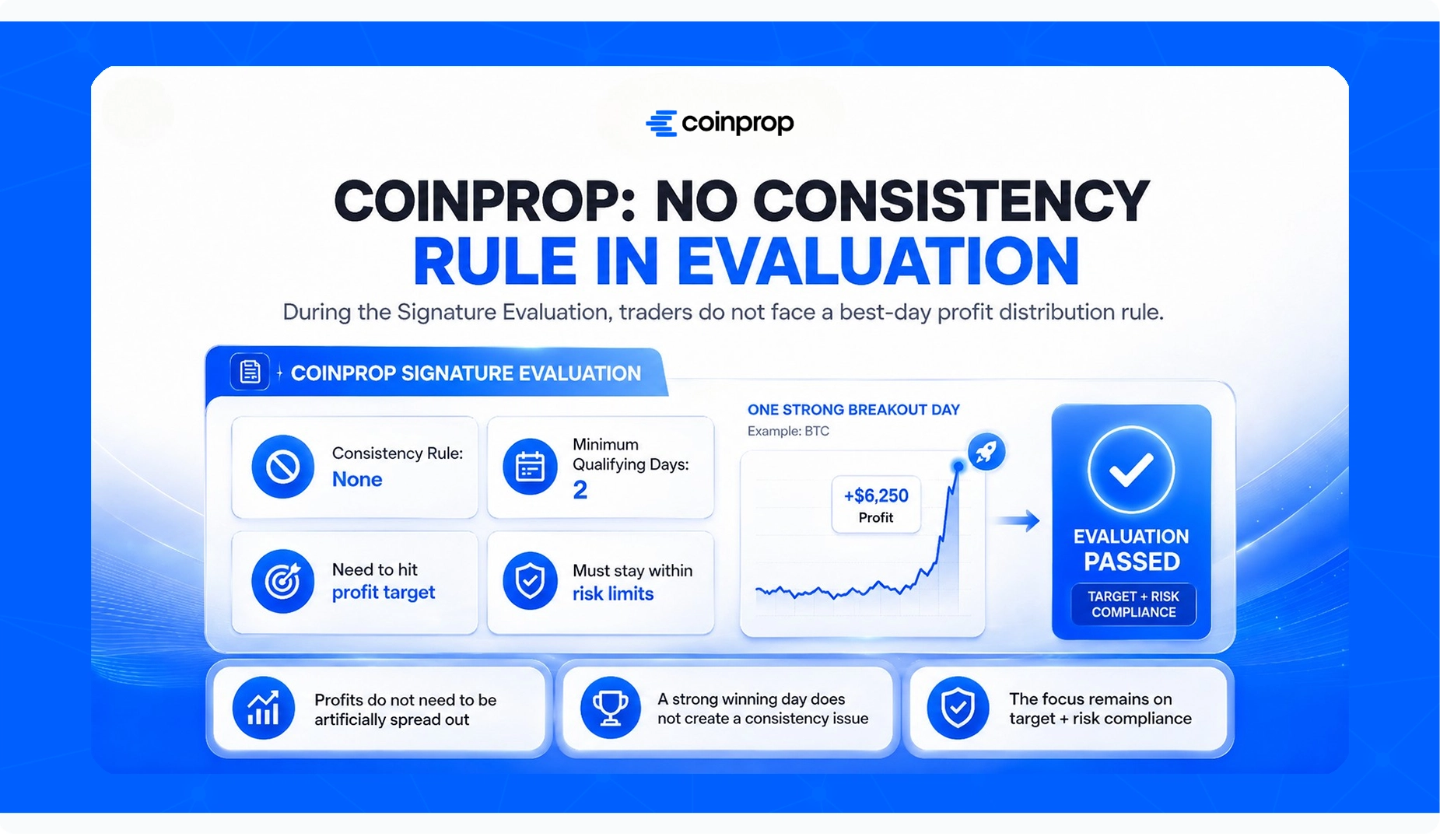
CoinProp does not impose a consistency rule during its Signature Evaluation. Traders can generate the required profit without having to limit how much of their total profit comes from a single trading day.
The evaluation requires a minimum of 2 qualifying trading days, but there is no best-day percentage or profit-distribution requirement during this stage. This allows traders to complete the evaluation without artificially spreading their profits across multiple sessions.
For example, if a trader identifies a strong Bitcoin breakout and generates a significant portion of the required profit during that move, the profitable day does not create an additional consistency requirement during the evaluation. The trader still needs to meet the applicable profit target and respect the account's risk limits, but the distribution of profits across trading days is not restricted.
The consistency requirement changes once the trader moves to a Signature funded account.
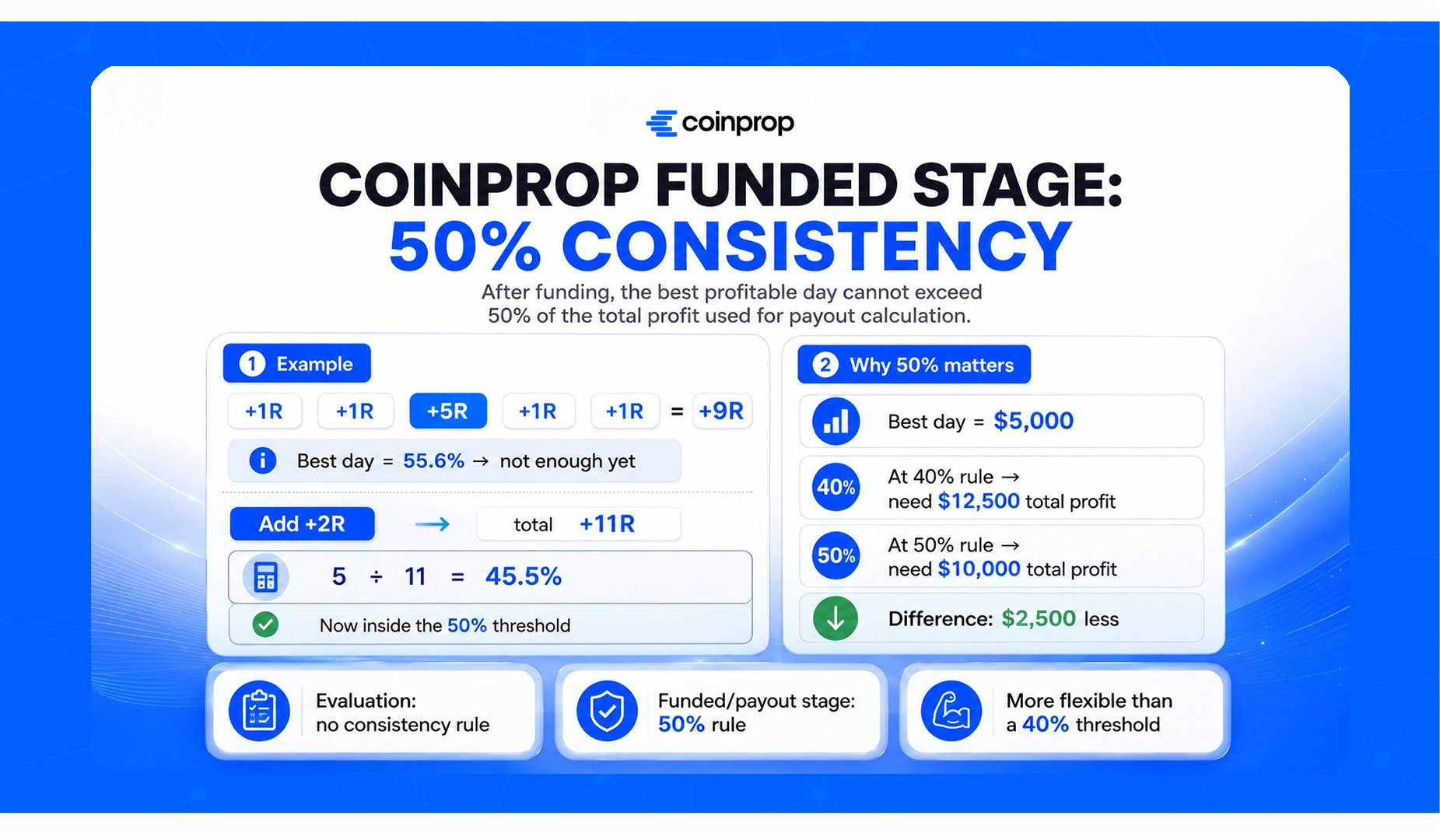
CoinProp applies a 50% consistency requirement at the funded stage. The trader's best profitable day cannot account for more than 50% of the total profit used for the applicable payout calculation.
This does not mean that every trading day needs to produce the same return. A trader can still have smaller winning days, losing days, and occasional significantly larger profitable sessions.
Consider a simplified example:
Trading Day 1: +1R
Trading Day 2: +1R
Trading Day 3: +5R
Trading Day 4: +1R
Trading Day 5: +1R
Total: +9R
The +5R day represents 55.6% of the total profit, so the trader would not yet satisfy a 50% consistency threshold.
However, if the trader continues trading and generates another +2R:
Previous Total: +9R
Additional Profit: +2R
New Total: +11R
The best day remains +5R, but it now represents:
5 ÷ 11 = 45.5%
The 50% consistency threshold is therefore satisfied, assuming all other applicable payout conditions are also met.
The important point is that the trader does not need to eliminate large winning days. A strong market move can still generate substantially more profit than an ordinary trading session. The trader simply needs enough additional overall profit for that exceptional day to fall within the 50% threshold.
The 50% threshold becomes more meaningful when compared with consistency requirements used by other crypto prop firms.
For example, HyroTrader applies a 40% profit-distribution rule during its evaluation, meaning a trader's best trading day cannot account for more than 40% of the total profit under its applicable calculation.
Other prop firms also use thresholds around the 30–40% range, although the exact percentage, calculation method, and stage at which the rule applies can differ.
CoinProp Signature — Evaluation: No consistency threshold
CoinProp Signature — Funded / Payout: 50%
HyroTrader — Evaluation: 40%
Other Prop Firm Models: Varies, often 30–40%
The practical difference between a 40% and 50% threshold can be significant.
Suppose a trader's best day generates $5,000 in profit.
Under a 40% consistency requirement, the trader needs at least:
$5,000 ÷ 0.40 = $12,500 total profit
before that $5,000 day represents 40% or less of total profit.
Under a 50% requirement:
$5,000 ÷ 0.50 = $10,000 total profit
So the trader needs $2,500 less total profit to bring the same $5,000 winning day within the applicable consistency threshold.
This gives traders more room for an unusually profitable day than a stricter 40% requirement.
This distinction is particularly relevant to crypto traders because market opportunities are not evenly distributed.
A trader may have several sessions with relatively small returns and then encounter a sharp BTC or ETH move that produces a much larger result.
A simplified performance profile might look like:
+1R → +1R → +5R → +1R → +1R → +2R
The returns are uneven, but the larger result may simply reflect a larger market opportunity rather than a fundamentally different trading strategy.
With CoinProp, that type of performance profile can be used during the evaluation without a consistency restriction. Once funded, the 50% threshold still allows considerable room for an exceptional trading day while preventing one day from dominating the total profit used for the payout calculation.
The overall path is therefore straightforward:
Fast evaluation → minimum 2 qualifying trading days → funded account → continue trading → satisfy the 50% consistency requirement → qualify for payout
The key is that the 50% rule does not require every trading day to be profitable or produce similar returns. It limits how dominant a single profitable day can be within the total profit used for the applicable payout
Consistency rules are not necessarily a problem for every trader. Their impact depends largely on how a trader's strategy generates returns. A trader who produces relatively similar profits across multiple sessions may never be significantly affected by a consistency requirement. For traders whose performance is naturally concentrated around a small number of high quality opportunities, however, the rule can become an additional restriction.
This is one reason some traders specifically look for crypto prop firms without consistency rules. They want the freedom to let their actual trading performance determine when and how profits are generated, rather than having to manage their trades around a separate profit distribution requirement.
The most obvious benefit is greater freedom in how profits are generated.
Without a consistency requirement, a trader does not need to ensure that profits are distributed across trading days according to a predefined percentage. One day can be significantly more profitable than another, and the trader does not have to deliberately reduce the concentration of those profits simply to satisfy a consistency calculation.
This can be particularly useful in crypto markets, where volatility can change considerably from one session to another. A trader might have several days with limited opportunities followed by a strong market move that produces a large portion of their total return.
A no consistency model allows that distribution to remain uneven as long as the trader continues to comply with the firm's other rules.
Some trading strategies are built around waiting for a small number of high conviction setups rather than taking many trades every day.
For example, a trader may wait for a specific combination of market structure, volume, liquidity, and momentum before entering a position. Most days may produce little or no trading activity, while one setup can generate a significant return.
A consistency requirement can create an additional consideration for this type of trader because a highly profitable trade may represent a large percentage of the trader's overall profits.
A prop firm without a consistency rule allows the trader to focus primarily on whether the setup meets their strategy and risk parameters rather than whether the resulting profit will make their best day percentage too high.
Breakout and momentum strategies can naturally produce uneven returns.
A trader might spend several sessions waiting for BTC, ETH, or another cryptocurrency to break through a significant support or resistance level. When the breakout occurs, the resulting price movement can be substantially larger than the average daily movement during the preceding sessions.
Under a consistency based model, that unusually profitable session may increase the trader's best day percentage and potentially create an additional requirement before a payout or evaluation can be completed.
With no consistency rule, the trader does not have to distribute the profits from that breakout across future trading sessions simply because the trade was unusually successful.
That does not make the strategy inherently more profitable, but it can make the firm's rules more compatible with a strategy where returns are naturally uneven.
Crypto markets can react sharply to events such as major economic announcements, regulatory developments, ETF related news, protocol upgrades, exchange events, or unexpected market shocks.
Traders who specialize in these situations may have relatively quiet periods followed by one or two highly profitable opportunities.
A consistency rule can be less convenient for this type of trading because a single event driven trade may generate a large percentage of the trader's total profit. A firm without a consistency requirement does not impose an additional profit distribution condition simply because one event produced an outsized return.
However, traders should still check whether the firm has separate news trading, volatility, position size, or risk management restrictions. No consistency rule does not automatically mean that event driven trading is unrestricted.
A consistency requirement can sometimes create a situation where a trader reaches the profit target but cannot immediately complete the relevant stage because too much of the profit came from one day.
For example, a trader might reach a $10,000 profit target after generating $7,000 on one particularly successful day. If the firm's rules require the best day to represent no more than 50% of total profit, the trader may need to generate additional profits before satisfying the requirement.
This can create pressure to continue trading even when the trader's strategy does not currently offer attractive setups.
A no consistency model can remove that particular incentive. Once the trader has reached the required target and satisfied the firm's other conditions, there is no separate requirement to keep generating profits simply to reduce the percentage represented by a previous winning day.
The trader should still avoid unnecessary trades, particularly because reaching a profit target does not eliminate drawdown or other risk rules until the relevant stage of the evaluation is officially completed.
Perhaps the biggest appeal of a no consistency model is that traders do not need to change their behavior solely to make their profit distribution look more consistent.
Suppose a trader's strategy produces the following results:
The trader's performance is clearly uneven, but that does not necessarily mean the strategy is poorly managed. The large Day 3 gain may simply reflect a particularly strong market opportunity.
A consistency rule can make this distribution relevant to whether the trader satisfies the firm's conditions. A prop firm without a consistency rule does not impose that additional requirement.
This is ultimately why no consistency prop firms can be attractive to certain trading styles: they evaluate the trader based on the firm's defined profit and risk parameters without adding a separate requirement for how evenly those profits must be generated.
That said, traders should not choose a prop firm solely because it has no consistency rule. The overall conditions, including drawdown, daily loss limits, leverage, minimum trading days, trading restrictions, and payout requirements, can have a much greater impact on the practical difficulty of completing an evaluation and withdrawing profits.
A crypto prop firm without consistency rules can be a better fit for some traders, but it is not automatically a better choice for everyone. The absence of a consistency requirement removes one potential restriction, but traders still need to consider the firm's complete trading model.
A firm with no consistency rule may have stricter drawdown limits, lower leverage, minimum trading day requirements, or additional payout conditions. Therefore, the right question is not simply whether a prop firm has a consistency rule, but whether its overall rules are compatible with your trading strategy and risk management.
The main advantage is flexibility. Traders can allow their profits to develop naturally instead of managing their trades around a specific profit distribution requirement.
For traders whose returns are naturally uneven, this can be particularly useful. A strategy may produce several small or inactive days followed by one highly profitable session. Without a consistency requirement, the trader does not have to generate additional profits simply to reduce the percentage represented by that winning day.
This can also make the rules easier to understand from a payout perspective. When there is no best day or profit distribution calculation, traders have one fewer condition to monitor when determining whether their performance satisfies the firm's requirements.
No consistency models can therefore be particularly suitable for traders who use high conviction, breakout, momentum, or event driven strategies, where a relatively small number of trades may account for a significant portion of total returns.
The absence of a consistency rule does not mean that the prop firm has fewer restrictions overall.
A firm may remove its consistency requirement while imposing tighter limits elsewhere. For example, it may have a smaller maximum drawdown, a stricter daily loss limit, lower leverage, or tighter position and exposure restrictions.
These differences can have a much greater practical impact on a trader than a consistency rule.
Consider two firms. Firm A has no consistency rule but allows only a 4% maximum drawdown, while Firm B has a 50% best day consistency requirement but provides a 6% drawdown. For a trader whose strategy regularly experiences normal fluctuations before producing larger winning trades, Firm B may actually provide more usable risk capacity despite having a consistency requirement.
Payout conditions can also differ. A firm may have no consistency requirement during its evaluation but introduce additional conditions once the trader reaches a funded account or requests a payout.
This is why traders should compare the entire rule set, rather than treating the presence or absence of one restriction as the deciding factor.
A consistency rule is only one component of a crypto prop firm's evaluation model.
For example, removing a 50% best day requirement may make a firm more attractive to a breakout trader, but that advantage could be offset by a lower drawdown limit or stricter daily loss rule. Similarly, higher leverage may appear attractive, but it does not necessarily compensate for restrictive position limits or difficult payout conditions.
The most useful way to compare crypto prop firms is therefore to look at how their rules interact with your trading strategy.
A trader should consider questions such as:
Ultimately, a crypto prop firm without a consistency rule is not inherently better, it is simply a different rule structure. It can be a significant advantage for traders whose profits are naturally concentrated in a small number of opportunities, but another firm's overall risk and payout conditions may make it a better choice for a different trading style.
The best prop firm is therefore not necessarily the one with the fewest rules. It is the one whose rules allow your strategy to operate normally while giving you reasonable risk limits and clear, achievable payout conditions.
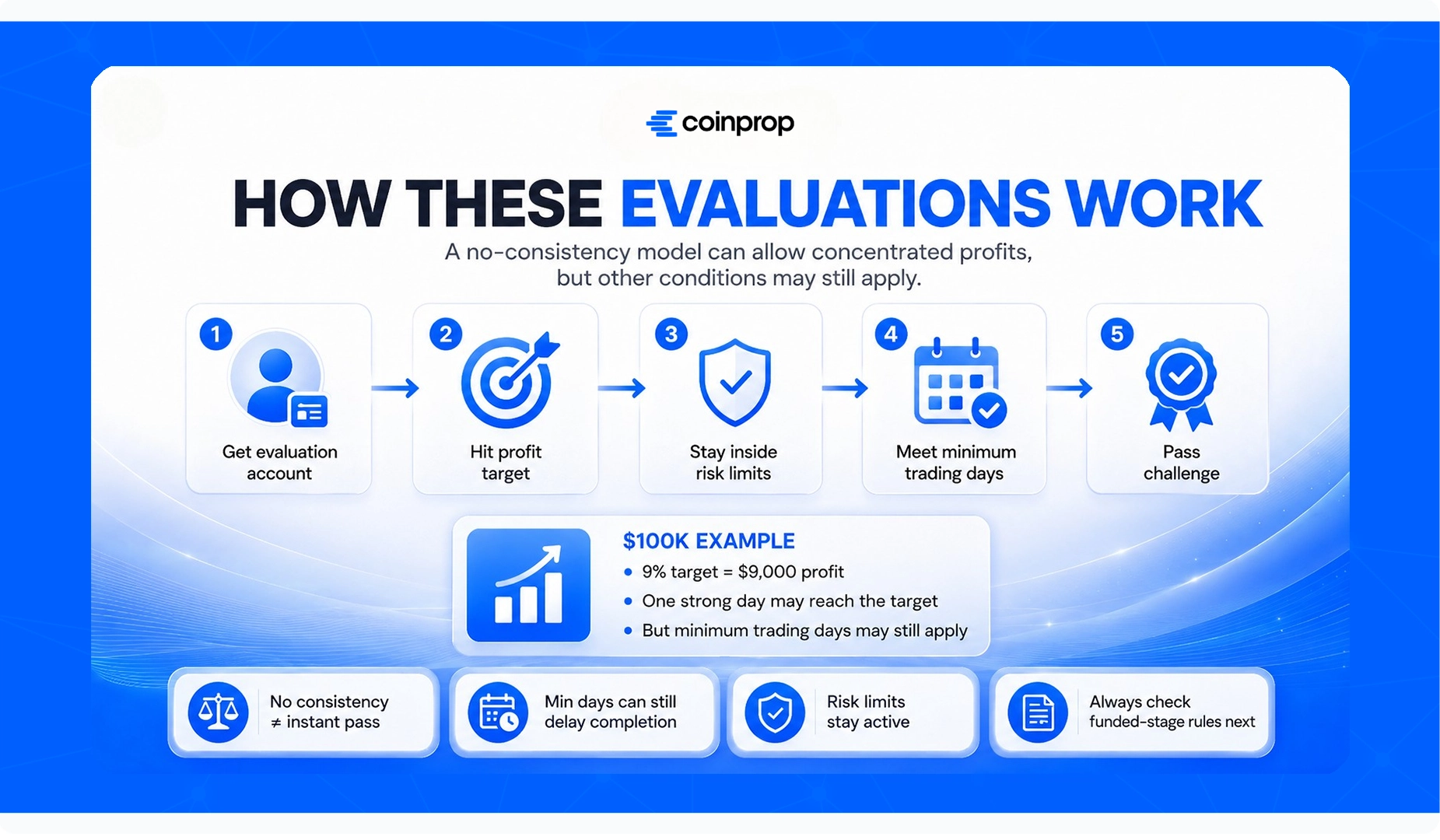
Finding a crypto prop firm that does not advertise a consistency rule is only the first step. Different firms can use the term no consistency rule in different ways, and a restriction that does not apply during the evaluation may still appear in the funded account or payout process.
For that reason, traders should compare the specific conditions attached to each stage of the account rather than relying on a single statement about consistency. The following factors provide a more accurate way to evaluate crypto prop firms without consistency rules.
Start by checking whether the evaluation itself has a consistency requirement.
Some firms may require traders to reach the profit target while keeping their best trading day below a specific percentage of total profits. Others may have no such requirement at all.
If there is no evaluation consistency rule, the trader can generally have an uneven distribution of profits while completing the challenge, provided all other evaluation conditions are satisfied.
However, it is important to check the exact wording. A firm may not call its requirement a consistency rule while still imposing a best day, profit distribution, or similar condition.
Passing the evaluation does not necessarily mean that the same rules continue, or disappear, on the funded account.
Some prop firms may apply different trading conditions after a trader receives a funded account. A consistency requirement could be introduced at this stage even if the evaluation itself has no such restriction.
When comparing firms, therefore, check whether the funded account has any requirements related to:
The key question is whether the trader can continue using the same strategy after funding without having to change the way profits are generated.
Payout conditions deserve particular attention because a firm can have no consistency rule during the evaluation but still impose a consistency related condition when a trader requests a withdrawal.
For example, a trader may be allowed to reach the evaluation target with most of their profit coming from one day. However, the payout policy might later require the trader's best day to represent no more than a certain percentage of total profits.
In that case, simply describing the firm as having no consistency rule would not provide the complete picture.
When comparing firms, check the payout policy separately and determine whether profit distribution can affect when or how much of a trader's profit can be withdrawn.
A best day restriction is one of the most common ways a consistency requirement is implemented.
The firm may specify that the trader's most profitable day cannot exceed a certain percentage of total profits. For example, with a 50% requirement, a trader who has generated $10,000 in total profit generally could not have more than $5,000 attributed to their best day under that particular calculation.
Not every firm uses the same percentage or calculation method, so the actual rule must be checked individually.
Even when a firm does not use the term consistency, a best day restriction effectively creates a limit on profit concentration and should be treated as part of the comparison.
Not every consistency requirement is based on the best trading day.
A firm may instead require profits to be distributed across a certain number of trading days or may use another formula to determine whether a trader's performance is sufficiently consistent.
This is why searching the rules only for the word consistency is not always enough. Traders should also look for terms such as profit distribution, best day, profit concentration, profitable days, or similar language.
The objective is to determine whether the firm places any restrictions on where or when the trader's profits come from.
Minimum trading days are separate from consistency rules, but they can have a similar practical effect on how quickly a trader can complete an evaluation.
A trader might reach the profit target in one highly profitable session, yet still need to trade on additional days because the firm requires a minimum number of trading days.
This is particularly important when comparing no consistency firms. The absence of a consistency requirement does not necessarily mean that a trader can complete the evaluation immediately after reaching the profit target.
The trader should therefore check both requirements separately:
Consistency requirement: How must profits be distributed?
Minimum trading days: How many days must the trader participate?
Maximum drawdown is one of the most important rules to compare because it determines how much room a trader has for losing trades before breaching the account's risk limit.
Two firms can both have no consistency rule but offer very different drawdown conditions.
A firm with a wider drawdown may be more suitable for a strategy that experiences normal fluctuations before producing larger winning trades. Conversely, a smaller drawdown may require tighter position sizing and more conservative risk management.
Traders should also determine whether the drawdown is static or trailing, because these structures can behave very differently as the account becomes profitable.
The Daily Loss Limit (DLL) determines how much a trader can lose within a single trading day before violating the firm's rules.
This is completely different from a consistency rule. A consistency rule generally concerns the distribution of profits, while a daily loss limit concerns downside risk.
A no consistency firm can still have a strict DLL. Therefore, traders should not assume that removing one restriction means the account is generally more permissive.
The calculation also matters. Some firms calculate daily loss from the starting balance, while others may use equity, balance, or another reference point. Traders should understand exactly how the limit is calculated and when it resets.
Leverage determines the maximum exposure a trader can obtain relative to the account size, while position limits can restrict how much capital or exposure can be allocated to a particular asset or position.
These rules are especially relevant in crypto because traders can encounter substantial volatility and rapid price movements.
A firm may offer no consistency rule but compensate with lower leverage or strict position and exposure limits. Another firm may provide higher leverage while imposing different restrictions.
Therefore, leverage should never be evaluated in isolation. The more useful comparison is between leverage, position limits, drawdown, and the trader's actual risk per trade.
Ultimately, when comparing crypto prop firms without consistency rules, the goal is not simply to find the firm with the fewest restrictions. It is to determine which firm gives your trading strategy enough flexibility while maintaining clear and manageable risk and payout conditions.
A crypto prop firm without a consistency rule may give traders more flexibility over how they generate profits, but consistency is only one part of the overall trading model. Other rules can have an even greater impact on how difficult an evaluation is and whether a trader can maintain the account after passing.
Start with the firm's risk rules, particularly the maximum drawdown and Daily Loss Limit. Maximum drawdown determines how much the account can lose before the account is breached, while the Daily Loss Limit limits how much can be lost within a single trading day. It is also important to check whether the drawdown is static or trailing, because a trailing drawdown can change as the account becomes profitable. A firm may have no consistency rule but impose tighter risk limits that make the account more difficult to trade.
Next, consider the evaluation requirements, including the profit target and minimum trading days. A no consistency rule does not necessarily mean that a trader can pass immediately after reaching the profit target. A minimum trading day requirement may still apply, and a higher profit target can make the evaluation more demanding even when profits do not need to be distributed across multiple days.
Leverage, position limits, and exposure restrictions are also important, particularly in crypto trading. Higher leverage can provide more flexibility, but a firm may limit the size of individual positions or the total exposure that can remain open. These restrictions can significantly affect strategies that rely on larger positions or high conviction trades.
Traders should also check trading restrictions that may have nothing to do with consistency. Depending on the firm, these can include restrictions on news trading, weekend or overnight positions, copy trading, automated trading, or specific trading strategies. A firm may have no consistency requirement while still restricting a strategy that a trader regularly uses.
Finally, review the payout rules carefully. This is especially important because the absence of a consistency rule during the evaluation does not necessarily mean that there are no profit related conditions after funding. A firm may introduce additional requirements for funded accounts or withdrawals, including restrictions related to profit concentration, trading activity, or payout eligibility.
The goal is therefore not simply to find a crypto prop firm with the fewest rules. Instead, traders should determine whether the firm's risk, trading, evaluation, and payout conditions are compatible with their strategy. A no consistency rule can be a significant advantage, but only when the rest of the account structure also works for the trader.
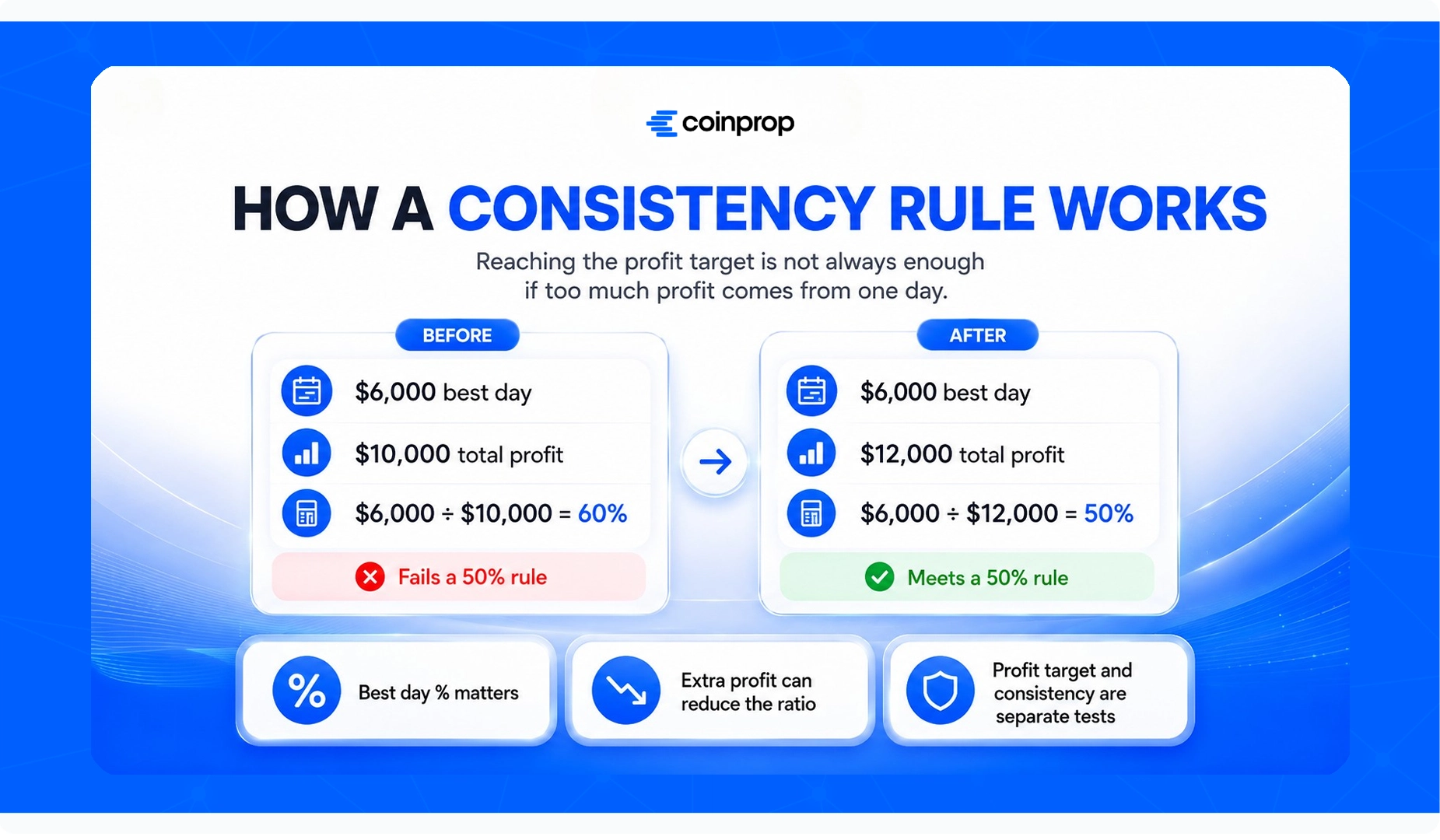
The phrase no consistency rule can be interpreted differently from one crypto prop firm to another. A firm may genuinely have no consistency requirement, or it may simply have no consistency rule during the evaluation while introducing a similar restriction after funding or when a trader requests a payout.
Before choosing a firm, traders should verify the rule themselves rather than relying solely on comparison websites, reviews, or marketing claims.
Start with the firm's official rules for the specific challenge or account you are considering. Look for any requirement that limits how profits can be generated or distributed.
Do not search only for the exact phrase consistency rule. A firm may describe the same concept using terms such as best trading day, profit distribution, profit concentration, or maximum percentage of total profit.
Also make sure you are reading the rules for the correct account type. A firm can offer several evaluation models with different conditions.
The evaluation rules are only one part of the process. After passing the challenge, the trader may move to a funded account with a different set of conditions.
Check whether the funded account introduces any requirement related to the trader's best day, profit distribution, number of profitable days, or trading activity.
This distinction is important because no consistency rule during evaluation does not necessarily mean no consistency rule after funding.
The payout policy should be checked separately from the trading rules.
A trader may be allowed to generate profits without a consistency restriction during the evaluation but face a profit related condition when requesting a withdrawal. If a payout depends on meeting a best day or profit distribution requirement, that should be clearly identified when comparing the firm.
The key question is simple:
Can the trader withdraw profits without having to satisfy a separate consistency requirement?
If the answer is no, the firm should not be presented as having no consistency restrictions throughout the entire trading and payout process.
A best day restriction is one of the clearest indicators of a consistency requirement.
For example, a firm might state that a trader's most profitable day cannot represent more than a certain percentage of total profits. Even if the firm never uses the term consistency rule, this type of restriction effectively limits profit concentration.
The calculation also matters. Some firms may calculate the percentage using total profits, eligible profits, or another formula. Always use the firm's actual definition rather than assuming that every best day rule works the same way.
Consistency requirements can also appear as a broader profit distribution requirement.
A firm may require profits to be generated across a certain number of trading days or may impose another condition designed to prevent the trader from relying heavily on a single profitable session.
When reviewing the rules, look for language related to:
best day, profit distribution, profit concentration, profitable days, consistency percentage, or similar concepts.
This is particularly important when researching firms for a comparison article because a simple No consistency rule label can be misleading if another rule produces essentially the same restriction.
Always identify when a rule applies.
A firm can have no consistency requirement during the evaluation but introduce one once the trader reaches a funded account. It could also apply the requirement only when the trader becomes eligible for a payout.
A useful way to verify this is to separate the process into three stages:
Evaluation → Funded Account → Payout
Check the rules at each stage rather than treating the firm as having one universal rulebook.
Prop firm rules can change, so the information you find in an older review, Reddit discussion, comparison site, or social media post may no longer reflect the firm's current conditions.
Before purchasing an evaluation, check the firm's current official rules and payout policy and confirm that they apply to the specific account model you intend to use.
This is also important when publishing a comparison article. A firm should only be listed as having no consistency rule based on rules that can be verified at the time of publication. If the firm changes its conditions later, the comparison should be updated accordingly.
Ultimately, the safest approach is to treat no consistency rule as a claim that needs to be verified, not as a marketing label. The goal is to determine whether the trader is genuinely free from profit distribution restrictions throughout the relevant stages of the account, not simply whether the words consistency rule appear in the firm's rules.

A crypto prop firm without consistency rules can be particularly useful for traders whose strategies naturally produce uneven returns. If a trader's best opportunities tend to occur only a few times per week or month, a consistency requirement can add another layer of restrictions by limiting how much of the total profit can come from those opportunities.
However, the absence of a consistency rule is not automatically an advantage for every trader. The main consideration is whether the firm's profit distribution rules fit the way the trader actually generates returns.
Breakout traders often wait for price to move beyond an important support or resistance level before entering a position. Most trading sessions may produce no suitable setup, while a successful breakout can generate a relatively large profit in a short period.
This naturally creates uneven daily returns. A no consistency prop firm can be a good fit because the trader does not need to reduce the percentage of total profit generated by a particularly successful breakout simply to satisfy a best day requirement.
Momentum traders typically focus on assets that are experiencing strong directional movement. In crypto markets, momentum can develop rapidly and produce significantly larger returns on some days than others.
A trader might have several low profit or inactive sessions followed by one strong momentum move in BTC, ETH, SOL, or another cryptocurrency. Without a consistency requirement, the trader can allow those returns to remain concentrated in the sessions where the strongest opportunities actually occurred.
Swing traders generally hold positions for longer periods and may take relatively few trades compared with short term traders. Their returns can therefore be highly uneven across individual trading days.
A position opened after a strong technical setup could remain open for several days before producing a substantial gain. A prop firm without consistency rules may be more compatible with this style because the trader is not required to generate a specific amount of profit every day or distribute profits evenly across sessions.
Swing traders should still pay close attention to overnight and weekend holding rules, since these restrictions can be more relevant to their strategy than consistency requirements.
Event driven traders look for opportunities created by significant market events, such as major economic announcements, regulatory developments, ETF related news, protocol updates, or sudden changes in market sentiment.
These opportunities are inherently difficult to distribute evenly. A trader may have very little activity for several sessions and then generate a substantial return from one high impact market event.
A no consistency model can therefore provide more flexibility for this type of strategy. However, traders should separately verify whether the prop firm allows news trading and whether it imposes restrictions on holding positions during major market events.
You do not necessarily need to follow a specific trading strategy to benefit from a no consistency model. The most important characteristic may simply be how your profits are distributed over time.
For example, a trader could have the following results:
This does not automatically indicate poor trading performance. It may simply reflect a strategy where profitable opportunities occur irregularly.
For traders with this type of return profile, a consistency rule can become an additional constraint. A no consistency prop firm allows performance to remain uneven as long as the trader continues to meet the firm's actual risk and trading requirements.
Some traders simply prefer a prop firm that does not tell them how their profits need to be distributed.
They may want to focus on their entry criteria, position sizing, and risk management without monitoring whether one profitable day is becoming too large a percentage of their overall returns.
For these traders, a no consistency rule can make the account structure easier to manage. It removes one specific condition from the evaluation or payout process and allows the trader's profits to develop according to their strategy.
That said, fewer profit distribution restrictions should not be confused with fewer rules overall. Traders should still compare drawdown, daily loss limits, leverage, position restrictions, minimum trading days, and payout conditions before deciding whether a particular crypto prop firm is suitable.
A crypto prop firm without consistency rules is not necessarily the best option for every trader. If a trader's strategy already produces relatively stable returns across multiple sessions, the absence of a consistency requirement may provide little practical advantage.
In these cases, other factors, such as drawdown, daily loss limits, leverage, execution, trading restrictions, and payout conditions, may be more important when choosing a prop firm.
Traders who regularly generate similar levels of profit across multiple trading days may not be significantly affected by a consistency requirement.
For example, if a trader's strategy typically produces small but relatively stable gains throughout the week, their best trading day is unlikely to represent an unusually large percentage of their total profits. A best day requirement may therefore have little impact on their ability to complete an evaluation or qualify for a payout.
For this type of trader, it may make more sense to prioritize other account conditions rather than specifically looking for a no consistency model.
Scalpers who take multiple trades throughout the day may naturally distribute their returns across a large number of positions and sessions.
Because their strategy does not depend on a small number of exceptionally large trades, a consistency requirement may be less restrictive. A trader generating many smaller gains is less likely to have one trading day dominate their total profit.
For these traders, factors such as execution quality, trading fees or costs, leverage, position limits, and daily loss limits may have a greater practical impact than whether the firm has a consistency rule.
Some traders intentionally distribute their exposure and trading activity across multiple sessions. They may avoid concentrating their risk in a single position or waiting for one major market move to generate most of their returns.
If this already matches the trader's strategy, a consistency rule may not create a significant additional burden.
In this situation, choosing a prop firm solely because it has no consistency rule may not provide much benefit. The trader may be better served by comparing the firm's overall risk structure, drawdown, payout terms, leverage, and trading conditions.
Ultimately, the value of a no consistency model depends on the trader's return profile. The more naturally uneven your profits are, the more relevant a no consistency rule becomes. If your strategy already produces relatively consistent returns, other characteristics of the prop firm may deserve greater weight in the decision.
A consistency rule is only one type of restriction that can affect a trader's experience with a crypto prop firm. While it focuses on how profits are distributed, other rules control losses, account drawdown, trading activity, or position exposure.
Understanding the difference is important when comparing crypto prop firms without consistency rules. A firm may remove a consistency requirement while still maintaining strict risk or trading restrictions.
Consistency Rule: Controls profit distribution.
Example: Best day ≤ X% of total profit.
Daily Loss Limit: Controls daily losses.
Example: Cannot lose more than X% in one day.
Maximum Drawdown: Controls overall account loss.
Example: Account cannot fall below X%.
Profit Target: Controls the required profit.
Example: Reach X% profit.
Minimum Trading Days: Controls trading activity.
Example: Trade on at least X days.
Leverage Limit: Controls position exposure.
Example: Maximum X× leverage.
The key difference is that a consistency rule does not primarily control risk. Instead, it controls the distribution of a trader's profits. A Daily Loss Limit and Maximum Drawdown, on the other hand, are designed to limit losses and protect the account from excessive downside.
The Profit Target determines how much a trader needs to earn during an evaluation, while Minimum Trading Days determines how many trading sessions may be required regardless of how quickly the profit target is reached. Leverage Limits control the amount of market exposure a trader can take relative to the account size.
This distinction matters because a crypto prop firm can have no consistency rule while still having strict risk limits. Therefore, removing one rule does not necessarily make the entire evaluation easier.
When comparing firms, traders should look at these rules together. A no consistency account with a tight drawdown or restrictive leverage may be less suitable for a particular strategy than another account that has a consistency requirement but provides more room for the trader's normal risk management.
A crypto prop firm without a consistency rule is a proprietary trading firm that does not require traders to distribute their profits across multiple trading days or limit how much of their total profit can come from one day or trade. The trader must still follow the firm's other rules, such as profit targets, drawdown limits, daily loss limits, and trading restrictions.
Yes. Some crypto prop firms do not impose a consistency requirement during their evaluation, while others may have no consistency requirement throughout the evaluation, funded account, and payout process. However, rules vary between firms and account types, so traders should verify the current official rules before choosing an account.
If the prop firm does not impose a best day or profit distribution requirement, a trader can generally generate a large portion of their total profit in one trading day without creating a separate consistency violation. However, other conditions, such as minimum trading days, drawdown limits, and daily loss limits, may still apply.
Not necessarily. A firm without a consistency rule may allow a trader's profit to come from one large winning trade, but other evaluation requirements can still prevent the challenge from being completed immediately. For example, the firm may require multiple trading days or impose specific risk limits that the trader must satisfy.
Some do and some do not. Where a consistency rule exists, it may limit the percentage of total profit that can come from the trader's best day or impose another profit distribution requirement. Other firms may have no such restriction. The rule can also differ between evaluation, funded accounts, and payouts.
It depends on the prop firm. A firm may have no consistency requirement during the evaluation but introduce one after the trader receives a funded account. Others may maintain the same rule throughout the account lifecycle, while some may have no consistency requirement at all. Traders should therefore check the funded account rules separately from the evaluation rules.
Yes. A prop firm can allow traders to complete an evaluation without a consistency requirement and then impose a best day or profit distribution condition before approving a payout. This is why evaluation rules and payout rules should be reviewed separately when comparing crypto prop firms.
Not necessarily. A no consistency model can be better suited to traders whose profits are naturally uneven, such as breakout, momentum, swing, or event driven traders. However, another firm may offer more favorable drawdown, leverage, daily loss, trading, or payout conditions. The best choice depends on how the firm's complete rule set fits the trader's strategy.
In addition to consistency, check the profit target, maximum drawdown, Daily Loss Limit, static or trailing drawdown structure, minimum trading days, leverage and position limits, trading restrictions, and payout conditions. It is also important to determine whether these rules change after the evaluation or when requesting a payout.
A crypto prop firm without a consistency rule can be a strong option for traders who generate uneven returns and do not want their profits to be restricted by a best day or profit distribution requirement. Breakout, momentum, swing, and event driven traders may particularly benefit because a small number of high conviction trades can naturally account for a large portion of their overall profits.
However, the absence of a consistency rule should not be the only factor in your decision. A firm can remove its consistency requirement while maintaining stricter conditions elsewhere. Maximum drawdown, Daily Loss Limit, leverage, position restrictions, minimum trading days, and payout requirements can have a significant impact on how practical the account is for your strategy.
It is also important to distinguish between the evaluation, funded account, and payout stages. A firm may have no consistency rule during the challenge but introduce a profit distribution requirement after funding or before a payout. Before choosing an account, verify the rules that apply at each stage rather than relying on a general no consistency rule claim.
Ultimately, the right choice depends on your trading style and return profile. If your strategy relies on a few high conviction opportunities and naturally produces uneven daily returns, avoiding consistency restrictions may be valuable. If your strategy already produces relatively stable returns, drawdown, execution, leverage, and payout conditions may deserve more attention.
The best crypto prop firm is therefore not necessarily the one with the fewest rules. It is the one whose complete trading and payout structure fits the way you actually trade.
