Funded perps trading gives traders access to perpetual markets through a crypto prop firm without requiring the same level of personal trading capital. This guide explains how funded perps accounts work, what markets you can trade, how evaluations and payouts are structured, which rules and costs matter, and what to consider when choosing a crypto prop firm for perpetual trading.
Funded perps trading combines perpetual contracts with the funded account model offered by a crypto prop firm. Instead of providing the full amount of trading capital required to take positions in the market, a trader first completes the prop firm's evaluation process and, if successful, receives access to a funded account.
The trader can then trade the perpetual markets available through the prop firm while following its risk and trading rules. These rules can define maximum drawdown, daily loss limits, leverage, position size, trading restrictions, and the conditions under which profits can be withdrawn.
For crypto traders, a crypto prop firm can provide access to leveraged long and short positions across markets such as Bitcoin, Ethereum, altcoins, and other perpetual contracts without requiring the trader to commit the same amount of personal capital to the trading account.
However, a funded account is not simply a larger trading account. The account balance, maximum permitted loss, leverage, margin, and payout conditions all work together to define how much room a trader actually has to operate.
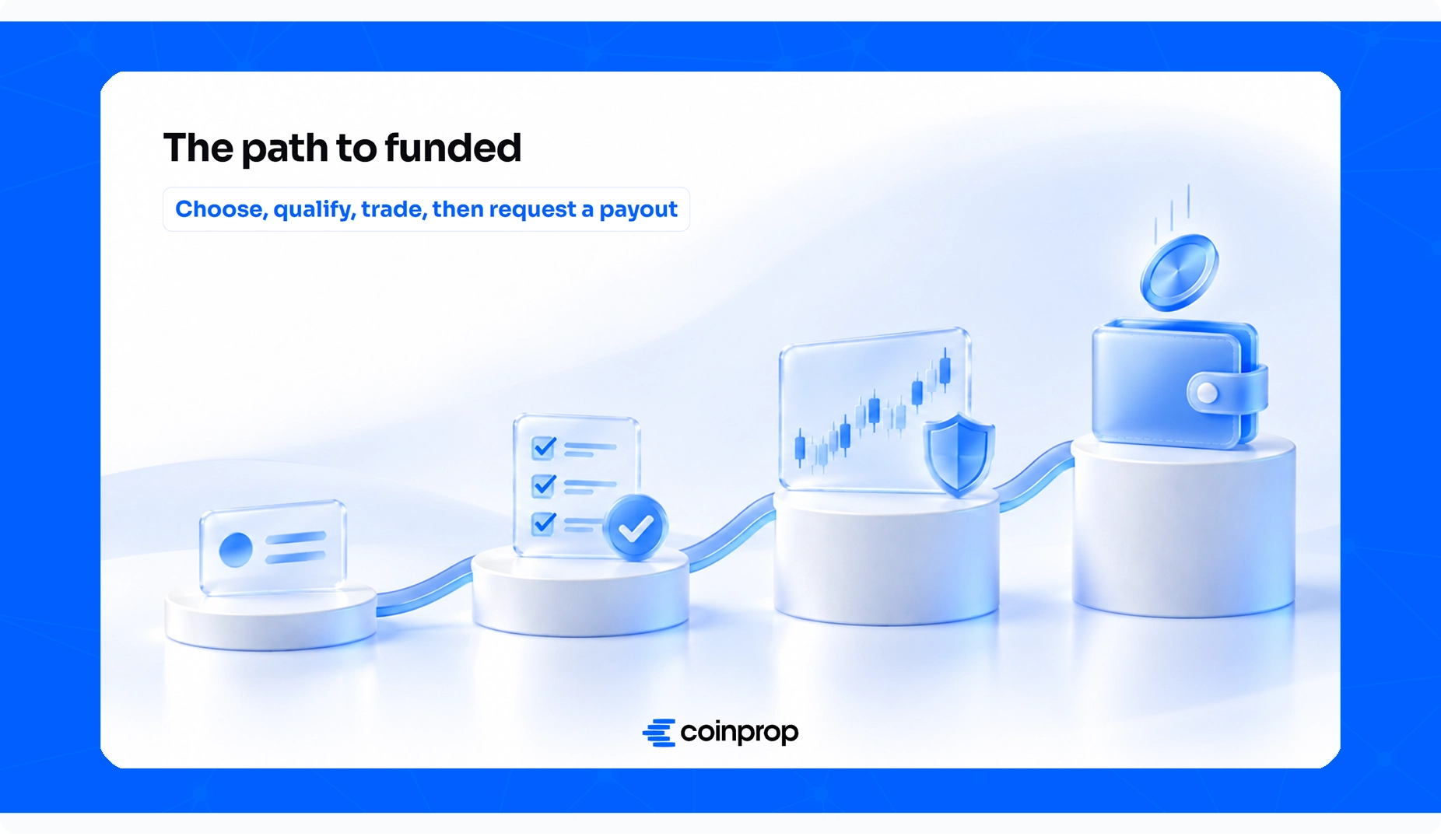
A funded perps account typically begins with an evaluation. The trader selects an account size and attempts to meet the firm's qualification requirements while staying within its risk limits.
Once the evaluation requirements are completed, the trader moves to the funded stage, subject to the firm's terms. The trader can then trade the available perpetual markets and generate profits according to the funded account's rules.
A typical funded perps account has several important components:
The specific rules vary between crypto prop firms, so traders should evaluate the full account structure rather than focusing only on the advertised account size.
The main difference between funded perps and trading perpetual contracts with personal capital is how the trading account is structured and who provides the trading capital or account allocation.
When trading with personal capital, the trader deposits their own funds and directly bears losses within the amount they choose to risk. The trader also generally keeps the profits generated in the account, after applicable trading costs and taxes.
With a funded perps program, the trader typically pays an evaluation or account fee, completes the required qualification process, and then trades under the prop firm's funded account structure. The trader's potential payout is usually based on the profits generated while following the firm's rules.
| Factor | Funded Perps | Personal Trading |
|---|---|---|
| Initial trading capital | Provided through the prop firm's account structure | Trader's own capital |
| Evaluation | Usually required | Not required |
| Risk limits | Defined by the prop firm | Set by the trader or platform |
| Maximum drawdown | Defined by the program | Depends on the trader's capital and risk |
| Leverage | Defined by the provider | Depends on the trading platform |
| Profit split | Usually applies | Trader generally keeps account profits |
| Payout rules | Provider-specific | Depends on the account and withdrawal method |
| Trading restrictions | May apply | Usually determined by the trader and platform |
The comparison is not simply about having access to more capital. A trader using a funded account accepts a predefined set of conditions in exchange for the opportunity to trade within that account structure.
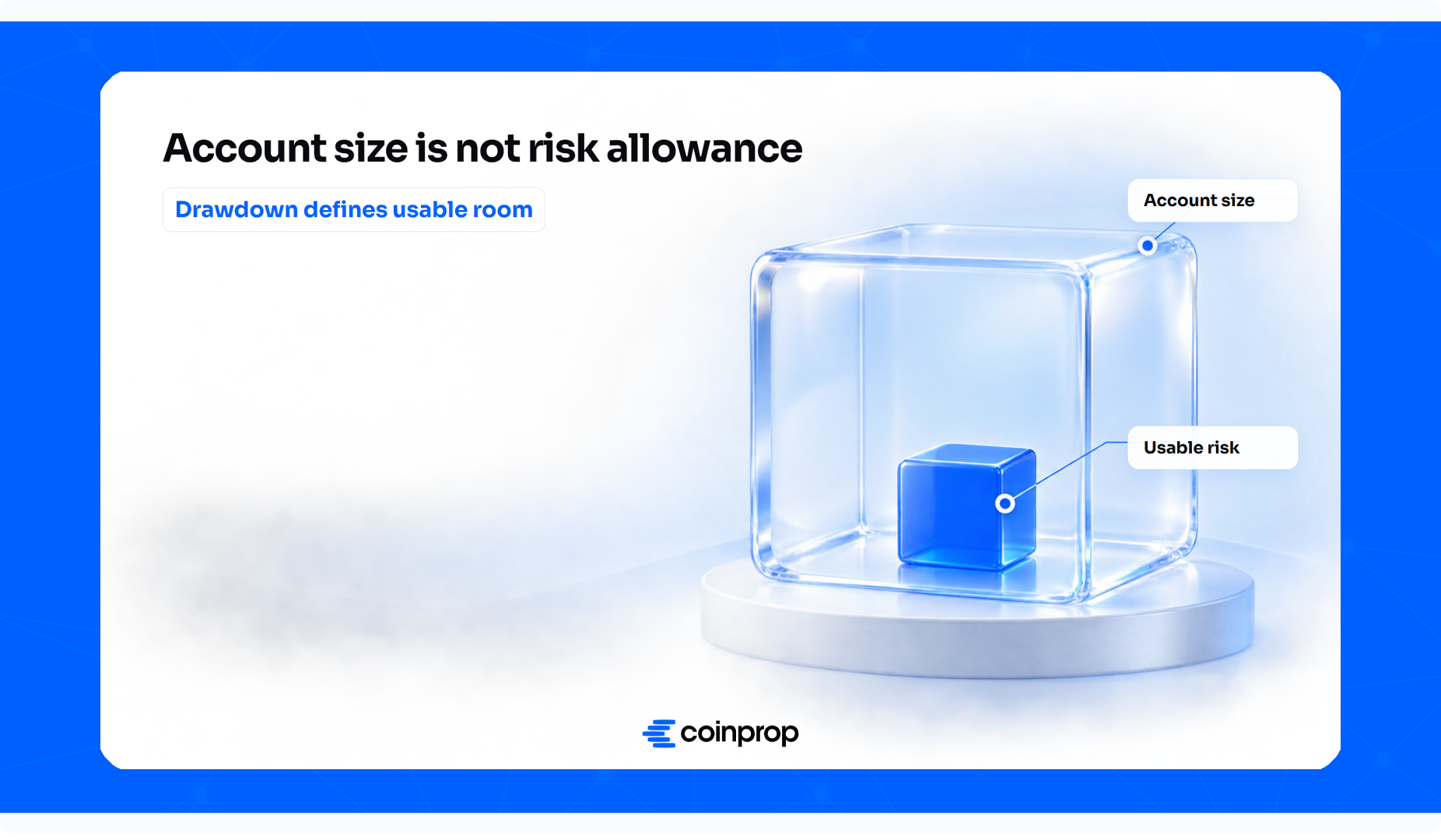
This makes the firm's rules particularly important. A nominal $100,000 account, for example, does not necessarily mean the trader can lose $100,000. The actual trading room is determined by the account's drawdown and daily loss limits.
Risk management is one of the most important parts of funded perps trading. Prop firms generally define specific limits that determine how much an account can lose before the account is closed or the trader fails the program.
The two most common limits are the daily loss limit and maximum drawdown.
A daily loss limit restricts the amount an account can lose during a defined trading day. Depending on the provider, the calculation may include realized losses, unrealized losses, trading fees, funding costs, or other account adjustments.
A maximum drawdown defines the overall loss an account can sustain before the trading account is breached. Drawdown may be static or trailing, depending on the program.
These limits can have a greater practical impact on a trading strategy than the advertised account size. A trader should therefore calculate the actual risk room available before deciding how large each position should be.
Leverage also affects risk. Higher leverage does not automatically mean that a trader must take larger positions, but it allows greater exposure relative to margin. Position sizing should therefore be based on the account's drawdown and the trader's predefined risk per trade rather than the maximum leverage available.
Other restrictions can also affect how a funded perps account is traded. These may include maximum position sizes, exposure limits, prohibited strategies, minimum trading days, consistency requirements, news restrictions, or other program-specific conditions.
Because rules differ significantly between providers, traders should always review the current terms before opening an account.
Payouts are a central part of the funded account model. After reaching the funded stage and generating profits while complying with the applicable rules, traders may become eligible to request a portion of those profits.
The exact payout structure varies between prop firms. Important factors include the required number of trading days, payout frequency, minimum payout amount, profit split, consistency conditions, payout caps, processing time, and available withdrawal methods.
Some programs allow on-demand withdrawals after a trader meets the required conditions, while others use fixed payout windows.
The profit split also matters. A program may offer a standard percentage of profits to the trader, with optional account upgrades or add-ons changing the split.
Traders should also check whether the funded stage introduces rules that did not apply during the evaluation. For example, some programs may have different consistency requirements, drawdown calculations, or payout conditions after funding.
The advertised account balance is only one part of a funded account. The actual trading room depends on several interacting factors.
Suppose a program advertises a $100,000 account but has a 6% maximum drawdown. The trader's account is not designed to absorb a $100,000 loss. The relevant risk boundary is the program's permitted drawdown, along with its daily loss and other restrictions.
The same principle applies to leverage. A program offering 5x leverage does not mean every position should use 5x leverage. The appropriate position size depends on the trader's strategy, stop distance, volatility, available margin, and the account's risk limits.
For this reason, funded perps traders should think about an account in terms of risk budget and trading conditions, not just account size.
The available markets depend on the prop firm and its trading platform. Crypto-focused programs commonly offer perpetual contracts for major cryptocurrencies such as Bitcoin and Ethereum, along with altcoins and other crypto assets.
Some providers also extend perpetual trading to other markets, including forex, stocks, commodities, and indices.
Market availability matters because the underlying market affects volatility, liquidity, trading hours, fees, funding, and execution. A trader who primarily trades BTC perps has different requirements from someone trading smaller altcoins or non-crypto perpetual markets.
Before choosing a funded perps account, traders should confirm the exact markets available and understand how prices, execution, leverage, and costs are determined for those markets.
Funded perps trading is not defined only by account rules. The trading environment can directly affect execution and risk management.
Important factors include the source of market data, charting tools, order execution, spread, slippage, trading fees, funding costs, order types, and risk-management tools.
For active perpetual traders, small differences in execution can matter, particularly when entering or exiting positions frequently. Market data should also reflect a reliable underlying market rather than an artificial price feed that behaves differently from the market the trader is trying to trade.
A professional funded perps environment should therefore be evaluated as a complete trading system: the account rules, available markets, platform, market data, execution, costs, and payout structure all matter.
Funded perps can be relevant to traders who already understand perpetual contracts and want to trade within a defined risk framework rather than committing a large amount of personal capital.
Different trading styles can be used, provided they comply with the program's rules. Short-term traders may focus on intraday price movements, while other traders may hold positions for longer periods when the platform and account conditions allow it.
The important consideration is whether the trader's strategy fits the account's restrictions.
A strategy that depends on very large positions, long holding periods, high funding costs, or frequent entries may interact differently with a funded program than a strategy based on smaller, controlled positions.
Before opening an account, traders should review the complete trading conditions rather than relying on the headline account size or evaluation price.
Key factors include:
These factors determine how the account actually works in practice and whether its structure matches the trader's approach.
Not necessarily. Both models can use evaluations, predefined drawdown limits, leverage, and profit splits, but the underlying contracts can be different.
Funded perps programs use perpetual contracts that do not have a fixed expiration date. Traditional futures contracts generally have defined expiration or settlement dates.
This difference can affect how positions are held, how contracts are managed, and what costs apply. Perpetual contracts may use funding mechanisms, while traditional futures use different pricing and settlement structures.
For traders comparing the two models, the most important factors are the actual contract specifications, trading hours, market availability, risk rules, execution, and costs offered by the specific provider.
Perpetual trading refers to trading perpetual futures, commonly known as perps. These derivative contracts allow traders to speculate on the price of an underlying asset without owning it directly. Unlike traditional futures, perpetual contracts have no fixed expiration date, so positions can remain open as long as the trader maintains the required margin and stays within the applicable risk conditions.
Perpetual trading is most commonly associated with crypto markets, where perps are widely used to trade assets such as Bitcoin, Ethereum, and other cryptocurrencies. However, perpetual contracts can also be offered on markets such as forex, stocks, commodities, and indices, depending on the trading platform or prop firm.
For traders using a crypto prop firm, perpetual trading provides a way to access leveraged long and short positions through a defined account structure. When these markets are offered through a funded program, traders can trade perps under the prop firm's account limits, risk rules, and payout conditions.
A perpetual contract tracks the price of an underlying market without requiring the trader to own the underlying asset. Traders can take a long position when they expect the price to rise or a short position when they expect it to fall.
Leverage allows traders to control a larger position with less margin than would be required to purchase the underlying asset directly. However, leverage also increases the impact of price movements on account equity and can bring a position closer to liquidation or a defined risk limit.
Because perpetual contracts do not expire, they use a funding mechanism to help keep the contract price aligned with the underlying market. Funding payments can be charged or credited to traders depending on the market and the prevailing funding rate.
The combination of no fixed expiration, long and short positions, leverage, and funding makes perpetual contracts particularly common in crypto trading.
The main difference between perpetual contracts and traditional futures is expiration. Traditional futures have a defined expiration or settlement date, while perpetual contracts do not.
| Feature | Perpetual Contracts | Traditional Futures |
|---|---|---|
| Expiration | No fixed expiration | Fixed expiration |
| Long positions | Yes | Yes |
| Short positions | Yes | Yes |
| Leverage | Available | Available |
| Funding mechanism | Commonly used | Typically not used in the same way |
| Rollover | Not required because there is no expiration | May be required to maintain exposure |
The exact contract specifications, leverage, margin requirements, and settlement mechanisms depend on the market and trading platform.
Spot trading involves buying or selling the underlying asset directly. For example, buying Bitcoin on a spot market gives the trader ownership of the Bitcoin, subject to the platform's custody and settlement structure.
Perpetual trading works differently. A perpetual is a derivative contract that tracks the price of an underlying asset without transferring ownership of that asset. Traders can generally take both long and short positions and may use leverage.
This also introduces additional considerations, including margin requirements, funding payments, liquidation risk, and the specific risk limits imposed by the trading platform or prop firm.
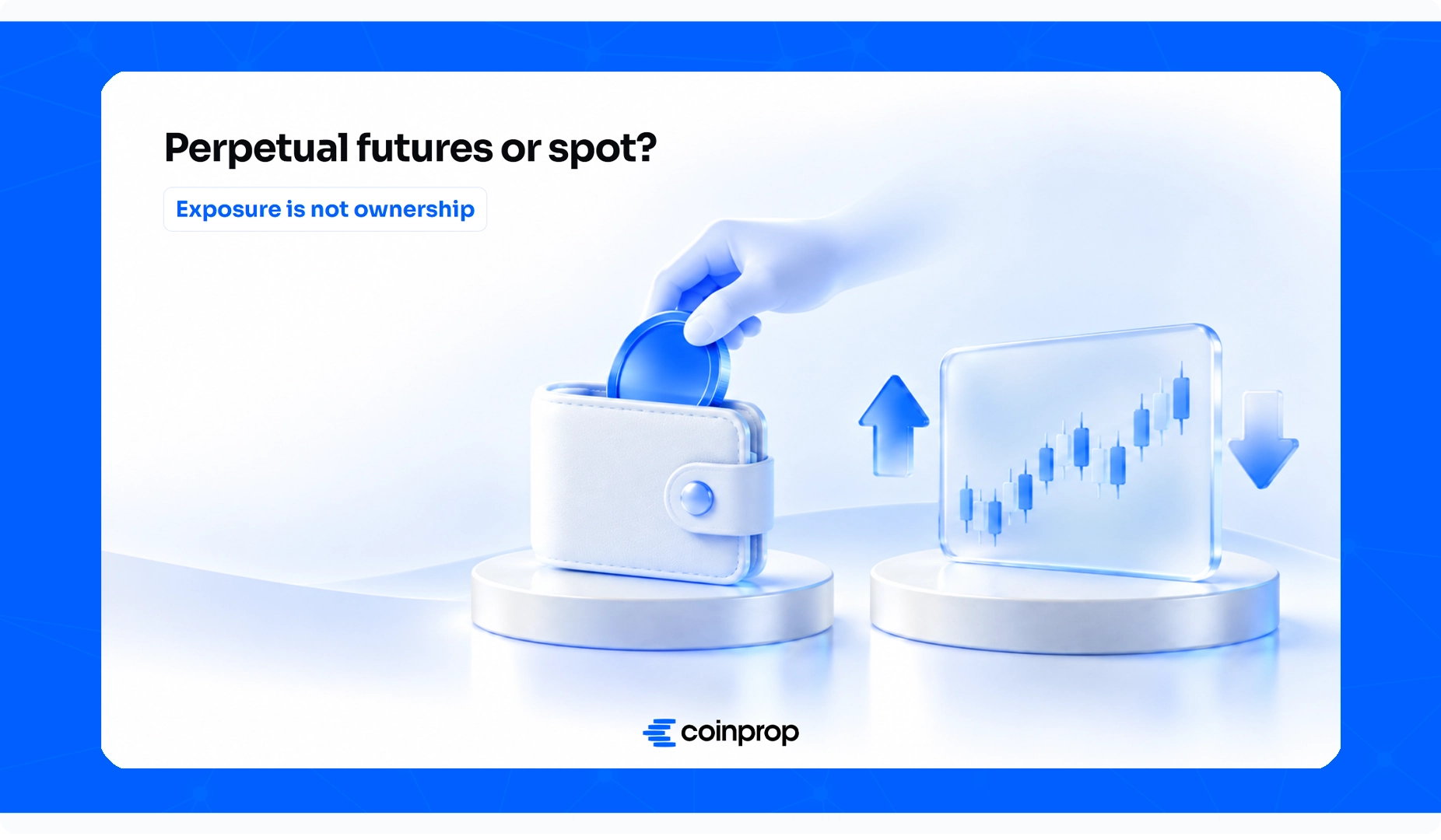
Perpetual contracts provide a standardized way to offer leveraged long and short exposure across a wide range of markets. This makes them suitable for prop firm environments where traders operate within predefined account and risk parameters.
A crypto prop firm may offer perpetual markets across major cryptocurrencies, altcoins, and other asset classes such as forex, stocks, commodities, or indices. For funded traders, the important factors go beyond the markets themselves and include drawdown limits, daily loss rules, leverage, execution, market data, trading costs, and payout conditions.
Perpetual trading through a crypto prop firm combines perpetual markets with a predefined account and risk structure. Instead of trading directly with the full amount of personal capital required to take a position, traders can enter a prop firm's evaluation program and, after meeting its requirements, receive access to a funded account.
The exact structure varies between firms, but the process typically involves choosing an account, completing an evaluation, trading within defined risk limits, and becoming eligible for payouts after reaching the funded stage.
When comparing crypto prop firms for perpetual trading, look beyond the advertised account size or evaluation fee. The trading environment, available markets, leverage, drawdown rules, daily loss limits, execution, market data, trading costs, and payout conditions can all affect how the account works in practice.
It is also important to check whether the firm offers the perpetual markets you actually trade and whether its rules are compatible with your trading strategy.
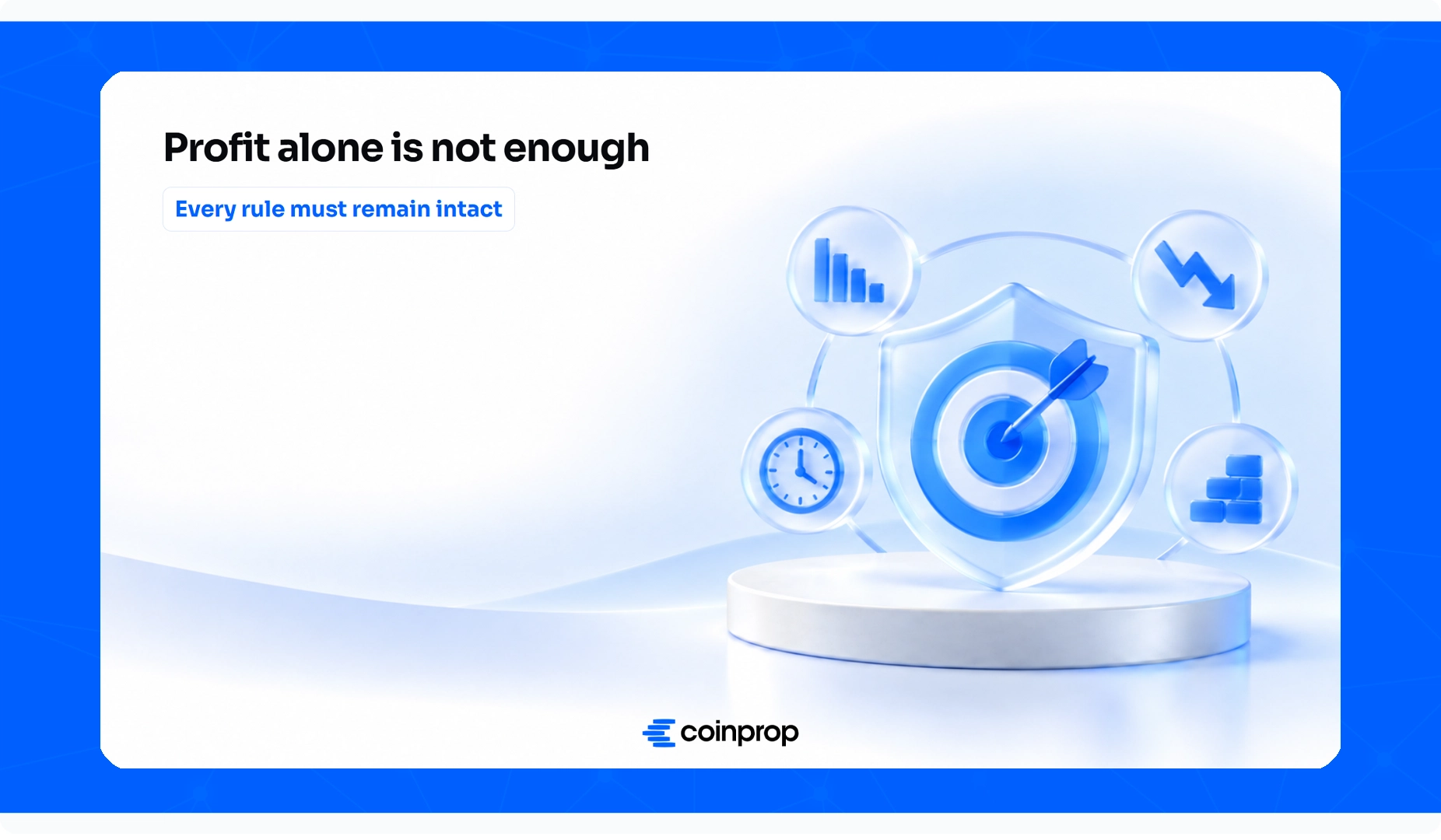
A prop firm evaluation is designed to determine whether a trader can meet specific profit and risk requirements within the firm's rules. The evaluation may include a profit target, maximum drawdown, daily loss limit, minimum trading days, or other trading restrictions.
Some firms use a single-step evaluation, while others require multiple stages. The conditions also vary between account types, so traders should review the complete rules before starting an evaluation.
After completing the required evaluation conditions without violating the account's risk rules, a trader can move to the funded stage. The account remains subject to the prop firm's trading conditions, but the requirements may differ from those used during the evaluation.
For traders looking for funded perps, the key factors include the available perpetual markets, leverage, maximum drawdown, daily loss limits, position restrictions, and the conditions for requesting payouts.
Once funded, traders can use the firm's trading environment to take positions in the available perpetual markets while staying within the applicable account limits. Depending on the provider, this can include crypto perps as well as perpetual markets for other asset classes.
The funded stage is not simply an extension of the evaluation. Traders should understand which rules continue to apply, whether there are additional conditions, and how profits and drawdown are calculated before trading the account.
Payout conditions vary between crypto prop firms. Some providers allow traders to request payouts after meeting a minimum number of trading days, while others may impose profit targets, consistency requirements, payout caps, or other conditions.
When comparing funded perps accounts, traders should check the payout frequency, profit split, minimum payout requirements, withdrawal methods, fees, and any restrictions that apply after funding. These conditions can be just as important as the initial evaluation requirements when assessing a funded trading program.
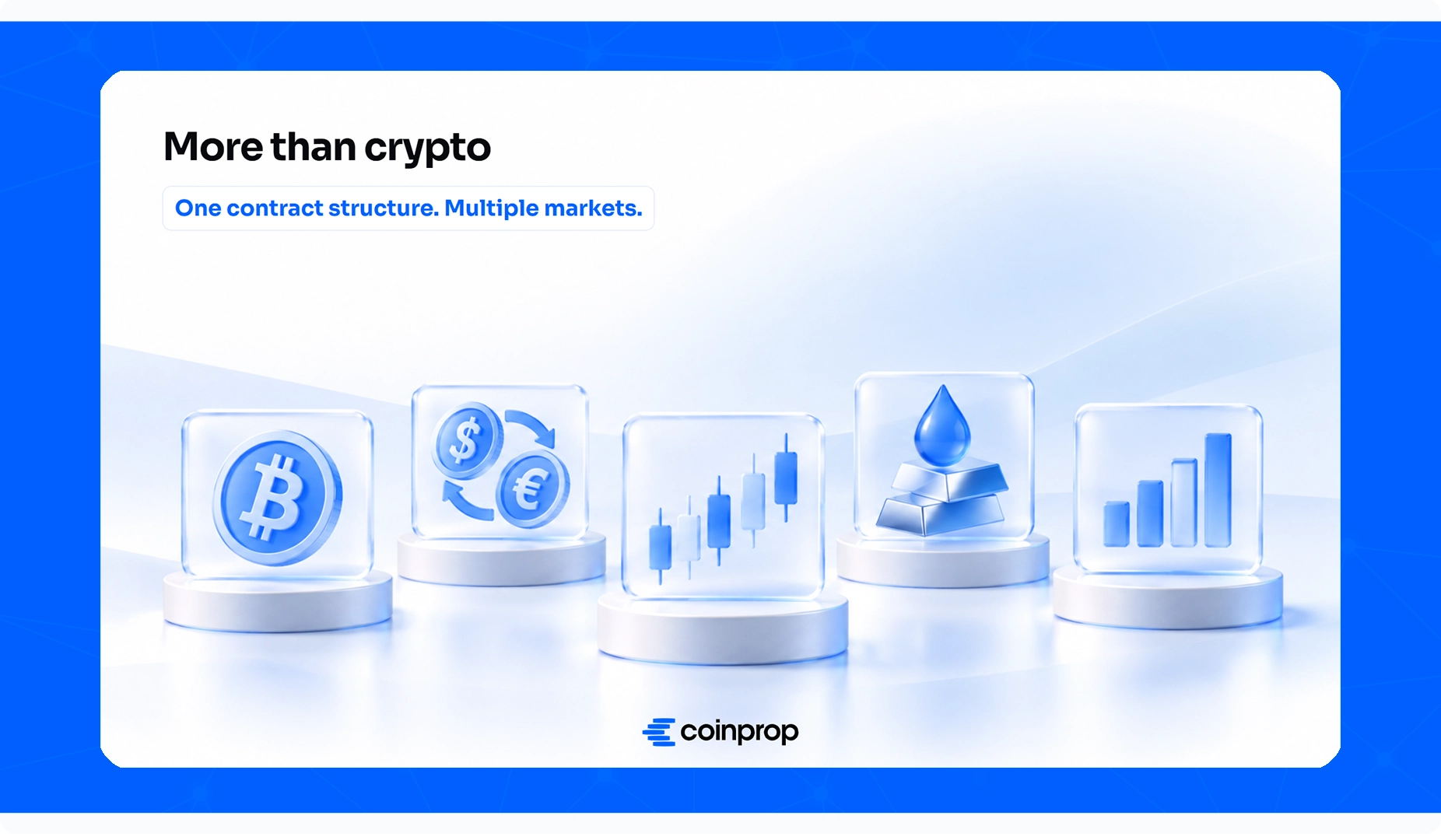
The markets available through a funded perps program depend on the prop firm, its trading platform, and the perpetual contracts it supports. Crypto is the most common market for perps, but some crypto prop firms also offer perpetual contracts based on forex, stocks, commodities, or indices.
Market availability matters because different markets have different levels of volatility, liquidity, trading hours, leverage, funding costs, and execution characteristics. A trader who primarily trades Bitcoin perps may have very different requirements from someone trading altcoins, forex, or stock-based perpetuals.
Before choosing a funded perps account, check the exact markets available, the leverage for each market, trading costs, market-data source, and any position or exposure limits that apply.
Funded crypto perps allow traders to take long or short positions on cryptocurrency markets through a funded account. Bitcoin and Ethereum are among the most widely traded perpetual markets, while many platforms also offer perpetual contracts for altcoins and other crypto assets.
Crypto perps are available around the clock on many trading platforms, which gives traders flexibility to trade outside traditional market hours. However, crypto markets can also experience significant volatility, particularly during major market moves or periods of reduced liquidity.
For funded traders, this makes risk management especially important. Leverage, position size, daily loss limits, maximum drawdown, and the cost of holding positions can all affect how a crypto perps strategy performs within a funded account.
Depending on the prop firm, the available crypto markets can range from major assets to hundreds of altcoin and memecoin perpetual contracts. Traders should verify the specific market list rather than assuming that every cryptocurrency is available.
Funded forex perps provide exposure to currency markets through perpetual contracts rather than traditional spot forex or fixed-expiration futures.
A forex perpetual can track the price of a currency pair such as EUR/USD or GBP/USD while allowing traders to take long or short positions without owning the underlying currencies. Because the contract does not have a fixed expiration, traders do not need to manage a traditional futures expiry.
The trading conditions can differ significantly from conventional forex trading. Traders should check how the perpetual contract is priced, what market data it uses, whether funding or other holding costs apply, and what trading hours are available.
For funded traders, the prop firm's leverage, drawdown rules, position limits, and execution conditions are also important. A forex strategy that works with a traditional broker may need to be adapted when traded through a perpetual contract.
Funded stock perps give traders access to price exposure on individual stocks through perpetual contracts instead of purchasing the underlying shares.
A stock perpetual can allow traders to take either a long or short position based on the price movement of a stock. Unlike buying shares, the trader does not take ownership of the underlying company.
This structure can be useful for traders who focus on short-term price movements or want to trade both directions of the market. However, stock perps can have different trading hours, liquidity conditions, leverage limits, and costs from crypto perpetuals.
Traders should also consider events that can cause significant stock price movements, such as earnings releases, corporate announcements, and major market news. The applicable rules of the funded program may determine whether and how these events can be traded.
Some prop firms extend perpetual trading beyond cryptocurrencies and individual stocks to commodities and market indices.
Commodity perps can provide exposure to markets such as gold, silver, or crude oil without requiring the trader to purchase the physical commodity or use a traditional futures contract. Index perps can similarly provide price exposure to a market index through a derivative contract.
These markets can behave differently from crypto. Commodity and index prices are influenced by factors such as economic data, interest rates, monetary policy, geopolitical developments, and the opening and closing of major financial markets.
Trading conditions can also vary considerably between providers. Traders should check the contract specifications, market hours, leverage, margin requirements, funding or holding costs, and available liquidity before using a funded account for these markets.
The fact that a prop firm offers multiple perpetual markets does not mean they all have identical trading conditions. Leverage, trading fees, funding, liquidity, market hours, and position limits can vary by asset class.
For example, crypto perps may trade continuously and can experience sharp intraday volatility, while stock and index perps may follow the trading hours of their underlying markets. Forex and commodity perps can have their own pricing and trading schedules depending on the provider.
For this reason, traders should evaluate each market based on the strategy they intend to use rather than choosing an account simply because it offers a large number of markets.
The most useful questions to ask are:
Understanding these differences can help traders determine whether a funded perps program actually supports the markets and strategies they intend to trade.
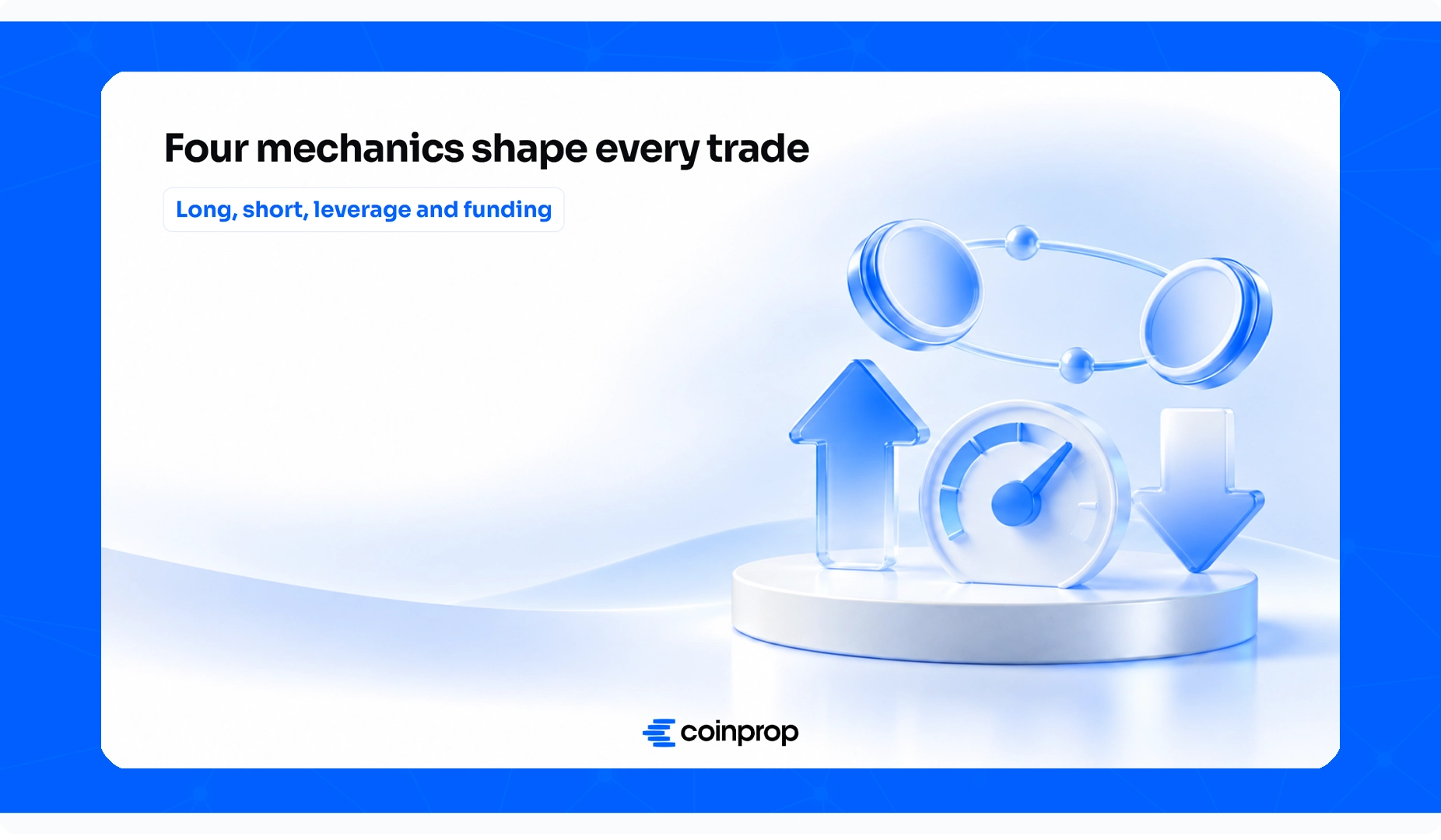
Funded crypto perps trading allows traders to trade cryptocurrency perpetual contracts through a crypto prop firm's funded account structure. Instead of buying and holding the underlying cryptocurrency, traders use perpetual contracts to take long or short positions based on price movements.
Bitcoin, Ethereum, and a wide range of altcoins are commonly available as crypto perpetual markets. Depending on the crypto prop firm, traders may also have access to smaller-cap assets and memecoins.
For funded traders, crypto perps combine the flexibility of perpetual trading with predefined account rules. Leverage, maximum drawdown, daily loss limits, position size, trading costs, funding rates, and payout conditions can all affect how a strategy performs.
Because crypto markets can move quickly and trade continuously, understanding both the perpetual contract and the funded account rules is essential before taking a position.
Bitcoin and Ethereum are among the most liquid and widely traded crypto perpetual markets. Their high trading activity makes them common markets for traders using funded accounts through a crypto prop firm.
BTC and ETH perps allow traders to take both long and short positions without directly owning Bitcoin or Ethereum. Traders can therefore participate in upward or downward price movements while managing their exposure through position size and leverage.
The risk profile is still significant. A large position relative to the account's drawdown limit can cause a relatively small market move to have a substantial effect on account equity.
For funded traders, key considerations include the account's maximum drawdown, daily loss limit, leverage, trading fees, funding costs, and execution conditions. The availability of a liquid market does not remove the need for disciplined position sizing.
Bitcoin and Ethereum can also experience rapid price movements around major economic announcements, market-wide liquidations, regulatory developments, or significant crypto-specific events. Traders should understand how their funded program handles these conditions before trading them.
Altcoin perps extend funded crypto trading beyond the largest cryptocurrencies. Depending on the provider, a funded account may support perpetual contracts for hundreds of additional crypto assets.
Altcoins can have very different volatility and liquidity characteristics from BTC and ETH. Some markets can move significantly in a short period, while smaller markets may have thinner order books and greater price sensitivity to large orders.
This makes position sizing particularly important. A position that appears reasonable based on its dollar value may represent substantially more risk in a volatile or less liquid market than the same position in a highly liquid asset.
Traders should also check whether the crypto prop firm's leverage differs between major cryptocurrencies and altcoins. Some providers apply lower leverage to smaller or more volatile assets.
Memecoins can introduce additional considerations because their prices may react sharply to market sentiment, social activity, announcements, and sudden changes in liquidity. If a funded program supports memecoin perps, traders should review the specific leverage, position, and risk conditions that apply to those markets.
One of the main characteristics of perpetual contracts is the ability to trade in both directions.
A long position is used when a trader expects the price of the underlying asset to rise. If the price increases after the position is opened, the position can generate a profit before trading costs and other applicable charges.
A short position is used when a trader expects the price to fall. A decline in the underlying price can generate a profit on the short position, again before applicable costs.
This two-sided structure is particularly relevant for funded trading because traders can look for setups in both rising and falling markets. However, both long and short positions carry substantial risk when leverage is used.
For example, a trader who opens a BTC perpetual with high leverage may have a relatively small margin requirement compared with the notional position size. A sharp move against the position can therefore consume a significant portion of the account's available risk.
Funded traders should define their maximum acceptable loss before entering a trade and size the position around the account's actual risk limits.
Leverage allows traders to control a larger notional position with less margin. In funded crypto trading, the maximum leverage is usually determined by the crypto prop firm and may vary between assets.
Leverage itself does not determine how much a trader must risk. A trader can use less than the maximum available leverage and keep position sizes relatively small. The more important question is how much of the account's available drawdown is exposed to a particular trade.
For example, if a funded account has a 6% maximum drawdown, the trader should not treat the full account balance as the amount available to lose. The relevant risk budget is the permitted drawdown, together with the daily loss limit and any other account restrictions.
A useful way to think about the relationship is:
Position size + leverage + market volatility + stop distance = trade risk
If the position is too large, a normal market fluctuation can have an outsized effect on account equity. This can become especially important in altcoin and memecoin markets, where price movements can be much larger than those typically seen in major crypto assets.
Funded traders should also consider the difference between realized and unrealized losses. A position can temporarily move against the trader even if it has not yet been closed, and some prop firms include unrealized PnL when calculating account risk limits.
The exact calculation depends on the provider, so traders should understand how daily loss and maximum drawdown are measured before trading.
Funding is one of the main mechanisms used by perpetual contracts to help keep their market price aligned with the underlying asset or reference market.
Unlike traditional futures, perpetual contracts do not have an expiration date that naturally brings the contract to settlement. Funding payments therefore help maintain the relationship between the perpetual contract and its reference price.
Depending on the market and the current funding rate, traders may either pay or receive funding. The direction and size of the payment can change as market conditions change.
For a funded trader, funding costs can become relevant when positions are held for longer periods. A strategy that generates a profit from price movement can still be affected by accumulated funding payments, trading fees, and other execution costs.
The actual funding mechanism depends on the platform and contract. Some crypto prop firms may mirror the funding conditions of an underlying exchange, while others may use a different structure.
Traders should therefore check:
Understanding funding is particularly important for swing traders and anyone who holds crypto perps for extended periods.
The quality and source of market data can have a direct impact on perpetual trading. Traders rely on accurate prices to identify entries, exits, stops, and take-profit levels.
A funded crypto perps platform may obtain market data from a specific exchange, liquidity provider, or other pricing source. The resulting price can affect charting, execution, spread, and the calculation of account PnL.
For this reason, traders should understand where the prices displayed on their platform come from and whether the execution environment reflects the underlying market conditions.
This becomes especially important during periods of high volatility, when spreads can widen, order-book liquidity can change quickly, and execution prices may differ from the price displayed when an order is submitted.
For traders choosing a crypto prop firm, the market-data source should therefore be considered alongside the account's rules, available markets, leverage, and trading costs.
Trading crypto perps through a funded account does not eliminate market risk. The prop firm's drawdown rules define the maximum room available, but the trader remains responsible for controlling exposure within those limits.
A practical risk framework can include:
The goal is not simply to avoid breaching a funded account. Consistent risk management also helps traders maintain enough room to execute their strategy through normal market fluctuations.
For that reason, choosing a crypto prop firm for funded crypto perps should involve more than comparing account sizes. The available markets, leverage, risk limits, execution, market data, costs, and payout conditions all form part of the trading environment.
Funded forex perps trading gives traders access to currency price movements through perpetual contracts within a crypto prop firm's funded account structure. Instead of trading a traditional spot forex position, traders use a derivative contract that tracks the price of a currency pair without requiring ownership of the underlying currencies.
Forex perpetuals can provide access to familiar currency markets while using the same basic structure found in other perpetual contracts. Traders can take long or short positions, use leverage where permitted, and hold positions without a fixed contract expiration.
For funded traders, however, the contract structure is only one part of the equation. The prop firm's drawdown limits, daily loss rules, leverage, position limits, trading costs, market data, execution, and payout conditions determine how forex perps can actually be traded.
For traders comparing a crypto prop firm that offers Forex perps, it is important to look beyond the availability of currency pairs and understand how the contracts are priced, executed, and incorporated into the funded account's risk model.
Funded forex perps are perpetual contracts that provide price exposure to a currency pair through a funded trading account. A trader does not directly purchase one currency against another in the spot market. Instead, the trader opens a derivative position whose value is linked to the price of the underlying forex market.
For example, a EUR/USD perpetual can be used to take a long position if the trader expects EUR/USD to rise or a short position if they expect it to fall.
Like other perpetual contracts, forex perps do not have a fixed expiration date. This distinguishes them from traditional currency futures, which generally have defined contract specifications and expiration or settlement dates.
The exact structure of a forex perpetual depends on the trading platform or prop firm. Important details can include the pricing source, trading hours, leverage, margin requirements, funding or holding costs, and how the contract tracks the underlying currency market.
For traders using a funded account, these details should be considered alongside the account's risk rules. A crypto prop firm's account structure may apply different leverage or trading conditions to Forex markets than it does to crypto perpetuals.
Trading forex perps through a funded account generally follows the same basic process as other funded perpetual markets.
The trader first completes the prop firm's qualification or evaluation requirements. After reaching the funded stage, the trader can trade the available forex perpetual markets while remaining within the account's risk and trading conditions.
A forex perpetual position can be opened in either direction. If a trader expects EUR/USD to increase, they can take a long position. If they expect the pair to decline, they can take a short position.
Leverage can increase the amount of market exposure relative to the margin used to open a position. However, the amount of leverage available does not determine how much risk a trader should take. Position size should be considered in relation to the account's maximum drawdown, daily loss limit, stop distance, and the volatility of the currency pair.
The trading environment also matters. The price shown on the platform should have a clearly defined relationship with the underlying forex market, and traders should understand how orders are executed and how PnL is calculated.
Before trading a forex perpetual through a funded account, traders should check:
These conditions can vary considerably between providers, including between different crypto prop firms offering funded Forex perps.
Funded forex perps and traditional forex trading can provide exposure to the same underlying currency markets, but the instruments are structured differently.
Traditional forex trading generally involves buying one currency and selling another through a forex broker. Forex perps are derivative contracts that track the price of a currency pair without requiring the trader to own or directly exchange the underlying currencies.
The distinction becomes particularly important when considering leverage, financing, pricing, execution, and holding costs.
| Feature | Forex Perps | Traditional Spot Forex |
|---|---|---|
| Instrument | Perpetual derivative | Currency transaction/position |
| Ownership | No direct ownership of currencies | Currency exposure through the forex position |
| Expiration | No fixed expiration | No futures-style expiration |
| Long positions | Yes | Yes |
| Short positions | Yes | Yes |
| Leverage | Depends on provider | Depends on broker and applicable conditions |
| Funding/holding costs | Depends on contract | Often involves financing or rollover costs |
| Pricing | Depends on the contract and provider | Depends on the forex broker/market structure |
| Trading hours | Provider-specific | Generally follows the global forex market |
Forex perps also differ from currency futures. Traditional currency futures have defined contract specifications and expiration dates, while perpetual contracts are designed to remain open without a fixed expiry.
For a trader using a crypto prop firm, the relevant comparison also includes the funded account itself. The trader should consider how the provider's drawdown, leverage, position, and payout rules interact with the characteristics of the Forex perpetual contract.
The most useful comparison is therefore not simply which instrument has the lower headline cost or higher leverage. The actual contract specifications, execution environment, risk rules, and payout structure should be evaluated together.
Forex perps carry many of the same market risks as other leveraged derivatives. A position can lose value when the underlying currency pair moves against the trader, and leverage can increase the effect of relatively small price movements on account equity.
One of the main risks for funded traders is allowing a position to become too large relative to the account's permitted drawdown. A currency pair does not need to make an unusually large move for an oversized position to create a significant account loss.
Leverage risk is another consideration. Higher leverage provides the ability to take larger exposure with less margin, but it does not make the underlying market less volatile. Traders should size positions based on their predefined risk rather than simply using the maximum leverage available.
Pricing and execution risk can also matter. The price of a forex perpetual may depend on the provider's market-data and pricing structure. Traders should understand the reference market and how execution prices are determined.
Holding costs should also be considered. Depending on the contract, funding or other costs may apply when positions remain open. These costs can become more significant for strategies that hold positions for extended periods.
Finally, funded traders face program-specific risk. Even when a trade remains within normal market risk parameters, violating a prop firm's daily loss limit, maximum drawdown, position limit, or other rule can result in an account breach.
For this reason, traders should understand both sides of the risk equation: the risk of the forex perpetual itself and the risk limits imposed by the funded account.
Before using a funded account for forex perpetual trading, traders should confirm that the contract and account structure fit their strategy.
The most important factors include the available currency pairs, pricing source, trading hours, leverage, margin, trading fees, funding or holding costs, execution conditions, and account risk limits.
It is also worth checking whether the crypto prop firm treats forex perps differently from crypto perps. Leverage, position limits, market hours, and costs may vary between asset classes.
A strategy designed for traditional forex should not automatically be assumed to work in exactly the same way with a perpetual contract. The trader should first understand the contract mechanics and then determine whether the funded account's rules allow the strategy to be executed as intended.
Ultimately, funded forex perps are another way to obtain leveraged exposure to currency markets through a funded trading structure. The key is to evaluate the underlying contract, trading environment, and account rules together rather than looking at leverage or account size in isolation.
Stock perps give traders a way to speculate on the price movements of individual stocks through perpetual contracts rather than owning the underlying shares. When these contracts are offered through a crypto prop firm, traders can access stock markets within the same funded trading environment used for other perpetual markets.
The structure is different from traditional stock investing. Traders are not purchasing shares or receiving ownership rights. Instead, they are trading a derivative that tracks the price of an underlying stock, with the ability to take long or short positions depending on the market and the prop firm's available instruments.
Funded stock perps are perpetual contracts based on individual stocks that traders access through a funded account. The trader completes the prop firm's qualification process, receives a funded trading account after meeting the required conditions, and then trades available stock perpetuals under the firm's risk rules.
Like other perpetual contracts, stock perps generally do not have a fixed expiration date. This allows traders to maintain positions without managing the expiration and rollover process associated with traditional futures contracts.
The important distinction is that a stock perp does not represent ownership of the underlying company. If a trader opens a long position on a stock perpetual, the trader is speculating on the stock's price increasing. A short position expresses the opposite view.
For example, if a prop firm offers a perpetual contract tracking a major technology stock, a funded trader could open a long position if they expect the stock price to rise or a short position if they expect it to fall. The position is managed within the funded account's leverage, drawdown, margin, and other trading limits.
The exact mechanics depend on how the prop firm structures its stock perpetual markets, including the underlying price source, trading hours, leverage, fees, funding mechanism, and execution model. These details matter because two platforms can offer instruments with similar names but very different trading conditions.
Trading stock perps through a funded account follows the same basic funded trading model used for other perpetual markets.
First, the trader completes the prop firm's evaluation or qualification requirements. Once the requirements are met, the trader receives access to a funded account. The trader can then open and manage positions in the stock perpetual markets supported by the platform.
A typical trade involves choosing the stock perp, selecting a position direction, determining the position size, and managing the trade according to the account's risk limits. Traders can generally use both long and short positions, although the exact instruments and conditions depend on the provider.
Position sizing is particularly important because leverage allows a relatively small amount of account equity to control a larger notional position. A trader who takes an oversized position can reach the account's daily loss or maximum drawdown limit much faster than expected.
Stock perps also require traders to understand how the underlying market behaves. Unlike crypto markets, individual stocks are usually associated with specific exchange sessions and can react sharply to earnings releases, economic data, company announcements, and changes in broader market sentiment.
For funded traders, this means the trading strategy and the prop firm's rules need to be considered together. A setup that makes sense from a market perspective can still create problems if the position size, leverage, or holding period exposes the account to excessive risk.
Another important consideration is the pricing and execution model. Traders should understand where the stock perp price comes from, how closely it tracks the underlying market, what happens outside regular market hours, and whether the platform applies funding, trading fees, or other costs.
Trading stock perps and buying shares provide exposure to stock price movements, but they are fundamentally different instruments.
When an investor buys shares, they own an interest in the underlying company. Depending on the stock and jurisdiction, shareholders may receive dividends and may have voting rights. A stock perp does not provide the same ownership rights because it is a derivative position rather than the purchase of the underlying shares.
The capital requirements are also different. Buying shares generally requires the investor to provide the purchase capital, while a funded account gives the trader access to a predefined trading account under the prop firm's rules. The trader's personal cost is therefore structured around the firm's evaluation or account requirements rather than purchasing the full notional value of the position.
Short selling is another major difference. With shares, opening a short position generally requires a specific short-selling mechanism and may involve borrowing shares. With a perpetual contract, going short is part of the basic contract structure.
Leverage also changes the risk profile. A stock perp can allow a trader to control a larger notional position with less account margin. In a funded account, however, leverage does not remove the firm's risk limits. Daily loss limits, maximum drawdown, margin requirements, and position limits can determine how much exposure a trader can actually maintain.
Holding costs can differ as well. Buying shares does not involve a perpetual funding mechanism simply for holding the shares. A stock perpetual may have funding or other carrying costs depending on how the contract is structured.
For this reason, traders comparing stock perps with traditional stock investing should look beyond the underlying ticker. The instrument structure, leverage, trading hours, pricing source, fees, and account rules all affect how the position behaves.
Stock perps carry many of the risks associated with leveraged derivatives, while also exposing traders to the volatility and event risk of individual equities.
Leverage risk is one of the most important considerations. A relatively small move in the underlying stock can have a much larger effect on the trader's account when leverage is used. In a funded account, a large loss can also bring the position closer to the firm's daily loss or maximum drawdown limit.
Gap and event risk can also be significant. Individual stocks can move sharply following earnings reports, company announcements, regulatory decisions, or unexpected news. If the underlying market moves rapidly, a position may lose value faster than a trader can adjust it.
Market-hours risk matters because stock markets do not generally trade continuously in the same way as crypto markets. A trader needs to understand when the underlying market is open, when the perp can be traded, and how the platform handles periods when the underlying market is closed.
Pricing and execution risk should also be considered. The trader should know which market or reference price the perpetual contract follows and how orders are executed. Differences between the underlying stock price and the derivative's trading price can affect entries, exits, stop-losses, and position management.
Funding and holding costs can affect longer-duration positions. If the stock perpetual uses a funding mechanism, traders should understand how those payments are calculated and whether they are charged or credited while a position remains open.
Finally, prop firm rules add another layer of risk management. A trade can be directionally correct but still violate an account rule through excessive exposure, insufficient margin, or a drawdown breach. Funded stock perp trading therefore requires both a market-based trading plan and a clear understanding of the account's risk parameters.
Commodity and index perpetuals extend funded perps trading beyond cryptocurrencies, currencies, and individual stocks. They give traders exposure to markets such as gold, oil, and major stock indices through perpetual contracts rather than requiring direct ownership of the underlying asset.
For traders using a funded account, these markets can provide access to different sources of volatility and different types of market behavior. However, the trading conditions depend heavily on how the crypto prop firm structures each perpetual contract, including pricing, trading hours, leverage, margin, funding, and risk limits.
For traders considering a crypto prop firm that offers markets beyond crypto, it is important to understand the characteristics of each underlying market as well as the specific conditions attached to its perpetual contract.
Gold and oil are two of the most recognizable commodities available through perpetual contracts.
Gold perps allow traders to speculate on changes in the price of gold without purchasing physical gold or a traditional gold futures contract. Gold is often influenced by interest-rate expectations, inflation data, the U.S. dollar, geopolitical developments, and changes in demand for defensive assets.
This can make gold particularly relevant around major macroeconomic events. Economic releases and central-bank decisions can cause significant price movements, so funded traders need to account for increased volatility when determining position size and risk.
Oil perps provide exposure to crude oil price movements through a perpetual contract. Oil prices can respond to supply and demand expectations, inventory data, production decisions, geopolitical events, and changes in global economic activity.
Because oil can move sharply when new information enters the market, position sizing is especially important in a funded account. A trade that uses excessive leverage can move quickly toward a daily loss or maximum drawdown limit.
Gold and oil also behave differently from many crypto assets. Their volatility, trading sessions, liquidity conditions, and major price catalysts can differ substantially. Traders should therefore avoid assuming that a strategy or position size that works for crypto perps will automatically translate to commodity perps.
The exact specifications also depend on the prop firm. Before trading a commodity perpetual, traders should check the contract's price source, available leverage, trading hours, fees, funding mechanism, and any restrictions on holding positions.
Index perps allow traders to speculate on the movement of a broader market index rather than an individual company.
Instead of taking a position on a single stock, a trader can use an index perpetual to gain exposure to the overall direction of a group of companies represented by an index. Depending on the markets offered by the platform, this may include major U.S. or international equity indices.
Index perps can behave differently from individual stock perps because the underlying index represents multiple companies. A single company's earnings announcement, for example, may have less impact on an index than on that company's individual stock.
However, major macroeconomic events can have a significant effect on indices. Interest-rate decisions, inflation data, employment reports, economic growth expectations, and broad changes in risk sentiment can all produce substantial index moves.
For funded traders, this makes index perps useful for strategies focused on broader market movements rather than individual-company events. At the same time, the larger and more diversified underlying basket does not eliminate risk. Indices can still experience rapid moves, particularly during major economic announcements or periods of market stress.
As with other perpetual markets, traders should understand how the index perp tracks its underlying reference market. The contract may use a specific pricing mechanism or market-data source, and the trading conditions may differ from those of the underlying index itself.
Trading commodities and indices through a funded account combines the characteristics of perpetual contracts with the risk-management framework of a prop firm.
The first consideration is market selection. Gold, oil, and equity indices respond to different catalysts. A trader who primarily trades crypto may need to adapt their approach when moving into markets driven more heavily by macroeconomic data, commodity fundamentals, or traditional market sessions.
The second consideration is leverage and position sizing. Leverage can increase the impact of relatively small price movements on a funded account. The appropriate position size should therefore be determined by the account's drawdown limits and the volatility of the instrument, rather than by the maximum leverage available.
For example, a crypto prop firm may apply different leverage limits to commodities and indices than to major crypto assets. Traders should check the leverage assigned to the specific instrument rather than assuming that the same conditions apply across all markets.
Trading hours are another important factor. Commodity and index markets can have different active sessions and liquidity conditions from crypto markets. Traders should understand when the underlying market is active and how the prop firm's perpetual contract behaves during less-liquid periods or when the underlying reference market is closed.
Market data and execution also matter. Traders should know what reference price the platform uses, how closely the perpetual follows the underlying market, and how orders are executed. This becomes particularly important during periods of high volatility, when spreads and execution conditions can change.
Funding and trading costs should be checked before holding positions for longer periods. Depending on the contract, a perpetual may involve funding payments, trading fees, or other costs. These expenses can affect the result of a strategy even when the market moves in the expected direction.
Finally, funded traders need to manage these markets within the prop firm's account rules. Daily loss limits, maximum drawdown, leverage restrictions, margin requirements, and position limits can determine how much risk a trader can take.
A commodity or index trade does not become safer simply because it is part of a diversified market. The trader still needs a defined entry and exit plan, appropriate position sizing, and enough room within the account's risk limits to handle normal market fluctuations.
For traders exploring funded perps beyond crypto, commodities and indices can provide exposure to markets with different drivers and trading characteristics. The key is to understand the underlying market and the specific perpetual contract before treating it as another version of a crypto perp. When evaluating a crypto prop firm, traders should therefore consider both the range of supported markets and the conditions attached to each one.
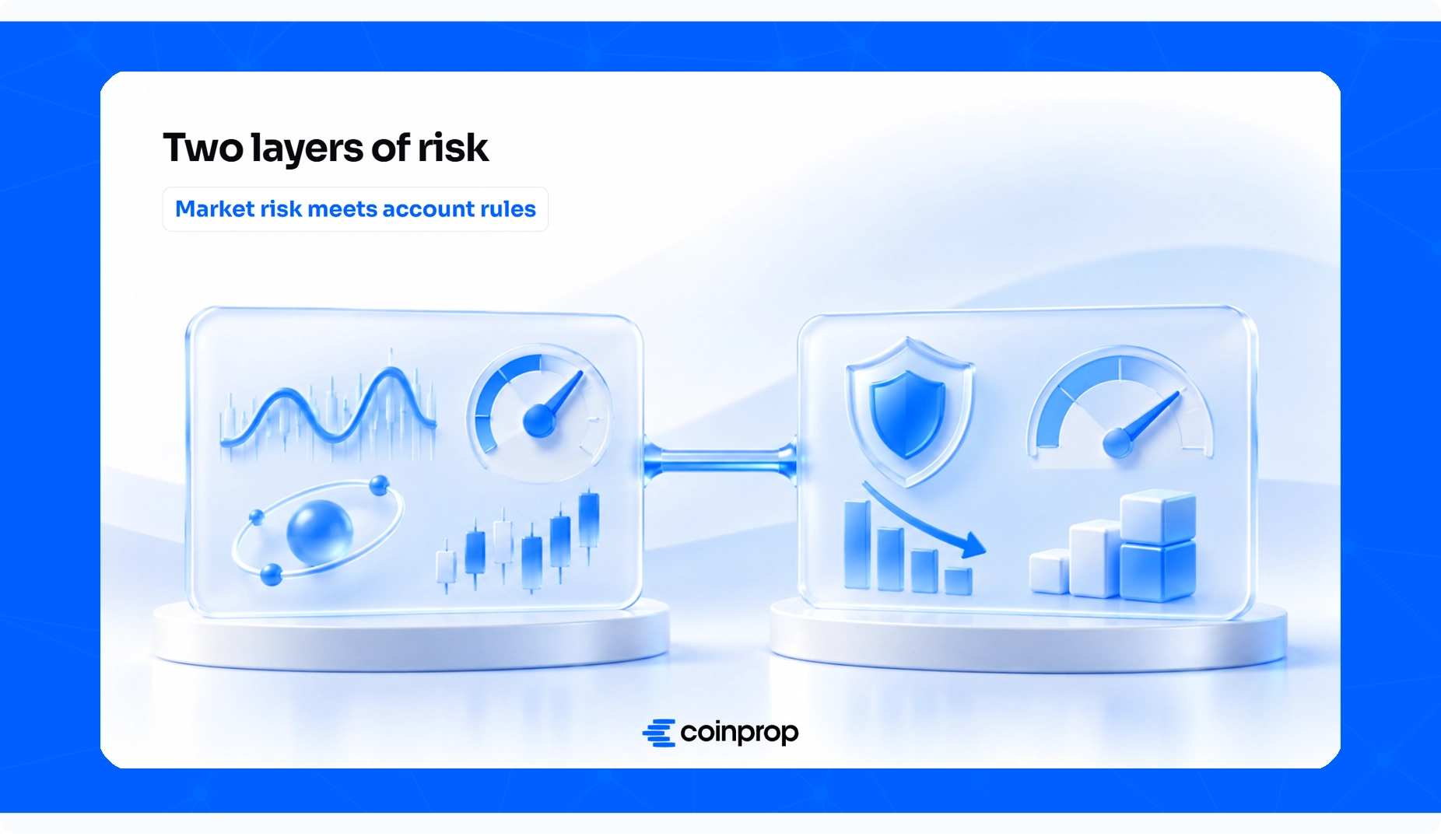
Funded perps trading comes with two sets of rules: the rules of the perpetual market itself and the rules imposed by the crypto prop firm providing the funded account. Understanding both is essential because a trading strategy can be profitable in the market while still causing an account breach if it violates the firm's risk parameters.
The most important prop firm rules usually relate to daily losses, maximum drawdown, leverage, margin, profit targets, minimum trading days, position size, and restricted trading activities. These conditions can vary significantly between providers, so traders should review the complete rule set before starting an evaluation.
For traders comparing funded perps accounts, the advertised account size is only one part of the structure. The actual trading room depends on how the prop firm combines its drawdown limits, leverage, margin requirements, and other restrictions.
A daily loss limit defines the maximum amount an account can lose during a trading day before the account is considered in breach.
For example, a prop firm might set a 3% daily loss limit. Under the firm's calculation method, the trader cannot allow losses to reach or exceed that threshold. The exact calculation can differ between providers and may include realized losses, unrealized losses, trading fees, and other account costs.
Daily loss limits are designed to prevent a single trading session from causing excessive damage to the account. They also affect position sizing because a trader needs enough room to absorb normal price fluctuations without approaching the limit.
This becomes particularly important when trading perpetual contracts with leverage. A relatively small move in the underlying market can produce a much larger percentage change in the trader's account when a leveraged position is used.
Traders should also check when the daily limit resets. Some firms use a fixed daily reset time, while others may use a different calculation method. The reset time can matter for positions that remain open across trading sessions.
Maximum drawdown is the total amount an account can lose before the trading account is breached.
Unlike a daily loss limit, which focuses on losses within a particular trading day, maximum drawdown generally measures the account's decline from a specified reference level.
For example, a crypto prop firm might set a 6% maximum drawdown. If the account reaches the firm's defined drawdown threshold, the account may be considered failed even if the trader did not exceed the daily loss limit.
The way drawdown is calculated is particularly important. Some firms use a static drawdown level based on the initial account balance, while others may use a trailing mechanism that moves as the account reaches new equity or balance highs.
For funded perps traders, the drawdown method can influence how aggressively an account can be traded. A static drawdown and a trailing drawdown can create very different risk-management requirements even when the headline percentage is identical.
Traders should therefore look beyond the percentage itself and confirm whether the drawdown is based on balance or equity, whether unrealized profits affect the threshold, and whether the limit changes as the account grows.
Leverage determines how much market exposure a trader can control relative to the margin allocated to a position.
Perpetual contracts commonly use leverage because traders can open positions with a fraction of the position's total notional value. However, higher leverage also increases the speed at which losses can accumulate.
A prop firm may set different leverage limits for different asset categories. For example, major cryptocurrencies may have one maximum leverage level while altcoins, stocks, commodities, or other perpetual markets have lower limits.
Maximum leverage should not be confused with recommended leverage. A trader does not need to use the maximum available leverage to trade a perpetual contract. Position size and the amount of account risk are usually more important than the leverage number displayed by the platform.
When evaluating a funded perps account, traders should check whether leverage is fixed or varies by instrument, whether leverage changes between the evaluation and funded stages, and whether specific markets have separate exposure limits.
For a crypto prop firm, these conditions can also differ between cryptocurrency perps and other markets such as stocks, commodities, or forex perps.
Margin is the amount of account equity required to support a leveraged position.
When a trader opens a perpetual position, the platform typically reserves part of the account's available margin to support that position. The required amount depends on the position's size, leverage, instrument, and the platform's margin rules.
For funded accounts, margin requirements can affect how many positions a trader can hold simultaneously. A trader may technically have enough capital to open a position but still be unable to maintain it if the position consumes too much available margin.
Margin management is especially important when multiple positions are correlated. For example, opening several long positions across highly related assets can create much more effective exposure than the individual position sizes suggest.
Traders should check whether the prop firm uses isolated or cross-margin mechanics, how unrealized losses affect available margin, whether there is a maximum margin or exposure limit, and what happens when available margin becomes insufficient.
Some funded perps evaluations require traders to reach a predefined profit target before they can progress to the funded stage.
A profit target is normally expressed as a percentage of the starting account balance. For example, a 9% target means the trader must generate the required amount of profit while remaining within all other account rules.
Profit targets are generally part of the evaluation rather than a permanent requirement for funded trading. Once a trader reaches the funded stage, the rules may change and the trader may no longer need to achieve another target before requesting payouts.
The presence of a profit target can influence trading behavior. Traders may be tempted to increase position size or take unnecessary risks when they are close to the target. This can create a conflict between reaching the target quickly and preserving enough drawdown capacity to complete the evaluation.
The exact target, calculation method, and conditions should therefore be reviewed together with the firm's loss and drawdown rules. A trader should evaluate the entire crypto prop firm account structure rather than treating the profit target as an isolated number.
Some prop firms require traders to complete a minimum number of qualifying trading days before they can pass an evaluation or request a payout.
A minimum trading day rule means that reaching the required profit target may not be enough by itself. The trader may also need to place qualifying trades across a specified number of separate days.
The definition of a trading day can vary. Some providers may require a position to be opened and closed, while others may define a qualifying day using a minimum profit or another condition.
This rule matters because it can change how traders approach an evaluation. A trader who reaches the profit target quickly may still need additional qualifying days before becoming eligible to proceed.
Funded accounts can also have separate payout-day requirements. Therefore, traders should distinguish between minimum trading days during an evaluation and the number of trading days required before a funded payout.
Position and exposure limits determine how much market risk a trader can take at one time.
A prop firm may restrict the maximum position size for a specific perpetual contract, the total notional value of open positions, or the amount of margin that can be used across an account.
These limits can be particularly important for larger funded accounts. A trader may have a relatively large account balance but still be subject to instrument-specific or account-wide exposure restrictions.
Exposure should also be considered across correlated markets. A trader holding several positions that tend to move in the same direction may effectively be taking one large directional bet even when the exposure is divided across multiple instruments.
Some firms may also impose restrictions on the number of open positions, maximum lots or contracts, or the total amount of leverage used across positions.
Before trading, traders should understand whether exposure limits are calculated per position, per asset, by asset category, or across the entire account.
Trading restrictions cover activities that a prop firm may prohibit or limit even when they do not directly relate to profit or loss.
Depending on the provider, restrictions can apply to practices such as hedging between accounts, certain forms of arbitrage, excessive position concentration, trading during specific events, or exploiting technical issues in the platform.
Some firms may also have rules around automated trading, copy trading, account sharing, or the use of particular strategies. Other providers may allow these activities under specific conditions.
For perpetual markets, traders should also understand any restrictions related to holding positions through market closures, funding periods, extremely volatile events, or periods of abnormal liquidity.
The important point is that a funded account is governed by a specific set of contractual and risk-management conditions. A strategy that is permitted on one crypto prop firm may be restricted by another, even when both firms offer similar perpetual markets.
Before starting a funded perps evaluation, traders should read the complete rule set and understand how each rule is calculated. The headline numbers alone are not enough. Daily loss limits, maximum drawdown, leverage, margin, trading restrictions, and payout conditions interact with each other and together determine how much trading room an account actually provides.
The cost of trading funded perps is not limited to the price of an evaluation account. Traders may also encounter trading fees, funding costs, spread and execution costs, and fees associated with payouts, depending on how the crypto prop firm structures its accounts.
These costs can have a meaningful impact on trading performance, particularly for strategies that generate many trades or hold perpetual positions for extended periods. Before choosing a funded perps account, traders should understand the complete fee structure rather than comparing evaluation prices alone.
An evaluation fee is the amount a trader pays to access a prop firm's qualification or challenge account.
The fee can vary based on the advertised account size, evaluation model, risk limits, and additional features. Some providers offer different account sizes or account types, while others may charge separately for optional upgrades such as higher profit splits or additional drawdown.
An evaluation fee should be viewed separately from the notional size of the funded account. A $50,000 funded account, for example, does not mean the trader is purchasing $50,000 of personal trading capital. The evaluation fee provides access to the firm's evaluation structure and, if the trader qualifies, to the subsequent funded account under its rules.
Traders should also check whether the evaluation is a one-time fee or whether there are recurring charges. Other conditions can matter as well, including reset fees, account activation fees, retry costs, or charges for optional account features.
A low entry price does not necessarily mean a lower overall cost. The evaluation fee should be considered alongside the account's drawdown limits, trading conditions, payout structure, and other costs.
Trading fees are charges associated with opening and closing positions.
For perpetual contracts, a trading fee may be calculated as a percentage of the position's notional value. Depending on the platform, the fee can differ between order types or between opening and closing a position.
This matters particularly for active traders. A strategy that generates a large number of trades can accumulate significant transaction costs even when the fee on each individual trade appears small.
For example, a trader who frequently enters and exits leveraged positions pays fees based on the transactions involved rather than simply the account balance. Larger position sizes therefore increase the absolute cost of trading.
Traders should check whether the prop firm charges trading fees on both sides of a trade, whether maker and taker rates differ, and whether fees are included in the account's profit and loss calculation.
The fee structure should also be considered when setting stop-loss and take-profit levels. A strategy targeting very small price movements may have less room to absorb transaction costs than a strategy targeting larger moves.
Funding fees are payments associated with holding a perpetual contract and are separate from the trading fee.
Perpetual contracts use funding mechanisms to help keep the contract price aligned with its underlying reference market. Depending on the funding rate and the direction of the position, a trader may pay funding or receive it.
Funding is therefore different from the cost of opening or closing a trade. A position that remains open for a longer period can accumulate multiple funding payments.
The impact depends on the specific market and the applicable funding rate. During certain market conditions, funding can become relatively expensive for one side of the market, while under other conditions it may be smaller or even provide a credit.
For funded perps traders, this is particularly relevant to strategies that hold positions overnight or for several days. A trade can move in the expected direction while funding costs reduce the net result.
Traders should check whether the prop firm's perpetual contracts use real or simulated funding rates, how often funding is applied, and whether funding is charged, credited, or incorporated into another part of the platform's pricing model.
Spread is the difference between the available buying and selling prices of a market. It represents one of the costs a trader can encounter when entering or exiting a position.
Execution quality can create additional differences between the price a trader expects and the price at which an order is actually filled. This can be particularly relevant during periods of high volatility or lower liquidity.
For perpetual contracts, execution conditions can vary significantly between markets. Major assets may generally have deeper liquidity than smaller altcoins, while stock and commodity perpetuals can have different liquidity characteristics from crypto markets.
A trader should therefore look at more than the advertised trading fee. A platform with a low transaction fee can still produce higher effective trading costs if spreads or execution conditions are less favorable for the strategy being used.
Market data is another important consideration. Traders should understand which price source the platform uses, how closely the perpetual follows its reference market, and whether the platform uses real-time exchange data or another pricing mechanism.
For short-term strategies, these details can have a noticeable effect because traders may enter and exit positions frequently and have relatively small expected profits per trade.
Payout fees are charges associated with withdrawing profits from a funded account.
Some prop firms charge a fixed payout fee, a percentage of the requested amount, or a network fee depending on the payment method. Others may advertise fee-free payouts under certain conditions.
The payout method itself can also affect the final amount received. Crypto-based payouts, for example, may involve blockchain network costs even when the prop firm does not charge a separate withdrawal fee.
Traders should also review payout requirements alongside payout fees. A provider may require a minimum profit, a certain number of funded trading days, a specific payout schedule, or compliance with additional conditions before a withdrawal can be requested.
The profit split is another part of the overall payout economics. A trader earning $1,000 with an 80% profit split receives a different amount than a trader earning the same gross profit under a 90% or 95% split.
For this reason, evaluating funded perps costs requires looking at both sides of the equation: what the trader pays to trade and what the trader ultimately receives from successful trading.
A complete cost comparison should therefore include the initial evaluation fee, trading costs, funding, spread and execution, payout fees, and profit split. Looking at only the advertised account price can give an incomplete picture of the actual economics of a funded perps account.
Choosing a crypto prop firm for funded perps requires looking beyond the advertised account size or evaluation price. The trading environment, risk rules, supported markets, leverage, execution, payout structure, and account scaling conditions can all affect how practical an account is for a particular trading strategy.
A funded account should be evaluated based on the amount of trading room it provides under its actual rules. A large advertised account with restrictive drawdown conditions may offer a very different trading experience from an account with the same nominal size but more flexible risk parameters.
Before starting an evaluation, traders should review the following areas.
The first question is whether the prop firm actually offers the perpetual markets you intend to trade.
Crypto-focused traders may want access to major assets such as Bitcoin and Ethereum, while others may specifically look for altcoin or memecoin perps. Some platforms also extend their perpetual markets to forex, stocks, commodities, or indices.
Market availability can also change over time, so traders should check the firm's current markets rather than relying only on older reviews or promotional material.
The number of listed markets is not the only consideration. Traders should also look at the underlying market-data source, liquidity, trading hours, contract specifications, and whether the instruments are available during both evaluation and funded stages.
If a strategy depends on a specific asset or market category, confirm that the exact instrument is supported before purchasing an evaluation.
Risk rules are one of the most important parts of a funded perps account because they determine how much room a trader has to absorb losses.
Key rules include the daily loss limit, maximum drawdown, drawdown calculation method, and how unrealized losses are treated. Traders should also check whether drawdown is static or trailing and whether the limits change after reaching the funded stage.
The headline percentages can be misleading if the calculation method is unclear. For example, two firms could advertise the same maximum drawdown percentage while using different reference balances, equity calculations, or trailing mechanisms.
Other risk conditions can include maximum position size, exposure limits, margin restrictions, or restrictions on holding certain positions.
The most useful approach is to evaluate the rules as a complete risk framework rather than comparing individual percentages in isolation. The question is not simply how large the account is, but how much usable drawdown and exposure the trader has within the firm's actual conditions.
Leverage determines how much market exposure a trader can control relative to the margin allocated to a position.
Higher maximum leverage may appear attractive, but it does not automatically provide better trading conditions. What matters is whether the available leverage is appropriate for the instruments and strategy being traded.
Prop firms may also apply different leverage limits to different asset categories. Major crypto perps may have different limits from altcoins, stocks, commodities, or indices.
Margin rules should be reviewed at the same time. Traders should understand how much margin is required, how unrealized losses affect available margin, whether positions can be held simultaneously, and whether there are account-level exposure limits.
A trader using several correlated positions should pay particular attention to these conditions. Multiple positions can create substantial combined exposure even when each individual position appears reasonable.
The trading platform directly affects how traders analyze markets, place orders, manage risk, and monitor positions.
For funded perps, traders should look for a platform that provides the tools required by their strategy, including reliable charts, order execution, position management, real-time market data, and account-level risk information.
The source of market data is particularly important for perpetual contracts. Traders should understand whether prices come directly from an exchange, from an aggregated market-data source, or from another pricing mechanism.
Execution should also be examined. Relevant factors include order types, slippage, spread, trading fees, execution speed, and how the platform handles volatile market conditions.
TradingView integration can be useful for traders who already rely on TradingView charts and analysis tools. Direct exchange market-data integration can also matter when the trader wants the perpetual contract to reflect a recognizable exchange market.
The platform should ultimately be evaluated as part of the trading environment, not as a separate feature. Charts, pricing, execution, risk controls, and order management all affect the practical experience of trading a funded account.
A funded perps account should also be evaluated based on how trading profits are shared and how traders can access their payouts.
The advertised profit split is only one part of the payout structure. Traders should also check when they become eligible to request a payout, whether there is a minimum withdrawal amount, whether additional consistency or performance conditions apply, and whether the rules differ between evaluation and funded stages.
Payout frequency can be particularly important for traders who plan to withdraw profits regularly. A firm may use a fixed payout schedule, a minimum number of funded trading days, or an on-demand system with specific eligibility requirements.
Payment methods and processing times should also be clear. If payouts are made in cryptocurrency, traders should understand which assets and networks are supported and whether any withdrawal or network fees apply.
The key is to compare the actual payout conditions, not just the percentage shown in the marketing material. A higher profit split can have less practical value if the account has additional conditions that make withdrawals difficult.
Trading restrictions can significantly affect whether a funded perps account fits a particular strategy.
Some prop firms place restrictions on hedging, automated trading, copy trading, account sharing, arbitrage, news trading, or specific trading behaviors. Others may allow these activities under defined conditions.
Traders should also check whether there are restrictions on holding positions overnight, during market closures, around major economic events, or through specific funding periods.
For perpetual markets, it is especially important to understand how the firm handles high-volatility events and unusual market conditions. A strategy that relies on rapid execution during major announcements may require different conditions from a strategy that trades slower market movements.
The safest approach is to read the actual trading rules rather than assuming that a common prop firm practice applies everywhere. Restrictions can vary substantially between providers.
Account scaling determines how a trader's available funded account size can change after demonstrating consistent performance.
Some prop firms offer a scaling program that increases account size based on profitability or other performance criteria. The increase may occur after a specific period, after reaching certain profit levels, or according to a predefined schedule.
Traders should check the maximum scaling level, the conditions required for each increase, and whether the additional account size comes with different risk rules or payout conditions.
Scaling can also affect portfolio planning. A trader who intends to manage multiple funded accounts should understand whether the firm imposes a maximum number of accounts or a combined capital limit.
The important point is that the initial account size is not necessarily the complete picture of a trader's potential funded capacity. The scaling structure can determine how the account develops over time and what conditions apply as the trader progresses.
Overall, choosing a crypto prop firm for funded perps comes down to matching the firm's trading environment with the way you actually trade. Supported markets, drawdown rules, leverage, margin, execution, market data, payouts, restrictions, and scaling should all be reviewed together.
The right comparison is therefore not simply which firm offers the largest account or lowest evaluation fee. It is whether the account's complete structure gives you enough trading room, supports your markets and strategy, and provides clearly defined conditions for managing risk and accessing profits.
Market data is a fundamental part of perpetual trading because it determines the prices traders see, the information they use to make decisions, and, depending on the platform, how orders are executed.
For funded perps traders, this becomes even more important. A trader can have a sound strategy and appropriate risk management, but differences in pricing, liquidity, spreads, and execution can still affect entries, exits, stop-losses, and overall trading costs.
Before trading perpetual contracts through a crypto prop firm, it is useful to understand where prices come from and how the platform's market data connects to the underlying market.
The price displayed for a perpetual contract comes from a market-data and pricing system that references the underlying market.
For crypto perpetuals, this may be based on data from a specific cryptocurrency exchange or from multiple market sources. For stock, commodity, or index perps, the pricing mechanism may reference the relevant underlying market or another defined data source.
The important point is that a perpetual contract does not necessarily have to trade at exactly the same price as every other platform offering exposure to the same asset. Different exchanges and platforms can have slightly different bid and ask prices, order-book depth, and short-term movements.
Perpetual contracts can also use different types of reference prices for risk management. A platform may use a mark price, index price, or other reference mechanism alongside the price at which traders can actually execute orders.
These prices serve different purposes. The market price reflects available buying and selling interest, while a mark price may be used for calculating unrealized profit and loss or liquidation-related conditions. An index price can represent a calculated reference based on one or more underlying markets.
For funded traders, understanding these distinctions matters because the price used to display a chart may not always be identical to the price used for every account calculation.
Exchange-based market data means that a trading platform receives market information from an established exchange or exchange-related source.
For crypto perpetuals, this can include information such as the latest traded price, bid and ask prices, order-book depth, trading volume, and available liquidity.
Using recognizable exchange market data can make the trading environment easier to understand because traders can compare the prices they see with an established market.
However, "exchange-based" does not automatically mean that two platforms will produce identical execution. The way a prop firm processes market data, builds its order book, applies fees, handles slippage, and executes simulated orders can still affect the final result.
Traders should therefore look for clear information about the source of pricing and execution rather than relying only on a statement that a platform uses exchange data.
For funded perps, this transparency is particularly useful. Traders should be able to understand what market their perpetual contract references and how the platform converts that market information into the trading prices they see.
Price differences between platforms are not necessarily evidence that one platform is using incorrect data. Different venues can have different liquidity, spreads, order-book conditions, and trading activity at the same moment.
For example, the best available bid and ask on one exchange can differ slightly from those on another exchange. During periods of high volatility, these differences can become more noticeable as market participants rapidly adjust their orders.
Execution can create another difference.
A trader may see a particular price on a chart but receive a different fill when submitting a market order. This can happen because the available liquidity changes between the time the order is submitted and the time it is executed. The difference is commonly referred to as slippage.
For funded perps traders, execution quality can have a meaningful effect on performance. A strategy that enters and exits frequently can be particularly sensitive to small differences in spread, slippage, and trading fees.
This is why traders should evaluate more than the chart itself. Important questions include:
Clear answers to these questions can help traders understand what they are actually trading.
TradingView is widely used for charting, technical analysis, and market monitoring. For traders who already use TradingView as part of their workflow, having TradingView charts integrated into a perpetual trading platform can reduce the need to move between separate applications.
TradingView can provide familiar charting functionality, indicators, drawing tools, multiple timeframes, and other analysis features. The exact functionality available depends on the platform's integration.
For funded perps traders, charting is only one part of the equation. The market data behind the chart still matters.
A TradingView-style chart does not by itself determine where the perpetual contract gets its execution price. Traders should distinguish between the charting interface and the underlying market-data and execution infrastructure.
A platform can therefore combine TradingView charts with a specific exchange's market data while using its own order-management and account-risk systems.
This distinction is useful when comparing funded perps providers. Traders should ask not only whether a platform "supports TradingView," but also what market data feeds the perpetual contracts and how orders are handled.
For crypto funded perps, Bybit is one example of an exchange whose market data can be used as a reference for perpetual markets.
A platform using direct Bybit market data integration can use exchange-derived information for the prices and market conditions presented to traders. This can provide a recognizable reference for traders who are familiar with Bybit's perpetual markets.
However, direct market-data integration should not automatically be interpreted as a partnership or as identical execution to trading directly on the exchange. The prop firm's own trading environment can still determine how orders are simulated or executed, how account risk is calculated, and how fees and slippage are applied.
This distinction is particularly important for funded accounts. Traders are not necessarily trading on the exchange itself simply because a prop firm's perpetual contracts use exchange market data.
When evaluating a funded crypto perps platform with Bybit market data, traders should therefore look at the complete setup: the source of prices, execution model, liquidity, fees, slippage, funding, risk calculations, and trading interface.
For example, CoinProp combines TradingView-based charts with direct Bybit market data integration within its own CPX trading environment. The result is a funded trading interface where traders can analyze perpetual markets through familiar charting tools while using exchange-derived market data for the supported crypto contracts.
Ultimately, market data is part of the trading infrastructure, not just a charting feature. For funded perps traders, knowing where prices come from and how those prices connect to execution can make it easier to understand the actual conditions of an account before starting an evaluation
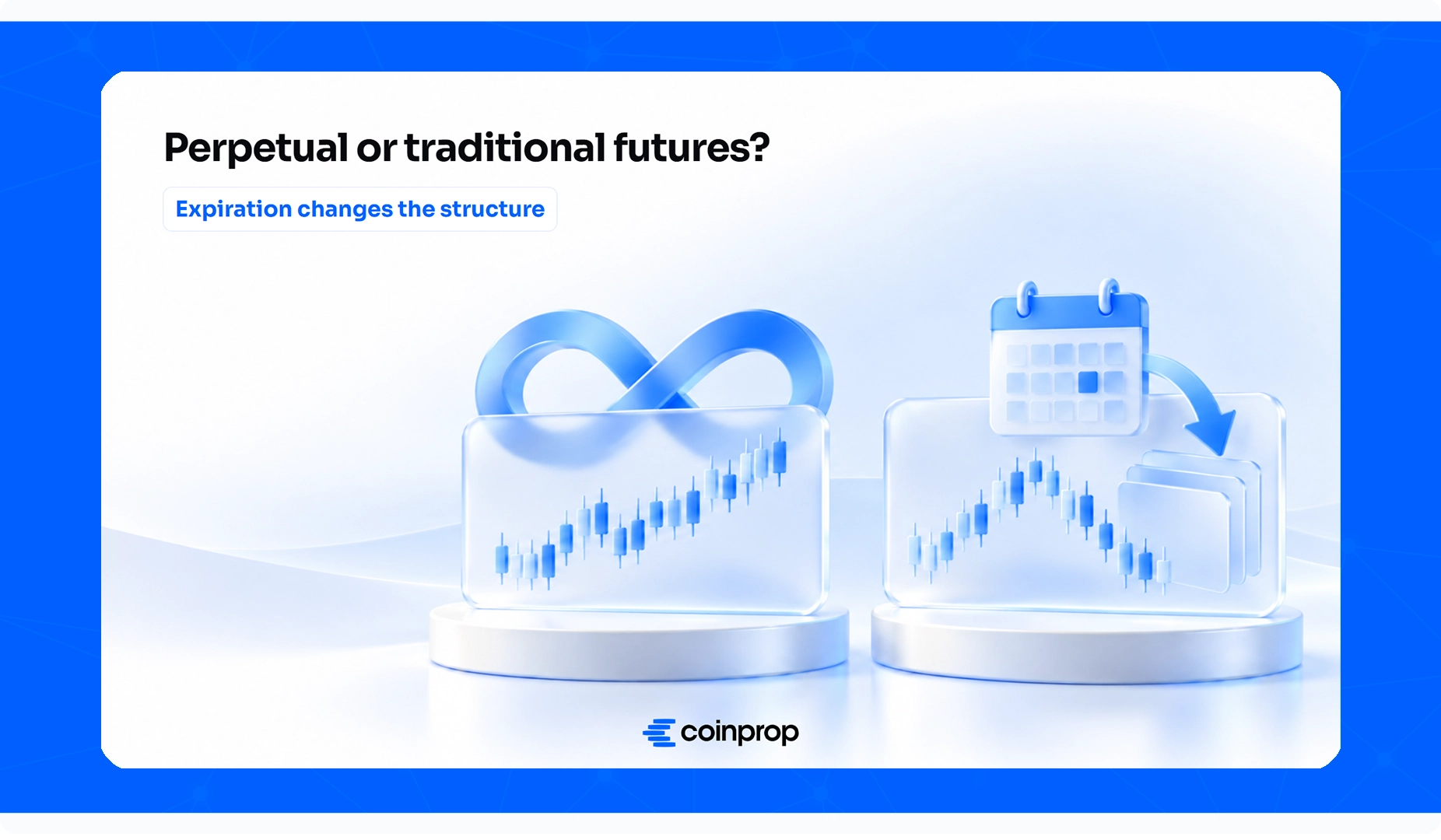
Funded perps and traditional funded futures both give traders access to leveraged derivative markets through a prop firm, but the underlying contracts can work differently. A crypto prop firm may use perpetual contracts as the primary trading instrument, while traditional futures prop firms generally provide access to exchange-listed futures contracts with defined expirations.
The biggest differences are expiration, trading hours, market availability, pricing, leverage, margin, and risk management. These differences can affect how traders enter and exit positions, how long they can hold trades, and which markets are available to them.
The funded model itself can be similar in both cases: a trader completes an evaluation or qualification process and, after meeting the required conditions, receives access to a funded account. The main difference is the type of derivative being traded and the rules surrounding that contract.
Perpetual contracts are derivatives designed without a fixed expiration date. Traders can generally keep a position open as long as they continue to meet the applicable margin and account requirements.
Traditional futures contracts, by contrast, have defined expiration dates. The contract specifies a particular delivery or settlement period, and traders need to close, roll, or otherwise manage the position as that date approaches.
This difference changes the way a position is managed.
With a perpetual contract, a trader does not normally need to plan around a contract expiry. The position can remain open while the trader continues to satisfy the relevant account and market requirements. Perpetual contracts typically use a funding mechanism to help keep their market price aligned with the underlying reference market.
Traditional futures use a different structure. Contracts are created for specific expiration months or dates, and their pricing can reflect factors such as the time remaining until expiration and the underlying market.
For crypto traders, this distinction is particularly relevant because perpetual contracts have become a common way to trade crypto derivatives. A crypto prop firm may therefore build its funded account offering around crypto perps rather than traditional futures contracts.
Traditional futures are also widely used across commodities, indices, currencies, and other financial markets. The funded account structure can exist on either side. What changes is the contract specification and the way the trader manages exposure.
Trading hours can differ substantially between perpetual and traditional futures markets.
Crypto perpetual markets are commonly designed for near-continuous trading because the underlying cryptocurrency market operates around the clock. This means traders can generally monitor and manage crypto perp positions outside traditional stock-market sessions.
Traditional futures can also offer extended trading hours, but the exact schedule depends on the exchange and the specific contract. Some markets have scheduled breaks, maintenance periods, or defined sessions.
For funded traders, trading hours matter because they determine when positions can be opened, closed, or adjusted.
The difference becomes particularly important when a trader holds positions across market sessions. A stock or commodity futures contract may have a period during which the market is closed, while a crypto perpetual can continue trading during that time.
Traders using a prop firm should therefore check the actual trading schedule of each instrument rather than assuming that all perpetuals or futures markets operate on the same schedule.
Expiration is one of the clearest structural differences between traditional futures and perpetual contracts.
A traditional futures contract has a defined expiration date. Depending on the contract, it may be financially settled or physically settled when it expires. Traders who want to maintain exposure beyond that point may need to move their position into a later contract, a process commonly referred to as rolling the position.
Perpetual contracts do not have a fixed expiration date. Instead, their design uses mechanisms such as funding to help keep the contract price aligned with its underlying market.
For a funded trader, this means there is no traditional contract-expiration event that requires the position to be rolled from one contract to another.
However, no-expiration does not mean that holding a position is cost-free or risk-free. Funding, trading fees, market volatility, margin requirements, and the prop firm's account rules can all affect the position while it remains open.
Market availability can also differ between funded perps and traditional funded futures.
Traditional futures markets are offered through established futures exchanges and cover asset classes such as equity indices, commodities, interest rates, currencies, and agricultural products. The exact markets available depend on the exchange and the prop firm's supported contracts.
Funded perps can provide access to crypto markets and, depending on the provider, may also extend to stocks, commodities, indices, or currencies through perpetual contracts.
Crypto perpetuals are particularly common for assets such as Bitcoin, Ethereum, and other digital assets. Some platforms also offer a much broader range of altcoin markets.
For traders comparing the two models, the relevant question is not simply how many instruments a firm advertises. It is whether the specific markets required by the trading strategy are available and whether those markets have suitable liquidity, trading hours, and execution conditions.
The contract structure also matters. Two products can reference similar underlying assets while having different specifications because one is a traditional futures contract and the other is a perpetual derivative.
Both perpetual contracts and traditional futures can use leverage, allowing traders to control a larger notional position with a smaller amount of margin.
The exact leverage available depends on the instrument, exchange, broker or platform, and prop firm's rules.
With perpetuals, leverage is commonly presented as a multiple of the margin allocated to the position. Traditional futures use futures-specific margin requirements that can vary based on the contract and market conditions.
Higher leverage increases exposure and can make both gains and losses occur more quickly. For a funded trader, the practical constraint is usually not the maximum leverage displayed by the platform but the account's overall risk limits.
Daily loss limits, maximum drawdown, margin requirements, and position limits can all restrict how much exposure a trader can safely maintain.
The calculation of margin can also differ between platforms. Traders should understand whether margin is isolated or shared across positions, how unrealized losses affect available margin, and whether the prop firm imposes additional exposure restrictions beyond the underlying market's requirements.
Risk management is essential in both funded perps and traditional funded futures, but the specific risks a trader needs to manage can differ because the contracts have different structures.
With perpetuals, traders need to consider factors such as funding rates, leverage, liquidity, mark prices, and the absence of a fixed expiration date.
With traditional futures, traders need to consider expiration, contract rollover, contract specifications, exchange trading sessions, and futures margin requirements.
In both models, the crypto prop firm's or futures prop firm's own account rules add another layer of risk management. A trader may need to stay within daily loss limits, maximum drawdown, position limits, and other restrictions regardless of the underlying market.
Position sizing should therefore be based on the account's actual risk limits rather than simply the maximum leverage available.
A trader comparing funded perps with traditional funded futures should also consider how the contract fits the trading strategy. Short-term traders may focus heavily on execution, spread, and liquidity, while traders holding positions for longer periods may pay more attention to funding, expiration, trading sessions, and carrying costs.
Ultimately, funded perps and traditional funded futures use different derivative structures within a similar broader prop trading model. Understanding those structural differences helps traders evaluate whether a crypto prop firm offering funded perps, or a traditional futures prop firm, provides the markets, contract structure, and account conditions that fit their intended trading approach.
Funded perps trading can provide access to leveraged perpetual markets without requiring the trader to commit the full notional value of the account. However, the same leverage and account structure that creates more trading opportunities can also magnify mistakes.
Many funded account failures are not caused by a lack of market knowledge alone. Position sizing, drawdown management, funding costs, and emotional responses to profit targets can all affect whether a trader stays within the account's rules.
Understanding the most common mistakes can help traders build a more controlled approach to funded perpetual trading.
High leverage can make a position appear more efficient because less margin is required to control a larger notional position. The problem is that leverage also increases the effect of relatively small price movements on account equity.
A trader does not need to reach the maximum available leverage for an account to become overexposed. A position that is too large relative to the account's drawdown limit can create a significant loss from a relatively small market move.
This is particularly important in crypto perps, where individual assets can experience rapid price movements. Volatility can increase further around major economic releases, market-wide liquidations, or significant crypto-specific events.
The maximum leverage offered by a prop firm should therefore not be treated as a target. Traders should determine position size based on their stop-loss distance, acceptable account risk, market volatility, and remaining drawdown capacity.
Using less leverage can give a position more room to absorb normal price fluctuations and reduce the chance that a single trade has a disproportionate effect on the account.
A trader can have a profitable strategy and still lose a funded account by misunderstanding its drawdown rules.
Daily loss limits and maximum drawdown are not simply numbers to remember. Traders need to understand exactly how they are calculated, when they reset, and whether they are based on balance, equity, or another reference value.
Unrealized losses can also matter. A position that has not been closed may still affect the account's equity and therefore its available drawdown.
Trailing drawdown rules require additional attention because the threshold can change as the account reaches new highs. A trader who does not understand how the reference level moves can unintentionally place the account close to its breach level.
Another common mistake is using the entire available drawdown as if it were the intended trading risk. A maximum drawdown is a failure threshold, not necessarily an appropriate amount to risk on a single position.
Traders should leave enough room between normal trading losses and the account's breach level to handle losing streaks and ordinary market volatility.
Oversizing is closely related to leverage but is a separate risk-management problem. A trader can take an oversized position even when the leverage setting itself does not appear excessive.
Position size should be connected to the amount the trader is willing to lose if the trade reaches its invalidation point.
For example, two trades using the same account and leverage can have very different risk levels if one has a tight stop-loss and the other has a much wider stop. The notional position alone does not tell the entire risk story.
Oversizing can become particularly dangerous when several positions are opened at the same time. Multiple trades may appear independent but can be strongly correlated. Several long positions in crypto assets, for example, can all lose value during a broad market sell-off.
Funded traders should therefore consider total account exposure rather than evaluating each position separately.
A consistent position-sizing method can help keep individual trades and combined exposure within the account's available risk capacity.
Funding is an important consideration when trading perpetual contracts, particularly for positions that remain open for longer periods.
A trader may focus on the entry price and expected price movement while overlooking the cost of maintaining the position. Depending on the funding rate and position direction, funding can reduce the trade's net result or, under some conditions, provide a credit.
The impact becomes more noticeable when positions are held for extended periods or when funding rates become elevated.
Funding should therefore be included when evaluating the expected return of a perpetual trade. A position that has a small expected profit may not provide enough room to absorb trading fees and funding costs.
Traders should understand how the specific prop firm's platform handles funding, including the rate used, when funding is applied, and whether it is charged or credited to the account.
For short-term strategies, funding may have a smaller effect than execution costs. For longer-duration strategies, however, it can become a more relevant part of the trade's overall economics.
Entering a trade without a predefined risk plan can lead to inconsistent decisions once the market starts moving.
Before opening a funded perp position, a trader should know where the trade becomes invalid, how much account risk is acceptable, how large the position should be, and what conditions would justify closing the trade.
Without those parameters, traders can easily move a stop-loss farther away after a losing trade, add to a position simply because the market moved against them, or hold a losing position in the hope that it will recover.
A risk plan does not need to predict the market correctly every time. Its purpose is to control what happens when the prediction is wrong.
For funded trading, the plan should also account for the prop firm's account rules. The trader's personal risk limit should generally leave sufficient room below the firm's daily loss and maximum drawdown thresholds.
Risk management should therefore be established before the trade rather than improvised after the position is already losing.
Profit targets can create a particularly strong psychological pressure during funded evaluations.
When a trader is trying to reach a predefined target, there can be a temptation to increase position size, trade more frequently, or take setups that would normally be outside the trading plan.
The problem is that the profit target does not change the account's maximum loss or drawdown limits. Taking more risk to reach a target faster can increase the probability of hitting those limits before the target is reached.
A trader who is close to the target can also make the opposite mistake: continuing to trade aggressively after reaching or nearly reaching the required profit level instead of protecting the progress already made.
The evaluation should therefore be treated as a risk-management exercise rather than a race to reach the target.
A more controlled approach is to focus on executing the same strategy and maintaining consistent risk while allowing profitable trades to accumulate over time.
This becomes even more important after reaching the funded stage. If the funded account does not have a profit target, the objective shifts from passing an evaluation to managing positions within the account's rules and building sustainable trading performance.
Ultimately, successful funded perps trading depends on controlling the downside as much as identifying profitable opportunities. Excessive leverage, oversized positions, misunderstood drawdown rules, ignored funding costs, and target-driven decisions can all turn a potentially good trading strategy into an account-management problem.
The goal is not to eliminate losing trades. Losses are a normal part of trading. The goal is to keep individual losses and losing periods small enough that the account remains within its risk parameters and the trading strategy has room to play out.
CoinProp is a crypto prop firm built around funded perpetual trading, giving traders access to crypto perps as well as selected Forex, stock, and commodity markets through its own trading environment.
The model combines a one-step evaluation with defined risk limits, access to perpetual markets, TradingView-based charts, direct Bybit market data integration for crypto markets, and performance-based payouts after traders qualify for a funded account.
Instead of requiring traders to provide the full notional capital needed to trade leveraged perpetual contracts themselves, CoinProp provides a simulated funded account structure where traders operate under predefined risk rules and can receive a share of eligible profits.
For traders evaluating a crypto prop firm for funded perps, the important factors include not only the available account size, but also the markets, leverage, drawdown rules, trading environment, and payout structure.
CoinProp is primarily designed around crypto perpetual trading, with access to 700+ perpetual markets across major cryptocurrencies, altcoins, and memecoins.
Traders can take both long and short positions and use leverage according to the market category. BTC, ETH, and SOL can be traded with up to 5x leverage, while other crypto markets, including altcoins and memecoins, are subject to lower leverage limits.
The distinction is important because leverage is not uniform across every perpetual market. A trader who can use 5x on BTC, ETH, or SOL should not assume that the same leverage is available on smaller or more volatile assets.
CoinProp's crypto perpetual environment is built around market data from Bybit. The platform uses a direct Bybit market data integration for crypto markets rather than an artificial or synthetic price feed.
This gives traders access to a broad range of perpetual markets while keeping the trading environment focused on the instruments commonly used by crypto perpetual traders.
For traders looking beyond BTC and ETH, the available market selection also includes a large number of altcoins and memecoins. However, additional market availability does not remove the account's risk limits, so position sizing remains important when trading more volatile assets.
CoinProp also provides access to Forex perpetual markets, allowing traders to trade currency pairs through a perpetual contract structure rather than a traditional spot-Forex or expiring futures contract.
Supported Forex markets include pairs such as EURUSD, GBPUSD, and JPYUSD. These markets allow traders to apply familiar Forex concepts such as directional analysis, support and resistance, macroeconomic events, and session-based trading within a perpetual-style funded account.
Forex perpetuals can be useful for traders who want to trade currency price movements without dealing with a conventional futures expiration date.
Leverage is also different from the major crypto markets. Forex markets on CoinProp are subject to a 2x leverage limit, so traders should size positions based on the available leverage and the account's drawdown rules rather than assuming that crypto leverage conditions apply to Forex.
Another consideration is the cost structure. Forex perpetuals do not necessarily have the same funding mechanics as crypto markets, and traders should check the current CoinProp rules and platform information for the specific market they intend to trade.
CoinProp also supports perpetual-style trading on selected stocks, giving traders the ability to take directional positions without directly purchasing or owning the underlying shares.
Stock perps can be traded from the same funded account environment, which means traders can potentially use long or short strategies while managing their positions according to the account's risk limits.
This structure differs from buying shares. A trader opening a stock perpetual position is trading a derivative that tracks the underlying market rather than taking ownership of the company.
Stock markets are subject to a 2x leverage limit on CoinProp. This lower leverage reflects the different characteristics of stock markets compared with the highest-leverage crypto instruments.
Traders should also consider market-session availability, price gaps, earnings announcements, economic news, and other events that can create rapid changes in stock prices.
Because the funded account's drawdown limits apply regardless of the market being traded, using lower leverage does not eliminate the need for position sizing and risk management.
CoinProp also extends its perpetual trading environment beyond crypto and currencies to selected commodities.
Markets such as gold, silver, and crude oil give traders exposure to commodity price movements through the same general funded account structure.
Commodity markets can behave differently from crypto. Gold may react to interest rates, inflation expectations, the U.S. dollar, and geopolitical developments, while crude oil can be affected by inventory data, production decisions, supply disruptions, and changes in global demand.
CoinProp applies market-specific leverage limits to these instruments, with commodities available at up to 2x leverage.
This makes risk management particularly important when trading commodities around major economic releases or market events. A position that looks relatively small in notional terms can still produce a meaningful account-level loss when the underlying market moves quickly.
The same funded account principles continue to apply: traders need to remain within the account's daily loss and maximum drawdown limits while managing their positions and exposure.
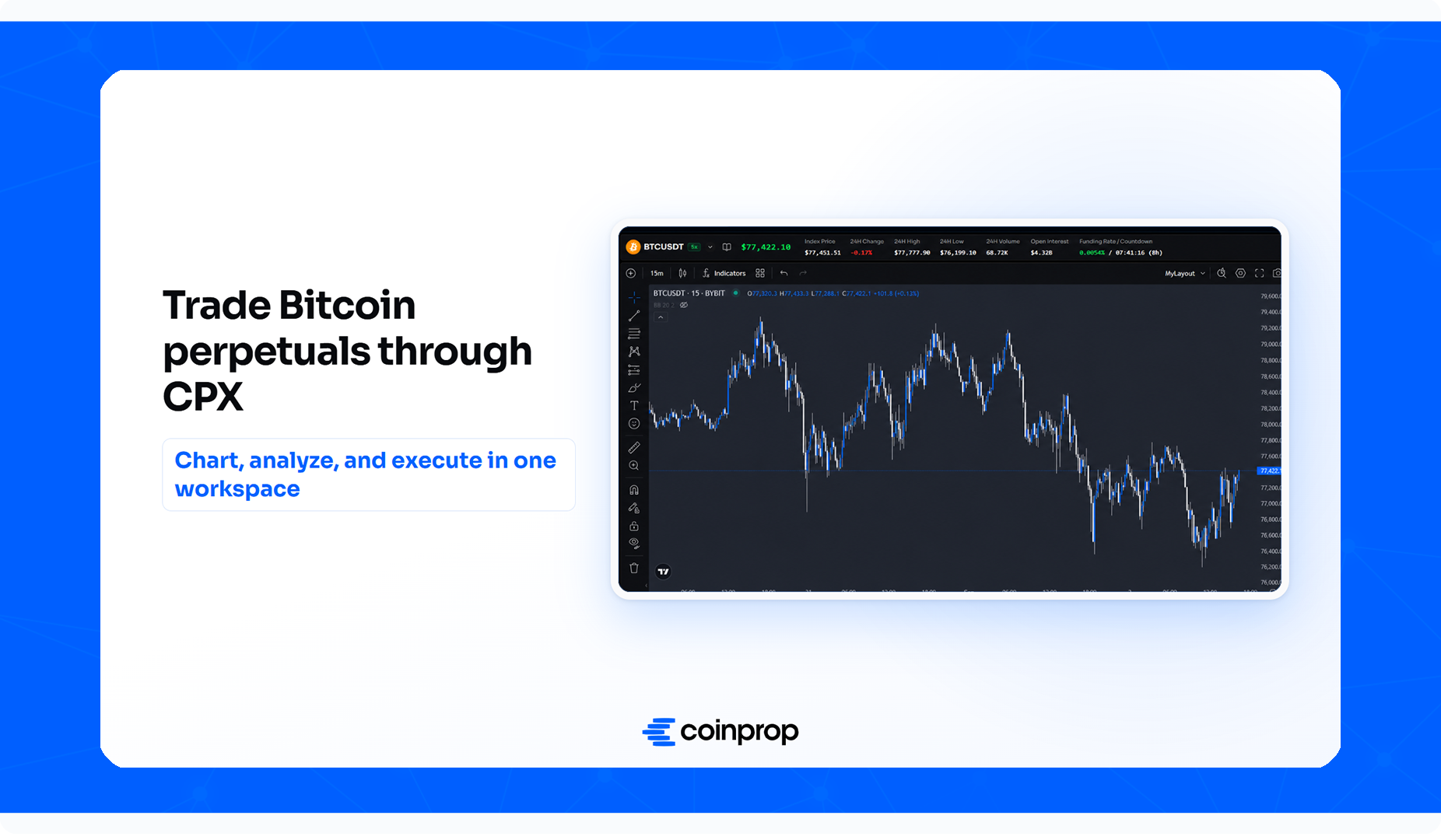
CoinProp's perpetual markets are traded through CPX, its in-house trading environment built around TradingView charts and live market data.
The platform is designed to bring charting, execution, risk management, and account information into one trading environment instead of requiring traders to move between separate tools.
CPX includes TradingView-based charts, live market data, position and risk information, and tools that help traders manage their trades directly from the platform.
Risk limits can also be reflected directly on the chart, allowing traders to see important account thresholds while planning and managing positions.
For crypto perpetuals, CoinProp uses a direct Bybit market data integration. This provides market pricing and order-book data from Bybit within the CoinProp trading environment. It should not be interpreted as a claim of partnership with Bybit or as meaning that CoinProp accounts are the same as trading directly on the Bybit exchange.
The trading environment is simulated, but it is designed around live market conditions and real exchange-based market data. CoinProp also states that it does not use an artificial spread to create a separate synthetic price environment.
CoinProp uses a one-step evaluation for its funded accounts. Traders need to reach the required profit target while staying within the account's risk parameters.
The current Signature evaluation includes a 9% profit target, a 3% daily loss limit, and a 6% maximum drawdown. Traders must also complete at least 2 qualifying trading days.
There is no overall time limit for completing the evaluation, so traders do not have to increase their risk simply because a deadline is approaching.
The account's drawdown rules are particularly important because reaching the profit target does not override the maximum loss restrictions. A trader can reach a significant portion of the target and still fail the account if the applicable loss limit is breached.
CoinProp also offers a Booster account structure with different evaluation conditions, including a 9% target, a 3% daily loss limit, and a 3% maximum drawdown, without a minimum number of trading days.
Leverage depends on the market. The highest leverage is available on BTC, ETH, and SOL at up to 5x, while other supported markets have lower limits. Altcoins and memecoins, Forex, stocks, and commodities are subject to the applicable 2x leverage limit.
The account structure is therefore not based on one universal leverage number. Traders need to check the leverage assigned to the specific instrument before opening a position.
CoinProp accounts also have defined trading and risk conditions that apply during the evaluation and funded stages. Traders should review the current rules before trading because account limits, payout requirements, and market conditions can change.
After qualifying for a funded account, traders do not need to reach another profit target before requesting a payout.
The standard profit split is 80% for the trader, with an optional add-on available to increase the trader's share to 95%.
Funded traders can request a payout after meeting the applicable 5 qualifying trading day requirement. Payout eligibility is also subject to the funded account's other conditions, including the applicable consistency requirement.
Payouts are made in USDC, with supported networks including Ethereum and Arbitrum. CoinProp does not charge a withdrawal fee, and payouts are designed to be processed within the stated payout timeframe.
This structure makes the funded stage different from the evaluation. During the evaluation, the trader is working toward the required target while staying within the loss limits. After funding, there is no new profit target; the focus shifts to continuing to trade within the account's rules and becoming eligible for payouts.
Market data and charting are important parts of the funded perps trading experience because perpetual contracts can move quickly and small differences in price or execution can affect a leveraged position.
CoinProp's CPX environment uses TradingView-based charts, giving traders access to a familiar charting interface for technical analysis and trade planning.
For crypto perpetuals, CoinProp also uses direct Bybit market data integration. This provides the underlying crypto market data used within the platform and supports access to a broad range of perpetual markets.
The combination is designed to keep analysis and execution within the same trading environment. Traders can analyze a market, plan a position, monitor risk, and manage an open trade without relying on a separate charting platform for the core workflow.
For traders comparing a crypto prop firm, the trading environment can be just as relevant as the headline account terms. Access to familiar charting, exchange-based market data, risk information, and execution tools can directly affect how a funded perps strategy is planned and managed.
CoinProp's funded perps offering therefore combines a one-step evaluation, defined account risk limits, market-specific leverage, access to crypto and other perpetual markets, and a dedicated trading environment through CPX.
For traders considering a funded perpetual account, the important factors are not only the advertised account size or leverage. The evaluation target, daily loss limit, maximum drawdown, market availability, execution environment, trading costs, payout conditions, and restrictions all determine how the account can actually be traded.
Funded perps are perpetual contracts traded through a crypto prop firm's funded account structure. Instead of providing the full trading capital yourself, you complete the firm's evaluation requirements and, if you qualify, receive access to a funded account under specific risk and trading rules.
The account can provide access to perpetual markets while limiting the amount of personal capital the trader needs to commit to the trading account. Traders who generate eligible profits can receive a percentage of those profits according to the prop firm's payout terms.
Yes. Some crypto prop firms offer perpetual futures, commonly called perps, as part of their funded trading programs.
The exact markets, leverage, trading platform, risk limits, evaluation requirements, and payout conditions depend on the provider. Some firms focus primarily on crypto perpetuals, while others may also offer perpetual contracts linked to currencies, stocks, commodities, or indices.
Before opening an account, traders should verify which perpetual markets are actually supported and how the crypto prop firm's rules apply to them.
A funded perps account typically starts with an evaluation. The trader must reach a specified profit target while staying within limits such as daily loss and maximum drawdown.
After passing the evaluation, the trader moves to the funded stage and continues trading under the firm's rules. Depending on the provider, the funded account may not have another profit target, while payout eligibility may depend on factors such as a minimum number of trading days and other account conditions.
The trader does not necessarily receive the stated account size as cash to withdraw or transfer. Instead, the account generally represents a defined trading environment with specific risk limits and a profit-sharing arrangement.
The available markets depend on the prop firm. Crypto-focused providers may offer Bitcoin, Ethereum, altcoins, and memecoins, while some also provide perpetual markets linked to Forex pairs, stocks, commodities, or indices.
Leverage can also vary by market. A provider may allow higher leverage on major crypto assets while applying lower limits to smaller cryptocurrencies, stocks, commodities, or currency markets.
The market list and leverage conditions should therefore be checked before choosing a funded perps account, particularly if you trade a specific asset or market regularly.
Perpetual futures and traditional futures are both leveraged derivative contracts, but they are not exactly the same.
The main difference is expiration. Traditional futures have a specified expiration date, after which the contract settles or must be rolled into another contract. Perpetual futures do not have a fixed expiration date and are designed to remain open as long as the applicable margin and risk conditions are maintained.
Perpetual contracts commonly use a funding mechanism to help keep their price aligned with the underlying market. Traditional futures instead use an expiration and settlement structure.
Yes, if the crypto prop firm supports Forex perpetual markets.
Forex perps allow traders to speculate on currency price movements through a perpetual contract rather than directly buying and selling currencies in the spot Forex market.
The available currency pairs, leverage, trading hours, pricing source, funding or holding costs, and risk rules depend on the provider. Traders should confirm that the specific Forex pairs they want to trade are available before purchasing an account.
Yes, some prop firms offer stock perpetuals.
Stock perps are derivative contracts that track the price of an underlying stock without giving the trader ownership of the shares. This structure can allow traders to take either long or short positions through a funded trading account.
Because stock markets have different trading sessions, volatility characteristics, and event risks from crypto, traders should check the provider's supported stocks, market hours, leverage limits, and execution conditions before trading them.
Whether a funded perps account makes sense depends on the trader's strategy, risk tolerance, trading style, and the specific account conditions.
The main factors to evaluate include the evaluation fee, profit target, daily loss limit, maximum drawdown, leverage, supported markets, trading costs, platform and market data, payout requirements, profit split, and trading restrictions.
A funded account can reduce the amount of personal capital required to access a leveraged trading environment, but it does not eliminate trading risk. Traders still need to manage positions within the provider's rules and can lose access to the account if those limits are breached.
The most useful comparison is therefore between the actual trading conditions and the way you intend to trade, rather than focusing on the advertised account size alone.
Funded perps trading combines perpetual contracts with a prop firm account structure, giving traders a way to access leveraged markets without providing the full notional capital themselves. The model can cover crypto perpetuals as well as other markets, depending on the provider.
The important part is understanding how the two sides of the model work together. Perpetual trading has its own considerations, including leverage, funding costs, market volatility, execution, and the absence of a fixed expiration date. A funded account adds another layer of rules, such as daily loss limits, maximum drawdown, profit targets, minimum trading days, and payout conditions.
For that reason, choosing a crypto prop firm for funded perps should involve more than comparing account sizes or advertised leverage. Traders should look at the markets available, risk limits, position restrictions, trading costs, market data, platform, and how payouts are handled.
CoinProp combines a one-step funded account structure with access to crypto, Forex, stock, and commodity perpetual markets through CPX. Traders can use TradingView-based charts and direct Bybit market data integration for crypto markets while managing positions within defined account risk limits.
Ultimately, funded perps trading is not simply about getting access to more leverage. It is about having enough trading room to execute a strategy while keeping risk within the rules of the funded account. Understanding both the perpetual market and the prop firm's account structure is essential before committing to an evaluation.
