
Forex (FX) Perpetual Futures in a Crypto Prop Firm
Published
Forex perpetual futures bring currency markets into the same trading environment used by crypto prop traders. This guide explains how FX perpetual contracts work, how they differ from traditional Forex and crypto perpetuals, and how a crypto prop firm like CoinProp lets traders access Forex markets alongside crypto using TradingView and Bybit market data.
- What Are Forex Perpetual Futures?
- Can You Trade Forex With a Crypto Prop Firm?
- Forex Perpetual Futures vs CFDs for Prop Firm Trading
- How Forex Perpetual Futures Work in a Funded Account
- Forex Markets Available at CoinProp
- How to Trade Forex Perpetual Futures at CoinProp
- Forex Perpetual Futures vs. Crypto Perpetual Futures
- How to Trade Forex Perpetual Futures in a Prop Firm
- Forex Perpetual Futures Risk Management in a Prop Firm
- Best Strategies for Forex Perpetual Futures
- Risks of Forex Perpetual Futures
- Who Can Trade Forex Perpetual Futures Through a Crypto Prop Firm?
- Are Forex Perpetual Futures Worth Trading Through a Crypto Prop Firm?
- FAQ
What Are Forex Perpetual Futures?
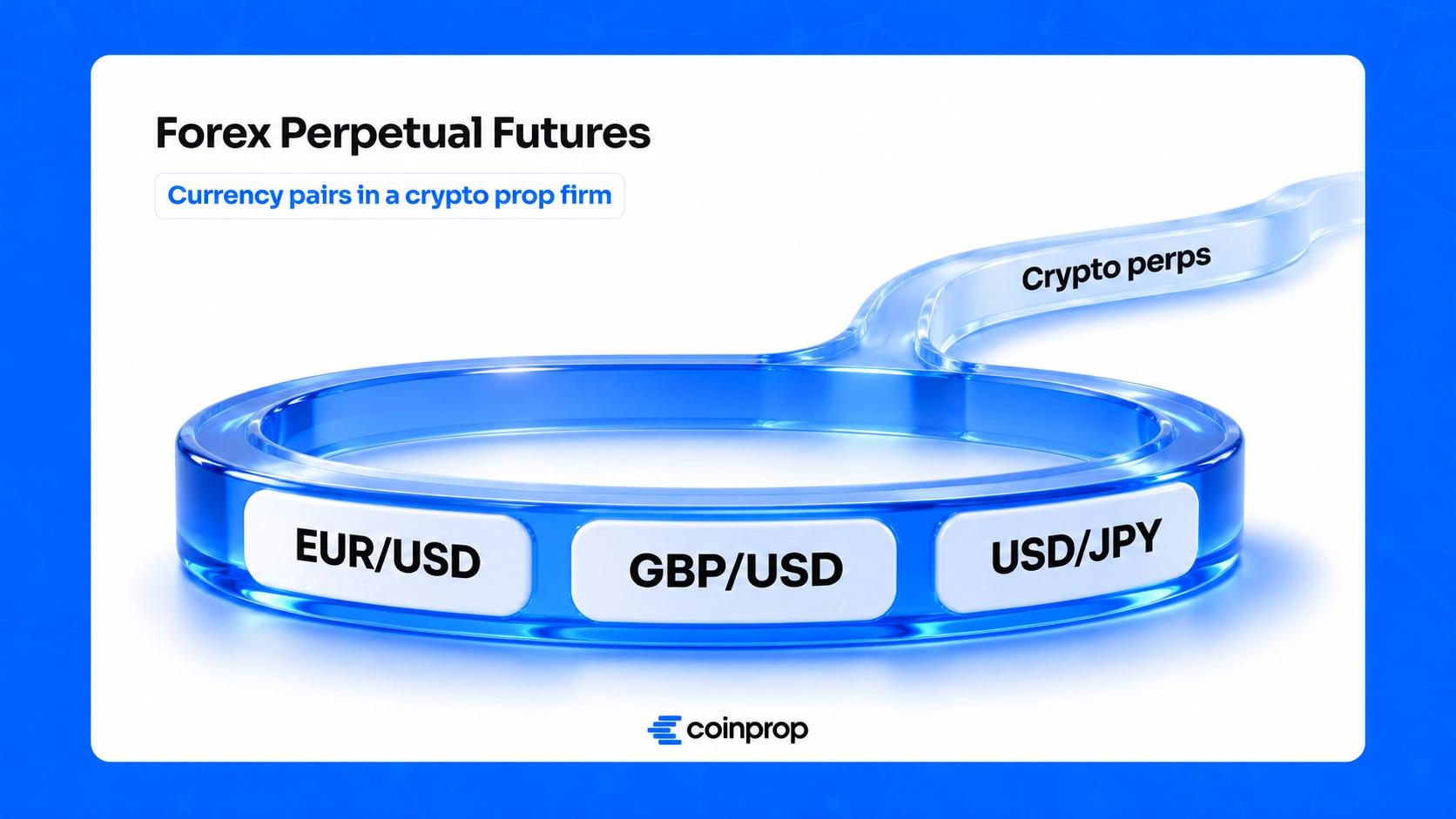
Forex perpetual futures are derivative contracts that track the price of a currency pair, such as EUR/USD, GBP/USD, or USD/JPY, without having a fixed expiration date. Instead of buying or selling the underlying currencies directly, a trader takes a long or short position on the expected price movement of the pair.
Forex perpetual futures combine the price exposure of the foreign exchange market with the structure of a perpetual futures contract. This makes it possible to trade currency pairs through a derivatives platform using mechanisms such as leverage, margin, and funding.
For a crypto prop trader, the basic trading concept is familiar: open a long or short position, manage the position with available margin, and close it when the trading strategy reaches its exit conditions. The main difference is the underlying market. Instead of Bitcoin, Ethereum, or another crypto asset, the contract tracks a traditional currency pair.
What Is a Forex Perpetual Contract?
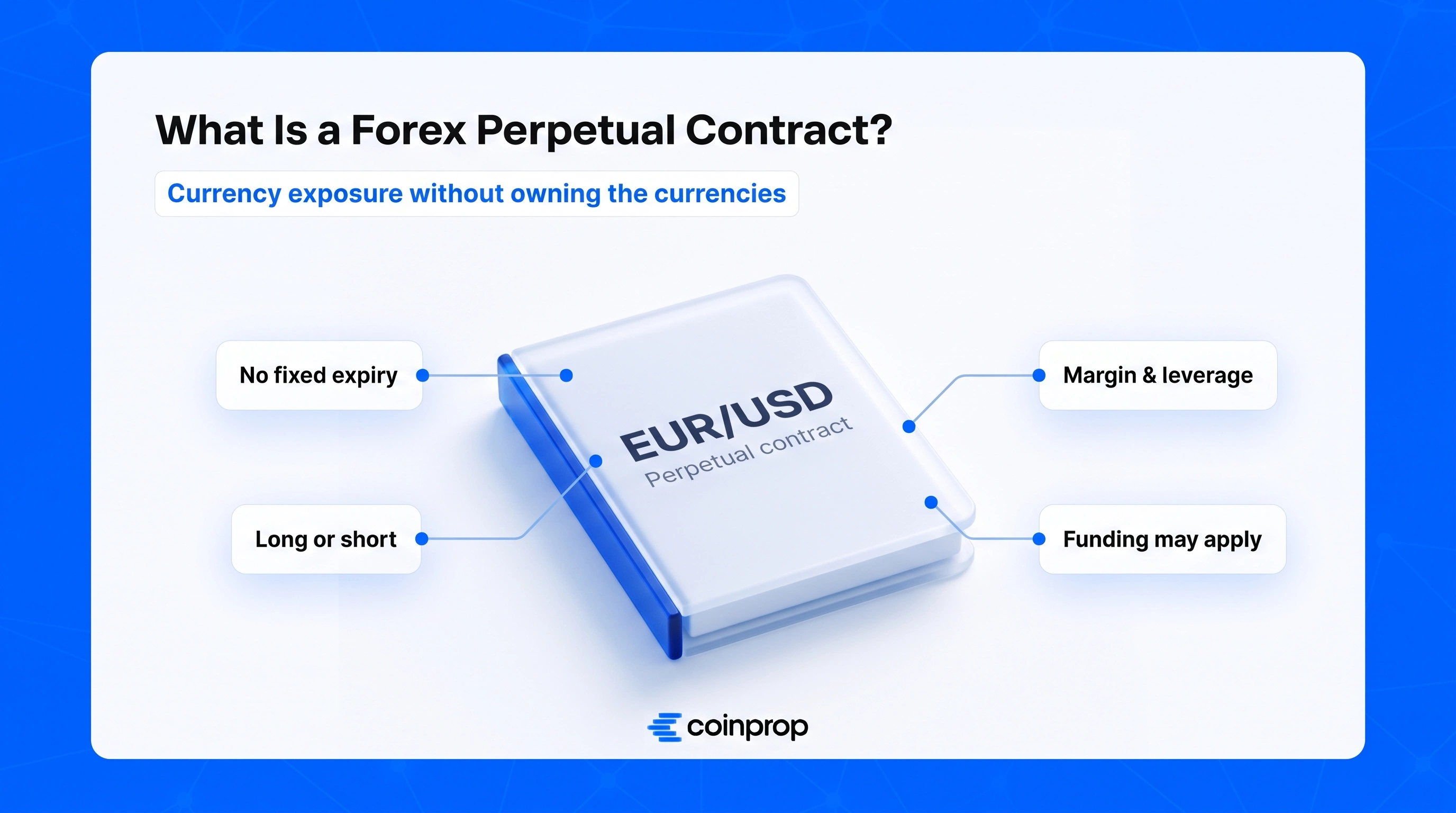
A Forex perpetual contract is a derivative instrument designed to follow the price of a foreign exchange pair without a predetermined settlement or expiration date.
For example, an EUR/USD perpetual contract tracks movements in the EUR/USD exchange rate. If a trader expects the euro to strengthen against the U.S. dollar, they can open a long position. If they expect the euro to weaken, they can open a short position.
The trader does not need to own euros or dollars to take the position. The position is based on the price movement of the underlying currency pair.
This structure has several important characteristics:
- No fixed expiration: Unlike traditional futures contracts, perpetual contracts do not expire on a specific date.
- Long and short positions: Traders can seek to profit from either rising or falling prices.
- Margin and leverage: Traders can control a position using a fraction of its total notional value, subject to the platform's margin and leverage rules.
- Funding mechanism: Perpetual contracts typically use periodic funding payments to help keep the contract price aligned with its underlying market.
- Derivative exposure: Traders gain exposure to the price movement of the currency pair without directly holding the underlying currencies.
These characteristics make Forex perpetuals structurally similar to crypto perpetual futures, while the underlying market remains the foreign exchange market.
How Do Forex Perpetual Futures Work?
Trading a Forex perpetual future starts with selecting a currency pair and determining the direction of the trade.
Suppose a trader believes EUR/USD will rise. They can open a long position on an EUR/USD perpetual contract. If EUR/USD increases after the position is opened, the position generates a profit before trading costs and funding. If the price falls, the position generates a loss.
The opposite applies to a short position. A trader who expects EUR/USD to decline can open a short position and potentially profit if the price moves lower.
The basic process can be summarized as:
Choose a currency pair → Analyze the market → Open a long or short position → Manage risk → Close the position
Leverage can increase the amount of market exposure relative to the margin used for a position. However, leverage also magnifies losses and can bring liquidation closer when the market moves against the trader. For this reason, position size and drawdown management are particularly important when trading Forex perpetual futures through a funded account or crypto prop firm.
The Role of Funding
Because perpetual contracts do not have an expiration date, they generally need a mechanism that helps keep their market price aligned with the underlying asset.
Funding is one such mechanism. Depending on the funding rate and the direction of a position, traders may pay or receive funding at periodic intervals.
Funding is therefore different from the traditional concept of a futures contract reaching its expiration and being settled. It is an ongoing part of the perpetual contract structure.
The exact funding calculation, interval, and rate depend on the platform and contract.
What Moves Forex Perpetual Futures?
Although the instrument is traded as a perpetual derivative, its price is ultimately influenced by the underlying currency market.
Major drivers of Forex prices include:
- Central bank interest rate decisions
- Inflation data
- Employment reports
- Economic growth
- Monetary policy expectations
- Government and central bank statements
- Geopolitical developments
- Changes in interest rate differentials between countries
For example, expectations that the Federal Reserve will keep U.S. interest rates higher for longer can influence the U.S. dollar and, consequently, major currency pairs involving USD.
This is one of the key differences a crypto trader should understand when moving from crypto perpetuals into Forex perpetual futures. Crypto markets have their own drivers, while FX markets are strongly connected to global monetary policy and macroeconomic data.
Forex Perpetual Futures vs. Traditional Forex
Forex perpetual futures and traditional Forex both provide exposure to currency pairs, but they use different trading structures.
In traditional Forex, traders generally participate in the foreign exchange market through a broker or other financial institution. Depending on the product and provider, positions may involve the actual exchange of currencies, rolling spot positions, or other forms of derivative exposure.
Forex perpetual futures are derivatives with no fixed expiration date. The trader opens a contract position rather than directly exchanging the underlying currencies.
| Feature | Forex Perpetual Futures | Traditional Forex |
|---|---|---|
| Underlying market | Currency pairs | Currency pairs |
| Contract structure | Perpetual derivative | Depends on the product |
| Expiration | No fixed expiration | Depends on the instrument |
| Long positions | Yes | Yes |
| Short positions | Yes | Yes |
| Leverage | Available depending on platform | Available depending on broker/product |
| Funding/rollover | Perpetual funding mechanism | Rollover/swap may apply depending on the product |
| Settlement | Depends on the contract | Depends on the broker/instrument |
| Trading environment | Derivatives platform | Forex broker or financial market |
The most important distinction is therefore not the underlying market, but the contract structure.
A trader can gain exposure to EUR/USD through both approaches, but the mechanics of opening, maintaining, funding, and closing the position can be different.
For traders coming from crypto, Forex perpetual futures can feel more familiar because the trading model resembles crypto perpetual contracts: both use perpetual derivatives, support long and short positions, and can use margin and leverage.
Forex Perpetual Futures vs. Forex CFDs
Forex perpetual futures are also different from Forex CFDs, even though both allow traders to speculate on currency price movements without owning the underlying currencies.
A CFD, or Contract for Difference, is a derivative agreement between a trader and a provider based on the difference between the opening and closing price of an asset. Forex CFDs are commonly offered by retail brokers.
A Forex perpetual future, on the other hand, is a perpetual derivatives contract with its own market, margin, funding, and settlement mechanics.
| Feature | Forex Perpetual Futures | Forex CFDs |
|---|---|---|
| Instrument | Perpetual futures contract | Contract for Difference |
| Expiration | No fixed expiration | Usually no fixed expiration |
| Underlying exposure | Currency pair | Currency pair |
| Long/short | Yes | Yes |
| Leverage | Depends on platform | Depends on provider and jurisdiction |
| Funding/holding costs | Perpetual funding may apply | Overnight/financing costs may apply |
| Pricing | Based on the perpetual contract and underlying market | Determined by the CFD provider |
| Trading venue | Derivatives exchange/platform | Usually broker/platform |
The cost structure is particularly important. A Forex CFD may involve overnight financing or other holding costs, while a perpetual contract generally uses a funding mechanism. Neither structure should automatically be treated as equivalent to the other.
Traders should also check the specific contract specifications, including leverage, margin requirements, funding rates, trading hours, fees, and liquidation rules, before trading.
Why Does the Difference Matter for a Crypto Prop Trader?
For a crypto prop trader, the biggest advantage of understanding these distinctions is knowing what actually changes when moving from crypto into Forex.
The trading framework may look familiar: analyze a market, choose long or short, define position size, manage drawdown, and exit the trade.
The market behavior and fundamental drivers, however, can be very different.
Crypto perpetuals are heavily influenced by crypto specific liquidity, sentiment, market structure, and industry news. Forex markets are more closely connected to interest rates, inflation, central bank policy, economic releases, and relative strength between economies.
This means a trader who is already comfortable with perpetual futures does not necessarily need to learn an entirely new trading structure to trade FX perpetuals, but they do need to understand the characteristics of the Forex market itself.
For a crypto prop trader, Forex perpetual futures therefore represent a way to apply a familiar perpetual trading structure to a different underlying market.
Can You Trade Forex With a Crypto Prop Firm?
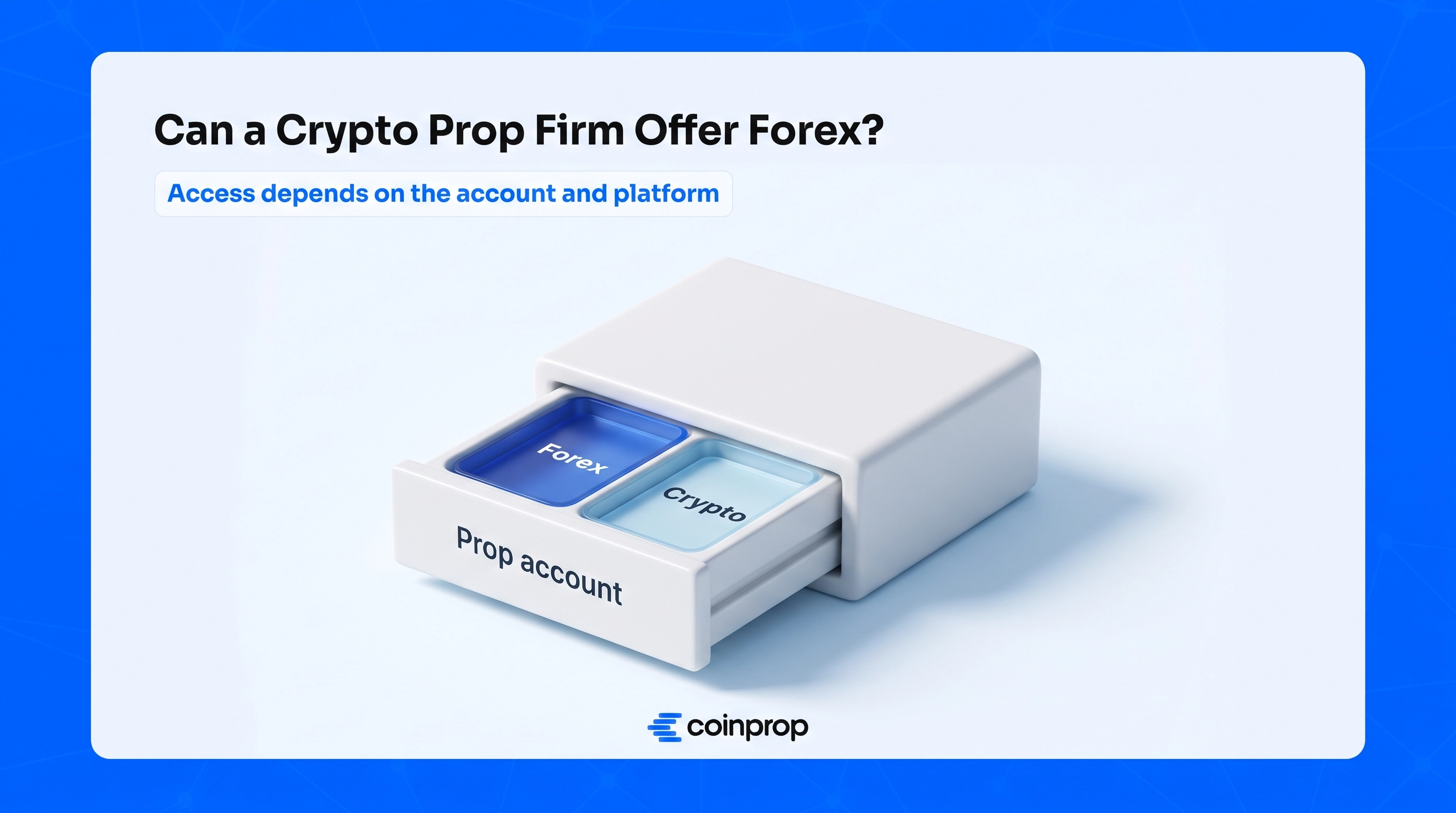
A crypto prop firm can offer access to Forex markets alongside cryptocurrency markets when its trading infrastructure supports Forex instruments such as FX perpetual futures.
Traditionally, crypto prop firms have focused primarily on digital assets such as Bitcoin, Ethereum, and other cryptocurrencies. As some platforms expand their market coverage, traders can now find crypto prop firms that provide access to additional markets, including Forex, commodities, and stocks.
For traders, this creates a multi market prop trading environment where the same funded account can potentially be used to trade different types of instruments, depending on the firm's available markets and trading rules.
What Is a Crypto Prop Firm?
A crypto prop firm is a proprietary trading company that provides traders with access to a trading account under a defined set of risk and performance rules. Instead of requiring the trader to provide the full amount of trading capital, the firm provides a simulated or funded trading environment where traders can demonstrate their ability to manage risk and generate profits.
The exact model varies between firms. Some use an evaluation or challenge before granting access to a funded account, while others offer different paths to funded trading.
A typical crypto prop firm account may include rules covering:
- Profit targets
- Maximum daily loss
- Maximum drawdown
- Leverage
- Position sizing
- Trading days
- Trading restrictions
- Payout conditions
The instruments available also depend on the firm. A crypto focused prop firm may primarily offer cryptocurrency perpetual futures, while a broader platform may include Forex perpetual futures and other markets.
How Does Funded Forex Trading Work Through a Crypto Prop Firm?
Funded Forex trading through a crypto prop firm follows a similar general process to funded crypto trading, but the underlying market is a currency pair rather than a cryptocurrency.
A trader typically starts by selecting an account and meeting the firm's requirements. Depending on the firm's model, this can involve completing an evaluation before becoming eligible for a funded account.
Once the trader has access to the appropriate account, they can trade the Forex instruments supported by the platform.
For example, a trader might analyze EUR/USD and decide to open a long position because they expect the euro to appreciate against the U.S. dollar. Another trader could take a short position if their analysis indicates that EUR/USD may decline.
The trading process can generally be described as:
Choose a supported Forex market → Analyze the setup → Open a position → Manage risk → Close the position → Meet the account's rules
The important point is that the trader is not necessarily opening a traditional Forex brokerage account. They are trading within the prop firm's specific account structure and are subject to its risk rules.
Those rules can be particularly important when leverage is available. A relatively small price movement in the underlying Forex market can have a larger effect on account equity when a position uses leverage. Traders therefore need to consider position size, stop loss placement, available margin, and the account's maximum loss limits.
The exact conditions vary by firm, so traders should review the firm's rules before opening positions.
Why Are Crypto Prop Firms Adding Forex Markets?
The expansion into Forex can give crypto prop firms a way to offer traders access to markets beyond digital assets.
Crypto and Forex have different market characteristics and different primary drivers. Crypto markets are closely associated with digital asset liquidity, sentiment, blockchain developments, and crypto specific news. Forex markets are strongly influenced by interest rates, monetary policy, inflation, economic data, and the relative strength of different economies.
Adding Forex therefore allows a crypto prop firm to serve traders who want to work across more than one asset class.
There is also a practical benefit for traders who already understand perpetual futures. Forex perpetual futures use a derivative structure that can be familiar to crypto traders, including long and short positions, leverage, margin, and funding mechanisms.
Instead of maintaining separate trading environments for crypto and Forex, a multi market platform can bring these instruments into a single trading interface.
For example, a trader may use Bitcoin perpetual futures when crypto market conditions match their strategy and switch to an FX perpetual such as EUR/USD when a currency market setup appears.
This does not mean that Forex and crypto behave in the same way. The underlying markets remain different, and a strategy that works well in one market may require adjustments in another.
Crypto Prop Firm vs. Traditional Forex Prop Firm
A crypto prop firm and a traditional Forex prop firm can both provide traders with access to funded trading programs, but their market focus and infrastructure can differ.
A traditional Forex prop firm generally focuses on Forex instruments and may build its trading environment around conventional Forex or CFD products. A crypto prop firm traditionally focuses on cryptocurrency derivatives, particularly perpetual futures.
A crypto prop firm that adds Forex perpetual futures sits somewhere between these two market environments. It can provide access to currency markets while retaining a trading infrastructure originally designed around crypto derivatives.
| Feature | Crypto Prop Firm With Forex | Traditional Forex Prop Firm |
|---|---|---|
| Primary markets | Crypto and Forex | Primarily Forex |
| Forex instruments | May include FX perpetual futures | Commonly Forex spot/CFDs or other FX products |
| Crypto markets | Usually available | Depends on the firm |
| Contract structure | May use perpetual futures | Depends on the firm's instruments |
| Long and short | Yes | Yes |
| Leverage | Depends on the firm and instrument | Depends on the firm and instrument |
| Funding mechanism | May apply to perpetual contracts | Depends on the instrument |
| Trading platform | Depends on the firm | Depends on the firm |
| Risk rules | Firm specific | Firm specific |
| Payout structure | Firm specific | Firm specific |
The distinction is therefore less about the label and more about which markets and instruments the prop firm actually provides.
A trader considering a Forex prop firm should check whether it offers the specific type of Forex exposure they want. Trading EUR/USD through a Forex perpetual contract is structurally different from trading EUR/USD through a traditional spot Forex or CFD product.
Likewise, a crypto trader considering a crypto prop firm with Forex should check whether the firm supports the required currency pairs, leverage, trading hours, fees, funding conditions, and risk limits.
Can Crypto Prop Traders Trade Both Forex and Crypto?
A crypto prop trader can trade both markets when the prop firm's account and trading platform support both crypto and Forex instruments.
This creates an opportunity to use different markets for different trading conditions. For example, a trader may focus on crypto perpetuals during periods of strong crypto volatility and use Forex markets when a clear macroeconomic or technical setup develops.
However, trading multiple markets does not automatically mean that every strategy should be applied in the same way.
Forex and crypto differ in:
- Typical volatility
- Liquidity
- Market drivers
- Economic sensitivity
- Price behavior
- Trading sessions
- Reaction to news
- Funding and trading costs
A trader moving from crypto perpetuals into Forex perpetual futures should therefore understand the characteristics of the currency market before increasing exposure.
The key benefit is access to another market within the same prop trading environment—not that Forex is necessarily easier or more predictable than crypto.
What Should You Check Before Trading Forex With a Crypto Prop Firm?
Before choosing a crypto prop firm for Forex trading, traders should look beyond the number of available markets.
Important factors include:
Available Forex pairs: Check which currency pairs are actually supported and whether the pairs you trade are available.
Contract type: Confirm whether the firm offers Forex perpetual futures, CFDs, spot Forex, or another derivative product.
Leverage: Understand the maximum leverage for Forex and how it affects position sizing and liquidation risk.
Trading costs: Review commissions, spreads, funding rates, and any other applicable costs.
Risk rules: Check daily loss limits, maximum drawdown, and any restrictions that apply to Forex positions.
Trading hours: Forex perpetual futures may have different availability and market behavior from traditional Forex products.
Platform and market data: Check where prices and market data come from and which charting and execution tools are available.
These details can have a greater impact on a trading strategy than the simple fact that a prop firm lists Forex among its available markets.
For a trader who already understands crypto perpetuals, the transition to Forex can be relatively straightforward from a contract structure perspective, but the underlying market requires a different understanding of macroeconomic factors and currency behavior.
A crypto prop firm with Forex perpetual futures can therefore provide a broader trading environment for traders who want to work with both digital assets and traditional currency markets through perpetual derivatives.
Forex Perpetual Futures vs CFDs for Prop Firm Trading
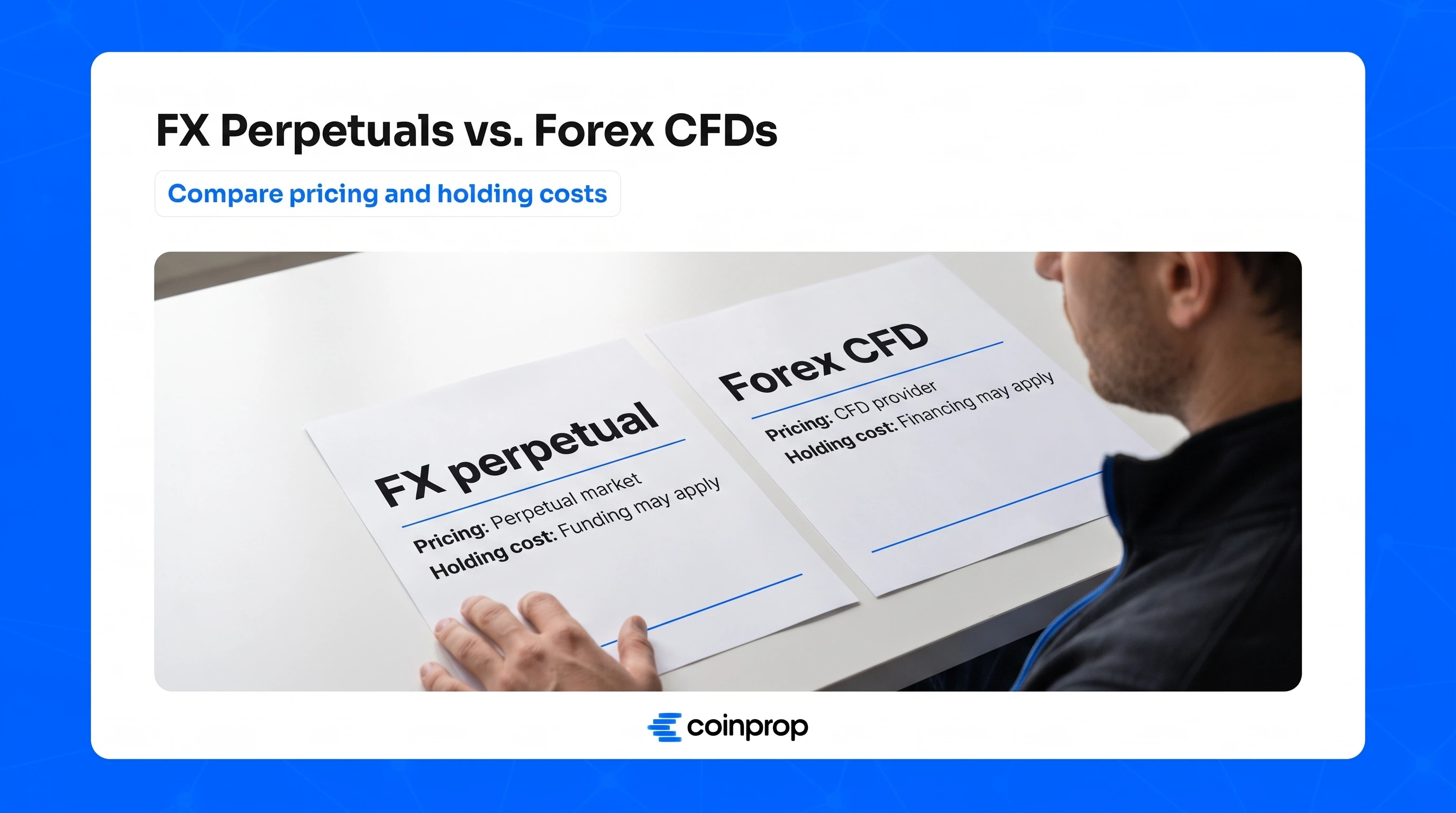
Forex perpetual futures and CFDs can both give traders exposure to currency price movements without directly owning the underlying currencies. However, they use different contract structures, pricing models, and trading environments.
The distinction becomes particularly relevant when Forex is offered through a crypto prop firm. Traders should look beyond the underlying currency pair and understand how the contract is priced, where its market data comes from, how positions are held, and what costs and account rules apply.
How Forex Perpetual Futures Differ From CFDs
A Forex perpetual future is a derivative contract that tracks the price of a currency pair without a fixed expiration date. Traders can take long or short positions while managing leverage and margin according to the trading environment and prop firm's rules.
A CFD, or Contract for Difference, is a derivative agreement based on the difference between the opening and closing price of an underlying asset. CFDs are commonly offered by brokers or CFD providers, with the provider determining the contract specifications, pricing, financing, and execution conditions.
Both structures can provide exposure to Forex price movements, but the mechanics behind that exposure are different.
Overnight Swap and Funding Costs
The cost of holding a position is another important difference.
Traditional Forex brokers commonly charge swap or rollover fees when positions remain open overnight. Some Forex prop firms may also apply overnight financing or swap-related charges depending on their trading model.
Perpetual futures can use a different mechanism called a funding rate. Funding payments are generally used to help keep the perpetual contract's price aligned with its underlying market, and the rate can vary depending on market conditions.
CoinProp's Forex perpetual futures do not charge an overnight swap or a funding rate.
This means traders can hold a Forex position beyond a single trading session without an overnight swap or funding payment being applied to the position. Other applicable trading costs and the prop firm's account rules still need to be considered.
Liquidity and Market Data
The source of market data and liquidity is another factor traders should consider.
CFD providers typically operate their own pricing and execution environment, so prices and trading conditions can vary between providers. Perpetual futures can instead be connected to an exchange market and its available liquidity.
At CoinProp, Forex perpetual futures use direct Bybit market data and liquidity within the trading environment. This allows traders to access Forex alongside crypto markets without moving to a separate traditional Forex trading setup.
The exact trading conditions can still vary by instrument and market conditions, so traders should review the available market, execution, and fee information before trading.
What Prop Traders Should Check
For traders comparing Forex perpetual futures with CFDs, the underlying currency pair is only part of the decision. The trading structure and account conditions can have a direct impact on how a strategy works.
Before trading, consider:
- Where the market data and liquidity come from
- How the Forex contract is priced
- Whether overnight swap or financing applies
- Whether a funding rate applies
- How leverage and margin work
- How liquidation is handled
- What trading hours are available
- How daily loss and maximum drawdown rules apply
- What fees apply to opening and closing positions
A trader familiar with traditional Forex or CFDs should therefore understand the mechanics of the specific perpetual contract before treating it as simply another way to trade currency pairs.
Forex perpetual futures are not simply traditional Forex with the expiration removed. They combine currency-market exposure with a perpetual derivative structure, while a prop firm adds its own account-level risk and trading rules.
How Forex Perpetual Futures Work in a Funded Account
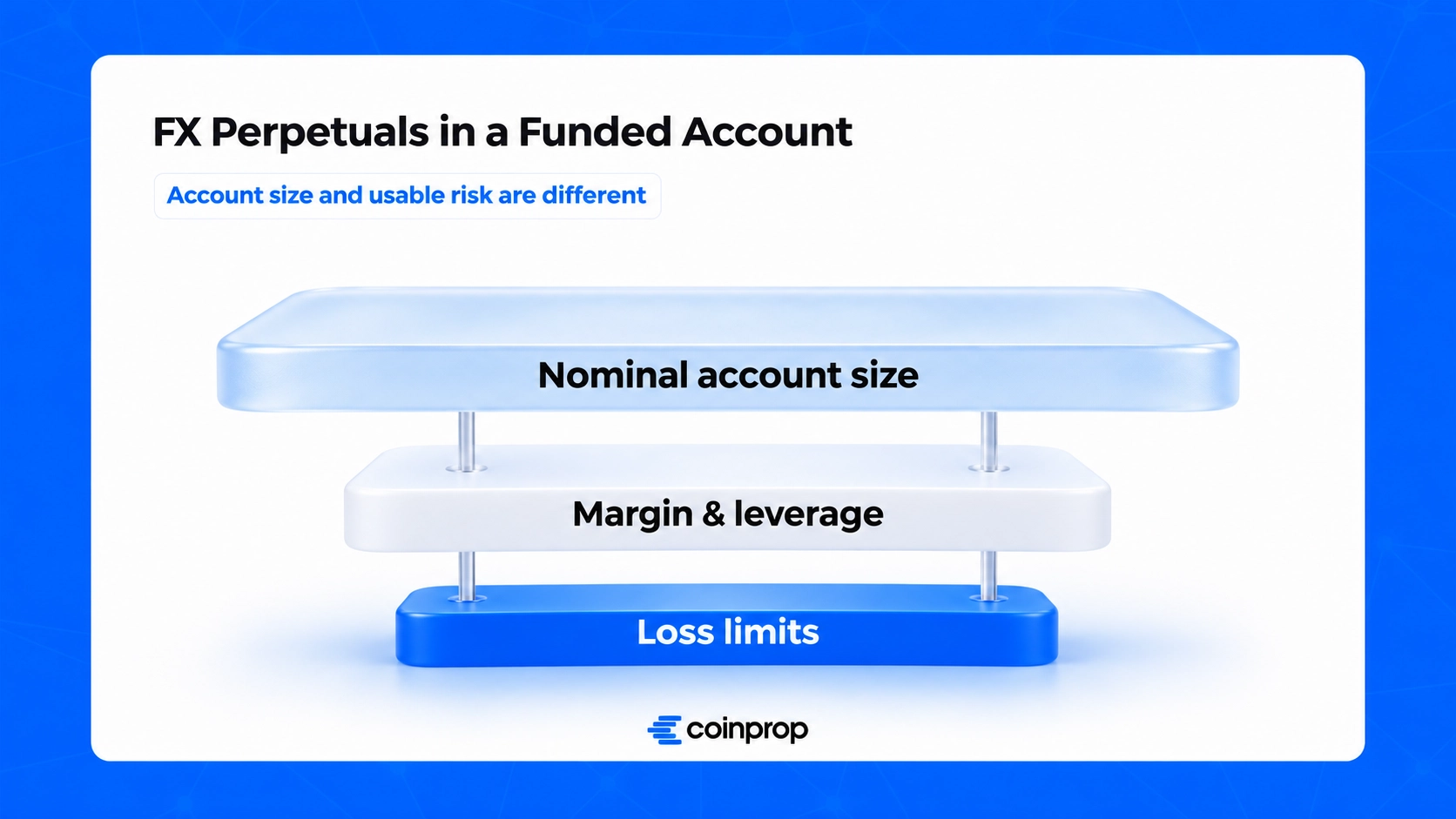
Trading Forex perpetual futures through a funded account combines the structure of perpetual contracts with the risk management rules of a prop trading program. Instead of using only personal trading capital, the trader operates within an account provided by a prop firm and must follow predefined limits for losses, drawdown, leverage, and other trading conditions.
The exact account structure varies between prop firms, but the basic process is similar: select an account, meet the firm's requirements, gain access to the applicable funded trading environment, and trade supported Forex perpetual contracts while staying within the account's risk rules.
For a broader explanation of how funded perpetual futures accounts work, including account models, drawdown, risk limits, and payouts, see our complete guide to funded perpetual futures.
Account Structure
A funded Forex perpetual futures account typically defines the amount of trading capital available to the trader, the maximum amount they can lose, and the conditions under which profits can be withdrawn.
The account size itself does not necessarily represent the amount of cash a trader can withdraw or freely lose. Instead, prop firms generally use account parameters to define the trading environment and establish risk limits.
Depending on the firm, an account may include:
- An initial or nominal account balance
- A profit target during an evaluation
- A maximum daily loss
- A maximum overall drawdown
- Maximum leverage
- Trading day requirements
- Position or exposure restrictions
- Profit sharing rules
- Payout requirements
These conditions determine how a trader can manage Forex perpetual positions within the account.
Long and Short Forex Positions
Forex perpetual futures allow traders to take either long or short positions.
A long position is used when a trader expects the price of the currency pair to increase. For example, if a trader expects EUR/USD to rise, they can open a long EUR/USD perpetual position.
A short position is used when a trader expects the price to decrease. If the trader expects EUR/USD to fall, they can open a short position instead.
This two directional structure is familiar to crypto perpetual traders. The main difference is the underlying market: a Forex perpetual tracks a currency pair rather than a cryptocurrency.
The profit or loss of the position depends on the price movement, position size, and entry and exit prices, before applicable trading costs and funding.
Leverage in a Funded Forex Account
Leverage allows a trader to control a position with less margin than the position's full notional value.
For example, if a platform allows 4x leverage, a trader can obtain exposure larger than the margin allocated to the position. The exact calculation and requirements depend on the platform and contract.
Leverage does not increase the trader's actual risk limit. A prop firm can still impose a fixed maximum daily loss or maximum drawdown regardless of the leverage available.
This distinction is important.
A trader may have access to a relatively large nominal account while having a much smaller amount of room before reaching the account's drawdown limit. Position sizing should therefore be based on the account's actual risk parameters rather than simply on the advertised account size.
Higher leverage can also cause losses to accumulate faster when a position moves against the trader. For this reason, leverage and position size should be considered together.
Drawdown and Loss Limits
Drawdown is one of the most important differences between trading a personal Forex account and trading Forex through a prop firm.
A prop firm's drawdown rules define how much the account can lose before the account is considered to have violated its risk conditions.
Common limits include:
- Daily loss limit: The maximum loss allowed during a trading day.
- Maximum drawdown: The maximum overall loss allowed from the account's defined reference point.
- Equity based limits: Rules that take unrealized profit and loss into account.
- Static or trailing drawdown: Depending on the firm's rules, the drawdown threshold may remain fixed or move as the account reaches certain profit levels.
These rules can affect how a trader manages Forex perpetual positions.
For example, a strategy that is acceptable in a personal account may be unsuitable for a prop account if its normal losing streak or position size can bring the trader close to the firm's daily loss or maximum drawdown limit.
This is why risk management is not simply about avoiding liquidation. A trader must also stay within the specific risk framework of the prop firm.
Position Sizing for Forex Perpetual Futures
Position sizing determines how much exposure a trader takes on in a Forex perpetual contract.
A common approach is to determine the amount of account equity a trader is willing to risk before calculating the appropriate position size. The distance between the entry price and the planned stop loss can then be used to determine how large the position should be.
For example:
Risk per trade ÷ Stop loss distance = Position size
The exact calculation depends on the contract's specifications and how the platform measures the value of price movements.
For funded trading, position sizing should also account for the prop firm's daily loss and maximum drawdown limits. A trader may choose a smaller position size than the maximum permitted by the platform in order to leave room for multiple trades or normal market fluctuations.
This becomes especially important around major economic releases, when currency markets can move quickly.
Funding in Forex Perpetual Futures
Funding is a characteristic of perpetual futures that helps keep the contract price aligned with its underlying market.
Depending on the funding rate and the direction of the position, a trader may pay or receive funding. The rate can change over time according to market conditions and the methodology used by the trading platform.
Funding should therefore be considered when holding a Forex perpetual position, particularly if the trade remains open for an extended period.
This is different from the traditional overnight swap or rollover structure used by many Forex brokers. While both can represent a cost or credit associated with maintaining a position, their calculation and mechanics are not necessarily the same.
Before trading, traders should check the specific funding methodology and current contract conditions provided by the platform.
Payouts From a Funded Forex Account
Profits generated in a funded prop trading account are subject to the firm's payout rules.
The payout process can vary considerably between prop firms. Some may require a minimum number of trading days or a specific waiting period, while others may allow traders to request a payout once certain conditions have been met.
A trader should check:
- When a payout can be requested
- Whether a minimum profit is required
- Whether additional trading days are required
- The applicable profit split
- Available payout methods
- Any payout restrictions or caps
The fact that a trader is trading Forex rather than crypto does not necessarily create a separate payout model. In many cases, payouts are determined by the overall prop firm's account rules rather than by the underlying market.
For a detailed explanation of funded perpetual futures, including how traders progress through funded accounts and how risk and payout structures work, see our Funded Perpetual Futures guide.
The Key Difference From Trading Forex With Your Own Capital
The biggest difference is the risk framework.
When trading a personal account, the trader determines how much capital to deposit and how much of that capital to risk. In a funded prop account, the trader must operate within the firm's predefined limits.
That means a Forex perpetual futures strategy needs to work not only in the market itself but also within the account's:
- Daily loss limit
- Maximum drawdown
- Leverage limits
- Position size requirements
- Trading restrictions
- Payout conditions
For this reason, successful funded Forex trading requires more than correctly predicting the direction of EUR/USD, GBP/USD, or another currency pair. The trader must also manage the position in a way that keeps the account within its risk parameters.

Forex Markets Available at CoinProp
CoinProp supports Forex perpetual futures alongside its existing cryptocurrency markets, giving traders access to major currency pairs within the same prop trading environment.
The available Forex markets are offered as perpetual futures, allowing traders to take long or short positions without directly holding the underlying currencies. Unlike traditional Forex trading, CoinProp's Forex perpetual futures do not use overnight swap charges or funding rates.
EUR/USD
EUR/USD represents the value of the euro relative to the U.S. dollar and is one of the most widely traded currency pairs in the global Forex market.
With an EUR/USD perpetual future, traders can take either a long or short position based on their view of the pair's price movement. The pair is influenced by factors such as European and U.S. monetary policy, interest-rate expectations, inflation, economic data, and broader macroeconomic conditions.
For crypto traders, EUR/USD provides a familiar long/short perpetual structure while introducing a different set of market drivers.
GBP/USD
GBP/USD tracks the value of the British pound relative to the U.S. dollar.
The pair can be influenced by economic data from the United Kingdom and United States, central-bank decisions, interest-rate expectations, inflation, and broader market sentiment.
Through a GBP/USD perpetual future, traders can take long or short exposure to the pair without directly holding GBP or USD.
USD/JPY
USD/JPY represents the value of the U.S. dollar relative to the Japanese yen.
The pair can be particularly sensitive to differences in U.S. and Japanese monetary policy, interest-rate expectations, inflation, and changes in global risk sentiment.
A USD/JPY perpetual future allows traders to take long or short exposure to the currency pair through a perpetual derivatives structure.
No Overnight Swap or Funding Rate
One of the differences between CoinProp's Forex perpetual futures and many traditional Forex trading environments is the absence of overnight swap charges and funding rates.
Traditional Forex brokers may charge swap or rollover fees when positions remain open overnight. Perpetual futures on some trading venues can also use funding payments to help maintain alignment between the contract and its underlying market.
CoinProp's Forex perpetual futures do not charge traders an overnight swap or funding rate for holding these positions.
This can be relevant for traders who hold Forex positions beyond a single trading session, although other trading costs and the prop firm's account rules still apply.
More Forex Markets Can Be Added
CoinProp's Forex market coverage can expand as additional FX perpetual futures become available.
The current selection should therefore be treated as a list of available markets rather than a permanent set of instruments. Traders can check the CoinProp markets page for the latest supported Forex pairs and other available markets.
As additional pairs are introduced, traders can access a broader range of currency markets alongside crypto within the same prop trading environment.
How to Trade Forex Perpetual Futures at CoinProp
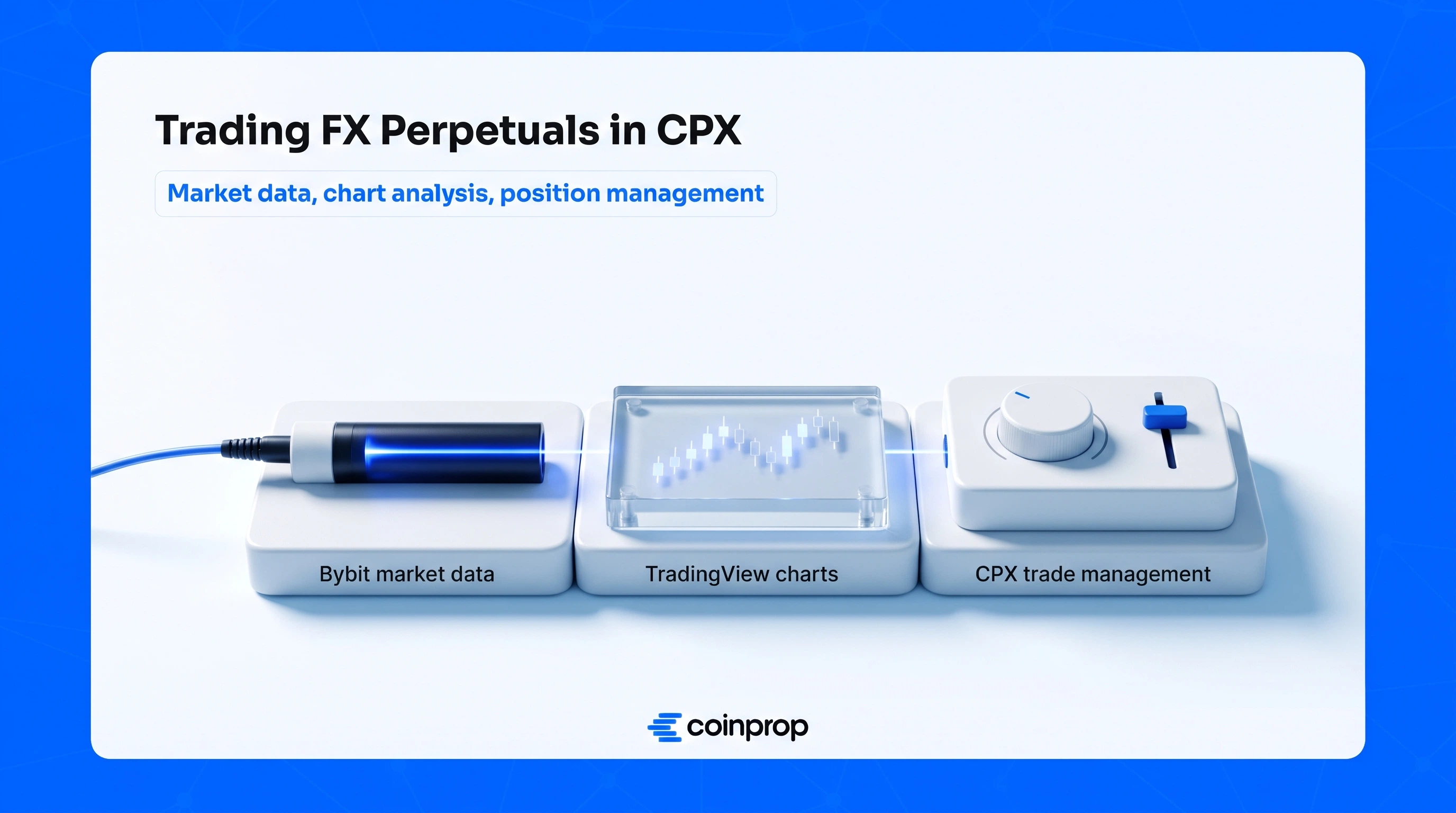
CoinProp brings Forex perpetual futures into the same trading environment used for crypto trading. Traders can access supported FX markets through CPX, use TradingView charts with direct Bybit market data integration, and manage Forex positions alongside crypto markets. This allows crypto traders to add currency markets without moving to a separate trading platform or changing to a traditional Forex trading setup.
TradingView and Bybit Market Data
TradingView is integrated directly into the CoinProp trading environment, giving traders access to familiar charting tools while trading supported Forex perpetual futures. The integration uses direct Bybit market data, allowing traders to analyze the same underlying market data available through the supported Bybit markets.
For Forex traders, this provides a familiar chart based workflow for analyzing currency pairs such as EUR/USD, GBP/USD, and USD/JPY. Traders can apply technical analysis, monitor price movements, identify support and resistance levels, and build their trading plans directly from the charting interface.
The Bybit market data integration is particularly relevant for traders who already use Bybit markets for crypto trading. Instead of switching between unrelated data feeds and platforms, traders can work with Forex and crypto markets within the same CoinProp environment.
TradingView also makes it easier for traders who are already familiar with its charting interface to transition from crypto perpetual futures to Forex markets. The underlying markets are different, but the chart based analysis workflow remains familiar.
Trading Forex Through CPX
CPX is CoinProp's proprietary trading terminal and provides the main environment for managing trades. Rather than treating Forex as a separate product that requires a different platform, CoinProp integrates supported Forex markets into the same trading environment used for other markets.
A typical Forex trading workflow can begin with selecting a supported currency pair and analyzing its price action through the integrated TradingView charts. Once a setup is identified, traders can use the available trading tools to determine position size, choose a direction, and manage the position from the CPX interface.
CPX also provides tools designed to help traders manage positions and monitor trading activity. Depending on the market and trading workflow, these include position sizing tools, order flow and DOM features, PnL tracking, journaling, and account analytics.
This creates a workflow that can be familiar to an experienced crypto perpetual trader:
- Select a supported Forex market.
- Analyze the market using TradingView charts and available market data.
- Define the trade direction and position size.
- Open and manage the position through CPX.
- Monitor PnL and account risk while the position is open.
- Review the trade through the platform's tracking and analytics tools.
The goal is not to turn Forex into a traditional spot Forex trading experience. Forex perpetual futures remain derivative contracts, so traders need to understand their specific mechanics, including leverage, funding, and the risk limits that apply to the funded account.
Managing Forex Positions
Managing a Forex perpetual position requires more than identifying the correct direction. Position size, leverage, drawdown, and the distance to the invalidation level can all affect the risk of a trade.
For a funded account, this becomes particularly important because the trader is operating within predefined account limits. A position that might be manageable in a personal trading account can have a very different impact when measured against a prop firm's daily loss or maximum drawdown limits.
Position sizing tools can help traders determine an appropriate trade size before entering the market. Instead of choosing a position based only on the available account balance, traders can consider the amount they are willing to risk and how a potential price movement could affect the account.
Forex markets can also react quickly to macroeconomic events. Interest rate decisions, inflation data, employment reports, and central bank announcements can create significant price movements in major currency pairs. Traders should therefore consider the timing of major economic events when managing open positions.
CPX provides account and trading information that can help traders monitor their positions and overall performance. Combining this information with predefined risk rules can make it easier to keep individual Forex trades within the broader limits of a funded account.
The same principle applies when moving from crypto to Forex: familiar trading tools do not eliminate market specific risk. Forex and crypto can behave differently around major news, liquidity changes, and periods of volatility, so position sizing and risk management should reflect the characteristics of the market being traded.
Trading Crypto and Forex in One Environment
One of the main differences between using a crypto prop firm with Forex markets and using a traditional Forex only prop firm is the ability to access multiple asset classes within the same trading environment.
A trader who normally focuses on crypto perpetual futures can use supported Forex markets when currency markets offer a setup that fits their strategy. Conversely, a Forex trader can access supported crypto markets without needing a separate trading environment.
This can be useful for traders who follow different market conditions throughout the week. Crypto markets operate around the clock, while Forex activity is strongly influenced by global trading sessions, economic releases, interest rate expectations, and liquidity conditions. Having both markets available gives traders more instruments to monitor without requiring separate platforms for each market.
For example, a trader might analyze EUR/USD during a major European or U.S. session and later monitor BTC or another supported crypto market when a suitable setup develops. The instruments and market drivers are different, but the trader can manage both through the same CoinProp environment.
This multi market approach also means traders do not have to treat Forex and crypto as competing trading styles. They can be separate markets within the same broader trading process, with each trade evaluated according to its own volatility, liquidity, market drivers, and risk characteristics.
For traders already familiar with crypto perpetual futures, Forex perpetual futures can therefore provide another market to analyze while keeping the same general workflow: analyze the market, define the setup, size the position, execute the trade, and manage risk within the account's limits.
Forex Perpetual Futures vs. Crypto Perpetual Futures
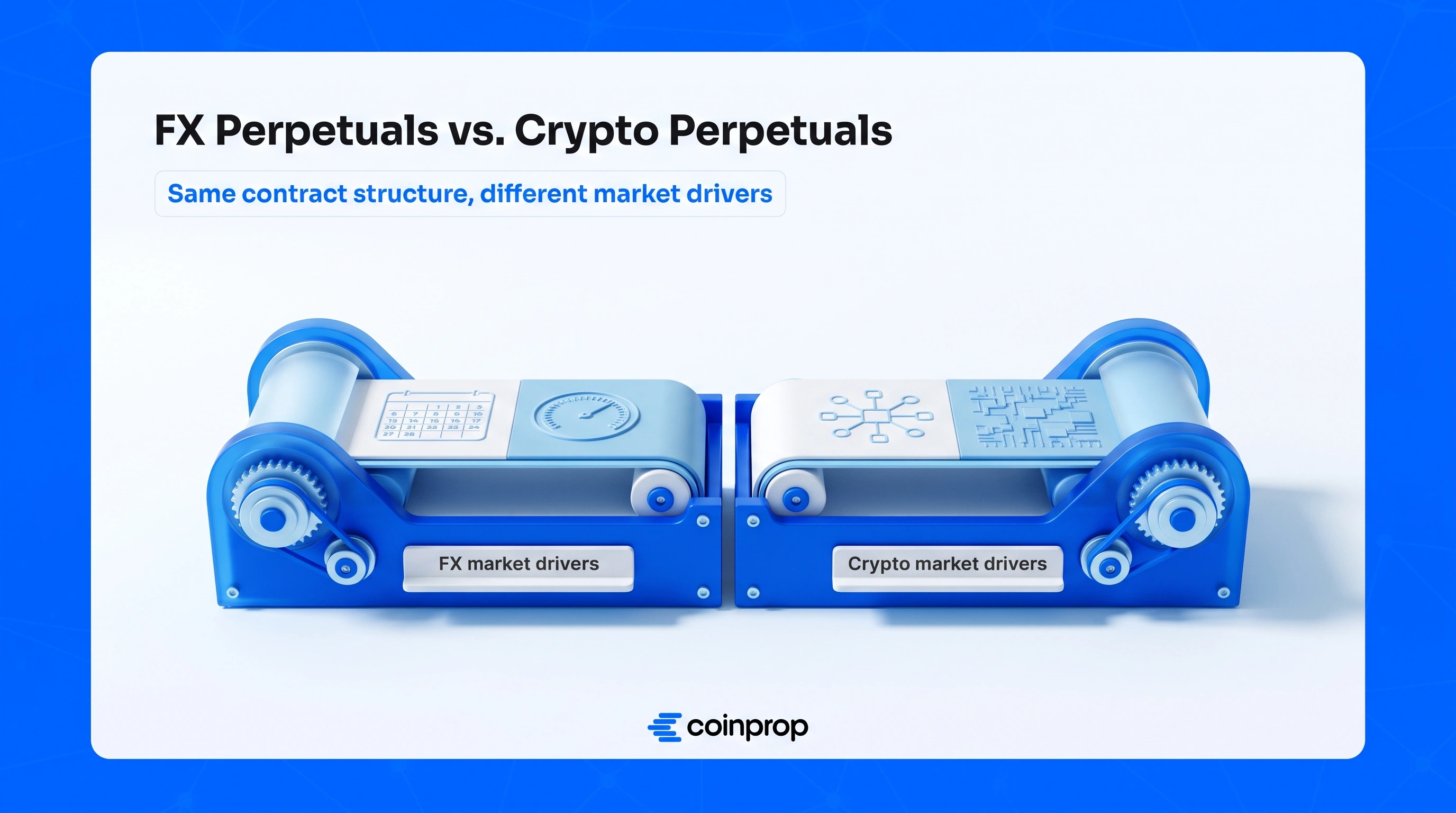
Forex perpetual futures and crypto perpetual futures share the same basic derivative structure: both allow traders to take long or short positions without a fixed expiration date. The major difference is the underlying market.
Forex perpetual futures track currency pairs such as EUR/USD, GBP/USD, and USD/JPY, while crypto perpetual futures track digital assets such as BTC/USDT and ETH/USDT. Because the underlying markets have different liquidity characteristics, participants, and economic drivers, the way traders analyze and manage these instruments can also differ.
| Forex Perpetual Futures | Crypto Perpetual Futures | |
|---|---|---|
| Underlying | Currency pairs | Crypto assets |
| Example | EUR/USD | BTC/USDT |
| Volatility | Generally lower | Generally higher |
| Main drivers | Interest rates, inflation, employment, economic data, monetary policy | Crypto sentiment, liquidity, market flows, market news, network and industry developments |
| Trading structure | Perpetual | Perpetual |
| Long/Short | Yes | Yes |
| Market sessions | Strongly influenced by global Forex sessions | Operates continuously across the week |
| Key macro influence | Central banks and interest rate expectations | Crypto market conditions and broader risk sentiment |
The comparison does not mean that every Forex market is less volatile than every crypto market. Volatility can change significantly depending on the currency pair, economic conditions, and market event. However, major currency pairs generally experience smaller price fluctuations than major crypto assets over comparable periods.
For a trader, the most important difference is therefore not the ability to go long or short. Both markets provide that functionality. The bigger difference is what moves the market and how quickly those drivers can affect price.
What Crypto Traders Should Know Before Trading FX
Crypto traders already familiar with perpetual futures may find the basic trading structure of Forex perpetual futures relatively familiar. Long and short positions, leverage, position sizing, funding, and account risk are concepts that can carry over from one market to the other.
What changes is the market environment.
Crypto markets are heavily influenced by factors such as market sentiment, liquidity, large market flows, regulatory developments, token specific news, and broader risk appetite. Forex markets are much more closely connected to the global economy and the relative strength of different currencies.
For example, EUR/USD can be affected by changes in expectations around European Central Bank or Federal Reserve policy. Employment data, inflation reports, GDP figures, and interest rate decisions can all change expectations about the relative value of the two currencies.
This means crypto traders moving into FX need to pay more attention to the economic calendar and scheduled macroeconomic events.
Forex Is Driven by Relative Currency Strength
A crypto trader may analyze BTC/USD primarily by looking at Bitcoin specific developments and overall crypto market conditions. With EUR/USD, the trader is analyzing the relative value of two currencies.
If the U.S. dollar strengthens while the euro remains relatively unchanged, EUR/USD can fall. If expectations for European monetary policy become more supportive relative to U.S. policy, the pair can move in the opposite direction.
Understanding this relative relationship is important because a Forex trade is not simply a bet on whether one currency is "strong" or "weak" in isolation.
Macro Events Can Matter More
Major economic releases can have a significant impact on Forex markets. Traders should be aware of events such as:
- Central bank interest rate decisions
- Inflation data
- Employment reports
- GDP releases
- Monetary policy statements
- Major economic forecasts
A currency pair can move rapidly when new data changes market expectations. For a funded trader, this matters because a sudden move can affect both an individual position and the account's drawdown limits.
Forex Sessions Matter
Unlike crypto, which trades continuously throughout the week, traditional Forex activity is organized around global market sessions. Liquidity and volatility can change as Asian, European, and U.S. markets become active.
Crypto traders who are accustomed to monitoring the market at any time may therefore need to think differently about when a Forex setup is most likely to develop.
Lower Typical Volatility Does Not Mean Lower Risk
Forex is often associated with lower volatility than crypto, but that should not be interpreted as meaning Forex perpetual futures are low risk instruments.
Leverage can magnify relatively small price movements. A major economic announcement can also create a rapid move in a currency pair. In a funded account, the relevant question is not only how volatile the underlying market normally is, but how a particular position affects the account's risk limits.
Crypto traders moving into FX should therefore adapt their position sizing rather than simply transferring the same position sizes they use for crypto.
What Forex Traders Should Know Before Trading Crypto
The transition works in the opposite direction as well. Forex traders who begin trading crypto perpetual futures will recognize familiar concepts such as leverage, long and short positions, technical analysis, and risk management.
However, crypto markets have their own market structure and can behave very differently from major currency pairs.
The most obvious difference is volatility. Major crypto assets can experience substantially larger price movements over short periods than major Forex pairs. A strategy that uses relatively tight stops or position sizes in Forex may therefore require significant adjustment when applied to crypto.
Crypto Has Different Market Drivers
Crypto prices can respond to a different combination of factors than currency markets.
Market sentiment, liquidity, major capital flows, regulatory developments, exchange activity, protocol developments, and broader risk appetite can all influence crypto prices. Individual assets can also react strongly to asset specific news.
This creates a different analytical environment from Forex, where central bank policy, interest rate expectations, inflation, employment, and economic growth are among the major recurring drivers.
Crypto Volatility Can Change Position Sizing
Forex traders moving into crypto should avoid assuming that the same percentage move represents the same level of risk.
A position size that appears reasonable for a major currency pair may be too large for a volatile crypto asset. Larger price swings can cause a position to reach its predefined risk level much faster.
For traders operating under prop firm drawdown rules, position sizing becomes especially important. The goal is to make the size of the position consistent with the expected volatility of the asset and the account's loss limits.
Crypto Trades Around the Clock
Another major difference is market availability.
Crypto perpetual futures can generally be traded continuously, rather than being concentrated around traditional Forex sessions. This gives traders more flexibility, but it also means there is less separation between active and inactive periods.
A Forex trader moving into crypto may therefore need to define specific trading hours rather than feeling that every market movement requires attention.
Crypto and Forex Require Different Market Context
Technical analysis can be used in both markets, but the context behind a price movement can be very different.
A breakout in EUR/USD might occur around an interest rate decision or major economic release. A similar breakout in BTC/USDT might be connected to changes in crypto liquidity, market sentiment, major news, or a broader move across digital assets.
The chart may look familiar, but the reason behind the move matters.
The Main Difference for Multi Market Traders
For traders who want to trade both markets through a crypto prop firm, the key is not to force one market to behave like the other.
Forex perpetual futures and crypto perpetual futures use a similar trading structure, but they operate in different market environments. Forex traders need to understand macroeconomic and currency specific drivers, while crypto traders need to account for higher and more variable volatility and crypto specific market conditions.
A multi market trader can use the same overall risk management framework across both markets while adapting the strategy, position size, and market analysis to the underlying asset.
This is one reason having Forex and crypto markets in the same prop trading environment can be useful: traders can apply a familiar execution and risk management workflow while learning to analyze different markets on their own terms.
How to Trade Forex Perpetual Futures in a Prop Firm
Trading Forex perpetual futures through a prop firm combines the mechanics of perpetual contracts with the risk rules of a funded trading account. The trader is not simply looking for profitable Forex setups; each position also needs to fit within the account's drawdown, leverage, and risk limits.
For crypto traders moving into Forex, the basic long and short structure may feel familiar. The bigger adjustment is understanding how currency markets behave and how Forex positions interact with prop firm risk rules.
Choosing a Forex Market
The first step is choosing a currency pair that fits your trading strategy and the market conditions you want to trade.
Major pairs such as EUR/USD, GBP/USD, and USD/JPY are influenced by different combinations of economic data, interest rate expectations, central bank policy, and market sentiment. Their trading characteristics can also change depending on the active market session and upcoming economic events.
A prop trader should consider more than simply looking for the pair with the biggest recent move. The market should fit the trader's strategy, expected volatility, available liquidity, and account risk limits.
For example, a trader using a short term strategy may prefer a highly liquid major pair during an active trading session. Another trader may focus on a currency pair because of a specific macroeconomic setup or a developing interest rate divergence.
The important point is to choose the market before deciding the position size. The characteristics of the currency pair should influence how much risk is appropriate for the trade.
Position Sizing and Leverage in a Prop Firm
Position sizing becomes especially important when trading Forex perpetual futures through a prop firm.
Leverage can allow a trader to control a larger position with less margin, but it does not reduce the underlying market risk. A relatively small movement in the currency pair can produce a meaningful change in the position's PnL when leverage and position size are high.
For a funded trader, position size should therefore be considered in relation to the account's drawdown limits rather than simply the amount of margin available.
A practical approach is to determine the maximum acceptable loss for the trade first and then calculate the position size based on the distance to the invalidation level.
This is particularly important for Forex perpetual futures because a currency pair may normally appear less volatile than a crypto asset. Lower typical volatility can sometimes encourage traders to use larger positions, but leverage can quickly change the risk profile.
The goal is not to use as much leverage as the account allows. The goal is to use a position size that allows the trade to remain within the trader's predefined risk parameters.
Managing Risk With Prop Firm Drawdown Rules
Risk management works differently when trading a prop firm account because the trader is operating within predefined account limits.
A losing trade does not only reduce the current position's PnL. It can also reduce the remaining room before the account reaches its daily loss or maximum drawdown threshold.
This makes drawdown management an important part of Forex perpetual futures trading.
A trader should understand:
- The account's daily loss limit
- The maximum drawdown limit
- How unrealized and realized PnL affect those limits
- Whether open positions can expose the account to a drawdown breach
- How position size changes the distance to the account's loss limits
The same trade can therefore have very different consequences depending on the account size and risk rules.
For example, opening several highly correlated Forex positions can create more exposure to the U.S. dollar than the number of individual trades suggests. EUR/USD, GBP/USD, and other dollar related pairs may respond to the same macroeconomic event. Treating each position as completely independent can therefore underestimate total account risk.
For funded Forex trading, risk management should consider the combined exposure of the account, not only the risk of each individual position.
This is also where Forex perpetual futures differ from simply trading a personal account. A trader may have enough personal capital to withstand a temporary drawdown, while a prop firm account has predefined limits that can end the trading cycle much sooner.
Technical Analysis for Forex Perpetual Futures
Technical analysis can be used for Forex perpetual futures in much the same way it is used for other perpetual markets.
Traders may use:
- Support and resistance
- Trend lines
- Moving averages
- Market structure
- Breakouts
- Pullbacks
- Momentum indicators
- Volume and order flow information where available
However, technical analysis should not be separated completely from the broader Forex environment.
A technical breakout that occurs immediately before a major central bank announcement may have a very different risk profile from a similar breakout during a relatively quiet market period.
For prop traders, technical analysis is therefore often most useful when combined with a clear risk framework. The chart can help define the entry, invalidation level, and potential target, while the account rules determine whether the resulting position size is appropriate.
The objective is not to predict every Forex price movement. It is to identify setups where the potential trade fits both the market conditions and the risk parameters of the funded account.
Trading Around Macro Events
Economic events are particularly important when trading Forex perpetual futures because currency markets can react quickly when new information changes expectations about interest rates, economic growth, or monetary policy.
Before opening a position, a Forex prop trader should check the economic calendar for major events affecting the currencies in the selected pair.
Important events can include:
- CPI and inflation data
- Interest rate decisions
- Central bank meetings and statements
- Employment reports
- GDP releases
- Retail sales and other major economic indicators
- Central bank speeches and monetary policy guidance
For example, a major U.S. inflation release can affect expectations for Federal Reserve policy and consequently influence USD related currency pairs. Similarly, an interest rate decision from the European Central Bank can create significant movement in EUR/USD.
This does not mean traders necessarily need to avoid every economic release. Some strategies are specifically designed around macroeconomic events. The important consideration for a prop trader is understanding how event driven volatility can affect the position and the account's drawdown limits.
A position that looks appropriately sized during normal market conditions can become much more exposed when volatility increases around a major announcement.
Using an Economic Calendar as a Prop Trading Tool
An economic calendar can therefore be part of the normal pre trade process rather than something checked only after a position has been opened.
A simple workflow can be:
- Identify the Forex pair and trading setup.
- Check upcoming high impact economic events.
- Determine whether the event can materially affect either currency.
- Assess expected volatility around the release.
- Define the trade's invalidation level and acceptable risk.
- Adjust position size if necessary.
- Enter the trade only if it remains within the prop firm's account limits.
This approach is particularly relevant for traders moving from crypto perpetual futures into Forex. Crypto traders may already monitor market news closely, but Forex requires a stronger focus on scheduled economic data and central bank expectations.
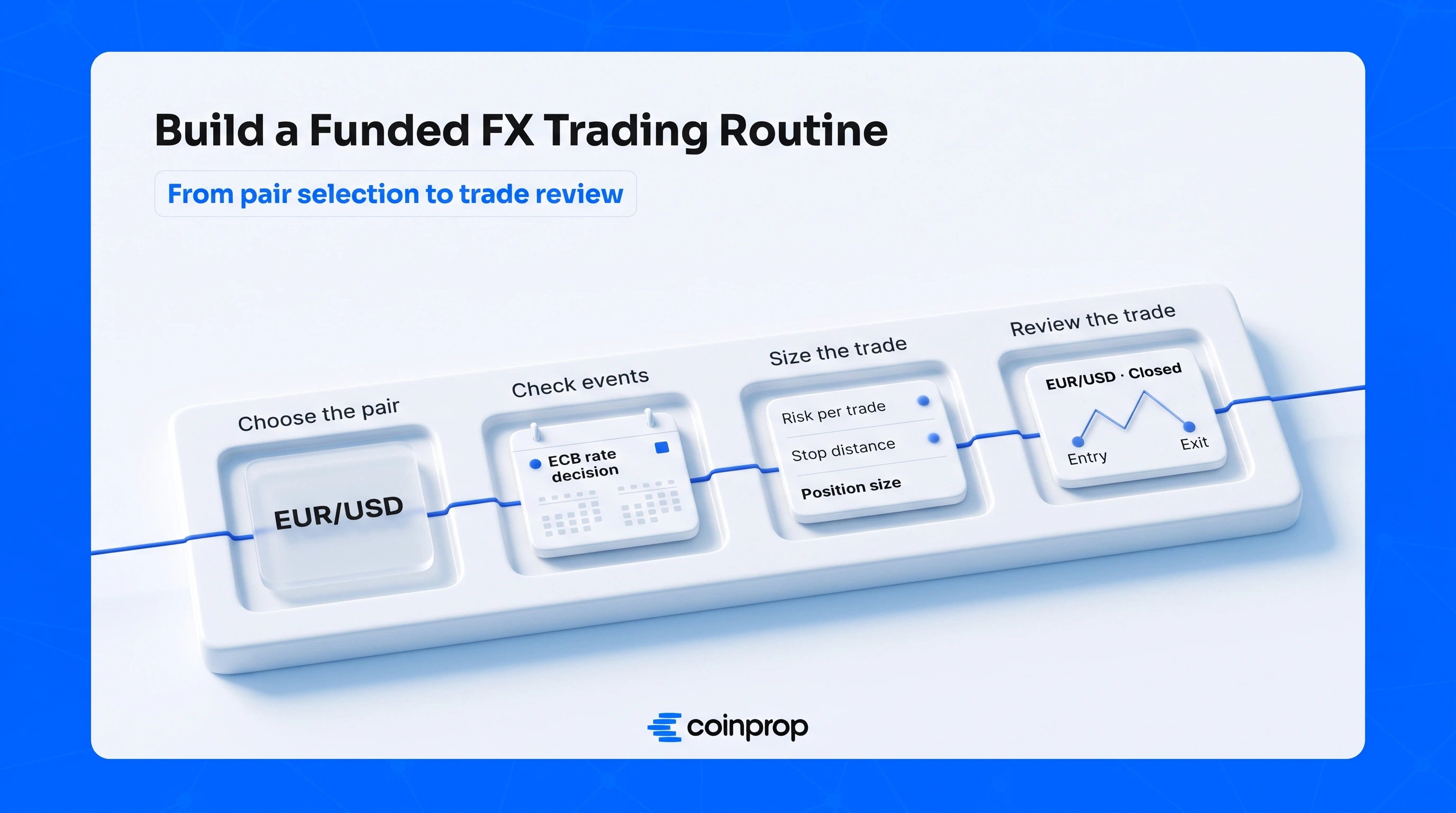
Building a Prop Firm Forex Trading Routine
A consistent routine can help connect market analysis with the specific requirements of a funded account.
Before trading, a Forex prop trader can review the major currency pairs, identify the active trading session, check the economic calendar, and determine which events could change the market's volatility.
During the trade, the focus shifts to position management and account risk. After closing the position, the trader can record the setup, entry, exit, result, and any relevant market event for later review.
This creates a process that combines Forex market analysis with prop firm risk management rather than treating them as separate tasks.
For traders using a crypto prop firm that also supports Forex perpetual futures, this approach can provide a structured way to add currency markets without abandoning the risk management principles already used for crypto trading.
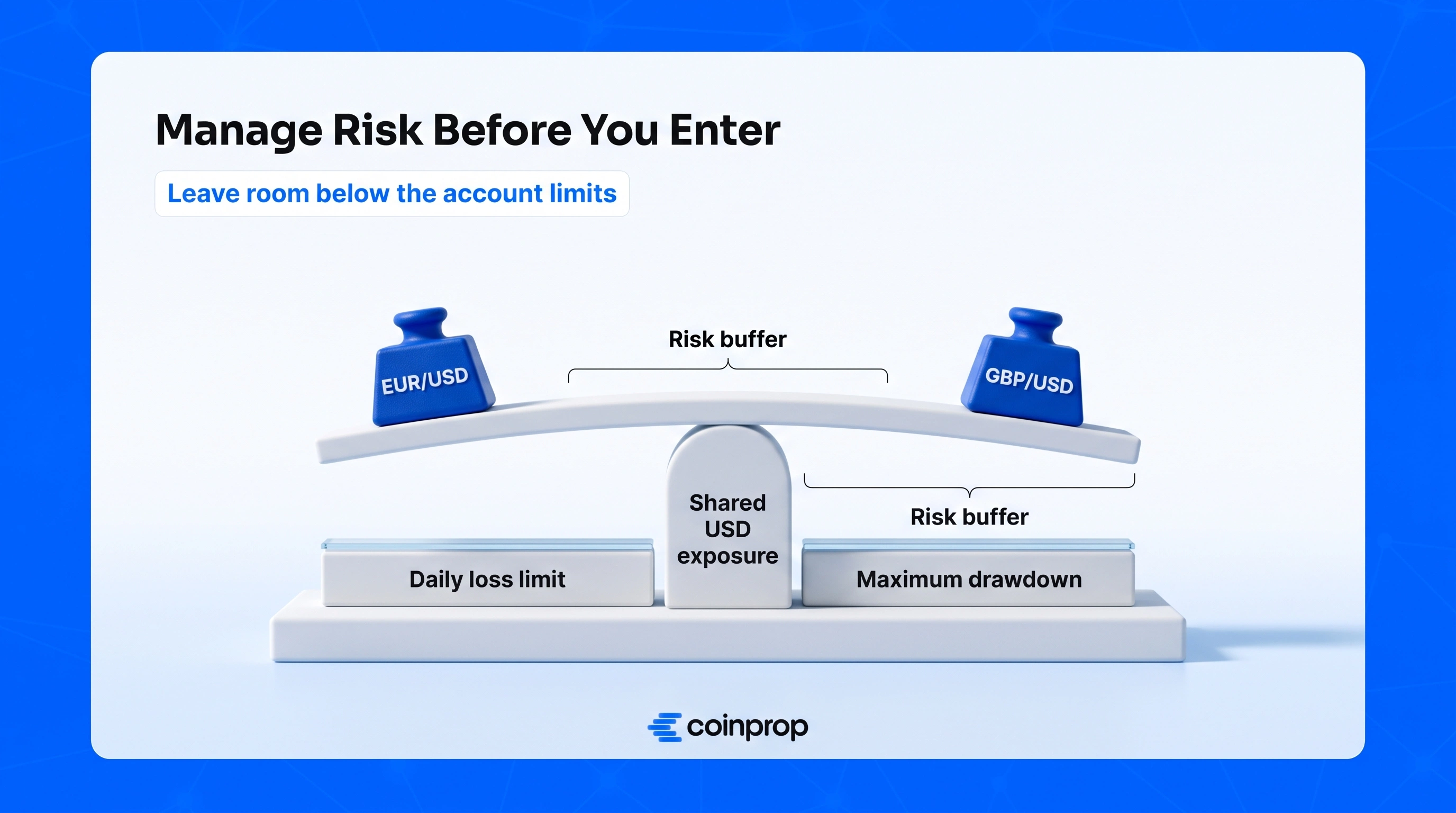
Forex Perpetual Futures Risk Management in a Prop Firm
Risk management becomes even more important when trading Forex perpetual futures through a prop firm. Unlike a personal trading account, a funded account operates within predefined loss and drawdown limits. A profitable trading strategy can still fail if position size, leverage, or exposure is not controlled properly.
For Forex prop traders, risk management should therefore be part of the trading process from the moment a setup is identified until the position is closed.
Risk Per Trade
One of the simplest ways to control risk is to define the maximum amount that can be lost on a single trade before entering the position.
Instead of choosing a position size first and then deciding how much risk the trade carries, traders can work in the opposite direction:
Define the acceptable risk → determine the invalidation level → calculate the position size.
For example, if a trader decides that a particular setup should risk only a small portion of the available account drawdown, the position size can be adjusted according to the distance between the entry and the trade's invalidation level.
This approach helps prevent a common problem in funded trading: using the same position size for every setup even though different trades have different levels of risk.
A wider invalidation level generally requires a smaller position to maintain the same monetary risk. A tighter level may allow a larger position, although the trader still needs to account for market volatility and the possibility of short term price fluctuations.
The exact risk percentage is a matter of trading style and account rules. The important principle is consistency: a single losing trade should not put a disproportionate amount of the funded account at risk.
Daily Loss Limits
Prop firms commonly use daily loss limits to prevent a trader from taking excessive risk during a single trading session.
For a Forex perpetual futures trader, the daily limit should be treated as a hard risk boundary rather than a target to trade toward.
For example, after several consecutive losses, continuing to increase position size in an attempt to recover the losses can quickly turn a normal losing session into a drawdown problem.
A more structured approach is to define a personal daily risk threshold below the firm's maximum allowed loss.
This creates a buffer between the trader's normal risk management and the account's actual breach level.
Daily loss management can also help control behavioral risk. When a trader knows that only a limited amount of risk is available for the session, there is less reason to keep increasing exposure after a losing trade.
Maximum Drawdown
Maximum drawdown measures how much an account can decline before the trading account reaches its overall loss threshold.
This is particularly important in funded Forex trading because the trader needs to consider both the risk of the current trade and the account's remaining drawdown room.
Suppose a funded account has already experienced a period of losses. The same position size that was reasonable at the beginning of the trading cycle may now represent a much larger percentage of the remaining drawdown capacity.
For this reason, traders can consider reducing risk when the account moves into a drawdown period rather than trying to recover the account with larger trades.
Maximum drawdown should also be considered across multiple open positions. Several Forex trades can create overlapping exposure to the same currency or macroeconomic factor, even when the positions are technically different trades.
Position Sizing for Forex Perpetual Futures
Position sizing connects the trading setup with the account's risk limits.
A trader can consider several variables before opening a Forex perpetual position:
- Account equity
- Remaining daily loss allowance
- Remaining maximum drawdown
- Entry price
- Invalidation or stop level
- Distance to the invalidation level
- Expected market volatility
- Contract size
- Leverage
- Existing positions
The important distinction is between position size and risk.
A larger position does not automatically mean a better opportunity. It simply increases the financial impact of a given price movement.
For example, two EUR/USD trades can have the same entry and exit idea but very different risk profiles if one uses twice the position size.
In a prop firm environment, position sizing should therefore be based on the amount the trader is willing to lose if the setup fails, not on the maximum margin or leverage available.
Leverage Management
Leverage is one of the areas where Forex perpetual futures can become particularly risky.
Higher leverage allows traders to control a larger notional position relative to the margin committed. It does not make the underlying market less volatile or reduce the potential loss on the position.
A trader using excessive leverage may have very little room for normal price fluctuations before the position creates a significant loss relative to the account.
This is especially important around economic announcements, when currency pairs can move quickly.
Effective leverage management therefore means using only as much exposure as the trading setup and account risk allow. The maximum leverage offered by a prop firm should not automatically become the leverage used on every trade.
Managing Correlated Forex Positions
Correlation is another important consideration for Forex prop traders.
Opening several positions does not necessarily mean the account is diversified.
For example, a trader might hold positions in EUR/USD and GBP/USD at the same time. Although these are different currency pairs, both can be affected by broad movements in the U.S. dollar and broader macroeconomic conditions.
Similarly, several USD related pairs can react to the same major U.S. economic release.
This means traders should evaluate their total currency exposure, not simply count the number of open trades.
Before opening another position, it can be useful to ask:
- Am I already exposed to the same currency?
- Could the same economic event affect several positions?
- Would these positions likely move in the same direction?
- What would happen to total account risk if the dollar or another major currency moved sharply?
Managing correlation can prevent a trader from unintentionally creating one large macro bet through several smaller positions.
Managing Risk During High Impact News
Major economic events can create significantly higher volatility in Forex markets.
Events such as CPI releases, central bank interest rate decisions, employment reports, and major monetary policy announcements can cause rapid price movements in affected currency pairs.
For a prop trader, this creates two separate risks.
The first is market risk: the position can move sharply against the trader.
The second is account risk: the resulting movement can bring the account closer to its daily loss or maximum drawdown limit.
Traders who hold positions through major economic releases should therefore understand how increased volatility can affect their planned risk.
An economic calendar can be used before each trading session to identify high impact events affecting the currencies being traded.
Depending on the strategy and prop firm's rules, a trader may decide to reduce exposure, wait until the release has passed, or specifically trade the volatility generated by the event.
The important point is that news trading should be deliberate rather than accidental.
Protecting a Funded Account
Protecting a funded account is ultimately about managing the downside well enough to remain in the trading environment long enough for the strategy to work.
A trader does not need to maximize exposure on every setup. In many cases, preserving drawdown capacity can be more important than increasing the potential profit of an individual trade.
A practical risk management framework can include:
- Define risk before entering the trade.
- Keep position size consistent with the setup and account limits.
- Maintain a buffer below the firm's daily loss limit.
- Monitor remaining maximum drawdown.
- Account for correlated positions.
- Check major economic events before opening or holding positions.
- Reduce exposure when market volatility changes significantly.
- Avoid increasing position size simply to recover previous losses.
This approach is especially relevant for traders using a crypto prop firm that supports Forex perpetual futures. The trading environment may be familiar to a crypto perpetual trader, but the risk management process needs to account for the different volatility patterns and macroeconomic drivers of the Forex market.
The objective of risk management in a prop firm is not to eliminate losing trades. Losing trades are a normal part of trading. The objective is to make sure that individual losses, losing streaks, and unexpected market movements remain within a level that allows the trading strategy to continue operating.
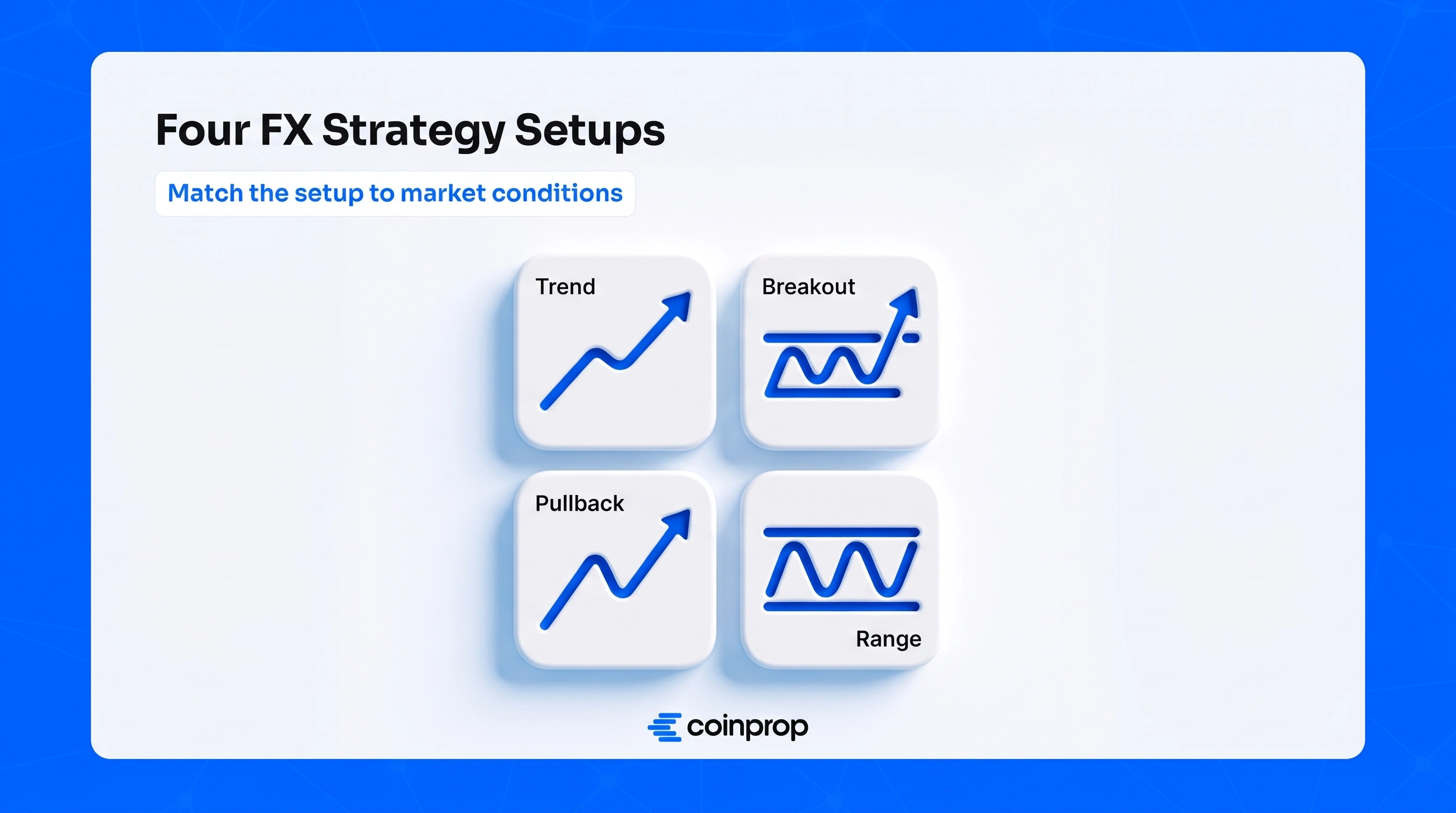
Best Strategies for Forex Perpetual Futures
There is no single strategy that is the best fit for every Forex perpetual futures trader. The right approach depends on the trader's timeframe, market conditions, risk tolerance, and the rules of the prop firm account.
Forex perpetual futures can be traded using several established approaches, including scalping, intraday trading, trend following, breakouts, pullbacks, range trading, session based strategies, and event driven trading.
For traders using a crypto prop firm with Forex markets, the strategy also needs to work within the account's drawdown and risk limits. A strategy that generates frequent opportunities but requires large positions or excessive exposure may not be suitable for a funded account.
Forex Scalping
Forex scalping focuses on capturing relatively small price movements over short periods. Traders may open and close positions within minutes rather than holding them for several hours or days.
Scalping can be applied to liquid Forex perpetual markets when short term price action provides enough movement to justify the trade. Traders may use support and resistance, market structure, momentum, short term breakouts, or order flow information to identify entries.
For a prop trader, the main challenge is controlling the number and size of trades. Because scalping can generate many positions during a session, transaction costs, execution quality, and cumulative risk can become important.
A trader may have a high percentage of winning trades but still experience significant losses if losing positions are larger than winners or if too many trades are taken during unfavorable market conditions.
Scalping therefore requires strict position sizing and a clear daily risk limit.
Intraday Forex Trading
Intraday trading involves opening and closing Forex positions within the same trading day rather than holding them for extended periods.
This approach gives traders more time to develop a setup than scalping while still avoiding the need to maintain positions for multiple days.
An intraday trader might identify a directional move, wait for a pullback, and enter when the price structure supports the original thesis. Another approach may involve trading a range between established support and resistance levels.
For funded traders, intraday trading can also make it easier to define a daily trading routine. The trader can identify the markets to watch, review the economic calendar, trade during selected sessions, and finish the session with no open positions.
However, closing positions before the end of the trading day does not automatically remove risk. Major economic events can occur during the session, and short term positions can still experience significant volatility.
Trend Following Strategies
Trend following attempts to participate in an established directional move rather than predicting every short term reversal.
In Forex, trends can develop when expectations around interest rates, monetary policy, economic growth, or relative currency strength create a sustained directional bias.
A trader might use market structure, moving averages, trend lines, or pullback patterns to identify whether a market is maintaining a broader direction.
For example, instead of entering after every upward movement in EUR/USD, a trend following trader may wait for the market to establish a higher high and higher low structure and then look for a controlled pullback before entering.
Trend following can be particularly relevant to funded trading because the strategy does not necessarily require constant market activity. The trader can wait for a specific setup rather than forcing trades during periods without a clear directional move.
The main challenge is that Forex markets do not trend continuously. A trend following strategy can experience a series of small losses when the market moves sideways or repeatedly changes direction.
Forex Breakout Trading
Breakout trading focuses on price moving outside an established trading range, consolidation area, or important technical level.
A breakout may occur when market participants react to new information or when buying or selling pressure becomes strong enough to move price beyond a previously established range.
Traders can look for breakouts around:
- Support and resistance levels
- Consolidation ranges
- Previous session highs and lows
- Key technical levels
- Major market opens
- Significant economic events
Not every breakout develops into a sustained move. False breakouts are common, particularly when liquidity is changing or when price briefly moves beyond a level before returning to the previous range.
For a prop trader, the risk of false breakouts makes position sizing especially important. A strategy should be designed so that several unsuccessful breakout attempts do not consume a large portion of the account's available drawdown.
Pullback Trading
Pullback trading attempts to enter an existing trend after a temporary move against the prevailing direction.
For example, if EUR/USD is maintaining an upward market structure, a trader may wait for price to retrace toward a previous support area before looking for confirmation of renewed buying pressure.
The basic idea is to avoid entering after an extended move and instead wait for the market to provide a more defined entry point.
Pullbacks can be combined with:
- Support and resistance
- Moving averages
- Trend lines
- Previous breakout levels
- Market structure
- Momentum confirmation
For funded Forex trading, pullback strategies can also provide clearly defined invalidation levels. If the market structure that supports the trade breaks, the trader can exit rather than continuing to hold a position simply because the original trend remains intact on a larger timeframe.
Range Trading
Range trading focuses on markets that are moving between relatively well defined support and resistance levels rather than maintaining a strong directional trend.
A trader may look for potential long setups near the lower end of a range and short setups near the upper end, while recognizing that the range can eventually break.
Range strategies tend to work best when the market is consolidating and there is no strong directional catalyst. They can become less suitable when a major economic release or central bank decision is approaching because new information can cause the market to leave the established range.
For a prop trader, range trading also requires careful consideration of where the range is considered invalid. Entering repeatedly against a developing breakout can lead to a sequence of losses and unnecessary drawdown.
Session Based Forex Trading
Forex markets are strongly influenced by global trading sessions, making session based strategies another approach for perpetual futures traders.
A trader may focus on specific periods such as the European or U.S. trading session rather than monitoring the market continuously.
Different sessions can have different levels of liquidity and volatility. The transition between sessions can also create changes in market activity.
Session based trading can be useful for prop traders who want to create a defined trading schedule. Instead of looking for opportunities throughout the entire day, the trader can focus on specific market hours that match their strategy.
This approach can also help reduce overtrading. Having a predefined trading window makes it easier to distinguish between a planned trading session and random market activity outside the strategy's preferred conditions.
News and Event Driven Forex Trading
Economic news can create some of the largest short term price movements in major Forex markets.
Event driven trading focuses specifically on these periods, with traders building strategies around scheduled economic releases and central bank events.
Important events can include:
- CPI and inflation reports
- Interest rate decisions
- Central bank statements
- Employment reports
- GDP data
- Retail sales
- Major economic forecasts
For example, a significant change in inflation expectations can affect expectations for future interest rates and consequently influence a currency pair.
A trader using a news based strategy may prepare before the announcement, wait for the initial volatility to settle, or attempt to trade the direction that develops after the market has interpreted the new information.
For prop traders, news trading requires additional risk control. A rapid price movement can produce both larger gains and larger losses, while spreads, liquidity, and execution conditions may also change around major announcements.
The strategy therefore needs to account for the prop firm's drawdown limits rather than focusing only on the potential size of the move.
Combining Strategies With Prop Firm Risk Management
Forex strategies should not be evaluated separately from risk management when trading through a prop firm.
Two traders can use the same technical setup but have completely different outcomes because they use different position sizes, leverage, trade frequencies, or risk limits.
A strategy can therefore be evaluated using several questions:
- How frequently does it generate trades?
- What is the typical position size?
- How does it perform during high volatility periods?
- How many consecutive losses can occur?
- How much drawdown can a normal losing streak create?
- Does it depend on specific Forex sessions?
- Does it require holding positions through major economic events?
- Can the strategy operate within the prop firm's account limits?
This is particularly important for traders coming from crypto perpetual futures. A strategy that works with the volatility and trading behavior of BTC or other crypto assets may require significant adjustments when applied to Forex.
The same applies in the opposite direction. A Forex strategy based on relatively controlled currency movements may need different position sizing and risk parameters when applied to crypto perpetual futures.
Choosing a Forex Perpetual Futures Strategy
The most suitable strategy is ultimately the one that matches the trader's timeframe, market knowledge, execution style, and risk limits.
A scalper may prefer short term price action and active sessions. An intraday trader may combine technical structure with macroeconomic context. A trend follower may wait for larger directional moves, while a range trader may focus on periods of consolidation.
For traders using a crypto prop firm with Forex markets, the strategy should also be compatible with the funded account's rules.
The goal is not to find a strategy that produces a winning trade every time. It is to build a repeatable process where entries, exits, position sizes, and risk are defined clearly enough that the trader can execute the strategy consistently across different market conditions.
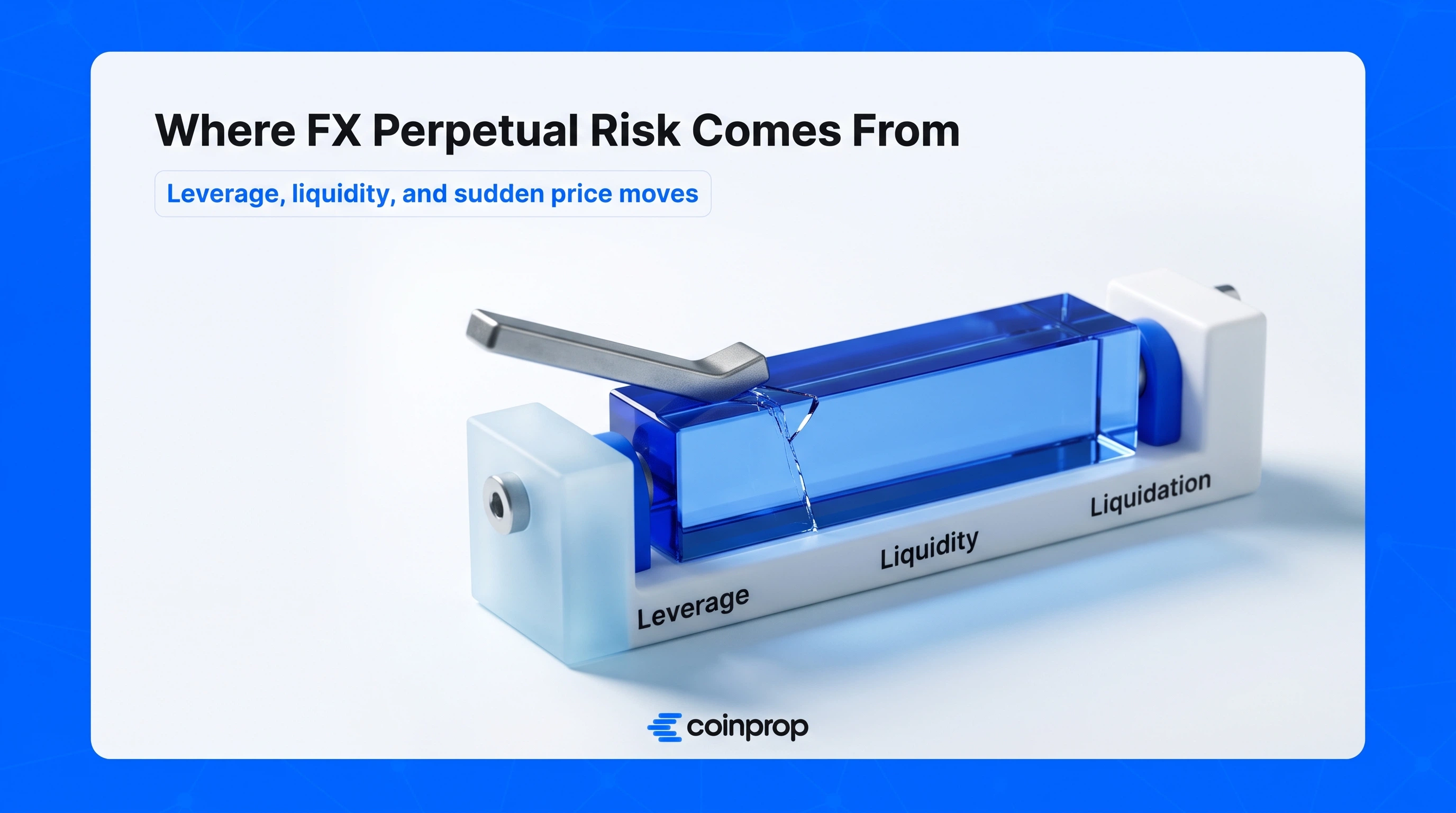
Risks of Forex Perpetual Futures
Forex perpetual futures provide access to currency markets without a fixed contract expiration, but the structure also introduces risks that traders need to understand before using leverage or trading with a funded account. The main risks include leverage, liquidation, funding costs, changing liquidity conditions, economic releases, extended trading hours, and the drawdown rules imposed by a prop firm.
Leverage Risk
Leverage allows a trader to control a larger position with less margin, but it also magnifies the effect of relatively small price movements.
For example, a 2% move in the underlying market does not necessarily translate into a 2% change in the trader's account exposure when leverage is being used. The larger the position relative to the available margin, the faster an adverse move can affect the account.
This matters particularly in a prop firm because the trader is usually working within predefined daily loss and maximum drawdown limits. A position that would be manageable in a personal trading account can breach a prop firm's limits if it is oversized relative to the account's risk parameters.
Liquidation Risk
If losses reduce available margin below the required level, a leveraged perpetual futures position can be liquidated. The exact liquidation mechanism depends on the trading venue, position size, margin configuration, and other account parameters.
Liquidation is different from a planned stop loss. A stop loss is a risk management decision made by the trader, while liquidation occurs when the position no longer meets the platform's margin requirements.
Traders should therefore understand their margin requirements and liquidation levels before opening leveraged Forex perpetual positions rather than relying on liquidation as a form of risk management.
Funding Risk
Perpetual contracts do not have a traditional expiration date, so funding mechanisms can be used to help keep the contract price aligned with its underlying market.
Funding payments can become a trading cost when a position is held for longer periods, although the direction and size of funding can change with market conditions. Traders should check how funding is calculated for the specific Forex perpetual contract they are trading.
This is particularly relevant for strategies that hold positions beyond short intraday periods. A trade can move in the expected direction while accumulated funding costs reduce its overall result.
Volatility Around Economic Releases
Major economic releases can produce rapid price movements in currency markets. Inflation data, employment reports, interest rate decisions, central bank statements, GDP figures, and other high impact releases can cause sudden changes in volatility and liquidity.
Price movements around these events can be significantly different from normal market conditions. Spreads and execution conditions may also change, depending on the market and trading venue.
For funded traders, the risk is not limited to the market moving against the position. A sudden move can also cause a trader to reach a prop firm's daily loss or maximum drawdown limit much faster than expected.
Liquidity Risk
Major Forex pairs generally have deep global markets, but liquidity is not identical at all times or across all instruments. Conditions can change around major economic announcements, market transitions, holidays, and periods of reduced participation.
Lower liquidity can affect execution quality and increase the potential difference between the expected and actual execution price. This becomes more important when trading larger positions or using strategies that depend on precise entries and exits.
Traders should therefore evaluate the liquidity and trading conditions of the specific perpetual contract rather than assuming that every Forex market behaves like the most liquid spot currency pairs.
Weekend and Extended Hours Risk
Traditional Forex markets are commonly associated with a five day trading week, while perpetual futures can operate under a different schedule depending on the trading venue.
This creates an important distinction for traders moving from traditional Forex to Forex perpetual futures. Positions may remain exposed outside the market hours a trader is accustomed to, and market conditions can change before the trader returns to the screen.
Extended hours exposure can be particularly relevant around geopolitical developments, unexpected economic news, and periods when liquidity conditions are different from those during major Forex sessions.
Before holding a position outside normal trading sessions, traders should understand the contract's trading schedule and how their prop firm's risk rules apply during those periods.
Prop Firm Drawdown Risk
When Forex perpetual futures are traded through a prop firm, market risk is combined with account level restrictions.
A prop firm may define a maximum daily loss, maximum drawdown, or other limits that determine how much an account can lose before trading is restricted or the account is terminated. These limits can make position sizing and risk management fundamentally different from trading with unrestricted personal capital.
For example, a trader may have a valid market thesis but still lose access to the account because the position was too large relative to the permitted drawdown. The market does not need to move far for this to happen if leverage and position size are aggressive.
This is why understanding the prop firm's rules is part of managing Forex perpetual futures risk. Traders should know the daily loss calculation, maximum drawdown methodology, margin requirements, and any restrictions around news or holding positions before they begin trading.
Why These Risks Matter in a Crypto Prop Firm
Trading Forex through a crypto prop firm combines the characteristics of perpetual futures with the risk framework of a funded account. The underlying market may be Forex, but traders still need to account for leverage, funding, liquidation, liquidity, and the firm's drawdown rules.
The practical implication is that a Forex strategy cannot be evaluated only by its potential entry and exit signals. Position size, expected volatility, holding time, funding costs, and the account's loss limits all affect whether the strategy can be used effectively in a funded environment.
Understanding these risks does not mean avoiding Forex perpetual futures. It means evaluating the contract, trading conditions, and prop firm rules together before putting a strategy into practice.
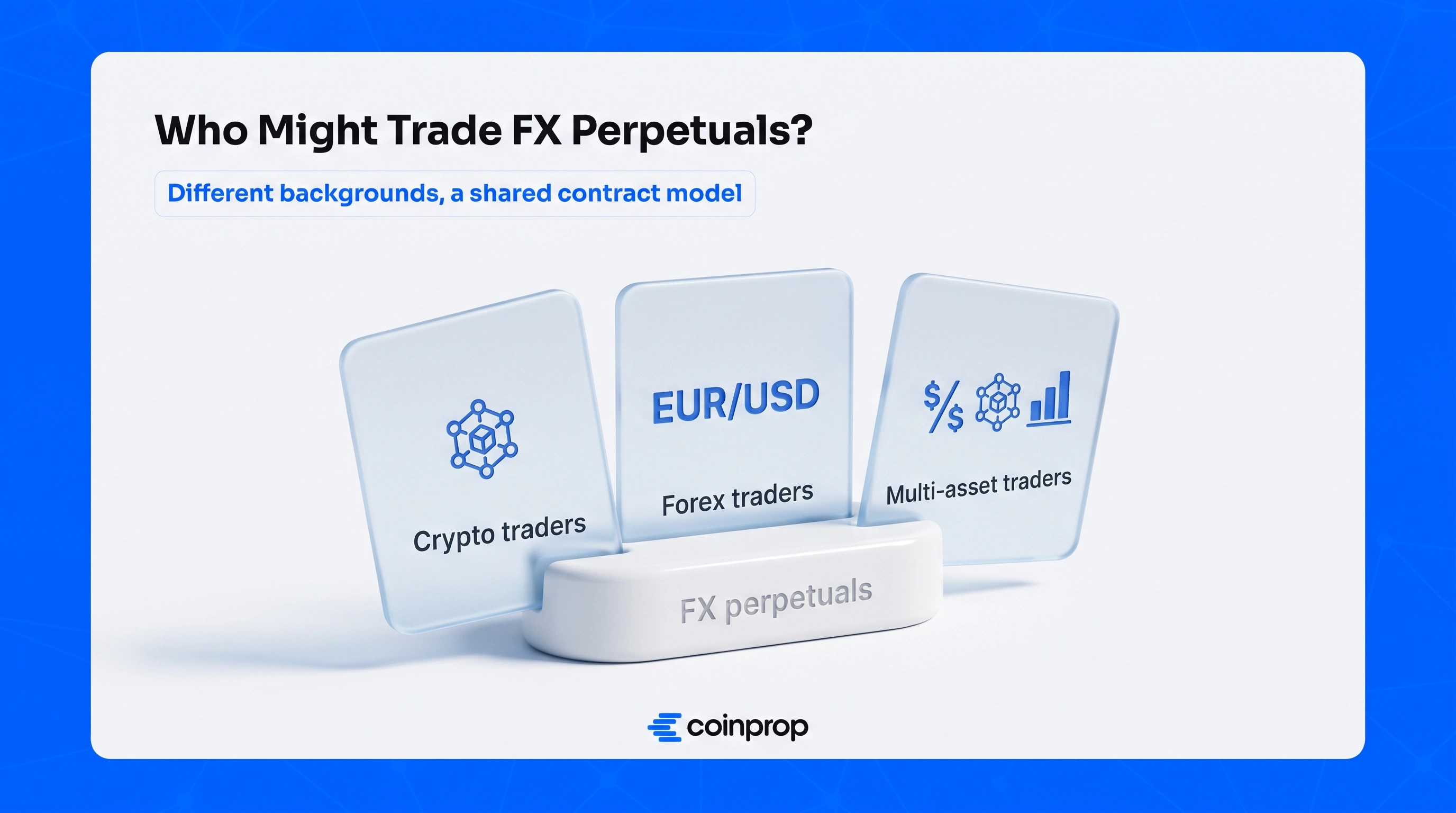
Who Can Trade Forex Perpetual Futures Through a Crypto Prop Firm?
Forex perpetual futures are not limited to traditional Forex traders. Because these contracts combine currency markets with a perpetual futures structure, they can also be relevant to crypto traders, multi asset traders, and traders who want to access funded capital.
The right fit depends on the trader's experience, strategy, risk management approach, and familiarity with the rules of the prop firm.
Existing Crypto Traders
Crypto traders who already trade perpetual futures may find the structure of Forex perpetuals familiar.
The core mechanics can be similar: traders can take long or short positions, use leverage, manage margin, and trade contracts without a traditional expiration date. The main difference is the underlying market. Instead of trading assets such as BTC or ETH, the trader is exposed to currency pairs such as EUR/USD, GBP/USD, or USD/JPY.
Crypto traders moving into Forex should still learn the factors that drive currency markets. Interest rate expectations, central bank policy, inflation, employment data, and economic releases can have a much greater direct influence on FX markets than many crypto traders are accustomed to.
Forex Traders
Traditional Forex traders may already understand currency pairs, market sessions, macroeconomic data, and the relationship between interest rates and exchange rates.
Forex perpetual futures introduce a different trading structure, however. Instead of trading traditional spot Forex, the trader is using a perpetual derivative with its own margin, funding, and liquidation mechanics.
For experienced Forex traders, the main learning curve may therefore be understanding the specific perpetual contract and the prop firm's trading rules rather than learning currency markets from scratch.
Multi Asset Traders
Traders who already work across multiple markets can use Forex perpetual futures as another market alongside crypto and other instruments.
Different markets can behave differently under the same macroeconomic conditions. A trader may monitor currency markets around central bank decisions or economic releases while also tracking crypto markets for changes in broader risk sentiment.
A multi asset approach does not automatically reduce risk. Correlations can change, and holding positions across several markets can increase total exposure. Traders still need to consider the combined risk of all open positions.
Traders Looking for Funded Capital
Forex perpetual futures can also be relevant to traders who have a strategy but want to trade within a funded account structure rather than using a large amount of personal trading capital.
A crypto prop firm can provide access to a defined trading account subject to its own evaluation requirements, risk limits, and payout rules. The trader remains responsible for following those rules while managing positions in the available markets.
The important distinction is that funded trading does not remove market risk. Leverage, volatility, drawdown limits, and position sizing still determine how quickly an account can approach its risk limits.
Traders Who Prefer Perpetual Contracts
Some traders prefer perpetual contracts because they do not have a traditional expiration date. This allows positions to be managed according to the trader's strategy rather than around a scheduled contract expiry.
For traders familiar with crypto perpetual futures, trading Forex through a perpetual structure can provide a way to apply familiar trading mechanics to currency markets.
However, the absence of a fixed expiration does not mean a position can be held without cost or risk. Funding, leverage, market conditions, and the prop firm's account rules can all affect the outcome of a trade.
Is Forex Perpetual Trading Right for Every Trader?
Not necessarily. A trader who is unfamiliar with leverage, perpetual contracts, macroeconomic events, or prop firm drawdown rules may need to understand these mechanics before trading a funded Forex account.
Likewise, a strategy designed specifically for crypto may not transfer directly to currency markets. Forex and crypto have different liquidity patterns, volatility characteristics, trading sessions, and market drivers.
The most important factor is therefore not whether a trader comes from crypto or Forex, but whether their strategy, risk management, and trading style are compatible with the characteristics of Forex perpetual futures and the rules of the prop firm.

Are Forex Perpetual Futures Worth Trading Through a Crypto Prop Firm?
Whether Forex perpetual futures are worth trading through a crypto prop firm depends on the trader's strategy, preferred markets, and the trading conditions offered by the firm.
For a trader who already focuses on crypto, access to Forex can provide another market to trade when crypto conditions are less attractive. Instead of forcing trades during a low volatility or range bound crypto market, a trader can look for opportunities in currency markets driven by different factors.
An Alternative Market for Crypto Traders
Crypto markets do not offer the same conditions every day. There are periods of strong trends and volatility, but there are also quieter sessions, extended ranges, and periods when a trader's usual setups simply do not appear.
Having access to Forex perpetual futures can give crypto focused traders another market to monitor without necessarily leaving the same trading environment.
For example, a trader who normally looks for intraday setups in BTC or ETH may also monitor EUR/USD or GBP/USD when currency markets are showing clearer technical structure or when major economic events are creating defined opportunities.
The goal is not to trade more simply because another market is available. It is to have another market to consider when the trader's existing strategy has no suitable crypto setup.
Forex Without Traditional Overnight Swap
Another consideration is the cost of holding Forex positions overnight.
Traditional Forex brokers commonly use swap or rollover charges for positions held past a specified time, although the exact treatment varies by broker, instrument, and account type. Some Forex prop firms may also have overnight financing or swap related costs depending on their trading model.
Forex perpetual futures use a different mechanism. Instead of traditional overnight swap, perpetual contracts can use funding payments to help keep the contract aligned with its underlying market.
At CoinProp, Forex perpetual futures are available without an overnight swap charge. This can be relevant for traders who want to hold a Forex position beyond a single trading session without the traditional swap cost associated with many conventional Forex accounts.
This does not mean that holding a position is cost free. Perpetual futures can still involve funding and other trading costs, so traders should understand the specific contract conditions before holding positions for extended periods.
Why Crypto Traders May Consider Forex
For an existing crypto trader, the main attraction is not simply adding more instruments to a watchlist. Forex can provide exposure to a market with different drivers and trading characteristics.
Crypto prices are influenced by factors such as market liquidity, crypto specific news, sentiment, and flows across digital assets. Currency markets are much more directly connected to interest rates, inflation, employment data, central bank policy, and economic conditions.
This difference can make Forex useful as a complementary market.
A crypto trader may continue focusing primarily on BTC, ETH, or other digital assets while using Forex as an additional opportunity set when the crypto market does not provide a suitable setup.
One Trading Environment for Crypto and Forex
For traders who already use a crypto prop firm, having Forex available within the same trading environment can also simplify the workflow.
Instead of maintaining a separate setup purely for Forex, traders can monitor crypto and currency markets within the same platform, apply their normal risk management process, and decide which market currently offers a valid setup.
At CoinProp, Forex perpetual futures are available alongside crypto markets through the same trading environment, with TradingView integration and direct Bybit market data integration.
This can be particularly useful for traders who do not want to become full time Forex traders but want access to currency markets as an additional option.
When Forex May Not Be Worth Adding
More markets do not automatically mean better trading results. If a trader does not understand currency market drivers, economic releases, or the mechanics of Forex perpetual contracts, adding Forex can simply create more opportunities to overtrade.
The same applies to traders who already have a well defined crypto strategy and find that switching between markets causes them to take lower quality setups.
Forex perpetual futures make the most sense when they complement an existing trading process rather than replace it. A trader can remain primarily focused on crypto while using Forex selectively when the market conditions, strategy, and risk parameters align.
FAQ
What are Forex perpetual futures?
Forex perpetual futures are derivative contracts that track the price of currency pairs such as EUR/USD, GBP/USD, and USD/JPY without a fixed expiration date. Traders can take long or short positions and use leverage, while the contract can use funding payments to help keep its price aligned with the underlying market.
Can you trade Forex through a crypto prop firm?
Yes. Some crypto prop firms offer Forex markets alongside cryptocurrencies. This allows traders to access currency markets through a funded trading environment while following the firm's evaluation, drawdown, position, and payout rules.
What is a Forex perpetual contract?
A Forex perpetual contract is a derivative that tracks a currency pair without a traditional futures expiration date. Unlike spot Forex, the trader does not directly exchange the underlying currencies. The position is based on the price movement of the perpetual contract and can be held long or short subject to margin, funding, and account rules.
Are Forex perpetual futures the same as CFDs?
No. Forex perpetual futures and CFDs are both derivatives, but they are different contract structures. Forex perpetuals generally use a perpetual futures mechanism with no fixed expiration and may use funding payments, while CFDs are typically offered through a broker under its own pricing, financing, and contract terms.
Can you trade Forex and crypto in the same prop firm account?
It depends on the prop firm's available markets and account rules. A crypto prop firm that supports both asset classes can allow traders to access cryptocurrency and Forex markets within the same trading environment. CoinProp, for example, offers Forex perpetual futures alongside its crypto markets.
What Forex pairs are available at CoinProp?
CoinProp currently offers Forex markets including EUR/USD, GBP/USD, and USD/JPY. The available market list can change as additional instruments are added, so traders should check the current markets page before trading.
Do Forex perpetual futures expire?
No. Perpetual futures do not have a traditional expiration date. A position can remain open according to the trading platform's rules, margin requirements, funding mechanism, and any applicable prop firm restrictions.
How does funding work on Forex perpetual futures?
Funding is a periodic payment mechanism used by perpetual contracts to help keep their market price aligned with the underlying asset. Depending on the funding rate and whether the trader is long or short, the trader may pay or receive funding. Funding rates can change with market conditions.
Are Forex perpetual futures suitable for day trading?
They can be. The ability to take both long and short positions without a fixed expiration can fit intraday trading strategies such as scalping, breakouts, trend following, and session based trading. However, suitability depends on the trader's strategy, execution conditions, leverage, and risk limits.
What are the risks of trading Forex perpetual futures?
The main risks include leverage, liquidation, funding costs, volatility around economic releases, changing liquidity conditions, extended hours exposure, and prop firm drawdown limits. Traders should understand both the contract mechanics and the specific risk rules of their funded account before trading.