
How Much Can You Earn With a Crypto Prop Firm? Real Numbers, Income Scenarios & Examples
Published
How much can you earn with a crypto prop firm? Your potential income depends on funded account size, trading performance, profit split, and consistency. This guide breaks down realistic income scenarios, payout examples, full time earning potential, common mistakes, and the factors that can determine how much of your trading profits you can actually withdraw.
- How Much Can a Crypto Prop Firm Trader Really Earn?
- What Affects How Much You Can Earn?
- Realistic Crypto Prop Firm Income Scenarios
- How Much Can You Earn at Different Trading Performance Levels?
- Can You Make a Full Time Income With a Crypto Prop Firm?
- How Much Can Successful Crypto Prop Traders Earn?
- What Can Limit Your Actual Crypto Prop Firm Payout?
- Common Mistakes That Reduce Your Crypto Prop Firm Earnings
- How to Increase Your Crypto Prop Firm Income
- Crypto Prop Firm vs Trading Your Own Capital
- Frequently Asked Questions
How Much Can a Crypto Prop Firm Trader Really Earn?
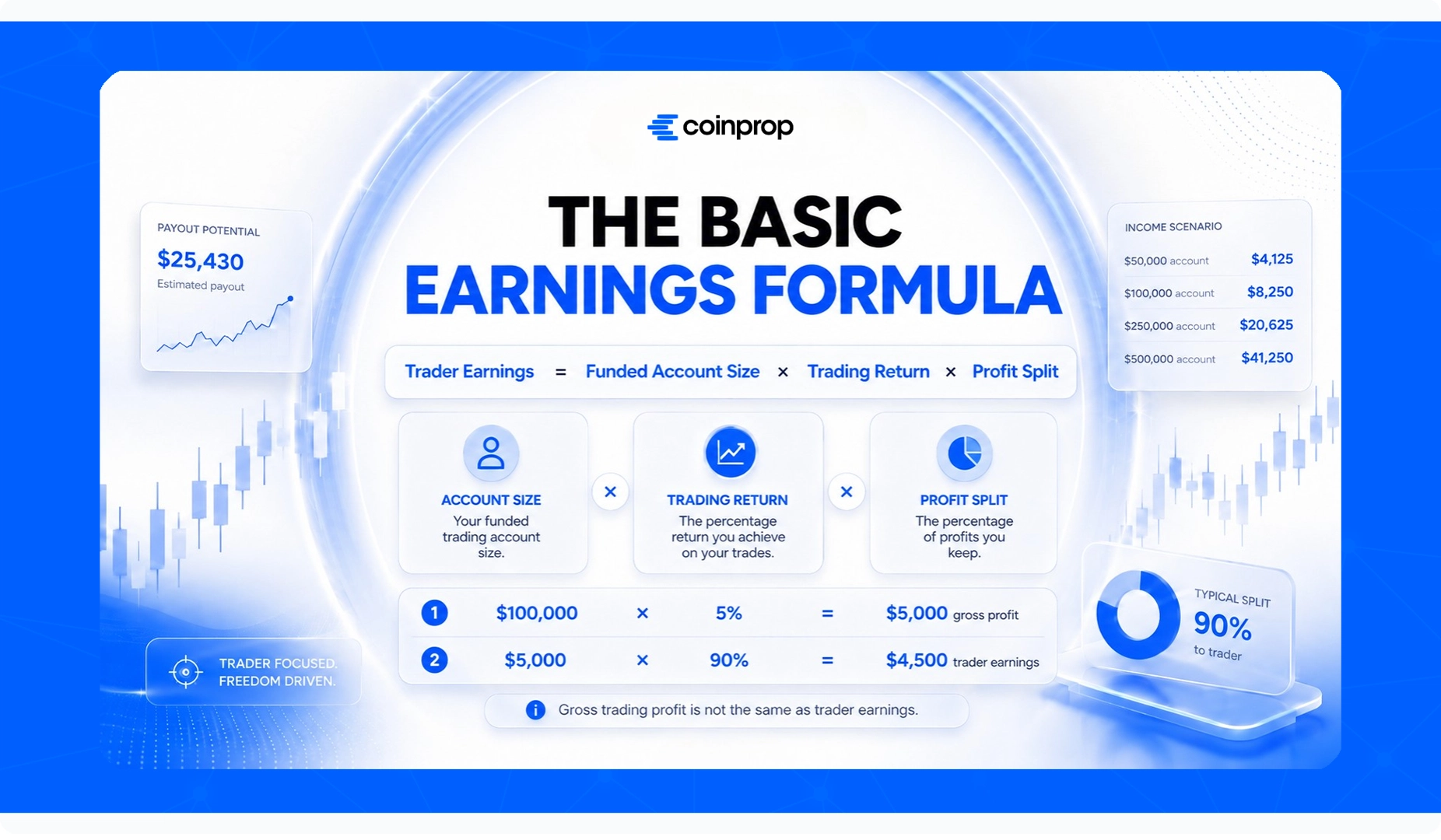
The amount you can earn with a crypto prop firm depends mainly on three factors: your funded account size, your trading return, and the profit split. A larger funded account can increase your earning potential, but the account size alone does not determine how much you will actually receive.
For example, a trader managing a $100,000 funded account who generates a 5% return would produce $5,000 in gross trading profit. With a 90% profit split, the trader's share would be $4,500.
These calculations show the potential relationship between account size, trading performance, and trader earnings. They should not be interpreted as guaranteed or typical monthly returns.
The Basic Crypto Prop Firm Earnings Formula
A simple way to estimate potential earnings from a crypto prop firm is:
Trader Earnings = Funded Account Size × Trading Return × Profit Split
The first step is to calculate the gross trading profit by multiplying the funded account size by the trading return. The profit split is then applied to determine the portion of that profit paid to the trader.
For example, consider a $100,000 funded account with a 5% monthly return and a 90% profit split:
$100,000 × 5% = $5,000 gross profit
$5,000 × 90% = $4,500 trader earnings
The same formula can be used with different account sizes, returns, and profit split percentages.
It is important to distinguish between gross trading profit and trader earnings. Gross profit is the amount generated by the trading performance before the profit split, while trader earnings represent the portion allocated to the trader under the firm's payout structure.
Example Crypto Prop Firm Earnings by Account Size
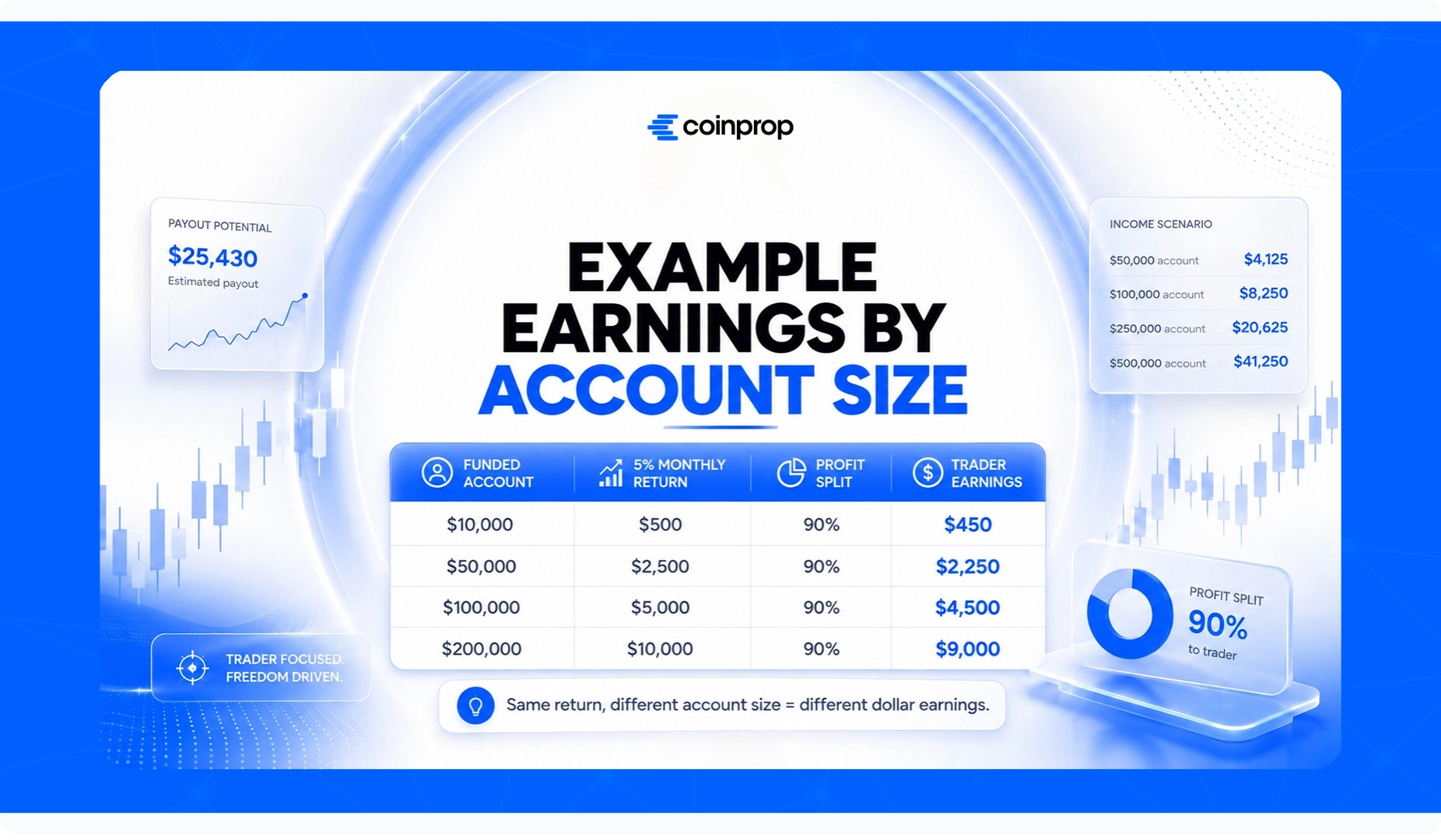
Account size can have a significant effect on potential earnings when the trading return and profit split remain the same. For example, a 5% return on a $10,000 account produces $500 in gross profit, while the same 5% return on a $200,000 account produces $10,000.
The following examples use a 5% monthly return and a 90% profit split to illustrate how account size changes potential trader earnings.
| Funded Account | 5% Monthly Return | 90% Profit Split | Trader Earnings |
|---|---|---|---|
| $10,000 | $500 | 90% | $450 |
| $50,000 | $2,500 | 90% | $2,250 |
| $100,000 | $5,000 | 90% | $4,500 |
| $200,000 | $10,000 | 90% | $9,000 |
These figures demonstrate the effect of account size when all other variables remain constant. They do not mean that traders should expect to generate a 5% return every month.
A trader with a smaller account can also earn more than someone with a larger account if they generate a significantly higher percentage return. For example, a 5% return on a $50,000 account produces $2,500 in gross profit, while a 1% return on a $100,000 account produces only $1,000.
This is why funded account size is only one part of the earnings equation. Trading performance determines how effectively that account generates profit.
What These Numbers Do and Don't Mean
The calculations above are useful for understanding potential earnings, but they should not be treated as income forecasts. A crypto prop firm's funded account does not guarantee a specific monthly return, and trading performance can vary significantly from one month to another.
A 5% monthly return, for example, is simply an illustrative assumption used to show how the earnings formula works. It does not mean that 5% is a typical, expected, or guaranteed result for funded traders.
Actual payouts can also differ from simple profit calculations depending on the firm's structure and rules. Factors such as the profit split, payout eligibility, drawdown limits, trading restrictions, payout schedule, and account conditions can affect whether a trader can withdraw the full amount calculated from a theoretical return.
The key distinction is between potential trading profit and actual trader payout. A trader may generate a certain amount of gross profit on paper, but the amount ultimately received depends on the applicable profit sharing and payout rules.
For this reason, the most useful way to evaluate crypto prop firm earning potential is not to ask only how large the funded account is. Instead, consider the entire equation:
Account Size × Sustainable Trading Performance × Profit Split = Potential Trader Earnings
This provides a more realistic framework for understanding how much you can potentially earn with a crypto prop firm without treating hypothetical returns as guaranteed income.
What Affects How Much You Can Earn?
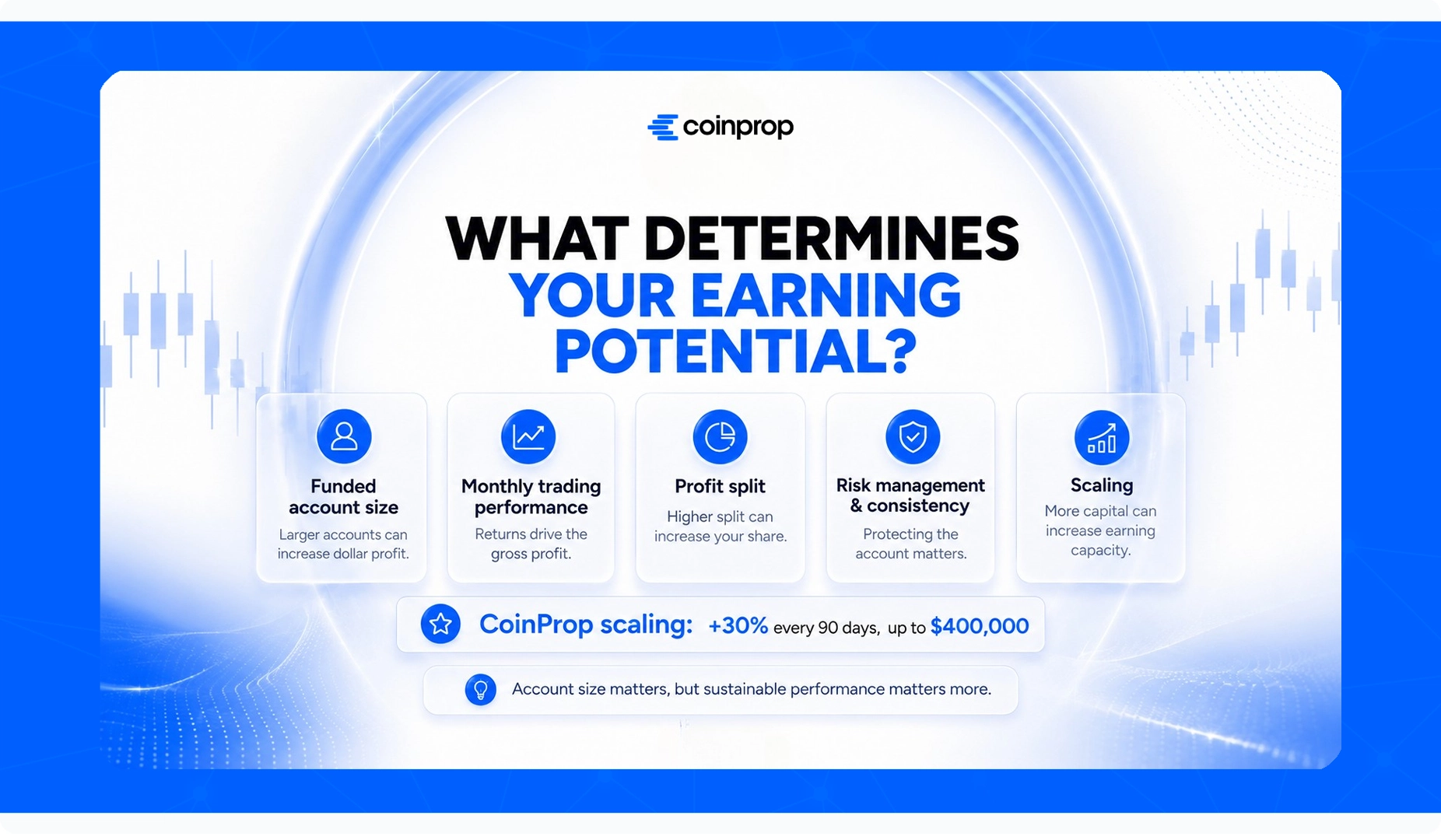
Your earning potential with a crypto prop firm is influenced by more than the size of your funded account. The amount you ultimately earn depends on how much capital you manage, the returns you generate, the percentage of profits you keep, and your ability to maintain the account over time.
These factors work together. A larger account can increase potential earnings, but only if you can generate sustainable returns while staying within the firm's trading rules.
Funded Account Size
Funded account size is one of the most direct factors affecting your potential earnings. When the trading return and profit split remain the same, a larger account produces a larger dollar profit.
For example, a 3% return on a $10,000 funded account generates $300 in gross profit, while the same 3% return on a $100,000 account generates $3,000.
However, a larger account does not automatically result in higher income. A trader with a smaller account can generate more profit by producing a higher percentage return.
This means account size should be viewed as the scale of the earning opportunity, rather than a guarantee of higher payouts.
Monthly Trading Performance
Your trading performance determines how much profit your funded account actually generates. Even with the same account size and profit split, two traders can have very different earnings because their monthly returns differ.
For example, on a $100,000 funded account:
- 1% return = $1,000 gross profit
- 3% return = $3,000 gross profit
- 5% return = $5,000 gross profit
The higher the return, the greater the potential payout. However, higher returns should not automatically be treated as better performance if they require excessive risk.
A sustainable trading approach focuses on generating repeatable results rather than maximizing returns in a single month.
Profit Split
The profit split determines how much of your generated trading profit you keep and how much is allocated to the prop firm.
For example, if you generate $5,000 in trading profit:
- 80% profit split = $4,000 to the trader
- 90% profit split = $4,500 to the trader
- 95% profit split = $4,750 to the trader
A higher profit split can therefore increase your payout without requiring a higher trading return. However, profit split should not be considered in isolation. Other factors such as account rules, trading conditions, payout requirements, and scaling terms can also affect the overall value of a funded account.
Risk Management and Consistency
Trading performance only creates earning potential if you can maintain the funded account. Poor risk management can lead to large drawdowns, rule violations, or account loss, preventing a trader from continuing to generate payouts.
Effective risk management typically involves controlling position sizes, limiting exposure, respecting drawdown rules, and avoiding excessive leverage.
Consistency is equally important. A trader who generates moderate returns while protecting the account may have greater long term earning potential than a trader who produces one unusually profitable month but takes excessive risks and loses the account afterward.
The goal is therefore not simply to maximize monthly returns. It is to generate profits while maintaining the account and remaining eligible for future payouts.
Scaling Your Funded Account
Scaling can increase earning potential by allowing successful traders to manage larger funded accounts over time. If a trader can maintain consistent performance, a larger allocation can produce greater dollar profits even when the percentage return remains unchanged.
For example, a trader generating a 5% return on a $50,000 account produces $2,500 in gross profit. If the same trader later manages $100,000 and maintains the same 5% return, gross profit increases to $5,000.
CoinProp's scaling program allows eligible traders to increase their account allocation by 30% every 90 days, subject to the program's requirements, with a maximum allocation of $400,000. This means consistent performance can increase potential earning capacity without requiring the trader to provide the full additional trading capital personally.
Scaling does not guarantee higher income, however. Managing a larger account still requires the trader to maintain their strategy, control risk, and comply with the firm's rules.
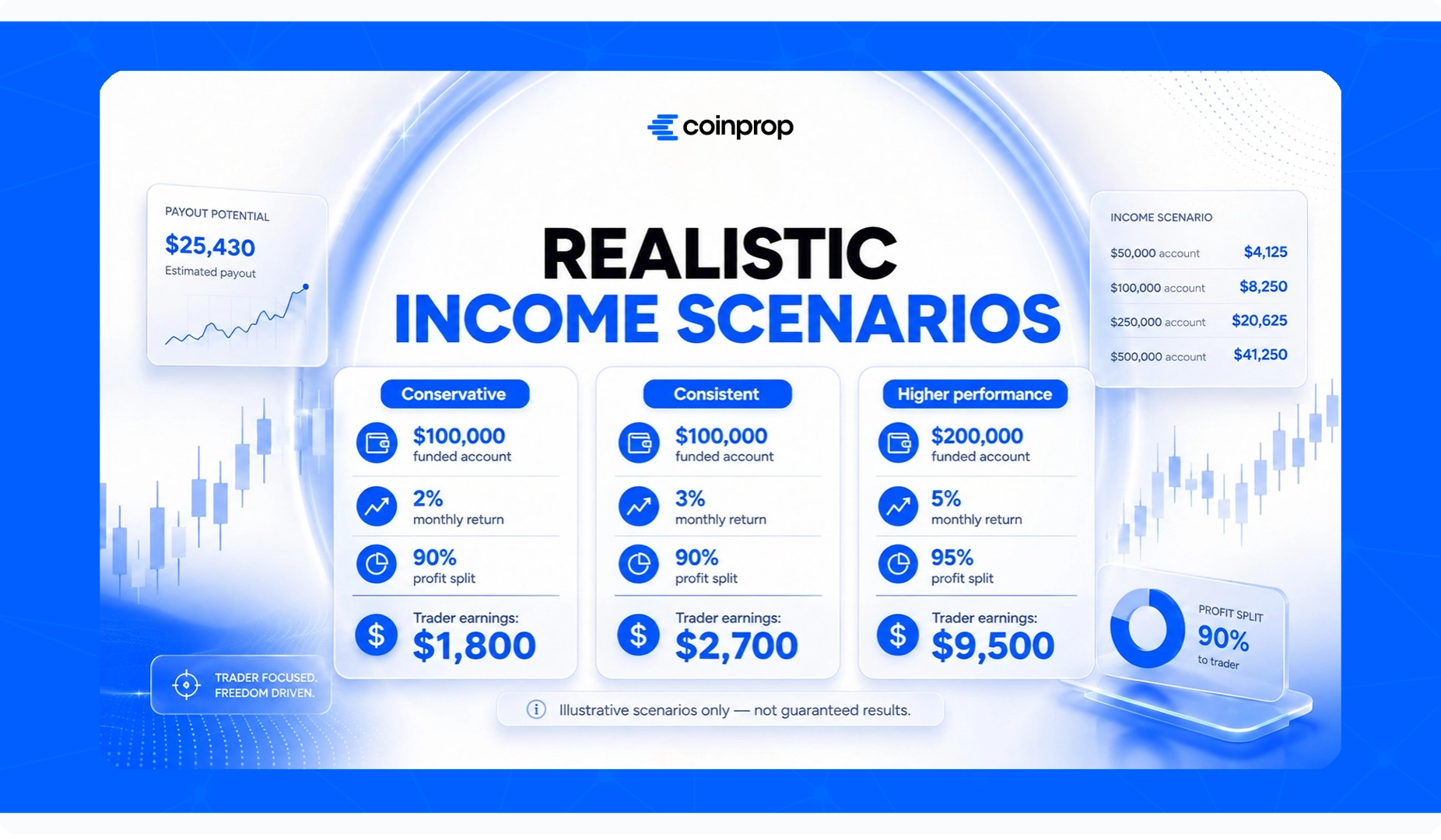
Realistic Crypto Prop Firm Income Scenarios
The examples below show how different trading performance levels can affect potential income from a crypto prop firm. Each scenario uses a different combination of account size, trading return, and profit split to illustrate a range of possible outcomes.
These are illustrative scenarios, not forecasts of typical trader performance. Actual results can vary from month to month, and traders may also experience losing periods.
Conservative Income Scenario
A conservative trading approach generally prioritizes capital preservation and controlled risk rather than maximizing monthly returns.
For example, consider a trader managing a $100,000 funded account who generates a 2% monthly return with a 90% profit split.
The calculation would be:
- Funded account: $100,000
- Monthly return: 2%
- Gross trading profit: $2,000
- Profit split: 90%
- Trader earnings: $1,800
This scenario illustrates how even a relatively modest percentage return can produce meaningful dollar earnings when applied to a larger funded account.
However, 2% should not be interpreted as a typical or guaranteed monthly return. The purpose of the example is simply to demonstrate how a conservative return could translate into potential trader earnings.
Consistent Income Scenario
A consistent trader focuses on producing repeatable results while keeping risk under control. The objective is not necessarily to generate the highest return in every month, but to maintain the account and remain eligible for future payouts.
For example, a trader with a $100,000 funded account generates a 3% monthly return with a 90% profit split:
- Funded account: $100,000
- Monthly return: 3%
- Gross trading profit: $3,000
- Profit split: 90%
- Trader earnings: $2,700
If a trader could maintain similar performance over multiple months, the potential income would be more meaningful than a single unusually profitable month. However, actual trading results will naturally vary, so this should be viewed as a mathematical scenario rather than a projected monthly income.
Higher Performance Income Scenario
A higher performance scenario combines a larger funded account with a stronger monthly return and a higher profit split.
For example, a trader managing a $200,000 funded account generates a 5% monthly return and receives a 95% profit split:
- Funded account: $200,000
- Monthly return: 5%
- Gross trading profit: $10,000
- Profit split: 95%
- Trader earnings: $9,500
This demonstrates how larger allocations and higher profit sharing percentages can significantly increase potential payouts.
However, this is an illustrative higher return scenario, not a typical or guaranteed monthly result. Maintaining a higher return while staying within drawdown limits and other prop firm rules can be challenging. The ability to repeat the performance matters more than achieving a single strong month.
Can a Smaller Account Outperform a Larger Account?
Yes. A larger funded account provides greater earning potential at the same percentage return, but account size does not determine profitability by itself.
Consider two traders:
Trader A
- Funded account: $50,000
- Monthly return: 5%
- Gross profit: $2,500
Trader B
- Funded account: $100,000
- Monthly return: 1%
- Gross profit: $1,000
Despite managing half the capital, Trader A generates more gross profit because the trading return is significantly higher.
This illustrates an important point: account size determines the scale of potential earnings, while trading performance determines how effectively that capital is used.
At the same time, a higher return should not be pursued simply to outperform a larger account. Taking excessive risk to achieve a higher percentage return can increase the probability of large drawdowns or account loss.
The most useful way to evaluate earning potential is therefore to consider account size, sustainable performance, risk management, and profit split together, rather than focusing on account size alone.
How Much Can You Earn at Different Trading Performance Levels?
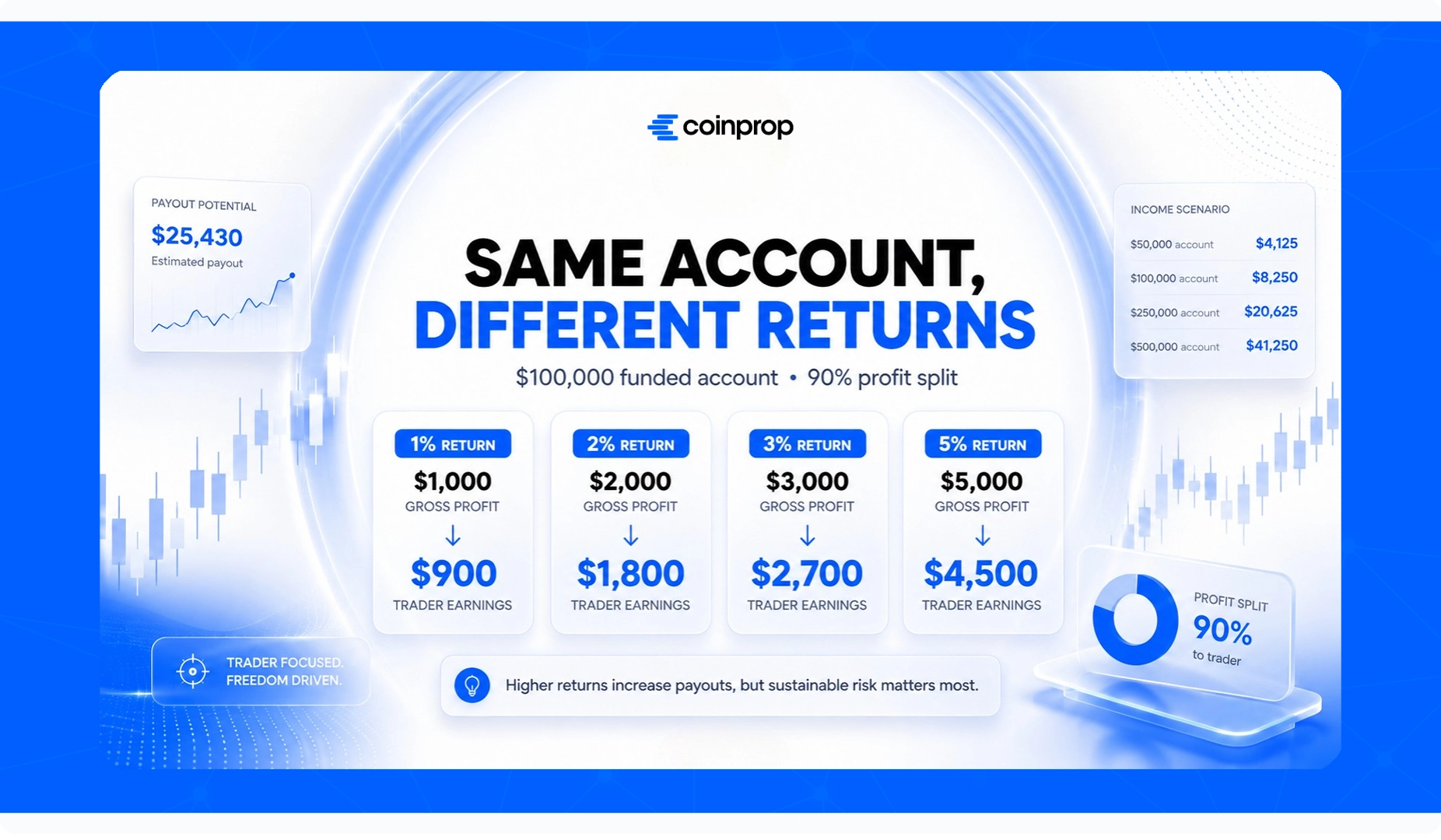
Trading performance has a direct impact on how much a trader can potentially earn from a funded account. Even when the account size and profit split remain unchanged, a difference in monthly return can produce a significant difference in trader earnings.
The examples below use a $100,000 funded account and a 90% profit split to show how different return levels affect potential monthly earnings. These are mathematical illustrations only and should not be interpreted as expected or guaranteed monthly returns.
At 1% Monthly Return
A 1% monthly return on a $100,000 funded account would generate
- Funded account: $100,000
- Monthly return: 1%
- Gross trading profit: $1,000
- Profit split: 90%
- Trader earnings: $900
A lower return can still produce meaningful dollar earnings when applied to a larger funded account. For a trader focused primarily on capital preservation and account longevity, the objective may be to maintain controlled and repeatable performance rather than pursue aggressive returns.
At 2% Monthly Return
A 2% monthly return on the same $100,000 account would generate:
- Funded account: $100,000
- Monthly return: 2%
- Gross trading profit: $2,000
- Profit split: 90%
- Trader earnings: $1,800
Doubling the return from 1% to 2% also doubles the gross profit and trader earnings, assuming the account size and profit split remain unchanged.
However, this calculation does not mean that a trader can simply increase returns without increasing risk. Actual trading performance depends on strategy, market conditions, execution, and risk management.
At 3% Monthly Return
At a 3% monthly return, the same account would generate:
- Funded account: $100,000
- Monthly return: 3%
- Gross trading profit: $3,000
- Profit split: 90%
- Trader earnings: $2,700
At this level, the difference between the return percentages becomes more significant in dollar terms. A trader earning 3% instead of 1% would generate three times as much gross profit on the same funded account.
The important consideration is whether the return can be achieved while maintaining controlled risk and staying within the firm's trading rules.
At 5% Monthly Return
A 5% monthly return on a $100,000 funded account would generate:
- Funded account: $100,000
- Monthly return: 5%
- Gross trading profit: $5,000
- Profit split: 90%
- Trader earnings: $4,500
This illustrates how higher trading performance can substantially increase potential payouts without changing the funded account size.
However, a 5% monthly return should be treated as an illustrative higher return scenario, not as a typical or guaranteed result. Traders should not increase risk simply to target a specific monthly percentage.
The key takeaway is that there is no single return level that defines how much a crypto prop trader can earn. The same funded account can produce very different payouts depending on trading performance, while sustainable performance is generally more important than achieving a high return in a single month.
Can You Make a Full Time Income With a Crypto Prop Firm?
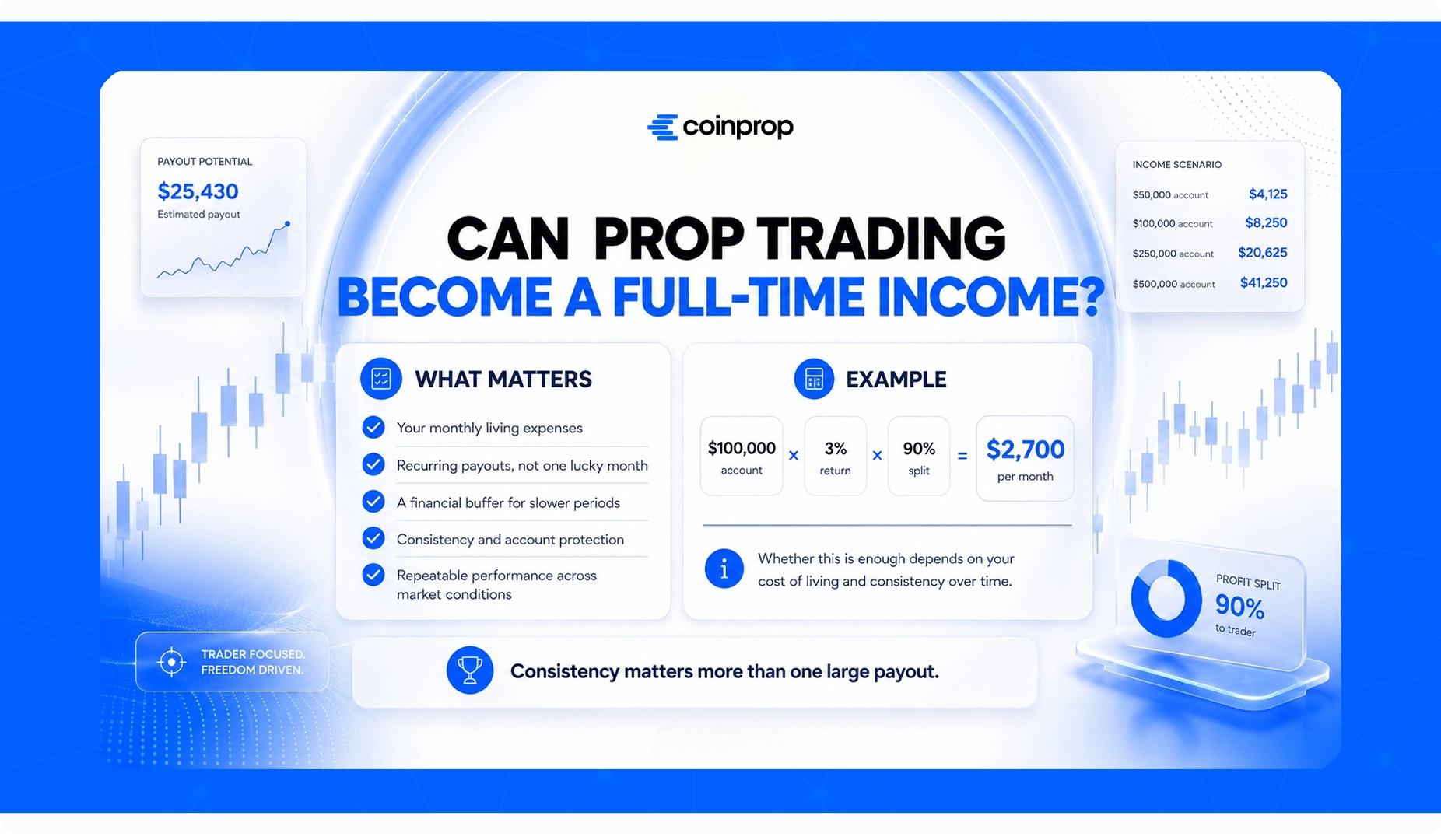
A crypto prop firm can potentially provide enough income to support full time trading, but funded trading does not provide a fixed salary or guaranteed monthly income. Whether it can replace a traditional job depends on your living expenses, trading performance, account size, payout structure, and ability to maintain consistent results over time.
The key difference is that a full time trader needs to think beyond a single profitable month. Sustainable income requires enough recurring payouts to cover expenses while maintaining sufficient financial reserves for periods when trading results are lower.
How Much Monthly Income Do You Need?
The amount you need to earn from a crypto prop firm depends on your personal cost of living and financial obligations. A trader living in a lower cost location may be able to live on $2,000 or $3,000 per month, while someone in a more expensive city may require significantly more.
Your required income should account for housing, food, transportation, insurance, taxes, savings, and other recurring financial obligations. It is also important to leave room for months when trading performance is lower than expected.
For example, a trader whose monthly expenses are $3,000 may need more than $3,000 in average trading payouts to create a reasonable financial buffer. Relying on an exact payout amount every month leaves little room for losing periods, delayed withdrawals, or changes in trading performance.
This is why the more useful question is not simply "Can I make $3,000 a month?" but rather "Can I generate enough reliable income to cover my expenses across different market conditions?"
Why Consistent Payouts Matter More Than One Large Payout
A single large payout does not necessarily represent sustainable trading income.
For example, a trader might receive a $10,000 payout in one month but generate very little or no profit during the following months. That result is very different from consistently receiving $3,000 to $4,000 in payouts over an extended period.
Consistent payouts provide a better indication of whether a trader can maintain profitable performance rather than relying on one unusually successful period.
Consistency does not mean generating the exact same return every month. Trading results naturally fluctuate, and losing months can occur. Instead, sustainable performance means maintaining a trading process that can withstand different market conditions without taking excessive risks to recover losses or hit a specific income target.
For traders relying on funded accounts as an income source, protecting the account is therefore just as important as generating profits. The ability to continue trading and remain eligible for future payouts is what makes trading income more sustainable.
When Does Prop Trading Become a Full Time Income?
There is no specific account size or monthly return that automatically turns prop trading into a full time income. It becomes more realistic when a trader can consistently generate sufficient payouts to cover their expenses while maintaining an adequate financial safety margin.
Before making the transition, traders should look at the bigger picture. They need a trading history that demonstrates repeatable performance across different market conditions, a funded allocation large enough to produce meaningful payouts without excessive risk, and a payout history that extends beyond one unusually profitable month.
Personal savings are also important. Maintaining financial reserves outside the funded account can reduce the pressure to generate a specific return every month. That pressure can otherwise encourage overtrading, excessive leverage, or taking trades that do not fit the trader's strategy.
For example, a trader with a $100,000 funded account who generates a 3% return in a particular month at a 90% profit split would receive $2,700 in trader earnings before any other applicable considerations. Whether that qualifies as a full time income depends entirely on the trader's expenses and whether similar results can be sustained over time.
Ultimately, full time prop trading is less about reaching one specific monthly payout and more about building a sustainable income process. A trader who can manage risk, preserve funded capital, and generate repeatable payouts is in a stronger position than one who relies on occasional high return months.
How Much Can Successful Crypto Prop Traders Earn?
Successful crypto prop traders can potentially earn from hundreds or a few thousand dollars to significantly larger payouts, depending on their funded account size, trading performance, profit split, and ability to maintain the account over time.
There is no fixed income level that defines a successful funded trader. A trader with a smaller account can generate meaningful payouts through strong performance, while a trader with a larger allocation may earn less if their returns are lower.
The important distinction is between potential earning capacity and sustainable income. A large payout in one month does not necessarily indicate that a trader can reproduce the same result consistently.
Monthly Earnings Scenarios
Monthly earnings can vary substantially between funded traders because both account size and trading performance differ.
For example, consider several illustrative scenarios:
- $50,000 funded account × 3% return × 90% split = $1,350
- $100,000 funded account × 3% return × 90% split = $2,700
- $100,000 funded account × 5% return × 90% split = $4,500
- $200,000 funded account × 5% return × 95% split = $9,500
These examples demonstrate how higher allocations, stronger trading performance, and higher profit splits can combine to increase potential trader earnings.
However, these figures should not be interpreted as typical monthly earnings for successful traders. They are illustrative calculations showing what different combinations of account size, return, and profit split can produce.
Actual trading results can include profitable months, lower return periods, and losses. A trader's long term earning potential therefore depends on maintaining a process that can survive these variations rather than maximizing a single month's return.
Annual Income Potential
Monthly payouts can be converted into annual figures to illustrate the potential scale of funded trading income. However, simply multiplying one profitable month's result by 12 assumes that the trader generates exactly the same return every month, which is unlikely in real trading.
For example:
- $2,000 per month × 12 = $24,000 per year
- $5,000 per month × 12 = $60,000 per year
- $10,000 per month × 12 = $120,000 per year
These are mathematical projections based on a constant monthly payout, not forecasts of actual annual income.
Real annual earnings may be lower or higher depending on market conditions, trading performance, account changes, losing periods, payout eligibility, and the trader's ability to maintain funded accounts.
For this reason, annual income should be evaluated using a longer track record rather than extrapolating from one strong month.
What Separates Sustainable Earnings From Short Term Results?
The biggest difference between sustainable trading income and a short term profitable period is the ability to repeat good performance without taking disproportionate risk.
A trader can generate a large payout through a few successful trades, but that result becomes less meaningful if achieving it required excessive leverage or exposed the account to a significant drawdown.
Sustainable earnings are generally supported by several factors:
Risk Control
Successful traders need to manage position sizes and account exposure so that a losing period does not eliminate their ability to continue trading.
Consistency
Consistency does not mean earning the same percentage every month. It means maintaining a repeatable process and avoiding extreme swings in risk or performance.
Strategy
A trading strategy should be suitable for the trader's style, market conditions, and the rules of the funded account. A strategy that works during one market environment may require adjustments when conditions change.
Trading Psychology
Emotional decisions can undermine an otherwise profitable strategy. Revenge trading, increasing risk after losses, or chasing a specific monthly target can turn a profitable approach into an unsustainable one.
Ultimately, successful crypto prop trading is not defined by the largest payout a trader can achieve in a single month. Sustainable earning potential comes from generating profits while preserving the funded account and maintaining the ability to receive future payouts.
What Can Limit Your Actual Crypto Prop Firm Payout?
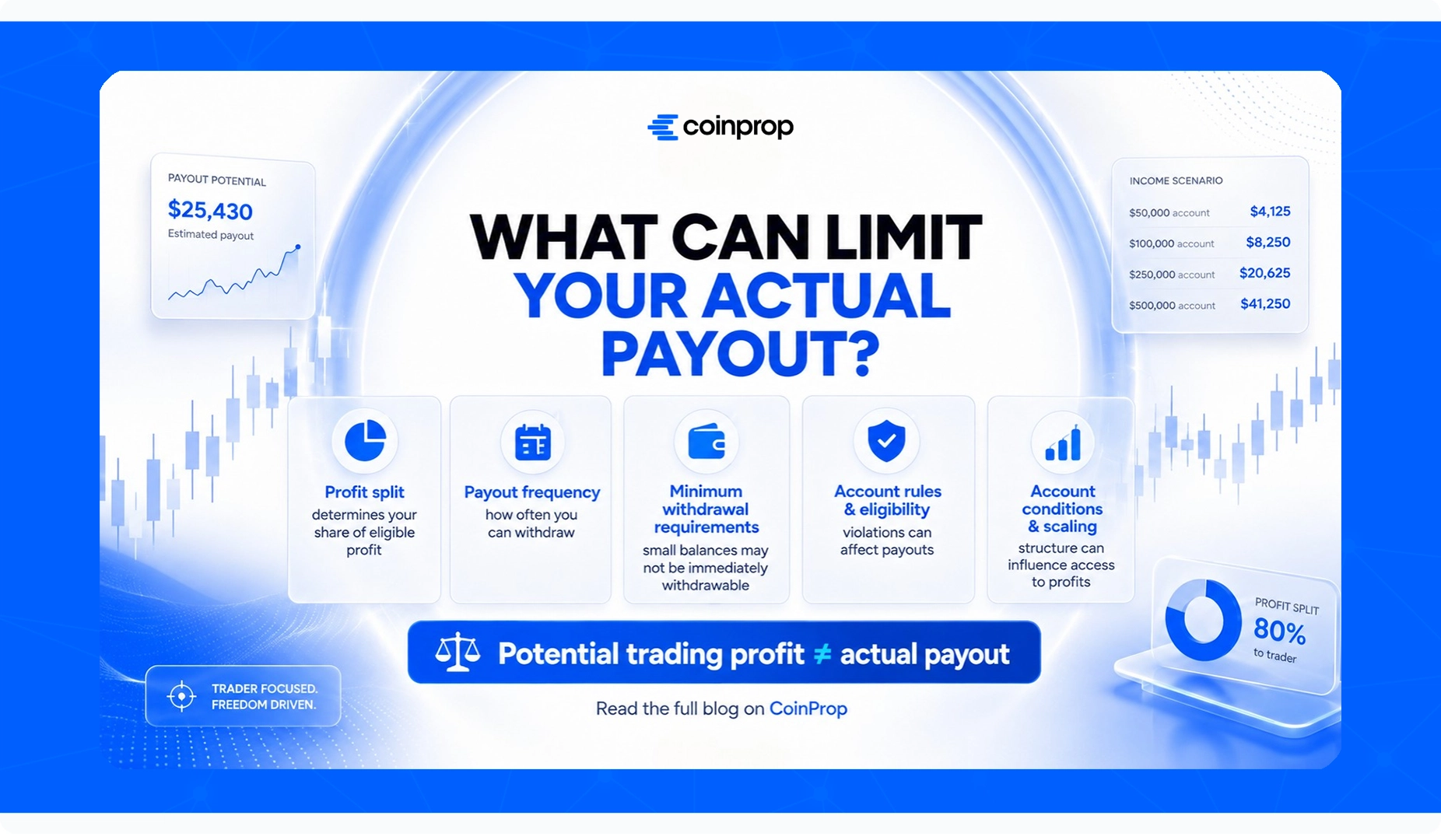
The amount a trader can potentially generate on a funded account is not always the same as the amount they can actually withdraw. Gross trading profit is only the starting point. The final payout can depend on the firm's profit split, withdrawal schedule, account rules, eligibility requirements, and scaling structure.
Understanding these factors is important when evaluating crypto prop firm earning potential because potential profit and actual payout are not always the same thing.
Profit Split
The profit split determines how much of your eligible trading profit you receive as a trader.
For example, if a trader generates $5,000 in eligible profit:
- 80% profit split → $4,000 trader payout
- 90% profit split → $4,500 trader payout
- 95% profit split → $4,750 trader payout
A higher profit split can therefore increase the amount you receive without changing your trading performance.
However, profit split should not be considered on its own. A firm with a higher advertised split may have different account rules, payout conditions, or other restrictions that affect the overall value of the account.
When comparing firms, traders should evaluate the complete payout structure rather than focusing only on the highest percentage shown in the marketing materials.
Payout Frequency and Minimum Withdrawal Requirements
Payout frequency determines how often a trader can request a withdrawal after meeting the applicable requirements.
Some crypto prop firms allow frequent payout requests, while others require traders to wait for a specific payout cycle or reach certain conditions before requesting a withdrawal.
Minimum withdrawal requirements can also affect when a trader can access their profits. If a firm requires a minimum payout amount, a trader with a small profit balance may need to continue trading before becoming eligible to withdraw.
For example, generating $500 in profit does not necessarily mean that the trader can immediately withdraw $500. The actual withdrawal amount and timing depend on the firm's payout structure.
This is why traders should consider both how much they can earn and how quickly they can access those earnings when evaluating a crypto prop firm.
Trading Rules and Drawdown Limits
Trading rules can directly affect whether generated profits remain available for payout.
A trader may produce a profitable position or even reach a significant account profit, but violating a daily loss limit, maximum drawdown rule, or another trading restriction can result in account termination or loss of payout eligibility.
Drawdown limits are particularly important because they determine how much adverse performance an account can withstand.
For example, a trader who generates several thousand dollars in profit but later exceeds the firm's maximum loss limit may lose access to the account and any future earning potential associated with it.
This makes risk management an important part of payout planning. Traders need to protect both their existing profits and their ability to continue trading.
Payout Eligibility
Generating a profit does not always mean that a trader is immediately eligible to withdraw it. Prop firms may apply specific requirements before approving payouts.
Depending on the firm's structure, eligibility can be affected by factors such as:
- Minimum trading days
- Payout cycle requirements
- Account status
- Trading rule compliance
- Profit requirements
- Other account specific conditions
Traders should therefore check the firm's current payout terms before assuming that a calculated profit is immediately withdrawable.
For CoinProp, for example, payout eligibility and withdrawal timing should be evaluated according to the firm's current payout structure and account requirements rather than based solely on the gross profit shown in the trading account.
Scaling Rules and Account Limits
Scaling programs can increase long term earning potential, but they can also place limits on how quickly a trader's funded capital can grow.
A trader may perform consistently and qualify for larger allocations, but the increase may be subject to specific requirements, time periods, account limits, or performance conditions.
For example, CoinProp's scaling program allows eligible traders to increase their account allocation by 30% every 90 days, subject to the program's requirements, with a maximum allocation of $400,000.
Scaling can therefore increase potential earnings over time, but it does not create unlimited capital or guaranteed income.
A trader evaluating long term earning potential should consider not only the starting account size but also how the firm's scaling structure affects the maximum allocation and the pace at which additional capital can become available.
Ultimately, the amount a trader can withdraw depends on more than the profit generated on the account. Profit split, payout timing, trading rules, eligibility requirements, and scaling limits all determine how potential trading profits translate into actual payouts.
Common Mistakes That Reduce Your Crypto Prop Firm Earnings
Your earning potential with a crypto prop firm depends not only on how much profit you can generate, but also on your ability to protect the funded account. A trader can have a profitable strategy and still reduce long term earnings by taking excessive risk, violating account rules, or making emotional decisions.
The most costly mistakes are often not the trades that lose a few dollars. They are the decisions that create large drawdowns, cause account violations, or prevent a trader from continuing to receive payouts.
Overleveraging
Overleveraging is one of the easiest ways to increase risk without realizing how quickly losses can accumulate. While greater exposure can produce larger profits when a trade moves in your favor, the same exposure can cause significant losses when the market moves against you.
For example, a trader trying to reach a specific monthly return may increase position size or use more leverage than their normal strategy requires. A single unfavorable move can then create a large drawdown and bring the account closer to its loss limits.
This can directly reduce earning potential. Even if excessive leverage produces a large profit occasionally, losing the funded account can eliminate the opportunity to generate future payouts.
For prop traders, leverage should therefore be viewed as a risk management tool rather than a way to force higher returns. Position size should be based on the amount the trader is willing to risk, the account's drawdown limits, and the specific setup—not simply on the maximum leverage available.
Breaking Prop Firm Rules
Prop firm rules are another factor that can reduce actual earnings. A trader may generate profitable trades but still lose access to the account by violating a daily loss limit, maximum drawdown, or another trading restriction.
This is particularly important because the financial impact of a rule violation can be much larger than the loss on an individual trade. Once an account is terminated, the trader can no longer generate additional profits or benefit from future payout opportunities on that account.
Understanding the rules before trading is therefore part of protecting your earning potential. Traders should know how loss limits are calculated, when they reset, and which trading activities are restricted under the specific account structure they are using.
Emotional Trading
Trading psychology can have a major effect on long term earnings because profitable strategies can become unprofitable when traders stop following their process.
A common example is revenge trading. After taking a loss, a trader may increase position size or enter additional trades to recover the money quickly. Instead of allowing the original loss to remain within the planned risk parameters, the trader creates additional exposure based on emotion.
The same problem can occur after a winning streak. A trader who becomes overconfident may increase risk because recent trades were successful, potentially turning a profitable period into a significant drawdown.
Consistent funded trading requires the ability to follow a predefined process during both winning and losing periods. The objective is not to eliminate emotions, but to prevent short term emotions from changing risk decisions.
Overtrading
Overtrading occurs when traders take more positions than their strategy or market conditions justify. More trades do not automatically create more profit, and excessive activity can reduce the quality of decision making.
For example, a trader may continue looking for setups after already completing their planned trading session, enter marginal opportunities during a slow market, or take additional positions after a loss in an attempt to recover.
Over time, this can increase unnecessary exposure and make it harder to maintain consistent execution.
A disciplined trader does not need to trade every market movement. Waiting for high quality setups can be more valuable than increasing trade frequency simply to generate more opportunities.
Ultimately, the goal of a crypto prop firm trader should not be to maximize risk or the number of trades. Long term earnings come from generating profits while preserving the funded account and remaining eligible for future payouts.
How to Increase Your Crypto Prop Firm Income
Increasing your crypto prop firm income is not simply a matter of targeting higher monthly returns. In practice, long term earning potential comes from combining stronger trading performance with effective risk management, larger funded allocations, and a payout structure that fits your trading approach.
The goal is to increase the amount you can earn without taking disproportionate risks that could shorten the life of the funded account.
Scale Your Funded Account
Scaling can increase your earning potential by allowing you to manage more funded capital as your performance improves. If you can maintain the same percentage return on a larger account, the resulting dollar profit can increase significantly.
For example, a 5% return on a $50,000 account produces $2,500 in gross profit. The same 5% return on a $100,000 account produces $5,000.
CoinProp's scaling program allows eligible traders to increase their account allocation by 30% every 90 days, subject to the program's requirements, with a maximum allocation of $400,000. This gives traders who maintain consistent performance a way to increase their potential earning capacity over time.
However, scaling should not be viewed as a reason to increase risk. Managing a larger account requires the same discipline and risk control that allowed the trader to qualify for the additional capital in the first place.
Improve Your Trading Performance
Improving your trading performance can increase earnings without requiring a larger funded account. A trader who can generate better returns while maintaining the same level of risk can potentially increase the profit available for payout.
Improvement usually comes from refining the trading process rather than simply trading more aggressively. Reviewing previous trades, identifying recurring mistakes, improving entries and exits, and focusing on higher quality setups can all contribute to better execution.
For example, increasing the return on a $100,000 account from 2% to 3% changes gross profit from $2,000 to $3,000. With a 90% profit split, that represents an increase in potential trader earnings from $1,800 to $2,700.
The important distinction is that improving performance should not mean forcing a higher monthly target. A stronger result is only valuable if it can be achieved consistently and within the firm's risk limits.
Protect Your Funded Account
Protecting the funded account is one of the most important ways to preserve long term earning potential. A trader cannot continue generating payouts from an account that has been lost because of excessive drawdown or a rule violation.
Effective account protection starts with controlling position size and keeping individual trade risk within reasonable limits. Traders should also leave enough room below daily loss and maximum drawdown thresholds to avoid having normal market volatility turn into an account ending event.
This is particularly important when a trader is already profitable. Taking additional risk simply because the account has generated profits can give back those gains and potentially threaten the account itself.
In other words, preserving the account creates more opportunities to earn future payouts. Long term income is built through repeated profitable periods rather than maximizing the return of a single trading session.
Choose the Right Profit Split
The profit split directly affects how much of your trading profit you ultimately receive. A higher split can therefore increase your payout without requiring additional trading performance.
For example, if you generate $5,000 in eligible profit:
- An 80% split gives you $4,000.
- A 90% split gives you $4,500.
- A 95% split gives you $4,750.
However, the highest advertised profit split is not necessarily the best choice for every trader. Profit sharing should be evaluated alongside account pricing, trading rules, payout conditions, scaling opportunities, and other restrictions.
CoinProp offers profit split options ranging from 80% up to 95%, depending on the account plan and available options. Traders should therefore consider how the selected structure affects their actual payout rather than focusing on the percentage alone.
Build a Sustainable Withdrawal Strategy
Increasing income is only useful if you can manage the money you earn. A sustainable withdrawal strategy can help traders benefit from regular payouts while maintaining a long term approach to funded trading.
Instead of treating every profitable period as an opportunity to maximize withdrawals, traders can establish a consistent approach to taking profits while keeping their trading decisions separate from personal financial pressure.
For example, a trader who depends on generating a specific amount every month may feel pressured to increase risk after a losing period. That pressure can lead to overtrading, larger positions, or violations of the firm's rules.
A more sustainable approach is to treat payouts as variable trading income rather than a guaranteed salary. Maintaining personal savings and avoiding the need to generate a specific return every month can reduce the pressure to force trades.
Ultimately, increasing crypto prop firm income is about improving the entire earning process: increase funded capital when possible, improve trading performance, protect the account, use an appropriate profit split, and manage withdrawals in a way that supports long term consistency.
Crypto Prop Firm vs Trading Your Own Capital
Choosing between a crypto prop firm and trading your own capital comes down to more than potential returns. The two approaches differ in how much capital you need, how losses affect you, how profits are distributed, and how easily you can scale your trading.
A prop firm can provide access to a larger funded account without requiring you to provide the full trading capital, but you trade under the firm's rules and typically share a portion of your profits. Trading your own capital gives you complete control over your account and profits, but your earning potential is directly tied to the amount of personal capital you can allocate.
Capital Requirements
The biggest difference is the amount of capital required to trade at a particular scale.
When trading your own crypto account, you need to provide the capital yourself. If you have $5,000 available and generate a 5% return, your gross trading profit is $250.
With a crypto prop firm, you may be able to trade a significantly larger funded account without depositing the full account value yourself. A $100,000 funded account generating the same 5% return would produce $5,000 in gross trading profit. With a 90% profit split, the trader's share would be $4,500.
This illustrates the capital efficiency advantage of funded trading. However, the funded account comes with specific rules and conditions, and the trader does not simply receive $100,000 in cash to use without restrictions.
Risk Exposure
The risk structure is also different.
When you trade your own capital, trading losses directly reduce your personal account balance. If a $5,000 account loses 10%, you have personally lost $500.
With a prop firm, the trader generally does not provide the full nominal value of the funded account. Instead, the account is governed by specific loss and drawdown limits. Losing access to the account can also mean losing the money paid for the evaluation or account, depending on the firm's structure.
This does not make funded trading risk free. Traders still face financial risk, including account costs, potential account loss, and the opportunity cost of time and trading activity. More importantly, breaking the firm's risk limits can end the trading relationship and eliminate future payout opportunities.
The practical difference is that personal trading exposes your own trading capital directly to market losses, while prop trading places greater emphasis on operating within the firm's defined risk parameters.
Income Potential
Trading your own capital allows you to keep 100% of your trading profits, but the amount you can earn is constrained by the size of your personal account.
For example, a trader with $5,000 of personal capital generating a 5% return produces $250 in gross profit. A trader managing a $100,000 funded account at the same 5% return generates $5,000 in gross profit. At a 90% profit split, the funded trader receives $4,500.
The personal trader keeps the entire $250, while the funded trader shares the $5,000 profit with the prop firm.
This creates an important trade off: personal trading provides full ownership of profits, while prop trading can provide access to greater nominal capital in exchange for a profit split and trading restrictions.
Neither approach guarantees a particular income level. Actual earnings depend on trading performance, risk management, account size, and the conditions attached to the trading account.
Scalability
Scalability is another major difference between the two models.
When trading personal capital, increasing your trading size generally requires adding more of your own money or reinvesting profits. A trader who wants to move from $10,000 to $100,000 of personal trading capital must ultimately fund that increase themselves.
A prop firm may offer another path through account scaling. Traders who meet the firm's performance and risk requirements may qualify for larger funded allocations over time.
For example, a trader could begin with a $50,000 funded account and, after demonstrating consistent performance, qualify for a larger allocation. If the trader maintains the same percentage return on the larger account, potential dollar earnings increase accordingly.
This makes scaling one of the main attractions of funded trading. However, scaling programs have their own requirements and maximum account limits, so they should not be viewed as unlimited access to capital.
Ultimately, trading your own capital offers greater control and 100% ownership of profits, while a crypto prop firm can offer greater capital efficiency and scalability. The better option depends on how much personal capital you have available, your trading experience, your tolerance for account restrictions, and your long term trading objectives.
Frequently Asked Questions
How Much Can Beginners Earn With a Crypto Prop Firm?
There is no fixed income level for beginner crypto prop traders. Earnings depend on the funded account size, trading performance, profit split, and ability to maintain the account.
For example, a $10,000 funded account generating a 2% return with a 90% profit split would produce $180 in trader earnings. However, beginners should generally focus on developing consistency and risk management rather than targeting a specific monthly income.
Can You Make $5,000 a Month With a Crypto Prop Firm?
Yes, a trader can potentially generate $5,000 in monthly earnings with a crypto prop firm, but the result depends on account size, trading performance, and profit split.
For example, a $100,000 funded account generating a 5% return would produce $5,000 in gross profit. With a 100% split, that would equal $5,000 to the trader; with a 90% split, the trader would receive $4,500.
The calculation demonstrates what is mathematically possible, but it should not be interpreted as a guaranteed or typical monthly income.
Can You Make $10,000 a Month With a Crypto Prop Firm?
It is mathematically possible to reach $10,000 in monthly trader earnings, but doing so requires a sufficiently large funded account, a strong trading return, and an applicable profit split.
For example, with a $200,000 account and a 95% profit split, a trader would need to generate approximately 5.26% in monthly profit to receive about $10,000:
$200,000 × 5.26% × 95% ≈ $9,994
This is an illustrative calculation rather than an expected monthly return. Maintaining such performance while staying within drawdown limits and other trading rules can be challenging.
Can You Make a Living With a Crypto Prop Firm?
Some traders may be able to generate enough recurring payouts to use crypto prop trading as a full time income source. However, funded trading does not provide a fixed salary, and monthly results can vary significantly.
Whether it is enough to live on depends on your expenses, account size, trading performance, payout structure, and ability to maintain the funded account.
A more reliable approach is to evaluate your income over multiple months rather than deciding based on one large payout. Maintaining personal savings can also reduce the pressure to generate a specific return every month.
Do Larger Funded Accounts Always Earn More?
No. A larger funded account provides greater earning potential at the same percentage return, but it does not guarantee higher earnings.
For example, a $50,000 account generating a 5% return produces $2,500 in gross profit, while a $100,000 account generating a 1% return produces only $1,000.
This is why account size should be considered alongside trading performance and risk management. A smaller account can outperform a larger account when the trader generates a sufficiently higher return.
How Long Does It Take to Become Consistently Profitable?
There is no universal timeframe for becoming consistently profitable with a crypto prop firm. The process depends on a trader's experience, strategy, risk management, market knowledge, and ability to follow a repeatable trading process.
Some traders may improve relatively quickly, while others require significantly more time and practice. Passing an evaluation or achieving one profitable month also does not necessarily demonstrate long term consistency.
A better measure is whether a trader can maintain disciplined execution and controlled risk across different market conditions over an extended period.