
Crypto Exchange vs Crypto Prop Firm: Which Is Better for Crypto Traders?
Published
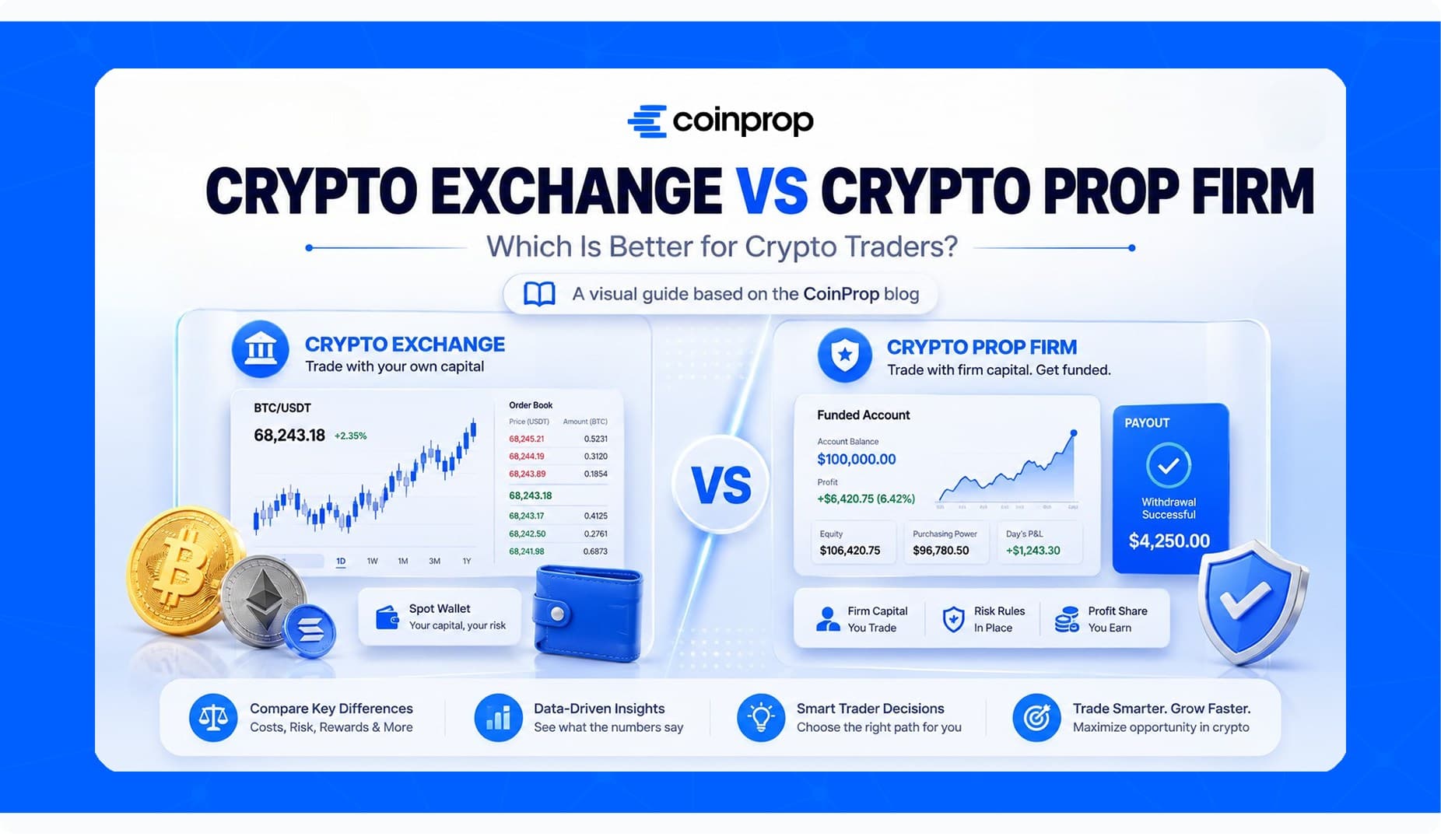
Crypto exchanges let traders use their own capital to buy, sell, and hold digital assets, while crypto prop firms provide access to funded trading accounts with specific risk rules. Learn the key differences between trading on an exchange and a prop firm, and discover which option fits your trading goals.
- Crypto Prop Firm vs Crypto Exchange: Quick Comparison
- Crypto Exchange vs Crypto Prop Firm: Key Differences
- Trading With a Crypto Exchange vs Crypto Prop Firm
- Why Most Crypto Traders Start With an Exchange
- When Traders Consider Moving From a Crypto Exchange to a Prop Firm
- Why Crypto Prop Firms Became an Alternative for Active Traders
- Risk Differences Between Crypto Exchanges and Prop Firms
- Ownership and Control: Crypto Exchange vs Prop Firm
- Cost of Trading on a Crypto Exchange vs Crypto Prop Firm
- Leverage in Crypto Exchanges vs Crypto Prop Firms
- Trading Freedom: Exchange vs Crypto Prop Firm
- Scaling Your Trading Capital: Exchange vs Prop Firm
- Crypto Market Access on Exchanges vs Prop Firms
- Crypto Prop Firm vs Crypto Exchange: Which One Should You Choose?
- Can You Use a Crypto Prop Firm and Exchange Together?
- How CoinProp Combines Crypto Markets With Funded Trading
- Frequently Asked Questions
Crypto Prop Firm vs Crypto Exchange: Quick Comparison
Crypto exchanges and crypto prop firm both give traders access to cryptocurrency markets, but they work in very different ways. The main difference is how trading capital is provided, who bears the financial risk, and what rules traders must follow.
A crypto exchange allows you to trade with your own money and maintain ownership of the assets you purchase. A crypto prop firm, on the other hand, provides access to a funded trading account under a specific set of rules and risk limits.
How Crypto Exchanges Work
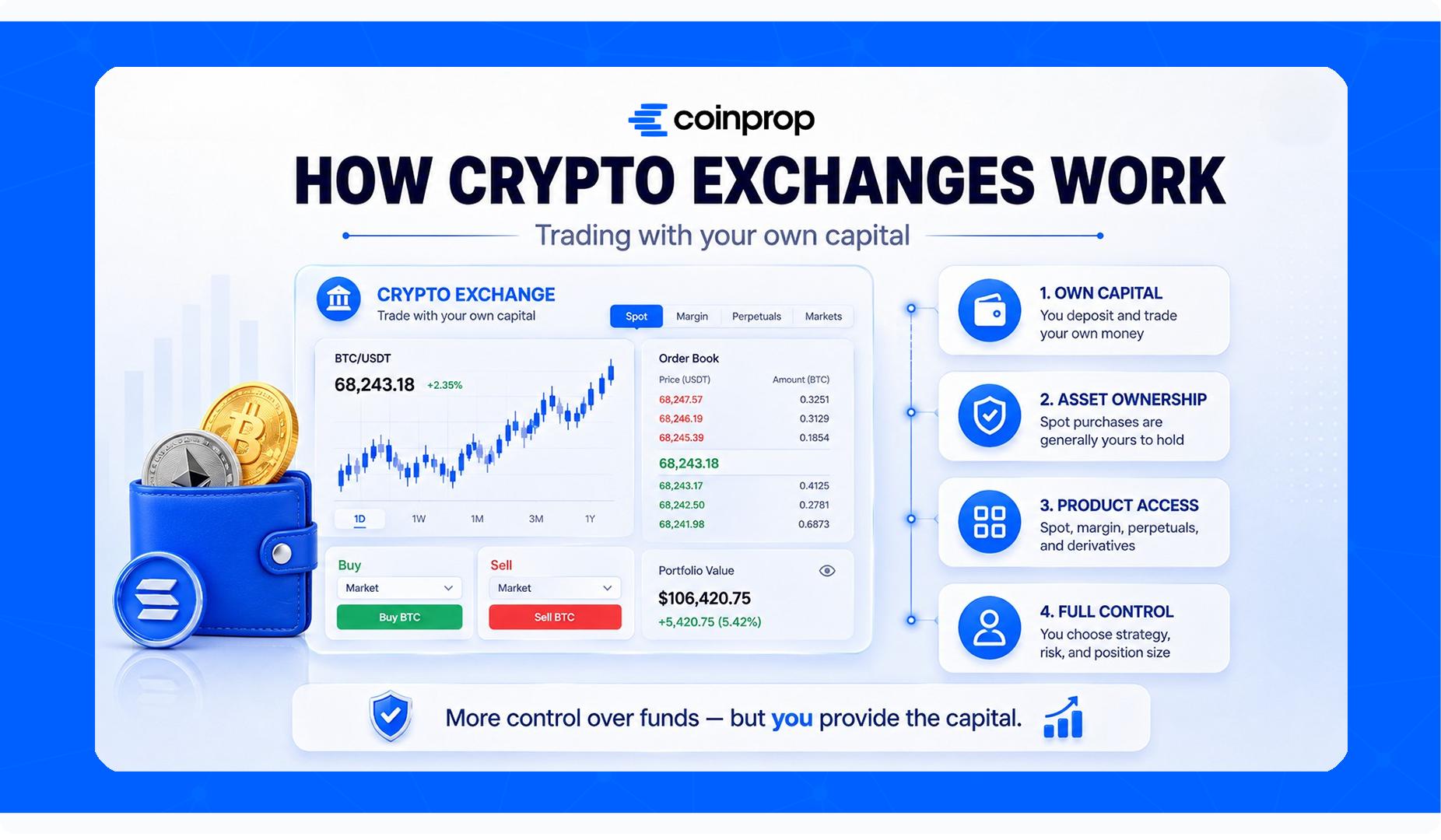
A crypto exchange is a platform where users can buy, sell, and trade digital assets using their own capital. Traders decide how much money to deposit, which cryptocurrencies to trade, and how they want to manage their positions.
Depending on the exchange and the products available, traders may have access to spot trading, margin trading, perpetual futures, and other derivatives.
One of the main advantages of an exchange is control. Traders generally have direct control over their funds and, when purchasing spot cryptocurrency, ownership of the assets they hold. They can also choose their own strategies without having to meet a prop firm's evaluation requirements or predefined trading rules.
The trade off is that the trader is responsible for providing the capital. If a trader wants to increase their potential returns, they generally need to increase their account size or compound their existing profits.
How Crypto Prop Firms Work
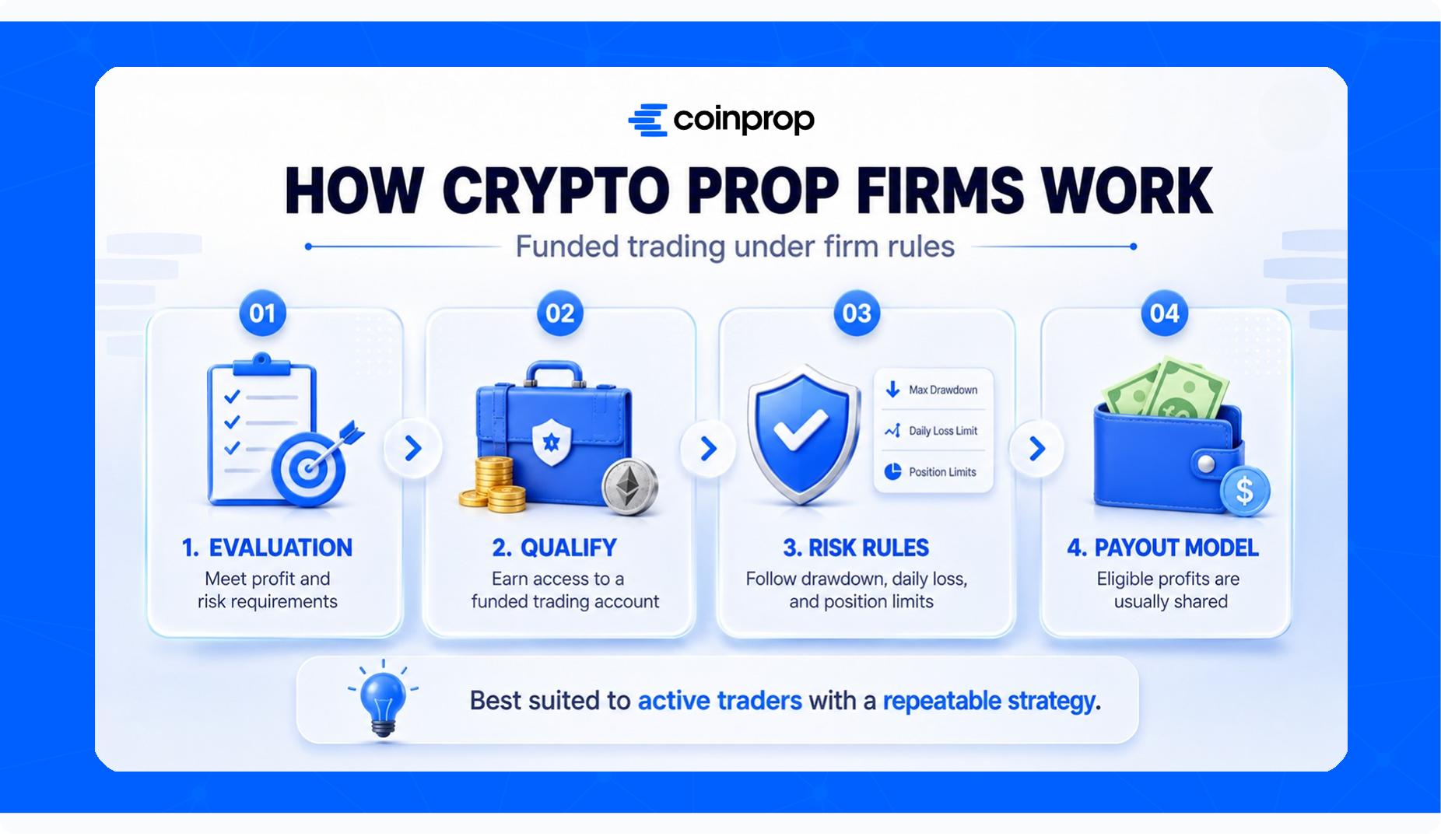
A crypto prop firm offers traders an alternative way to access larger nominal trading accounts without requiring them to provide the entire account balance themselves.
Depending on the firm's model, traders may first need to complete an evaluation or challenge by meeting specific performance and risk requirements. Once they qualify for a funded account, they can trade under the firm's rules and receive a share of eligible profits.
These rules can include daily loss limits, maximum drawdown limits, position size restrictions, profit targets, minimum trading days, and other requirements.
Unlike trading on an exchange with personal funds, traders generally do not own the funded account balance or the underlying assets being traded. Instead, the main objective is to demonstrate consistent trading performance while staying within the firm's risk parameters.
This makes prop firms more relevant to active traders who already have a trading strategy and want to access more trading capital without relying entirely on personal funds.
Crypto Exchange vs Crypto Prop Firm: Key Differences
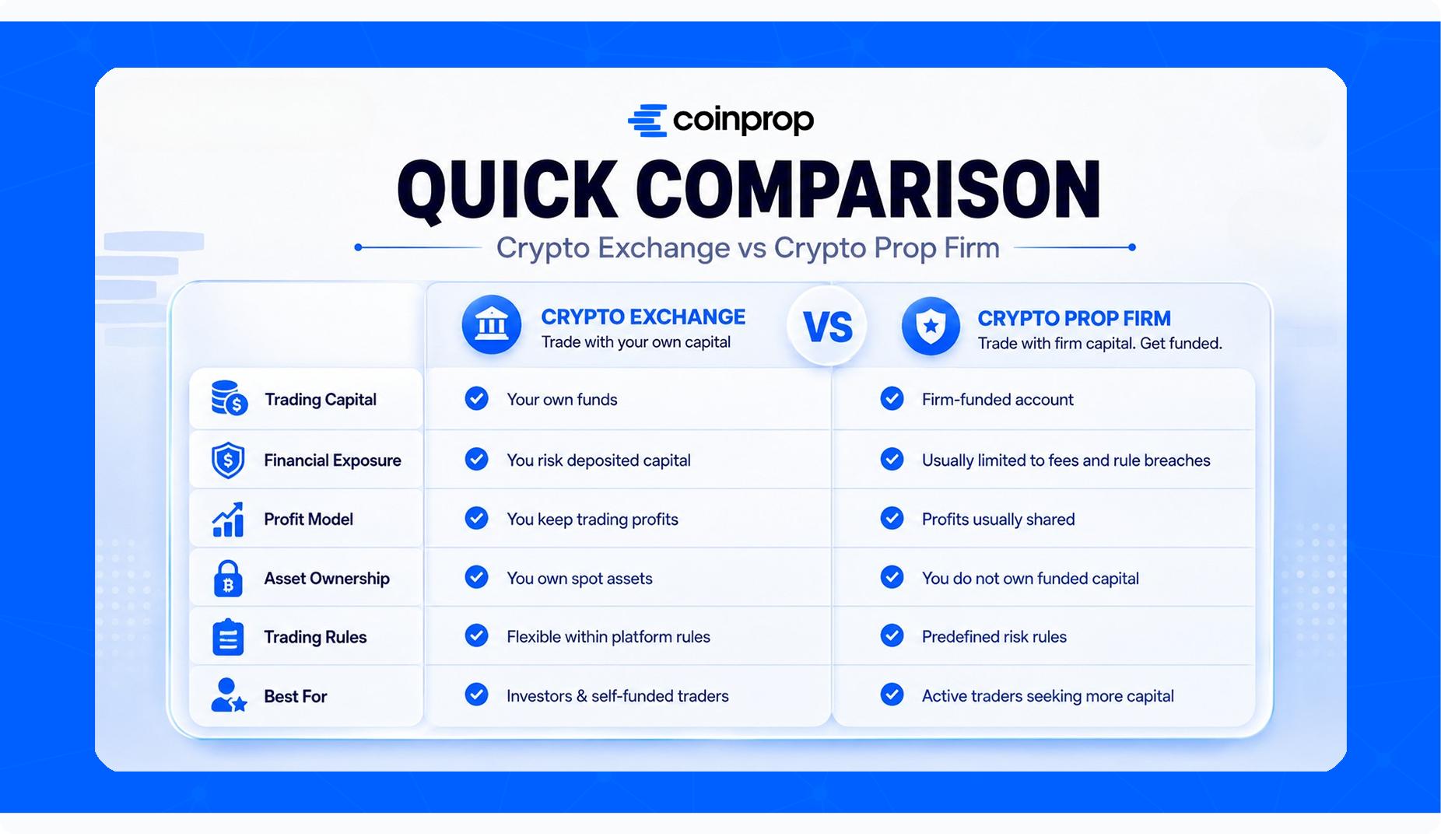
- Feature: Trading Capital
Crypto Exchange: Your own funds
Crypto Prop Firm: Firm provided or funded account capital - Feature: Personal Financial Exposure
Crypto Exchange: You directly risk your deposited capital
Crypto Prop Firm: Usually limited to program fees and related costs, depending on the firm's model - Feature: Profit Model
Crypto Exchange: You generally keep your trading profits
Crypto Prop Firm: Profits are typically shared according to the firm's payout structure - Feature: Asset Ownership
Crypto Exchange: You own crypto assets purchased through spot trading
Crypto Prop Firm: You generally do not own the funded account balance or underlying trading capital - Feature: Trading Rules
Crypto Exchange: You choose your own trading approach within platform rules
Crypto Prop Firm: Predefined risk and trading rules apply - Feature: Leverage
Crypto Exchange: Depends on the exchange and product
Crypto Prop Firm: Depends on the firm's rules and supported instruments - Feature: Scaling
Crypto Exchange: Requires additional personal capital or compounding
Crypto Prop Firm: May be available through a firm's scaling program - Feature: Withdrawals
Crypto Exchange: You can generally withdraw your available personal funds
Crypto Prop Firm: Withdrawals are subject to the firm's payout rules and eligibility requirements - Feature: Best Suited For
Crypto Exchange: Investors and self-funded traders
Crypto Prop Firm: Active traders seeking access to larger trading capital
The key distinction is therefore not simply exchange vs prop firm. It is personal capital and asset ownership vs funded trading and structured risk management.
For traders focused on long term ownership or complete control over their funds, an exchange may be the more natural choice. For traders focused primarily on active trading and gaining access to larger account sizes, a crypto prop firm may provide a more suitable model.
Trading With a Crypto Exchange vs Crypto Prop Firm
The biggest difference between trading on a crypto exchange and trading through a crypto prop firm is not the cryptocurrency market itself. Both can give traders access to price movements across assets such as Bitcoin, Ethereum, and altcoins. The difference is how the trading account is funded, who bears the financial exposure, and what conditions the trader must operate under.
Trading With Your Own Capital on a Crypto Exchange
When you trade through a crypto exchange, you are using your own capital. You decide how much to deposit, which assets to trade, how much risk to take, and when to enter or exit a position.
This gives you a high degree of control over your trading activity. If you buy cryptocurrency through spot trading, you also generally own the assets in your account. You can hold them for days, months, or years depending on your strategy.
Trading with personal capital also means that your profits belong to you. There is no profit split with a prop firm, although you still have to account for trading fees, spreads, funding costs, and other costs associated with the exchange and the products you use.
The main limitation is capital. Your potential dollar returns are directly connected to the amount of money in your account. Growing that account usually requires additional deposits, compounding profits, or both.
Trading With Firm Funded Capital Through a Crypto Prop Firm
A crypto prop firm uses a different model. Instead of providing all of the trading capital yourself, you trade through a funded account subject to the firm's requirements and risk parameters.
Depending on the firm's model, traders may need to complete an evaluation before receiving access to a funded account. The evaluation can include requirements such as a profit target, maximum drawdown, daily loss limit, minimum trading days, or other trading conditions.
Once trading under the firm's program, the trader's focus is not simply on generating profits. Staying within the firm's risk rules is equally important. A profitable strategy can still fail if the trader violates a predefined drawdown or loss limit.
In return for providing access to a larger nominal account size, the firm typically keeps a portion of the profits according to its profit sharing structure. Payouts may also be subject to specific eligibility requirements and withdrawal conditions.
For traders with an established strategy but limited personal capital, this model can provide another way to pursue larger trading opportunities without having to deposit the full nominal account balance themselves.
The Biggest Difference: Capital Behind Your Strategy
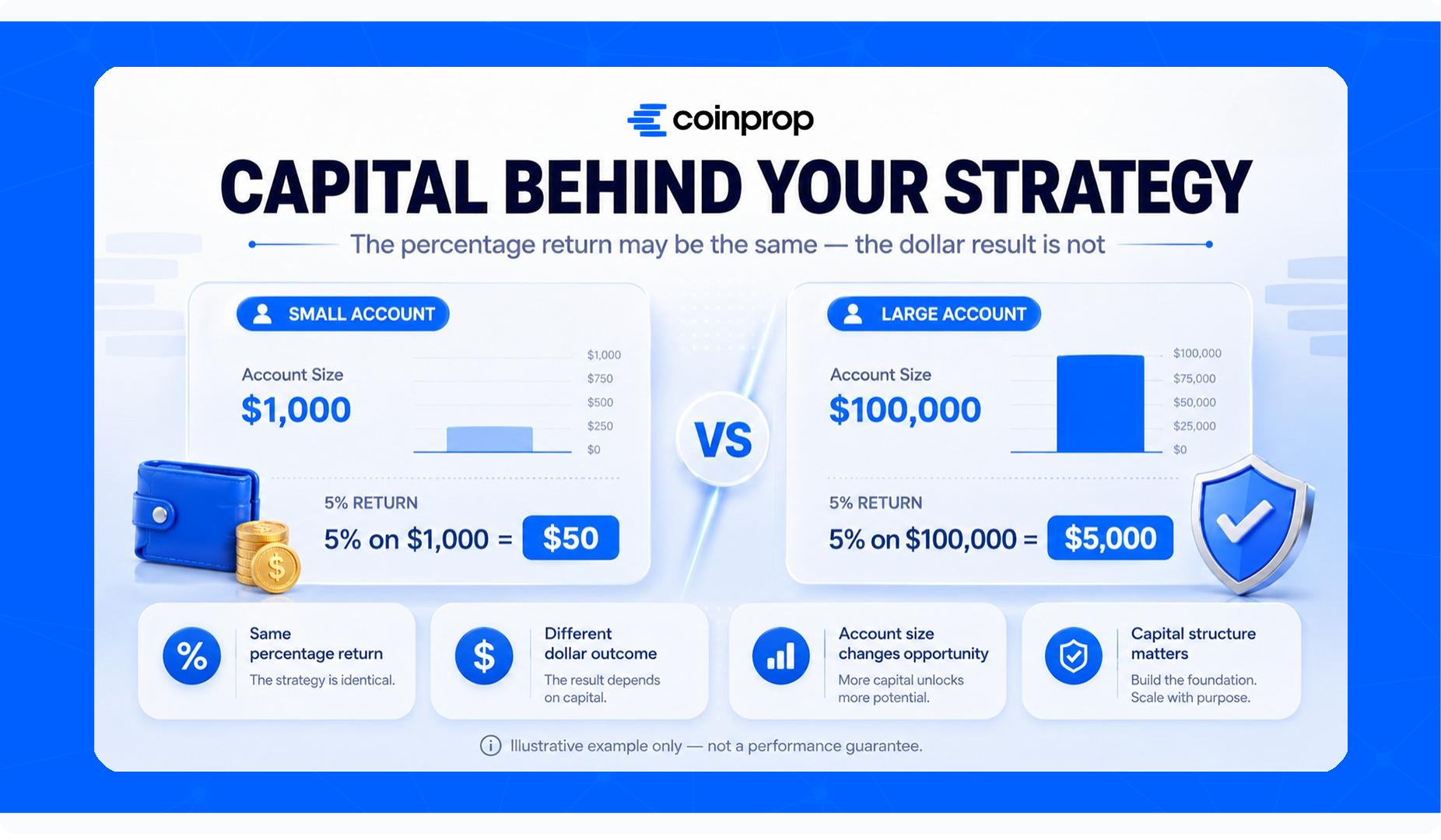
For many active traders, the difference between an exchange and a prop firm becomes most obvious when account size enters the equation.
Consider a simplified example. A trader who generates a 5% return on a $1,000 account earns $50 before trading costs. The same 5% return on a $100,000 account represents $5,000 before costs.
The strategy has not changed. The percentage return is the same. What changes is the amount of capital behind the strategy.
Of course, a 5% monthly return is only an illustrative example and should not be treated as a guaranteed or sustainable return. Actual trading performance varies significantly across strategies, markets, and time periods.
With a personal exchange account, increasing the capital behind a strategy generally means depositing more of your own money or allowing profits to compound over time. With a prop firm, traders may have access to larger nominal account sizes after meeting the firm's requirements, although those accounts come with predefined risk rules and profit sharing conditions.
This creates an important distinction: an exchange gives you greater control over your own capital, while a prop firm can give you access to a larger trading account under a structured set of conditions.
For traders deciding between the two, the question is therefore not simply which platform offers more capital. It is which model better matches their risk tolerance, trading experience, capital availability, and long term goals.

Why Most Crypto Traders Start With an Exchange
For most people, the first step into crypto is opening an account with an exchange. Exchanges provide a relatively straightforward way to buy cryptocurrency, monitor prices, and participate in the market using personal funds.
At this stage, most users are not thinking about funded accounts or professional trading programs. They are usually focused on understanding the market, owning digital assets, and learning how cryptocurrency prices move.
Buying and Holding Cryptocurrency
Many people enter the crypto market with a simple goal: buy an asset and hold it in the hope that its value increases over time.
An exchange makes this possible by giving users access to spot markets where they can purchase cryptocurrencies such as Bitcoin, Ethereum, and other digital assets. Once purchased, these assets can generally be held in the user's account or transferred to a personal wallet, depending on the platform and the asset.
This ownership model is one of the main advantages of using an exchange. Traders and investors maintain control over their personal capital and, when buying spot assets, own the cryptocurrency they purchase.
For long term investors, this can make an exchange more suitable than a prop firm. They do not need to meet an evaluation target, follow a firm's trading rules, or share their investment profits with another party.
Learning How Crypto Markets Work
As users spend more time on an exchange, they often become interested in how crypto markets actually move.
They may start analyzing price charts, following market trends, comparing different cryptocurrencies, and learning about concepts such as volatility, liquidity, leverage, and market structure.
This stage is important because there is a significant difference between simply owning cryptocurrency and actively trading it. Investors may focus primarily on the long term value of an asset, while active traders pay closer attention to shorter term price movements and trade execution.
An exchange provides an environment where users can gradually develop this understanding while managing their own capital.
Moving From Investing to Active Trading
Over time, some crypto users move beyond buying and holding and begin actively trading market movements.
Instead of holding an asset for months or years, an active trader may look for opportunities across different timeframes and markets. Their focus shifts toward developing a repeatable strategy, managing position size, controlling risk, and improving execution.
This transition can change the way a trader thinks about capital.
When investing, the primary question may be which assets to own and how long to hold them. In active trading, account size becomes increasingly important because the dollar value of returns depends on the amount of capital supporting the strategy.
For example, a trader with a small account may have a profitable strategy but still generate relatively small dollar returns. As trading experience develops, some traders therefore begin exploring alternatives that can provide access to larger trading accounts.
This is one of the points where a crypto prop firm may become relevant. Rather than replacing the exchange entirely, a prop firm offers a different model for traders who are primarily interested in active trading and want to explore funded capital under predefined risk conditions.
When Traders Consider Moving From a Crypto Exchange to a Prop Firm
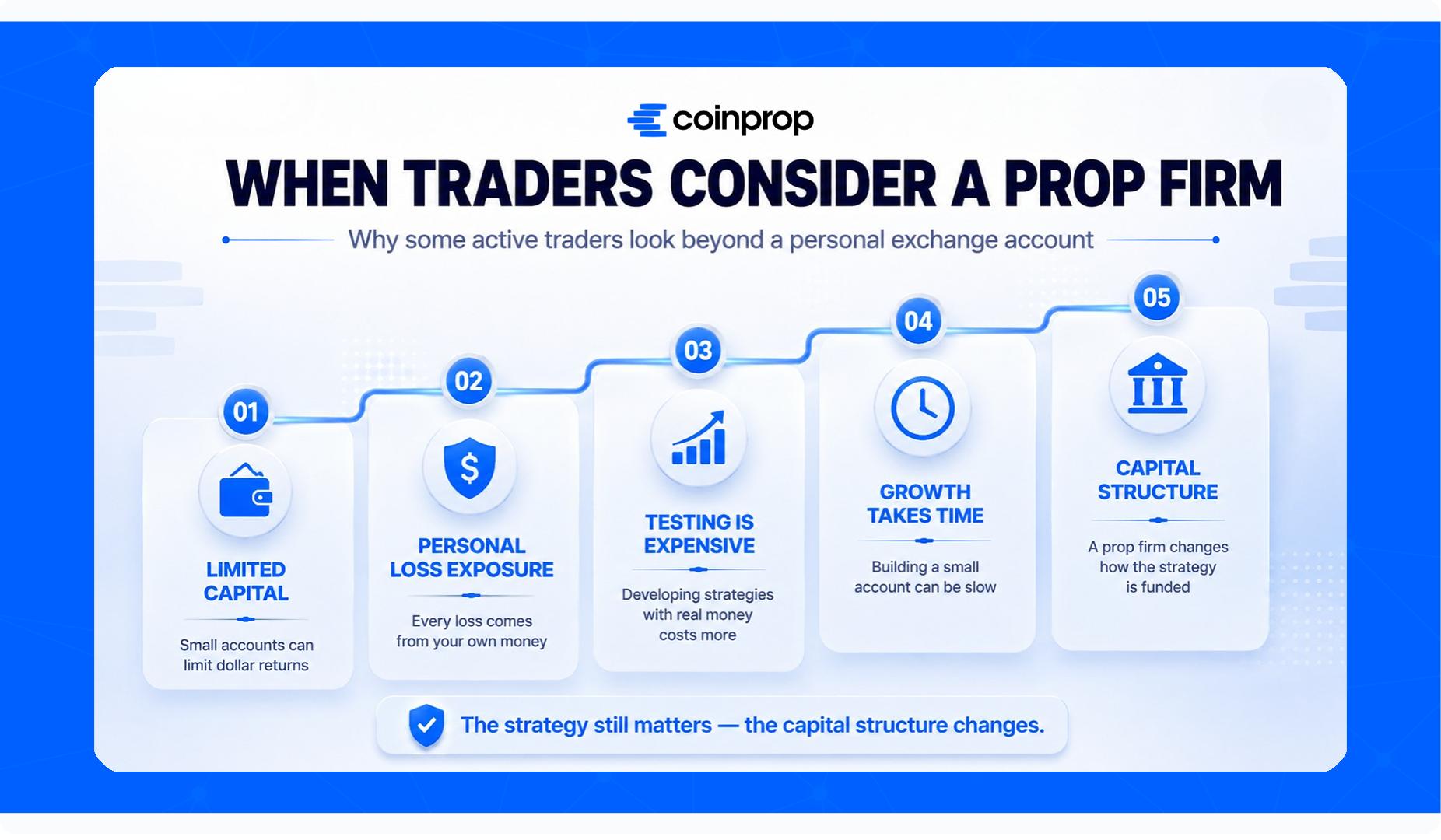
Trading on a crypto exchange can be enough for many traders, especially when they are investing with a comfortable amount of personal capital. However, as traders become more experienced, they may start looking for alternatives when their account size, risk tolerance, or ability to grow capital becomes a limiting factor.
A prop firm does not necessarily replace an exchange. Instead, it offers a different model for traders who want to focus on active trading and potentially access larger account sizes without providing the entire nominal trading balance themselves.
Limited Capital Limits Your Income Potential
One of the most obvious limitations of trading with personal capital is that the size of your account affects the dollar value of your returns.
For example, a 5% return on a $1,000 account produces $50, while the same percentage return on a $50,000 account produces $2,500. The strategy and percentage return are identical, but the amount of capital behind the strategy is different.
This does not mean that traders should simply use more leverage or take greater risks to increase their returns. In fact, increasing position sizes without proper risk management can accelerate losses just as quickly as profits.
For traders who already have a tested strategy and consistent risk management, the challenge may instead be finding a way to increase their trading capital without committing a large amount of additional personal funds. This is one reason some active traders consider a prop firm.
Every Loss Comes From Your Own Money
When trading on an exchange with personal capital, losses directly reduce your account balance.
This gives you complete control over the account, but it also means that every trading mistake has a direct financial consequence. Poor position sizing, excessive leverage, emotional trading, or a prolonged losing streak can significantly reduce the capital available for future trades.
This can make risk management especially important for self funded traders. A strategy can be profitable over time while still experiencing losing trades and drawdown periods along the way.
A prop firm changes the structure of this exposure. Instead of putting the entire nominal trading account at risk yourself, you generally pay a program or evaluation fee and then operate under the firm's predefined risk rules. However, this does not eliminate risk. Traders can still lose their account access, fail an evaluation, or become ineligible for payouts if they violate the firm's conditions.
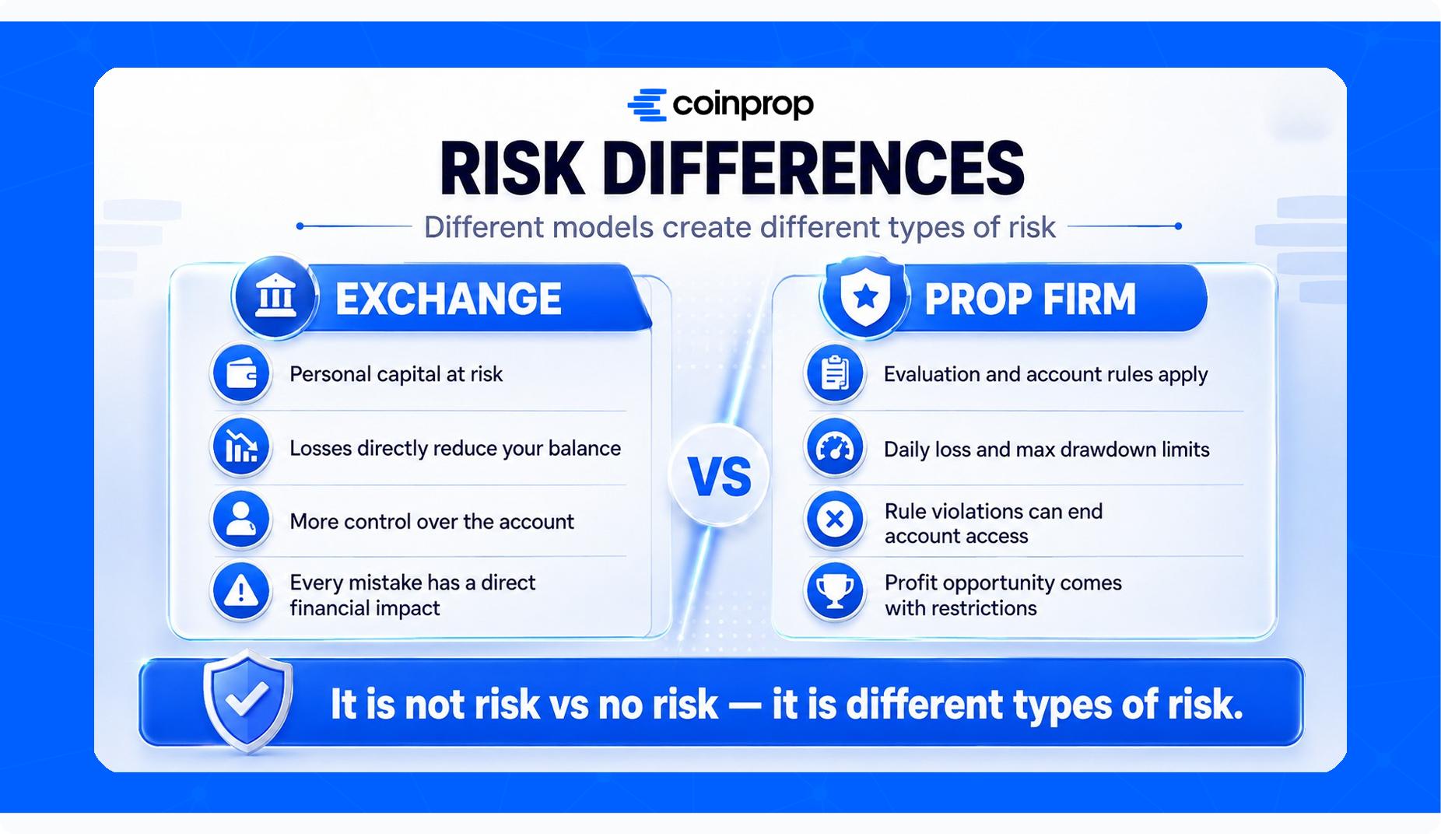
The difference is therefore not between "risk" and "no risk." It is between different types of financial and trading risk.
Testing Strategies With Real Money Is Expensive
Developing a trading strategy requires more than finding an entry signal that appears profitable on a chart. Traders need to understand how their strategy behaves across different market conditions and how factors such as volatility, spreads, slippage, execution, and psychology affect results.
Using personal capital to test an unproven strategy can become expensive. A trader may need to go through multiple iterations before understanding whether a strategy is genuinely consistent or simply benefited from a particular market environment.
Demo accounts and backtesting can help reduce this cost, but they cannot always reproduce every aspect of live trading or the psychological pressure associated with real financial exposure.
A prop firm can provide another structured environment for traders to apply a strategy while operating under predefined risk parameters. However, traders should not treat a prop firm evaluation as a substitute for proper strategy development. A challenge still involves performance requirements, and using an untested strategy simply because the upfront cost is lower can lead to repeated evaluation fees.
Growing a Small Trading Account Takes Time
Even when a trader has a profitable strategy, growing a small account into a substantially larger one can take considerable time.
Compounding can accelerate account growth, but aggressive compounding often requires accepting greater risk. A trader who attempts to turn a small account into a large one quickly may end up increasing position sizes beyond what their strategy and risk management can reasonably support.
For example, consistently earning moderate returns while maintaining controlled risk may be more sustainable than trying to generate extremely high returns every month.
This is where funded trading can become an alternative for experienced traders. Rather than waiting to build a large personal account through deposits and compounding, a trader may use a prop firm's program to pursue access to a larger nominal account size, subject to the firm's evaluation criteria, risk limits, and payout rules.
The important distinction is that a prop firm does not make a trading strategy more profitable. It changes the capital structure around the strategy. Traders still need a repeatable approach, disciplined risk management, and the ability to operate consistently within the firm's rules.
Why Crypto Prop Firms Became an Alternative for Active Traders
As crypto traders move from investing toward active trading, the need for a different capital structure can become more apparent. Trading on an exchange requires traders to provide their own capital, while a crypto prop firm offers a model built around access to a larger nominal trading account under predefined conditions.
This does not make prop firms a better replacement for exchanges in every situation. Instead, they can be an alternative for traders who already have a strategy, understand risk management, and are comfortable trading within a firm's rules.
Access More Trading Capital Without Large Deposits
One of the main reasons active traders consider a crypto prop firm is the opportunity to trade a larger nominal account without depositing the full account balance themselves.
With a personal exchange account, increasing available capital generally requires additional deposits or compounded trading profits. A trader with a relatively small account may therefore need considerable time to build an account large enough to produce meaningful dollar returns at a controlled level of risk.
Prop firms approach this differently. Depending on the firm's model, traders can pay an evaluation or program fee and attempt to qualify for a larger funded account. If they meet the required performance and risk conditions, they may become eligible to trade under the firm's funded program.
The larger account size does not mean the trader can take unlimited risk. Prop firms typically impose rules such as maximum drawdown, daily loss limits, position restrictions, or other risk controls.
The benefit is therefore not simply "more money." It is access to a different capital structure without having to provide the entire nominal account balance personally.
Trade in Market Based Trading Environments
Active trading requires more than identifying potential entries on a chart. Traders also need to understand how their strategies behave under real market conditions, including volatility, spreads, liquidity, and execution.
Crypto prop firms can provide trading environments built around market based pricing and execution conditions. Depending on the firm's model, the trading account may be simulated while using market data and execution mechanisms designed to reflect the underlying crypto markets.
This distinction is important. A funded account does not automatically mean that the trader is directly managing the firm's capital in live markets. The exact trading model, liquidity arrangement, execution environment, and account structure vary between prop firms.
For traders comparing firms, these details can be just as important as the advertised account size. Understanding how orders are executed, what markets are available, and how the firm handles spreads and slippage can help traders determine whether the trading environment is appropriate for their strategy.
Develop Better Trading Discipline Through Risk Rules
Prop firm rules are often viewed as restrictions, but they can also create a structured framework for risk management.
Common requirements include:
- Daily loss limits
- Maximum drawdown limits
- Position size restrictions
- Minimum trading day requirements
- Profit targets during evaluations
These rules can encourage traders to control position sizing and avoid behaviors such as revenge trading, excessive leverage, or attempting to recover losses through increasingly large positions.
However, rules alone do not create good risk management. A trader who does not already understand position sizing and risk control may simply fail the account more quickly by trading against the firm's limits.
For experienced traders, the value of a structured risk framework is that it can create clear boundaries around how much risk can be taken during a trading session or evaluation period.
Trade More Crypto Markets With One Account
Another reason active traders may consider a crypto prop firm is broader access to different crypto markets through a single trading account.
Depending on the firm and its platform, traders may be able to access major cryptocurrencies such as Bitcoin and Ethereum alongside altcoins and, in some cases, memecoins or other markets.
This can be useful for traders whose strategies are not limited to one asset. Different cryptocurrencies can exhibit different levels of volatility, liquidity, and market behavior, creating different trading opportunities across market conditions.
However, broader market access should not automatically be treated as an advantage. More available markets can also encourage overtrading or unnecessary diversification. The most useful setup is the one that provides access to the instruments that actually fit a trader's strategy.
Ultimately, crypto prop firms became an alternative for active traders because they combined access to larger nominal account sizes, structured risk parameters, and market based trading environments. The model can be useful for traders who have already developed a consistent approach, but it comes with its own rules, costs, and limitations that should be evaluated before choosing a firm.
Risk Differences Between Crypto Exchanges and Prop Firms
Risk is one of the most important differences between trading on a crypto exchange and trading through a crypto prop firm. Neither model eliminates trading risk, but the type of risk, the amount of personal capital exposed, and the rules governing losses can be very different.
With an exchange, traders are directly responsible for the capital they deposit and trade. With a prop firm, traders generally operate under a defined risk framework and may have less upfront personal capital at risk, but they must comply with the firm's conditions to maintain account access and become eligible for payouts.
Risking Personal Capital on an Exchange
When trading on a crypto exchange with your own funds, losses directly reduce your personal account balance.
This gives traders complete control over their capital, but it also means that the financial consequences of trading decisions are entirely their responsibility. A series of losing trades, excessive leverage, poor position sizing, or a major market move can significantly reduce the account.
The amount of risk ultimately depends on how the trader manages the account. A trader using conservative position sizes may keep individual trade risk relatively low, while another trader using high leverage can expose a much larger portion of their capital to market movements.
An important advantage is that there are generally no external prop firm drawdown rules determining when a trader loses access to an account. As long as the trader's exchange account remains funded and complies with the platform's own requirements, they can continue trading according to their strategy.
The trade off is that the capital being lost is their own.
Evaluation and Account Risk With a Prop Firm
Crypto prop firms change the structure of the trader's financial exposure.
Depending on the firm's model, traders may first pay an evaluation or challenge fee and then attempt to meet specific performance requirements. These can include profit targets, minimum trading days, maximum drawdown limits, or daily loss limits.
If the trader violates the firm's rules, the evaluation or trading account may be terminated. This creates a different type of risk compared with a personal exchange account.
For example, a trader may have a strategy that is profitable over the long term but experience a short term losing period that causes them to breach a firm's maximum drawdown rule. In that situation, the trader may lose access to the account even though the strategy itself has not necessarily become unprofitable.
This is why traders should evaluate a prop firm's rules before focusing on its advertised account size. A larger nominal account does not automatically mean that the trader has proportionally more usable risk.
The financial exposure may be lower than funding the same nominal account personally, but traders still risk program fees, account access, and potential payout eligibility if they fail to follow the firm's requirements.
Drawdown and Daily Loss Limits
Drawdown and daily loss limits are among the most important risk controls used by crypto prop firms.
A maximum drawdown defines how much an account can decline before the trader violates the firm's rules. A daily loss limit restricts how much the account can lose within a specific trading day or measurement period.
For example, a firm might allow a maximum drawdown of 6% and a daily loss limit of 3%. If the trader exceeds either threshold according to the firm's calculation method, the account may be considered in violation.
The exact calculation can vary significantly between firms. Some use static drawdown levels, while others use trailing drawdown. Daily loss limits can also be calculated using different combinations of balance, equity, closed profit and loss, or floating positions.
These rules can protect the firm from excessive account exposure, but they also affect how traders must manage positions.
A strategy that works comfortably on a personal exchange account may not be suitable for a prop firm if it regularly experiences large short term drawdowns. Traders therefore need to understand the firm's risk calculations and adjust position sizing accordingly.
How Profit Sharing Changes the Risk Reward Profile
Profit sharing creates another important difference between the two models.
When trading with personal capital on an exchange, the trader generally keeps the profits generated by their account, after applicable trading costs and other fees. There is no prop firm taking a percentage of the trading profits.
With a prop firm, traders typically receive a predetermined percentage of eligible profits while the firm retains the remaining share. The exact split can vary depending on the firm, account type, payout stage, and any optional upgrades.
This means that a prop firm may provide access to a larger nominal account, but the trader does not necessarily keep 100% of the profits generated.
Consider a simplified example. If a trader generates $5,000 in eligible profits and receives an 80% profit split, the trader would receive $4,000 while the remaining $1,000 goes to the firm, before considering any other applicable conditions or fees.
The trade off is therefore more nuanced than simply comparing account sizes. An exchange provides full ownership of trading profits but requires the trader to provide and risk their own capital. A prop firm may reduce the amount of personal capital required to access a larger nominal account, but introduces evaluation requirements, trading rules, payout conditions, and profit sharing.
For traders comparing the two models, the relevant question is not which one has less risk. It is which type of risk and capital structure better fits their trading strategy and financial situation.
Ownership and Control: Crypto Exchange vs Prop Firm
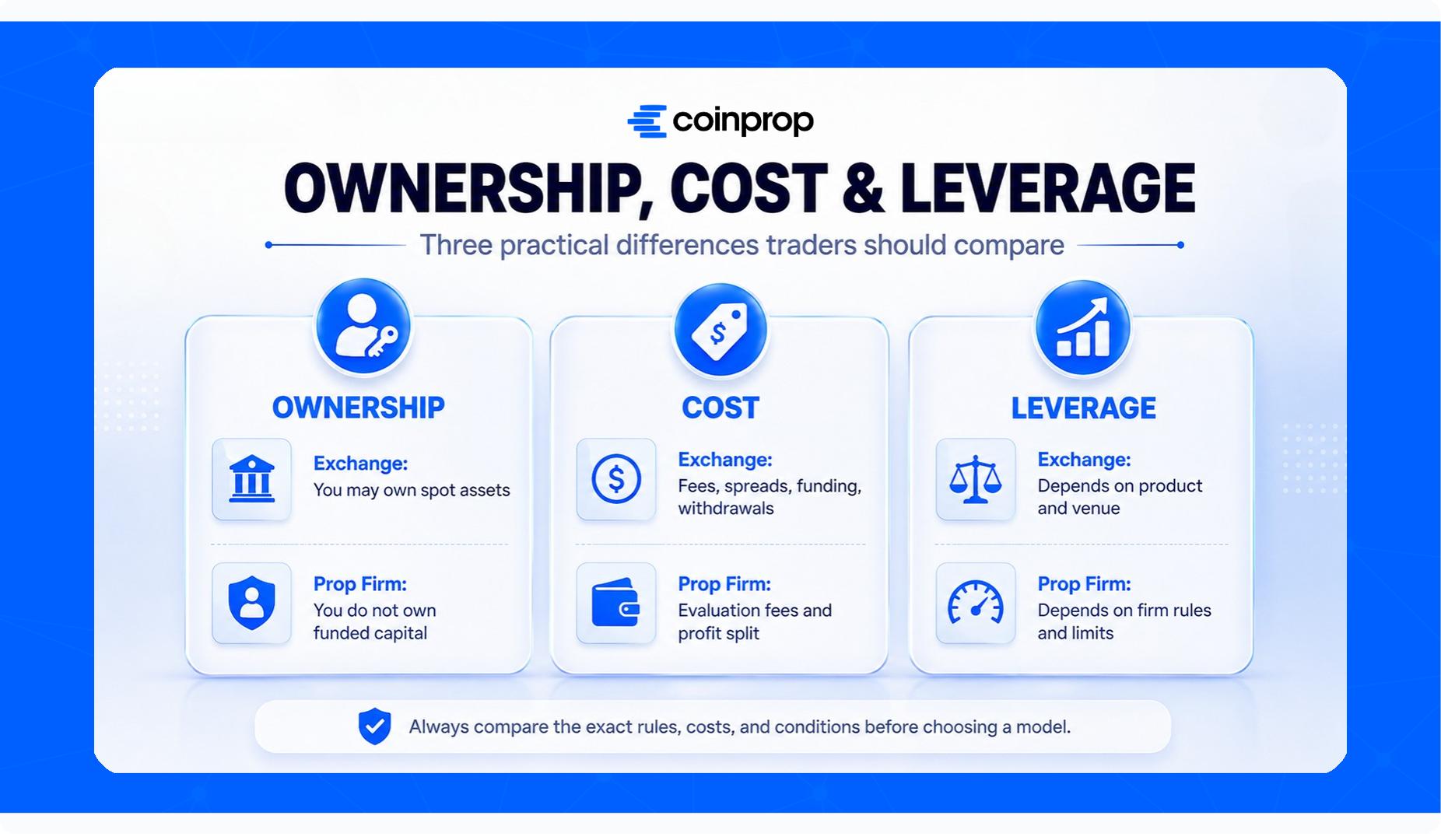
Ownership and control are two areas where crypto exchanges and prop firms differ significantly. On an exchange, traders generally use their own funds and, when buying spot cryptocurrency, own the assets they purchase. A prop firm account works differently: traders receive access to a trading account under the firm's terms, but the account balance and underlying capital are not generally the trader's personal assets.
Understanding this distinction is important because two accounts can display a similar balance while giving the trader very different rights and responsibilities.
Who Owns the Crypto Assets?
When you buy cryptocurrency through spot trading on an exchange, you generally own the assets in your account. You can hold them, sell them, or, where supported, transfer them to an external wallet.
This makes exchanges particularly suitable for users whose goal is long term cryptocurrency ownership. The trader decides which assets to purchase and how long to hold them, subject to the exchange's policies and applicable restrictions.
A prop firm account does not normally work this way. The balance displayed in a funded trading account represents the account's trading capital or simulated capital under the firm's program. It does not mean that the trader personally owns that amount of cryptocurrency.
This distinction becomes especially important when comparing funded accounts with spot crypto investing. A trader using a prop firm may be able to speculate on the price movements of Bitcoin, Ethereum, altcoins, or other supported assets without actually purchasing and taking ownership of those cryptocurrencies.
Who Controls the Trading Account?
An exchange account generally gives the trader broad control over how their personal capital is used, subject to the exchange's platform rules.
The trader can decide which supported markets to trade, how much capital to allocate, what strategies to use, and when to close positions. The exact level of flexibility depends on the exchange and the specific product being traded.
A prop firm account involves a different relationship. The trader controls the execution of trades within the account, but the firm determines the conditions under which the account can be used.
Those conditions may include maximum position sizes, leverage limits, drawdown thresholds, daily loss limits, prohibited strategies, minimum trading requirements, or other restrictions.
As a result, traders generally have less freedom than they would have when trading their own personal account. In exchange, they may gain access to a larger nominal account without having to provide the entire balance themselves.
Withdrawals and Access to Funds
Withdrawals also work differently under the two models.
With a personal exchange account, traders can generally withdraw available funds or transfer supported assets according to the exchange's withdrawal policies, network requirements, and account restrictions. The funds belong to the trader, although withdrawals may still be subject to verification, fees, limits, or temporary restrictions.
Prop firm withdrawals are usually based on payout eligibility rather than ownership of the account balance.
A trader does not normally withdraw the funded account's nominal balance. Instead, they request a payout of eligible trading profits according to the firm's rules. Requirements can include minimum trading periods, profit thresholds, payout schedules, consistency conditions, or other eligibility criteria.
This distinction is important when comparing account sizes. A $100,000 prop firm account does not mean the trader can withdraw $100,000. The account size represents the capital or nominal balance available for trading under the firm's program, while the trader's potential withdrawal is generally based on eligible profits and the applicable payout structure.
Trading Rules and Account Restrictions
The level of trading freedom is another major difference between the two models.
When trading personal funds on an exchange, traders generally have more freedom to determine their strategy. They can choose their position size, holding period, entry and exit methods, and risk tolerance within the exchange's product specific rules.
Prop firms typically impose additional restrictions because their programs are designed around predefined risk parameters.
Depending on the firm, these may include:
- Daily loss limits
- Maximum drawdown limits
- Position size restrictions
- Leverage limits
- Minimum trading days
- Holding period requirements
- Restrictions on certain trading strategies
- Rules around news events or market volatility
- Restrictions on account hedging or coordinated trading
The specific rules vary considerably between firms, so traders should read the terms carefully before starting an evaluation.
Ultimately, the ownership and control difference can be summarized simply: an exchange gives traders greater control over their personal assets and capital, while a prop firm gives traders access to a trading account under predefined conditions without giving them ownership of the firm's capital.
Cost of Trading on a Crypto Exchange vs Crypto Prop Firm
Cost is another important difference between trading on a crypto exchange and using a crypto prop firm. The two models charge traders in different ways, so comparing only the advertised trading fee or challenge price does not give the full picture.
With an exchange, costs are generally connected to executing trades, depositing or withdrawing funds, and using specific trading products. With a prop firm, traders may pay an evaluation or program fee and then give up a percentage of eligible profits through the firm's profit sharing structure.
The most cost effective option therefore depends on how frequently you trade, how much personal capital you have, and whether you successfully generate payouts.
Exchange Trading Fees and Spreads
When trading on a crypto exchange, one of the most obvious costs is the trading fee charged when opening or closing a position.
The exact fee depends on the exchange, trading volume, account tier, and product being traded. Some platforms use maker and taker fee structures, while derivatives may also involve additional costs such as funding payments.
Traders also need to consider the spread. The spread is the difference between the available buying and selling prices and can become particularly relevant for short term traders who enter and exit positions frequently.
For example, a scalper executing many trades may accumulate substantially more trading costs than a long term investor who makes only a few transactions.
Other potential costs can include borrowing or margin costs, funding payments for perpetual contracts, and fees associated with specific trading products.
Because these costs can vary significantly between platforms and products, traders should evaluate the complete trading cost rather than looking at the headline commission alone.
Deposits and Withdrawals
Exchanges can also charge costs when funds or cryptocurrency are moved into or out of an account.
Fiat deposits and withdrawals may involve payment processing fees, while crypto withdrawals can involve network fees or platform specific withdrawal charges. The actual cost depends on the asset, blockchain network, withdrawal method, and exchange.
For example, withdrawing USDC over one blockchain network may have a different cost from withdrawing the same asset over another network.
Traders should also consider withdrawal limits, processing times, and any verification requirements. A low trading fee does not necessarily mean that an exchange is inexpensive overall if the trader frequently moves funds in and out of the platform.
Prop Firm Challenge or Evaluation Fees
Crypto prop firms typically use a different cost structure. Instead of requiring the trader to deposit the full nominal account size, many firms charge an evaluation, challenge, or program fee.
The amount depends on the firm and the account size. Larger account programs generally have higher fees, while different account models may have different requirements and pricing structures.
This creates a potentially lower barrier to accessing a larger nominal trading account, but the fee is not the same as a traditional trading deposit.
If a trader fails the evaluation or violates the firm's rules, the fee may be lost. A trader who repeatedly purchases evaluations can therefore accumulate significant costs even if each individual challenge appears relatively inexpensive.
This is why the evaluation fee should be considered alongside the firm's drawdown rules, profit target, trading restrictions, and payout conditions rather than viewed in isolation.
Profit Splits and Payout Costs
Another cost associated with prop firms is the profit split.
When trading personal capital on an exchange, traders generally retain their trading profits after applicable trading and platform costs. A prop firm, however, typically pays the trader a predetermined percentage of eligible profits.
For example, if a trader generates $5,000 in eligible profits and receives an 80% profit split, the trader would receive $4,000 while the remaining $1,000 would go to the firm, before considering any additional conditions.
Some firms may also have payout related requirements, processing fees, minimum withdrawal amounts, or restrictions that affect how and when profits can be withdrawn.
These conditions should be considered part of the total cost of using a prop firm. A program with a low initial fee may not necessarily be cheaper if its payout structure is less favorable.
Which Model Has Lower Upfront Costs?
There is no universal answer because the two models require capital in different ways.
For an exchange, the trader generally needs to provide their own trading capital. A trader can start with a relatively small amount, but that capital is directly exposed to market losses.
A prop firm may require a smaller upfront payment relative to the nominal account size because the trader is not depositing the entire advertised account balance. However, the trader must operate under the firm's rules and may need to pay another fee if an evaluation is unsuccessful.
The difference becomes clearer when separating upfront cost from total trading cost.
An exchange can have a relatively low entry cost because traders can deposit only the amount they are comfortable using, but they remain responsible for their own trading losses. A prop firm can provide access to a larger nominal account for a comparatively smaller initial fee, but the trader gives up part of eligible profits and accepts additional account restrictions.
For this reason, traders should compare the complete cost structure, including:
- Initial deposit or evaluation fee
- Trading fees and spreads
- Funding or financing costs
- Withdrawal fees
- Profit sharing terms
- Payout conditions
- Potential costs of failed evaluations
The cheaper option depends on the trader's strategy and behavior. An exchange may be more cost effective for traders who already have sufficient personal capital and want to retain their profits, while a prop firm may appeal to traders who prioritize access to larger nominal trading accounts without providing the full capital themselves.
Leverage in Crypto Exchanges vs Crypto Prop Firms
Leverage can significantly change how traders manage positions in crypto markets, but it works differently depending on whether the trader is using a personal exchange account or a crypto prop firm.
Both models may offer leveraged trading, but the maximum leverage available is only one part of the equation. Margin requirements, position limits, drawdown rules, liquidation mechanisms, and the trader's own risk management can have a much greater impact on actual trading risk.
How Exchange Leverage Works
On a crypto exchange, leverage allows traders to control a position larger than the amount of capital they commit as margin.
For example, with 5× leverage, a trader using $1,000 of margin could potentially control a $5,000 position, subject to the exchange's requirements and available products.
Leverage can increase the potential return on the capital used as margin, but it also magnifies losses. A relatively small adverse price movement can therefore have a significant impact on the trader's account.
The exact leverage available depends on the exchange, trading pair, product type, account conditions, and sometimes the size of the position. Major cryptocurrencies may have different limits from smaller or more volatile assets.
Traders also need to understand that leverage does not change the underlying market movement. If Bitcoin moves 1% against a leveraged position, the percentage impact on the margin can be much larger than it would be on an unleveraged position.
Leverage Rules at Crypto Prop Firms
Crypto prop firms may also provide leveraged trading, but leverage is usually combined with additional account level risk restrictions.
A firm may specify maximum leverage for different asset classes while also imposing maximum drawdown, daily loss, position size, or exposure limits.
This means that a trader cannot necessarily use the maximum advertised leverage on every trade or assume that the entire nominal account balance can be deployed at that level.
For example, a prop firm might offer higher leverage on major cryptocurrencies while applying lower leverage to smaller altcoins because of their higher volatility and lower liquidity.
The exact structure varies considerably between firms. Some may focus primarily on leverage limits, while others may impose additional restrictions on cumulative exposure, margin usage, or individual position sizes.
For traders comparing prop firms, the relevant question is therefore not simply "What is the maximum leverage?" but "How much exposure can I actually maintain under the firm's complete risk rules?"
Why Higher Leverage Does Not Always Mean Higher Opportunity
Higher leverage can make a smaller amount of capital capable of controlling a larger position, but it does not automatically create a better trading opportunity.
A trader with a profitable strategy can potentially use moderate leverage effectively, while excessive leverage can cause a single unfavorable price movement to create a disproportionately large loss.
This is particularly important in crypto markets, where volatility can be significantly higher than in many traditional financial markets.
Consider two traders using the same strategy. One uses moderate leverage and leaves enough room for normal market fluctuations. The other uses substantially higher leverage and places a much larger position relative to available capital. Even if both traders identify the same market direction, the second trader may reach a liquidation level, daily loss limit, or drawdown threshold much sooner.
For prop firm traders, excessive leverage can be especially problematic because violating the firm's risk limits can result in losing account access even if the underlying trading thesis was eventually correct.
Leverage should therefore be evaluated alongside position size, stop loss placement, drawdown, and overall account exposure rather than treated as a standalone advantage.
Managing Leverage and Position Size
Effective leverage management starts with position sizing rather than simply selecting the highest leverage available.
A trader should first determine how much of the account they are willing to risk on a particular trade and then calculate an appropriate position size based on the entry price, stop loss level, and distance to invalidation.
For example, a trader who is willing to risk 1% of an account on a trade should determine the appropriate position size from that risk limit rather than starting with the maximum available leverage and building the position around it.
This approach is relevant to both exchange and prop firm trading, although prop firm traders must also account for the firm's specific daily loss, maximum drawdown, margin, and exposure requirements.
A useful distinction is:
Leverage determines how much exposure your margin can support. Position sizing determines how much exposure you actually take.
Using the maximum available leverage does not mean a trader must use the maximum possible position size. In many situations, experienced traders use leverage primarily as a capital efficiency tool while keeping actual account risk relatively controlled.
Ultimately, the best leverage level is the one that allows a trader's strategy to operate within a sustainable risk framework. For exchange traders, that framework is primarily determined by their own risk tolerance and account structure. For prop firm traders, it must also fit within the firm's predefined trading rules.
Trading Freedom: Exchange vs Crypto Prop Firm
Trading freedom is another important difference between using a crypto exchange and trading through a crypto prop firm. An exchange generally gives traders more control over how they use their own capital, while a prop firm places additional conditions on how its trading accounts can be managed.
This does not necessarily mean that one model is better than the other. Greater freedom can be useful for experienced traders who want complete control, while structured rules can help traders operate within clearly defined risk boundaries.
Strategy Flexibility on an Exchange
When trading with personal capital on a crypto exchange, traders generally have broad freedom to choose their strategies.
Depending on the available products, they may be able to hold positions for minutes, days, or months, trade different timeframes, use spot or derivatives markets, and adjust their position sizes according to their own risk management approach.
A trader can also change strategies without needing approval from a third party. If a particular approach stops working, the trader can modify their position sizing, holding period, or trading methodology as long as the activity remains within the exchange's terms and the rules of the relevant market.
This flexibility can be particularly valuable for traders who use strategies that do not fit neatly into predefined trading conditions.
However, greater freedom also means greater responsibility. Without external account level limits, traders must establish and enforce their own risk controls.
Trading Rules at Prop Firms
Crypto prop firms generally provide a more structured trading environment.
Traders must follow the specific rules associated with their evaluation or funded account. These rules are designed to control account level risk and can determine whether a trader remains eligible to continue trading.
Common requirements may include:
- Daily loss limits
- Maximum drawdown limits
- Position size restrictions
- Leverage limits
- Minimum trading days
- Profit targets
- Restrictions on certain trading behaviors
The exact rules vary between firms and account types. Some firms may allow strategies that others prohibit, so traders should review the firm's rules before selecting an account.
For traders with a strategy that naturally fits within these conditions, the additional structure may not be a major limitation. For others, the rules can significantly affect how they trade.
Restrictions on Position Size and Holding
Position size is one area where the difference can become particularly noticeable.
On an exchange, a trader generally decides how large a position to take based on their available capital, margin requirements, and personal risk management. The exchange may impose its own maximum position or leverage limits, but the trader is not usually subject to a separate prop firm's account level drawdown framework.
Prop firms can impose additional limits on position size, margin usage, or total market exposure.
For example, a firm may limit how much of the account can be allocated to a particular asset or restrict the amount of cumulative exposure a trader can maintain across multiple positions.
Holding periods can also matter. Some firms may allow positions to remain open overnight or over weekends, while others may impose restrictions depending on the account model or market conditions.
These requirements can affect strategies that rely on holding positions through volatile periods or maintaining large positions for extended periods.
Before joining a prop firm, traders should therefore check not only the advertised leverage but also the rules governing position size, exposure, and holding periods.
News Trading, Scalping, and Other Strategy Restrictions
Certain trading styles can require additional attention when using a prop firm.
Scalping, for example, involves frequent short term trades and can generate significant execution costs and order activity. Some firms allow scalping without specific restrictions, while others may impose conditions related to execution, minimum holding periods, or trading behavior.
News trading can also be treated differently between firms. Some prop firms allow traders to hold positions during major economic or market events, while others may restrict certain types of news based trading.
Other strategies that may receive additional scrutiny can include:
- High frequency trading
- Arbitrage
- Latency based strategies
- Account hedging
- Copy trading
- Coordinated trading across multiple accounts
- Certain forms of automated trading
Not every firm restricts these activities, and the specific definitions can differ substantially. A strategy that is acceptable at one prop firm may violate the rules of another.
This makes rule compatibility an important part of choosing a prop firm. A trader should not change a proven strategy simply to fit an account, but should instead determine whether the firm's trading conditions are compatible with the way they already trade.
Ultimately, an exchange generally offers greater strategic freedom because you control your own capital, while a prop firm offers a more structured environment in exchange for access to funded or nominal trading capital. The right choice depends on whether the trader values maximum flexibility or is comfortable operating within predefined risk parameters.
Scaling Your Trading Capital: Exchange vs Prop Firm
Scaling trading capital is one of the biggest differences between using a personal crypto exchange account and trading through a prop firm. With an exchange, traders generally increase their capital by adding personal funds or compounding profits. With a prop firm, traders may be able to access larger nominal account sizes through a scaling program after meeting the firm's performance and risk requirements.
Neither approach guarantees faster or more profitable growth. The right model depends on how much personal capital a trader has, how consistently they perform, and how much control they want over their trading account.
Growing Capital Through Personal Deposits
The most direct way to increase trading capital on an exchange is to deposit more of your own money.
A trader starting with a $5,000 account, for example, could increase their available capital to $10,000 by adding another $5,000. This provides immediate control over a larger account, but the additional capital is also personally exposed to market losses.
For traders with sufficient savings or investment capital, this approach can be straightforward. There are no prop firm evaluation requirements or profit sharing arrangements, and the trader maintains full control over how the additional capital is used.
The limitation is obvious: scaling depends on how much additional personal capital the trader is willing and able to commit.
For someone who wants to increase account size significantly, relying solely on deposits may require substantial financial resources.
Compounding Returns on an Exchange
Traders can also increase their account size by reinvesting profits rather than withdrawing them.
For example, if a trader consistently generates returns and leaves those profits in the account, the account balance can grow over time. Future returns are then generated on a larger capital base.
However, compounding should not be confused with guaranteed growth. Trading returns vary from month to month, and losing periods can reduce the account just as quickly as profitable periods can increase it.
Aggressive compounding can also encourage traders to increase their risk in an attempt to accelerate growth. Increasing position sizes without maintaining appropriate risk controls can expose the account to larger drawdowns.
For this reason, sustainable scaling generally depends more on consistent risk management than on targeting extremely high returns.
Scaling Programs at Crypto Prop Firms
Crypto prop firms can offer a different path to increasing nominal trading capital.
Some firms have scaling programs that allow eligible traders to move into larger account sizes after meeting specific performance, consistency, or risk management requirements.
The exact structure varies between firms. A scaling program might require a trader to maintain profitability for a certain period, meet specific payout conditions, avoid rule violations, or demonstrate consistent performance before the account size is increased.
This can allow successful traders to pursue larger nominal account sizes without making equivalent personal deposits.
However, scaling is not automatic. Traders must continue operating within the firm's rules, and a larger account does not necessarily mean that the trader can take proportionally larger risks.
For example, a trader who receives a larger account may still be subject to the same types of daily loss, maximum drawdown, leverage, or position size restrictions.
The main advantage is therefore the potential to increase available trading capital through performance rather than relying entirely on additional personal funds.
How Long Does It Take to Grow Trading Capital?
There is no universal timeline for growing a trading account.
With an exchange, the timeline depends on the trader's starting capital, additional deposits, trading performance, withdrawals, and compounding decisions. A trader with substantial personal capital can increase account size immediately through a deposit, while someone starting with a small account may need considerably more time.
With a prop firm, the timeline depends on the firm's evaluation process, funded account requirements, payout schedule, and scaling criteria. A trader may qualify for a funded account relatively quickly but still need to demonstrate consistent performance before becoming eligible for larger account sizes.
The important point is that account growth should not be measured only by how quickly the nominal balance increases. Sustainable growth also requires maintaining controlled risk and avoiding the kind of aggressive trading that can produce large short term gains but significant drawdowns.
For exchange traders, scaling primarily comes from personal deposits and compounded profits. For prop firm traders, scaling may come from meeting performance requirements and progressing through the firm's account structure.
Ultimately, the better scaling model depends on whether the trader prioritizes full ownership and control of personal capital or prefers to pursue access to larger nominal trading accounts under predefined conditions.
Crypto Market Access on Exchanges vs Prop Firms
The range of markets available can be another important difference between a crypto exchange and a crypto prop firm. Both can provide access to major cryptocurrencies, but the specific assets, products, and trading instruments available depend on the platform and its trading model.
For traders, having more markets does not automatically mean having better opportunities. The more important question is whether the platform provides access to the assets and instruments that actually fit the trader's strategy.
Major Cryptocurrencies
Bitcoin and Ethereum are among the most widely available cryptocurrencies across both exchanges and crypto prop firms.
These large cap assets generally have deeper liquidity and higher trading volume than smaller cryptocurrencies, making them popular with both short term and longer term traders.
On an exchange, traders may be able to access these assets through spot markets, perpetual futures, margin products, or other derivatives, depending on the platform.
Crypto prop firms may also offer BTC and ETH, particularly for traders focused on active trading. However, the available leverage, position size, exposure, and trading conditions can differ from those offered by exchanges.
For traders who primarily trade major cryptocurrencies, the difference between the two models may therefore be less about whether Bitcoin or Ethereum is available and more about how those markets can be traded.
Altcoins and Memecoins
Beyond Bitcoin and Ethereum, traders may want access to a broader selection of altcoins and memecoins.
Exchanges often list a large number of digital assets, although availability varies significantly between platforms. Smaller assets can provide opportunities during periods of high market activity, but they can also involve lower liquidity, wider spreads, and greater volatility.
Some crypto prop firms also provide access to altcoins and memecoins, but the selection is usually determined by the firm's supported markets and trading infrastructure.
Restrictions may also differ by asset. A prop firm could apply lower leverage, smaller position limits, or additional exposure restrictions to more volatile cryptocurrencies.
Traders who want access to a broad range of crypto markets through a Bybit prop firm should check the firm's actual supported instrument list rather than assuming every Bybit-listed asset is available.
Perpetual Futures and Derivatives
Perpetual futures are particularly relevant to active crypto traders because they allow traders to speculate on price movements without necessarily owning the underlying cryptocurrency.
Unlike traditional futures, perpetual contracts do not have a fixed expiration date. They commonly use a funding mechanism to help keep the contract price aligned with the underlying market.
Many crypto exchanges provide perpetual futures with varying levels of leverage. Traders can potentially take either long or short positions and use leverage according to the exchange's requirements.
Crypto prop firms may also offer perpetual style trading or other derivatives through their trading platforms. However, the exact product structure can vary. Some firms provide simulated trading environments based on market data rather than giving traders direct access to an exchange's live derivatives order book.
This distinction matters when comparing platforms. Traders should understand whether they are trading spot assets, perpetual contracts, CFDs, or another derivative product, as well as how pricing, execution, funding, and liquidation are handled.
Differences in Available Trading Instruments
The biggest difference in market access is often the combination of assets and trading instruments, rather than the number of cryptocurrencies listed.
An exchange may offer:
- Spot cryptocurrency markets
- Perpetual futures
- Margin trading
- Options
- Crypto pairs
- Other derivatives
A crypto prop firm may offer a more focused selection of instruments designed specifically for active trading. Depending on the firm, this could include:
- Bitcoin and Ethereum
- Major altcoins
- Smaller altcoins
- Memecoins
- Perpetual style contracts
- Other supported markets
There can also be significant differences in leverage, trading hours, position limits, liquidity, spreads, and execution conditions for each instrument.
For example, a trader who primarily buys and holds Bitcoin may benefit from the ownership model of an exchange. A trader who focuses on short term perpetual futures may care much more about leverage, execution, spreads, funding costs, and position limits.
Ultimately, market access should be evaluated based on what you actually trade, not simply how many assets a platform advertises. Before choosing an exchange or prop firm, traders should check the supported instruments, leverage conditions, exposure limits, and trading rules for the specific markets they intend to use.
Crypto Prop Firm vs Crypto Exchange: Which One Should You Choose?
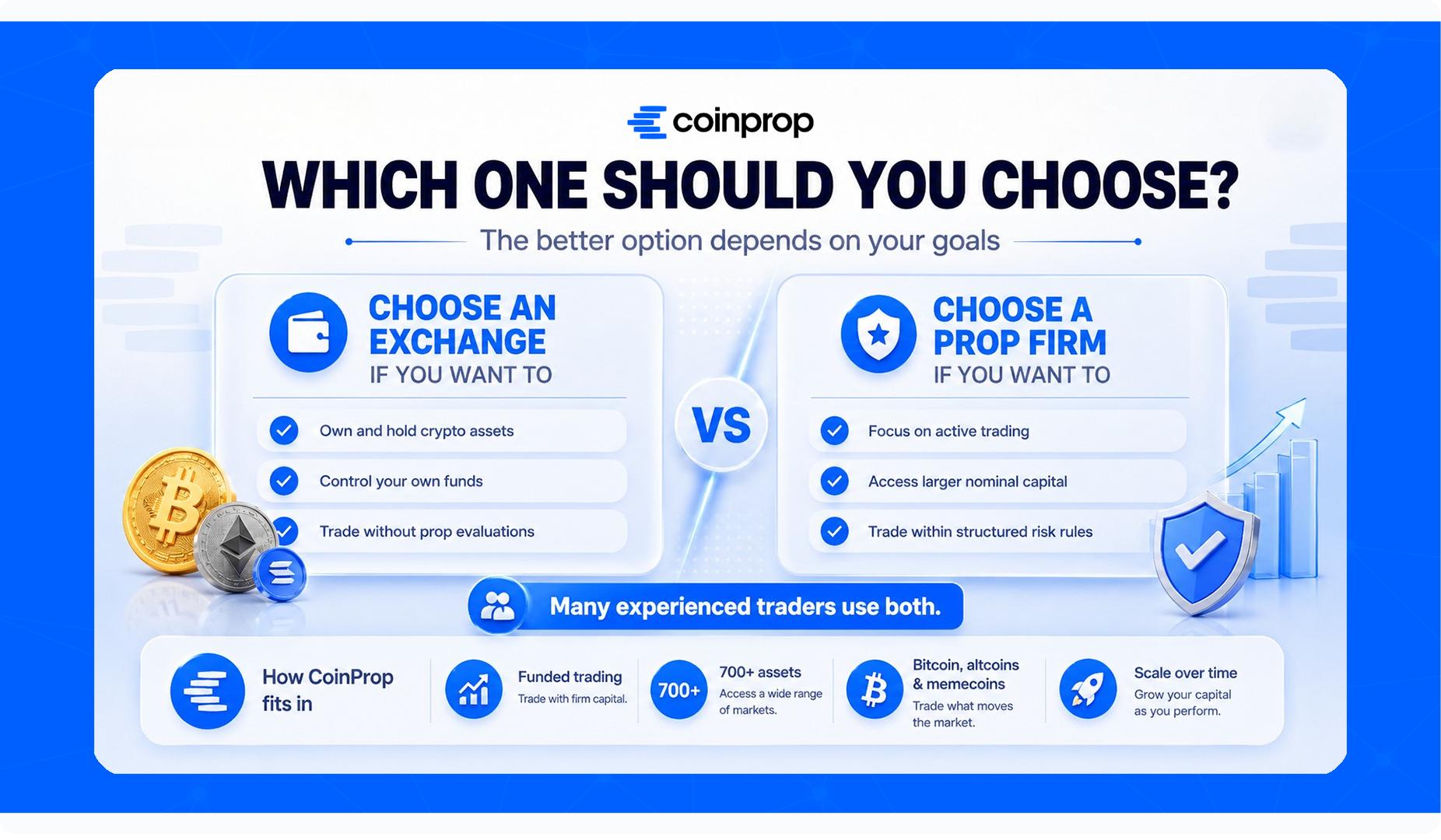
There is no universal winner between a crypto exchange and a crypto prop firm. The better option depends on what you want to do with your capital, how you trade, and how much control you want over your account.
An exchange is generally better suited to traders and investors who want to own cryptocurrency and control their personal capital. A prop firm may be more suitable for active traders who already have a strategy and want to pursue access to a larger nominal trading account under predefined risk rules.
Choose a Crypto Exchange If You Want To Hold and Own Crypto Assets
A crypto exchange is usually the better fit if your primary goal is buying, holding, and managing your own cryptocurrency.
An exchange may be more suitable if you want to:
- Buy and hold Bitcoin, Ethereum, or other cryptocurrencies
- Maintain ownership of the assets you purchase through spot trading
- Control your own trading capital
- Keep 100% of your trading profits after applicable costs
- Build a long term crypto portfolio
- Trade without a prop firm's evaluation or account level risk rules
This model also provides greater flexibility for traders who want to determine their own position sizes, holding periods, and strategies within the exchange's rules.
For long term investors and self funded traders with sufficient personal capital, an exchange can therefore be the more straightforward option.
Choose a Crypto Prop Firm If You Want to Focus on Active Trading
A crypto prop firm may be more appropriate if your primary objective is active trading rather than cryptocurrency ownership.
This model can make sense for traders who want to:
- Apply an established trading strategy
- Access a larger nominal account without providing the full balance personally
- Focus on short and medium term market opportunities
- Operate within predefined risk parameters
- Potentially scale their trading capital through a firm's scaling program
- Receive a share of eligible trading profits
However, the larger nominal account comes with conditions. Traders may need to complete an evaluation, meet profit targets, respect daily loss and maximum drawdown limits, and follow other trading restrictions.
A prop firm is therefore generally better suited to traders who are comfortable trading within a structured risk framework and understand that access to funded capital does not mean ownership of the account balance.
The key question is not simply which model provides more capital. It is whether you value ownership and control of your own funds or access to a larger trading account under predefined conditions.
Can You Use a Crypto Prop Firm and Exchange Together?
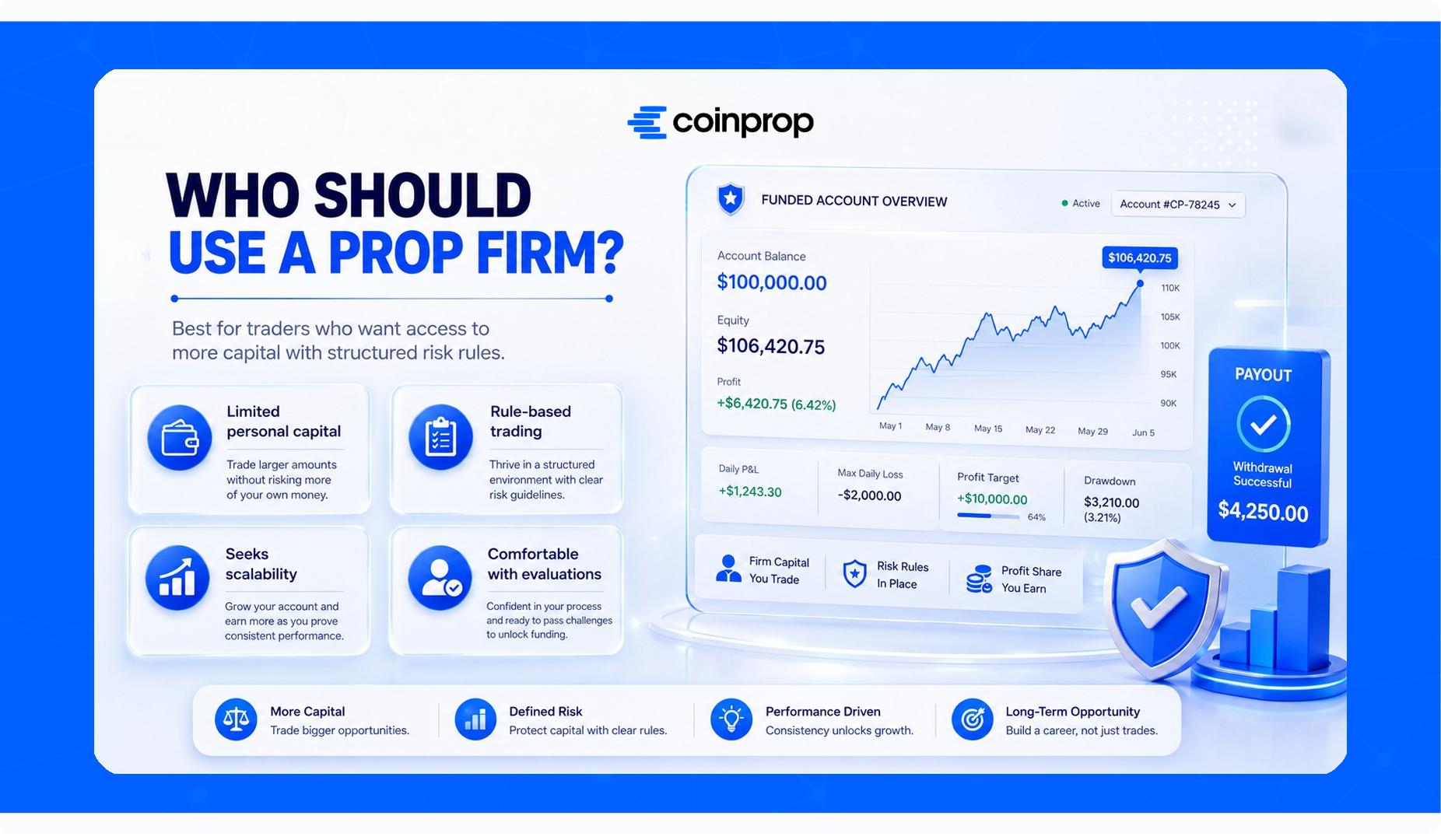
Choosing between a crypto exchange and a prop firm does not necessarily have to be an either or decision. Because the two models serve different purposes, some traders may choose to use both as part of their broader approach to crypto.
An exchange can be used for personal investments and asset ownership, while a prop firm can be used for active trading under a predefined risk framework. Keeping these activities separate can also make it easier to distinguish long term investments from short term trading performance.
Using an Exchange for Investing
A crypto exchange can be used to build and manage a personal cryptocurrency portfolio.
For example, a trader may use an exchange to buy and hold Bitcoin or other digital assets based on a long term investment thesis. Because the trader is using personal capital, they maintain ownership of the assets and can decide when to sell or transfer them, subject to the exchange's policies.
This approach can be kept separate from active trading. Instead of using the same account for both long term holdings and frequent trades, a trader may use the exchange primarily for investments while using a separate account or platform for active strategies.
The advantage is greater control over personal assets and the ability to hold positions without having to meet prop firm trading requirements.
Using a Prop Firm for Active Trading
A crypto prop firm can serve a different purpose by providing access to a trading account under predefined conditions.
A trader may use a prop firm to apply a short term or medium term strategy while following requirements such as daily loss limits, maximum drawdown, position size restrictions, and payout conditions.
This can allow the trader to separate active trading from their personal investment portfolio. Instead of exposing long term holdings to the decisions made during active trading, the trader can manage each activity according to its own objectives and risk framework.
However, traders should still understand the firm's specific rules. Some prop firms may restrict certain forms of hedging, copy trading, or coordinated trading between accounts, so using both platforms does not mean that every strategy involving both accounts is permitted.
Why Many Experienced Traders Use Both
The two models can complement each other because they solve different problems.
An exchange provides ownership and control of personal assets, while a prop firm can provide access to a larger nominal trading account under predefined risk conditions.
For example, a trader could use an exchange for long term Bitcoin holdings while using a prop firm for short term trading opportunities in Bitcoin, Ethereum, altcoins, or other supported markets.
Separating the two can also make performance tracking easier. Investment returns can be evaluated separately from active trading results, while the trader can manage the different risks associated with each activity.
However, using both does not automatically improve performance. Traders still need to manage total exposure across their accounts and avoid taking correlated positions simply because capital is available in multiple places.
Ultimately, an exchange and a crypto prop firm do not have to be competing choices. An exchange can serve as a vehicle for personal asset ownership and investment, while a prop firm can serve as a structured environment for active trading. The right combination depends on the trader's strategy, capital, risk tolerance, and goals.
How CoinProp Combines Crypto Markets With Funded Trading
After comparing crypto exchanges and prop firms, it is useful to look at how a crypto focused prop firm applies the funded trading model in practice. CoinProp combines access to a broad range of crypto markets with a funded account structure designed for active traders.
Rather than requiring traders to build a large personal trading account, the model focuses on providing access to larger nominal account sizes while applying predefined risk parameters. This makes CoinProp more relevant to traders who are primarily interested in active crypto trading rather than long term asset ownership.
Trade Crypto Markets With Funded Capital
CoinProp provides traders with access to funded trading accounts, allowing them to pursue crypto trading opportunities without having to provide the full nominal account balance themselves.
The model is built around a structured risk framework. Traders must operate within predefined limits while applying their own trading strategies and managing positions according to the account's requirements.
This creates a different experience from trading on a personal crypto exchange account. Instead of owning the trading capital, traders receive access to an account under CoinProp's trading conditions and can earn a share of eligible profits when they meet the applicable requirements.
For active traders who already have a defined strategy, this approach can provide an alternative to building a large personal account through deposits and compounding.
Access Hundreds of Crypto Assets
CoinProp provides access to a broad selection of crypto markets through its trading environment, giving traders the ability to look beyond only the largest cryptocurrencies.
The platform supports more than 750 crypto assets, allowing traders to explore opportunities across different segments of the market.
This broader market access can be useful for traders who use different strategies depending on volatility, liquidity, and market conditions. Instead of limiting their activity to one or two major assets, traders can look for setups across a wider selection of supported markets.
However, having access to hundreds of assets does not mean traders should trade all of them. A larger instrument selection is most useful when it supports a trader's existing strategy and risk management approach.
Trade Bitcoin, Altcoins, and Memecoins
CoinProp provides access to major cryptocurrencies such as Bitcoin and Ethereum alongside a broader range of altcoins and memecoins.
This allows traders to choose markets based on their preferred trading style and the conditions they identify. A trader who focuses on large cap assets can concentrate on markets such as BTC and ETH, while another trader may look for short term opportunities in more volatile altcoins or memecoins.
Different assets can also involve different levels of volatility and trading risk. Traders should therefore consider position size, leverage, liquidity, and the account's applicable risk limits rather than treating every available market in the same way.
The ability to trade across multiple crypto categories can be particularly useful for active traders who want flexibility without maintaining separate personal accounts for every market.
Scale Your Trading Capital Over Time
CoinProp also provides a scaling path for eligible traders who demonstrate consistent performance.
Under the scaling structure, traders can increase their account size by 30% every 90 days after meeting the applicable requirements, allowing successful traders to progressively access larger nominal trading capital.
For example, a $100,000 account could progress through stages such as:
$100,000 → $130,000 → $169,000 → $219,700 → $285,610 → $371,293 → up to $400,000
The purpose of this structure is to connect increased trading capital with demonstrated
performance rather than requiring traders to make equivalent personal deposits.
Scaling does not remove the importance of risk management. As account sizes increase, traders still need to operate within the applicable trading rules and maintain consistent position sizing and risk control.
This creates a key distinction between personal account growth and funded account scaling: an exchange trader generally grows capital through deposits and compounding, while a prop firm trader may be able to increase nominal account size by demonstrating consistent performance within the firm's framework.
Frequently Asked Questions
Is a Crypto Prop Firm Better Than a Crypto Exchange?
Neither is universally better. A crypto exchange is generally more suitable for traders and investors who want to use their own capital, own cryptocurrency, and maintain full control over their funds. A crypto prop firm may be more suitable for active traders who want access to a larger nominal trading account while operating under predefined risk rules and profit sharing conditions.
Can a Crypto Prop Firm Replace a Crypto Exchange?
Not completely. A crypto prop firm and a crypto exchange serve different purposes. Exchanges allow users to buy, hold, and manage personal crypto assets, while prop firms are primarily designed around active trading under specific account conditions. A prop firm generally does not provide the same asset ownership and portfolio management functionality as an exchange.
Are Crypto Prop Firms Safer Than Crypto Exchanges?
Not necessarily. The two models involve different types of risk rather than one simply being safer than the other. With an exchange, traders directly risk their own trading capital. With a prop firm, personal financial exposure may be lower upfront, but traders must comply with evaluation requirements, drawdown limits, daily loss rules, and payout conditions.
A prop firm can therefore change the structure of a trader's risk without eliminating trading risk.
Can You Trade Bitcoin, Altcoins, and Memecoins With a Crypto Prop Firm?
Many crypto prop firms provide access to Bitcoin, Ethereum, altcoins, and, in some cases, memecoins. However, the exact markets available depend on the firm's platform and trading conditions.
Leverage, position limits, exposure restrictions, and other rules may also vary between asset categories. Traders should check the firm's supported instrument list before choosing an account, particularly if their strategy depends on specific altcoins or memecoins.
Should Beginners Start With a Crypto Exchange or a Prop Firm?
For most beginners, a crypto exchange can be a simpler starting point for learning how crypto markets work. It allows users to become familiar with market structure, order types, volatility, and basic risk management without first having to meet a prop firm's evaluation requirements.
A prop firm may be more appropriate after a trader has developed a consistent strategy, understands position sizing and risk management, and is comfortable operating under predefined trading rules.
Starting with a prop firm does not automatically make a beginner a better trader. A funded account can provide access to a larger nominal balance, but it does not replace the experience required to manage risk effectively.
Can I Use Both a Crypto Exchange and a Prop Firm?
Yes. The two models can be used for different purposes. A trader might use an exchange to buy and hold cryptocurrency with personal capital while using a prop firm for active trading strategies.
Using both can help separate long term investments from active trading, but traders should still consider their total market exposure across all accounts. They should also make sure that any strategy involving multiple accounts complies with the relevant prop firm's rules.