Choosing a crypto prop firm involves more than comparing challenge prices and advertised account sizes. Breakout vs BrightFunded vs CoinProp reveals important differences in evaluation rules, profit targets, drawdown conditions, trading costs, available markets, liquidity, platforms, and profit splits. These differences can affect how traders manage risk, choose markets, and approach both the evaluation and funded stages. In this comparison, we’ll examine the key conditions offered by Breakout, BrightFunded, and CoinProp to give traders a clear view of how their trading environments differ and which conditions may fit different trading styles and preferences.
Evaluation Model
Challenge Fee
Profit Target
Max Daily Loss
Maximum Drawdown
Time Limit
Minimum Trading Days
News Trading
Profit Split
Tradable Markets
Liquidity Source
Access to New Listings
Overnight Swap Fees
Trading Platform
Trading Fee
Account Size Restrictions
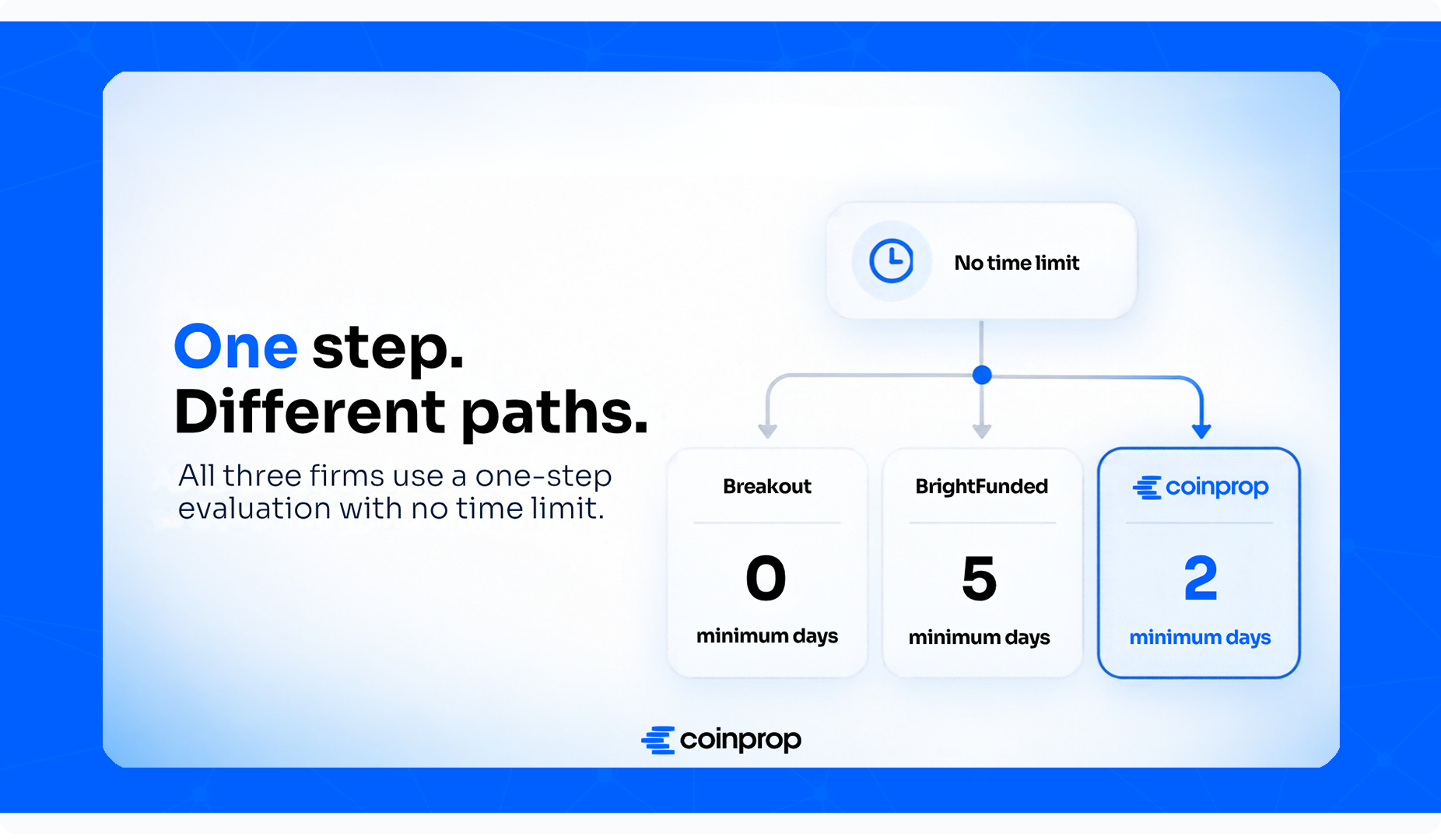
Breakout, BrightFunded, and CoinProp all use a one step evaluation model, giving traders a single challenge to complete before moving to the funded stage. They also offer no time limit, allowing traders to work toward the profit target without a fixed deadline.
However, the three evaluations differ in several important areas. BrightFunded uses a 10% profit target and a 6% trailing drawdown, while Breakout and CoinProp both use a 10% and 9% profit target respectively with a 6% static drawdown. The firms also differ in challenge fees, minimum trading days, and news trading rules.
The following sections compare these evaluation conditions in more detail.
Breakout, BrightFunded, and CoinProp all use a one step evaluation model. Traders only need to complete a single evaluation phase while meeting the firm's profit target and risk requirements.
All three firms also offer unlimited time to complete the evaluation. This allows traders to wait for suitable market conditions instead of working toward a fixed challenge deadline.
The main difference in the basic evaluation structure is the minimum trading day requirement.
Breakout does not require any minimum trading days. Once a trader reaches the profit target while following all risk rules, the evaluation can be completed.
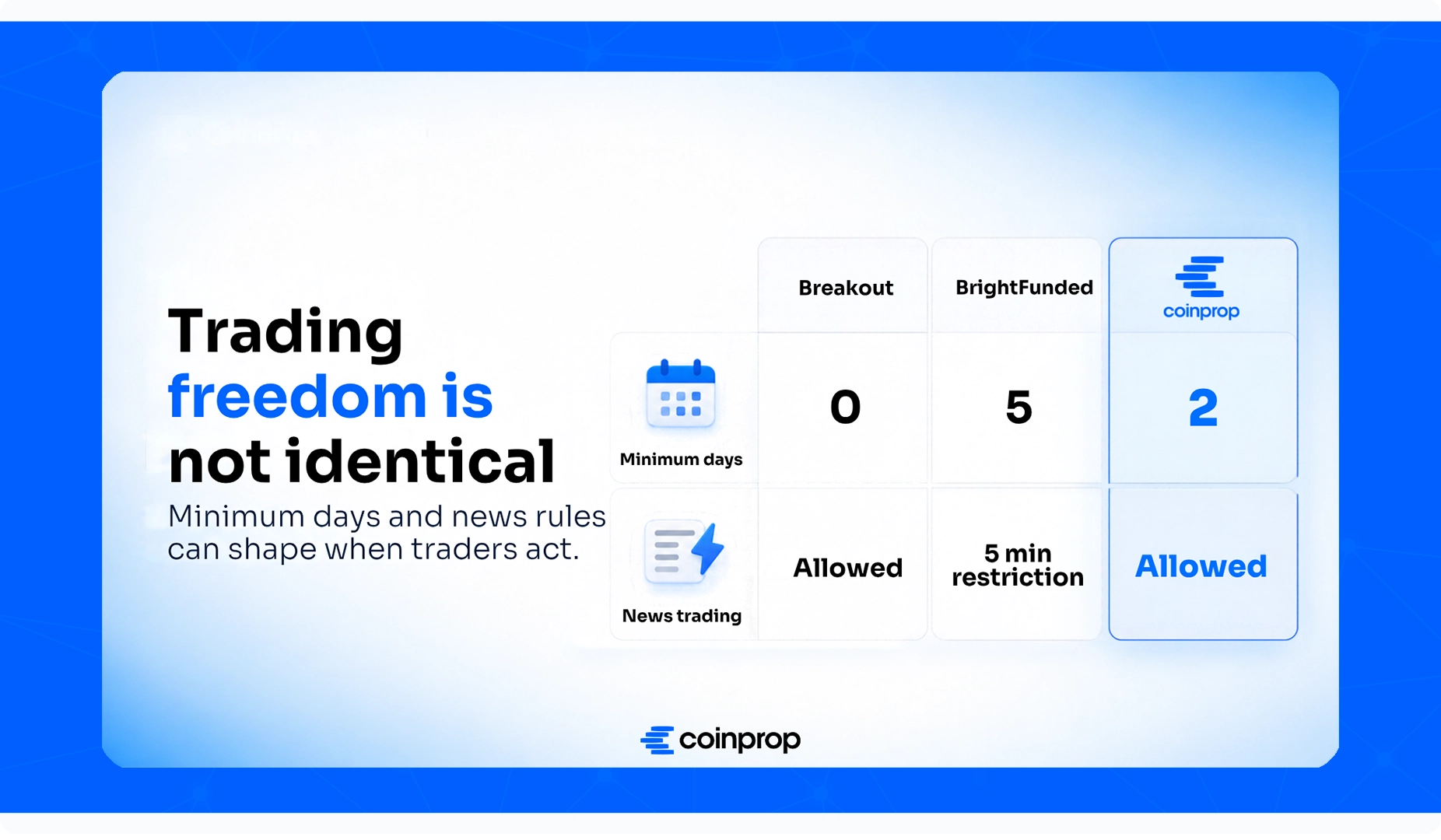
CoinProp requires trading on at least two separate days, while BrightFunded requires at least five trading days. This makes the minimum day requirement different across all three firms, with Breakout allowing the evaluation to be completed without a specified minimum number of trading days.
The 100K challenge fees differ significantly between the three firms.
Breakout charges $800, while CoinProp's 100K challenge costs $699. BrightFunded's standard price is €497, which is approximately $580 depending on the exchange rate.
This makes BrightFunded the lowest priced option among the three based on the listed standard prices, followed by CoinProp and then Breakout.
However, the challenge fee is only one part of the overall cost of an evaluation. Trading commissions, overnight fees, drawdown conditions, and the profit target can also affect the cost and difficulty of trading through the challenge.
Breakout and BrightFunded both require a 10% profit target for their 100K one step evaluations, while CoinProp requires 9%.
The 1 percentage point difference means CoinProp requires traders to reach a lower return before completing the evaluation. All three firms have a 3% daily loss limit, but their other drawdown conditions differ.
CoinProp and Breakout use a 6% static maximum drawdown, meaning the maximum loss is measured against the initial account balance. BrightFunded uses a 6% trailing drawdown, which follows the account's performance and therefore works differently as the account balance or equity increases.
As a result, the profit target should be considered together with the drawdown model rather than evaluated on its own. A 10% target paired with a static drawdown produces a different risk framework from the same target paired with a trailing drawdown.
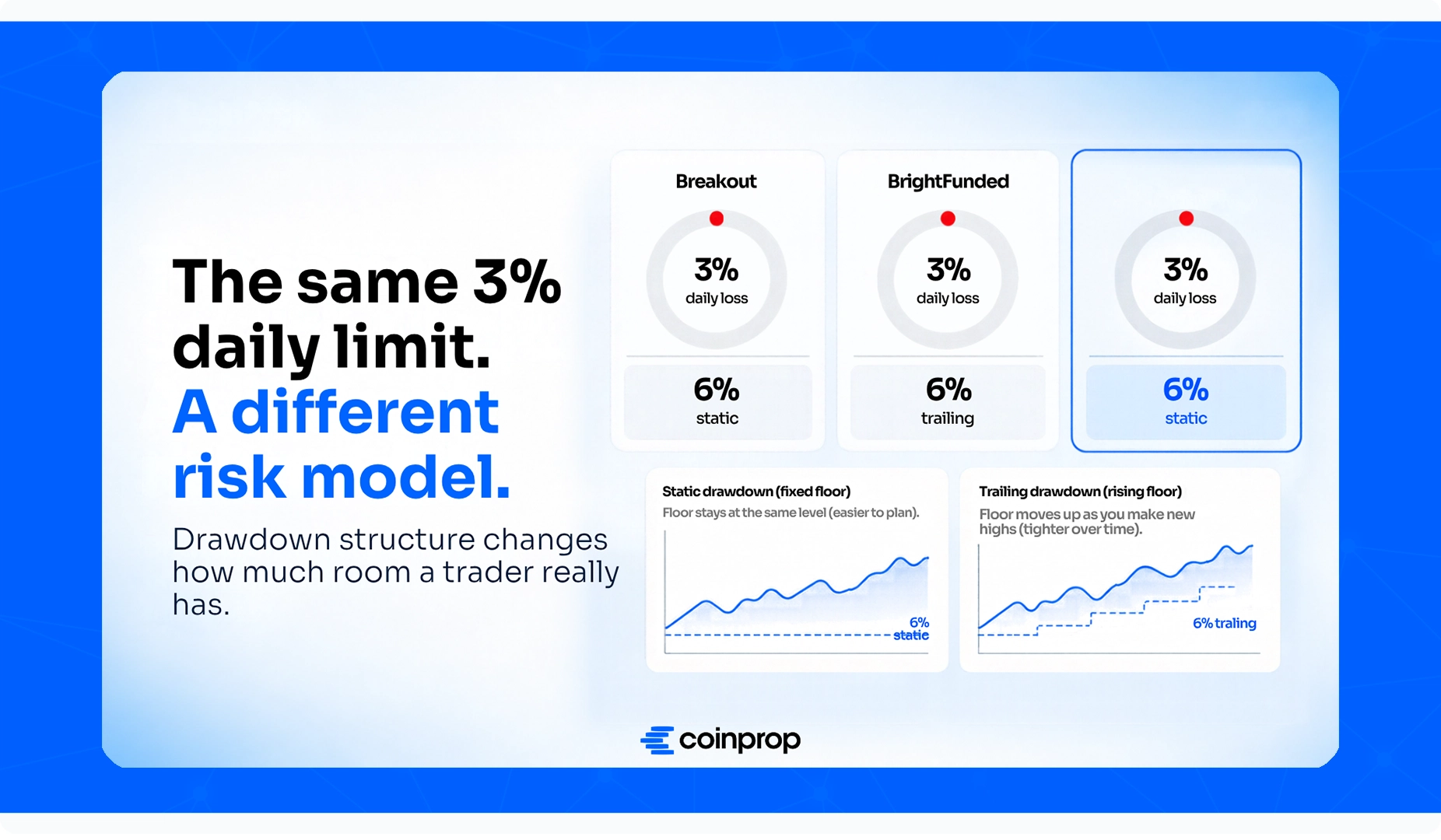
Risk management rules are among the most important factors when comparing crypto prop firms. Even when firms advertise similar daily loss limits or maximum drawdowns, the way these rules are calculated and applied can have a meaningful impact on how traders manage positions.
Breakout, BrightFunded, and CoinProp all use a 3% Daily Loss Limit, but their drawdown structures and other challenge conditions are not identical. CoinProp and Breakout use a 6% static maximum drawdown, while BrightFunded uses a 6% trailing drawdown. The firms also differ in minimum trading days and news trading restrictions.
Breakout, BrightFunded, and CoinProp all set their Daily Loss Limit at 3%, but the way the limit is calculated differs between the firms.
CoinProp uses a fixed Daily Loss amount based on 3% of the initial account balance. The dollar amount remains fixed, while the daily loss floor is recalculated from the account's current equity at 00:00 UTC. For example, on a $10,000 account, the Daily Loss amount is $300. If the account has $9,800 in equity at the daily reset, the new loss floor would be $9,500.
Breakout calculates its 3% Daily Loss Limit based on the account balance at the daily rollover. If a trader carries an unrealized loss into the next trading day, that loss can reduce the available room under the new daily limit.
BrightFunded also applies a 3% Daily Loss Limit, which operates alongside its 6% trailing maximum drawdown. These two limits should be considered separately because they use different calculation methods.
Breakout and CoinProp both use a 6% static maximum drawdown, while BrightFunded uses a 6% trailing drawdown.
With a static drawdown, the maximum loss is measured from the initial account balance and does not move higher as the account grows. On a $100,000 account, a 6% static drawdown represents a $6,000 maximum loss.
A trailing drawdown moves according to the account's performance, so the available drawdown can change as the account reaches new equity levels. This creates a different risk framework from a static drawdown, even though both are advertised as 6%.
For this reason, traders should look beyond the percentage itself and check whether the drawdown is static or trailing.
All three firms offer unlimited time to complete the challenge. Traders are not required to reach the profit target within a fixed number of days.
This gives traders more flexibility to wait for suitable market conditions instead of increasing position sizes simply to meet a deadline.
The minimum trading day requirements differ across the three firms.
Breakout does not require a minimum number of trading days. A trader can complete the challenge once the profit target and all other rules have been met.
CoinProp requires at least two trading days, while BrightFunded requires at least five trading days.
This means the number of required trading days can affect how quickly a trader can complete the challenge, even though all three firms offer unlimited overall time.
Breakout and CoinProp allow news trading without a specific restriction during the challenge.
BrightFunded applies a five minute restriction before and after major news events. Traders who regularly trade around economic releases should therefore check the applicable news trading window before entering positions.
Breakout, BrightFunded, and CoinProp do not impose a profit cap during the challenge. None of the three firms requires a consistency rule to complete the challenge.
These conditions apply specifically to the challenge stage. Funded account rules can differ after a trader passes the evaluation, so the funded stage requirements should be reviewed separately.
Overall, the main differences in the challenge rules are the Daily Loss Limit calculation, static versus trailing drawdown, minimum trading days, and news trading restrictions.
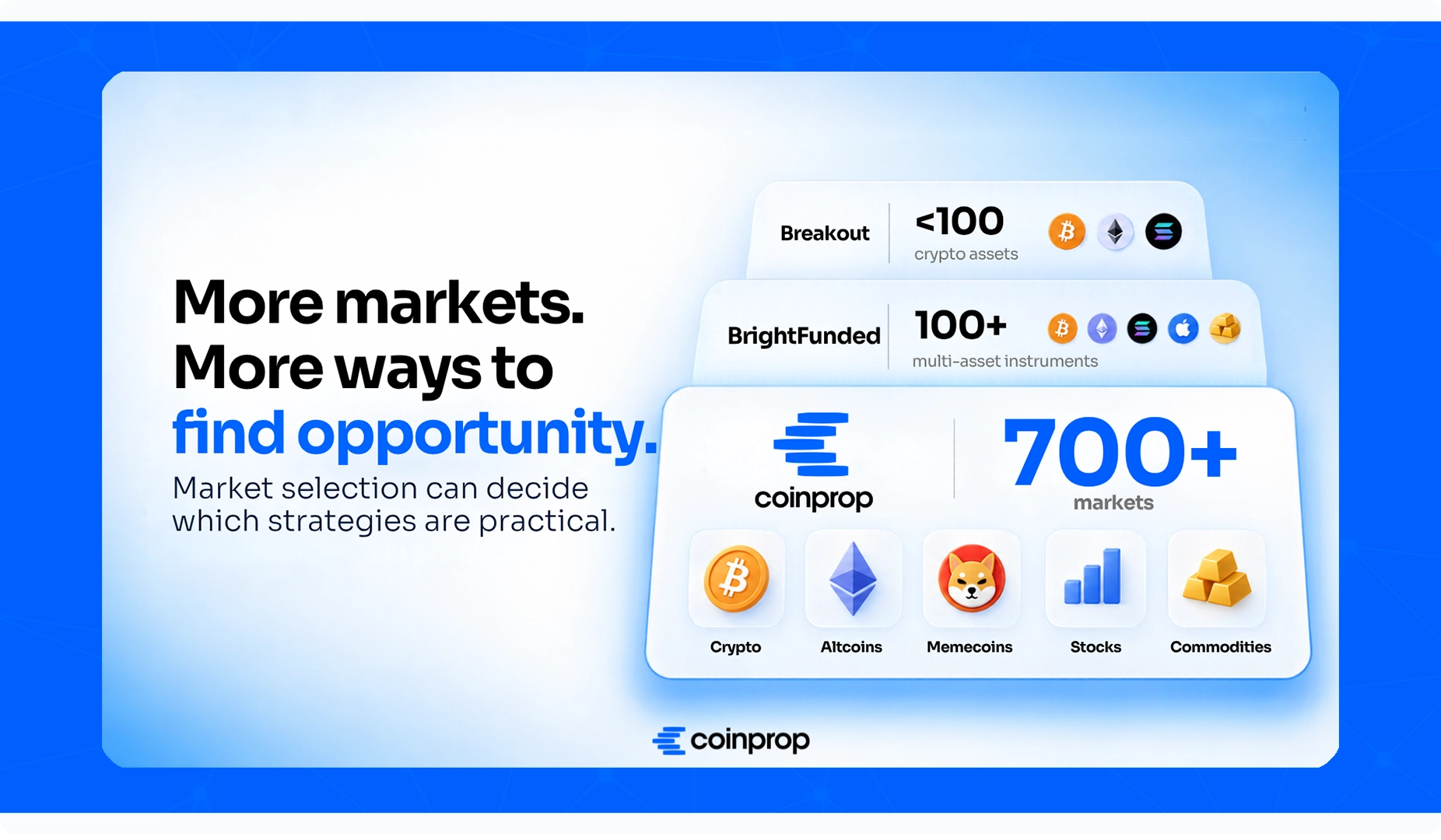
The trading environment affects how traders can apply their strategies after choosing a prop firm. Available markets, liquidity and market data, leverage, and trading costs can all influence which strategies are practical and how positions are managed.
Breakout, BrightFunded, and CoinProp offer different market selections and trading conditions. CoinProp provides access to 700+ markets with Bybit market data and liquidity, while Breakout focuses on a smaller selection of crypto assets. BrightFunded takes a broader multi asset approach across Forex, Crypto, Indices, and Commodities.
The number and type of available markets differ significantly between the three firms.
CoinProp provides access to more than 700 markets, including cryptocurrencies, altcoins, memecoins, commodities, and stocks. All Bybit listed cryptocurrency markets are available for trading, giving traders a broad selection of crypto assets alongside other market categories.
Breakout offers fewer than 100 crypto assets. Its market selection covers a range of major cryptocurrencies and other supported digital assets, but it remains more limited than CoinProp's overall market offering. Some Breakout instruments also have account size restrictions.
BrightFunded offers a multi asset trading environment covering Forex, Crypto, Indices, and Commodities. This gives traders access to several traditional and digital markets within the same account rather than focusing exclusively on cryptocurrency markets.
For traders who want to trade a broad range of cryptocurrencies, including altcoins and memecoins, CoinProp provides a larger crypto market selection. Traders looking for access to Forex and other traditional asset classes can find those markets through BrightFunded.
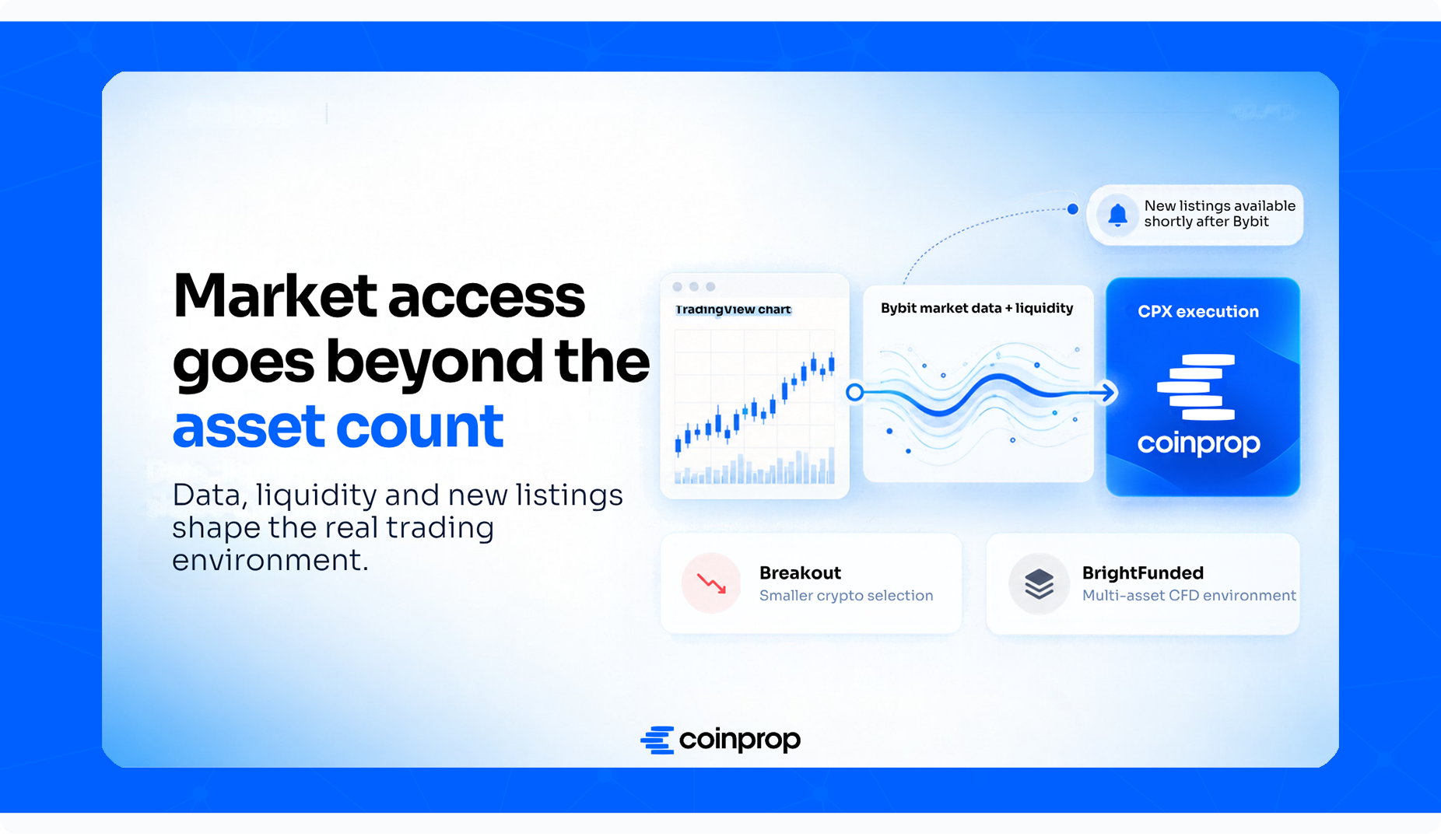
Market data and liquidity can affect how prices are displayed and how trades are executed, particularly during periods of high volatility.
CoinProp integrates TradingView directly with Bybit market data and liquidity through its CPX trading environment. This gives traders access to live Bybit market conditions while using TradingView charts for market analysis and execution.
CoinProp also makes newly listed Bybit markets available shortly after they are listed in many cases. This can be relevant for traders who focus on emerging cryptocurrencies, altcoins, or memecoins.
Breakout provides a smaller selection of crypto markets and does not offer the same TradingView integration with Bybit market data and liquidity.
BrightFunded uses a multi asset trading environment across Forex, Crypto, Indices, and Commodities. Its platform and market structure differ from CoinProp's Bybit based crypto market integration, so traders should consider the underlying market access and execution environment rather than comparing the firms only by the number of available instruments.
Leverage varies by asset and firm, so the advertised maximum should not be viewed as a single leverage level across all markets.
For crypto trading, Breakout and CoinProp both offer:
CoinProp also offers leverage for commodities and stocks, allowing traders to access multiple asset classes within the same trading environment.
BrightFunded also applies leverage according to the asset being traded, with conditions varying across its Forex, Crypto, Indices, and Commodities markets.
Because leverage conditions can vary by instrument, traders should check the specific leverage available for the assets they intend to trade rather than comparing firms based only on their highest advertised leverage.
Trading costs include both transaction fees and the costs associated with holding positions. These expenses can become more relevant for active traders or strategies that generate frequent trades.
CoinProp charges a 0.03% trading fee, while Breakout charges 0.04%.
BrightFunded uses variable commission rates depending on the asset class rather than applying one trading fee across all markets. Its commission structure therefore needs to be considered separately for Forex, Crypto, Indices, and Commodities.
The difference between a fixed percentage fee and asset specific commissions means traders should compare the actual cost for the markets and trading frequency relevant to their strategy.
Overnight trading costs are another important difference between the three firms.
CoinProp does not charge overnight swap or financing fees. Traders can therefore keep positions open across multiple trading sessions without an additional overnight holding charge.
Breakout applies overnight financing fees to open positions. The applicable charges depend on the trading platform and are applied around the daily rollover period.
BrightFunded also charges overnight swap fees on applicable positions. Traders who regularly hold positions for several days should include these costs when evaluating the total cost of their trading strategy.
For intraday traders, overnight fees may have little or no impact when positions are closed before the applicable rollover. For swing traders, however, recurring overnight charges can become a more important part of the overall trading cost.
Overall, the three firms provide different trading environments. CoinProp combines 700+ markets with TradingView integration and Bybit market data and liquidity, Breakout offers a smaller crypto focused market selection, and BrightFunded provides access to multiple traditional and digital asset classes. Trading fees and overnight costs also vary, making the underlying trading conditions important to compare alongside the challenge rules.
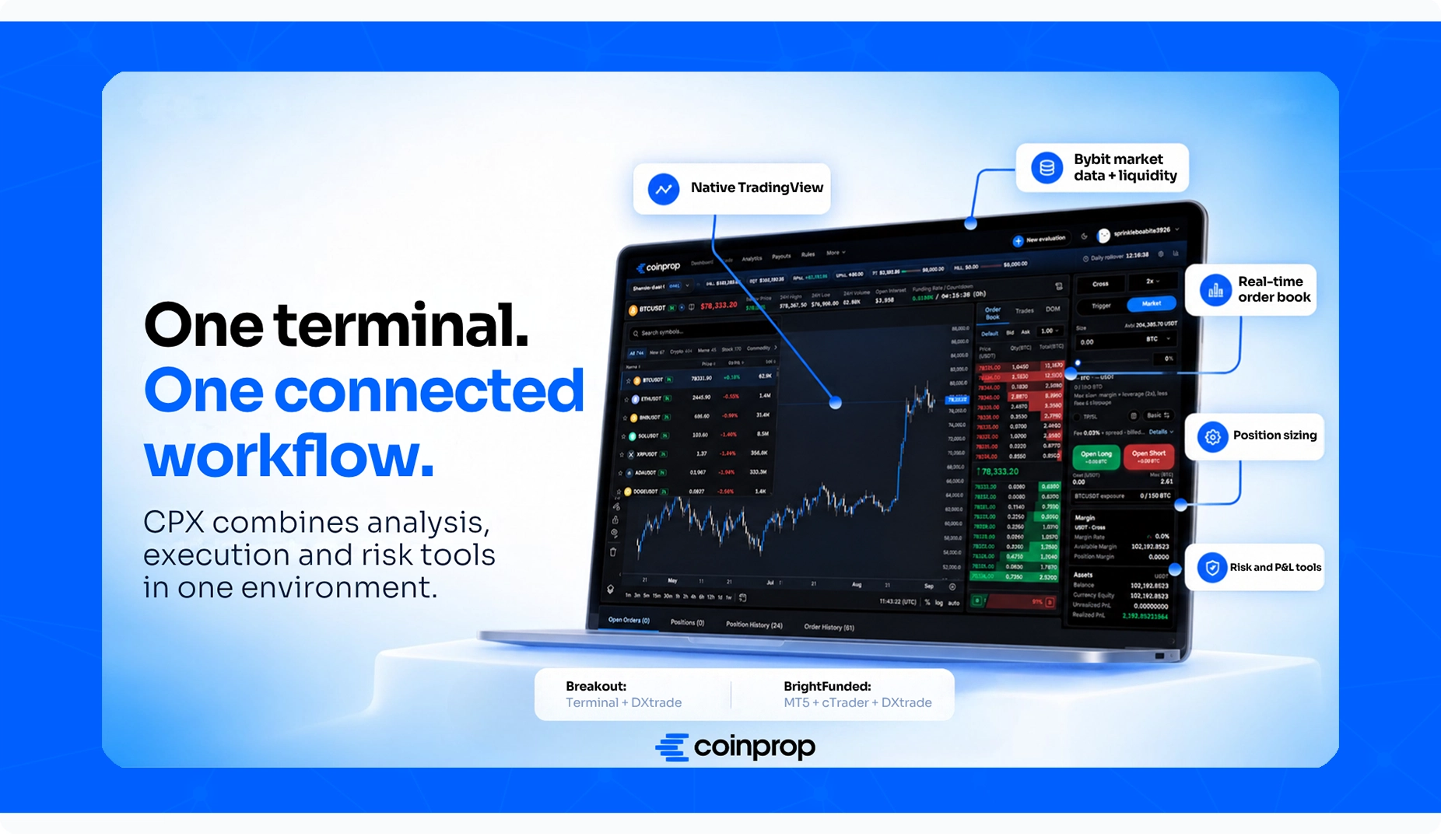
The trading platform directly affects how traders analyse markets, execute orders, and manage positions. Charting capabilities, market data, execution tools, and risk management features can all shape the day to day trading experience.
Breakout, BrightFunded, and CoinProp use different platform setups. Breakout offers Breakout Terminal and DXtrade, BrightFunded supports MT5, cTrader, and DXtrade, while CoinProp provides the CPX Terminal with native TradingView integration and Bybit market data and liquidity.
CoinProp's CPX Terminal is built for crypto prop trading and combines charting, execution, market data, and risk management tools within the same trading environment.
Key features include:
The TradingView integration allows traders to analyse markets using familiar charts, indicators, and drawing tools while keeping execution within the same environment.
The platform also provides direct access to Bybit market data and liquidity, which is particularly relevant for traders focused on cryptocurrency markets and newly listed Bybit assets.
Breakout offers two trading platforms: its proprietary Breakout Terminal and DXtrade.
Both platforms provide the core functionality required to analyse markets and execute trades. Breakout Terminal is designed for the firm's crypto trading environment, while DXtrade provides a separate professional trading interface.
Breakout does not provide the same native TradingView integration with Bybit market data and liquidity available through CoinProp's CPX Terminal.
BrightFunded supports three established trading platforms: MetaTrader 5 (MT5), cTrader, and DXtrade.
This gives traders several platform options depending on their preferred trading interface and workflow. BrightFunded's multi asset environment also supports trading across Forex, Crypto, Indices, and Commodities.
Unlike CoinProp, BrightFunded does not provide the same native TradingView integration with Bybit market data and liquidity within its trading environment.
TradingView is widely used for technical analysis because of its charting tools, indicators, drawing features, and customizable layouts.
CoinProp integrates TradingView directly into CPX Terminal, allowing traders to analyse charts and execute trades within the same environment. This can be particularly useful for traders who already use TradingView as part of their regular analysis workflow.
Breakout and BrightFunded offer other established trading platforms, but neither provides the same native TradingView integration with Bybit market data and liquidity that CoinProp offers.
Risk management tools can be particularly useful in prop trading because traders need to control position size and exposure while staying within daily loss and maximum drawdown limits.
CoinProp's CPX Terminal includes several tools designed to support this process, including:
These tools allow traders to calculate position size, estimate margin requirements, and monitor the potential impact of a trade before and after execution.
Breakout and BrightFunded provide the trading functionality required to manage positions through their supported platforms, but the specific tools and workflows available can vary depending on the platform selected.
Trading Platform
TradingView Integration
Market Data
Order Book
Risk Management Tools
Overall, CoinProp combines TradingView analysis, direct Bybit market data and liquidity, and built in risk management tools in one trading environment, while Breakout and BrightFunded offer different platform based setups for market analysis and execution.
Beyond passing the evaluation, traders should also consider how a prop firm's profit split and scaling structure work after reaching the funded stage. These conditions determine how much of the generated profit a trader can retain and how the account allocation can grow over time.
Breakout, BrightFunded, and CoinProp all offer profit sharing models and scaling opportunities, but they differ in maximum profit split and maximum scaling allocation.
The profit split determines how much of the generated trading profit the trader keeps after reaching the funded stage.
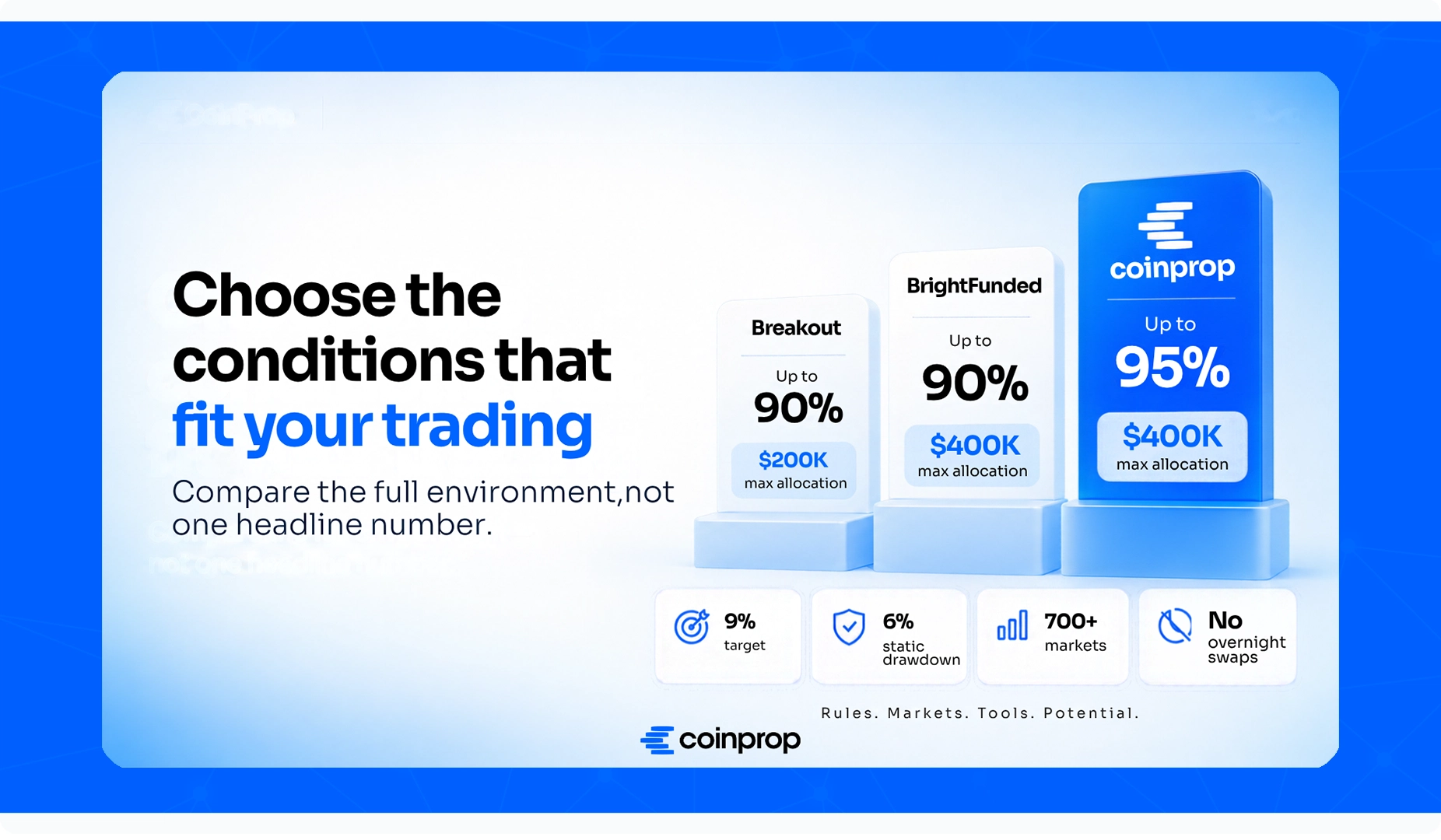
CoinProp offers a standard profit split that can be increased up to 95% through the available add on. Breakout and BrightFunded both offer profit splits of up to 90%.
The difference becomes more relevant as trading profits increase. For example, on $10,000 in profit, an 80% split would leave the trader with $8,000, while a 90% split would leave $9,000 and a 95% split would leave $9,500.
CoinProp offers a maximum profit split of up to 95% through its available add on.
The higher split allows eligible traders to retain a larger portion of their generated profits at the funded stage.
Breakout offers a maximum profit split of up to 90% through its available add on.
The maximum percentage is lower than CoinProp's 95% maximum, while the underlying profit sharing model allows traders to participate in profits generated on their funded account.
BrightFunded offers a profit split of up to 90%.
This places its maximum profit split at the same level as Breakout and below CoinProp's maximum 95% split.
Scaling programs allow traders to increase their funded account allocation after meeting the firm's requirements.
The three firms differ in how far their account allocations can grow.
CoinProp allows funded accounts to increase by 30% every 90 days after meeting the applicable performance and risk requirements.
The scaling path can continue up to a maximum allocation of $400,000.
For example, a $100,000 allocation could progress through the following stages:
The 30% scaling increments provide a defined progression based on continued performance.
Breakout also offers account scaling for successful traders.
Its scaling program can increase the funded allocation up to a maximum of $200,000. This is lower than CoinProp's $400,000 maximum allocation.
BrightFunded allows traders to receive a total funded capital allocation of up to $400,000.
This should be distinguished from the scaling mechanics themselves. The maximum allocation indicates the total capital available under the firm's program, while the specific conditions for increasing an individual account depend on the firm's scaling requirements.
Maximum Profit Split
Scaling Available
Maximum Funded Allocation
The three firms therefore provide different combinations of profit sharing and account growth conditions. Breakout and BrightFunded offer profit splits of up to 90%, while CoinProp's maximum reaches 95%. Breakout's maximum scaling allocation is $200,000, compared with up to $400,000 under the CoinProp and BrightFunded programs.
For traders comparing funded account structures, the relevant factors include both the percentage of profits retained and the maximum allocation available under the firm's scaling program.
Lower Profit Target
CoinProp requires a 9% profit target, compared with 10% at both Breakout and BrightFunded. This means traders need to reach a lower return to complete the challenge.
Static Maximum Drawdown
CoinProp uses a 6% static maximum drawdown, matching Breakout's 6% static drawdown. BrightFunded uses a 6% trailing drawdown, which follows the account's performance.
700+ Tradable Markets
CoinProp provides access to more than 700 markets, including cryptocurrencies, altcoins, memecoins, commodities, and stocks. This gives traders a broader selection of markets compared with Breakout's smaller crypto focused asset selection.
Bybit Market Data and Liquidity
CoinProp combines TradingView with direct Bybit market data and liquidity through its CPX trading environment. Newly listed cryptocurrencies on Bybit can also become available on CoinProp shortly after listing, giving traders access to a broad selection of crypto markets.
No Overnight Swap Fees
CoinProp does not charge overnight swap or financing fees on open positions. This can be particularly relevant for swing traders who regularly hold positions across multiple trading sessions.
TradingView Integration with Bybit Liquidity
The CPX Terminal combines TradingView analysis, direct Bybit market data and liquidity, real time order book access, and built in risk management tools within a single trading environment.
Higher Maximum Profit Split
CoinProp offers a maximum profit split of up to 95%, compared with up to 90% at both Breakout and BrightFunded.
Higher Scaling Allocation
CoinProp supports scaling up to a maximum allocation of $400,000. Breakout's maximum scaling allocation is $200,000, while BrightFunded also offers up to $400,000 in total funded capital allocation.
Lower Trading Fee
CoinProp charges a 0.03% trading fee, compared with 0.04% at Breakout. BrightFunded uses variable commissions depending on the asset class.
Higher Challenge Fee Than BrightFunded
CoinProp's 100K challenge costs $699. This is higher than BrightFunded's €497 standard price, approximately $580, but lower than Breakout's $800 fee.
Minimum Trading Day Requirement
CoinProp requires at least two trading days to complete the challenge. Breakout does not require a minimum number of trading days, while BrightFunded requires five.
No Minimum Trading Days
Breakout does not require a minimum number of trading days to complete the challenge. Traders can complete the evaluation once they reach the 10% profit target while meeting all other risk requirements.
No Time Limit
Breakout does not impose a deadline for completing the challenge. This gives traders flexibility to wait for suitable market conditions instead of working toward a fixed completion date.
No News Trading Restriction
Breakout allows traders to trade during news events without a specific news trading restriction. CoinProp also allows news trading without a restriction, while BrightFunded applies a five minute restriction around major news events.
Higher Challenge Fee
Breakout's 100K challenge costs $800, compared with $699 at CoinProp and €497 at BrightFunded, approximately $580. This makes Breakout's listed challenge fee the highest among the three firms.
Higher Profit Target
Breakout requires a 10% profit target, compared with CoinProp's 9%. BrightFunded also requires a 10% target.
Fewer Tradable Markets
Breakout offers fewer than 100 crypto assets, compared with CoinProp's 700+ markets. BrightFunded also provides access to multiple asset classes, including Forex, Crypto, Indices, and Commodities.
Limited Access to New Listings
Breakout's smaller crypto market selection means traders have access to fewer newly listed cryptocurrencies than through CoinProp's Bybit based market selection, where new Bybit listings can become available shortly after listing.
Overnight Financing Fees
Breakout applies overnight financing charges to open positions. These costs can accumulate for traders who regularly hold positions across multiple trading sessions.
Lower Maximum Profit Split
Breakout offers a maximum profit split of up to 90%, compared with CoinProp's maximum of 95%. BrightFunded also offers up to 90%.
Lower Scaling Allocation
Breakout's scaling program reaches a maximum allocation of $200,000. CoinProp and BrightFunded both offer up to $400,000 in total funded capital allocation.
Higher Trading Fee
Breakout charges a 0.04% trading fee, compared with CoinProp's 0.03%. BrightFunded uses variable commission rates depending on the asset class.
Lower Challenge Fee
BrightFunded's €497 challenge fee (approximately $580) is lower than the $800 Breakout fee and the $699 CoinProp fee for a 100K account.
Broader Market Access
BrightFunded supports multiple asset classes, including Forex, Crypto, Indices, and Commodities, giving traders access to a wider range of markets than the crypto focused options in this comparison.
Multiple Trading Platforms
BrightFunded supports MT5, cTrader, and DXtrade, giving traders more platform options than Breakout and CoinProp.
Trailing Drawdown
BrightFunded uses a 6% trailing drawdown, while both Breakout and CoinProp use a 6% static drawdown. A trailing limit can affect how much room traders have as their account equity increases.
Higher Profit Target
BrightFunded requires a 10% profit target, compared with CoinProp's 9%.
Five Minimum Trading Days
BrightFunded requires at least five trading days to complete the evaluation. This is higher than CoinProp's two day requirement and Breakout's lack of a minimum trading day requirement.
News Trading Restriction
BrightFunded applies a five minute restriction around major news events, while both Breakout and CoinProp allow news trading without this restriction.
Overnight Swap Fees
BrightFunded charges overnight swap fees on positions held through the applicable rollover period. These additional costs can matter for traders who regularly hold positions overnight.
Lower Maximum Profit Split
BrightFunded's maximum profit split reaches 90%, compared with CoinProp's maximum of 95%.
No TradingView Integration With Bybit Liquidity
BrightFunded does not offer the same TradingView integration with Bybit liquidity available through CoinProp's trading environment.
Variable Trading Commissions
BrightFunded uses different commission rates depending on the asset class, making its trading costs less straightforward to compare than the fixed 0.03% trading fee offered by CoinProp.
Challenge Fee
Minimum Trading Days
Profit Target
Daily Loss Limit
Maximum Drawdown
Market Selection
Liquidity & Market Data
Trading Platform
Trading Costs
Maximum Profit Split
Maximum Funded Allocation
Overall, Breakout, BrightFunded, and CoinProp differ across challenge pricing, evaluation requirements, market access, trading infrastructure, costs, and funded account conditions. Breakout has no minimum trading day requirement, BrightFunded combines multiple asset classes with several platform options, and CoinProp offers 700+ markets with TradingView integration and Bybit market data and liquidity, along with a 9% profit target, up to 95% profit split, and scaling up to $400,000.
CoinProp's trading conditions may be relevant to traders who prioritize broad market access, TradingView integration, Bybit market data and liquidity, and specific funded account conditions over the lowest possible challenge fee.
Its 100K challenge costs $699, while BrightFunded's standard price is €497 (approximately $580) and Breakout's is $800. The three firms also differ in market selection, drawdown structure, trading costs, platform setup, profit split, and scaling allocation.
CoinProp provides access to more than 700 markets, including cryptocurrencies, altcoins, memecoins, commodities, and stocks.
This can suit traders who do not want to limit their strategies to a small selection of major cryptocurrencies. Traders can look for setups across different crypto markets and additional asset classes within the same trading environment.
This broader selection can also be relevant when market activity shifts between different sectors. For example, traders who follow altcoins or memecoins can access those markets alongside major cryptocurrencies rather than relying on a limited list of supported assets.
CoinProp may be relevant to traders who already use TradingView as part of their regular analysis workflow.
The CPX Terminal provides native TradingView integration with direct Bybit market data and liquidity, allowing traders to analyse charts and execute trades within the same trading environment.
The setup includes:
This setup can reduce the need to move between separate charting and execution environments for traders who prefer TradingView based analysis.
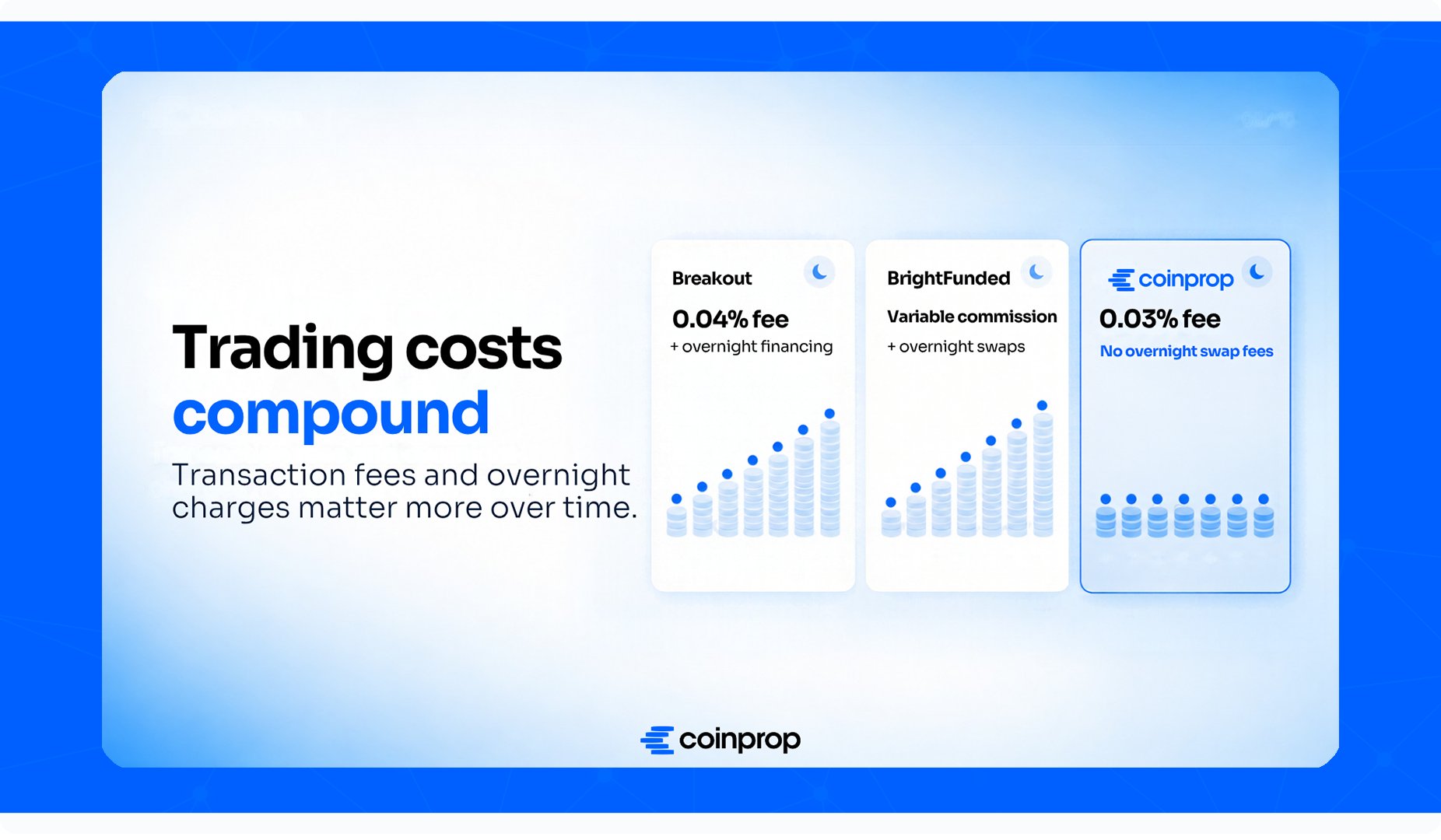
CoinProp does not charge overnight swap or financing fees on open positions.
This is particularly relevant to swing traders and others who regularly keep positions open across multiple trading sessions. Breakout and BrightFunded both apply overnight fees to applicable positions, so holding costs are one of the differences to consider when comparing the three firms.
CoinProp uses a 6% static maximum drawdown. Breakout also uses a 6% static drawdown, while BrightFunded uses a 6% trailing drawdown.
A static drawdown remains based on the initial account balance rather than moving upward as the account reaches new equity levels. Traders who specifically prefer a static drawdown structure may therefore want to consider how this condition fits their position and risk management approach.
CoinProp requires a 9% profit target for its one step challenge, compared with 10% at both Breakout and BrightFunded.
The lower target is one of the main differences in the evaluation structure and may be relevant to traders who compare challenge conditions based on the return required to complete the evaluation.
CoinProp offers a maximum profit split of up to 95% and scaling up to a maximum allocation of $400,000.
Breakout offers up to 90% and scales up to $200,000, while BrightFunded offers up to 90% and up to $400,000 in total funded capital allocation.
For traders comparing funded stage conditions, both the percentage of profits retained and the maximum available allocation are relevant factors.
Different trading requirements may point traders toward another firm's conditions.
Traders focused on the lowest listed 100K challenge fee may want to compare BrightFunded's €497 standard price (approximately $580) with CoinProp's $699 and Breakout's $800.
Traders who want no minimum trading day requirement may prefer Breakout's challenge structure, since Breakout does not specify a minimum number of trading days. CoinProp requires two days, while BrightFunded requires five.
Traders who want access to Forex, Indices, and Commodities alongside crypto may want to consider BrightFunded's multi asset market selection.
CoinProp's conditions are centered around broad market access, TradingView integration with Bybit market data and liquidity, a 9% challenge profit target, a 6% static maximum drawdown, no overnight swap fees, and a maximum profit split of up to 95%.
For traders comparing these factors, the relevant question is how CoinProp's specific trading environment and funded account conditions align with their preferred markets, platform workflow, holding period, and risk management approach.
Breakout's conditions may be relevant to traders who prioritize a one step evaluation with no minimum trading day requirement and a crypto focused market selection.
Its 100K challenge costs $800, compared with $699 at CoinProp and €497 at BrightFunded, approximately $580. The three firms also differ in profit target, drawdown structure, market access, trading costs, and funded stage conditions.
Breakout does not require a minimum number of trading days to complete the challenge.
Once a trader reaches the 10% profit target while meeting all applicable risk requirements, the evaluation can be completed without waiting for a specified number of trading days.
CoinProp requires at least two trading days, while BrightFunded requires five.
This structure may be relevant to traders who prefer to complete an evaluation as soon as they meet its requirements, including:
Breakout uses a one step evaluation model, meaning traders complete a single challenge before moving to the funded stage.
The basic process involves:
The one step structure is also used by BrightFunded and CoinProp, so this is not a feature unique to Breakout. The main differences are found in the specific rules and trading conditions attached to each evaluation.
Breakout focuses on cryptocurrency markets and offers fewer than 100 crypto assets.
This market selection may be sufficient for traders whose strategies are centered on established cryptocurrencies rather than a broad range of altcoins, memecoins, and other asset classes.
By comparison, CoinProp offers 700+ markets across crypto and additional asset classes, while BrightFunded provides access to Forex, Crypto, Indices, and Commodities.
Traders should therefore compare the supported instruments against the specific markets they actually trade rather than relying only on the total number of available assets.
Breakout applies overnight financing fees to applicable open positions.
Traders who normally close positions within the same trading session will generally have less exposure to these holding costs than traders who regularly keep positions open overnight.
This can be relevant for day traders and other short term strategies. Traders who frequently hold positions for several days should include overnight financing in their overall cost comparison.
Breakout does not impose a specific news trading restriction during the challenge.
CoinProp also allows news trading without a restriction, while BrightFunded applies a five minute restriction before and after major news events.
Traders who regularly trade around major economic releases can therefore compare the firms based on the specific news trading rules that apply to their strategies.
Breakout's challenge conditions include:
Its 100K challenge costs $800, while CoinProp charges $699 and BrightFunded's standard price is €497 (approximately $580).
For traders comparing these three firms, Breakout's conditions should be considered alongside its 10% profit target, 6% static drawdown, smaller crypto market selection, 0.04% trading fee, and overnight financing costs.
BrightFunded conditions may be relevant to traders who prioritize a lower listed challenge fee, multi asset market access, and a choice of established trading platforms.
For a 100K account, the standard challenge fee is €497, approximately $580, compared with $699 for CoinProp and $800 for Breakout.
BrightFunded has a listed 100K challenge price of €497, approximately $580 depending on the exchange rate. This is lower than the listed 100K prices of CoinProp and Breakout.
BrightFunded offers access to multiple asset classes, including Forex, Crypto, Indices, and Commodities. This differs from Breakout's crypto focused market selection and CoinProp's 700+ markets across crypto and other supported markets.
BrightFunded supports MT5, cTrader, and DXtrade, giving traders several platform options for analysis and execution.
BrightFunded requires at least five trading days during the evaluation. By comparison, CoinProp requires two minimum trading days, while Breakout has no minimum trading day requirement.
BrightFunded applies a five minute restriction before and after major news events. Traders using strategies around major economic releases need to account for this rule, while Breakout and CoinProp do not impose the same challenge stage restriction.
BrightFunded uses a 6% trailing maximum drawdown, while Breakout and CoinProp use a 6% static maximum drawdown. The difference affects how the maximum loss level is calculated as the account changes over time.
BrightFunded offers up to $400,000 in total funded capital allocation. Breakout's maximum allocation is $200,000, while CoinProp can scale up to $400,000.
Traders who prioritize a lower profit target may compare CoinProp's 9% target with the 10% target at BrightFunded and Breakout.
Traders who want a static 6% maximum drawdown can compare BrightFunded's trailing drawdown with the static drawdown structures at Breakout and CoinProp.
Traders who prefer no minimum trading days can compare BrightFunded's five day requirement with Breakout's no minimum day structure and CoinProp's two day requirement.
Traders who want TradingView integration with direct Bybit market data and liquidity can compare BrightFunded's platform setup with CoinProp's CPX Terminal.
BrightFunded combines a €497 100K challenge fee, multi asset market access, multiple trading platforms, a 10% profit target, 6% trailing drawdown, and up to $400,000 in total funded capital allocation. Its five day minimum trading requirement, major news restriction, and overnight swap fees are also part of the conditions traders should consider when comparing it with Breakout and CoinProp.
Breakout, BrightFunded, and CoinProp all offer one step crypto prop firm evaluations, but their account conditions and trading environments differ across several important areas.
Breakout has a $800 100K challenge fee, a 10% profit target, 6% static maximum drawdown, no minimum trading day requirement, and a crypto focused market selection. It also allows news trading without a specific challenge stage restriction, while overnight financing fees apply.
BrightFunded lists its 100K challenge at €497, approximately $580, and offers access to Forex, Crypto, Indices, and Commodities through MT5, cTrader, and DXtrade. Its evaluation includes a 10% profit target, 6% trailing maximum drawdown, five minimum trading days, and a five minute restriction before and after major news events.
CoinProp has a $699 100K challenge fee, a 9% profit target, 6% static maximum drawdown, and a two day minimum trading requirement. Its CPX Terminal combines native TradingView integration with direct Bybit market data and liquidity, while its market selection includes 700+ supported markets. CoinProp also has no overnight swap fees, a 0.03% trading fee, profit splits of up to 95%, and scaling up to $400,000.
The main differences come down to challenge pricing, drawdown structure, minimum trading days, market access, trading platforms, trading costs, and funded stage conditions. Traders can compare these factors based on the markets they trade, how they manage risk, and which platform and account conditions they prefer.
CoinProp, Breakout, and BrightFunded all offer one step evaluations, but their account conditions differ. Key differences include challenge fees, profit targets, drawdown structures, minimum trading days, market selection, trading platforms, trading costs, and profit splits.
For a 100K account, BrightFunded lists its standard challenge at €497, approximately $580, compared with $699 for CoinProp and $800 for Breakout. Actual USD equivalents can vary with exchange rates.
All three firms use a 3% Daily Loss Limit, but the calculation methods differ. Breakout calculates its daily loss limit based on the account balance at rollover, while CoinProp uses a fixed daily loss amount based on the initial balance and recalculates the daily loss floor from current equity at the daily reset. BrightFunded also uses a 3% daily loss limit alongside its 6% trailing maximum drawdown.
CoinProp provides access to 700+ markets across cryptocurrencies, altcoins, memecoins, commodities, and stocks. Breakout offers fewer than 100 crypto assets, while BrightFunded provides access to multiple asset classes, including Forex, Crypto, Indices, and Commodities.
Yes. Breakout applies overnight financing fees to open positions. BrightFunded also charges overnight swap fees, while CoinProp does not charge overnight swap or financing fees.
CoinProp offers a maximum profit split of up to 95%, while Breakout and BrightFunded offer up to 90%.
CoinProp supports a broad selection of cryptocurrencies, including memecoins available through its supported market selection and Bybit market data and liquidity. Breakout offers a smaller crypto market selection, so the availability of individual memecoins can differ between the two firms.
Breakout provides the Breakout Terminal and DXtrade. BrightFunded supports MT5, cTrader, and DXtrade. CoinProp uses the CPX Terminal, which includes native TradingView integration with direct Bybit market data and liquidity, along with built in tools for position sizing, margin, profit calculations, risk management, and P&L tracking.
Breakout and CoinProp both use a 6% static maximum drawdown. BrightFunded uses a 6% trailing maximum drawdown, meaning the drawdown level changes as the account's performance increases.
Breakout has no minimum trading day requirement. CoinProp requires two minimum trading days, while BrightFunded requires five.
CoinProp can scale up to $400,000, while Breakout scales up to $200,000. BrightFunded offers up to $400,000 in total funded capital allocation.
Breakout and CoinProp do not impose a specific challenge stage news trading restriction. BrightFunded applies a five minute restriction before and after major news events.
