Discover the best crypto Discord servers to join for traders, including beginners. While some groups promote free signals, elite Discord communities focus on strategy, risk management, and real-time market context instead of signal dependency. Explore curated Discord lists designed to help traders improve execution, build consistency, and perform better in prop firm challenges through structured learning and collaboration.

At 3 a.m., when Bitcoin is either breaking structure or collapsing on news, trading decisions don’t feel technical anymore, they feel psychological. You are not just reacting to price; you are managing uncertainty alone.
This is where elite trading Discord changes its role. In low-quality environments, it amplifies noise. In high-quality environments, it reduces uncertainty by providing shared market context. The difference is not information volume, it is information structure.
For prop traders, this matters because every decision is constrained by rules: drawdown limits, consistency requirements, and capital protection. In that context, a Discord server becomes less of a chat platform and more of a behavioral control system.
The first major split in elite Discord communities is not about strategy, it’s about intent.
Spam-driven groups operate on output: entry, stop loss, take profit. No reasoning, no structure, no accountability. This creates a psychological dependency where traders stop interpreting the market and start outsourcing decisions.
In contrast, structured communities operate on reasoning. Traders explain why a setup exists, not just what to do. They discuss invalidation, context, and structure.
The key difference is cognitive:

Professional traders don’t see the market as a sequence of trades. They see it as a series of conditions.
Instead of asking “is this a buy?”, they ask:
In strong crypto Discord community, setups are not presented as fixed instructions. They are presented as conditional frameworks.
This matters because prop trading is not about being right, it is about staying consistent across changing conditions. Context-based thinking reduces overtrading and improves selectivity, which directly impacts survival during evaluation phases.
One of the most underrated aspects of serious elite trading Discord communities is exposure to real outcomes, not theory.
Funded traders don’t just share wins, they share the path that led to them. This includes drawdowns, mistakes, psychological pressure, and recovery phases.
Payout discussions are particularly important because they shift perception. They move trading from abstract performance to measurable behavior. This creates a feedback loop: traders begin to understand what consistency actually looks like in real capital environments.
For prop traders, this is critical. Passing a challenge is not a single event, it is a repetition of controlled behavior under constraint.
Many traders join crypto prop firms to access funded capital and improve execution discipline under strict risk rules.
Prop trading is structurally isolating. Rules limit risk, but also limit emotional flexibility. Without external feedback, traders tend to overcorrect mistakes internally, usually by overtrading or hesitation
A crypto trading community introduces external calibration. It does not replace strategy; it stabilizes execution behavior.
The real value is not “ideas from others”, it is exposure to how other disciplined traders behave under the same constraints.
Markets move fast, but most losses do not come from speed, they come from misalignment.
In quality Discord communities, traders continuously interpret structure as it evolves. This creates a shared understanding of market behavior rather than isolated reactions.
Over time, this improves timing, reduces emotional interference, and aligns execution with actual market conditions instead of assumptions.
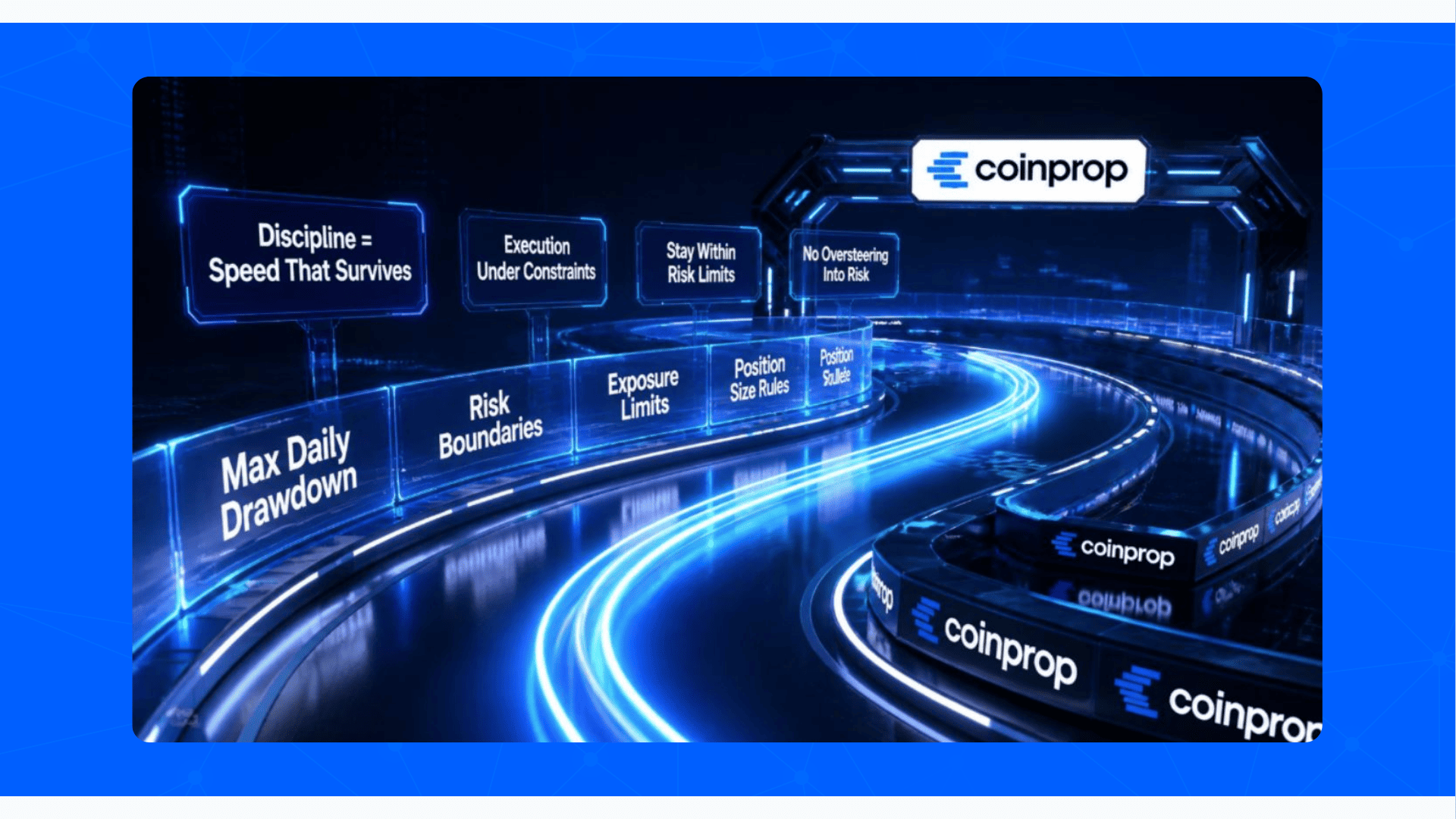
In serious environments, trade sharing is not about signals. It is about logic transfer.
Experienced traders explain:
This transforms trading from a “decision moment” into a “decision system.”
For prop traders, this shift is critical because consistency is not built on accuracy, it is built on repeatable logic under uncertainty.
Without feedback, trading becomes repetitive. With feedback, it becomes evolutionary.
When traders expose their decisions to others, they gain access to perspectives they cannot generate alone. This highlights blind spots in risk, timing, and execution.
Over time, feedback loops compress learning cycles. Mistakes that would normally repeat over months are corrected in days.
Crypto Discord communities are no longer just simple chat groups or places to share signals. They have evolved into structured environments where different types of traders, retail participants and prop traders, interact, learn, and refine how they approach the market.
At first glance, these two groups seem completely different. Retail traders are usually focused on learning, exploring strategies, and understanding market behavior. Prop traders, on the other hand, operate under strict rules where consistency, risk control, and execution discipline matter more than occasional high returns.
However, in practice, both groups rely on the same foundation: structured thinking, clear market context, and disciplined execution. The difference is not in what they trade, but in how they process information and make decisions.
This is where well-designed Discord communities become important. Instead of separating traders by experience level, they create a shared environment where thinking patterns are exposed, discussed, and refined. Retail traders observe how structured decision-making works in real conditions, while prop traders benefit from broader perspectives and behavioral feedback.
Over time, this creates a natural bridge between learning and execution. Traders don’t just improve their strategies, they improve how they think about the market itself.
Retail traders often enter the market looking for simple answers, signals, indicators, or shortcuts that tell them when to buy or sell. While this approach may provide short-term clarity, it rarely builds long-term consistency.
In structured Discord environments, the focus shifts from “what to do” to “how to think.” Instead of receiving isolated trade ideas, retail traders are exposed to reasoning, market context, and scenario-based analysis.
This helps them gradually move away from dependency on signals and toward understanding structure. They begin to recognize why certain setups matter, how market conditions influence probability, and why execution timing is just as important as direction.
Over time, this shift builds independence. Traders stop reacting to every alert and start evaluating the market through their own framework.

Prop traders operate in a completely different environment. Their success is not defined by occasional wins, but by consistent execution under strict constraints such as drawdowns, daily limits, and performance targets.
Because of this, their focus is less on prediction and more on precision. Every decision must align with risk management rules and long-term consistency.
Inside structured Discord communities, prop traders benefit from shared execution insights and real-time market context. Discussions often revolve around trade quality, risk adjustment, and scenario planning rather than simple buy or sell calls.
This environment reinforces discipline. It encourages traders to think in terms of probability, structure, and controlled exposure rather than emotional reactions or impulsive decisions.
Despite their differences, retail and prop traders are connected by one core element: how they interpret market context.
When both groups operate within the same structured environment, a valuable exchange happens. Retail traders gain exposure to disciplined execution thinking, while prop traders benefit from fresh perspectives and broader market interpretation.
Shared market context becomes the bridge between the two. Instead of fragmented opinions or isolated analysis, traders are aligned around the same structural understanding of price action.
This alignment creates a more complete learning environment. Beginners develop faster, and experienced traders refine their edge through discussion and feedback.
Ultimately, this is what separates a simple Discord group from a true trading ecosystem.
A high-quality prop Discord is not defined by activity, it is defined by structure.
Noise creates attention. Structure creates performance.
The difference is whether the environment is optimized for engagement or execution.
Information alone has no value. Interpretation does.
Good servers don’t flood users with alerts. They provide structured context around what matters: liquidity shifts, structural breaks, and market conditions.
This allows traders to filter opportunities instead of reacting to every movement.
Most traders fail not because of strategy, but because of uncontrolled behavior.
Structured Discords introduce discipline through systems:
This turns trading from a reactive process into a measurable one.
In prop trading, ambiguity is risk.
Clear rules around drawdown, consistency, and execution expectations eliminate unnecessary mistakes. This allows traders to focus entirely on performance instead of interpretation errors.
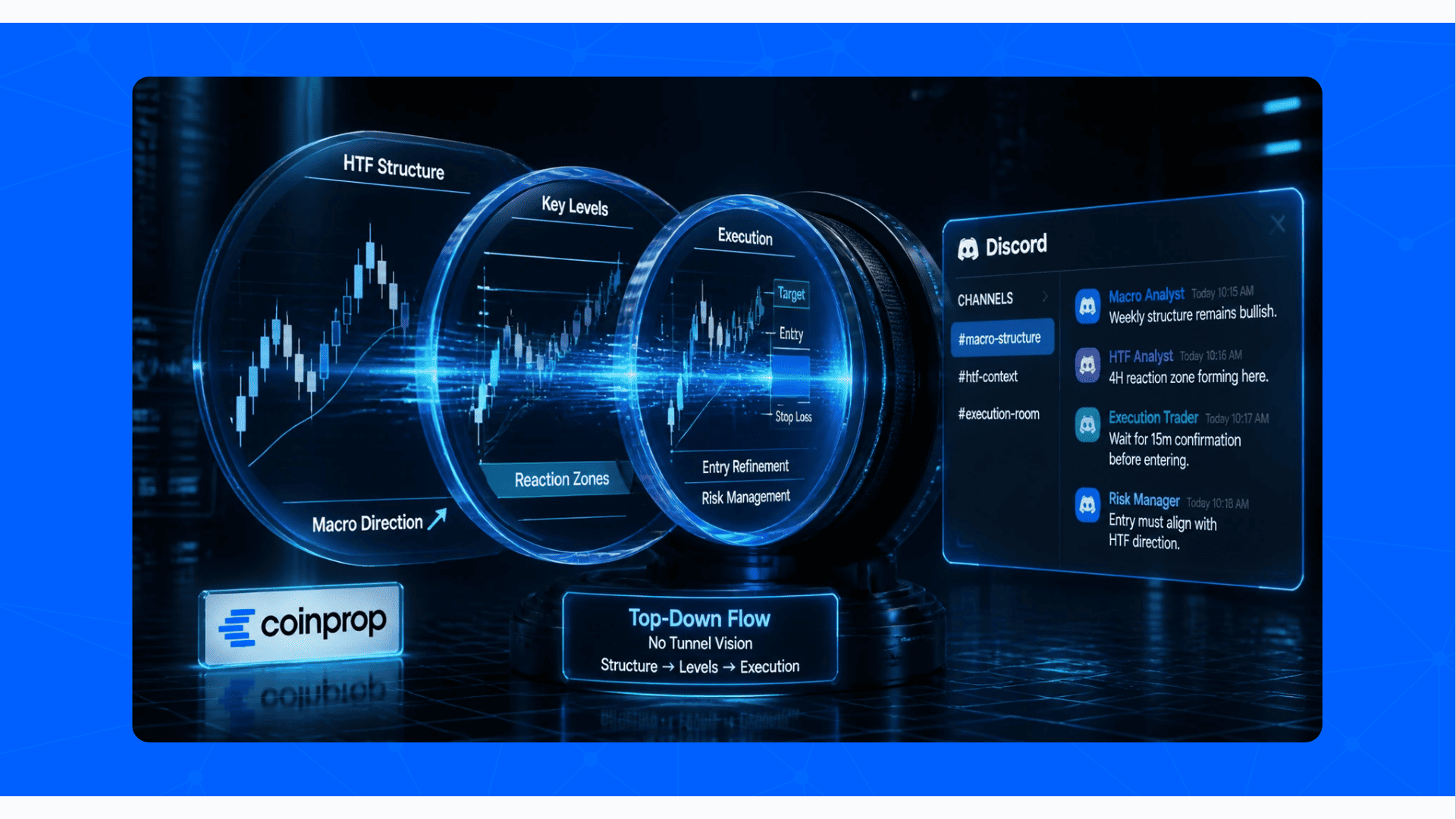
Crypto prop firm challenges and evaluation models are not just about making profits, they’re designed to test how consistently you can execute under strict rules. Drawdown limits, risk caps, and performance targets create a controlled environment where discipline matters more than opportunity.
The reality is, most traders don’t fail because they can’t find good setups. They fail because their behavior changes under pressure. A few losses lead to overtrading. A winning streak leads to overconfidence. These small deviations compound quickly and break consistency.
This is where a structured Discord environment becomes valuable. It doesn’t give you an edge through signals, it stabilizes your behavior. By exposing you to how other disciplined traders think and act in real time, it reduces emotional drift and helps you stay aligned with your plan, even when the market becomes unpredictable.
Emotional trading is rarely a single mistake, it’s a gradual shift in behavior.
It often starts subtly: a slightly larger position after a loss, a rushed entry after missing a move, or hesitation when a valid setup appears. When you’re trading alone, these small changes go unnoticed until they turn into larger problems.
In a structured Discord environment, that isolation is reduced. You’re constantly seeing how other traders manage similar situations, how they stick to their rules during drawdowns or stay patient after wins. This creates a form of behavioral alignment.
You don’t just learn what to do, you internalize how disciplined execution looks in real time. Over time, this reduces impulsive decisions and helps you maintain consistency when it matters most.
One of the biggest differences between inconsistent traders and stable performers is what happens before execution.
Instead of taking every setup they see, experienced traders filter their ideas. They question their logic, check conditions, and look for confirmation that the trade actually fits their plan.
In a Discord environment, this process becomes externalized. Sharing an idea forces clarity. When other traders challenge your reasoning or add perspective, weak setups become obvious before they turn into losses.
This doesn’t mean relying on others to approve trades, it means refining your thinking. Over time, this habit reduces unnecessary trades, improves selectivity, and increases confidence when you do decide to execute.
Risk management is easy to understand in theory, but difficult to apply consistently in real conditions.
Most traders know concepts like position sizing and drawdown control, but under pressure, execution breaks down. This is where observation becomes more powerful than instruction.
In a strong Discord community, experienced traders don’t just talk about risk, they demonstrate it. You see how they reduce exposure after losses, how they scale positions based on conditions, and how they protect capital during uncertainty.
This real-time exposure builds a deeper understanding of risk as a dynamic process, not a fixed rule. For prop traders, this is critical. Success isn’t about maximizing gains, it’s about surviving long enough to stay consistent within the firm’s constraints.
A real trading ecosystem is not just a collection of chats, it’s a structured system where analysis, execution, and review are constantly connected.
In high-performance Discord environments, this structure forms a continuous loop:
Each step feeds into the next. Over time, this loop transforms trading from isolated decisions into a repeatable process built on refinement.
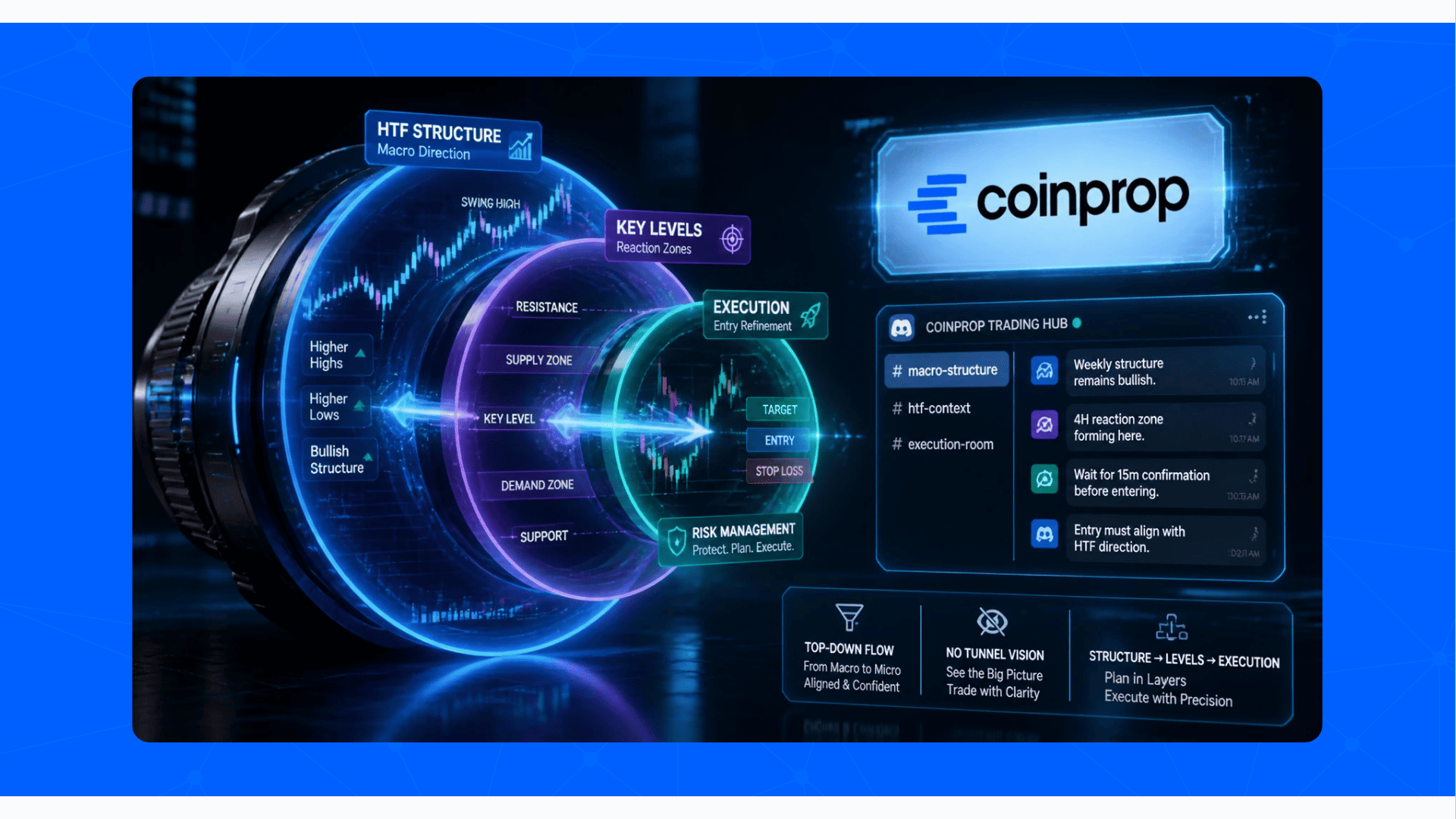
Markets don’t move in a straight line, and they don’t exist on a single timeframe.
Many traders struggle because they focus too narrowly. They either zoom in too much and get lost in noise, or zoom out too much and miss execution opportunities.
In strong Discord communities, traders approach the market from multiple layers at once. Higher timeframes define structure and direction, while lower timeframes refine entries and risk.
What makes this powerful is not just the analysis itself, but the interaction between different perspectives. One trader may highlight a macro level, while another identifies a short-term reaction. Together, this creates a more complete view of the market.
Over time, this trains you to think in layers, reducing tunnel vision and improving your ability to identify setups that actually align with broader market conditions.
Most traders rely on memory, but memory is inconsistent and biased.
A structured Discord environment introduces discipline through documentation. Trade journaling captures key elements such as:
This creates visibility. Patterns begin to emerge, where discipline breaks, where consistency exists, and where emotional decisions occur.
With feedback from other traders, journaling becomes more than tracking, it becomes a system for continuous improvement.
No single trading style captures the full picture of the market.
Scalpers focus on precision and timing. Swing traders focus on structure and patience. Analysts focus on context and broader direction. Each perspective is incomplete on its own, but powerful when combined.
In a high-performance Discord environment, these perspectives interact. Traders challenge each other’s assumptions, add missing context, and refine ideas through discussion.
This reduces blind spots. A setup that looks strong on one timeframe might conflict with a higher timeframe structure. A macro bias might miss short-term volatility risks.
By being exposed to different approaches, you develop a more balanced view of the market. You don’t abandon your style, you strengthen it by understanding where it fits within the bigger picture.
Over time, this collaboration improves not just what you trade, but how you think about trading itself.
Most trading failures inside Discord are not technical, they are behavioral.
The main issue is not information quality, but how that information is used.
Dependency on signals removes responsibility from the trader.
Without internal analysis, execution becomes fragile and unable to adapt when conditions change.
Risk is often overlooked because it is less exciting than entries.
However, in prop trading, survival is determined more by risk control than by accuracy.
Not all contributors operate at the same level of discipline.
Following unverified traders introduces inconsistency into decision-making systems.
Prop challenges are designed for consistency, not randomness.
Signal dependency fails because it does not build adaptive thinking or independent execution capability.
A Discord server is not an advantage by itself. The advantage comes from how it shapes trader behavior over time.
Used correctly, it becomes a structured environment for refinement. Used incorrectly, it becomes a source of noise.
Trading edge is not created, it is accumulated through repetition, feedback, and correction.
Structured environments accelerate this process by exposing traders to better decision frameworks.
No external system replaces discipline.
The most consistent traders use Discord as a reference layer, not a dependency layer. Execution remains internally governed, not externally dictated.

Most Discord servers are built for activity. Messages, alerts, and constant notifications create the illusion of value, but rarely improve how traders actually perform.
A high-quality trading Discord should operate differently. It should function as an execution-focused environment where information is structured, context is clear, and every interaction supports better decision-making.
The goal is not to tell traders what to do. The goal is to help them understand why the market behaves the way it does, and how to respond with discipline.
That’s the foundation behind how a properly built Discord should work.
In any crypto trading community, especially under prop firm rules, uncertainty creates hesitation, and hesitation leads to mistakes.
Traders need immediate clarity around:
When communication is slow or unclear, execution suffers. A structured Discord removes that friction. It ensures that traders are not second-guessing rules or searching for answers while the market is moving.
Clarity reduces errors. And in prop trading, fewer errors often matter more than more wins.
Most traders don’t struggle with lack of information, they struggle with too much of it.
A strong Discord environment filters the noise and delivers only what matters. Instead of random opinions or constant alerts, traders are exposed to structured market context:
This changes behavior. Instead of reacting impulsively, traders begin to operate with intent. They understand the environment before acting inside it.
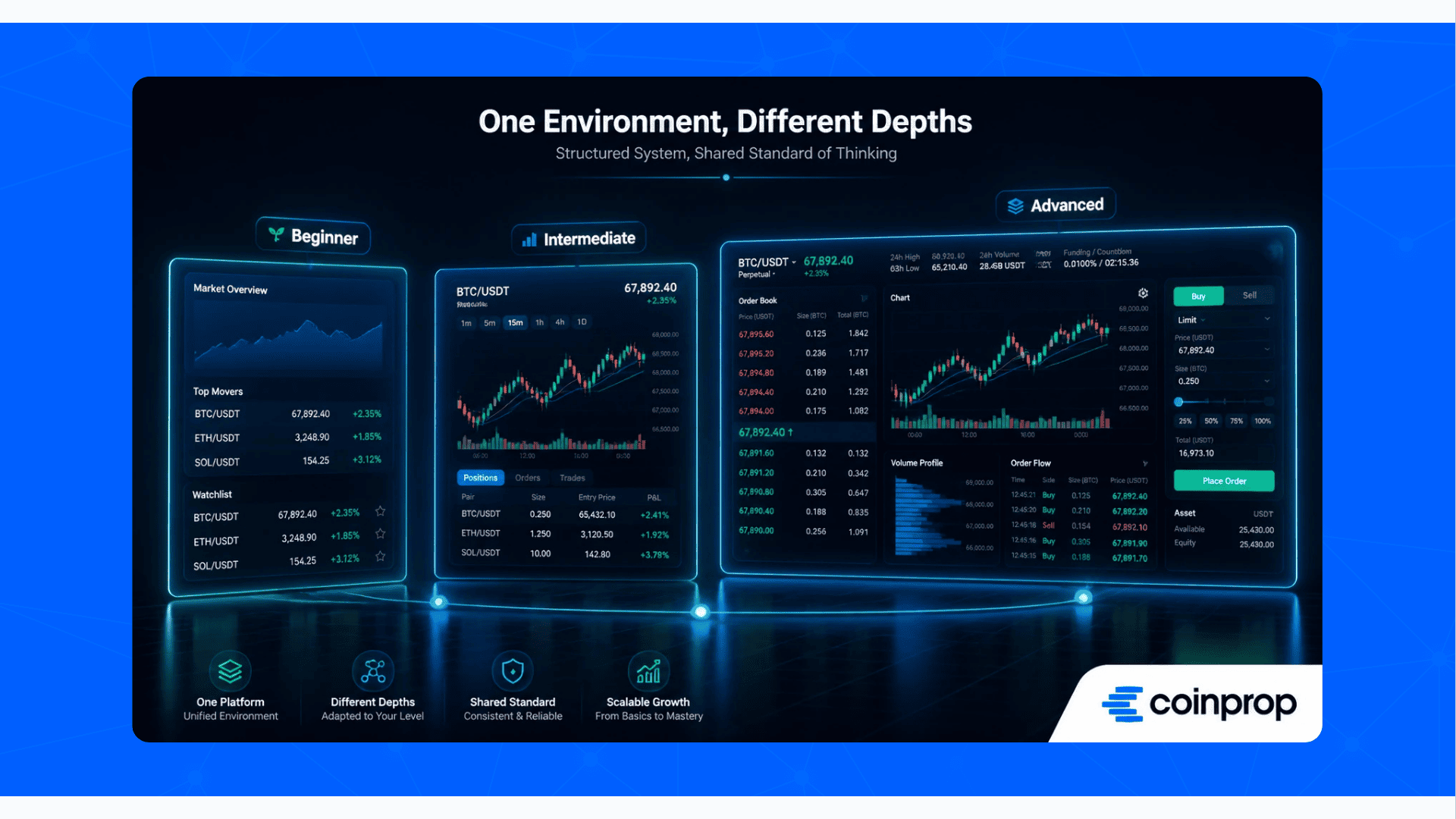
A well-built Discord should not be limited to one type of trader.
Beginners need clarity and direction.
Intermediate traders need structure and validation.
Advanced traders need efficiency and high-quality discussion.
The right environment supports all three, without diluting quality.
This is where most communities fail. They either oversimplify for beginners or become too fragmented for serious traders. A structured system allows different levels of depth while maintaining a shared standard of thinking.
In trading, trust is not built through claims, it is built through evidence.
Seeing real outcomes changes perception. Verified payouts, trader milestones, and documented progress provide a realistic view of what consistency actually looks like.
This does two things:
Instead of chasing quick wins, traders begin to align with what is sustainable.
The quality of a crypto trading community is defined by who participates in it.
Without proper controls, even strong communities degrade over time, filled with noise, spam, and low-quality input.
A structured onboarding and verification system ensures that:
Because in the end, environment shapes behavior, and behavior determines results.
Most Discord servers try to attract traders with signals.
CoinProp takes a different approach.
Instead of focusing on predictions, the environment is built around how traders think, execute, and manage risk in real time. The goal is not to create dependency, but to develop independent, disciplined traders.
Inside the CoinProp Discord, you’ll find:
This makes it valuable not only for prop traders, but for any crypto trader looking to improve how they operate in live market conditions.
Most traders spend months, sometimes years, jumping between Discord servers, looking for better signals.
Very few stop to ask a more important question:
Is this environment actually improving how I trade?
If your goal is to move beyond signal dependency and develop real execution discipline, the environment you choose matters.
Join the CoinProp Discord and experience how structured trading discussions actually work
Whether you're new to prop trading or already have experience, understanding how crypto prop firms work can help you evaluate different funding models, trading rules, and payout structures.
