Compare CoinProp, Hyrotrader, and Crypto Fund Trader across their standard 10K One Step accounts. This guide compares pricing, profit targets, drawdown and daily loss limits, leverage, trading restrictions, profit splits, platforms, market coverage, and payout rules. It also highlights key differences in trading capacity and infrastructure to help traders understand which crypto prop firm best fits their strategy.
The table below compares the 10K One Step Challenge offerings from CoinProp, Hyrotrader, and Crypto Fund Trader (Crypto Fund Trader). CoinProp is represented by both its Signature and Booster plans because both are One Step challenges but use different maximum drawdown structures.
The comparison focuses on the standard account conditions for each challenge and excludes optional add ons and upgrades. Funded stage information, such as profit splits and payout processing, is included separately to provide a broader view of each firm's overall offering.
Where Crypto Fund Trader does not clearly disclose a directly comparable rule in its publicly available information, it is marked as Not clearly disclosed rather than inferred.
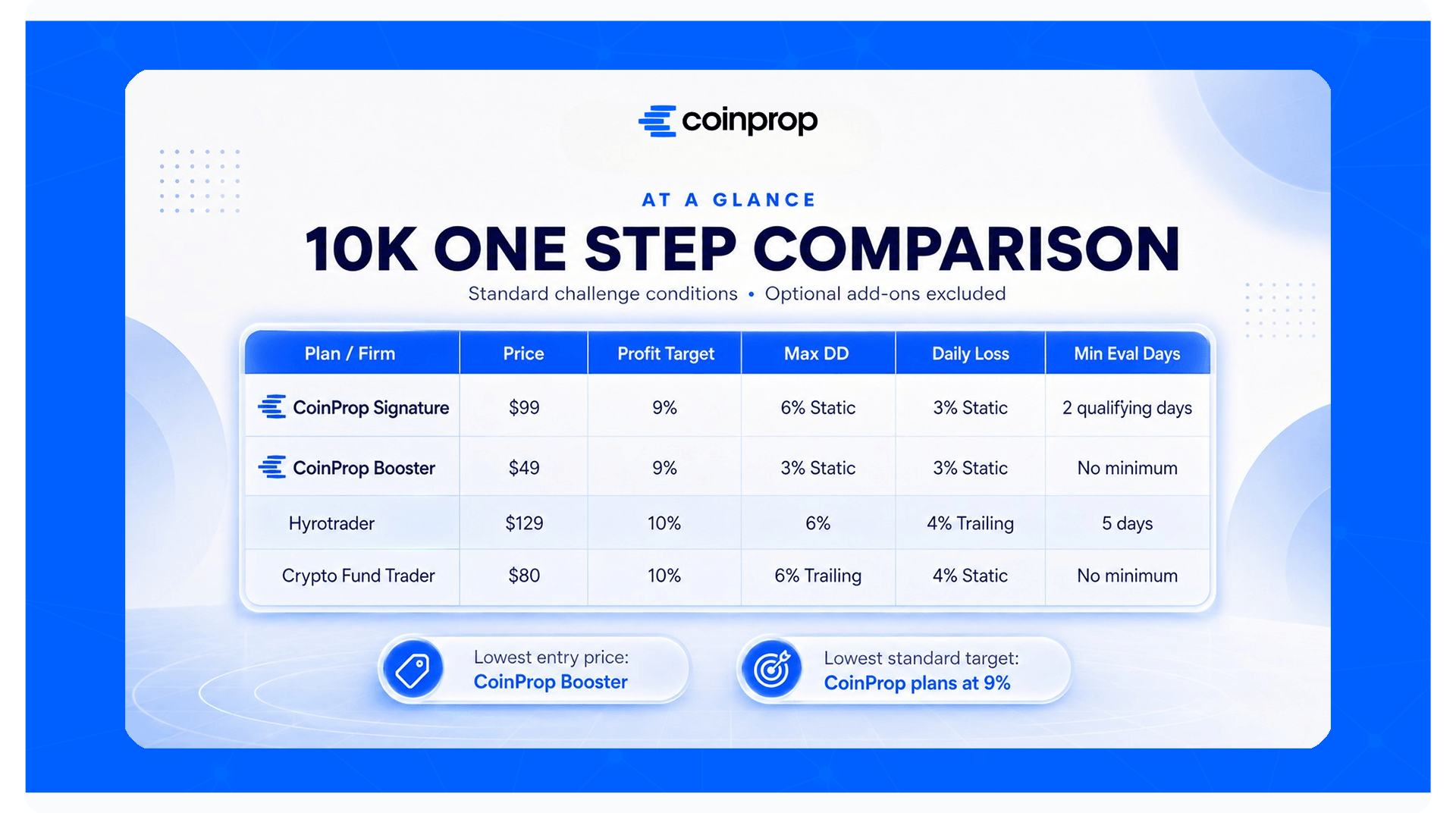
CoinProp Signature: $99
CoinProp Booster: $49
HyroTrader: $129
Crypto Fund Trader (CFT): $80
CoinProp Signature: 9%
CoinProp Booster: 9%
HyroTrader: 10%
Crypto Fund Trader (CFT): 10%
CoinProp Signature: 6% Static
CoinProp Booster: 3% Static
HyroTrader: 6%
Crypto Fund Trader (CFT): 6% Trailing
CoinProp Signature: 3% Static
CoinProp Booster: 3% Static
HyroTrader: 4% Trailing
Crypto Fund Trader (CFT): 4% Static
CoinProp Signature: None
CoinProp Booster: None
HyroTrader: 40%
Crypto Fund Trader (CFT): None
CoinProp Signature: 2 qualifying days
CoinProp Booster: No minimum
HyroTrader: 5 days
Crypto Fund Trader (CFT): No minimum
CoinProp Signature: No
CoinProp Booster: No
HyroTrader: Yes, with first payout
Crypto Fund Trader (CFT): No
CoinProp Signature: Yes
CoinProp Booster: Yes
HyroTrader: Yes
Crypto Fund Trader (CFT): No
CoinProp Signature: 80%
CoinProp Booster: 80%
HyroTrader: 80%
Crypto Fund Trader (CFT): 80%
CoinProp Signature: 95%
CoinProp Booster: 90%
HyroTrader: 90%
Crypto Fund Trader (CFT): 90%
CoinProp Signature: Up to 5× leverage
CoinProp Booster: Up to 5× leverage
HyroTrader: 2× cumulative exposure
Crypto Fund Trader (CFT): No fixed numerical limit clearly disclosed; the firm may impose position size limits
CoinProp Signature: CPX with native TradingView integration and live Bybit liquidity
CoinProp Booster: CPX with native TradingView integration and live Bybit liquidity
HyroTrader: Bybit / Tealstreet / CLEO
Crypto Fund Trader (CFT): Bybit / MT5 / Match-Trader
CoinProp Signature: No swap fees
CoinProp Booster: No swap fees
HyroTrader: Trading environment dependent
Crypto Fund Trader (CFT): Applies on MT5 / Match-Trader
CoinProp Signature: Crypto / Bybit market data and liquidity
CoinProp Booster: Crypto / Bybit market data and liquidity
HyroTrader: Exchange-based
Crypto Fund Trader (CFT): Bybit; CFDs via MT5 / Match-Trader
CoinProp Signature: 5 days
CoinProp Booster: 5 days
HyroTrader: No minimum
Crypto Fund Trader (CFT): 15 trading days or 30 calendar days
CoinProp Signature: Typically ~6 hours; up to 24 hours
CoinProp Booster: Typically ~6 hours; up to 24 hours
HyroTrader: Within 12 hours
Crypto Fund Trader (CFT): 24–48 hours
Profit split and payout processing apply to the funded stage rather than the initial challenge. They are included here to provide a high level view of the overall offering.
Note: The CoinProp Booster and Signature plans are both One Step challenges, but they use different maximum drawdown structures. The Booster has a lower entry price and no minimum evaluation trading day requirement, while the Signature plan provides a wider maximum drawdown. Optional add ons and upgrades are excluded from this comparison.
This gives the reader a quick overview of the main differences before the article examines each category in more detail.
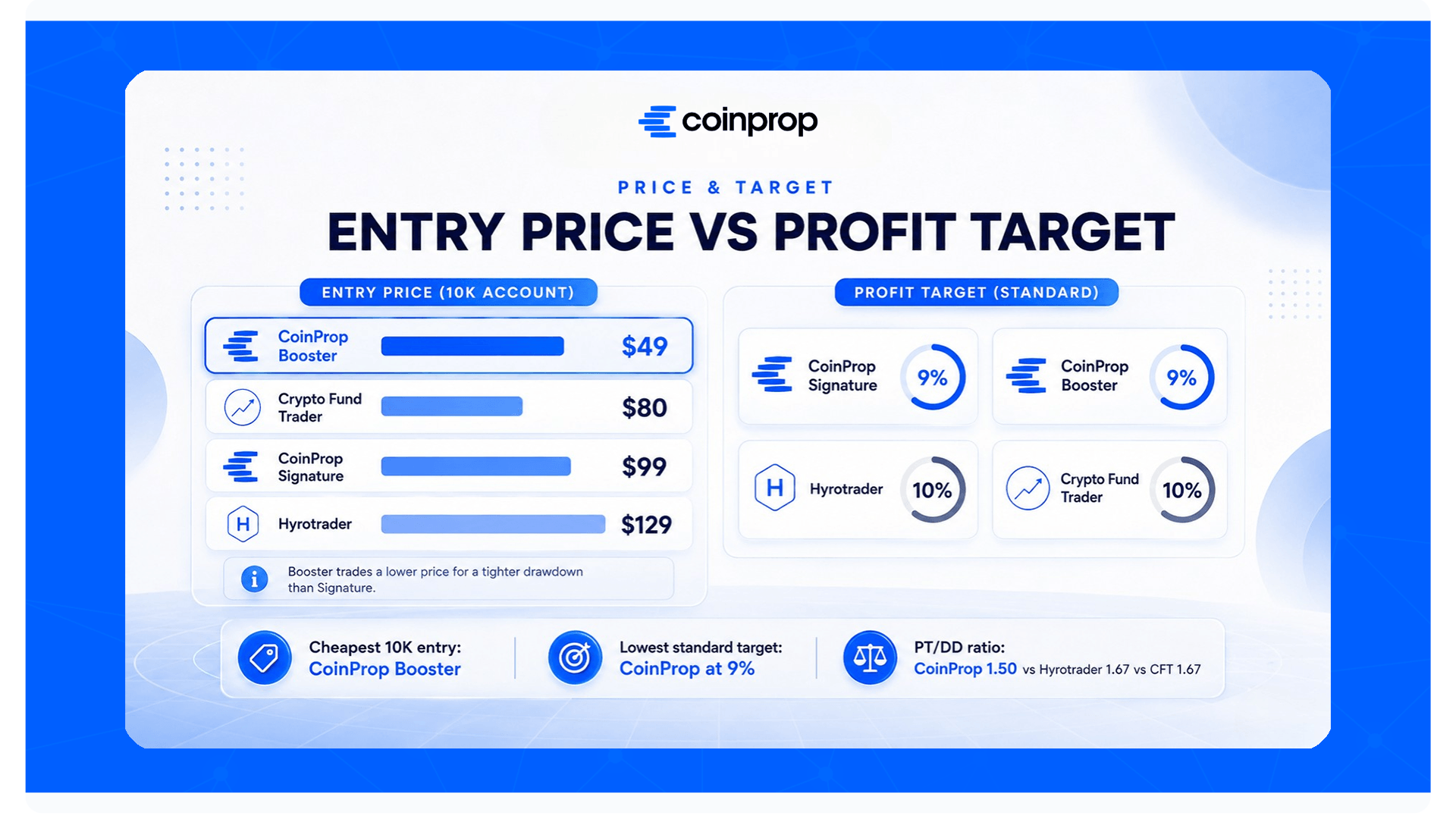
Price is one of the first factors traders consider when comparing crypto prop firms, but the lowest entry price does not necessarily represent the best value. The rules attached to a challenge, including the profit target, drawdown structure, daily loss limit, and payout conditions, can have a greater impact on the trading experience than the initial challenge fee.
The table below compares the 10K One Step Challenge prices and core risk conditions across the CoinProp Signature and Booster plans, Hyrotrader, and Crypto Fund Trader. Optional add ons and upgrades are excluded.
CoinProp Booster has the lowest entry price in this comparison at $49 for a 10K One Step Challenge, followed by Crypto Fund Trader at $80, CoinProp Signature at $99, and Hyrotrader at $129.
However, price alone does not determine which challenge offers the best value. The Booster's lower price comes with a 3% static maximum drawdown, compared with 6% on the Signature plan. Both CoinProp plans use a 9% profit target, while Hyrotrader and Crypto Fund Trader use 10%.
On a $10,000 account, a 9% profit target requires $900 in profit, compared with $1,000 under a 10% target. The difference is the same for both CoinProp plans.
The drawdown structure creates a more significant distinction between the two CoinProp plans. The Signature plan provides a 6% static maximum drawdown, equivalent to a $600 loss threshold on a $10,000 account. The Booster plan uses a 3% static maximum drawdown, equivalent to $300 on the same account.
Crypto Fund Trader has the lowest price among the three firms when comparing against CoinProp Signature, at $80, but its 6% maximum drawdown is trailing rather than static. Hyrotrader has the highest base price at $129 and uses a 10% profit target with a 6% maximum drawdown under the compared configuration.
The challenge fee should therefore be viewed as the starting point of the comparison rather than the final measure of value. Traders should consider the price together with the profit target, drawdown structure, daily loss limit, trading restrictions, and payout conditions.
Note: Optional add ons and upgrades are excluded from the prices and conditions compared in this article. CoinProp's Booster and Signature plans are both standard One Step challenges, but their maximum drawdown structures differ.
The profit target is one of the most important rules in a crypto prop firm evaluation because it determines how much profit a trader must generate before completing the challenge. However, the target should not be evaluated in isolation. The amount of profit required should also be considered alongside the account's maximum drawdown and other risk limits.
CoinProp has the lowest standard profit target at 9%, while both Hyrotrader and Crypto Fund Trader use a 10% target for the standard 10K One Step accounts compared in this article.
On a $10,000 account, a 9% target requires $900 in profit, while a 10% target requires $1,000. The difference is therefore $100 on a 10K account.
Although a one percentage point difference may appear small, the target represents the amount of profit that must be generated while remaining within the account's risk limits. This makes the relationship between the profit target and maximum drawdown particularly important.
The profit target to drawdown (PT/DD) ratio compares the headline profit target with the maximum drawdown percentage. It is calculated by dividing the profit target by the maximum drawdown.
CoinProp therefore has a 1.50 PT/DD ratio, compared with 1.67 for both Hyrotrader and Crypto Fund Trader.
However, the PT/DD ratio should be treated as a simple comparison metric rather than a measure of evaluation difficulty or probability of passing. It does not account for differences in how drawdown is calculated, daily loss limits, consistency requirements, position size restrictions, or other trading rules.
For example, CoinProp's 6% maximum drawdown is static, while Crypto Fund Trader uses a 6% trailing maximum loss. Although both accounts have the same headline drawdown percentage, the way the threshold behaves can be different as the account becomes profitable.
This is why the profit target should be considered together with the drawdown structure, daily loss limit, and other evaluation rules, rather than used as a standalone measure of challenge difficulty.
For traders who prioritize a lower evaluation target, CoinProp has a clear difference in this comparison: $900 is required to reach the target on a 10K account, compared with $1,000 at Hyrotrader and Crypto Fund Trader.
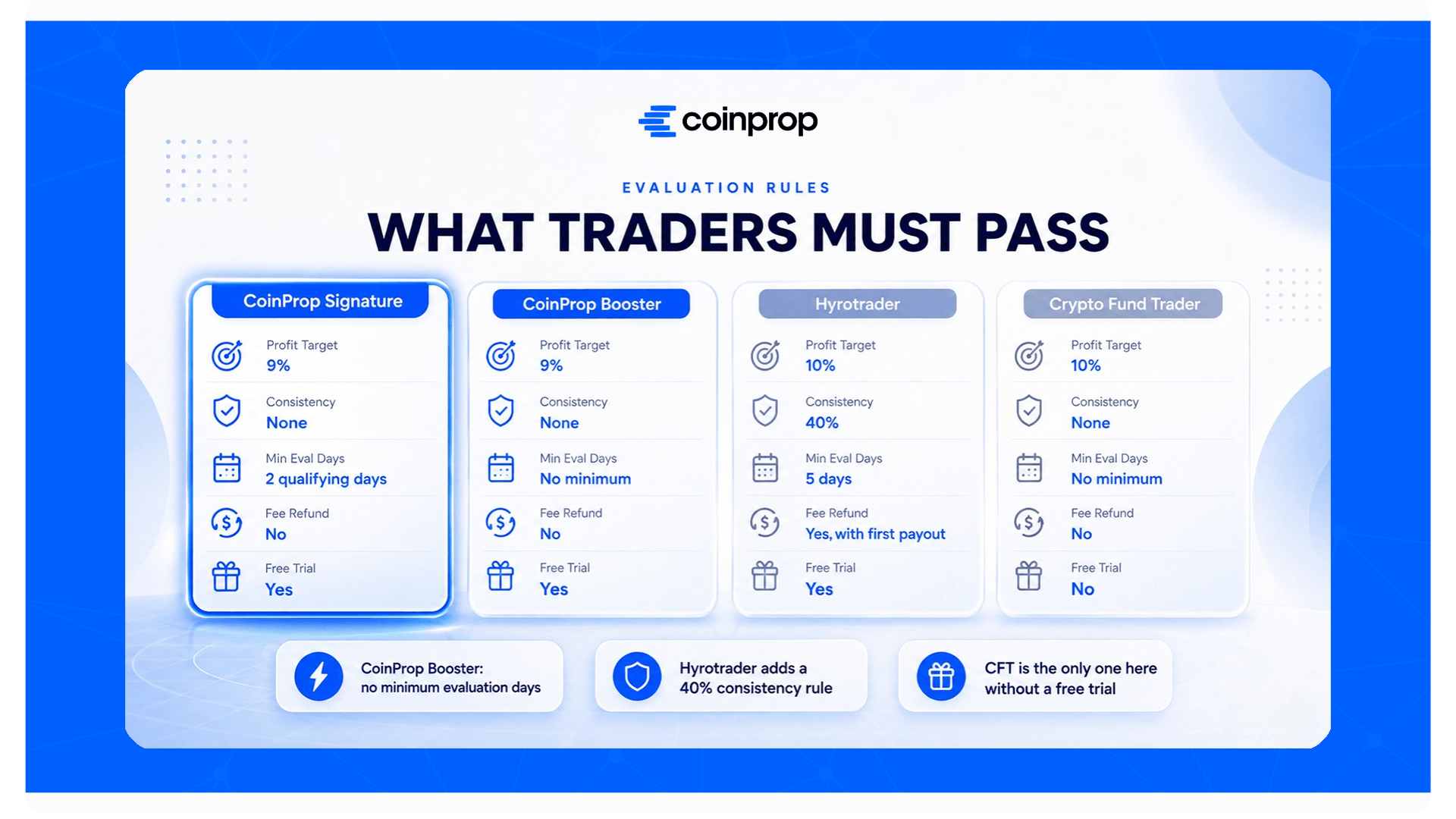
The evaluation rules determine what traders need to achieve before they can move to a funded account. While the headline profit target is often the first rule traders notice, the combination of drawdown limits, daily loss rules, consistency requirements, and minimum trading days can have an equally important impact on how an evaluation must be approached.
The table below compares the standard 10K One Step evaluation rules for CoinProp's Signature and Booster challenges, Hyrotrader, and Crypto Fund Trader. Optional add ons and upgrades are excluded.
Profit Target
Maximum Drawdown
Daily Loss Limit
Consistency Rule
Minimum Evaluation Trading Days
Challenge Fee Refund
Both CoinProp One Step challenges use a 9% profit target, which is lower than the 10% target used by Hyrotrader and Crypto Fund Trader for the accounts compared here.
On a $10,000 account, this represents a $900 profit target for either CoinProp plan, compared with $1,000 for a 10% target.
The profit target is therefore the same across CoinProp's Signature and Booster challenges, even though their maximum drawdown structures differ.
Consistency requirements can affect how traders distribute their profits during an evaluation.
Neither the CoinProp Signature nor Booster challenge applies a consistency rule under the standard evaluation conditions compared here. Hyrotrader applies a 40% consistency requirement, meaning traders need to account for this restriction when planning how profits are generated during the challenge.
Crypto Fund Trader does not clearly disclose a consistency requirement for the standard account in the publicly available information reviewed for this comparison.
The minimum number of trading days is another difference between the two CoinProp plans.
The Signature challenge requires 2 qualifying trading days, while the Booster challenge has no minimum evaluation trading day requirement.
Hyrotrader currently requires 5 trading days for its standard 1 Step evaluation.
Crypto Fund Trader's minimum evaluation trading day requirement is not clearly disclosed in the publicly available information reviewed.
This makes the Booster particularly different from the other challenges in this comparison: traders can meet the other evaluation requirements without having to complete a fixed number of qualifying trading days.
The challenge fee treatment also differs between the firms.
Hyrotrader states that the challenge fee is refunded with the first payout for the applicable account. Neither CoinProp's Signature nor Booster challenge refunds the initial challenge fee under the standard conditions compared here.
Crypto Fund Trader does not offer a challenge fee refund under the conditions compared here.
These rules provide the basic framework for passing the evaluation. However, the percentage values alone do not explain how much room a trader actually has before violating an account. The next section looks more closely at maximum drawdown and daily loss limits, including the difference between static and trailing structures.
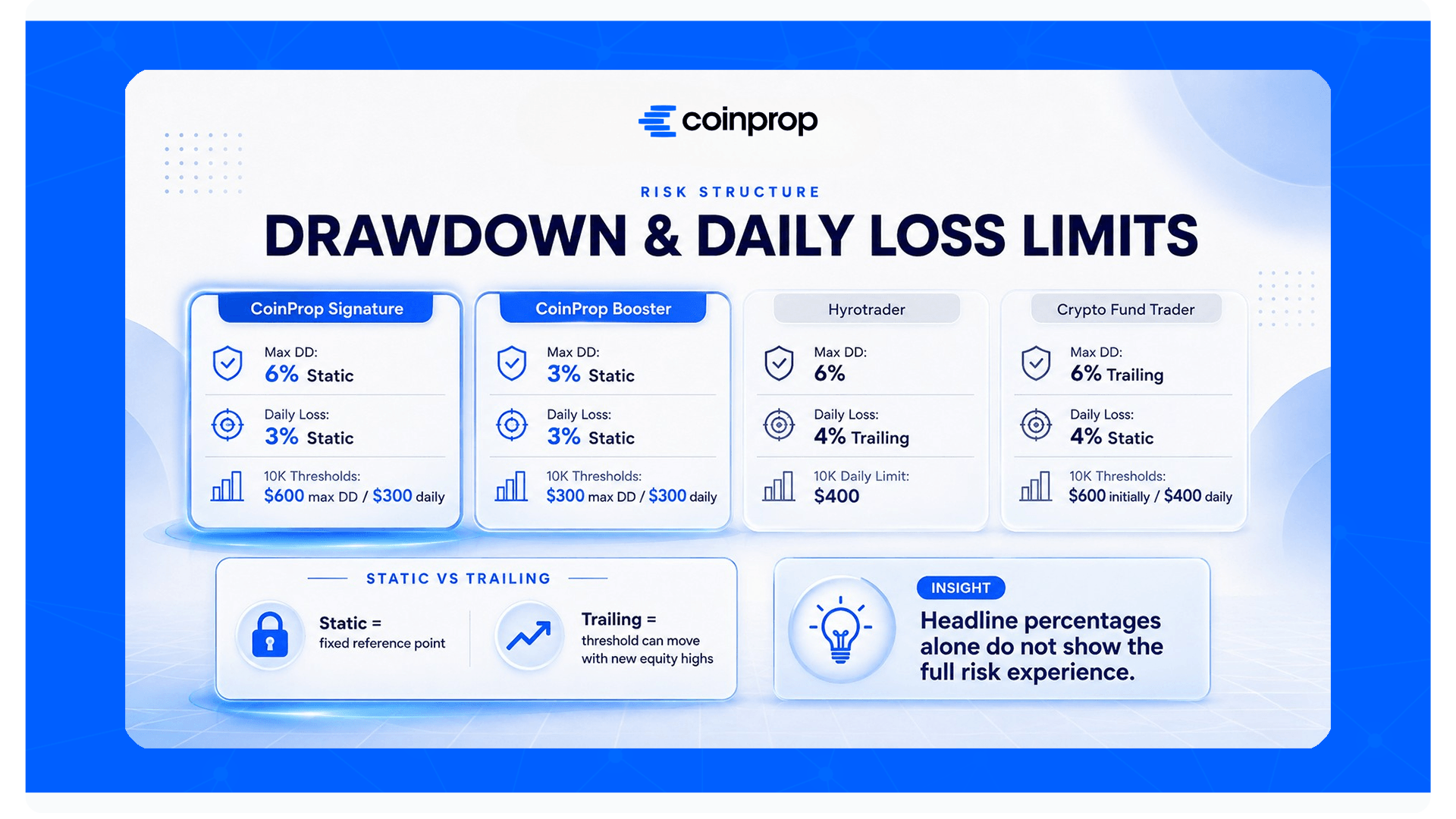
Maximum drawdown and daily loss limits determine how much room a trader has before an account violates its risk rules. However, comparing the percentages alone can be misleading because a static drawdown and a trailing drawdown behave differently as the account balance changes.
Maximum Drawdown on a $10K Account
CoinProp uses different maximum drawdown levels across its two One Step challenges. The Signature challenge has a 6% static maximum drawdown, while the Booster challenge uses a 3% static maximum drawdown.
On a $10,000 account, this represents a $600 maximum loss threshold for Signature and a $300 threshold for Booster, based on the starting balance.
A static drawdown remains tied to the defined starting balance threshold rather than automatically moving higher as the account reaches new equity highs. This provides a fixed reference point for the maximum loss throughout the evaluation.
The key trade off between CoinProp's two plans is therefore straightforward: Booster has a lower entry price but a tighter maximum drawdown, while Signature provides a wider drawdown buffer.
Crypto Fund Trader uses a 6% trailing maximum loss. While the initial percentage is also 6%, the trailing structure can cause the loss threshold to change as the account reaches new highs, depending on the firm's specific calculation method. This makes its risk structure different from CoinProp's static drawdown even though the headline percentage is the same.
Hyrotrader's standard account is advertised with a 6% maximum drawdown. Traders should review the applicable account rules to determine how the threshold is calculated and whether specific conditions affect how the drawdown behaves.
The daily loss limit is separate from maximum drawdown. It determines how much loss an account can sustain within the firm's daily risk calculation, while maximum drawdown represents the broader loss threshold for the account.
Both CoinProp Signature and Booster use a 3% static daily loss limit. On a $10,000 account, this corresponds to a $300 daily loss threshold.
Hyrotrader and Crypto Fund Trader use 4% daily loss limits under the conditions compared here, equivalent to $400 on a $10,000 account.
The distinction between daily loss and maximum drawdown is important. A trader can remain above the account's overall maximum drawdown threshold while still violating the daily loss limit. Conversely, staying within the daily limit does not guarantee that the account cannot eventually reach its maximum drawdown.
Two accounts can both advertise a 6% maximum drawdown but provide a different risk experience depending on how that threshold is calculated.
With a static drawdown, the loss threshold remains anchored to the defined starting balance. With a trailing drawdown, the threshold can move as the account reaches new highs, depending on the firm's specific calculation method.
This distinction is particularly important for traders who allow profits to accumulate before increasing their position size. A trailing threshold can reduce the amount of room available after an account has moved into profit, while a static threshold provides a fixed reference point.
For this reason, traders should compare not only the drawdown percentage, but also whether the rule is static or trailing and exactly how the firm calculates the threshold.
Note: Optional add ons are excluded from this section. The comparison is based on the standard 10K One Step Challenge conditions.
Leverage is only one part of the equation when comparing trading capacity. Position exposure, margin limits, and restrictions on specific types of cryptocurrencies can significantly affect how much a trader can actually deploy.
The table below focuses on the standard trading conditions publicly disclosed for each firm. Where Crypto Fund Trader does not clearly disclose a comparable rule, it is marked as Not clearly disclosed rather than inferred.
The difference between leverage and cumulative position exposure is important when comparing CoinProp and Hyrotrader.
CoinProp allows up to 5× leverage on BTC, ETH, and SOL, while Hyrotrader limits cumulative open position exposure to 2× the initial account balance.
For example, on a hypothetical $100,000 account, a 5× leverage limit would correspond to up to $500,000 in notional position value, subject to the firm's other risk rules. Under Hyrotrader's 2× cumulative exposure limit, the total value of open positions would be limited to $200,000.
These figures should not be interpreted as guaranteed position sizes. Actual trading capacity can also depend on available margin, the instrument being traded, and other account level restrictions.
The difference becomes even more relevant when trading altcoins and meme coins.
CoinProp allows up to 2× leverage on altcoins and meme coins without applying a profit counting penalty.
Hyrotrader applies a 5% allocation limit to qualifying altcoins and lower cap assets, and only 40% of profits from these trades count toward the evaluation target.
This means that two firms can offer access to the same broad category of crypto assets while giving traders very different practical flexibility when trading them.
For traders whose strategies rely heavily on altcoins or meme coins, asset specific rules can therefore matter as much as the headline leverage figure.
Hyrotrader also limits the margin used across open positions to 25% of the initial account balance.
On a hypothetical $100,000 account, this represents a maximum of $25,000 in margin under the stated rule.
CoinProp does not apply the same 25% maximum margin cap, giving traders greater flexibility in how margin can be allocated across eligible positions, subject to its other risk rules.
A higher headline leverage number does not automatically mean a trader has proportionally greater trading capacity.
Actual capacity can be affected by:
For example, comparing CoinProp's 5× BTC/ETH/SOL leverage directly with Hyrotrader's 2× cumulative exposure without considering margin and position restrictions would not provide a complete picture.
This is why traders should evaluate leverage, position exposure, margin requirements, and asset specific restrictions together rather than relying on the headline leverage figure alone.
Trading restrictions can have a direct impact on which strategies a trader can use during an evaluation and after receiving a funded account. Rules around martingale, hedging, stop losses, and inactivity are particularly important because a strategy that is permitted by one firm may be restricted by another.
The table below compares the standard rules publicly disclosed for the three firms.
Martingale trading is allowed by CoinProp under its stated rules, while Hyrotrader prohibits martingale strategies.
Crypto Fund Trader allows martingale trading under the rules reviewed for this comparison.
This distinction can be important for traders who use position sizing strategies that involve increasing exposure after losing trades. However, allowing martingale does not remove the account's other risk limits, including maximum drawdown and daily loss rules.
CoinProp does not allow hedging under its standard rules.
Hyrotrader permits hedging when trading through a single Bybit account, while hedging is not supported when using CLEO.
Crypto Fund Trader also does not allow hedging under the rules reviewed.
None of the three firms requires traders to place a stop loss order under the standard conditions compared here.
However, the absence of a mandatory stop loss requirement does not mean that traders can ignore the firm's loss limits. Positions remain subject to the applicable daily loss, maximum drawdown, and other risk rules.
Hyrotrader specifies an inactivity rule requiring traders to have a closed trade within 30 days.
A comparable inactivity requirement is not clearly disclosed in the publicly available information reviewed for CoinProp and Crypto Fund Trader.
Trading restrictions can be just as important as the headline evaluation rules when choosing a prop firm.
A trader using martingale, hedging, or other specialized strategies should verify that the strategy is permitted before purchasing an account. The same applies to traders who may leave accounts inactive for extended periods.
Where a firm's public documentation does not clearly disclose a specific restriction, traders should confirm the current rule directly with the firm's official support team before relying on the absence of a restriction.
Note: This section compares standard account conditions and excludes optional add ons. Not clearly disclosed means that a directly comparable rule could not be verified from the firm's publicly available information; it does not necessarily mean that no such rule exists.
Profit split determines how much of the trading profit a funded trader keeps, while account scaling determines how the funded account can grow over time. These conditions can be just as important as the initial challenge price when comparing the long term value of a prop firm.
The comparison below focuses on the standard account conditions without optional add ons or upgrades.
CoinProp's standard profit split is 80%. The standard account does not automatically increase the trader's profit share over time.
CoinProp also uses a scaling structure in which eligible funded accounts can increase by 30% every 90 days, subject to the applicable performance and account requirements. The published scaling structure allows accounts to grow up to $400,000.
Optional upgrades that can increase the profit split are excluded from this comparison so that the three firms are evaluated using their standard account conditions.
Hyrotrader starts with an 80% profit split under the standard structure.
Its published funded account progression can increase the trader's profit share by 5 percentage points every four months, subject to the applicable requirements, up to a maximum of 90%.
Hyrotrader also offers account scaling based on funded trading performance and time. Its currently advertised funding level is $200,000, with higher amounts potentially available through its scaling structure.
Crypto Fund Trader's standard profit split is 80%, while its maximum profit split can reach 90% under applicable programs or upgrades.
Because Crypto Fund Trader offers multiple funding models and account structures, its scaling conditions and maximum funding levels can vary by program. The corresponding details are therefore program dependent rather than treated as a single standard rule.
A higher maximum profit split does not automatically make one prop firm more attractive.
For example, a trader receiving 90% of profits may still prefer an account with a lower profit target, a different drawdown structure, or more suitable trading restrictions. Similarly, a scaling program only matters if the trader can consistently meet its requirements.
For that reason, profit split should be evaluated alongside evaluation rules, drawdown, trading capacity, payout conditions, and the firm's scaling requirements rather than viewed in isolation.
Note: Optional profit split upgrades and other add ons are excluded from the standard comparison. Where Crypto Fund Trader's conditions vary between programs, they are identified as program dependent rather than generalized across all accounts.
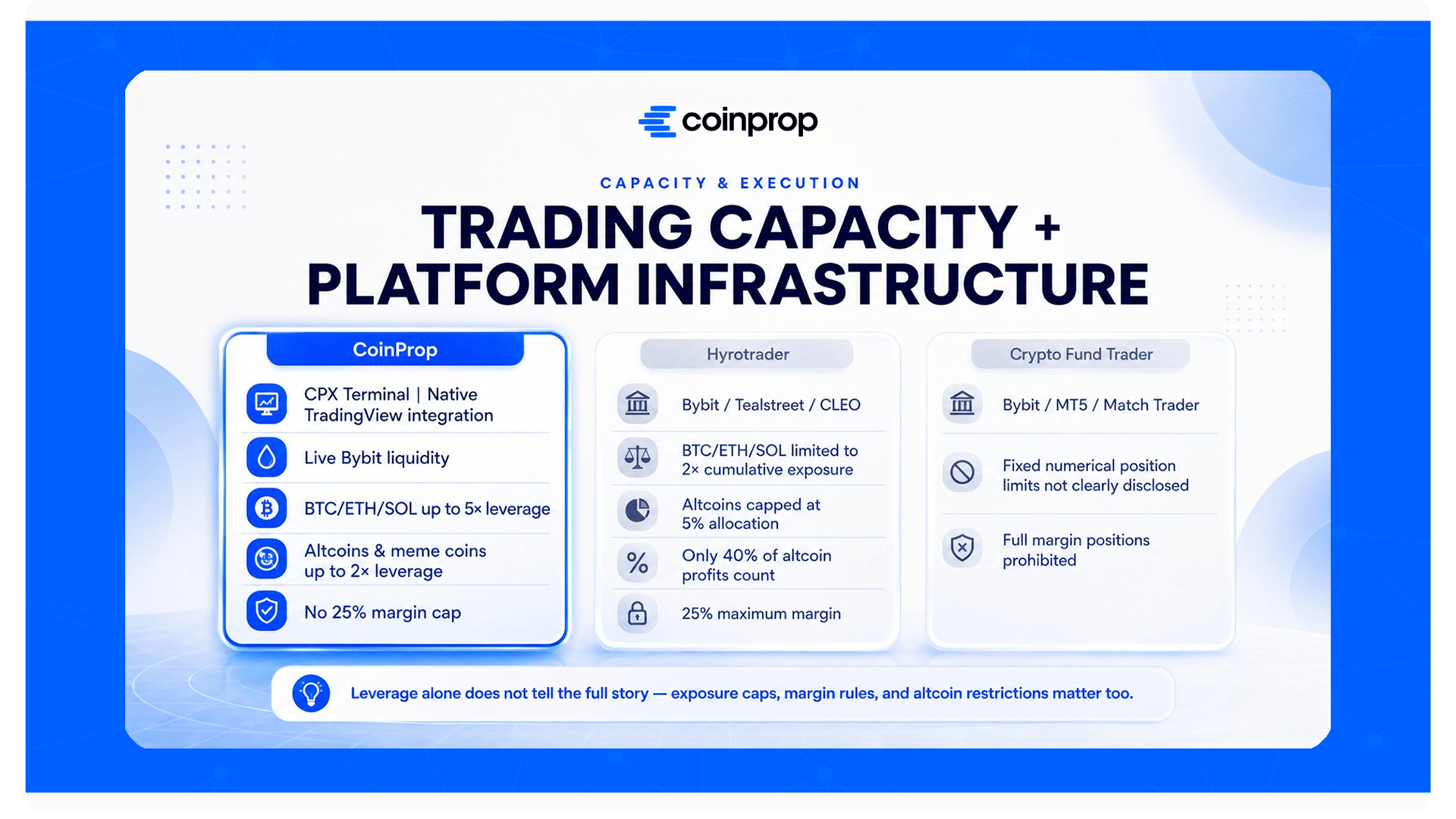
The trading platform can have a major impact on the day to day experience of a funded trader. Charting, market data, order execution, order book visibility, and platform connectivity can all affect how efficiently traders analyze and manage positions.
The three firms take noticeably different approaches to trading infrastructure.
CoinProp provides its own CPX trading terminal, rather than requiring traders to use a separate third party trading interface.
CPX includes native TradingView integration, allowing traders to use TradingView charts and analysis tools within the same environment where they execute trades. The terminal also integrates live Bybit market data and liquidity, providing an exchange based market environment for crypto trading.
The platform includes tools such as order book and DOM functionality, execution tools, and hotkeys, giving active traders access to both chart based and order flow oriented workflows without switching between separate applications.
Another distinction is that traders using CPX do not need to connect their own personal Bybit API to execute trades through the terminal.
Hyrotrader takes a different approach by supporting multiple trading environments, including Bybit, Tealstreet, and CLEO.
This gives traders more choice over their preferred execution interface. For example, traders who prefer a dedicated execution platform can use Tealstreet, while those who want a direct exchange based environment can trade through Bybit under the applicable setup.
The exact market data and connectivity experience can therefore depend on the platform selected by the trader.
Hyrotrader does not provide the same native TradingView integration inside a proprietary trading terminal offered by CoinProp's CPX environment.
Crypto Fund Trader supports multiple trading environments, including Bybit, MT5, and Match Trader. However, these environments do not necessarily provide the same type of market exposure.
For Bybit, traders access crypto exchange based markets. By contrast, trading through MT5 and Match Trader can involve CFD instruments, depending on the selected setup and provider. These CFD environments may have different trading conditions, including spreads, commissions, and swap fees.
This distinction is important because a crypto prop firm's trading experience depends not only on the platform itself, but also on the underlying market structure and pricing model.
Crypto Fund Trader's use of multiple environments gives traders greater platform flexibility, but it also means that market data, execution, available instruments, and trading costs can vary depending on the selected environment.
It is also important to distinguish between supporting a trading platform and having native TradingView integration.
CoinProp's CPX Terminal integrates TradingView directly into the trading environment, allowing traders to analyze charts and execute trades within the same terminal while using Bybit market data and liquidity.
Hyrotrader and Crypto Fund Trader offer multiple trading environments, but neither provides the same type of proprietary trading terminal with native TradingView integration in the configurations compared here.
The difference between exchange based crypto trading and CFD trading can affect the trading experience.
With an exchange based environment such as Bybit, the trader is interacting with an exchange based crypto market. With CFD environments, the trader is trading a derivative that tracks the price of an underlying asset rather than trading the underlying asset itself.
CFD environments can also introduce costs that are less relevant to a purely exchange based setup, such as overnight swap charges. Crypto Fund Trader's published rules indicate that swap fees apply to its non Bybit trading environments, making the selected platform relevant not only for execution but also for the overall cost of holding positions.
For traders who primarily trade crypto and prefer TradingView, exchange based market data, and an integrated execution environment, CoinProp's CPX approach is a distinct difference.
For traders who prefer multiple trading environments, including exchange based and CFD based setups, Crypto Fund Trader provides more platform variety.
Note: Platform availability, supported instruments, market structure, fees, and execution conditions can vary by account and trading environment. Traders should verify the applicable conditions before purchasing.
The number of available cryptocurrencies is only one part of evaluating a prop firm's market coverage. Traders should also consider where the market data comes from, how liquidity is sourced, whether newly listed assets become available, and how much access traders have to altcoins and meme coins.
CoinProp's CPX Terminal uses live Bybit market data and liquidity, giving traders access to an exchange based crypto market environment.
Hyrotrader supports exchange based trading through its available setups, including Bybit and Binance depending on the selected configuration. As a result, the exact market data source can depend on how the trader connects to the platform.
Crypto Fund Trader's market data source can depend on the selected trading platform or provider, and its public information does not provide enough detail to establish a single primary source across all account configurations.
CoinProp currently advertises access to 680+ Bybit pairs, while Hyrotrader advertises 700+ Bybit pairs in its available crypto environment.
However, pair counts should not be treated as a direct measure of trading flexibility. A trader should also consider whether specific assets are subject to allocation limits, leverage restrictions, or profit counting rules.
This is particularly relevant for Hyrotrader, where certain altcoins and lower cap assets are subject to additional restrictions. CoinProp provides broader Bybit based access to altcoins under its applicable leverage and risk rules.
Crypto Fund Trader's public information does not provide enough detail to establish a comparable number of crypto pairs or a consistent level of altcoin coverage across its different trading configurations.
Meme coins and lower cap cryptocurrencies can have different liquidity and risk characteristics from major assets such as BTC and ETH.
CoinProp's Bybit based market environment provides access to a broad range of Bybit listed assets, including meme coins, subject to the applicable trading rules.
Hyrotrader also provides exchange based access to a broad range of crypto assets, but lower cap and altcoin trading can be subject to additional allocation and profit counting restrictions.
Crypto Fund Trader's publicly available information does not clearly disclose a comparable list or coverage level for meme coins and lower cap assets.
An exchange based market data source can also affect how quickly newly listed assets become available.
CoinProp's market coverage is tied to Bybit listings, meaning assets listed and supported by Bybit can become part of the available trading universe subject to CoinProp's platform and risk rules.
For Hyrotrader, new asset availability depends on the supported exchange and trading setup being used.
Crypto Fund Trader's public documentation does not clearly disclose a comparable policy for newly listed cryptocurrencies.
Two prop firms can advertise a similar number of available cryptocurrencies while providing a different trading experience.
The underlying market data source can influence pricing, order book depth, liquidity, available trading pairs, and access to newly listed assets. This becomes particularly important for traders who focus on altcoins, meme coins, or short term strategies where liquidity and execution conditions can have a greater practical impact.
For this reason, traders should evaluate not only the number of listed assets but also the exchange or market data source behind those assets.
Note: Where Crypto Fund Trader does not clearly disclose a directly comparable market coverage detail in its publicly available information, it is marked as Not clearly disclosed rather than inferred. This does not necessarily mean that the relevant assets or functionality are unavailable.
Payout conditions determine when a funded trader can request a withdrawal, how frequently payouts can be requested, how long processing takes, and which payment methods are available. These rules can materially affect the practical value of a funded account, so they should be compared alongside the profit split and trading rules.
The table below focuses on standard account conditions and only includes information that can be clearly verified. Where Crypto Fund Trader does not provide enough detail for a reliable comparison, it is marked as Not clearly disclosed.
CoinProp's standard funded account requires 5 trading days before a payout request can be made. Once eligible, traders can request a withdrawal through the platform.
CoinProp processes payouts in USDC, with supported networks including Ethereum and Arbitrum. The typical processing time is approximately 6 hours, with a stated maximum processing window of 24 hours.
After completing another qualifying five day payout cycle, an eligible trader can submit another withdrawal request.
Hyrotrader currently states that there is no minimum number of funded trading days required before requesting a payout, provided the trader meets the other applicable payout conditions.
Its published processing time is within 12 hours, with crypto payout options including USDT and USDC.
This gives Hyrotrader a different payout structure from CoinProp: CoinProp uses a defined five trading day payout cycle, while Hyrotrader does not impose the same fixed funded trading day minimum.
Crypto Fund Trader supports several payout methods, including USDT, BTC, ETH, and bank payments, with available networks or methods including TRC20, ERC20, BTC, ETH, and bank transfer, depending on the applicable setup.
Its published processing window is generally 24–48 hours.
For the funded account, Crypto Fund Trader requires traders to complete a minimum of 15 trading days or 30 calendar days before becoming eligible for a payout, subject to the other applicable withdrawal conditions.
Because Crypto Fund Trader offers multiple account and funding programs, traders should still verify the specific payout conditions that apply to their selected program before purchasing.
A prop firm's profit split only matters once a trader can actually withdraw eligible profits. The practical payout experience therefore depends on more than the advertised percentage.
Traders should consider:
For this comparison, CoinProp provides a defined five trading day payout cycle, while Hyrotrader allows payout requests without a fixed funded day minimum. Crypto Fund Trader offers multiple payout methods, but its standard account conditions are not disclosed clearly enough to establish a directly comparable payout schedule.
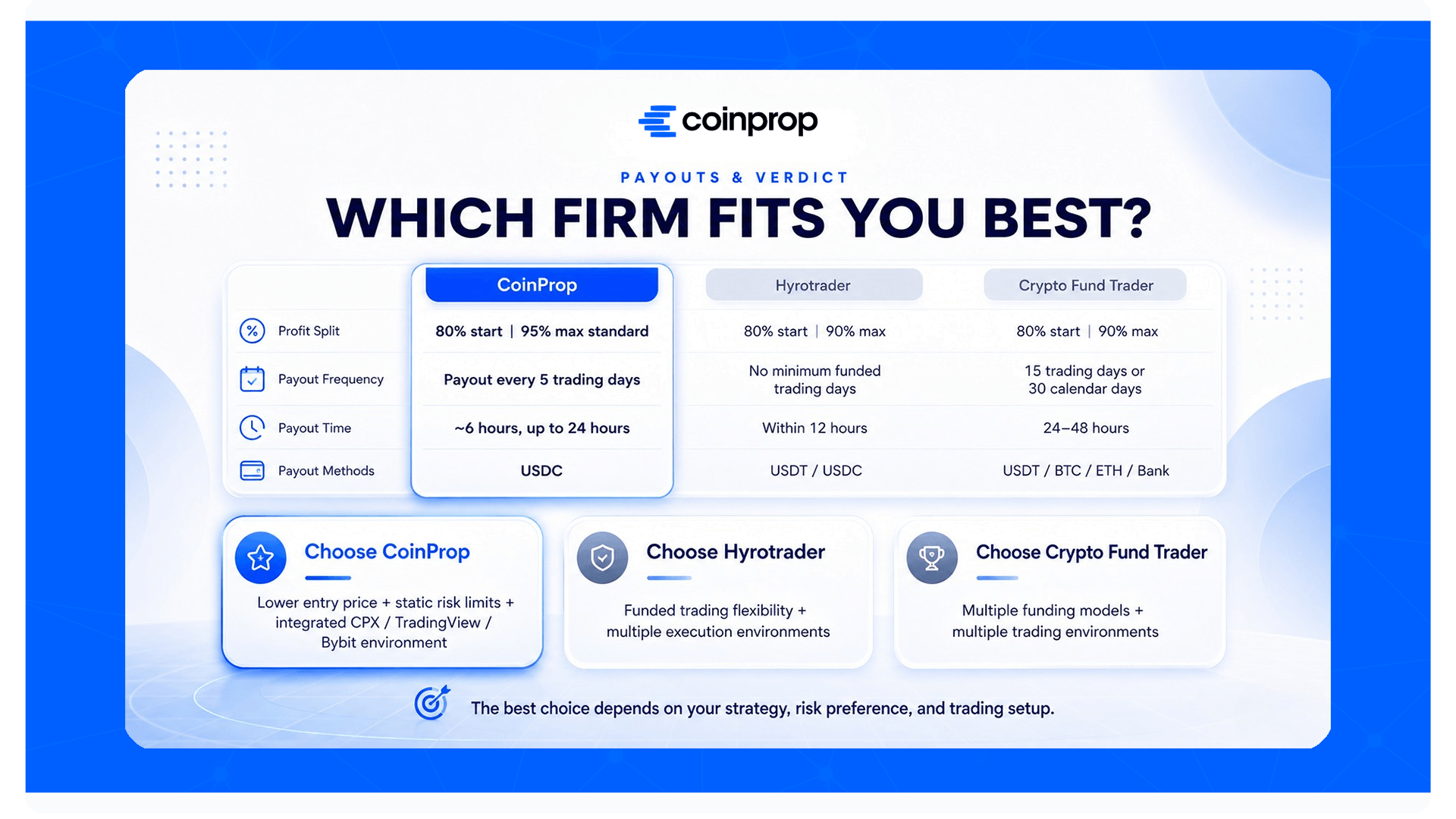
There is no single best crypto prop firm for every trader. The better choice depends on the rules, trading infrastructure, market access, and payout conditions that matter most to your trading approach.
CoinProp may be a better fit for traders who prioritize a low entry price, a 9% profit target, and static risk limits across its One Step challenges.
Its two One Step plans offer different risk structures:
The Booster 10K account is priced at $49, making it less expensive than the $80 Crypto Fund Trader 10K One Step account and the $129 Hyrotrader 10K account. The Booster also has no minimum evaluation trading day requirement.
By comparison, the Signature 10K account costs $99 but provides a wider 6% static maximum drawdown and requires 2 qualifying evaluation trading days.
CoinProp may also appeal to traders who prefer an integrated trading environment. Its CPX Terminal includes native TradingView integration and live Bybit market data and liquidity, while its trading conditions provide up to 5× leverage on BTC, ETH, and SOL and up to 2× leverage on altcoins and meme coins without the same profit counting restriction applied by Hyrotrader.
The choice between Booster and Signature therefore depends on the trader's priorities. Booster offers a lower entry price and a simpler minimum day requirement, while Signature provides a wider drawdown buffer.
Hyrotrader may be a better fit for traders who prioritize no minimum funded trading days, multiple trading environments, and a gradual increase in profit share over time.
Its support for Bybit, Tealstreet, and CLEO gives traders several execution environments to choose from, while its published profit split structure can increase from 80% toward 90% based on funded trading time and applicable requirements.
However, traders should also consider Hyrotrader's additional trading restrictions, including its 40% consistency requirement, altcoin allocation limits, cumulative exposure rules, and maximum margin restriction.
For traders who are comfortable with these restrictions and place greater importance on funded account flexibility and multiple execution environments, Hyrotrader can be a suitable alternative.
Crypto Fund Trader may be worth considering for traders who want access to multiple funding models and trading environments.
Its 10K One Step account is priced at $80, placing it between CoinProp Booster at $49 and CoinProp Signature at $99. Crypto Fund Trader also offers different funding structures, including One Step, Two Step, and Instant Funding programs.
Crypto Fund Trader also provides multiple trading environments, including Bybit and CFD based trading through MT5 and Match Trader. This may appeal to traders who want to choose between exchange based crypto trading and CFD based environments.
However, Crypto Fund Trader's public documentation does not disclose every trading and payout condition as clearly as the corresponding information available for CoinProp and Hyrotrader. Where a directly comparable rule could not be verified, this comparison uses Not clearly disclosed rather than making an assumption.
The comparison does not produce a universal winner. Instead, each option has different strengths:
The most suitable firm, or CoinProp plan, is therefore the one whose specific rules, risk structure, trading environment, and pricing align with the way you trade, rather than simply the firm with the lowest challenge price or highest advertised profit split.
There is no universal winner among CoinProp, Hyrotrader, and Crypto Fund Trader. Each firm stands out in a different area, and the better choice depends on which conditions matter most to the trader.
Crypto Fund Trader stands out for its lowest 10K One Step entry price at $80, making it the most cost focused option among the three firms compared.
Hyrotrader is a strong option for traders who prioritize funded account flexibility, particularly the absence of a minimum funded trading day requirement and its choice of trading environments, including Bybit, Tealstreet, and CLEO.
CoinProp stands out for combining a 9% profit target, static risk structure, and integrated crypto trading infrastructure. Its two One Step challenges provide different risk profiles: Signature offers a 6% static maximum drawdown, while Booster offers a lower entry price with a tighter 3% static maximum drawdown and no minimum evaluation trading days.
Both CoinProp plans use the CPX Terminal with native TradingView integration and live Bybit market data and liquidity, alongside the firm's crypto focused trading infrastructure and BTC, ETH, SOL, and altcoin trading capacity.
Ultimately, the right choice is not simply the firm with the lowest price or highest profit split. Traders should choose the challenge whose evaluation rules, risk structure, trading environment, and payout conditions best match their own trading approach.
For a 10K One Step Challenge, CoinProp Booster is the cheapest option at $49, followed by Crypto Fund Trader at $80, CoinProp Signature at $99, and Hyrotrader at $129.
Both CoinProp Signature and Booster have the lowest profit target at 9% among the challenges compared in this article. Hyrotrader and Crypto Fund Trader use a 10% target for the accounts compared here.
CoinProp Signature has a 6% static maximum drawdown, while CoinProp Booster has a 3% static maximum drawdown.
On a $10,000 account, this represents a $600 threshold for Signature and a $300 threshold for Booster. Booster therefore has a lower entry price but a tighter maximum drawdown.
Both CoinProp Signature and Booster use static maximum drawdown, at 6% and 3%, respectively.
Crypto Fund Trader uses a 6% trailing maximum drawdown. Hyrotrader's standard account is advertised with a 6% maximum drawdown, but traders should verify the exact calculation method under the applicable account rules.
CoinProp Booster has no minimum evaluation trading day requirement. Signature requires 2 qualifying trading days.
Hyrotrader currently requires 5 evaluation trading days, while Crypto Fund Trader's minimum evaluation trading day requirement is not clearly disclosed in the publicly available information reviewed for this comparison.
CoinProp supports native TradingView integration through its CPX Terminal on both its Signature and Booster challenges.
Neither Hyrotrader nor Crypto Fund Trader offers the same type of native TradingView integration within a proprietary trading terminal.
CoinProp uses live Bybit market data and liquidity through CPX across its trading environment. Hyrotrader also supports Bybit based trading, depending on the selected setup.
Crypto Fund Trader supports Bybit among its available trading environments, although its exact market data configuration can depend on the selected platform.
No. Hyrotrader does not currently require a fixed minimum number of funded trading days before an eligible trader can request a payout, subject to its other applicable payout conditions.
No, not all of them. Some Crypto Fund Trader trading, payout, and account conditions are not clearly disclosed in its publicly available information at the same level of detail as CoinProp and Hyrotrader.
Where a directly comparable rule could not be verified, this article uses Not clearly disclosed rather than making an assumption.
Among the standard conditions compared in this article, Hyrotrader and Crypto Fund Trader offer the highest standard maximum profit split at 90%.
Both CoinProp Signature and Booster have an 80% standard profit split. Optional upgrades are excluded from this comparison.
CoinProp offers up to 5× leverage on BTC, ETH, and SOL on both Signature and Booster.
Hyrotrader limits cumulative open position exposure to 2× the initial account balance for BTC, ETH, and SOL. Crypto Fund Trader's comparable BTC/ETH/SOL trading capacity rule is not clearly disclosed.
