High leverage in crypto prop firms amplifies both opportunity and risk by magnifying price movements within a structured risk framework. It enables traders to control larger positions with limited capital, but requires strict discipline to stay within drawdown limits. Understanding how leverage interacts with execution speed and market volatility is key to maintaining consistent performance in crypto prop trading environments.

High leverage in crypto prop trading is often misunderstood as a tool for simply increasing position size, but in reality, it functions more like a mechanism for capital efficiency within a controlled risk environment. It allows traders to access larger market exposure without directly committing large amounts of personal capital, which fundamentally changes how strategies are executed.
In fast-moving crypto markets, where volatility can expand within minutes, leverage plays a key role in how quickly price movements translate into trading outcomes. A small shift in price can have a meaningful impact on account equity, which is why precision and risk control become more important than raw exposure.
In a prop trading environment, this structure becomes even more defined. A funded account allows traders to operate with significantly larger notional value than their initial account size. For example, a $100K funded account combined with 1:5 leverage can provide exposure of up to $500K in market positions, while still being constrained by strict drawdown and risk management rules. This setup is not about increasing risk, but about improving capital efficiency under controlled conditions.
Because of this framework, high leverage should not be viewed as a shortcut to higher profits, but rather as a tool that amplifies both opportunity and responsibility. Understanding how leverage is used inside professional environments is a core part of evaluating modern trading models, especially within structured funding systems such as crypto prop trading firms.
Ultimately, success in high leverage prop trading depends less on how much exposure is available and more on how effectively a trader can manage execution, discipline, and risk under pressure.
High leverage doesn’t just increase position size, it changes the speed at which market movements impact your account. In simple terms, small price fluctuations start to matter much more, both in profit and in loss.
This creates a faster feedback loop between decision and outcome. A setup that would normally take time to develop in a low-leverage environment can reach profit targets or drawdown limits much quicker when leverage is high.
For traders, this speed effect means there is less room for hesitation or emotional delay. Execution needs to be precise, because the market reacts to your position with amplified sensitivity.

Prop firms don’t offer high leverage as an open invitation to take bigger risks, they pair it with strict risk controls for a reason.
Systems like daily drawdown limits, overall loss caps, and position sizing rules exist to ensure that leverage is used within a controlled framework. Without these constraints, high leverage would quickly lead to inconsistent results and account blowups.
These controls are not designed to limit opportunity, but to standardize risk across all traders. The goal is to create an environment where skill, discipline, and consistency matter more than aggressive exposure.
In this structure, leverage becomes a tool for efficiency, not uncontrolled speculation.
Successful prop traders learn quickly that high leverage is neither purely an advantage nor a risk, it’s a balance between speed and control.
Speed gives you the ability to capture opportunities as they appear in fast-moving crypto markets. Control ensures that those opportunities do not turn into unnecessary losses.
The real skill lies in combining both. Traders who focus only on speed often overtrade or overexpose themselves. Those who focus only on control tend to underutilize opportunities and miss the full potential of their setups.
In the end, consistency comes from aligning fast execution with strict risk discipline. That balance is what allows leverage to work as an advantage rather than a liability.
High leverage in crypto prop trading is one of those concepts that sounds simple at first, but changes everything once you actually work with it in real markets. It’s basically the difference between trading with your own limited capital and trading with amplified buying power provided by a prop firm.
In crypto, where price movements can be sharp, fast, and sometimes chaotic, leverage becomes less of a nice feature and more of a structural part of how traders try to scale returns. Prop firms step into this space by giving traders access to larger position sizes than they could normally afford, while still enforcing risk rules to keep losses controlled.
But to really understand how this works, you need to break it down properly, starting with what leverage actually means in crypto trading.
High leverage simply means controlling a larger position in the market with a smaller amount of capital.
For example, with 1:100 leverage, every $1 you risk controls $100 worth of market exposure. So instead of needing thousands of dollars to open a meaningful Bitcoin position, you can control that same size with a fraction of the capital.
In crypto trading, this has two very real effects:
First, small price movements suddenly matter a lot more. A 1% move in the market can feel like a big swing in your account balance when leverage is applied
Second, execution timing becomes critical. When positions are amplified, even minor mistakes in entry or stop placement can decide whether a trade becomes highly profitable or hits drawdown quickly.
That’s why high leverage is not just about bigger profits, it’s really about precision. The higher the leverage, the less room there is for emotional or technical errors.
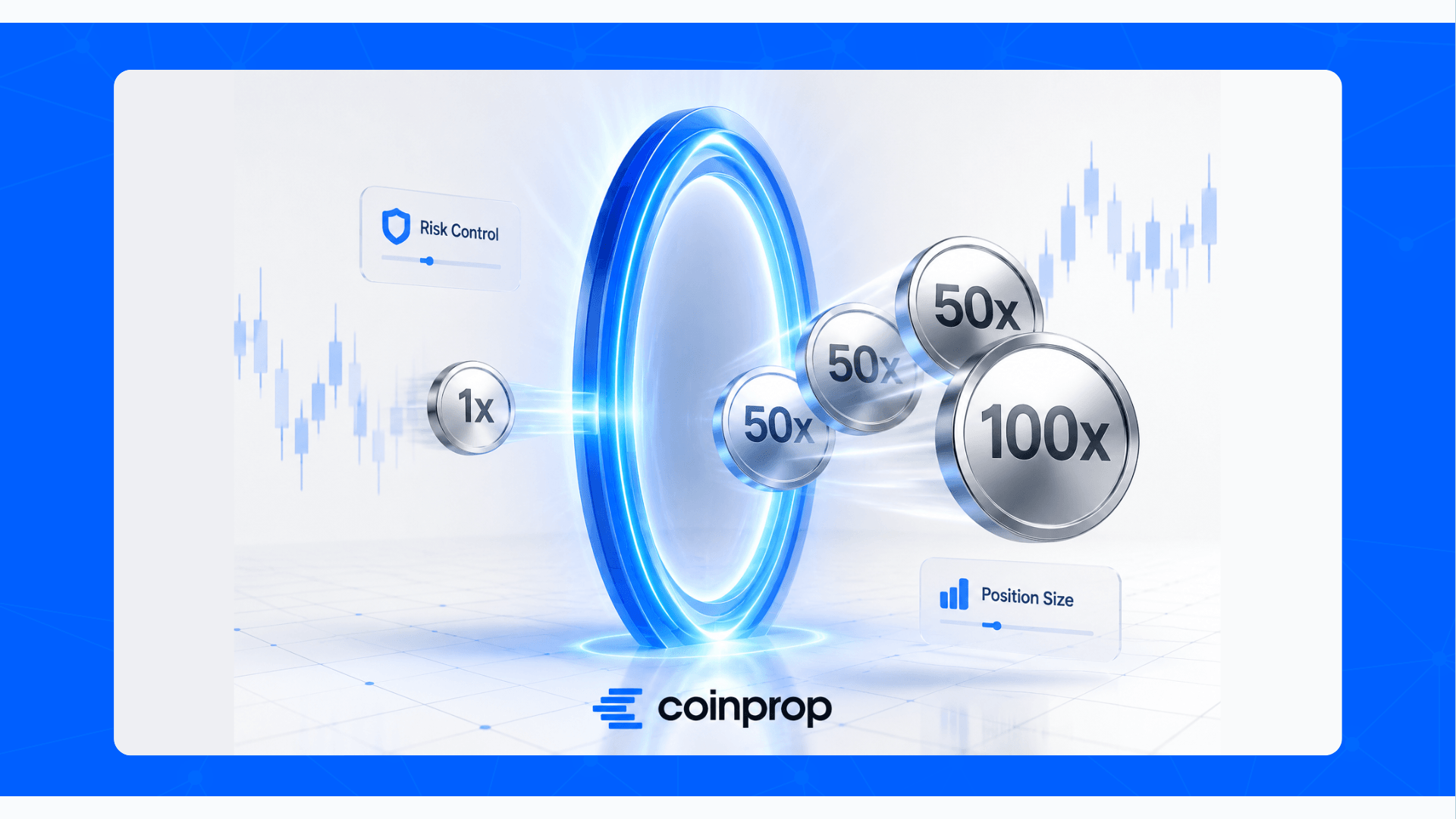
Most traders misunderstand this part. Prop firms don’t offer leverage just to make trading more exciting or aggressive. They offer it because it solves a structural problem in trading: capital efficiency.
Very few traders start with enough personal capital to generate meaningful returns without taking excessive risk. Even a skilled trader with a small account is limited by position size. Leverage bridges that gap.
Instead of asking traders to risk their own savings to scale up, prop firms provide funded capital. Leverage then becomes a tool to:
In other words, prop firms separate skill from capital. If you can trade well, you don’t need to be rich first, you just need to be consistent.
But there’s another reason leverage exists in prop models: risk control. By combining funded accounts with strict drawdown rules, firms can offer large notional exposure while still protecting the downside.
So instead of traders risking everything personally, risk becomes structured, measured, and capped.
High leverage is one of those tools that doesn’t change the market, it changes how strongly you feel the market.
On the opportunity side, leverage allows traders to:
This is why scalpers and intraday traders often rely heavily on leverage. Without it, many setups simply wouldn’t be worth trading.
But the downside is just as real, and often underestimated.
Leverage amplifies mistakes just as much as it amplifies gains. A small miscalculation in position size or a slightly late entry can turn into a fast drawdown. In volatile crypto conditions, price can move against you quickly enough that hesitation becomes expensive.
There’s also a psychological layer. Higher leverage tends to increase emotional pressure. Traders start reacting to short-term fluctuations instead of sticking to their strategy, which is usually where accounts begin to break down.
So the real trade-off is not risk vs reward in a simple sense. It’s more like:
High leverage works best when it is treated as a tool for execution efficiency, not as a shortcut to bigger profits.
In prop trading, that distinction is everything.
High leverage in crypto prop firms isn’t just a bigger multiplier on your trades. In practice, it’s a system that connects margin, position sizing, and risk limits into one controlled environment. If you understand how these three pieces interact, leverage stops being abstract and becomes something you can actually work with instead of fear.
Most traders only see the surface, 1:100 leverage means I can trade more. But inside a prop firm, what really matters is how that leverage behaves under drawdown rules, execution conditions, and liquidation thresholds.
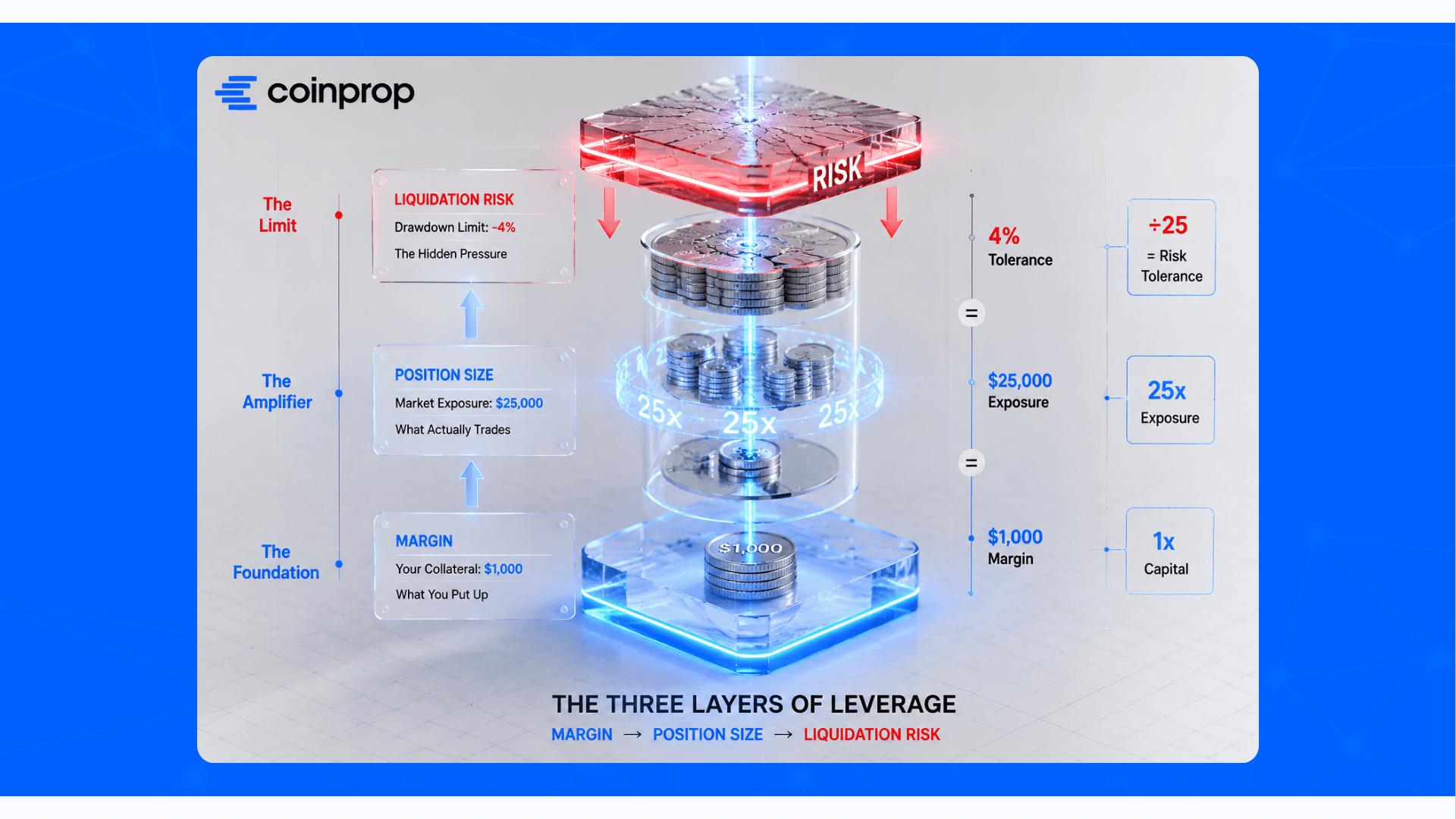
To understand leverage properly, you need to separate three things that are often mixed together: margin, position size, and liquidation risk.
Margin is the actual capital you put up to open a trade. In a prop firm, this isn’t usually your own money in the traditional sense, but it still acts as the collateral for the position.
Position size is the real exposure in the market. This is what actually moves your profit and loss. With leverage, your position size can be many times larger than your margin.
So if you’re using 1:100 leverage, putting up $1,000 margin could control a $100,000 position. That’s where things start to feel different, because now every small price movement is affecting a much larger notional value.
Liquidation risk is the hidden pressure behind all of this. Even in prop environments where you don’t get traditional liquidations like retail margin accounts, you still have a functional equivalent: drawdown limits. If your losses reach a certain level too quickly, the account is effectively done.
So the real danger isn’t leverage itself, it’s how quickly leverage can push your position close to those risk boundaries if you’re not sizing correctly.
Leverage doesn’t create profit or loss, it just scales the outcome of whatever you’re already doing.
If price moves in your favor, leveraged positions accelerate gains. A small percentage move in the market turns into a much larger percentage move on your account equity. This is why traders use leverage in the first place: it compresses time. Instead of waiting weeks for meaningful returns, a well-timed move can deliver results in hours or even minutes.
But the same mechanism works in reverse.
A small adverse move becomes much more painful when position size is amplified. This is where most inexperienced traders misinterpret leverage, they focus on the upside without fully internalizing how fast downside pressure builds in volatile crypto conditions.
In prop trading specifically, this effect is even more noticeable because of strict daily and overall drawdown rules. You’re not just trading against the market, you’re also trading within a predefined risk envelope. That means leverage doesn’t just impact profit potential, it directly influences how long you can stay in the game.
Professional traders don’t use leverage to make more money. They use it to optimize risk-to-reward efficiency. The goal is not bigger trades, it’s cleaner execution of high-probability setups with controlled risk per position.
Let’s make this practical.
Imagine you’re trading with a $10,000 funded account and using 1:100 leverage.
That gives you theoretical control over a $1,000,000 position. But in reality, no serious trader uses that full capacity blindly. What matters is how much of that leverage you actually deploy.
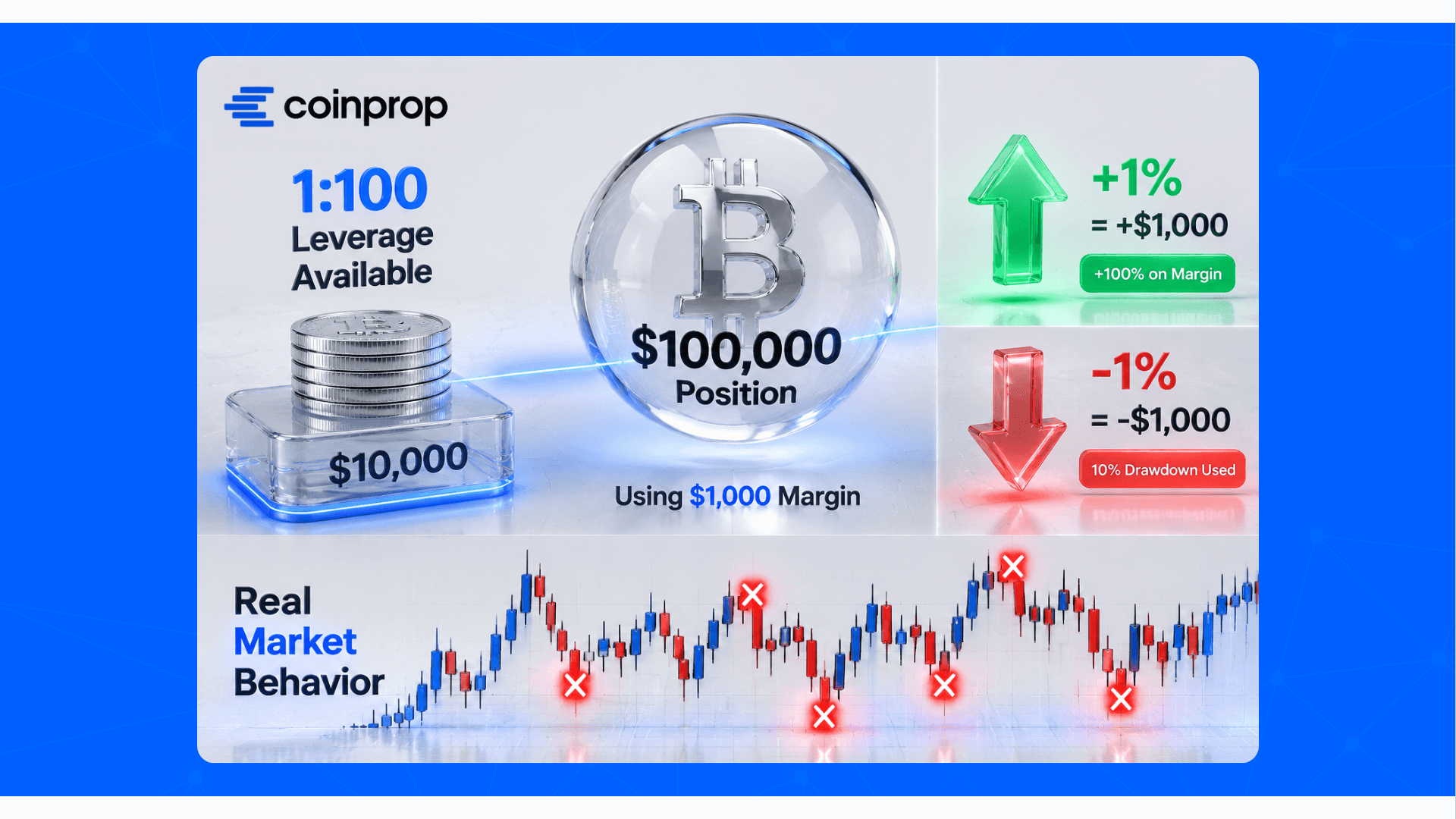
Say you open a $100,000 position in Bitcoin using $1,000 margin. If Bitcoin moves 1% in your favor, that’s a $1,000 gain, effectively a 100% return on your margin for that trade.
Sounds powerful, but the reverse is just as important. A 1% move against you equals a $1,000 loss on the same position. In a prop firm environment, that single move might represent a significant portion of your daily drawdown limit.
Now bring in real market behavior, crypto rarely moves in straight lines. It spikes, pulls back, hunts liquidity, and creates short-term volatility that can easily trigger stops if your positioning is careless.
So in practice, experienced traders rarely think in terms of how much leverage can I use. Instead, they think:
That’s the real use of 1:100 leverage, it’s not about maximizing exposure, it’s about having enough flexibility to size a precise idea properly without being constrained by capital.
In other words, leverage doesn’t make bad trades better. It just gives good trades enough room to be expressed properly.
If you’ve traded long enough, you eventually stop looking at leverage as a feature and start seeing it as a workaround for a much bigger problem: capital limitation. In prop trading, high leverage isn’t about being aggressive for the sake of it, it’s about making a strategy actually work in real market conditions without needing a large personal account.
Most profitable strategies in crypto don’t fail because they’re wrong. They fail because the trader doesn’t have enough capital to scale them properly while still respecting risk limits. That’s exactly where prop firms and high leverage step in.
There’s a huge difference between trading a small personal account and trading a funded prop account, even if the strategy is identical.
With a small account, everything is constrained. You might have a good setup, a clean entry model, even a solid win rate, but your position size is so limited that the returns feel slow and sometimes discouraging. Traders often end up overleveraging their personal funds just to make progress feel meaningful, which usually backfires.
High leverage in prop trading removes that bottleneck.
Instead of trying to force growth on a small balance, you’re working with a funded structure where position size is no longer artificially capped by your deposit. That changes the psychology completely. You stop thinking in terms of how much can I afford to risk from my own pocket and start thinking in terms of execution quality.
But more importantly, it allows scaling strategies that actually need size, like scalping, intraday reversals, or short-term volatility plays, without needing unrealistic personal capital.
In simple terms: small accounts force compromise, funded accounts allow precision.
Crypto is not a slow market. It moves in bursts, liquidity shifts fast, and opportunities often exist in very short windows. That makes capital efficiency more important than just capital size.
High leverage becomes useful here because it allows traders to allocate capital dynamically instead of locking it into long, slow positions.
A trader doesn’t want to tie up $50,000 just to catch a 1–2% move. That’s inefficient. But with leverage, the same exposure can be achieved with a fraction of the capital, leaving room to diversify across multiple setups instead of overcommitting to a single trade.
This is where experienced traders think differently from beginners. They’re not trying to maximize exposure on one idea, they’re trying to maximize opportunity coverage across multiple high-quality setups.
In prop environments, this becomes even more relevant because capital isn’t the limiting factor anymore, execution quality is. So leverage shifts from being a risk amplifier to being a capital allocation tool.
Used properly, it allows traders to stay active in multiple conditions:
Without constantly running out of usable margin or missing opportunities because capital is tied up elsewhere.
One of the biggest psychological shifts in prop trading is realizing you don’t need to risk your own capital to scale.
In traditional trading, every decision carries personal financial weight. That naturally leads to hesitation, under-sizing, or on the opposite end, reckless over-sizing when traders try to make it back faster. Both are emotional reactions to capital risk.
Prop models change that structure completely.
Instead of risking your entire account or personal savings, you’re operating within a controlled risk framework. The firm absorbs the capital exposure, while you operate under defined drawdown limits.
High leverage inside this model is not about increasing personal risk, it’s about maximizing efficiency within a protected environment.
That distinction matters more than most traders realize.
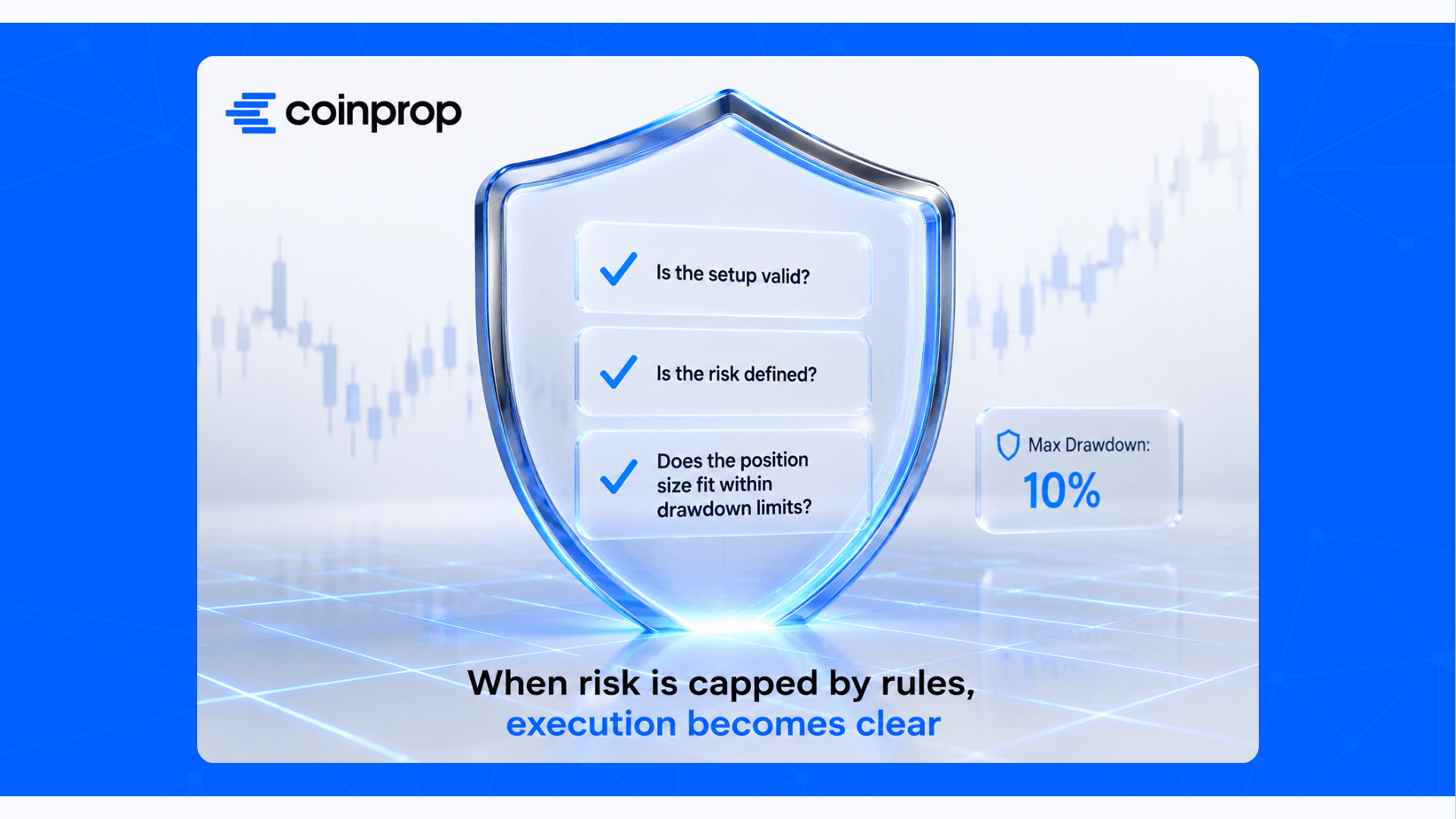
Because when your downside is capped by rules instead of personal exposure, your decision-making improves. You stop trading emotionally and start focusing on execution:
This is where high leverage actually becomes logical instead of dangerous. It allows you to express a trading idea fully without needing to overcommit personal capital or hesitate due to fear of loss.
In a way, prop trading flips the usual equation. You’re no longer using leverage to take bigger risks. You’re using it to remove capital friction so your strategy can operate at full efficiency under controlled risk
When it comes to liquidity and market credibility, Bybit is one of the most recognized exchanges in the crypto industry. With consistently high daily trading volumes and deep order books across major assets, it has become a benchmark for real market pricing and execution conditions.
In practice, this level of liquidity matters because leverage is only as effective as the underlying market quality. Fast execution, tight spreads, and stable pricing environments allow traders to apply leverage more efficiently without unnecessary distortions.

A common question among traders is why prop firms are needed when exchanges like Bybit already offer margin trading with leverage up to 1:10 or higher. The difference is not the availability of leverage, but the structure around it.
On exchanges, traders use leverage with their own capital, meaning every position carries direct personal financial risk. In highly volatile crypto conditions, even a small adverse move can lead to liquidation or significant losses.
In contrast, prop trading models introduce leverage within a controlled framework, where risk is defined by drawdown limits and evaluation rules rather than margin alone. This shifts the focus from capital protection to performance consistency.
The key distinction is not just leverage, but the execution environment. In traditional setups, traders may face slippage variability, inconsistent fills, or liquidity gaps during high volatility.
Prop trading environments aim to standardize this experience by aligning execution with structured market feeds and risk systems. This allows traders to focus on strategy execution rather than infrastructure uncertainty.
The difference between exchange trading and prop trading is not just about leverage, it’s about the entire execution environment and how risk is structured.
In traditional exchange trading, traders operate directly with their own capital. This means every position is fully exposed to market risk, and outcomes depend entirely on personal risk management. Leverage is available, but it amplifies both profit and loss on the trader’s own funds, which can lead to liquidation during volatile market conditions.
In a prop trading environment, the structure changes significantly. Traders still use leverage, but the risk is defined by preset drawdown limits and account rules rather than direct capital exposure. This creates a controlled environment where performance is measured within boundaries, not open-ended personal risk.
Execution quality is also a key difference. On exchanges, trading conditions can vary depending on liquidity, volatility, and order flow. In prop environments, execution is typically standardized to reduce inconsistencies and allow traders to focus on strategy rather than infrastructure issues.
The result is two very different models: one where leverage is tied directly to personal capital risk, and another where leverage is embedded inside a structured risk system designed for consistency and scalability.
When traders start comparing prop firms, most of them focus on the wrong thing first, leverage. But in reality, leverage is only useful if the infrastructure behind it can actually support consistent execution and risk control.
A high leverage prop firm isn’t good just because it offers big numbers on paper. What matters is how that leverage behaves in real trading conditions: execution speed, slippage behavior, drawdown structure, and how easily you can actually extract profits.
If you strip away marketing noise, the best firms all share a few core traits that directly impact your ability to survive and scale.

Execution quality is where most traders feel the difference between a real prop environment and a weak one.
High leverage only works if entries and exits are precise. In fast-moving crypto markets, even a small delay or inconsistent fill can completely distort your risk model. You might plan a tight stop based on structure, but if execution slips, your actual risk becomes something very different from what you calculated.
That’s why serious traders always look at:
In practical terms, good execution means your trade behaves the way you planned it. Bad execution means your strategy slowly breaks down even if your analysis is correct.
For high leverage trading, this becomes even more critical because leverage amplifies execution errors just like it amplifies profits.
Not all assets in crypto behave the same way, so leverage shouldn’t be treated as a fixed number across everything.
A solid prop firm usually adjusts leverage depending on:
For example, Bitcoin and Ethereum typically allow higher and more stable leverage because they have deep liquidity and tighter spreads. On the other hand, altcoins and memecoins may require more conservative leverage due to sharper price swings and thinner order books.
The key thing traders should look for is flexibility, not just maximum leverage.
A firm that blindly offers extreme leverage on everything is usually compensating for weak risk control elsewhere. A well-structured firm balances leverage with asset behavior so traders can scale when conditions are clean and reduce exposure when markets get chaotic.
This is where most traders either succeed or get eliminated.
High leverage means nothing if drawdown rules are too tight or poorly structured. In prop trading, drawdown is effectively your real risk ceiling, not your stop loss.
The most important things to evaluate are:
A good prop firm gives you enough room to actually execute a strategy without forcing you into over-defensive trading after one or two losses.
But there’s a balance. Too loose, and risk management becomes meaningless. Too strict, and traders are forced into unrealistic precision that doesn’t match real market behavior.
High leverage only works when drawdown rules are aligned with natural volatility, not against it.
At the end of the day, traders don’t trade leverage, they trade for payouts.
Payout speed and structure are where trust is either built or lost.
A strong prop firm usually offers:
But beyond the numbers, what really matters is reliability. If a trader hits their target but faces friction during withdrawal, the entire model loses credibility.
Experienced traders pay attention to how smooth the transition is from trading to payout. Because in real prop trading, consistency of cash flow is just as important as consistency of trades.
High leverage might get you to the target faster, but payout structure determines whether that effort actually translates into real, usable income.
In other words, execution gets you into profit, but payout systems decide whether that profit actually matters.
High leverage only becomes meaningful when it’s paired with a strategy that actually needs it. Otherwise, it just turns normal trading into unnecessary risk. In prop trading, experienced traders don’t use leverage to trade bigger in a random way, they use it to express precise setups where small price inefficiencies can be monetized efficiently.
The key idea here is simple: leverage should support structure, not replace it.
Smart Money Concepts (SMC) trading fits naturally with high leverage because it’s built around precision entries and invalidation-based risk.
In this approach, traders are not guessing direction, they’re waiting for structure to form around liquidity pools, order blocks, and displacement moves. Entry points are usually very specific, and stop losses are placed just beyond structural invalidation zones.
That’s where leverage becomes useful.
Instead of needing wide stops to stay safe, traders can keep stops extremely tight and use leverage to scale position size appropriately. The idea is not to increase risk, but to increase efficiency: small invalidation distance, controlled risk per trade, and high reward potential if the structure plays out.
SMC with leverage is essentially about timing liquidity events and letting the market confirm direction before committing size.
Scalping is probably the most leverage-dependent style in crypto prop trading.
In low timeframes, price movement is small, fast, and noisy. Without leverage, most of these moves are irrelevant from a profit perspective. But with high leverage, even minor fluctuations become tradable opportunities.
Scalpers rely heavily on:
In volatile crypto sessions, especially during spikes or news-driven moves, scalping becomes a way to repeatedly extract small edges from market inefficiencies.
The important part is discipline. High leverage in scalping doesn’t mean holding longer or hoping for bigger moves. It means executing fast, taking profit quickly, and avoiding exposure to unpredictable swings.
Done properly, scalping turns leverage into a tool for velocity, not aggression.
Range markets are often overlooked, but in crypto they happen more often than trends.
When price is moving sideways between clear support and resistance, most traders either lose patience or overtrade. But high leverage changes the equation completely.
In range trading, leverage allows traders to:
The key is efficiency. Each trade might only capture a small portion of movement, but with proper position sizing, those small moves become meaningful.
Instead of waiting for big trends, range traders using leverage focus on consistency, multiple controlled trades inside a defined structure.
The edge here comes from repetition, not prediction.
Trend trading with high leverage is less about entering big and more about building into strength.
In strong crypto trends, price doesn’t move in a straight line, it moves in waves. This creates opportunities to add to winning positions instead of committing full size upfront.
Pyramiding is the core concept here:
Leverage supports this by allowing traders to scale positions without tying up excessive margin early in the move.
The real advantage is psychological as much as technical. Instead of trying to predict the full move from the start, traders respond to structure as it develops. If the trend continues, they build exposure. If it fails, initial risk is already defined.
In strong markets, this approach turns leverage into a compounding mechanism rather than a single-shot bet.
In all four strategies, the common theme is the same: high leverage is not the strategy itself. It’s the tool that allows precision-based trading models to function efficiently in fast-moving crypto conditions.
If there’s one thing that separates traders who survive from those who blow up in high leverage environments, it’s not entry strategy, it’s risk management. In crypto prop trading, leverage doesn’t kill accounts by itself. Poor control of position size, stops, and emotional reaction to volatility does.
High leverage simply speeds everything up. It makes your decisions matter faster, and your mistakes show up sooner.
In prop trading, drawdown limits are the real boundary of survival. Not your account balance, not your leverage level, your drawdown.
That’s why professional traders don’t size positions based on how confident they feel or how strong a setup looks. They size based on how much they can afford to lose within the rules of the account.
A proper approach is to work backwards:
This mindset completely changes how you use leverage. Instead of how big can I go, the question becomes how do I stay inside risk limits while still expressing the setup properly.
When done correctly, leverage becomes invisible. It stops being a decision and becomes a structural tool for sizing.
With high leverage, stop loss placement is not just technical, it’s structural survival.
A stop that is too tight gets you chopped out by normal volatility. A stop that is too wide turns leverage against you by exposing too much capital per move.
Professional traders place stops based on invalidation, not comfort. That usually means:
The goal is not to avoid being wrong. The goal is to be wrong in a controlled, predictable way.
In leveraged environments, stop placement directly defines position size. A tighter stop allows smaller risk per trade and more efficient capital usage. A wider stop requires smaller size to stay within drawdown limits.
This is where most traders make mistakes, they decide to stop placement emotionally, then try to fix risk with leverage. It should always be the other way around.
Overleveraging is rarely intentional. It usually happens gradually.
A trader wins a few trades, confidence increases, and position size slowly creeps up without proper recalculation of risk. Or they try to recover faster after a loss and increase exposure beyond their plan.
The problem is that high leverage hides these mistakes until it’s too late.
Common overleveraging patterns include:
The solution is discipline in sizing logic. Every trade should be independent in terms of risk calculation. If leverage is being used correctly, it should never feel like you are pushing harder. It should feel consistent, repetitive, and controlled.
Experienced traders treat overleveraging not as a risk event, but as a process failure. If position size is changing emotionally, the system is already broken.
High leverage doesn’t just affect the account, it affects the trader.
When positions are amplified, price fluctuations feel faster and more intense. Even normal market noise can look like significant profit or loss. This creates psychological pressure that directly impacts decision-making.
The biggest issues traders face are:
In fast-moving crypto markets, this emotional reaction is often more dangerous than the strategy itself.
Professional traders manage this by shifting focus away from PnL and toward process. They don’t watch every tick. They don’t react to every candle. They operate based on predefined conditions and let the market play out.
High leverage magnifies everything, including discipline. If your system is structured, it rewards patience. If it’s emotional, it exposes it immediately.
In the end, the psychological side of leverage is just as important as the technical side. The market doesn’t change because you are stressed, but your decisions do.
Most accounts don’t get blown because the trader doesn’t know trading. They get blown because high leverage exposes small behavioral mistakes at scale. Things that would normally feel manageable in a small account suddenly become account-ending decisions when position size is amplified.
In prop trading, the edge is rarely just strategy. It’s execution discipline under pressure.
One of the most common traps is confusing leverage with skill progression.
A trader hits a few wins, increases position size, and suddenly the trades feel more important. That psychological shift often gets misinterpreted as I’m improving, when in reality it’s just increased exposure.
Large position size creates an illusion of control. Every tick feels meaningful, every small win feels like confirmation of superiority. That’s where discipline starts to degrade.
Overconfidence usually shows up in subtle ways:
In high leverage environments, confidence should come from consistency, not from size. When size becomes the source of confidence, the account is already in danger.
Crypto is not a linear market. It’s a liquidity-driven, volatility-heavy environment where price often moves to hunt stops before continuing in the intended direction.
A major mistake traders make with high leverage is ignoring this reality and treating all market conditions the same.
Low liquidity periods, news events, and sudden volatility spikes can completely distort price behavior. In those moments:
High leverage in these conditions turns normal volatility into unnecessary risk.
Professional traders adjust exposure based on market conditions. They don’t just ask what is the setup? They also ask what is the environment right now? Because leverage behaves very differently in calm vs. chaotic markets.
One of the fastest ways to destroy a leveraged account is entering trades based on anticipation instead of confirmation.
In low leverage trading, you can sometimes survive early entries or slightly imperfect timing. In high leverage trading, that margin for error disappears quickly.
Lack of confirmation usually looks like:
The problem is not just accuracy, it’s timing. Even a correct idea entered too early can turn into a losing trade because leverage amplifies the initial drawdown phase.
Experienced traders understand this clearly: they don’t try to predict the market. They wait for the market to prove direction first, then they execute.
If leverage exposes technical mistakes, revenge trading exposes emotional ones.
After a loss or drawdown hit, many traders immediately try to recover by increasing size or taking lower-quality setups. This is where discipline breaks completely.
Revenge trading usually follows a pattern:
In high leverage environments, this cycle escalates fast because every trade has amplified impact.
Professional traders treat drawdown as information, not emotional damage. A loss doesn’t create urgency, it triggers review. If the next trade is not objectively valid, it simply doesn’t exist.
The moment trading becomes emotionally reactive instead of structurally planned, leverage stops being a tool and starts becoming a multiplier of mistakes.
In high leverage prop trading, most failures don’t come from strategy breakdowns. They come from small behavioral shifts that get magnified by position size. The market doesn’t need traders to be wrong, it only needs them to be inconsistent.
High leverage in prop trading often gets misunderstood from the outside. It looks like firms are simply giving traders more power, but internally it’s actually a tightly controlled risk system. Prop firms don’t rely on leverage alone, they rely on structure, rules, and automated safeguards that make high leverage usable without letting it become destructive.
The goal is not to limit traders unnecessarily. The goal is to make sure leverage operates inside a predictable risk framework where both the trader and the firm are protected.
The core of any prop firm’s safety model is drawdown control. This is what actually defines risk, not leverage levels.
Daily and overall drawdown limits act like a hard boundary for account behavior. Once losses reach a certain threshold, trading is either restricted or the account is failed depending on the rules.
What makes this system effective is that it doesn’t care how the loss happens. Whether it comes from one large trade or multiple small ones, the result is the same: risk is capped.
Most prop firms also use:
This structure ensures that even if a trader uses high leverage, the maximum downside remains predictable. In other words, leverage increases exposure flexibility, but drawdown rules define survival.
From a firm’s perspective, leverage is not about encouraging risk-taking, it’s about enabling strategy diversity while maintaining control.
If leverage is too low, many legitimate trading strategies become inefficient or even untradeable. Scalping, short-term volatility trading, and precision-based entries all require enough position flexibility to make small moves meaningful.
But if leverage is too high without controls, the system becomes unstable. A few bad trades could wipe accounts too quickly, creating unsustainable risk for the firm.
That’s why most professional prop firms operate on a controlled leverage model:
In practice, firms are not trying to stop traders from using leverage. They are trying to ensure that leverage is used consistently with a risk-managed approach rather than impulsive scaling.
This balance is what allows prop firms to scale traders while keeping capital protected.
At first glance, leverage looks the same whether you’re trading on an exchange or inside a prop firm. But structurally, they are completely different systems.
On an exchange, leverage is directly tied to your personal capital. You are responsible for every gain and every loss. If liquidation happens, the damage is yours alone. There are no external constraints beyond margin requirements.
In prop trading, leverage is separated from personal financial risk. You are trading firm capital under predefined rules, not your own funds. That changes the entire dynamic of risk.
Key differences include:
The most important shift is psychological. On exchanges, traders often think in terms of how much can I afford to lose. In prop environments, the focus shifts to how well can I operate within risk rules while extracting consistent performance.
So while leverage looks similar on the surface, its meaning changes completely depending on the environment. In prop trading, leverage is not just a financial multiplier, it’s a controlled variable inside a structured risk system.
High leverage trading makes the most sense when you stop thinking of it as a bigger size and start seeing it as a way to express precise entries with controlled risk. The difference between a good and bad leveraged trade usually isn’t the leverage itself, it’s the quality of the setup and how clean the entry logic is.
Below are a few real-style examples that traders actually use in prop environments when they’re trying to combine structure with leverage efficiently.
One of the most common high probability setups in crypto is the liquidity sweep.
The idea is simple: price moves above a recent high or below a recent low, triggers stop losses from retail traders, and then quickly reverses once liquidity is taken.
In a leveraged context, this setup becomes very powerful because the invalidation point is usually very clear.
A typical scenario looks like this:
Because the stop is structurally tight, leverage allows proper position sizing without needing wide risk buffers. The key here is not predicting the sweep, it’s waiting for it to happen and reacting after the market shows its hand.
Fair Value Gaps are another popular model for leveraged trading because they provide clear inefficiency zones and structured risk placement.
After a strong impulsive move, the market often leaves behind an imbalance. Price tends to revisit this zone before continuing in the original direction.
In practice, traders:
The advantage of this setup in high leverage trading is precision. Entries are not random, they are anchored to structural inefficiencies. This allows tight stops, which is exactly what leverage needs to stay efficient.
When executed properly, the risk is small and clearly defined, while the potential move often extends far beyond the retracement zone.
High leverage trading becomes significantly more controlled when higher timeframe bias is combined with micro timeframe execution.
The process usually starts on a higher timeframe where the trader identifies:
But entry is not taken there. Instead, the execution happens on lower timeframes like 1-minute or 3-minute charts.
On these micro timeframes, traders wait for:
Only after this confirmation is a trade executed, with stops placed tightly behind the micro structure.
The role of leverage here is not to increase risk, but to compensate for the small stop distance. Without leverage, these small moves would not be meaningful. With leverage, they become precise, high efficiency entries.
This approach is especially common in prop trading because it balances two things: higher timeframe direction accuracy and lower timeframe execution precision.
In all three examples, the pattern is the same: leverage is not driving the trade. Structure is. Leverage only becomes useful once the market has already shown where risk is invalidated and where opportunity exists.
Memecoins are a completely different game compared to major crypto assets like Bitcoin or Ethereum. When you introduce high leverage into memecoin trading, you’re not just increasing exposure, you’re stepping into a market that behaves more like a liquidity-driven reaction system than a traditional trend structure.
Most traders underestimate this difference. They apply the same risk logic they use on majors, and that’s usually where things break down.
Memecoins don’t move on fundamentals or clean technical structure the same way larger assets do. They move on attention, liquidity bursts, and emotional trading cycles.
That changes everything about risk management.
In a leveraged environment, even a small position can behave aggressively because:
This means your usual clean structure + normal stop loss logic often doesn’t work the same way.
In practice, traders who survive memecoin volatility don’t try to eliminate risk, they redefine it. Stops are placed wider relative to noise, but position size is reduced accordingly so leverage still keeps exposure efficient.
The key shift is this: you stop treating memecoins like predictable instruments and start treating them like volatility engines.
The reason traders still use high leverage on memecoins is simple: volatility creates opportunity.
Low market cap coins can move 20%, 50%, sometimes even more in a very short time window. For leveraged traders, this kind of movement is where efficiency becomes interesting.
But the real edge isn’t just the size of the move, it’s the speed and compression of that move.
In a well-timed setup, leverage allows traders to:
The important part is timing. Memecoin trading is less about holding and more about catching phases of acceleration. Once momentum fades, the same leverage that helped you profit can work against you just as fast.
So experienced traders treat these opportunities as short bursts of activity, not long-term positions.
If there’s one thing that defines memecoin trading, it’s unpredictability in price action.
Wicks, spikes, and sudden reversals are not exceptions, they are normal behavior.
In high leverage environments, this becomes critical because:
This is why execution quality becomes just as important as strategy.
Professional traders manage this by:
Slippage risk is also a real factor in memecoins. During high volatility, price can move quickly through levels, meaning theoretical stop placement doesn’t always match actual execution.
The solution isn’t avoiding leverage, it’s respecting liquidity conditions. High leverage should only be applied when the market is actually capable of absorbing your position cleanly.
In memecoin trading, discipline matters more than precision prediction. The traders who survive are not the ones who catch every move, they are the ones who avoid getting caught in the wrong side of fast, chaotic swings.
In prop trading, getting the entry right is only half the job. The real difference between inconsistent traders and consistently profitable ones is how they manage the position after entry. High leverage doesn’t change that, it just makes good or bad management show its effects faster.
Scaling is where traders turn a single idea into a structured trade instead of a static bet. Done properly, it smooths equity curves, reduces emotional pressure, and improves overall capital efficiency.
Scaling in is not about increasing risk blindly, it’s about letting the market prove you right before committing full size.
In practice, experienced traders rarely enter their full position at once, especially in high leverage environments. Instead, they start with a smaller validation position when the initial setup appears.
Once price confirms direction, through structure breaks, pullbacks holding, or momentum continuation, they add additional positions.
This approach does two important things:
In trending crypto markets, this is especially useful because moves often develop in stages rather than in a single clean impulse. Scaling in aligns position size with market behavior instead of prediction.
If scaling in is about building exposure, scaling out is about protecting it.
One of the most common mistakes in leveraged trading is treating every position as all or nothing. Traders either fully close at the first target or hold everything and risk giving back profits.
Scaling out creates balance between those extremes.
A typical approach looks like:
This allows traders to lock in gains while still participating in larger moves if the trend continues.
In high leverage environments, this becomes even more important because volatility can reverse quickly. Scaling out ensures that even if the market pulls back sharply, the trade remains profitable overall.
Leverage becomes significantly more powerful when it’s used across multiple stages of a trade instead of a single entry point.
Instead of entering one large position and hoping for a full move, traders break execution into phases:
This structure turns leverage into a flexible tool rather than a fixed exposure decision.
The key advantage here is adaptability. Markets rarely move in a straight line, especially in crypto. Multi-stage positioning allows traders to adjust exposure as conditions evolve instead of being locked into a single static risk profile.
It also reduces psychological pressure. When a trade is structured in phases, no single decision defines the outcome. Each stage has its own logic, its own risk, and its own objective.
In high leverage prop trading, this is often the difference between surviving volatility and getting shaken out of it. Leverage works best not when it’s concentrated, but when it’s distributed intelligently across the lifecycle of a trade.

Most prop firms separate risk into two layers: daily drawdown and overall drawdown. Understanding the difference between them is critical because they behave very differently in practice.
Daily drawdown is about short-term control. It measures how much you can lose in a single day before your trading is restricted or the account is flagged. This rule is designed to prevent emotional spirals, one bad session shouldn’t destroy the entire evaluation.
Overall drawdown is the bigger boundary. It tracks total account loss from a starting point or peak equity. This is what ultimately defines whether you are still in the game.
The important thing traders often miss is that high leverage accelerates how fast both limits are approached. A single oversized position can hit daily drawdown in minutes, even if the long-term idea is correct.
So in practice:
Both must be respected at the same time, especially when using leverage.
Prop challenges are not about maximizing profit, they’re about surviving long enough to show consistency.
High leverage can help you reach targets faster, but only if it’s used within a controlled framework.
A realistic survival approach looks like this:
One of the biggest mistakes traders make in challenges is trying to speed up the process after a good trade or two. That usually leads to inconsistency and eventual drawdown breach.
Survival is not about being perfect, it’s about avoiding large, unnecessary mistakes repeatedly.
Account termination in prop trading almost always comes from one of three things:
overexposure, emotional decision-making, or ignoring drawdown structure.
Avoiding it is less about finding better entries and more about building a controlled trading rhythm.
The most important principles are:
High leverage doesn’t end accounts by itself, it exposes weak discipline faster. Traders who last in prop environments don’t avoid losses; they avoid loss escalation.
In the end, drawdown management is what turns leverage from a dangerous variable into a usable tool. Without it, even the best strategy eventually breaks.
High leverage is one of those topics that gets misunderstood quickly in crypto trading. A lot of traders assume that more leverage automatically means more opportunity, or that without it you’re somehow limited. In reality, the question isn’t whether high leverage is necessary, it’s when it actually adds value to your trading.
In prop trading, leverage is not the edge. Execution, risk control, and consistency are.
High leverage becomes useful in very specific conditions, not as a general requirement for trading.
It actually helps when:
In these situations, leverage is not about increasing aggression, it’s about making sure your position size accurately reflects your setup without being constrained by account size.
Without leverage, many short-term strategies simply don’t scale properly. The trade idea might be valid, but the capital efficiency is too low to make it meaningful.
So leverage has a role, but it’s situational, not mandatory.
One of the biggest shifts traders experience in prop trading is realizing they no longer need extreme leverage to achieve meaningful results.
In personal trading, leverage is often used to compensate for small account size. Traders try to amplify returns because the base capital is limited.
But in funded accounts, that constraint is already removed. You’re not trying to turn $1,000 into something significant, you’re working with a structured capital base where position size can already be meaningful.
That changes everything:
Instead, leverage becomes a fine-tuning tool, not a survival tool.
In many cases, lower or moderate leverage is actually more efficient in prop environments because it aligns better with drawdown constraints and reduces emotional pressure.
At the core, trading performance is not determined by leverage, it’s determined by how effectively capital is used.
Leverage is just a mechanism that changes how capital is expressed in the market. It doesn’t create edge. It doesn’t improve strategy quality. It only changes exposure.
What actually matters is:
A trader with strong execution and low leverage will outperform a trader with high leverage and poor control almost every time.
In prop trading, capital is already provided. That means the real focus shifts away from how much can I amplify toward how efficiently can I use what I already have.
Leverage is not the advantage. Capital discipline is.
And in the long run, traders who understand that distinction are the ones who stay funded.
Choosing a prop firm is not really about finding the one with the biggest leverage number on the website. That part is easy. The real challenge is figuring out which firm actually allows traders to perform consistently under real market conditions without hidden friction, unclear rules, or execution issues that slowly kill strategies over time.
In practice, the best high leverage prop firm is the one that doesn’t interfere with good trading. Everything else is secondary.
When experienced traders evaluate a prop firm, they don’t start with marketing claims. They look at how the environment behaves when real money risk is on the line.
The most important factors are:
A good prop firm doesn’t just give you leverage, it gives you a stable environment where your strategy behaves the same way every time.
Most problems in prop trading don’t show up immediately. They appear after you start scaling or after your first profitable phase.
Some of the biggest red flags include:
A strong rule of thumb: if the environment feels unstable, your performance will eventually reflect that instability.
A trader-friendly prop firm is not defined by how many features it offers, but by how little it interferes with execution.
The best environments usually share a few characteristics:
At the core, trader-friendly means one thing: you focus on trading, not on navigating the system.
When a prop firm is designed properly, leverage becomes what it’s supposed to be, a tool for scaling good decisions, not a distraction or constraint.
After going through all the mechanics, strategies, and risk structures, one thing becomes pretty clear: high leverage in crypto prop trading is not the real story. It’s just a multiplier. What actually matters is how and why you use it.
Most traders start by focusing on leverage as if it’s the core advantage. But over time, the perspective shifts. You realize leverage doesn’t fix bad decisions, and it doesn’t improve weak strategies. It simply accelerates whatever you’re already doing, good or bad.
In prop trading, that acceleration is controlled by rules, drawdown limits, and execution conditions. So the real edge isn’t using more leverage. It’s knowing when not to use it aggressively.
High leverage sits right on the line between opportunity and risk, and the difference between those two is almost always timing and discipline.
Used correctly, leverage allows traders to:
But the same mechanism can quickly become destructive if it’s used without structure. In fast-moving crypto markets, small mistakes don’t stay small for long.
The key takeaway is simple: leverage doesn’t create risk, it reveals it. If your process is solid, leverage becomes a tool for efficiency. If your process is weak, it becomes a fast track to drawdown.
Long-term survival in prop trading has very little to do with finding the perfect setup and much more to do with consistency under pressure.
Traders who last aren’t necessarily the ones who take the biggest trades or the fastest profits. They’re the ones who:
In a prop environment, discipline is what turns leverage from a risky amplifier into a controlled advantage.
The goal is not to use leverage more. The goal is to use it the same way, repeatedly, without deviation, regardless of emotions, market conditions, or recent results.
Because in the long run, it’s not leverage that defines performance. It’s the trader’s ability to stay consistent while using it.
High leverage itself does not increase risk automatically. What matters is position size and how it fits within drawdown limits. If risk per trade is controlled, leverage mainly affects speed of capital exposure, not overall safety.
Prop firms use leverage to give traders flexibility in position sizing without requiring large capital deposits. It allows strategies like scalping and short-term trading to be executed efficiently while still operating under strict risk rules.
Not directly. Accounts are typically breached when daily or overall drawdown limits are hit. High leverage can accelerate losses if position sizing is not managed properly, but the rules, not leverage itself, define account failure.
No. High leverage is most effective for precision-based strategies like scalping, liquidity-based entries, and short-term volatility trading. For long-term swing trading, moderate leverage is usually more practical and stable.
In well-structured prop firms, leverage conditions are usually consistent across both challenge and funded phases. This ensures traders experience the same market environment during evaluation and live trading.
Traders should focus on execution quality, drawdown rules, payout reliability, and market conditions. Leverage alone is not a reliable indicator of firm quality.
Want to understand the bigger picture? Our complete crypto prop firm guide explains how funded trading programs work from start to finish.
